Evil Gets a 4K Digital Transfer! “Ichi the Killer” review!


Three hundred million yen and Yakuza boss Anjo have disappeared without a trace. Anjo’s most deadly and most sadomasochistic enforcer, Kakihara, and the rest of the Yakuza gang embark on a torture-riddle search and rescue to find their missing boss. After unrightfully torturing and mutilating a rival Yakuza leader, Kakihara learns through a trail of mayhem of a fierce killer known as Ichi and after being exposed to Ichi’s grisly handiwork first hand, a usually stagnant and emotionally detached Kakihara becomes stimulated and eager to go one-on-one with a formidable foe like Ichi, who could possibly bestow upon him gratifying pain to feel something other than emptiness. Ichi’s eviscerating destruction isn’t totally in his control as the sexually-repressed and candidly disturbed overall nice guy is being coerce through psycho-manipulation by Jijii, an old man seeking retribution against the Anjo gang. With blades projecting from his shoes and his skill at martial arts, the timid Ichi becomes the ultimate killing machine when brainwashing takes him over the edge into a hysterical fit of rage that leaves guts and blood to paint the floor and walls.

Perhaps director Takashi Miike’s finest work, the 2001 Japanese blood bath “Ichi the Killer” is a must own for any film aficionado teetering on the razor wire between crime dramas and gory action flicks that might be on the viewing docket for then night, but certainly a must-see for all film lovers at some point in time. Miike’s stone cold, chaotic style of filmmaking embraces the story’s unwavering havoc that blisters with ruthless brutality between two very different, black and white characters with one thing in common – being good a killing. Based off the manga penned by Hideo Yamamoto and from the adapted screenplay by Sakichi Sato, Miike crafts the most disturbing elements of mankind and brings them to the forefront in a simple story of revenge. On one side, there’s Kakihara, a scarred-face Yakuza enforcer with a very rich violent history to the extent that he’s become numb to his own existence in the world and then there’s Ichi, a reclusive cry-baby stemmed from being mentally fed graphic bulling stories of battery and rape in a memory built upon languishing lies. Vastly different, well-written characters opposite the spectrum and both are good at dealing death, but one aims to dish it out and the other yearns to stop his carnage, and that compelling core element is immensely fluffed by extreme violence in a way that only Miike can deliver it.

But for a film like “Ichi the Killer,” Takashi Miike had a little (hint of sarcasm) help from his gifted cast in making this project a cult success. Before this actor was Hogun in the Marvel Universe’s “Thor” franchise, Tadanobu Asano shaped up the psychotic enforcer Kakihara and the usually dark featured Asano reconfigures his appearance to put life into the character who sports blonde, wavy hair, a frothy complexion, and small hoop piercings at the corners of his lips to keep the slits from opening to expose the entire gaping jaw which is used as a defensive weapon. Opposite Asano is the Tokyo born Nao Ohmori who perfectly subjects himself to being a wimpy human shell with an explosive inner anger. The two men have only a small amount of screen time together and that requires them to build their character’s standout personalities. Complimenting their performances is an amazing support cast, including Shin’ya Tsukamoto (“Marebito”), Miss Singapore 1994 Paulyn Sun, Hiroyuki Tanaka, and Suzuki Matsuo.

“Ichi the Killer” is simply magnificent where it vulgarly touches upon various themes, mostly human flawed that also destines opposing counterparts together. Aside from the graphically realistic violence, Miike’s film hits upon other attributable tangents, among them some are just being plain gross, but these aspects are undeniably important to the story. Themes ranging from sexual suppression and female inferiority to sadomasochism and severe obsession top the charts in a heap of motifs throughout. Accessorial blood and other bodily fluids are extravagantly portrayed, spraying across the room with jettison entrails or dripping from potted plants to a cloudy puddle below during in a voyeuristic rape scene, to get the clear sense of an adult manga inspired chockablock exploitation and crime drama.

Well Go USA presents “Ichi the Killer” on Blu-ray in a newly restored 4K digital transfer of the director’s cut; a task undertaken by Emperor Motion Pictures in 2017. Presented in a widescreen 16:9 (1.85:1) aspect ratio, the film starts off with a blurb about the history of this particular digital restoration and transfer that asserts director Takashi Miike’s approval for release. Well Go USA’s rendering resembles much of the previous Tokyo Shock Blu-ray with subtle differences such as a slightly more aqua tint to the picture coloring and also much like it’s other Region A Blu-ray counterpart, a bit of noise is present in the restoration, but still the better detail of the two. The Japanese stereo 5.1 DTE-HD Master Audio surround sound has an bombastic soundtrack, but dialogue remains on the softer side where relying on the English subtitles is crucial. No issues with timing or accuracy in the subtitles. Surprisingly, the only extras included on the Well Go USA release is an audio commentary with director Takashi Miike and manga artist Hideo Yamamoto, still gallery, and the trailer that undercuts this releases’ purchasing value and might as well hunt down for the out of print Media Blasters Blu-ray, if extras are a must. Even still, “Ichi the Killer” has been resurrected in North America again and the release technically sustains growth amongst the mass of releases around the world. The lack of special features is disconcerting, especially being a restored director’s cut, but “Ichi the Killer” can stand on it’s own as a gracefully sanguinary masterpiece. Look for the Blu-ray to hit retail and online shelves March 20th!

Get Ichi the Killer today on Blu-ray!

]

A Lonely Mind Plays Evil Tricks. “Visitors” review!


Yachtman Georgia Perry aims to be a part of the best of the best by joining a handful of women who’ve sailed around the world. The rules are simple: don’t step on land, don’t let anyone step on your boat, and don’t turn on your outboard motor. As Perry heads out into the open ocean, the 25-year-old carries with her a burden of lifetime baggage stemming from her mother’s acute depression and gruesome suicide, her father’s accident and deteriorating health, and the bond between her and her boyfriend Luke coming unraveled. Combine all that weight with complete isolation, loneliness, and no wind to push her sails, Georgia quickly spirals downward into a turbulent state with her only traveling companion being her cat with whom she has conversations on her becalmed sloop. All her fears come to fruition, blurring the line between reality and disturbing fantasy that threatens her voyage and, maybe, even her life.

Bayside Pictures presents “Visitors,” the last helmed feature by the late Richard Franklin of “Psycho II” and “F/X2” fame. “Razorback” writer Everett De Roche penned the 2003 psychological thriller and is able to conjure out some wicked mind buckling material of a woman subjected to cabin fever in the form of a volatile, non-linear story. Franklin adds his two-cent charm with impressive visual sets and effects from the early turn of the century, implementing CGI where appropriate, being practical when deemed, and, by golly, the effects resulted didn’t come out too shabby. The ocean has always been beautiful, yet terrifying mystery that has yet to be fully explored, and Franklin’s able to capture the ominous anomaly that associates with the deep blue sea under an overwhelming guise of mental health and severe isolated confinement.

Before she wandered into “Silent Hill,” but after becoming forsaken in “Pitch Black,” Radha Mitchell showed strength in solitary by playing the headstrong, nautically ambitious sailor, Georgia Perry. Mitchell, who was slightly older than her 25-year-old character, fabricates a troubled young woman willing to risk it all, even her life, even if it meant to leave to escape all her woes and that she holds dear at home. The “Rogue” and “The Crazies” remake actress from Melbourne has a sensationalized and systematic dynamic with her on-screen mother, played by the late Susannah York, in what’s considered to be a disturbing role of manipulative motherhood that forced Georgia to be extremely close and clingy to her endearing father, an underrated role bestowed upon Ray Barrett. A young and upcoming Dominic Purcell (“Blade: Trinity” and “Primeval”) costars as Georgia’s lover and business manager who may or may not have other underlying intentions with Georgia’s sponsors. Appearing never together and putting Mitchell at the epicenter of their lives, the foursome played their roles beautifully by stretching the limits of reality without being overly absurd to the point of being unbecoming of a thriller.

By no means is “Visitors” a woman versus nature premise. Yes, Georgia faces any elements that would plague any sailor who ventured into the ocean alone, but nature was only accessorial. “Visitors,” for the sake of being funny, is more of a film about a young girl embarking on a journey of self discovery. Georgia must get away from negativity that has been eating at her zealous spirit ever since the terrible childhood accident that had crippled her father and destroyed her parents’ marriage. Her embattled mother’s constant belittling, berating, and blaming is the brunt of that that has been burdening. At sea, Georgia battles her onshore demons, which also includes her father’s failing health and her failing relationship with Luke, and coinciding is her ever present looming and underlying fears that lurk out into manifestation, or a visitation if you will, during severe cabin fever. The trip around the world won’t kill her, but her inner demons just might which begs the question if “Visitors” is more of a mental health film and the answer is a firm yes without salty doubt.

Umbrella Entertainment releases “Visitors” onto a region 4 home entertainment DVD. The DVD is beyond an upgrade from it’s region 1 counterpart in the image and audio departments. The anamorphic widescreen, 2.35:1 aspect ratio, renders a cleaner image with slightly more natural color tone as well as offering more film flesh on either side from the 35mm negative. The English Dolby 5.1 audio track offers a range of diversity. The dialogue is clear and fine, the ambient track syncs with ample depth, and the brooding and perilous soundtrack from composer Nerida Tyson-Chew (“Anacondas: The Hunt for the Blood Orchid”) provides a delectable varied score to Georgia’s though process. The extras are thin, not much different from the Stateside release, including a photo gallery, cast and crew bios, and the Palace Film’s theatrical trailer. Considered widely as an Australian ozploitation film, “Visitors” is deep-seeded, mental trench warfare on the high seas set on a course of psychological doom. A fine film for being Richard Franklin’s last hurrah.

Evil Surgical Nightmares…on Repeat! “Inoperable” review!


From being stuck in stand still Floridian hurricane traffic to waking up in a hospital without any recollection of how she got there, Amy Barrett finds herself in a seemingly evacuated sanitarium on the verge of being hit by a category 5 hurricane. When she finally makes contact with the limited hospital staff, Amy discovers that the staff are not in the position to help, but desire to perform unnecessary surgeries. Then, she finds herself in traffic again. Then, she wakes up in hospital…again. Amy, and other patients, find themselves trapped in a nightmare loop forged by the powers of the massive hurricane. Before the storm passes over, Amy must find a way to end the corkscrew of timelines that propel her limbo hell or else she will be trapped in the hospital forever.

To the O.R. stat! From writer-director Christopher Lawrence Chapman comes “Inoperable,” the horror equivalent to Bill Murray’s exceptional dark comedy “Groundhog Day.” As Chapman’s sophomore directorial, first in the realm of horror, the director takes “Inoperable” to rebrand the quantum paradoxical plight by introducing a medical butchers with hours upon hours, days upon days, years upon years of experience with exploratory surgery and ghastly invasion procedures. Behind the wormhole of terror script with Chapman is co-writer, the b-horror screenwriter, Jeff Miller whose extensive credits include “Axe Giant: The Wrath of Paul Bunyan” and “Jolly Roger: Massacre at Cutter’s Cove.” In this go-around, Miller explores the space-time-continuum, or does he, with Amy reliving the same moment, experienced slightly differently, in an endless loop of grisliness.

Starring in “Inoperable” is the “Halloween’s” franchise third favorite star, behind Jamie Lee Curtis and Donald Pleseance, being Danielle Harris (“Halloween 4,” “Halloween 5,” and Rob Zombie’s “Halloween” remakes). Harris keeps and maintains the tension, supplementing an increasing annoying and frustrating tone with each and every reset, and does superbly in extended takes running through the hospital’s dark corridors. Amy’s center storied character really puts Harris to work on her ability to flex in sequentially illogical scenes that go in various tangents and come to a dead halt in the end, flipping the script that forces the modern day scream queen to relive some of those killer “Halloween” moments. Harris is accompanied by Katie Keene and Jeff Denton, both whom worked with Chapman previously on the clownsploitation slasher “ClownTown.” Keene and Denton’s characters are also caught up in the same situation as a Denton plays a beefy good looking cop named Ryan who brings in a witness, Keene’s JenArdsen, a dolled up blonde who while in his custody, to the hospital following a multi-vehicle pile up; the very exact incident Amy in which Amy was involved. The two fall for each other more and more with each and every restart and that pain coldly passes over when to bare witness to each other’s demise over and over again is disturbingly twisted. Rounding out the cast is Chris Hahn “Axe Giant: The Wrath of Paul Bunyan”), Cher Hubsher (“The Amityville Terror”), Michelle Marin (“Bloody 27”), Philip Schene, and Crystal Cordero.

The trio of resetters formulate a wildly speculated theory that a nearby military compound, experimenting in spatial physics, was ravaged by the hurricane that oozed out their experiments that disrupted timelines, affecting this particular hospital, and the only way to escape the madness is by displacing the same energy that was put into it; so for example, since Ryan and JenArdsen arrived together, they would have to escape together. As long as Amy doesn’t die, every trapped soul is eligible for escape. Wait, what? Like aforementioned, Amy is the centerpiece to the puzzle and the whole entire situation actually revolves around Amy, intentional or not. Even though clues try to put a monkey wrench in that notion, the story always seems to revert back to Amy much like the loop she’s caught in. That in itself is the biggest hint of all that funnels to a underwhelming ending in null and voids the rest of the story.

ITN Distribution presents “Inoperable” onto DVD and VOD. The DVD is presented in a widescreen to “preserve the aspect ratio of its original exhibition” and, yes, this was done so. Nothing too particularly to note about the image quality being a modern release, but the color palette is balanced and vivid. The English language 5.1 Dolby Digital track has some good range and clear dialogue that effective communicate all theories and explanations on why this is happen to Amy, Ryan, and JenArdsen. Extras are slim that include a cast and crew commentary and the theatrical trailer. The Zorya Films and Millman Productions’ “Inoperable” is open heart surgery gory and is unique in a deadfall environment that’s sublimely refreshing for the over saturated genre, but culminates flaccidly with a conventional finale too predictable for comfort.

A Lone Woman Takes On Three Evil Poachers in “Fair Game” review!


Jessica is a caretaker for a wildlife sanctuary located in the Australian outback. Her day-to-day challenges consist of refilling drinking water trowels in the midst of the heat and herding wandering animals away from a treacherous sinkhole with the help of faithful sheep dog, but Jessica’s way of life, and the lives of the sanctuary animals, becomes threated by three maniacal game poachers. Behind the wheel of a menacing modified truck, the poachers toy with the young woman: slaughtering the protected inhabited animals, destroying structures in her compound, and playing psychological games to mentally and physically break her will. When enough is enough, Jessica, whose nearly lost all that she has, decides to fight back against the well-armed and aggressive hunters that take their dangerous, back-and-forth game to a whole new life and death level.

Mario Andreacchio’s exploitation gem “Fair Game” makes a grand Blu-ray debut onto Umbrella Entertainment’s Ozploitation Classics collection line. Penned by screenwriter Rob George and headlined by the Brisbane beauty Cassandra Delaney, “Fair Game” is a lavishly brutal film about one isolated woman’s plight to righteously defend what’s hers at any cost against a blitzkrieg of assaults from three nasty, but very different, personalities. What’s utterly fantastic about Andreacchio’s film is the cinematography from the late “The Lord of the Rings: The Fellowship of the Ring” Oscar winner Andrew Lesnie. Lesnie, who worked on “Dark Age” that was also released on Blu-ray by Umbrella Entertainment, had a knack for vast landscapes and the director of photography made the already arid outback seem physically monstrous, especially during long shots of Cassandra Delaney running for her life through rocky, dusty terrain. There’s a stark contrast between his day approach and his night scenes that air a soft blue and white glow on the backdrop horizon, a familiar motif typically showcased in horror films, that immensely deepens the chase and stylizes the visual ambiance.

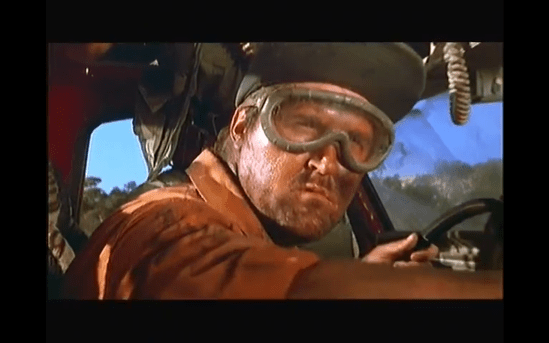
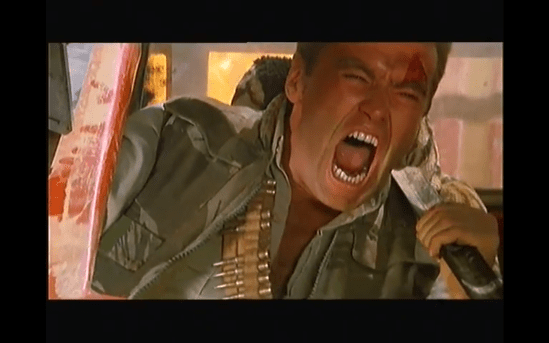
Cassandra Delaney stars as sanctuary overseer Jessica. The demanding role pits Delaney against the terrain elements as well as the three poachers in David Sanford, Garry Who, and Peter Ford as Sunny the trio’s relentless leader. Whereas Jessica’s as pure as they come, being an animal savior and contributor to the community with Delaney selling that to the fullest extent even when she’s pissed off and being a stoic like Sarah Connor, the antagonist are about as rotten as festering, worm-riddled apple with each actor portraying a very different type of character. David Sanford’s Ringo is an acrobatic young man with a punk rock look and attitude overlaying his athletic tone, marking him the versatile go-getter. Garry Who’s Sparks is a potbelly grease monkey and as the lone designated pit crew of his posse, Who enables the slightest probably of being the most sensible of the three thugs but still meager and mean when pushed by Ringo and Sunny. Sunny denotes himself the pit boss, an elite outback tracker with narcissistic tendencies in believing he’s invincible, and Ford’s hard nose and stern take on Sunny is pinpoint precision at it’s deadliest.

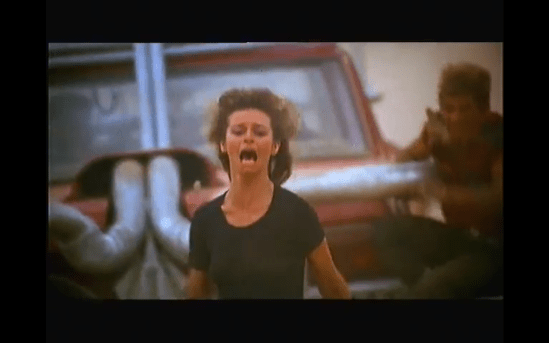
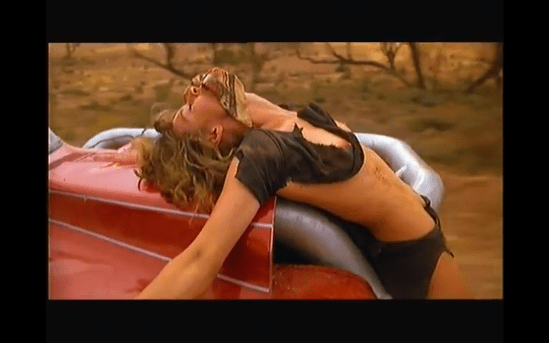
To be all fair about “Fair Game” reasonability, the big question that surfaces after viewing the film is who is the most certifiable between Jessica and Sunny’s gang of hoodlums. The answer to that riddle is ultimately Jessica. Though that might seem like a radical answer, Jessica is, by far, the craziest person with a severe death wish. Whenever Jessica retaliates against the poachers, the three inevitably response with something much worse. Here are some examples: Jessica dumps flour onto Ringo’s face and slaps a vegetarian bumper sticker on their truck that causes the ruffians to quietly invade her compound and take pictures of her while she sleeps naked, Jessica causes a small avalanche to temporarily trap them in a small cave and Sunny’s hoodlums respond by shooting her horse dead, and Jessica welds their assault rifles together in a heap of twisted metal and the poachers tie her half naked body to the hood of their truck and drive around until she passes out. The spat between them overwhelming seemed one sided, as Sunny as his hounds play with their live food before biting down hard to snap it’s neck, but made for kickass exploitation that echos genre classics such as “I Spit On Your Grave.”

Umbrella Entertainment releases 1986’s “Fair Game” onto high definition, 1080p Blu-ray with an all new transfer from a newly restored 2k master. Presented with a widescreen aspect ratio of 1.85:1, the transfer looks impeccable. The palette coloring isn’t vivid, but not surprising since the film is set in the arid outback with nothing but brown on top of brown or yellow on top of brown; however skin tones and the fine details are evidently splendid in Andrew Lesnie’s mise-en-scenes. There’s expected noise through out with some minor vertical scratches, especially earlier in some day time sequences and in the longer shots, but the restored transfer bares a cleaner and fresher take on the 30 year old plus film. The English 2.0 DTS-HD Master Audio track is a lossless transfer that reinvigorates the menacing aspects of the back-and-forth contest, an example would be the monster-like, if not personified, truck that rumbles and roars when trekking and chasing across the outback. Also enhance is the soundtrack that’s a concussed epiphany of acute and rough synthesized and blunt off key tones and melodies meshed together to form a mesmerizing score from composer Ashley Irwin. The release also contains a slew of special features including audio commentary by director Mario Andreacchio and screenwriter Rob George, an extended interview with Cassandra Delaney, a segment about “Fair Game’s” set location, A couple of local TV spots from 1985, a behind the scenes with Dean Bennett, the theatrical trailer, image gallery of still scenes and rare production and promotional materials, an animated storyboard, and five of Mario Andreachio’s short films. Whew. Talk about your full loaded package. “Fair Game” is the epitome of ozploitation with lucrative degenerate characters and a fair amount of gratuitous nudity that goes without being overly sleazy and downright violent like most collaborators in the subgenre. Packed with vicious machinery and a wicked sense of mind games, “Fair Game,” hands down, one of the best in the world of Australian cult cinema.

DVD/Blu-ray Announcement: “Children of the Corn: Runaway!”

You can’t keep these damn kids out of the corn fields! If you didn’t know this, “Children of the Corn: Runaway” is the 9th installment in this undying Stephen King spawned franchise and was helmed by “Feast’s” John Gulager!

Here’s the press release from Lionsgate:

PROGRAM DESCRIPTION
From director John Gulager (Piranha 3DD, Feast) comes a horrifying new chapter in the Children of the Corn series when Children of the Corn: Runaway arrives on Blu-ray™ (plus Digital), DVD, Digital, and On Demand March 13 from Lionsgate. Based on the original story “Children of the Corn” by Stephen King, the tenth installment of the legendary horror series follows a young woman who can’t escape her nightmarish past. Written by Joel Soisson (Children of the Corn: Genesis, Dracula 2000), the Children of the Corn: Runaway Blu-ray and DVD will be available for the suggested retail price of $21.99 and $19.98, respectively.

OFFICIAL SYNOPSIS
Children of the Corn: Runaway tells the story of young, pregnant Ruth, who escapes a murderous child cult in a small Midwestern town. She spends the next decade living anonymously in an attempt to spare her son the horrors that she experienced as a child. Ruth and her son end up in a small Oklahoma town, but something is following her. Now, she must confront this evil or lose her child.

BLU-RAY/DVD/DIGITAL HD SPECIAL FEATURES
· Deleted Scene

CAST
Marci Miller (“About Abigail,” “Viper,” The Ringer of Rimachi)
Lynn Andrews (“Borderlines 2” the Video Game, “Ghost of Goodnight Lane”
Mary Kathryn Bryant (“Hellraiser: Judgment”)
Jake Ryan Scott (“Bunnyman Vengeance,” “Warning Label”)