Be Creative, Be EVIL! “Scare Me” reviewed! (Acorn Media / Blu-ray)

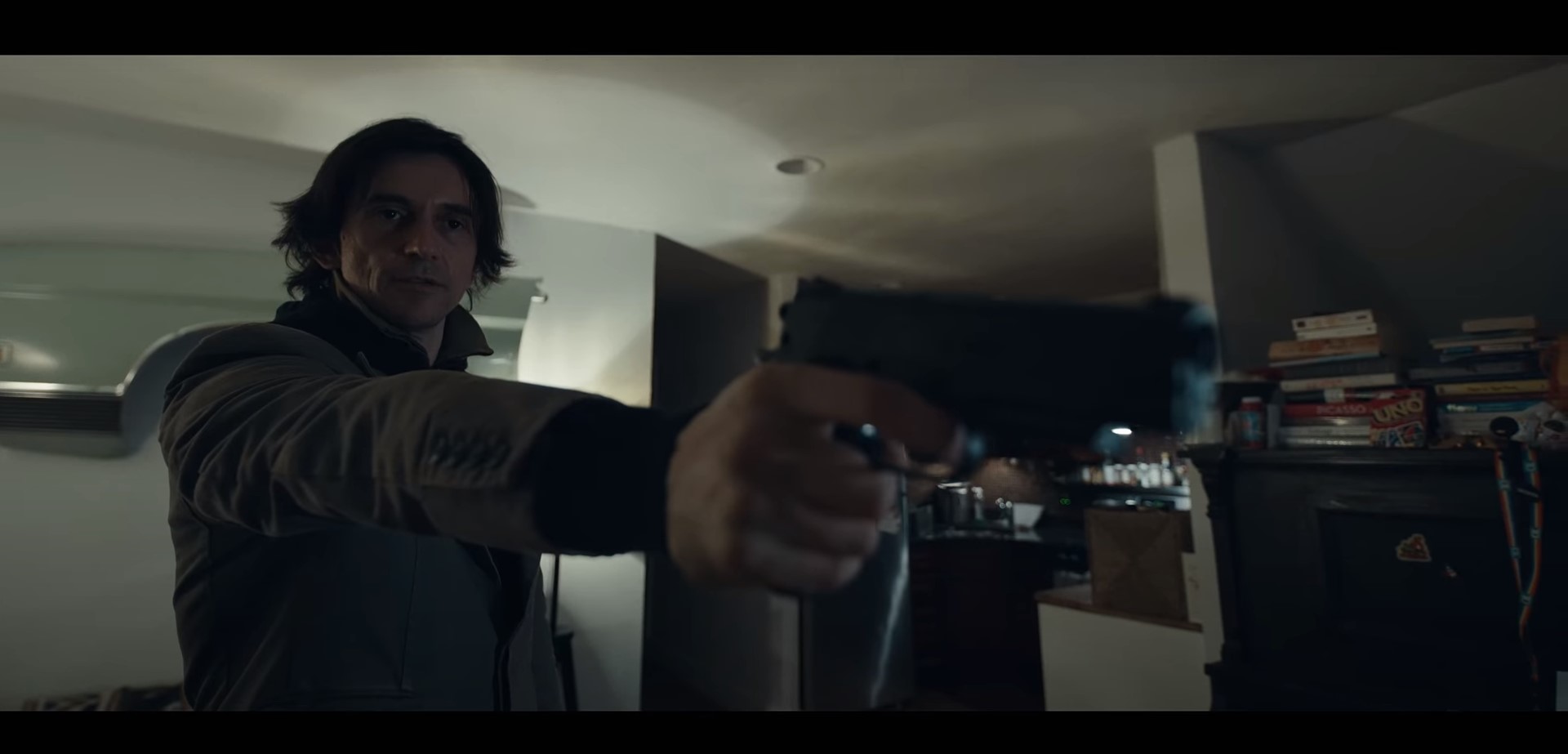
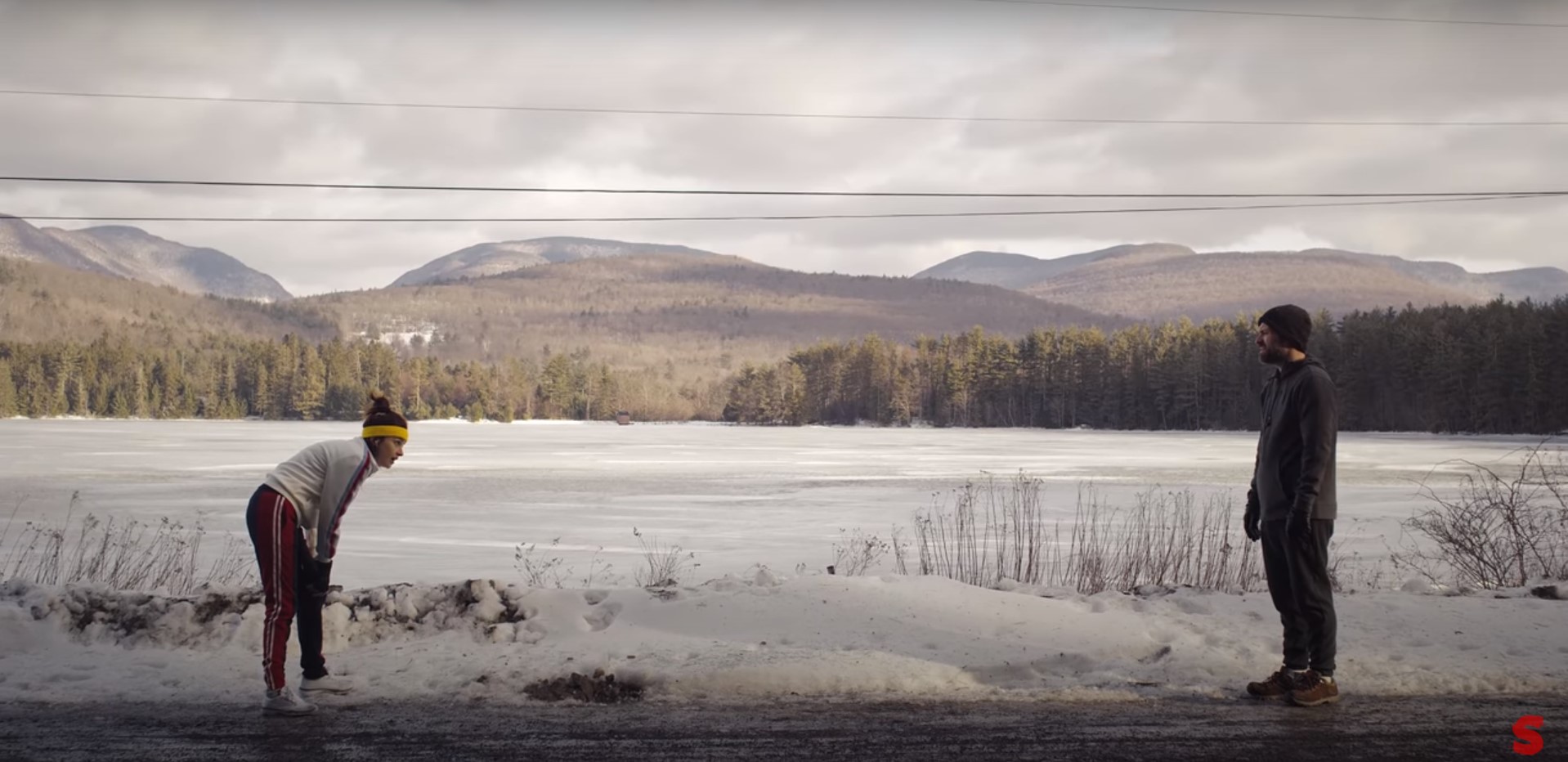
The down on luck Fred and a celebrated Fanny are both horror writers. Well, sort of. You see, Fred is an aspiring horror writer with unpretentious stories acted out by his creativity whereas Fanny is the hot, popular artist who just came out with an acclaimed novel everybody is talking about, even Fred. When their paths cross on a remote, snowy getaway during power outage, they consolidate to one cabin to stave off boredom by telling each other off the cuff scary stories, acting out every minor detail to flesh out the macabre tidbits in order for a good scare. As the night carries on and the stories become more involved, Fred’s night has been a rare highlight in recent days and now that day is on the brink of breaking, Fred has one more emotionally-driven scary story to tell the weary Fanny.

You wanna see something really scary? No, not the line from that wraparound story with Dan Aykroyd and Albert Brooks driving late a night in “The Twilight Zone: The Movie,” but rather really see a scary story come to life before your eyes with enthusiastic performances between two horror writers? Josh Ruben’s “Scare Me” does just that with the filmmakers’ 2020 horror-comedy hit. Ruben, whose latest comedy genre film, “Werewolves Within,” has been a critic success, writes and directs a petite cast packing a powerful punch pitched perfectly more so than this mouthful attempt at an awfully awkward alliteration. “Scare Me” is also produced by Ruben along with Alex Bach and Daniel Powell under a conglomerate of productions companies including Artists First (“Hell Baby”), Last Rodeo Studios (“Save Yourselves!), and Bach and Powell’s Irony Point with Shudder distributing.

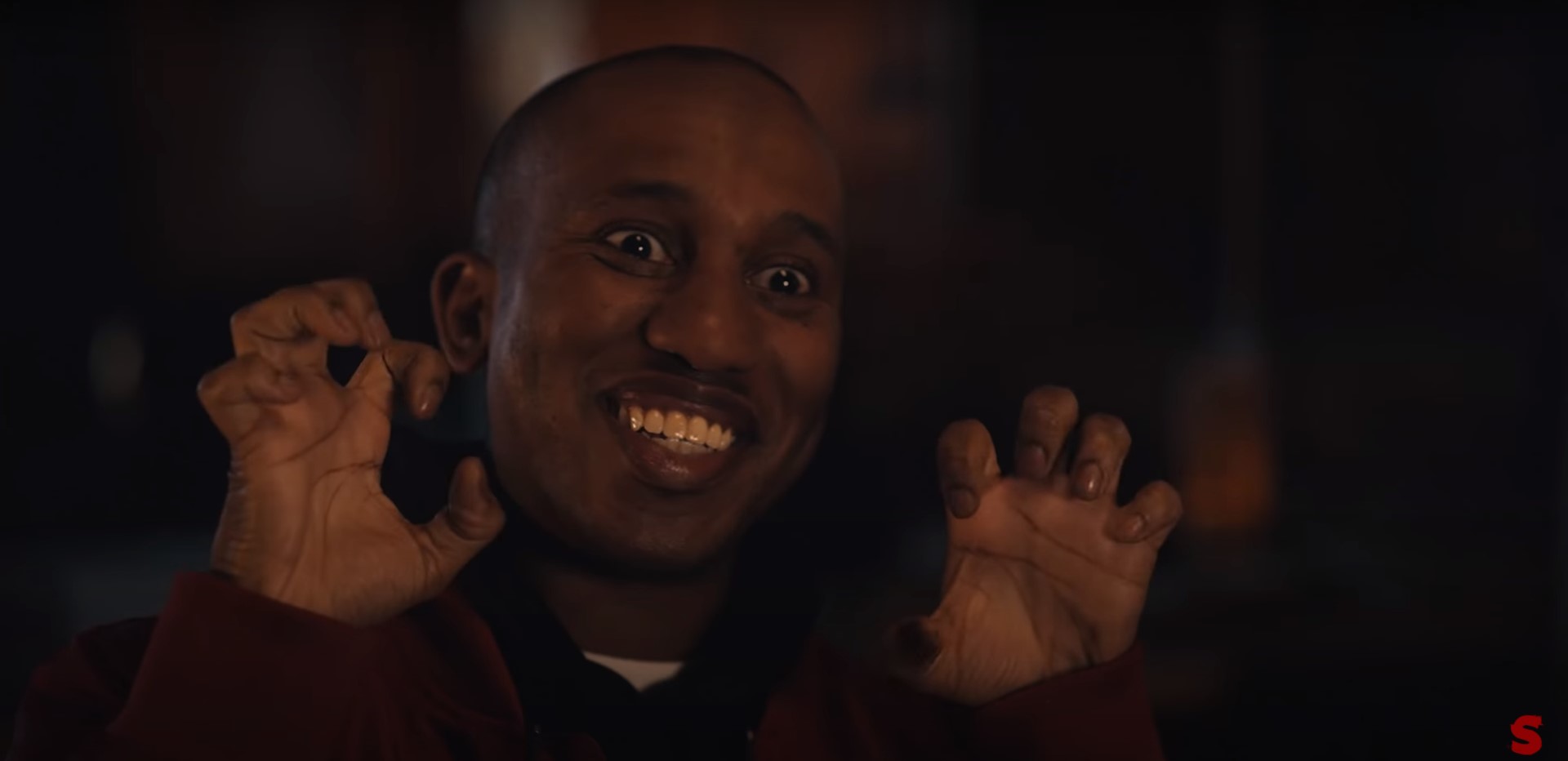
Ruben not only writes, directs, and produces his film, he also co-stars as Fred. With this Andy Serkis like looks, motions, and vocal talents, Ruben is a master at amplifying impressions and slapstick from the beginning as Fred using his unrestraint, and probably unstable, imagination to try and write a bestselling horror novel to help him get out of a life funk. Then, their is Aya Cash, who I have personally adored since her villainous role on Prime Video’s “The Boys.” Much like that role’s personality of the super-sadist Storm Front, Cash just dons snarky assertive woman to perfection as she continues the trend by embodying bestselling new age novelist Fanny with such. Fanny downright emancipates…I mean, emasculates…Fred at every chance and at every step along the way despite her warming up to Fred’s kooky lackadaisical first impressions with a side dish of caution for those who yearn for story ideas. Ruben and Cash bounce incredibly well off each other to the point of credibility between the dynamic and the dynamic is far from being a romantic love interest but more so an unlikely best friend; a best friend who constantly proclaims white male privilege whenever the opportunity presents itself. The funnies also keep on coming, especially mixed into the dialogue details, that are sharpened by Ruben and Cash’s timing and delivery telling their individual stories and the reactions each have during them, but then blend into that batter of bust-a-gut with comedian and “Vampires vs. the Bronx” actor Chris Redd, consider your every funny bone in your body rigged for explosion with the trio’s insanely charismatic skits and a musical number about a Devil possessed pop star to die for. Bringing up the rear of the comedic cast is “Key and Peele” writer Rebecca Drysdale.

If you had told me that “Scare Me’s” premise was two writers telling each other scary stories during a power outage, the film would have been near the forgotten bottom of my must-watch list with the inane dancing of “Orgy of the Dead” and the prosaic “Paranormal Activity 4.” After watching the film, all I have to say is this, Mr. Ruben, please accept my heartfelt apology for manifesting one single brain cell of doubt as “Scare Me” is the five-star movie everybody needs to see. I am not worthy. The idea behind the movie is simple, yet novel, that never ceases to peak as Ruben’s film perpetuates a steady incline of sharp-witty dialogue, an involved and spot-on sound design to create the stories’ allusions, and a trope-less ending that fits “Scare Me’s” unique, unbridles nature without being a grandiose end-all finale. Without the punctuating special effects, Ruben definitely curved a workaround with smart dialogue, entertaining writing, and with a cast who couldn’t sell the idea any better. The work lies severely on the shoulders of Cash, Redd, and Ruben and without them, “Scare Me” would probably been acerbically be retitled as “Bore Me” under the breath of many frustrated genre fans. Also, just because there isn’t knock-your-socks-off special effects, that doesn’t mean there was zilch as Fred, Fanny, and Carol (Redd) enact each stories, a slither of their dread-addicted imaginations comes to fruition like window glimpses into their minds and, damn, they can really sell their fear-stroking dark fantasies by telling classic tale spinoffs that could parallel cult favorites, many that were namedropped throughout the 104 minute runtime. “Scare Me” is without a doubt pure love of the genre and a tinseling homage to the macabre.

Better late than never, they say, in viewing Josh Ruben’s bewitching “Scare Me” on UK Blu-ray distributed by Acorn Media International. The region 2, PAL encoded BD25 presents the film in 1080p on a streaming platform dictated 2:1 aspect ratio. Aside from the bookend snowy landscapes and exteriors, much of the setting is located inside the compact two story cabin in the woods in which cinematographer Brandon H. Banks breaks into his debut feature with getting the precise angles to reassure and reaffirm Fred and Fanny’s telling of scary stories. As far as visuals go, the digital recording compression seems to hold up on the BD25 while still flaunting a good amount of bonus material and an English language Dolby Digital 5.1 surround sound. No issues here with the audio with phenomenally clarity in the diversity of sound bites and in dialogue even with Ruben and Cash’s modifying their voices for story characters. There isn’t a lot of actions to hone on and rein in the depth, but with this type of story inside, as aforementioned, a compact cabin, depth won’t make or break the audio report card. Special features include a director and cinematographer commentary, short interviews with the Ruben and Cash that run through their favorites things inside the horror genre, a behind the scenes photo gallery, a Make Cool Shit Podcast, outtakes, and “Feel the Music, Feel the Light” music video. I’m always up for a good tale of Fright and “Scare Me” slashes all the boxes with a traditional layout themed by envy and has a cast that illuminates each and every scene with funnies and fear.

That Little Strip of Tape Keeps EVIL From Spying On You! “Eye Without A Face” reviewed! (Gravitas Ventures / U.S. DVD and Miracle Media / UK Digital)


A lonely agoraphobic hacks into the laptop webcams of six beautiful women across the Los Angeles area, tapping into their lives as a compassionate friend from afar.  His voyeurism allows him interaction, even if it’s virtually, and to deal with his severe introverted panic attacks brought upon him by an extremely abusive father and an absent mother as a young boy.  As he continues to stare at the screen, watching the women’s every move, he becomes convinced that one of the women is drugging, killing, and cannibalizing her one night stands.  Trusting his struggling actor and eccentric Youtuber roommate with his secret, too much ambiguity divides their suspicions until the recorded videoclip files of the women’s death show up on the hacker’s computer one-by-one, leaving the hacker vulnerable to possibly someone watching him. 

Every time your laptop monitor is in the upright position, you’re face-to-face with the onboard camera reflecting every movement you take and everything that happens in the background.  Voyeurism is a powerful drug, a contactless addiction where the depraved eyes crave the lifestyles of others to either stimulate the opiate-secreting pleasure endorphins or for more nefarious reasons, such as obtaining sensitive information that can be used for blackmail or theft.  “Eye Without A Face” represents that all-seeing laptop camera lens peering into what should be a private space, quietly invading without making a sound, and possibly turning into the big brother you never wanted.  Ramin Niami’s written and director voyeuristic thriller plays into that unobstructed power over someone by an antisocial hermit and the more that hermit stays reclusive in his shell the more he feeds into his feed of women, becoming more delusional in his attachment for them.   The L.A. shot thriller is a production of the Iranian-born filmmaker’s Sideshow Films with leads Dakota Shapiro and Luke Cook co-executive producing alongside Karen Robsen and Somme Sahab.

Playing the agoraphobic, voyeuristic, hacker Henry is Dakota Shapiro making his feature film debut.  Henry on paper sounds like an oily and unscrupulous lowlife unable to fit as a piece inside society’s puzzle as he watches women from the comforts of his untidied home and unwashed sweatpants.  Niami saw Henry on the contrary as an abused loner seizing at the thought of being out in the world, being around people, and finding comfort incognito with being these women guardian angel.  Henry is empathetic, modest during more private acts, and speaks to them like an equal in a guiding, positive voice without a hint of aggression.  Dakota Shapiro accentuates Henry’s unthreatening existence with dopey eyes and a lethargic posture. Shapiro’s decelerates so slowly that he makes Luke Cook appear like Speedy Gonzales. “The Chilling Adventures of Sabrina” actor is Henry’s house tenant, Eric, an aspiration Aussie actor trying to land a gig, any gig, in Hollywood and his influencer status is an obsession in itself as he garnishes followers for his own path toward Tinseltown stardom. Eric’s intense self-arrogance can be a put off, but he’s oddly chumming with Henry even after Henry lets him in on his little watcher setup, buying his landlord breakfast nearly every morning, providing him drugs, advising him to stop taking prescription drugs, and trying to find a crack in Henry’s impervious shell as if it was a personal challenge extended to him undertake. Their relationship is night and day, hot and cold, and often splashed with awkward friction with Cook laying on the thick, goofy charm with great attention; yet despite Eric’s knack to have money for everything else but Henry’s rent, the struggling actor eagerly wants to befriend Henry in who might be considered Eric’s only friend as sad as that might sound. All of Henry’s other friends are unaware their performing for the all seeing webcam eye as the cast rounds out with Vlada Vereko, Rebecca Berg, Ashley Elyse Rogers, Evangeline Neuhart, Sarah Marie, Danielle Hope Abrom, and Shekaya Sky McCarthy.

There’s more to “Eye Without A Face” than what meets the…uh, well…eye. While the voyeurism isn’t sexually gratifying but the act itself certainly a core aspect, the blatancy of it is more a distraction to what’s really being conveyed by Niami’s script that’s more aligned with “Henry: A Portrait of a Serial Killer” as the film exhibits key homages to the Michael Rooker starring and John McNaughton directed film. Henry falls into the hazards of a blackhole by becoming entangled in a web of women, drugs, and mental illness without almost never leaving his chair.  Eric unintentionally perpetuates Henry’s reasoning for deviating from his straightened arrow path and constant routine.  In all fairness, that arrow was already severely bowed and wavy at best as the 30-something-year-old has more than definitely broken a few federal and local laws by spying on women through their hacked webcams.  Between the nightmares of an abusive father, memories recalled at Eric’s prying, and being fed the disillusion that the medication he’s taken for years is a figment of a society system trying to control him, Henry has to choose to stick with his current reality or try to be something more than a slug in his inherited home, going as far as to calling into one of the girl’s Onlyfans type website and striking up more of a branded I-am-a-stalker conversation than clearly expressing interest in just casual conversation that sends her into a panic defense mode.  From there, “Eye Without A Face” nearly resembles a theme of anti-confidence resulting in Henry blowing up his quaint and satisfying lifestyle when reaching for a little more that ends with disastrous consequences and becomes woke to his triggering of quelled past.  The surprise twist fails to hold water, making no splash when easily discerned, as it’s slathered way too thin and too revealing around Henry’s anxiety-riddled and panicked life.

The invasion of privacy leaves chills with an overwhelming uncomfortable take on the voyeur thriller while the shocking twist kicks around an underwhelming subplot too easy to spot in Ramin Niami’s “Eye Without A Face,” released on U.S. DVD on August 10th from Gravitas Ventures and on UK digital this coming Monday, August 23rd from Miracle Media. The region free Gravitas Ventures DVD is presented in a 16:9 widescreen aspect ratio on a DVD5 and is displayed with a healthy serving of natural digitally recorded coloring that only strays toward a yellow-mustard tint more noticeably whenever Henry dips into a tense or distressed state. The cinematography is the debut feature film work of Sideshow Films’ Tara Violet who has clever POV shots of characters in front of the camera and characters sitting in front of another camera while acting their individual personalities by a high resolution webcam. Among using different types of distortions to render Henry’s mindset, Violet also takes a page out of Terry Gilliam with a wide-angle lens and touch of a Dutch angle to compound the crazy factor. The Dolby Digital English language 5.1 surround on has prominent dialogue unimpeded by shoddy equipment or mic placement that renders good sound design with passable range and depth, especially during webcam dialogue and other miscellaneous sounds. DVD lacks special features aside from a static menu and, obviously, digital releases don’t usually come with any extras well. No bonus scenes during or after the credits. Despite some elements extracted respectfully from inspired classics, “Eye Without A Face” shares a troubling angle on creepy in a digital world and the calamitous ill-effects of ill-advised help that’s no more useful than saying to an uptight person with an anxiety disorder, “you just got to relax.”

“Eye Without A Face” available on DVD / Blu-ray / Prime Video!

Early Bill Paxton EVIL in “Mortuary” reviewed! (MVD Visual / Blu-ray)

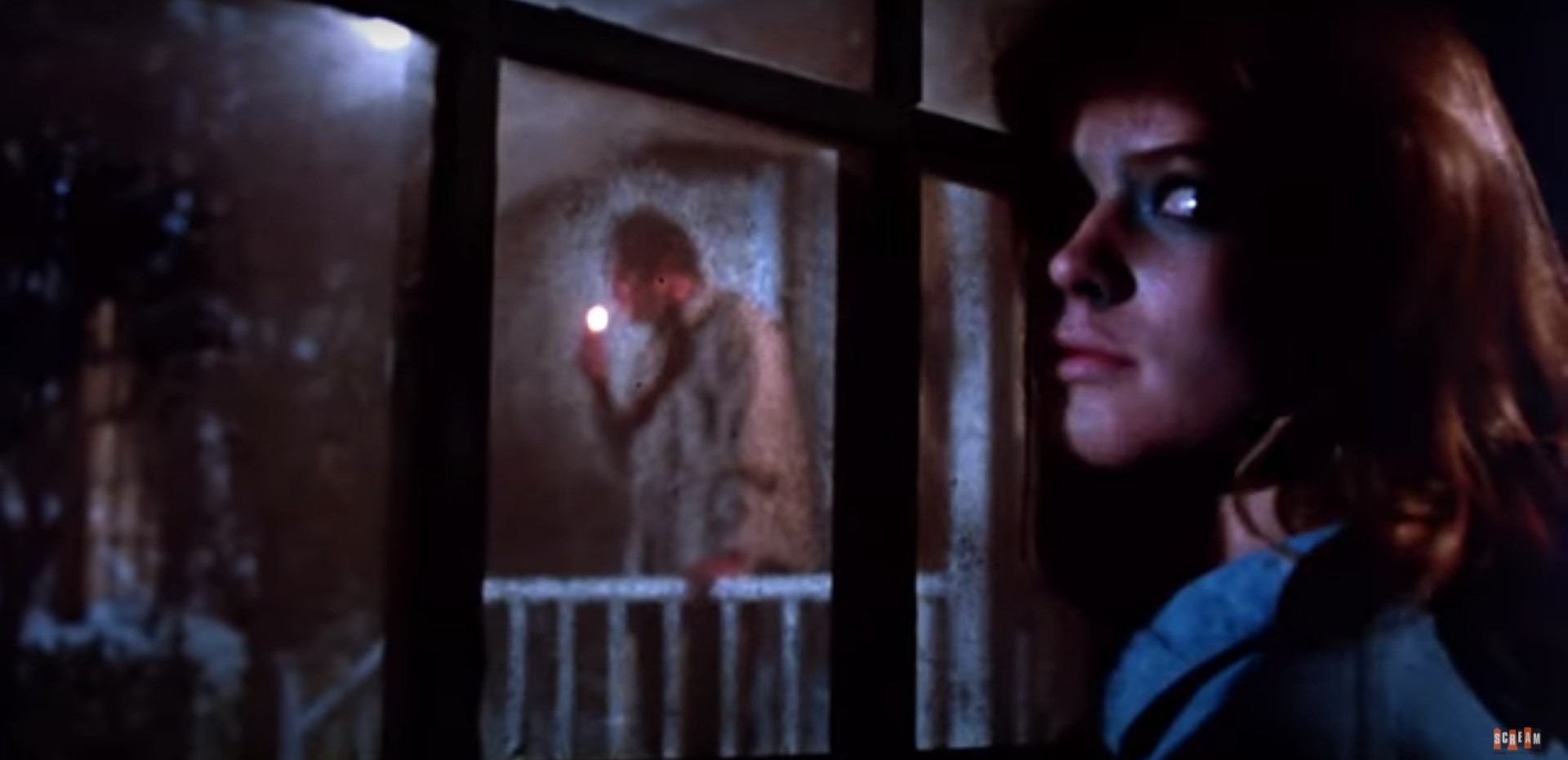
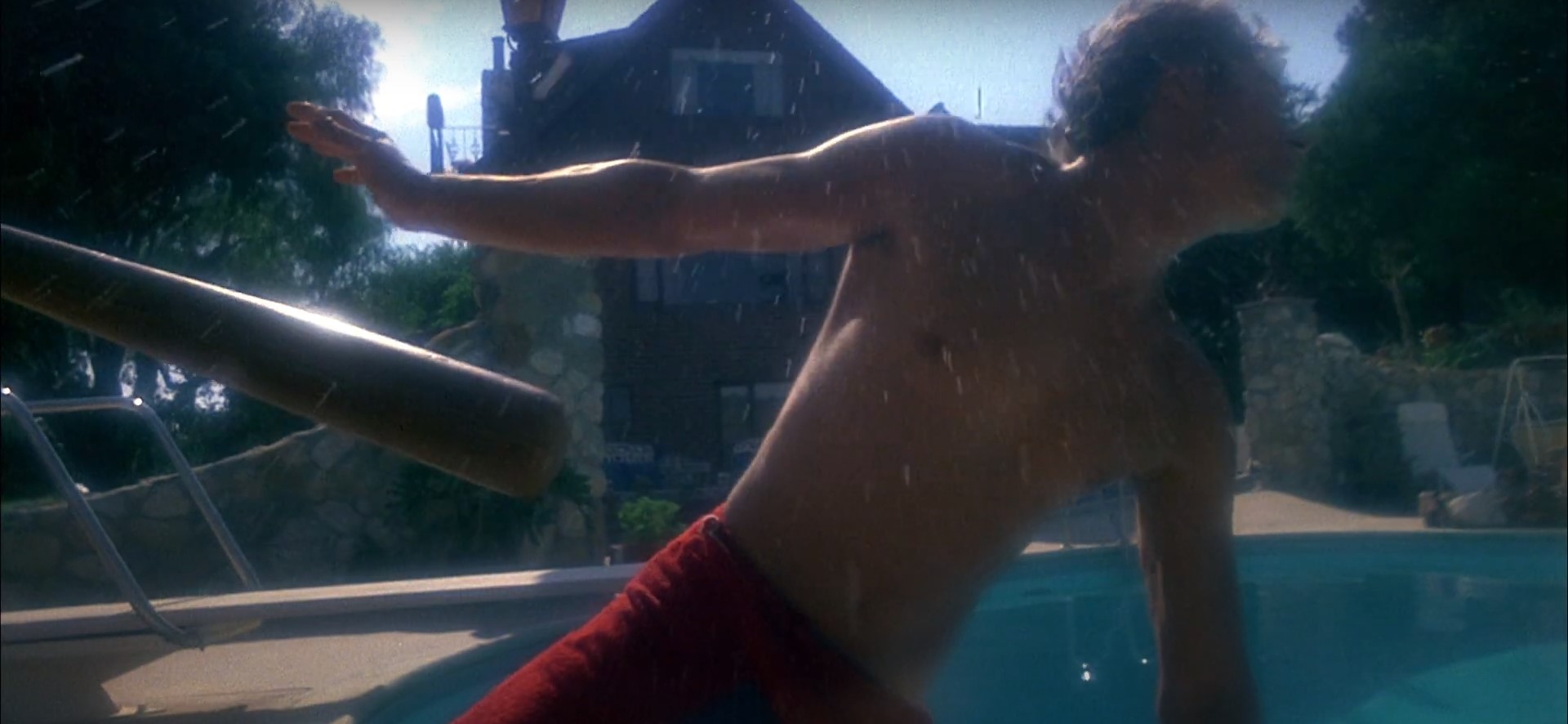
The tragic swimming pool drowning of Dr. Parsons might not have been an accident as determined by the police.  At least that is what his daughter, Christie, believes and she is for certain her mother has some involvement in the so called accident.  Plagued with nightmares followed by a stint of sleepwalking a month after her father’s untimely demise, Christie tries to maintain a semi normal life as a high school student romantically involved with boyfriend Greg Stevens.  Meanwhile, Greg’s best friend disappears after the two trespass onto local mortician Hank Andrews’s storage warehouse.  Christie and Greg unwittingly become embroiled into sinister intent by a masked and caped ghoulish killer stabbing victims with a detached embalming drain tube and at the center of it all is Hank Andrews and his son Paul’s family morgue that processes and possesses all the dead’s secrets. 

Before Wes Craven’s “Scream” mega-franchise turned caped killers revolutionary cool with meta-crafting horror tropes of the genre slasher, there was the little known “Mortuary” that perhaps paved just a slab of keystone for the Ghostface Killer who has become the face of slasher films for more than 20 years, much like Jason Voorhees or Michael Myers back in the 1980s and early 90s.  Written and directed by the Baghdad born filmmaker, Hikmet Labib Avedis, credited under the more westernized stage name of Howard Avedis, the 1983 film nearly had all the hallmarks of a peculiar macabre dance that skated around the slasher sphere.  “Mortuary” had seances, pagan rituals, a shrouded murderer, and, of course, the embalming of dead, naked bodies that are the inevitable, natural, mortality reminding entities in movies regarding morgues.  The late director, who passed away in 2017, cowrote the film with wife, producer, and actress Marlene Schmidt who had a role in every single piece of his body of work.  “Mortuary” was self-produce by the husband and wife filmmakers under their Hickmar Productions company and by grindhouse producer Edward L. Montoro (“Beyond the Door”).

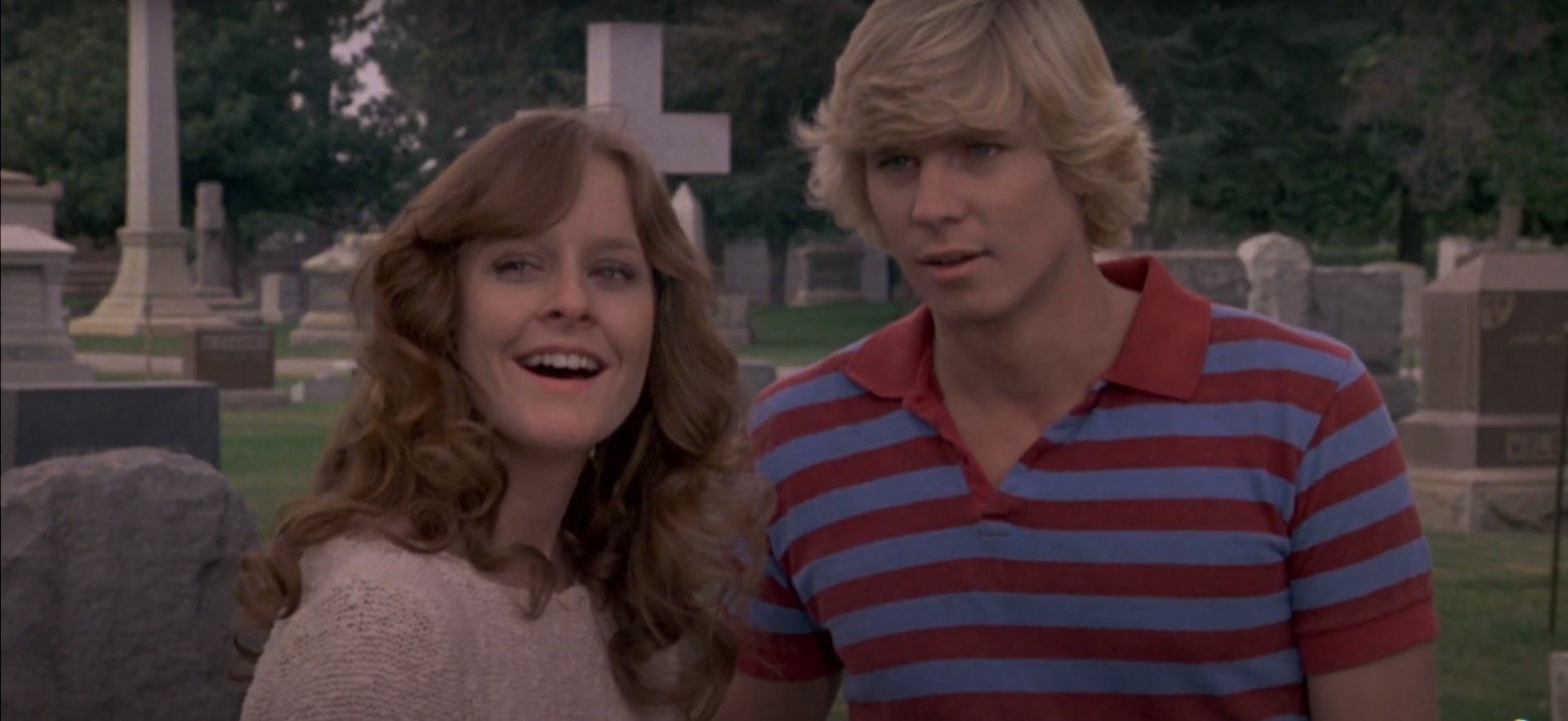
Though the post-credit opening scenes begins unscrupulous enough with Greg Stevens, played by television soap opera star David Wysocki whose credited as David Wallace, and his best friend Josh (Denis Mandel) stealing tires from Josh’s ex-employer, morgue owner Hank Andrews, the late “Day of the Animals” and “Pieces’s” Christopher George’s last cinematic role, because of being fired without being paid for his services, “Mortuary” inconspicuously moves from Stevens’ infringing on local law to surround itself more aligned with Stevens’ girlfriend Christie Parsons who feels more like a backseat character upon introduction.  Yet in a flurry of exposition with her mother, Christie, who is played by “Mom” actress Mary Beth McDonough, circles back and ties into the opening credit scenes of an unknown man being bashed over the head with a baseball bat and falling into his pool.  We learn that the man is Christie’s father whose death has been rule an accident (no evidence of baseball bat related injuries? Was evidence collecting really that low-tech in the 1980s?), but Christie begs to differ as she point blank accuses her mother, Christopher George’s life co-star Lynda Day George, being involved in his poolside death.   While performances statically hover inside the wheelhouse of teen horror with Greg and Christie seemingly unaffected by the mysterious incidents happening all around them until someone literally is grisly murdered in their adjacent bedroom, a fresh-faced Bill Paxton (“Frailty”) inevitably steals the show with this enormous presence on screen as Paul Andrews, the town’s mortician loony son working for his father as an embalmer.  Paxton’s zany act borders “Mortuary” as either a diverse trope horror with an awkward outlier character stuff into the eclectic mix or a seriously unserious bluff of being a serious horror film – see what I did there?  Paul listens to Mozart on vinyl, has an obsession for Christie, and likes to prance and skip through the graveyard as a son broken by his mother’s unhinged suicide.  “Mortuary” rounds out with Curt Ayers (“Zapped!”), stuntwoman Donna Garrett (“The Puppet Masters”), Greg Kaye (“They’re Playing With Fire”), Alvy Moore (“Intruder”), stuntman Danny Rogers, Marlene Schmidt, and Bill Conklin as a walking contradiction as a beach town sheriff wearing an unabashed cowboy hat like a sorely out of place rootin’-tootin’ lawman from the West complete with country draw lingo. Also – don’t miss the bad nude body double used for McDonough when Christie is lying on the morgue slab.

Now, I’m not saying “Mortuary” is the sole inspirational seed that sowed the way for the “Scream” franchise, as I’m sure many, many other iconic classics inspired Kevin Williamson, but, in my humble opinion as an aficionado about the genre components and how they’re all connected by a few or many degrees of separation, “Mortuary’s” villain could be the long, lost ancestral sperm donor responsible for the origins of Ghostface.  The purposeful movements and actions align very closely in a parallel of deranged defiance and floaty black and white costumes.  However, “Scream” is just packaged nicer as “Mortuary” continuously drips all over the place like a three scoop ice cream cone on a hot summer day.  Containing Avedis’s arc on Christie was nearly impossible as each act jumps and focuses on someone entirely different while also exposing the killer blatantly without even trying to misdirect or repel any kind of suspicion.  It was as if Avedis and Schmidt swung for the fences with a convoluted giallo mystery plot but couldn’t figure out how to build that into the narrative without drawing from and drowning in exposition and that’s how the cards came crashing down by unfolding with talking head pivotal plot points that steered to a rather quick, yet pleasant, climatic head of a total mental meltdown that’s much more cuckoo than Billy Loomis and Stu Macher will ever be. 

If you didn’t score a copy of Scorpion Releasing’s limited edition release of “Mortuary” on Blu-ray, then sing the praises of second chances with this Scorpion Releasing Blu-ray reissue through the MVD Visual Rewind Collection line. The all region release is presented in a high definition, 1080p, widescreen 1.78:1 aspect ratio of the Scorpion Releasing AVC encoded transfer on a BD25. Quality-wise, the release delivers the perhaps the full potential of a cleaned up 35 mm restore with no sign of cropping, edge enhancing, and a healthy amount of good grain, but there are noticeable gaffes with select scenes that seemed to have missed or left out of the restoration all together, reverting back to the rough, untouched image. Coloring, skin and objects in the mise-en-scene, come out lively, naturally, and without a flutter of instability with transfer damage at a minimum. Probably the most surprising is the original 2.0 mono LPCM track. The English language mix does the job without climbing the audiophile corporate latter, leaving in the wake a soft dialogue that’s a struggle to get through if you’re not wearing headphones. Depth seems a little slim, but the range keeps progressing nicely that often feeds into the late John Cacavas score. Cacavas operatic film score is bigger than the movie itself, often grandiose the Gary Graver one-note cinematography. The overexposed ethereal flashback has slapped redundant fatigue plastered all over it but, then again, the film is from the 80’s. Option English subtitles are available. Special features include only an interview with John Cacavas from 2012, from the original Scorpion Releasing print. Two upsides to the MVD Visual release are the cover art mini-poster tucked inside the casing and the added cardboard slip cover that resembles a tattered VHS rental tape slip box complete with a faded Movie Melt yellow caution sticker, a Be Kind, Remind sphere sticker, and a Rated R decal. If you’re a big Bill Paxton fan, “Mortuary” reveals another shade of talent from the late actor. Other than that, the Howard Avedis production often haphazardly stumbles bowleggedly to a giallo-errific-type ending made in America.

Don’t Be Fooled By the EVILs of Your Mind! “Open Your Eyes” reviewed! (Gravitas Ventures / Digital Screener)


Screenwriter Jason is on a deadline.  The producer is looking for his next script and soon.  The writer finds himself in a funk in not only fleshing out his script but also with his memories as a lingering sensation clings to him as flashes of moments that don’t seem quite right haunt his reality.  As he plugs along with his writing, other strange occurrences happen all around him:  a portion of his apartment wall is deteriorating from a leak in an adjacent upstairs unit, a cat has seemingly made it’s way into AC ducts, and objects disappear and reappear.  His dormant apartment complex is frustrating and lonely when he can’t reach the upstairs neighbor or the building manager about the leak that’s destroying his wall, but when he runs into Lisa, a neighbor from down the hall, many of his concerns fade away with her striking beauty and the two start up the beginnings of a possible relationship.  Yet, there’s still something amiss he can’t put his finger on and his newfound friend Lisa might just be the key to his awakening.   

Modest psychological horror has always been a tough one to pull off.  Instead of a straight forward zombie apocalypse or a killer behind a creepy mask slashing to bits half-naked teenagers, the psychological horror subgenre has to develop disintegration details and piece together fragmentations in a whirlwind character study that hopefully materializes into logical sense.  Writer-director Greg A. Sager tackles such threadbare cognizance with the filmmaker’s latest feature, “Open Your Eyes,” a Canadian psychological horror-thriller released this month.  Sager remains firmly in the horror realm with his fourth feature film behind 2012’s demon-seeding “The Devil in Me,” 2014’s supernatural penancing “Kingdom Come,” and 2018’s extraterrestrial thriller “Gray Matter.”  Continue the trend with all his independent productions, Sager self-produces alongside his co-founding Matchbox Pictures Inc., partner, Gary Elmer, who is also the cinematographer on the project.

“Open Your Eyes” is also modest in casting with two backbone characters keeping Sager’s narrative from being an bodiless work of art.  Doing much of the heavy lifting is the Toronto based Ry Barrett and with his close connection with filmmaker Chad Archibald, Barrett has had, in many different capacities, a role in a string of B-horror, including such films as “The Drownsman,” “Antisocial,” and “Neverlost” which are all tied to the Ontario director.  “Open Your Eyes” serves only as the second time Barrett and Sager team up following the release of “Kingdom Come.”   Barrett exudes an unconscious performance in Jason’s unravelling from crunch-time screenwriter to an unglued madman living in Jason’s version of a tenantable matrix.  Jason is almost sleepwalking through a lonely existence even before meeting his neighbor Lisa, a role played by Joanna Saul in her commencing feature film act, and the struggling to keep structural integrity writer hardly suspects and worries about strange manifestations that are happening all around him.  I don’t think Sager captures Jason’s full autonomy awareness that leaves the character more blank than bothered.  Barrett and Saul have adequate enough chemistry to make their barely a courtship romance intriguing, but her character’s implementation into restoring Jason’s vital grip on reality just kind of falls into his lap without a pinky being lifted on Jason’s part to assist in his own deliverance.   Heather May and Julianna Suzanne Bailey round out the small cast.

Aside from the nuisances with the character development, the sterilized comforts of Jason’s living conditions alone provide an unconventional chill.  Though living in an apartment complex is normally assumed chockablock with tenants living their lives, Jason’s apartment building is virtually vacant, void of the hustle and bustle of occupants, with not as much as a whisper from the exterior of Jason’s top-to-bottom, side-to-side walls.   What seems to be an idyllic environment for a concentrating writer becomes an oppressive variable that yet doesn’t seem to slow down or question Jason’s momentum or leave any kind of sense of threat along the way, leaving his what should be an ominous place of mind-bending confinement hanging out to whither and dry up .  I thought the plot twist to be shrouded enough to warrant a semi pleasantly surprised and unexpected ending that connects topically to today’s real-world climate.  Not to be riding a one trick themed pony, Sager also plays upon the themes of grief over loss and how the mind compensates with overactivity and gap fillers to avoid a complete mental system overload while also subtly adding a static charge of illusory sensations to make unsettling disturbances.  “Open Your Eyes” will not scare your socks off as it’s not that kind of film; instead, expect a slow-burn mystery more puzzling than panicky as the walls begin to crumble…literally. 

Okay, puzzlers.  Get puzzling on the new mystery horror-thriller, “Open Your Eyes,” that was distributed this past June by Gravitas Ventures on DVD, Blu-ray, and digital.  Producer Gary Elmer, as director of photography, paints the dark corners with softer figures that provides a really good shadowy contrast between character and background.  Elmer’s small use of the blue tint, his over-the-shoulder hallway delph, and shallow focus add tidbits of appeal without just “Open Your Eyes” seeming like another flat indie production.  Since I was provided with a digital screener, I can’t comment to confidently on the audio and video qualities of a physical release, but presented 2.35:1 widescreen was digitally shot on a CineAlta series Sony Venice camera that effectively provides a smoother grain, especially in the inky shadows, that transmit a really rich data scheme for post-production and offers that flexibility in producing range.  Another byproduct of the Venice camera is the natural looking skin tones seen with Elmer’s film when not under a tinted lens.  No bonus material offered with the digital screener and there were no bonus scenes during or after the credits.  Perhaps with a runtime a little longer than necessary, clocking in a 99 minutes, “Open Your Eyes” is a quaint terror touching the tattered strings of a mind, body, and soul pushed over the edge and into a falsehood bred by fear and loss.

Own “Open Your Eyes” on DVD or Watch on Prime Video!

The Devil’s Tongue is a Powerful, Influencing EVIL. “The Dark and The Wicked” reviewed! (Acorn Media / Blu-ray)


Siblings Louise and Michael Straker return home to their farmland house when their terminally ill father becomes bedridden.  A long time alone and isolated before her children arrived, Virginia provided suitable care for their father up until the voices started.  Lurking in between the shadows around the rural home, a menacing presence wedges itself into an already splintered family spirit as the harbinger of death coming for their father’s soul.  The influence of voices and grim visions tatter Louise and Michael resolve, testing their unconditional love for family and moral obligations, but evil can be very persuasive the closer their father comes to his end. 

The battle grounds of losing oneself during the verge of loss has commonly been a recurrent topic amongst indie films.  For filmmaker Bryan Bertino, the concept feels deeply personal.  “The Strangers” and “Monster” writer-director’s latest discomforting horror film, “The Dark and the Wicked,” uses Devil speak in mass, detrimental volumes as an allegoric device for the internal deconstruction of family, capitalizing for his tale the use of his family’s rural Texas farm house written as a threatening locale of isolation and the tenebrous unknown.  “The Dark and the Wicked’s” paganistic undertones heavily perceive a dissipating family structure’s disconnect from not only God but from the community who has been all but absent from coming to the fictional Straker family aid.  The 2020 released film is produced by Bertino’s production company, Unbroken Pictures, alongside Shotgun Shack Pictures (“Hurt”), Traveling Picture Show Company (“The Blackcoat’s Daughter’), and in association with Inwood Road Films.

To play characters accustomed to the rural lands of the Texas outskirts, “The Dark and the Wicked” required a range submerged with leisurely movements, a Lonestar draw, and to, of course, look good in plaid and Wrangler jeans.  The cast that emerged was nothing short of spectacularly precise in fabricating the lives of remote lives rural Texans, opening with a Texas-born Julie Oliver-Touchstone (“Bounded by Evil”) sewing dresses in the barn, tending the farm’s goats, and chopping produced in her white nightgown as who will be the catalytic mother, Virginia Straker, that passes not only the 24-hour hospice care to her children but also all the beneath the light misery that drives her terrified.  The girth of the story revolves around, Louise, “The Umbrella Academy’s” Marin Ireland, and Michael, Michael Abbot Jr. from the upcoming “Hell House,” as sister and brother who return back home upon the news of their bedridden father (Michael Zagst).  At this point in the story, where we meet Louise and Michael for the first time, a shrouded background puts a delectable side dish of mystery into making them initially interesting, but over the course of the 96 minute runtime, the enigma dissolves around why Louise no longer works from the Postal Service and what’s stringently being shied away from the thick layered division between the siblings from being close to one another.  The impending standoffish goes unspoken, never comes to a head between them as like the unfolding of “The Strangers” where Liv Tyler and Scott Speedman unravel and expose their marital struggles with the invisible wall between them before, and even in the midst of, being terrorized.  There’s something there that isn’t being part of the exposition or coming back around when the Devil comes really calling for their father’s doomed soul.  Instead, Ireland and Abbot simply assimilate well enough into their falling into farm life dynamics as the sister who must shoulder the responsibility of hospice care and the brother overseeing what could be considered man’s work of handling the duties of raising livestock.   We also get some messed up supporting second fiddlers to execute Satan’s handywork with performances Lynn Andrews, Tom Nowicki (“Conjurer”), Mindy Raymond (“Bigfoot Wars”), and “The Walking Dead’s” Xander Berkeley channeling his best Julian Beck’s Kane performance as a sinister Priest making a house call.

Bryan Bertino has a stillness about his films. Their creepily quiet, stirred in a somber stew of macabre, and utterly deranged in a nihilist coating. What appeals to me about “The Dark and the Wicked,” as well as “The Strangers,” is Bertino’s gift to deliver powerful fatalist realism. His stories couple earthly family drama with otherworldly malevolence stemmed from the deeper affects of prolonged relationship breakdowns that literally assigns a demonizing blame on the supernatural for people’s own crumbling failings. Another aspect is the godless presence wholeheartedly felt throughout from the Straker’s loud and proud proclamation of atheism to the lack of religious artifacts. Michael nearly tosses the priest out of his keester just for making checking and noting his mother’s recent unbeknownst connection to God to which Michael took great offense. This leads into the Straker’s lack of community connection as they seemingly are adverse or are agonized by those who wish to help and those who rather seem them burn under the guise of the malice presence. Goats are thematically prevalent to the story, especially when the shadowy Wicked hides amongst the herd, like a wolf in sheep’s clothing. Goats are often associated with Pagan beliefs, such as with the deity Baphomet, and the evils marked upon them by cultures all around the world and by having the Straker farm be a goat farm is more than just coincidence. “The Dark and the Wicked” brings chaos and confusion much like any circumstances where one or both parents die and all the burdens, all the consequences, and all the pure emotional baggage that comes with death is passed to the children whether the Devil is involved or not. When broken down rudimentary that decline of hope and overwhelming grief can cause a great amount of destruction for any family and even extend to friends with suicide being heavily portrayed in the film. Bertino masterfully touches upon every collateral damage output leaving no one spared from death’s, the Devil’s, hopeless hold on them.

Filled with frightening imagery, plenty of toe-curling suspense, and a loud silence of utter despondency, “The Dark and the Wicked” is a must own for any horror fan and, luckily for you, Acorn Media International just released the Bryan Bertino film on Blu-ray in the UK in alliance with horror’s favorite streaming service, Shudder. Listed as region 2, but more accurately a region B in Blu-ray format, the PAL encoded release is presented in a widescreen 2.39:1 aspect ratio. If there was one word to describe the comprehensive picture that word would be dark. Bertino maintains an eclipsing cinematography through hard lighting, matted lifeless colors, and a reduction tint to give it that extra gloomy blackness. Cinematographer Tristan Nyby’s first collaboration with Bertino is also the first debut into the genre field and Nyby comes out on top with an ability to show just enough, whether through shallow focus or obscured wide shots to always keep the depth and range of the unknown factor alive and frightening. In regards to the Blu-ray quality, “The Dark and the Wicked” has little to offer in details not because of the lack there of but because much of the film is shot in the dark, a fine midnight black with little-to-no wish or noise, and dim lighting . Facial details do appear slightly soft as you can’t make out the blemishes or even skin pores, but the intentional flat coloring steers much of that away from the senses. The English language DTS-HD Master Audio 5.1 surround sound is a boost of jumpscare ambient effects. The range and depth finely pitch the position of well-timed scares, especially when the strung together bottles, glasses, and cans rattle in a discordance. Dialogue has lossy muster that makes discerning characters’, especially Michael or his mother, Virginia’s, Southern draw. English subtitles are optional. Special features include only a Fantasia Q&A with actors Merin Ireland and Michael Abbott Jr that dive into their characters quite a bit and into Bertino’s morose mindset. Bleak and genuinely personal on a whole other level, “The Dark and the Wicked” is quintessential truth when talking about the Bryan Bertino Americana horror film and, believe you me, expect more devilish descriptors that’ll shock you.