Desert Rats Doing EVIL To Anyone Crossing Their Path! “Motorpsycho!” reviewed! (Severin Films / Blu-ray)

“Motorpsycho!” on a new 4K scan Blu-ray from Severin Films!

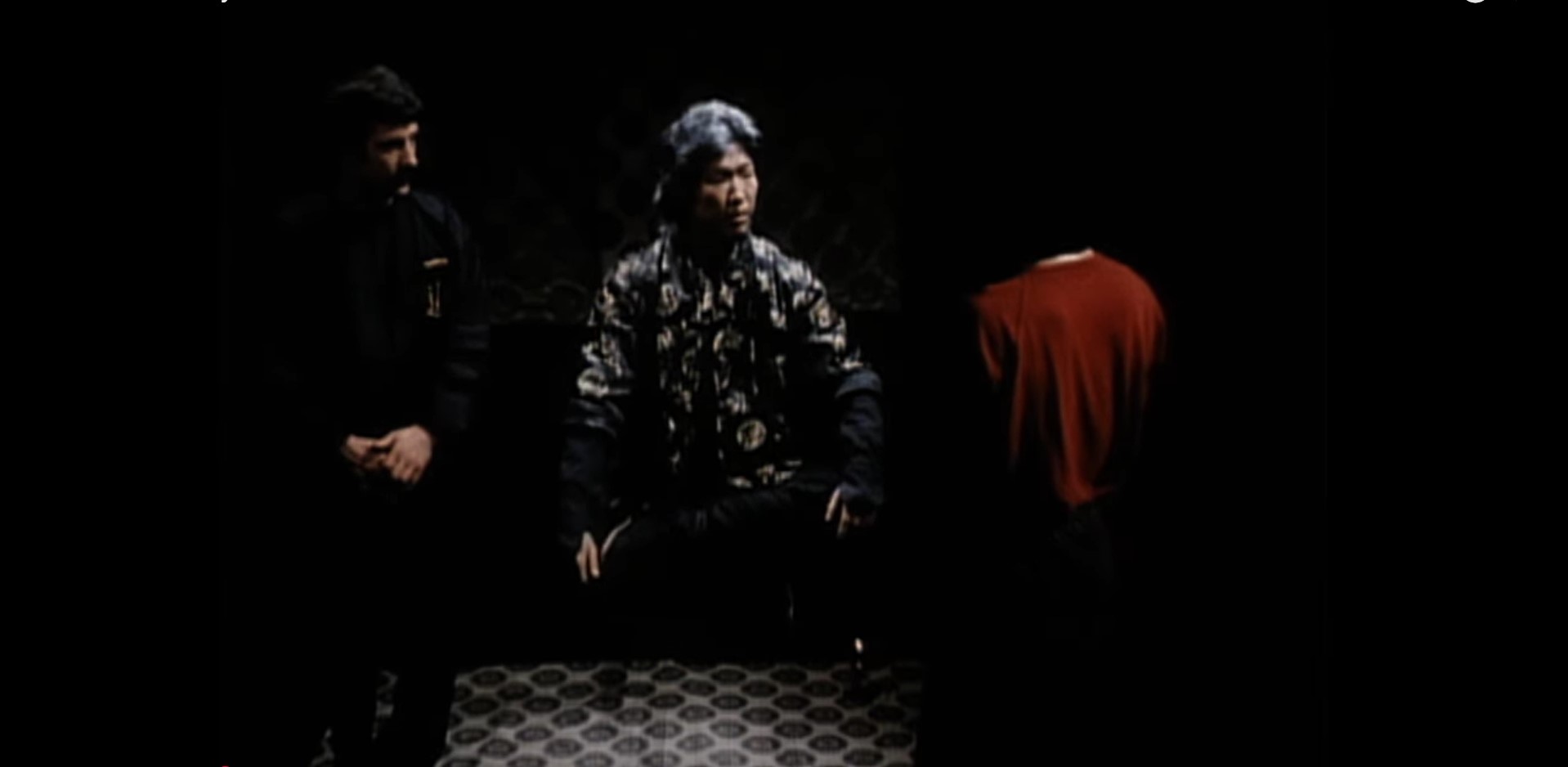
Three motorcycle hooligans on their way to Las Vegas through the Mojave Desert ride up on a smalltown Veterinarian named Cory Maddox and his voluptuous wife Gail.  A minor brush with the gang does little harm to the Maddoxes and the couple move on with their life certain the gang has moved on to the next town, but little does Cory know while on a professional checkup of a local mare, the gang invades his home and violently rapes his wife.  Hellbent for vengeance, Cory tracks their transgressive escapades through the arid landscape and comes across Ruby, a beautiful woman left for dead after her husband is gunned down and she herself being grazed by a bullet fired by the same delinquents.  The two track them down into an inescapable, unidirectional corner of the desert but with both sides facing car trouble, injury, and seeping slowly into mental instability, only one side will come out alive. 

By and large, “Motorpsycho!” is the Russ Meyer helmed B-picture that side straddles less explicit content.  The 1965 exploitational action feature, that sported less-than-speedy Honda Trials, flirted with bare-chested women, and immersed itself in light and dark innuendo, is nestled amongst two other Meyer films, “Mudhoney” and “Faster, Pussycat! Kill! Kill!,” released the same year and are showcase of unscrupulous violence and sexual content and innately sets the stage for Meyer’s bosomy and barren set movies that bestowed the former World War II photographer turned sexploitation director accolade success later in his career with the “Vixen!” branded films.  “Motorpsycho!” is co-written by Meyer and fellow “Mudhoney” writer William E. Sprague from an original idea from the screenwriters along with James Griffith (“Russ Meyer’s Lorna”) and Hal Hopper.  The Meyers, being Russ and wife Eve, produce the story in cahoots with Ross Massbaum (“Beach House”) and is produced and distributed theatrically by Eve Meyer’s Eve Productions.

The way Meyer sequences the “Motorpsycho!” story is an ebb and flow of events that culminate into a showdown and audiences, perhaps, won’t know exactly who the leads are until well into the chaos, such as with the female principal lead Ruby, a Cajun woman down on her luck travelling in a forced by necessity marriage to an older man in order ot start a new life in California, played by Haji, a Canadian dancer with a unique face and beautiful curves who caught Meyer’s eye for “Faster, Pussycat!  Kill!  Kill!”   For a new actress, Haji is impeccable and easy on the eyes while working off another first-time actor, principal lead Alex Rocco (“The Godfather”), playing vengeful veterinarian Cory Maddox.  Haji and Maddox have unquestionable sexual chemistry and tension despite their slight platonic relationship of seeking revenge as Meyer provides a great deal of sexual innuendo and reference instead, beating around the bush for the ultimate tease.  Don’t worry, “Motorpsycho!” doesn’t hang around the coquettish scene for entire duration as there’s plenty of one-on-one racy and salivating spiciness to sate sexploitation fans between the playful bedtime arousals of Rocco and on-screen wife Lane Carroll (“The Crazies”) and the playfully aggressive rape of Carroll and a fisherman’s wife a bikini-cladded large bosom.  “Motorpsycho!” has a man to woman ratio that strays from the normal Russ Meyer credits with the female cast rounding out with Sharon Lee in her usual typecasted role of a blonde bombshell and, more specifically in this story, a mare-owning flirt for Cory Maddox’s services.  While not a large breasted woman craving sex in every episodic scenario, this Meyer run has an interesting arc for the three ruffians who initially start with copasetic unity in their troublemaking fun through the Mojave only to end themselves in disbandment of backstabbing and derangement in unswerving performances from Timothy Scott (“Lolly-Madonna XXX”) as the handheld radio melomaniac, Joseph Cellini (“Beyond the Valley of the Dolls”) as a hip cat love-taker, Steve Oliver (“Werewolves on Wheels”) as their military vet leader with a stoic expression but unpredictably violent.  “Motorpsycho!” rounds out the cast with Coleman Francis (“Beyond the Valley of the Dolls”), Steve Masters, Fred Owens (“Supervixens!”), George Costello and Russ Meyer as the unsympathetic, cynical Sheriff.

Not as sordidly sleazy or insatiably randy as many of the Russ Meyer films we all know and love for their perky antics, voluptuous vixens, and zany comedy with a isolated desert town backdrop, “Motorpsycho!” is virtually nudity free in comparison to his thereafter work and shot entirely in black and white that, too, tones down the situationally shaded situations of diverging sexual overdrives that conclude around a centered focus, usually around something sexually themed.  That’s not to say just because production year is in the cinema puritanical early 60s and is in black and white does that mean the film goes without a fair amount of brief nudity as Meyer slips into a couple of nipple slipping instances and countless sideboob that would be deemed too salacious for media content harking back 60-years ago.  Innuendo has always been fair game in all sorts of production sizes and studios but couple what Meyer has done with the sexualized material with the gang violence and what you have is one of the earliest known grindhouse pictures prior to its monikered labeling in the 1970s.  Production value and authenticity floats around the low-budget spectrum with a film titled “Motorpsycho!” that spends what little funds there is to supply Honda Trials that are more the speed and look of Mopeds than motorcycles, but Meyer competently adds and edits fast paced car chases, the discharging of a single pump action rifle, and a curtain calling explosion with body prop fragmenting special effects to level up the value where it counts. 

The Museum of Modern Art and Severin Films restore and scan Russ Meyer’s “Motorpsycho!” onto a new 4K transfer from the original camera negative and encode the transfer onto a new Blu-ray release as part of the Russ Meyer’s Bosomania collection.  The region free AVC encoded, 1080p high-definition, BD25 is a perfect, snug fit for a well-endowed black-and-white feature restored to a virtually free of dust, dirt, and damage.  Meyer’s an eclectic electric editor and every transition is smooth and robust without fading reduction of quality in the rapid, rambunctious edits of his assembling panache.  Though in black-and-white, details don’t suffer from monochromic flattening and every inch of desert is captured with precision, every bodily curve is shapely contoured, and even when a resembled nights dims the lights, there’s plenty of definition of outline to let the mind do the rest of the work with textures and delineation within the presented 1.85:1 widescreen aspect ratio.  The English LPCM 1.0 track is about as expected, flat, but pumps through the single channel with great vitality and strength to be an effective, agreeable sound mix that, again, sees little-to-no distortion or interference.  Dialogue renders over clean and clearly without hissing or crackling in its ADR form with obvious but little asynchronous measure between visual and audio.  Closed captioning English subtitles are available.  Severin Films compiled special features, in association with the Russ Meyer Trust, include an audio commentary with queer film historian Elizabeth Purchell and “Malevolent” editor and filmmaker Zach Clark, archived interviews with stars Haji and Alex Rocco Desert Rats on Hondas, and the film’s trailer.  Primary red boxes in a mustard yellow background cover art with Steve Oliver and Sharon Lee providing the film’s genre caliber with fast bikes and big breasts plastically encased inside a black Blu-ray Amaray with the inside disc pressed with the same image, following suit to the previous first three Bosomania installments of “Vixen,” “Supervixens,” and “Beneath the Valley of Ultra-Vixens.”   The region free release has a runtime of 74-minutes.

Last Rites: “Motorpsycho!” is Russ Meyer convincing us he’s more than just a T&A sex hound with a 100% pure exploitation revved up with revenge, violence, and sordid sexual behavior.

“Motorpsycho!” on a new 4K scan Blu-ray from Severin Films!

Master Chen and his EVIL, Alien Clan Try to Take Over the Powers of the Astral Plane! “Furious” (Visual Vengeance / Blu-ray)

Get “Furious” Now on Blu-ray from Amazon.com!

After the murder of his sister who sought pursuit and protection of the astral plane power, the mourning and grief-stricken Karate instructor Simon is summoned to Master Chan’s space-age dojo where’s he’s tasked to track down four connecting pieces of a necklace artifact that will lead him to his sister’s murderer.  As soon as Simon leaves the building, his friends join his quest only to be confronted by Howard, a martial arts henchman with a throng of skilled fighter to descend upon Simon and killing his friends.  Simon finds himself in constant battle against not only Howard but also other highly skilled sub-bosses with ties to Master Chan in a devious and traitorous plot to obtain the power of the astral plane for himself.  Simon uses his Karate discipline to kick and punch his way through hordes of trained fighters to reach Master Chan to stop him and exact revenge for his sister. 

A martial arts movie with aliens, astral plans, a dragon’s head, evil fire-shooting magicians, and more, “Furious” lives up to the moniker as one punch after another action and completely ambitiously and guerrilla style on a miniscule 30K budget.  Entirely helming “Furious’s’” creative control and securing actors and stuntmen willing to take risks on their own accord and dime are USC film students Tim Everitt (visual effects animator and composite artist who would go on to work on “Deep Blue Sea” and “Red Planet”) and Tom Sartori (a career film editor) looking to break into the film industry with their own rapscallion production of a marketable chopsocky genre film at the tail end of its string of success coming out of the 1970s and into the early 1980s when horror began it’s rise.  Everitt and Sartori produced the all-American made martial arts production with funding from a motel entrepreneur.

At the center of “Furious” are two Korean-American brothers, Simon and Phillip Rhee, experts in Karate and dojo sensei who, like Everitt and Sartori, were looking break into the business.  The California-born Rhee brothers play the protagonist and antagonist roles with Simon playing the namesake hero thrust into doing evil’s biding while avenging his sister’s death and Phillip donning Master Chen’s white hair and manically, ruthless plot to exploit not only Simon to obtain astral plane summoning necklace pieces but also his henchmen who carry the pieces that must hold the essence of death.  Virtuosos in karate, the Rhee brothers show and pull off incredible difficult moves done practically, especially in the early 1980s without the help of high-flying wires and only a little help with some camera angle movie magic.  The sparring is fast and realistic without being pull-punching obviousness.  All of the sound was done in post, so the Rhee’s real voices are not used to either replicate the martial arts jagged voice synchronicity or sound design was not in the budget.  Likely, a little of both.  The lower-level bosses are a medley bunch and have a range of talents from a staff wielding wilderness man (Bob Folkard), to a tiger style soul fighter (Howard Jackson, “The Delta Force”), to a crazed wizard (Mika Elkan) with flaming projectiles Simon has deal with, one-on-one, in order to reach the pyramidal top, Master Chen.  “Furious” is purely an action film, casting no love interest for Simon resulting in no emotional or romantical arch.  The former is emphasized more intently by Simon’s lack of expressiveness for revenge; there’s a sliver of poignant energy when Simon has visions of his dead friends’ severed heads served to him on a food platter that could warrant retribution attributions.  Jon Dane, John Potter, and Joyce Tilley who are quicky established as character friends to Simon and are equally as quickly dispatched to place Simon in a world of loneliness against an aliens and evil karate master alliance for astral plane domination.

From the depths of Tubi comes a curation for the ages release of “Furious” for the first time ever having a proper package that’s not related to pornography, as was the first and only VHS issuance by VCII, a well-known adult film distributor at the time who released “Debbie Does Dallas.”  “Furious” is an odd, unpredictable, mashup of throwing darts to see what sticks and in that volatility, anticipation of what’s to come next is considerably high, especially when a shoestring budget production surprisingly opens with incredible helicopter shots tracking a foot chase sequence.  From there, “Furious’ keeps astonishment alive with high-level increments of bizarre alien in human skin behavior, punitive human to animal transformations, talking pigs, astral plane battles, Superman flying, and Devo band mania coupled with extensive and coherent editing to flesh out a feature on the front and back ends.  Granted, the plot’s very puzzling and motives are dubious at best to why Master Chen would task a competent fighter like Simon to track down pieces of a unifying necklace when Chen’s own men possess all of them and could easily have killed them himself for the death essence.  There’s also the alien aspect that goes by the wayside in a lack of explanation or exposition by jumping into assumption just by weird behaviors and flashy, ultra-modern buildings to serve as extraterrestrial evidence.  Even with that ambiguity, seeing Simon Rhee perform a triple-hit kick amongst a slew of other highly impressive stunts and special effects relative to the budget has “Furious” become a cult fan favorite. 

Visual Vengeance curates another title from out of the shadows and into our Blu-ray players with “Furious,” encoded with AVC, presented in a high-definition 1080p of the original fullscreen aspect ratio 1.33:1, on a BD50.  Sourced from the original tape elements, which I’m assuming was the original VHS release a few years later as the film was shot on an Arriflex camera that used film stock, the Blu-ray contains a new, director-approved SD master print.  Cleaned up to get some color saturation into the anemic picture, the image doesn’t look as washed as the monochromic qualities of VHS and this is a vast improvement in picture quality as well with some better delineation around objects.  There’s quite a bit of aliasing and ghosting that leaves object trails and rough edging but not enough to warrant visual concern for texture properties, such as the pig stubble or the decapitated heads on a pater that show coarseness where it matters.  Print damage, such as virtual scratches and some rough editing room splices and re-tapings, are present but not profound.  All of this is covered in the technical forewarning, regularly at the beginning of ever Visual Vengeance film so the expectation is set.  The English language LPCM stereo is all postproduction additions with ADR and foley artistry.  The first instances of dialogue don’t come up in the mix until the 13-minute mark, leaving much of the opening left to Foley work to build kinetic and atmospheric sound.  With any early postproduction work, three will always be space in between the synchrony and that can be said here but on slightly jagged edge which says something positive about Everitt and Sartori’s handling of the audio track.  Optional English subtitles are available.  Obscurity doesn’t mean less supplement goodies either and Visual Vengeance has proved that over time again and again with their amazing stockpile of exclusive and archived special features.  New interviews with directors Tom Sartori, High Kicking in Hollywood, and Tim Everitt, The Kung Fu Kid begin the exclusive content with length editing discussions from the directors about their time before, during, and after “Furious.”  Filmmaker and podcaster Justin Decloux provides a slew of material, including a feature length commentary, cohosted with Peter Kuplowsky of Toronto International Film Festival.  Decloux does a pair of video essays – North American No-Budget Martial Arts Cinema Primer and Rhee Brothers career overview. The buck doesn’t stop there with an archive commentary with co-director Tim Everitt, an archive podcast with Everitt circa 2013, Super 8 behind-the-scenes footage of “Furious,” Scorched Earth Policy 1987 EP with full six tracks, Cinema Face live in concert, Tom Sartori’s 80’s music video reel and Super 8 short films, original film trailers, and Visual Vengeance trailers. That’s not all! New slipcover artwork brings together an illustrated compilation of what to expect with the same art on the inside Amaray case. The cover art is reversible, depicting the original VHS cover art that’s not as charismatic, or good. Insert section houses a folded mini-poster reproduction of the original one sheet, a double-sided acknowledgement advert with alternate art, Visual Vengeance’s retro VHS sticker sheet, and a ninja star keychain accessory! The 17th Visual Vengeance title comes region free, has a runtime of 73 minutes, and is unrated.

Last Rites: Anomalously action-packed with a fantasy element, “Furious” is a one-of-a-kind, indie martial arts production that has everything, even the kitchen sink, thrown at with a journeyman tale of alien butt-kicking, astral plane dogfighting, and anthropomorphic black arts.

Get “Furious” Now on Blu-ray from Amazon.com!

EVIL Manga to EVIL Movie! “Liverleaf” reviewed! (SRS Cinema / DVD)

“LIverleaf” Pushes Through the Bleak to Shine. On DVD Now!

The move from Tokyo to a dwindling rural town hasn’t been easy for middle schooler Haruka.  Most of her classmates have grown up with each other and formed vicious cliques that bully her relentless during and after school.  Mitsuru Abu, a photography enthusiast and Haruka’s classmate is also an outsider but has family ties to the area, is about her only friend and whom she finds attractive.  Upon returning home after spending the day together, Haruka finds her family home engulfed in flames, her mother and father dead, and her little sister severely burned over her entire body.  The loss of her family, her only emotional support, mentally compromises Haruka’s self-control and sends her spiraling into a revenge fueled murdering spree, targeting her bullying classmates who had a hand in the inferno of her family home.  The root of malevolence is not as it appears on the surface, and it will be up to Haruka to kill her way in finding the truth and reveal the secrets.

Adapted from the popular manga series, “Misu Misō,” written by Oshikiri Rensuke, the film version incorporates the indelicate dramas of being a school age teen in while reproducing faithfully the graphic gore, violence, and disturbing nature of character of the series in great detail.  Titled “Liverleaf,” as in the resilient, mountainous found three-lobe leafed flower that resembles the human liver and can withstand harsh winter conditions, is helmed by “Let’s Make the Teacher Have a Miscarriage Club” director Eisuke Naitô and penned by Miako Tadano of “The World of Kanako,” another manga-based film adaptation.  The 2018 film, which can be described as a revenge-drama with particle elements of horror, is shot in one of the snow-covered foothills of Japan’s mountain regions and is produced by Shigeto Arai (“We Are Little Zombies”) under the production banners of the Nikkatsu Corp. and the L’espace Film Co.

Anna Yamada is in the lead role that’s very familiar and culturally significant to Japanese cinema.  A scorn-born femme fatale that’s merciless and personnel, the kind of role that Quentin Tarantino exacted in his tribute to Asian revenge narrative with “Kill Bill,” starring Uma Thurman, hunting down the offending party and dispatching the scum from the Earth in a one-by-one fashion.  The “Suicide Forest Village” actress Yamada headlined “Liverleaf” as mid-to-late teen portraying the manga series’ preteen or early teenage girl Haruka Nozaki.  She isn’t the only nearly adult woman to play a teen in the throes of hormones, peer pressures, and angsty conditions sideswiped by wickedness and a taste for dominance as the whole student body pretends to be a youthful waste in a snowy, mountainside village on the verge of collapse.  Howling Village’s Rinka Ôtani, as Taeko Oguro, stands out with her bright orange hair and a sense of indifferent authority being the supposed head of the gaggle of bullying girls.  “Liverleaf” is Ôtani debut picture and Ôtani would eventually reteam with Yamada on “Suicide Forest Village,” but their first dichotomized performance as protagonist and antagonists brings a palpable tension to the screen.  Throw a boy both girls stoically can’t admit with a lot of expression and that pressure pot grows into an ugly shape of jealousy spurred love triangle.  Mitsuru Aibe is tall, handsome, kind, and a photography buff always looking for the raw and beautiful moment to capture on film.  Played by Hiroya Shimizu, “The World of Kanako” and “Sadako” actor instills that hope for the future and a glance of stability amongst the opposing craziness that has ensued between the rebirthed revenger Nozaki and the horrible highschoolers now fearing for their lives because of their responsible part for the monster they’ve created but does he really provide a safer, greener pasture Nozaki needs to return to once her retribution is complete?  Kenshin Endô, Masato Endô, Reiko Kataoka, Seina Nakata, Arisa Sakura, Aki Moita, Minoir Terada, Kazuki Ôtomo, and ReRena Ôtsuka are cast in one messed up and depressive high school student body that ends in a blizzard of bloodshed.

One thing about “Liverleaf,” if looking at and considering all the components of the feature as a whole, to take away from the adaptation is how Eisuke Naitô facsimiles the plot points of a manga series or, in more general terms, Naitô” has plucked the rudimentary concepts straight from any regular extreme manga series, not just from Oshikiri Rensuke’s Misu Misō.  Yet, “Misu Misō” is very faithfully extracted from the illustrated pages for live action execution down to many of the details with very few changes to the story’s original design. Gore has an extreme graphic nature juxtaposed against the snow, contrasting in homage to those historical revenge genre films set in the same harsh, white blanket, and like all the heroines, or anti-heroines, Haruka Nozaki speaks her soul in her outfit, dressed in a continuously deepening red after each gruesome dispatch of her classmates.  This saturation into crimson extends into this belief that Nozaki is bordering being supernatural, like most condemned women done wrong, who somehow find the superhuman strength, endurance, know-how, and resilience in their own disdain for blood and violence to slay beyond their normal means without batting an eyelash.  “Liverleaf” is not the chippiest of narratives with a coursing core of grim doom and gloom through a quickly dilapidating little town with an austere school, junk pits, and modest structures that inhabit indifferent teachers, brooding teens, and a mental illness that ranges from inherent sociopathy to social sociopathy of peer pressures and bullying. 

SRS Cinema brings manga pen and paper to the big screen with their unrated DVD release of the film adaptation titled “Liverleaf.”  The MPEG2 encoded, upscaled 1080p, DVD9 release is presented in a 1.78:1 aspect ratio.  “Liverleaf” stands out unusual from the other SRS releases, a company that prides itself on standard definition 480 and 720 resolutions and compressing features and their special features onto a packed DVD5 that creates eye artefacts on already low budget, commercial grade, inexperienced film.  Instead, “Liverleaf” has punchier colors and distinction on that segregates the austere from the vibrancy and the extra space helps allow for this decoding to be as smooth as possible on what some may now consider an antiquated format.  Decoding at a higher range of 7-9Mbps, compression imprudence doesn’t show itself here with a clean picture that retians inky voids, charted snow mounds and footprints in a white sheet of snow, and the colors and details on objects that natural enlarge themselves when in contrast, such as Nozaki’s red jacket or the red, orange, and yellow glow of house flames against the night sky.  The Japanese LPCM 2.0 stereo renders a clean mix of dialogue, ambience, and soundtrack.  Dialogue’s clean, crisp, and clearly upfront of a subdued diegetic sound mixed from the boom mic or from post and a Hisashi Arita soundtrack that scores Japanese revenge in non-traditional Japanese notes.  Post mix and action does create some separation that uncouples the visual onomatopoeia of the activity but remains negligible throughout.  The burned-in English subtitles synch well and are error-free.  Extras include a featurette from Manga to Movie that goes into the history of manga and the adaptation concept which most thought the film couldn’t be adapted, Elijah Thomas supplements with his own thoughts and opinions on “Liverleaf” as well as another featurette titled Liverleaf’s Obsession that looks at the character’s dangerous obsessive qualities, the trailer, a Oshikiri Rensuke, biography The Comically Twisted Mind of Oshikiri Rensuke with narrator voiceover going into the writer’s family history and “Misu Misō” genesis, the trailer, and talent files on Anna Yamada, Eisuke Naito, Hiroya Shimizu, Miako Tadano, and Rinka Otani.  These features house behind a static menu, that only has a play option alongside the extras, with a neat art illustration of a murderously ominous Naruka Nozaki.  The cover art hints at the film’s stark contrast aesthetics with a Naruka Nozaki wrapped her red coat and jetblack hair sprawled out on the white snow.  The Amaray does not come with a reversible cover nor any tangible extras inside.  DVD has region A only playback and has a runtime of 114 minutes. 

Last Rites: “Liverleaf” is a surprising, better-than-no budget teen revenge thriller that deals with obsession, depression, and a consternation that Haruka’s tragic journey through the pits of a lowly high school hierarchy will only get worse before it gets better.

“LIverleaf” Pushes Through the Bleak to Shine. On DVD Now!

No Train Coach is Safe from a Family of EVIL Bandits. “Kill” reviewed! (Lionsgate / 4K UHD and Standard Blu-ray)

Get Your “Kill” on! 4K UHD and Standard Blu-ray Available at Amazon!

Captain Amrit of India’s National Security Guard boards a commuter train to stop the arranged marriage of his true love, Tulika.  As the two lovers reunite and promise each other to one another, a large family of thieves hijack the coach cars to loot the passengers.  Amrit and fellow captain and friend Verish fight to protect Tulika, her family, and the innocent passengers for the sake of their very lives.  When Tulika is taken by the hands of Fani, the ruthless thug son of the thieves’ leader, Amrit’s kill switch engages an unstoppable force of ferocity to get his blood-soaked hands around Fani’s neck.  He’ll first have to brutally bulldoze his way through 40 melee-weapon armed looters, all related to Fani, to get to his target while, at the same time, protect more innocent passengers from the hands of killer, uncompressing thieves and it’s a long train ride to destination New Delhi.

An India film that doesn’t have the typical unrealistic Bollywood action and violence and is labeled India’s most violent and gory film ever, “Kill” comes from writer-director Nikhil Nagesh Bhat (“Long Live Brij Mohan”).  Every ounce of close-quartered, free-for-all action is set entirely inside carefully detailed and constructed railcars that replicate almost down to the paint the very commuter diesel trains coursing the India rail lines. “Kill” accurately describes what Bhat accomplishes with a nonstop drive to protect the ones you love at no matter the cost and when moral planks are broken right underneath your feet.  The Lionsgate and Roadside Attractions presentation is a production of Sikhya Entertainment and Dharma Productions and is produced by Guneet Monga Kapoor (“Darkness Visible”), Apoorva Mehta (“Bhoot:  Part One – The Haunted Ship”), Achin Jain, Hiroo Johar (“Bhoot:  Part One – The Haunted Ship”), and Karan Johar (“Bhoot:  Part One – The Haunted Ship”).

“Kill” introduces actor Lakshya as the one-man army and killing machine Amrit, driven by love’s unflinching rage that’s about as unstoppable as the freight train he’s on.  The train has become a bout ring of carnage when a literal 40-person family of thieves, or dacoits, suddenly disperses to take control of multiple train cars, killing some passengers in the process.  At the head of the snake is a battle in itself between father Beni Bhushan (Ashish Vidyarthi, “AK 47”)) and son Fani (Raghav Juyal) but though they don’t see eye-to-eye on handle a sudden downturn with Amrit being a wrench in their looting scheme, there’s a glue that keeps them aligned.  Much of the loyalty is present throughout without ever a sense of treachery on either side but Vidyarthi and Juyal delineate juxtaposition well, especially with Fani’s loose cannon antics that make him formidable even if he’s not fully in charge. Lakshya and the rest of the cast move with intent when considering their action choreography but Lakshya offers one step further being a romantic and a tragic hero when it comes to his darling Tulika (Tanya Maniktala, “Tooth Pari:  When Love Bites”) as she’s used a pawn when the bandits discover her wealthy and powerful father on the train, Baldeo Singh Thakur (“Harsh Chhaya), to exploit him for more ransom riches.  There are also great dynamic interactions with standout sublevel principals in Amrit’s brother in arms and best friend, Viresh (Abhishek Chauhan) and Fani’s towering large and strong cousin Siddhi (Parth Tiwari) that support the main adversarial opposites.  The Bollywood actors in “Kill” round out with Pratap Verma, Devang Bagga, Adrija Sinha, Meenal Kapoor, and a train load supporting cast to play bandits and passengers.

Bollywood films are known for their grandiose appeal with beautifully crafted costumes, large scale sets, and physics defying action that’s makes the “Matrix” look like child’s play.  “Kill” hits different.  “Kill” offers some of the same characteristics of a “Bollywood” production, such as a lone-wolf hero slathered in a focused and swathed cool aura, but the film heavily contrasts with aspects that are uncommon in India’s moviemaking industry.  “Kill” is uber-violent that’s graphic, gory, and on a more realistic scale than other Bollywood action films which typically go against the laws of physics for pure ego-eccentric entertainment.  “Kill’s” heroic heart goes icy cold, reforming the moral principles of a man who out of duty and respect upheld life as precious to a man hurting with antiheroic qualities that sees every bad guy as just another disposable body in the way of his goal – revenge.  Amrit doesn’t turn into a Frank Castle killing machine until a little after 45 minutes when, at the same moment, the title drops in a surprise move of editing.  You really find yourself unaware that “Kill” did not name itself until almost halfway into the story and it becomes an indicator, a switch if you will, that Amrit, as too with the story’s tone, is different from before.  The kills pre-title and post-title change from barely a whisper with a few shrouded stabbings to a varietal, punchy onslaught of massacre proportions.

Pulling into the physical media station, carrier a story all the way from India, is “Kill” from Lionsgate.  The 2-Disc 4K UltraHD and Standard Blu-ray set comes with an HEVC encoded, 2160p resolution, BD100, per other source outlets on the UHD capacity; however, I only see two layers with code identifiers, which might suggest BD66.  Given that the UHD houses the movie plus special features, I’m inclined to agree with the BD100.  The Standard Blu-ray is AVC encoded, 1080p resolution, on a BD50.  HDR on the UHD provides a deeper saturation with easy transition between hues with the Blu-ray accomplishing much of the same with lesser color reproduction but that doesn’t stop the release from being vibrant and bold as mood density changes from a colorfully rich, jovial scheme of celebration and love to a colder tone with muted yellows, harsh grays, and milky blue as destruction and death continue down the rabbit hole.  The trains confined space doesn’t deter depth in either the parallel or perpendicular view of camera direction.  There’s also a great reproduction of textural details from clothes to skin to finer points, like hair or silks.  The Hindi Dolby Atmos 5.1 is a blaze of glory with full-bodied, immersive sound that puts you right in the middle of Coach A1 for the hand-to-hand melee with the rear and front channels while the back channels isolate the train’s depth of railway locomotion and exterior audibles created by the train’s passing, such as air ambient rearrangement when occupying the same space.  Dialogue is not compromised with a clean and forefront present track that progresses with each state of action.  The English subtitles are burned into the coding.  If native language audio tracks are not your thing, there is an English dub Dolby Digital 2.0 track available.  Spanish subtitles are optionally included on both tracks with English subtitle optionally available only on the English dub.  An approx. 46-minute making-of featurette How to Kill:  Making of a Bloody Train Ride goes into depth with set construction, interviews with cast and crew, action choreography, and the overall cinematography from the blood to standout in the picture to the natural colors of India being tweaked for the camera.  There are also individual behind-the-scenes and interviews that are basically Cliff Note versions of the arterial bonus feature with Making of the Train, Introduction Lakshya, Behind the Blood, and Behind the Action.  The theatrical trailer is also included.  The dual format release centers Amrit (Lakshya) about to take on knives, axes, and pipe-wielding attackers with the title yellow and largely in bold behind him.  The green UHD Amaray comes housed inside a rounded cardboard O-slipcover with a glossier version of the same cover art.  A disc of each format is snapped into each side interior with a blue hued 4K UHD for the hero and a red hued Standard Blu-ray for the villain.  A digital code is included in the insert of the 4K and Blu-ray release but is feature only.  Rated R for strong bloody violence throughout, grizzly images, and language, “Kill” is presented with a hard-encoded region A playback and clocks in at 105 minutes. 

Last Rites: Kill, Kill, Kill! India has stepped up the violence not yet seen in the land of Bollywood and “Kill” introduces a whole lot of new to the country’s movie industry that will revolutionize India’s filmmaking game.

Get Your “Kill” on! 4K UHD and Standard Blu-ray Available at Amazon!

Invisible As They May Be, Their EVIL is Palpable. “Imaginary” reviewed! (Lionsgate / 2-Disc Blu-ray and DVD Combo)

Chauncy Wants You To Be his Friend! “Imaginary” on Blu-ray DVD/Combo set!

Jessica purchases her family home, moving in with her new husband and stepchildren where she reminisced being happy once as a child up until her father’s mental breakdown forced her to move out of the house and live with her grandmother.  Returning to her childhood home might have suppressed most of memory but has also spurred a few good recollections she aims to share with the conflicting attitudes of her stepdaughters, the angsty, teenager Taylor and her little sister, Alice, who suffers from a traumatic past.  When Alice discovers a stuffed bear in the basement and conjures up an imagery friend named Chauncy, Jessica feels content knowing Alice is coping with a new friend outside intense therapy sessions but when Chauncy’s seeming innocent scavenger hunt turns to hurt Alice, all the forgotten, difficult memories of her past surface and Chauncy is more than an Alice’s imaginary friend but spurned entity seeking to reconnect to Jessica, feed off her unique creativity, and keep her always in the Never Ever world of imagination.

At least once during our childhood, we all had an imagery friend to lean on, to play with, to cope with difficult situations.  For me, my imagery friend was an 8-foot white teddy bear I would snuggle into its lap and read my adventurous stage one or two books to.  For Lionsgate and Blumhouse, their imagery friend is much, much more sinister!  “Imaginary’s” dark twist on the juvenile fantasy is the brainchild of writer-director Jeff Wadlow, the filmmaker behind 2018’s “Truth or Dare” and 2020’s “Fantasy Island.”   The Charlottesville, Virginia native seemingly has thing for spinning games and fantasies into crooked, ill-fated variants.  “Princess and the Frog” writers Greg Erb and Jason Oremland cowrite the script with Wadlow, adding their experiencing in writing children stories for Wadlow’s eviscerating of childhood joy.  Lionsgate Films and Blumehouse Productions distributor the Tower of Babble Entertainment film with Jason Blum, Sean Albertson, Paige Pemberton, Paul Uddo, Jennifer Scudder Trent, and Jeff Wadlow producing.

In the crosshairs of a targeting imaginary friend is Jessica, a successful children’s book author on the outside of trying to assimilate herself into a new family while, at the same time, struggling to understand her nightmares and troubled childhood past.  DeWanda Wise (“Jurassic World:  Dominion”) stars the struggling, but good-natured stepmother Jessica who’s married to “The Walking Dead’s” Jesus, I mean Tom Payne.  Taegen Burns and Pyper Braun play Payne’s sibling daughters in their respective roles of Taylor and Alice as they make their horror film debut.  Detrimental to “Imaginary’s” silkiness of a happy couple is the artificial interactions between Wise and Payne who appear to be just going through conventional motions of a very awkwardly scripted and painfully garish couple.  When Payne departs the entire climatic acts for his character’s musical tour, other characters begin to flourish more naturally from between Wise, Burns, and Braun who become entwined into a certain teddy bear’s revengeful plan and this fountains a pleasant range of character arcs with overcoming fears, building character emotions, and settling the tension between them within the context of a common foe narrative.  One crucial, tell-all character goes critically by the wayside because, at the very last possible moment, Betty Buckley (“Carrie”) as the longtime neighbor Gloria becomes a deluge of exposition and she’s only introduced in full much later into the story because the writers had no idea how to integrate her earlier and make the information Gloria sits make sense until desperate moments arise.  Buckley, though monotone at times, makes for a good crazy lady.  “Imaginary’s” cast fills out with Veronica Falcón (“The Wind of Fear”), Samuel Salary, Matthew Sato, and Alix Angelis (“The Cleansing Hour”).

Audiences will need to expand their imaginations to get immersed into “Imaginary’s” interdimensional, child creativity-eating plot that careens through the specifics and details.  “Imaginary” suggests children have this invisible pal that snake tongues into their ears, feeding them childish ploys and harrying shame to get them to do what they want, and, inevitably, suck them into the Never Ever world through a checklist bizarre ritual.  The story suggests a globally subversive circle of these entities have been explains that every culture has a take on the imaginary friend concept and even throws into the dialogue other children having disappeared shortly after speaking of the Never Ever but the shorted change of the widespread disappearances background and the fact that crazy old, neighbor lady Gloria somehow surmised a pile of information on the subject, self-published knowledgeability on the ritual, being, and even the Newer End world, provides threadbare, credulous support for the storyline.  Stylistic and visually, “Imaginary” endorses its own title with tactile manifestations of the entity’s power.  Men in nightmare costumes is always preferable over overly silky-smooth and impalpable computer-generated monsters and the work done by the effects crew greatly engenders childish fears with an overgrown, toothy, scary teddy bear and a topsy-turvy world that are magical yet foreboding. 

Snuggle up with your Teddybear and get ready to be scared in “Imaginary” on a 2-Disc DVD and Blu-ray set from Lionsgate Films. The AVC encoded, 1080p high-definition, BD50, presenting the film in a 2.39:1 widescreen aspect ratio, is a solid showing of image integrity with crafty cinematography from James McMillan (“Twisted Metal“) that avoids the seams of the monster suits, keeping them in a considerable degree of low-level shadows, and using odd angles to make contradictory scenes flush in the Never Ever. Yet, despite the max storage capacity of a 50-gigabyte disc, compression banding still rears its ugly between gradient tones contrasting dark and lit scenes; problematic areas are not entirely throughout the picture but intermittently spotty to say the least. The DVD9 is MPEG-2 encoded with an upscaled 1080p. The English language option is a three-dimensional Dolby Atmos surround sound and if Dolby Atmos was going to be used for anything feature, “Imaginary” would be that feature with tons of range and depth mechanicals to float audio into the spatial fields above and below. When Never Ever doesn’t formulate a logical structure and up is down and down is up, Atmos caters and evolves to the fluid environment, emitting pinpoint ambience to be shaped to the size of television room. Dialogue comes over clean and clear, established in the forefront amongst the other audio layers. Spanish and French 5.1 Dolby Digital surround sound are also available audio options with English, Spanish, and French subtitles to select from. Special features include a feature length audio commentary by director, and cowriter and producer, Jeff Wadlow with producer-actress DeWanda Wise. Also, encoded into one long featurette, are four medium-short mini-featurettes of Meet Your New Imaginary Friends of getting to know the characters of “Imaginary,” Frills and Thrills of taking a child’s joyous creativity and twisting it into a creature-laden nightmare, Crafting the Beast of Imaginary is a look at the tangible creations of “Imaginary’s” monsters, and Bringing Nightmares to Life looks at how the Never Ever is constructed and shot to get the illusion of an upside down interior slice of another dimension. Sheathed inside a glinty, nearly lenticular, cardboard slipcover is the traditional Blu-ray Amary, both with the innocently, ominously looking Chauncy bear on the front cover. In the interior, each side houses a respective format within a push lock. A digital copy does come with the release within the insert clasps. “Imaginary” is a PG-13 horror (are they trying to appeal to kids?) with a runtime of 104-minutes and a region A playback.

Last Rites: I Imagine “Imaginary” could have gone over ten times as smoothly and more coherent with a longer runtime time to flush out more characters and a better designed narrative. Instead, pacing is quickened to race through unpacking more complex themes: childhood abuse, childhood trauma, the division of the original and regluing of a new nuclear family, family history of mental illness, the concept of imaginary friends, and so forth. The result is a less than desirable bastardization of an imaginary friend that leaves us high and dry for more context and substance than just a puppeteered scare bear.

Chauncy Wants You To Be his Friend! “Imaginary” on Blu-ray DVD/Combo set!