White Space Men are the EVIL Captains of the Zombie-inducing Slave Trade and Intergalactic Fast-Food Industry! “Race War: The Remake” reviewed! (Wild Eye Releasing: Raw & Extreme / DVD)

Get Caught Up in the Middle of a “Race War: The Rmeake” on DVD

Drug dealer Baking Soda is feeling the peddling pangs of dropped traffic for his crystal pure PCP.  With no one buying his smack, he and his friend G.E.D. reside back home to drink with their close fish-headed friend Kreech and sleep off the day’s failure to try again tomorrow.  Their persistence to sell puts them on the radar of a white supremacy group vending a new drug on the street, the cause for Baking Soda’s drop in sales, but their product isn’t just going to get users high, it will turn them into flesh-eating zombie slaves.  When G.E.D. is kidnapped by the group, Baking Soda and Krrech have to run through the list of suspects – Jews, Hispanics, Chinese, and others – for the source of his sale woes and to rescue his friend, guns blazing if necessary or if unnecessary, but there may be more extraterrestrial motives that haven’t yet been unearthed. 

“Race War: The Remake” is a 2012 politically incorrect, ultra-offensive spoof comedy and blaxploitation horror from writer-director Tom Martino.  A Tom Savini school graduate, te special effects artist Martino (“Dead of Knight,” “Return to Nuke ‘Em High Volume 1,” “Doll Factory”) takes helm in the director’s chair for his debut in indie feature productions with one of the wildest, crudest, and tactlessly funny comedy-horrors I’ve seen since Troma’s “The Taint.”  Set in and around Houston, Texas and the greater surrounding area with guerrilla filming in locations such as the Houston Space Center and shooting with permission at the Darke Institute’s Phobia Haunted House, “Race War:  The Remake” doesn’t have an originating film despite the title in what is considered a spoof sequel – think of examples “Dude Bro Massacre III” and it’s standalone release or the non-existent second sequel between  “Thankskilling” and “Thankskilling III.”  Martino produces his own work under his outside of Houston-based company DWN Productions that doubles in making horror theme masks, busts, and props.

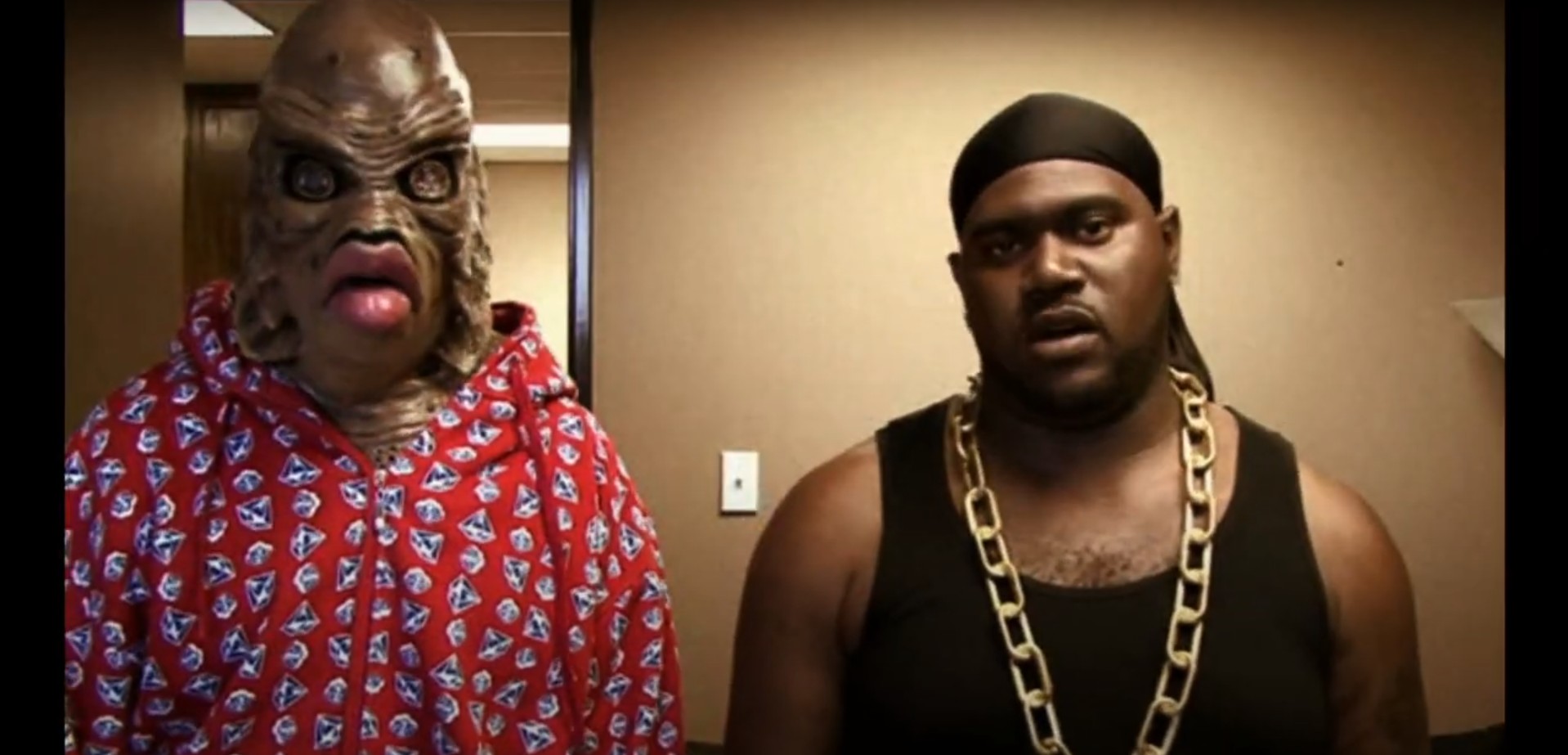
Thick-skinned actors comfortable with the narrative’s uncomfortable themes begin with Howard Calvert and Jamelle Kent as Baking Soda and G.E.D.  Calbert and Kent have become regulars in the Tom Martino catalogue of cast members for his more recent films and their humble beginnings in “Race War:  The Remake” proved their longevity to stay with the director, who is white, who wrote extensive race, gender, sexuality, and fart jokes in the context of a comedy-horror with cringy stereotypes and genuine tributes.  Calvert and Kent have great comedic timing to pull off all the zany editing, sound bites, and practical effects distaste Martino has flaming axe tosses at them to achieve his vision.  The two are joined by Danny McCarty, who would become another regular and be the visual effects supervisor for the film, dressed head-to-toe in loose-fitting urban attire to match the theme of Calvert and Kent’s black A-shirt and do-rags but his hands and face are masked to become the Creature from the Black Lagoon, aka Kreech.  Martino’s “Race War:  The Remake” isn’t just about the terrestrial races but intergalactic ones as well and we soon see that later on with the intentions of neo-Nazi white drug suppliers, led by Matt Rogers’ vulgarity in the horseshoe mustached Tex.  There are various other encountered gross stereotypes in the trio’s urban quest, such as a large nosed, greedy Jewish lawyer, Mexican luchador bodyguards, and a Pai Mei-esque Shifu speaking gibberish har har sounds and listing off popular Americanized Chinese dishes in attempt to be derogatorily funny.  With a film titled as “Race Wars:  The Remake,” the cast is mostly white and black actors poking uncouth fun with a big unconcerned and insensitive stick with Corey Fuller, Kerryn Ledet, Sam Rivas, and Coady Allen listed in the cast.

“Race Wars:  The Remake” isn’t funny, it’s stupid funny!  Having grown up in the 1980-2000s, consciously I might add, Martino’s politically incorrect and his brand of juvenile humor resonates with me, reminding me how cinema has become numb to the spoof humor.  Granted, Martino’s humor is over the top cutting, gross, and full of jest bigotry, traits that would trigger many in today’s sensitive awareness, and while cringy after a tasteless joke may result, there’ll likely be some a side of the mouth chuckle to go along with it.  On the opposite side of the spectrum, Martino tributes to references of certain popular culture icons, though slightly bastardizing some for laughs.  From Peter Jackson’s “Bad Taste,” to “Creature from the Black Lagoon,” to even “Mortal Kombat,” “Race Wars: The Remake” integrates the best parts of each these staples of pop culture and that gives his film a leg up on other offensive spoofs of the same crass caliber.  Th one negative story structure item to  highlight is the act one narrative takes a while to work the gears and get going as it attempts to setup the 40oz-drinking chumminess of Baking Soda, G.E.D., and Kreech but lags to a stagnant stall for hot second while still surround with the here-and-there gags, themed with G.E.D. homosexual tendencies and Baking Soda’s drug peddling woes on and off the streets, but once the antics pickup, there’s no stopping Martino and his filmic entourage from raining down an assault of insults. 

If you’re easily offended or put off by off-color race comedy, then Wild Eye Releasing’s “Race War:  The Remake” DVD is not for you!  For me, and those like me, unaffected by the type of uncouth spoof, Tom Martino’s debut is for you!  The Raw & Extreme sublabel’s DVD is MPEG2 encoded, 720p resolution, on a DVD5.  Presented in widescreen 1.78:1 aspect ratio, there is a breadth of visual presentation not confined within’ pillar and letterboxing but is stretched vertically that affects the already par level resolution.  Guerilla filmmaking also involves no production lighting and natural lighting is more than used here in Martino’s run around the Houston area, but one thing good about Martino’s naturally lit cinematography is its neutral set, avoiding under and overexposure.  The lesser used interiors have some tint lighting and key lighting to avoid total flat, dark outcomes but give the image a haze of hue, especially inside Baking Soda’s living room scene in the first act that sees a thin layer of red and green.  The English PCM Stereo has inconsistencies in volume.  Some scenes discern quieter than others because of the guerilla filmmaking constraints as well as just using commercial recording equipment.  However, the dialogue does land well enough for the jokes to hit and overlayed sound effects greatly lift the sound design where needed, such as with the Mortal Kombat video game sequence or with the array-spray of gunshots throughout and soundboard gag effects.  There are no subtitles with this release.  Included in the special features is Tom Martino director’s commentary, a gag/blooper reel, a behind-the-scenes reel of the gory moments, and Wild Eye Releasing trailers that include “Race War:  The Remake.”    The clear, ECO-Light Amaray DVD case houses stellar covert art illustration work by Belgium graphic artist, Stemo, with the inlaid narrative intensity and characters in collage.  The reverse side includes a gory still from one of the scenes.  The disc is pressed with the same front cover image but there are no other physical materials.  The unrated DVD runs for 95 minutes and is region free.

Last Rites:  Wild Eye Releasing re-unleashes another outrageous title on their Raw & Extreme label and the Tom Martino film is every ounce of the sentiment in it’s indie underground hokum of gore, racism, homosexuality, and aliens! 

Get Caught Up in the Middle of a “Race War: The Rmeake” on DVD

Put a Quarter in the Slot to Play EVIL’s Game! “Arcade” reviewed! (Full Moon / Blu-ray)

Insert Coin for “Arcade” on Blu-ray!

Arcade, the future of advanced, virtual reality-based video games, piques the interest of a group of teenagers eager to beta test the system in an underground arcade.  Vertigo, who engineered and programmed the game, sends the project manager to also hand out at-home editions of the game for continued testing.  When Arcade sucks in Alex’s boyfriend, Greg, into the game, she pleads to video game aficionado and good friend Nick about the game’s sentient dangers.  Nick experiences firsthand the horrors as their friend Laurie becomes entranced by its manipulative power and disappears during Arcade’s reach into reality.  Alex and Nick must venture into Arcade’s world to save Greg and their friends from a malicious machine seeking to invade and takeover the world, but they must find the hidden keys in all seven stages to reach Arcade’s soul and that’s no easy task when the game becomes very real when dying in the game will not grant respawn in the game or reality.

A movie ahead of its time but not ahead of the game, the Full Moon production “Arcade” is a live-action in a CGI-world thriller that’s one part “Tron” and one part “Virtuosity” for independent cinema, directed by the cybernetic and dystopian familiar filmmaker Albert Pyun (“Nemesis,” “Cyborg”).  Charles Band, founder of Full Moon and of a number of low-budget hit franchises, such as “Puppet Master” and “Demonic Toys,” light bulbs “Arcade’s” concept while David S. Goyer, the same David S. Goyer behind “Dark City,” “The Dark Knight,” and the 2022 “Hellraiser,” penned the script, marking the second collaborative production between Pyun and Goyer (“Kickboxer II”) as well as between Band and Goyer (“Demonic Toys”).  Band serves as executive producer alongside Michael Catalano and is show running produced by Cathy Gesualdo, all of whom were involved in the back-to-back productions with Albert Pyun with “Arcade” and “Dollman.”

Early Full Moon films always had an interest cast mix of known and unknown actors and “Arcade” is no exception with the tragically inclined Alex, a teen with nightmares about her mother’s year ago gruesome suicide and her father’s inability to cope since, played by an early 90’s recognizable beauty and then Full Moon regular Megan Ward (“Crash and Burn,” “Trancers II,”), coming off her success costarring alongside Brendan Fraser, Polly Shore, and Sean Astin as the love interest in “Encino Man.”  Ward role isn’t a damsel in distress one as Alex isn’t afraid to take and dive into a game of certain death to be the lone riser up against all odds.  An interesting piece of casting is Peter Billingsley, a name and face that might be familiar as Ralphie from Bob Clark’s “The Christmas Story.”  Instead of pining over a Red Ryder BB Gun that will undoubtedly shoot his eye out, Billingsley embodies the serious gamer amongst his group of friends who pines for the next level of gaming but also pines secretly for Alex, a subplot that’s not explored as well as it was technically setup.  The lone survivors of Arcade’s acute takeover embark into virtual reality to save the rest of their friends, under the cast of Bryan Dattilo as boyfriend Greg, Brandon Rane, A.J. Langer (“The People Under the Stairs”), and Seth Green (“Idle Hands”) in his early years, all of whom either disappear at moment’s notice of the game’s turn to complete evil or have a moment to stand out with dialogue or a pyshical scene.  John de Lancie’s role is small in comparison to his costars but the Q actor for “Star Trek:  The Next Generation” and “Picard” has the gift to protrude positively amongst the cast with Lancie’s quick-wit and timed deliveries as the Vertigo gaming production representative Difford unaware of the game’s conscious, dark design.   Norbert Weisser (“The Thing”), Don Stark (“Evilspeak”), Sharon Farrell (“Night of the Comet), and the voice of Jonathan Fuller (“The Pit and the Pendulum”) as Arcade’s voice round out the film’s amazingly cult chic cast.

In terms of computer-generated graphics of the early 1990s just eking out of the last decade, “Arcade’s” virtual world is of a clunky, chunky enterprise that epitomizes the era’s current technology.  One could argue “Tron” had that same boxiness only forgiven by its award-winning cast.  “Arcade” may not have an accolade-laden cast but the Band and Pyun production does, too, receive a pass for its eclectic and curious cast of well-rounded and peculiar-implanted actors and actresses, and also crew, that gives “Arcade” not only a reason to subdue the heavily-contrasted and bulky CGI but also rises it up to be larger than life, more than perhaps it deserved to be in regard to the story’s influences.  However, this poor man’s version still has a gimmick coating and the third act editing is atrociously choppy to a point where nowhere could possibly know what’s going on as Alex flies through the seven-level pyramid, easily unearthing the hidden keys, and ending in the summit of Arcade’s human brain wave laced soul.  Pieces of the reel were left on the cutting room floor, pieces that would have depicted more rigorous opposition to thwart Alex’s climb in the levels and would explains a whole lot more why she appears bangs up by the end.  Albert Pyun resurfaces some of his best directional work to create unsettling moments of possession or of being unhinged as well as using smoke to diffuse the primary hue vibrance starkly contrasted against the computerized gaming world.

Newly remastered in high-definition with touched up color and detail refinement, “Arcade” now has a new Blu-ray release from the Full Moon Feature catalogue.  Compounding and restoring various elements, the Full Moon team pulls together the best pieces for the best, up-to-date version available encoded on a MPEG-2 AVC, 1080p, BD25 disc.  Honestly, a BD50 would have been better suited for the compression as “Arcade” runs the gamut of effects, coloring, and dark scenes in which, those scenes outside of virtual reality, aka green screen, Albert Pyun’s infuses smoke for the underground arcade to diffuse the colors, spreading them amongst the crowd and the room to create that dive bar atmosphere.  However, there’s a bit of artificial banding surrounding the natural banding that delineates the colors within the darkness.  Details are also impossible to gauge with the choice styles of hazy and CGI but there are moments of clarity that gives “Arcade” a clean bill of image health around the skin textures. “Arcade” must have been made from televisions as the label remasters the ’93 feature inside it’s full screen 4:3 aspect ratio. Full Moon offers two audio formats: an English PCM 5.1 surround sound and a Stereo 2.0. Dialogue has clear projection without any damage or interference for an independent, 30+ year old film from the early 90’s, but the track isn’t as hardy as desired, especially in the multi-channel that doesn’t diffuse anemically through the side and back channels. Separation also can’t decipher between reality and virtual reality with the layers melding together on a level playing field. Range decently plays a wide berth of tonal shades in computerized, “Tron”-like synth-cycling and in-game explosions and distortions. There are no English subtitles available. Special features include an audio commentary with Full Moon found and producer Charles Band and Alex star Megan Ward in a good one-on-one conversational piece about the past production and a little insight rom Ward’s thoughts and Band’s history as a child to a movie mogul but there’s also a lot of Band flirting with Megan Ward. There’s an archival interview with John De Lancie, a rare VFX reel that extends a few scenes plus displays the scrapped original CGI, the typical accompanying Videozone marketing of Full Moon’s streaming catalogue, other Full Moon trailers, and the original film trailer. Inside the blue Amaray case, the cover art features the original VHS composition artwork and a disc concentratedly pressed with one version of “Arcade’s” virtual villains. The region free release is rated R and has a runtime of 101 minutes.

Last Rites: “Arcade” respawns in a newly remastered high-definition transfer that’s greatly cleaned up the flecked rough patches in front of the computer-generated engine but doesn’t smooth out the rocky terrain of the last act that suffers erratic editing for quick pinch pacing instead of really fleshing out the story flow.

Insert Coin for “Arcade” on Blu-ray!

EVIL is a Game Invented by Child and Ran by Clones! “Terminus” reviewed! (Blu-ray / MVDVisual Rewind Collection)

“Terminus” is a Win for the Rewind Collection! Buy it Here!

Super genius boy Mati programs an artificial intelligence RV known as Monster to trek through adversarial armed forces infested territory in a long-haul driving competition to reach Terminus where the winner will receive their weight in gold.  The Doctor, a mad cloning scientist who created the child, aims to subvert the government with Mati’s and the rest of his “unborn” clones under the malicious intentions of his superior named Sir.  When the lone driver Gus, an American woman competing in the game, is imprisoned and subsequently murdered by a ruthless Major after Monster unusual malfunction, Gus is able to pass along the Monster’s accessibility password to her inmate and lover Stump, a compassionate, for-the-people rebel against the military cruelty.  For his love for Gus and to do what’s right, Stump reluctantly joins Monster and a slaved orphan girl to finish the game while the boy genius Mati observes innocently from Terminus, but Doctor and Sir have other plans to use their clones and Monster to subvert government control.  

As you can tell from the synopsis alone, the French-German coproduced, science fiction dystopian actioner “Terminus” makes about as much sense as jumping out of an airplane without a parachute – an exhilarating ride without any understanding from a safety cushion.  Director Pierre-William Glenn, who was born at the height of Nazi-occupied France in 1943, helms the dystopian, futuristic picture from a script cowritten between Alain Gillot, Glenn and Patrice Duvic’s modifications, and Wallace Potts addition of English dialogue.  Glenn, whose main profession is a cinematographer, with a prior 1987 select filmography including “Death Watch,” “The Murdered Young Girl,” and “Wheel of Ashes,” removes his eye from the camera viewfinder to being incorporated into all aspects of the production for one of his first feature length films.  Anne François produces the film that was shot much in the landscapes and studios of Bavaria and Hungary under the European coalition of production companies of Initial Groupe, Les Films du Cheval de Fer, Films A2, CBL Films, and Cat Productions.

The script calls for and delivers color characters in a science fictional scope of subversive intentions, mad science, lone wolves, flawed good guys, mysterious pasts, unjustified brutality, and other varietal traits that run the gamut in this wild and untamed neo-revenge and sense of duty narrative.  For Pierre-William Glenn, he likes to color outside the lines, shading layers with precise measure to flesh out their nature, such as with Stump, a bleeding heart, anti-violence, maverick unwilling to see the impoverished and innocent violated by authoritative rule, played by French rock-n-roll singer and actor Johnny Hallyday.  Stump’s story stretches from how he lost his hand to his reasoning for joining the fight for Terminus unlike his companion Gus embodied by a notable American actress, “Indiana Jones and the Lost Ark’s” Karen Allen.  Gus’s is specifically pointed out as American, perhaps only in the U.S. cut, but her background or reason why she plays the game is ultimately lost or never provided in the cryptic conversations she has with stump during their incarceration intimacies.  We don’t even know why Gus is finitely taken out of the game by the callous Major (Dominique Valera) by either the eluding to the Major’s men gang-raping her or just severing her legs.  Again, very cryptic.  Allen co-headlines with the then up-and-coming “Das Boot” breakout star and Berlin, Germany born Jürgen Prochnow donning three roles, beginning with the head villain and red kimono-cladded Sir and his two clowns, the boy-genius creating “Doctor” and his more brutish field task rabbit Little Brother.  “Robocop 2’s” Gabriel Damon plays whiz kid Mati, designer of the game and of Monster whose being manipulated by Sir as a guinea pig for a super army of super smart clones like himself.  Julie Glenn, daughter of director Pierre-William Glen, brings up the rear as slave girl Princess.  While Julie is no princess Leia joining the rebellion, the young actress is kept mostly quiet without much dialogue to give the gradually important character silent with only a couple of defining narrative moments that save the day.  

“Terminus” has the componential makings of a surreal science fiction fantasy with a “Mad Max” tarpaulin overtop a “Flight of the Navigator” dominant core involving an A.I. Monster truck as a sanctioned, and calculating, entity guiding a path through the onslaught of roll caged government vehicles that drive about as good as Stormtroopers shoot.  Clones are at the precipice of usurpation and the international game of drive hard and fast becomes a ploy for the genetic deception, but Glenn can never really harness that energy at the heart of “Terminus’s” well-built special effects, fascinating characters, set locations and production designs that evoke a failed, if not futile, future.  The oppression angle loosely holds the yoke while Sir and his clones barely scratch the surface of being the true villains lurking in the shadows.  Instead, much of “Terminus” is contained around Stump and Monster’s fostering trust and solidifying the key connection between Mati and Princess and what they mean to a semisoft society.  “Terminus” is terribly lighthearted despite the story’s ugliness which is fleeting at best and audiences will not be confident in what they’re watching that have been intended for general audiences or restricted to an age limit as it all depends on which version, either U.S. or European, is viewed. 

Landing as the 66th release on the MVD Rewind Collection sublabel, “Terminus” provides two varying versions on a new Blu-ray release.  The AVC encoded, 1080p high-definition, BD50 is a collaborative release between MVDVisual and Multicom with a spectacular visual palette from a 2K scan of the original 35mm negative.  There are two cuts of the film both presented in different aspect ratios based on country.  The European Director’s Cut exhibits in the Eurpeaon 1.661 and incorporates back into the story all the edited violence and expands upon scenes with more context and accents by a whole 32 minutes, clocking in a total runtime of 115 minutes, comparatively to the U.S. version’s severely cut 83 minutes and is scene re-edited sequences.  The European Director’s Cut is slightly more compressed horizontally whereas for US audiences is more vertically but there’s no overall image loss other than the cuts themselves.  Grain appears and appeases healthily with little-to-no damage on a softer, lower contrast that brightens details but retains good textural value, especially around facial and skin features with equally organic tones.  Both cuts come with a LPCM 2.0 Stereo mix; however, the Euroean Director’s Cut is strictly French with optional English subtitles while the US Version is English with optional English subtitles.  Fun fact:  Both cuts are of the same film but two different shoots as because due to financial obligations and marketing, production had to principal shoot the same scenes in two different languages and thus is why if it looks like Karen Allen’s mouth appears to be saying the French words, she is actually speaking French.  However, both dialogues are a product of ADR so there’s some dyssynchronous between image and dialogue.  Even Monster’s voice is changed radically between the two films with a more computerized squeaky female (or child) voice in the Euro-cut and a hip-hop and slang crafted male voice that’s less robotic.  Both features handle the Stereo about as well as any front-loaded sound output could but a little more power in this track could go a long way with the explosions, crashes, and visual effect audio bytes being less emphasized and underfoot of the dialogue differences.  Encoded special features include a new video interview with Jürgen Prochnow on the film and growing up in the German/US industries, a new We All Descent – The Making-of Terminus featurette that sees interviews with Pierre-William Glenn’s now adult children Vincent Glenn and Julie Glenn, the latter had the role of Princess in the story, and archival, French dialogued, English-subtitled interviews with the director.  A photo gallery and the original theatrical trailer round out the extras.  The MVD Rewind Collections continues to provide the never-old, always-awesome faux retro encasement with a cardboard o-slipcover with artificial poster wear imagery of an illustrative composition of Johnny Hallyday, Jürgen Prochnow, and Karen Allen and a VHS sticker as the cherry on top.  The reverse cover of the primary, inside the clear Amaray case, has more colorfully alternative and little more kid friendly cover art and the disc is pressed with the plastic grooves of a VHS tape.  An unlikely reviewed PG rated release has region free capabilities to be played across the globe. 

Last Rites: Neither cut of “Terminus” outlines a clear-cut picture, but that ambivalence dotes cult and spurs disarray in parallel function that urges more from a story that wanes to the very end. At least the new MVD release is exceptional!

“Terminus” is a Win for the Rewind Collection! Buy it Here!

Experimental, Recreational Drug Use in College has Killer, EVIL Effects! “Blue Suneshine” reviewed! (Synapse Films / 3-Disc 4K UHD, Blu-ray, and CD Limited Edition Set)

Trip Out on Synapse’s Limited Edition “Blue Sunshine”

A party between friends turns deadly when one of them goes into a violent frenzy after being reveled his loss of all his hair.  Blamed for the murders, floating through life Jerry Zipkin is evading police investigators while also trying to connect the pieces on why a good friend of his would suddenly turn into a madman with no body hair and with five times the strength of any ordinary man.  His own investigation leads him to Blue Sunshine, an LSD variant connected to every transgressive event similar to the party, and at the center of it all is congressional frontrunner Edward Flemming who peddled Blue Sunshine 10 years ago at Stanford.  The latent consequence is now slowly surfacing to a head and more people are starting to experience the aggressive, alopecia effects, all Zipkin has to do to prove his innocent and a major ticking timebomb is to take a sample from a living specimen to show aberrant chromosome damage caused by the designer drug. 

Before becoming outed and investigated that the U.S. government experimented LSD on human subjects and it’s unknown but possible dormant side effects of years later, writer-director Jeff Lieberman put theory into sensationalized practicality with his post-psychedelic horror “Blue Sunshine” that turned ordinary, friendly people into headache-induced phonophobia sufferers and hairless, homicidal maniacs with super strength.  Lieberman’s 1977 released film snugs in between his killer Earthworm creature feature “Squirm” and one of the better backwoods slashers titled “Just Before Dawn,” tackling with themes of adverse effects from manmade drugs, political corruption, and to never judge a book by its cover.  The film is produced by “Squirm’s” George Manasse with “He Knows Your Alone” and “The Clairvoyant” producers Edgar Lansbury and Joseph Beruh serving as executive producers on the Ellanby Films production.

While the plot point that pushes Jerry Zipkin in the direction of investigation of the sudden fury and death surrounding his friend treads a threadbare rope with little background to suggest Zipkin is characteristically dedicated, loyal, curious, or all of the above to find out what happened, Zalman King’s overall performance as the path unaffixed Zipkin overshadows those missing background pieces and motivations.  In more key precise terms, Lieberman’s misdirection toward King’s erratic and strange behavior puts a lot of the focus on Zipkin rather than obvious derangement of the latent LSD maniacs with corrupted chromosomes in what was meant to puzzle the audiences in believing Zipkin himself might be the loose cannon cause behind the murders or, even perhaps, another ignorant victim of blue sunshine, which the latter would have been more intriguing and powerfully motivating for the Zipkin character as what drives him to solve the mystery and save himself.  None of the relationship resolve any type of secure or genuine interactions, specifically with Alicia Sweeney (Deborah Winters, “Tarantulas:  The Deadly Cargo”) with an unrealistic strong undying love for Zipkin despite only knowing him for a couple of months and the entire Stanford contingent from a decade earlier who Zipkin was able to easily link together within a matter of seconds of either examining a bloody crime scene or meeting a pair of the blue sunshine fiends.  One of the better, solid bonds is between the will-do-what-it-takes congress candidate Ed Flemming (Mark Goddard, Lost in Space) and his towering former college football buddy Wayne Mulligan (Ray Young, “Blood of Dracula’s Castle”) who becomes Flemming’s 6’6” advisor and bodyguard.  While might not seem like a well-rounded bond, Flemming and Mulligan have something tangible one can grab and understand when compared to other dynamic relationships that float in arbitrary.   Robert Walden (“Rage”), Charles Siebert (“Tarantulas:  The Deadly Cargo”), Ann Cooper, and Stefan Gierasch (“Carrie”) costar. 

“Blue Sunshine’s” premise has long stood the test of time because its more relatable now than ever as scientists and medical experts are in a fluid state of studying the effects of drugs digested, snorted, injected, or smoked weeks, months, years, and decades ago.  This premise also translates over to contaminants that cause sicknesses, such as the link between asbestos and cancer were tumors form years after exposure.  Lieberman catches wind early of the dangerous latent effects and manipulates it for the basis his film that is more fact than fiction.  Lieberman’s ability to minimize assurances on who is transfiguring into a killer is all in his characterizing nuances, shading in gray areas with excellently crafted character profile vignettes in between the opening credits that instill suspicion, fear, and some unknown stemmed danger ahead.  The unique setup is the filmmaker’s only real unconventional course in the narrative that plays out mostly a routine hand in a natural style albeit the surrealism of extreme closeups and angles on bald headed balefulness when the rage takes over or the slow, insidious madness that seeps into Zipkin’s mind causing hallucinations to exact an audience experiencing disturbance in the envisaged air.  Engaging and self-security eviscerating, “Blue Sunshine” is carbonated madness in a bottle, shook up and ready to pop. 

Synapse continues to upgrade their catalogue with Blue Sunshine next on the augmentation block with a new and mighty 3-disc Blu-ray and 4K UHD restoration release.  Presented in Dolby Vision HDR10, the restoration of the original 35mm camera negative sees it’s 4K transfer compressed with a HEVC codec that produces 2160p and is stored onto a BD100 while the Blu-ray is a compressed AVC, 1080p resolution, on a BD50.  The restoration will blow you away with diffused color palette and organic details that by far are the best they’ve ever looked with a balanced, natural grain level that keeps the speckling down in darker portions of the film to retain inkiness while securing the authenticity of the film stock without any smoothing over and artificial enhancements.  Vivid coloring, immersive details, and natural skin tones, when not softly grayed by the drug’s effects, throughout are appreciatively stable with no qualitative loss between cuts, creating a pleasurable and seamless visual experience on both formats.  Each format comes with two English audio options, a lossless DTS-HD master audio 5.1 surround sound, supervised and approved by director Jeff Lieberman, and a lossless DTS-HD master audio original theatrical mono 2.0.  While the amplification of the same sound output through the dual channels is inviting for purist, I highly recommend the immersive 5.1 surround sound that retains the genuine article of audio fidelity.   Charlie Gross’s orchestral strings instruments, percussive gongs, and synthesizing score fully engrosses the characters and audiences alike into a fold of unnerving, lingering tingles that evoke the monstrous maniac effect possibilities beyond the Jerry Zipkin tale.  Dialogue renders over with fine precision that hangs on every word and sentence with no hissing and crackling to obstruct it’s sweeping clarity.  A bountiful amount of Mind-Altering special features that fill this limited to 4000 copies set that include a new feature prologue introduction with director Jeff Lieberman.  There are two audio commentaries, an archived 2003 interview with Lieberman, a Channel Z Fantasy Film Festival ”Lieberman on Lieberman” interview with the director hosted by “Sleepwalkers” Mick Garris, a Q&A video from the Fantasia Film Festival 4K premiere moderated by Michael Gingold and Lieberman, an anti-drug scare-film “LSD-25” from 1967 and “LSD:  Insight or Insanity?” From 1968 from the American Genre Film Archive, Jeff Leiberman’s first film “The Ringer” with two cuts of the film, the original uncut version from the projection print source and the final release from the remastered Synapse Films 4K transfer with audio commentary included on the uncut version by Jeff Leiberman and moderator Howard S. Berger, still gallery and theatrical trailers. Synapse’s limited-edition boxset is nothing you’ve ever seen before from the company with not only a rigid slipbox case but there’s also a cardboard O-slipcover, both housing the clear, inch-thick Blu-ray Amaray case and both showcasing new illustrative, compositional, air brushed artwork of some of the key character scenes and expressions by Wes Benscoter, which is a real thing of beauty. The Amaray cover art is the regular 70’s grade cover art seen on previous releases from DVD to Blu-ray with a reverse side an image of the tripped-out Ed Flemming icon photo of his drug peddling days at Stanford. Overlapping 4K and Blu-ray discs display graphic presses in story moment compositions, though I don’t recall a half-naked woman in the film yet is on the cover. Not quite yet done with the bonus material, the 3rd disc is a 13-track Soundtrack CD of the score and laid overtop is the 11-page liner note booklet from Jeff Lieberman’s 2020 memoir “Day of the Living Me: Adventures of a Subversive Cult Filmmaker From the Golden Age,” plus the CD track listing, production credits, and special thanks on the backside. A reproduction of the original one sheet poster is stored in the insert as a mini-folded poster along with Synapse’s 2024 catalogue for your perusing pleasure. The rated-R film has a runtime of 95 minutes, and the limited edition doesn’t limit itself to a confined playback with region free decoding.

Last Rites: In order to snag a copy of this stellar Synapse set, muscles are required as this heavy boxset feels like 5lbs of software and hardware special features regarding Jeff Leiberman’s drugs-are-bad thriller “Blue Sunshine” with chrome dome, blank-stare killers doing the dormant bidding of 10-years-old recessed LSD.

Trip Out on Synapse’s Limited Edition “Blue Sunshine”

Next Step in Evolution Leads to EVIL’s War Against the Common Man. “Scanners” reviewed! (Second Sight / 4K UHD)

“Scanners” 4K is Head Popping Good! Buy it Here!

Dr. Paul Ruth is a ConSec scientist, the head of the private contract weapons department on the “Scanner” project.  A Scanner is a highly developed human with psychic and telekinetic powers able to control and damage the minds of others through the nervous system.   Ruth’s latest case is Cameron Vale, a vagrant helped by Ruth to control his self-detriment powers with the use of a scanning suppressive drug known as ephemerol.  When one of Ruth’s past subjects, a renegade Scanner known as Revok, infiltrates and assassinates a live public demonstration of the Scanner project with the intent to wage war on non-Scanners, Ruth’s only hope is to convince to conscript Vale to join the fight and infiltrate against Revok who kills any Scanner who doesn’t join his growing army.  Vale’s search for Revok leads him to learn of a treacherous mole within ConSec and that ephemerol is being weaponized against the normal human race.

On the heels of our Second Sight 4K review of David Cronenberg’s 1979 film “The Brood,” Cronenberg’s following film “Scanners” released two years later in 1981 ups the ante in elaborate special effects and high conceptual themes twirling around in a bowl of body horror soup and is now also available on 4K UHD from the UK Second Sight label!  Like “The Brood,” Cronenberg writes-and-direct a dysphoric film in his birth country of Canadian, per his normal track record of principal production countries, specifically shooting in in the urban and greater areas of Québec, Canada.  The first film of a trilogy, to which Cronenberg did not return to direct the subsequent sequels with both films released a decade later in 1991 and helmed by “Screamers” director Christian Duguay, is a production of the  CFDC (Canadian Film Development Corporation), Filmplan International, and Montreal Trust Company of Canada with Pierre David and Claude Héroux both returning from “The Brood” as executive producer and producer, respectively. 

The face of Scanners has been and always will be Michael Ironside, included on most poster and home video release stills and artworks of a flaringly distorted Ironside as Revok deep in a frighteningly milky-white eyed scanner turbulence.  The “Total Recall” and “Starship Troopers” actor has a face the camera loves, especially in an antagonistic role with Ironside’s gifted devilish grin, dagger eyes, and sarcastic stoic expressions.  However, he is not the heroic lead of Cronenberg’s “Scanners.”  Ironside is not even in the top three headlining credits.  That foremost distinction is consumed by Stephen Lack (“Perfect Strangers,” “Dead Ringers”) in the Cameron Vale role and Lack’s performance is indicative of his name in a completely overshadowed protagonist role.  Lack’s monotonic bordering dangerously to catatonic presence is swallowed up by Ironside who has fewer scenes but instills punchier passion toward his character’s rebellion against humanity cause, plus the contour control over his mannerism and expressions are impeccably cinematic  There are other actors credited ahead of Ironside, beginning with the greatly dramatical Patrick McGoohan (“Escape from Alcatraz”) as the pro-scanner ally Dr. Paul Ruth whose commanding the Vale assignment, “The Clown Murders’” Lawrence Dane as a traitorous ConSec company man Keller in Revok’s pocket lining, and “The Psychic’s” Jennifer O’Neill as fellow pacificist scanner and Vale love interest Kim Obrist.  Each actor finds their individual, attributable, character voice while giving into the required performance with commitment, a sentiment that was not shared by Lack in a strong leading man contender against the forces that face him or scan his mental space.  “Scanners” rounds out the cat with Robert A. Silverman (“The Brood,” “Jason X”), Mavor Moore (“Heavy Metal”),  Fred Doederlein (“Shivers”), Adam Ludwig (“Short Circuit 2”), and Victor Desy (“Rabid”) with that iconic head explosion scene.

To follow up “The Brood” almost right on its heels with “Scanners,” David Cronenberg’s creative synapses were just thunder stroking on all cylinders with ways to evolve mankind into next level grimdark science fiction.  The simple premise of the advanced human condition sparking a potential war between normal man and Scanner man with a private weapons developer in the middle, perhaps inadvertently or intentionally coaxing a new breed of man, is elevated by the special effects of Gary Zeller (“Visiting Hours, “Amityville II: The Possession”) and the makeup alley-oop by Dick Smith (“The Exorcist”) to give audiences those head-exploding, vein-popping, fire-starting special effects that are sear so well into the mind they’re virtually unerasable from the mind, as if real life scanners were implementing the reel into the occipital lobes themselves.  Plot devices like these inarguably saturate the cloak-and-dagger, on-the-run, and species-eradicating storyline with leadup anticipation, building suspense through the truth and lies of Vale’s assignment as well as Vale understanding and, ultimately, accepting his gift rather than seeing it as a burden or a blight to his being.  Unlike “The Brood,” “Scanners” leans more into the physical method of effects with not only the pulsing veins and the white contact lenses but Cronenberg amps up the pyrotechnics with violent and fiery explosions, both of which do a number of the body with blunt invisible force ravaging soft tissue, and also sets ablaze characters’ specific, isolated areas for visual awe and a presentation of a whole new possibility dimension plane of the mind and body that can create, endure, and eventually destroy.   

“Scanners” rounds out the pair of Second Sight’s David Cronenberg releases onto 4K UHD, in conjunction with “The Brood.” The HEVC encoded, 2160p ultra high-definition, BD100 houses the director approved 4K restoration transfer, presented in Dolby Vision HDR10 and in a widescreen 1.85:1 aspect ratio. Previous HD releases favored a slightly anemic image with a tilted color grading that never approached the aesthetics of the cinematic era. Second Sight improves on this with a present in time natural grading true to the late 70s into the early 80s. Healthy, organic grain filter through with an agreeable measure, never overtaking the details that effect upon texture and substance, such as from the massive head explosion with all the intricate gory bits of hair and flesh flying splattering about make for ideal visual immersion to the more macrolevel of inside circuitry when Vale enters the computerized nervous system through scanning. Skin tones render over organically with no flashes of a slightly orange tinge as in previous releases, corrected to overall completed neatness on the finer points. An English DTS-HD 5.1 master audio and a LPCM 1.0 mono consummate the release with fidelity honoring mixes. The surround sound offers a constructed immersive dynamic riddled with explosions and a feverish Howard Shore score engulfing the echoing of the scanner waves to denote the telekinetic or psychic use, but the mono track offers something far greater than any retroactive designed immersion track could offer, a genuine, unforced mix. Both tracks offer clean, robust dialogue with a clarity to match. English subtitles are available on both. Special features include a new audio commentary by Canadian film writer Caelum Vatnsdal and a second audio commentary by film academic William Beard. If comprehensive interviews straight for the horses’ mouths are your thing, than Second Sight has you covered with new and archive interviews with Stephen Lack My Art Keeps Me Sane, Michael Ironside A Method in His Madness, Lawrence Dane Bad Guy Dane, cinematographer Mark Irwin The Eye of Scanners, composer Howard Shore Mind Fragments, executive producer Pierre David The Chaos of Scanners, makeup artist Stephen Duplus Exploding Brains & Popping Veins, and with makeup effects artist Chris Walas Monster Kid. A new visual essay by Tim Coleman Cronenberg’s Tech Babies cabooses the special features. Encased in a traditional back UHD Amaray, the new artwork also sports a prominent and looming Michael Ironside as a raging scanner Revok but now Stephen Lack has presence space with his own iconic and disturbing moment from the film now on the front cover, as the little spoon of course. The companion standard Second Sight release of “Scanners” is UK certified 18, has a runtime of 103 minutes, and is region free!

Last Rites: “Scanners” never looked so good. An exceptional inception of a release from Second Sight Films that continues to aim high and raise the bar with every title they touch, like King Midas without being cursed by their success.

“Scanners” 4K is Head Popping Good! Buy it Here!