
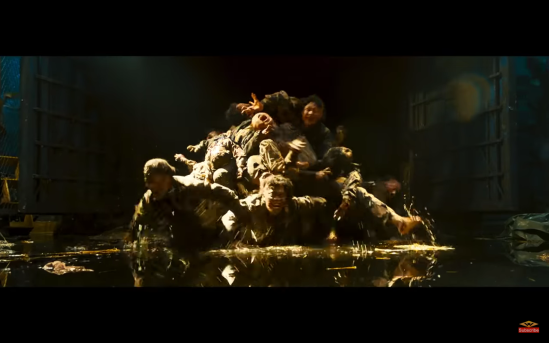
For four years after the initial zombie outbreak, a unified Korean peninsula is completely quarantined from the rest of the world with the remaining survivors having to fend for themselves. A former Korean Captain, Jung Seok, who was one of the last survivors to escape pre-quarantine and now lives in Hong Kong, is hired for a four man team to return to the peninsula and retrieve an unmarked and abandoned truck stowed with $20 million dollars in U.S. currency. With a promise from a Hong Kong mafia boss to keep part of the loot for their recovery services in order to start a new life, the team agrees to the terms and embarks on the seemingly succeed mission only to find survivors who have gone mad, pillaging their mission and conscripting them into a malicious betting game of survival in a watery pit full of zombies.
The highly anticipated sequel to South Korea’s 2016 sleeper zombie hit, “Train to Busan,” docks into U.S. theaters and VOD services on August 21st and is entitled simply, “Peninsula.” From the bullet train rails to the a devastated Korean port, the predecessor film’s director, Yeon Sang-ho, returns with a zombie overrun post-apocalypse that completely metastasized Korean derived from a biological agent quickly spreading throughout the two cinematically unified, North and South Korea. Joo-Suk Park returns as co-writer alongside Yeon to provide heart clenching, brutal action-horror suspense and a human sense of selfless compassion that won the hearts of many genre fans with “Train to Busan.” Zombie hordes rampage down streets, alleyways, and toppling over cars, fences, and other structures as a collective flesh easting unit that specializes in dominating and ravaging for the pure motive of infection and while that sounds all hip and cool that the “War World Z” and “I Am Legend” running zombie pandemonium makes for a glitzy entertainment feedbag, the Next Entertainment World and RedPeter Film production punches down on the gas pedal of gaslighting audiences with more of a “Fast and Furious: Tokyo Drift” with zombies, revving more to the tune of an exasperated exhaust rather than finishing strong with gripping storytelling.
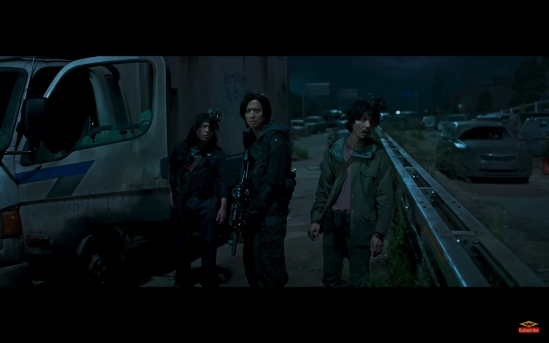
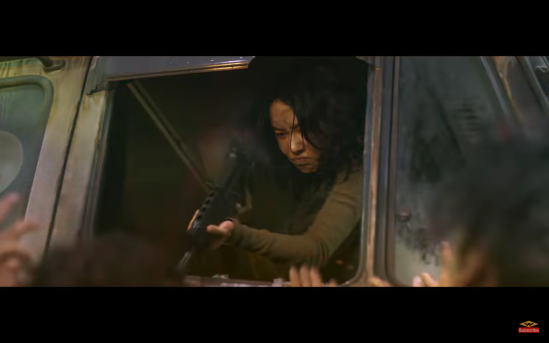
As a standalone film, the story doesn’t return the surviving characters from “Train to Busan.” Instead, a whole new set of characters reset the parameters of expectations, starting with the guilty conscious of the grief-stricken ex-soldier, Jung Seok, played by Dong-won Gang, who will star in Scott Mann’s upcoming disaster film “#tsunami.” Seok’s a reserved and stoic individual whose good a gun play, but isn’t the thinker when a plan is needed in place and while Dong-won Gang gives a par performance, the overall package of the lead character is sorely two-dimensional. This leaves room for other characters flourish, such as the mother and children Seok attempts to save on a second go-around. The mother, played by Lee Jung-hyun, has more grit that clearly defines her underlining hope for not only her salvation, but also her children who’ve known nothing but death, destruction, and meaning of being devoured growing up in the midst of a zombie apocalypse. On the slim change of success, she implements a plan to infiltrate Unit 631, former military turned murderous scavengers, to steal back a satellite phone and a truck full of cash while not becoming zombie chow or get caught in Unit 631’s sadistic survival methods. That brings us to the villains, the real villains, where are not the zombies, but the section 8 soldiers of Unit 631, Captain Seo (Koo Kyo-hwan) and Sergeant Hwang (Kim Min-jae). Though Seo and Hwang bring internal tension to the table, a mental game of cutthroat chess, they’re inevitably soft against the main threat, a combined effort of Jung= Seok and Min-jung, and don’t spill enough blood and craziness onto the screen to make them worthy of the antagonist position. “Peninsula” rounds out the cast with Kim Do-yoon, Lee Re, Lee Ye-won, Moon Woo-jin and Bella Rahim.
As almost methodical as it is with any second film in a series, “Peninsula” failed to be a rejuvenating and transcending sequel to “Train to Busan,” abandoning the first story’s benevolence for CGI flair that extends to not only the zombie hordes, but to the car chases. As excellent as the rendered zombies are slammed against the drifting cars can be represented, in what “Peninsula” can be described as an “Escape from L.A.” meets “Land of the Dead” meets “Mad Max: The Road Warrior,” the cars themselves are a product of computer imagery with little authentic driving happening. While the effects are not bad (they’re pretty good chiefly obscured by dim lit night scenes), the sensation of being scammed can’t be ignored as the vehicles operate unnaturally and maneuver in impossible situations without blowing a tire or upending or just frankly be dead in the water with an overheated and stress tussled engine that frags zombies left and right, becoming a collective character to have the highest kill count. That disingenuous feeling also spreads to the overly long-winded ending that tries really, really hard to capture a courageously defiant and heroic moment of family and personal redemption and much of the blame lies on director Yeon Sang-ho with a drawn out awkwardness and edit that made it seem satirical. In light of some positive words for “Peninsula,” the zombies are a greater, gigantic force that swarm on a colossally epic scale more so than the much more compact “Train to Busan” and, as aforementioned, the structured CGI isn’t of the degraded detail variety so the hordes never look cheap or obviously artificial alongside the more palatable, practical versions. What’s also interesting about “Peninsula” and what makes it separate from “Train to Busan,” which perhaps laid the foundation for, is “Peninsula” has integrated the western counterparts as English speaking actors chime in as U.S. Military, U.N. peacekeepers, or English mafia bosses based in the U.K. This challenges the Korean actors to speak a few different languages, especially English, inclining “Peninsula” as more of a global problem than an isolated Korean one.
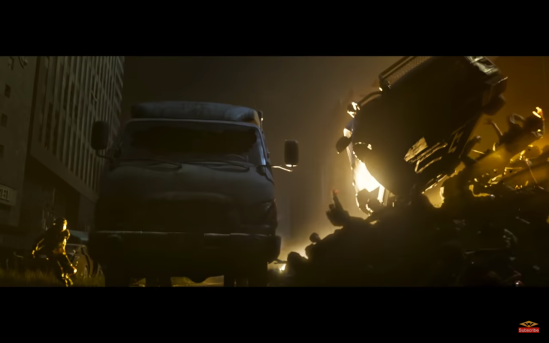
The zombie genre isn’t just defined by the ungodly amount of undead bodies reaping the world of every living soul, but is also defined by the diversity of chaos-driven social structures people find themselves confronted with in the action-heavy “Peninsula,” arriving into U.S. theaters on August 31 and distributed by Well Go USA Entertainment. This review will not contain the A/V aspects of the release as it’s a theatrical screening of the feature, but the theater specs will look something like this: projection is in scope lens format at an aspect ratio of a widescreen 2.39:1, a surround sound 5.1 stereo mix, Korean/English/Cantonese language with English subtitles, and has a runtime of just under two hours at 116 minutes. I will note that some scenes are very dark, but this only adds to the complete blackout of a civically desolated Korean peninsula. From fast trains to fast cars, “Peninsula” has retained the adrenaline popping rampant style with weaving, bobbing, and chassis chucking zombie bodies like the ball in a pinball machine despite a facile approach, but is ultimately missing that down-to-Earth social context complexity aimed to provoke thought and shed a few tears as an inferior part two of the “Train to Busan” universe.
Category Archives: Sequels
Spies, Lies, Thighs, and EVIL Guys! “The Dallas Connection” reviewed! (Mill Creek Entertainment / Blu-ray)
Chris Cannon and Mark Austin are back to save the world from a devious organization once again as the two bureau agents are assigned to protect the last world-renowned scientist that developed an International World Arms Removal (I/War) satellite project that could detect terrorists’ weaponry no matter how concealed, but when the other three scientists from around the globe are brutally assassinated, the odds are stacked up against them and the bad guys are always one step ahead of them. Given four computer chips to guard at all times, I/War assigns their best agents to the task of securing hope for the project, called The Dallas Connection, for three days until a specifically timed launch to coordinator with a passing asteroid field that’ll power the satellite for years decades to come, but the well-armed and well-organized crime uses all assets and their power of seduction to gain control over the satellite at all cost.
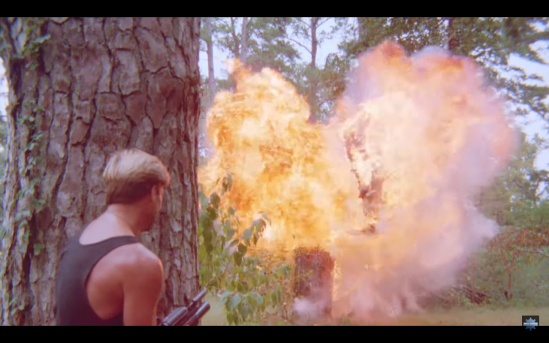
The L.E.T.H.A.L. ladies series continues with the second buddy-cop picture, “The Dallas Connection,” helmed by Christian Drew Sidaris, son of the erotically charged-action producer and filmmaker, Andy Sidaris that follows up on the first Drew Sidaris prospecting fracas, Enemy Gold. “The Dallas Connection” is the tenth installment of the series, known also as the Triple B series (that’s Boobs, Bombs, and Bullets) that has little-to-nothing linking the entire series cache together aside from being exclusively explosive wrapped with a sensual rouleau of Playmate and Penthouse centerfolds, tightly coiled around the tight and firm half-naked bodies of it’s leading stars. The Sidaris team, under the Malibu Bay Films and Skyhawks Films banners, one again economically ignite a successful B movie that promises 90’s attired, flamboyant action on set at a few familiarly recycled locations in Shreveport, Louisiana and Los Angeles, California, redressed for a not-so different genre or distant premise.

As aforementioned, centerfolds are a staple in any Sidaris, father or son, girls and guns feature and “The Dallas Connection” is no exception, starting off with their main squeeze, good friend, and cult movie icon, Julie Strain, as one of the chief co-antagonist under the nom de guerre, “Black Widow.” Strain is tall, sexy, and a wild villain capable of restraining the violent kick of an AK-47 in thigh high boots and a low-cut open jacket that embodies gun nuts most delectable dreams. The once Penthouse Pet of the Year stays quite reserved compared to her tantamount villainous role in “Enemy Gold” by going topless only in a couple of instances in a death grip roll that involves a lap dance before her prey’s demise, a specified attribute to the beautiful and deadly small spider she spins her call sign from. Black Widow is joined the just as deadly Cobra, fellow Penthouse Pet of the Month February 1993, Julie K. Smith, and Scorpion, the equally as Julie Strain tall, Playboy Playmate of the Month December 1991, Wendy Hamilton. Smith and Hamilton offer up polar features that doesn’t make “The Dallas Connection” a one-type of woman show, but both are voluptuous in their own rite, adding sizzling hot tub sex scenes and long-legged strip shows to accentuate “The Dallas Connection” amongst the B movie fray. “Phantasm II’s” Samantha Phillips becomes the whip cream on top, rounding out Sidaris’ centerfold assembly, as another the third Penthouse Pet of the Month, June 1993. There’s also Bruce Penhall and Mark Barriere, but who cares about these shirtless studs who drag race old Plymouths and jet ski when you four gorgeous women to ogle over? Penhall and Barriere mark their return as Chris Cannon and Mark Austin from Enemy Gold in a buddy-cop adventure loaded with a Dirty Harry Magnum .357 and a M1 Grenade launcher assault rifle. Kaboom! Rounding out the cast is Gerald Okamura (“Big Trouble in Little China”), Roland Marcus, Cassidy Phillips, Ron Browning, Tom Abbott, and Rodrigo Obregon as a satellite scientist.

After finishing “The Dallas Connection,” I wanted to say that I’ve seen this movie before and not because of some misplaced form of déjà vu, but, rather, that I, in fact, HAVE seen this movie before in the precursor film of the L.E.T.H.A.L. ladies series, “Enemy Gold.” The story’s been tweaked slightly to a story with the same framework. Hell, like also mentioned, when you throw in some of the same locations as in “Enemy Gold,” Sidaris’s home with the hot tub and the cabin the woods, and redress the same actors, Julie Strain, Bruce Penhall, Mark Barrier, Rodrigo Obregon, Tom Abbott, and Ron Browning all in the essentially the same roles, “The Dallas Connection” just feels like an extension or a mirror image of that former film, making the story a weary one with nothing really new to spectacle except for three pairs of new, large-and-in charge, breasts in Smith, Hamilton, and Phillips. One difference noticed is that the bureau agents this time around are a lot dafter with skulls thick as a brick and unable to use common logic in the most practical situations. There have been many a time when producer Andy Sidaris commented his films to James Bond, but at least Bond had the smarts to always be on guard; Chris Cannon and Mark Austin do indeed think with their other head that do, in benefit, leave the door open for some saucy hot tub sex that’s perhaps the best simulation from Sidaris reel I’ve seen to date.

Available for the first time on Blu-ray, “The Dallas Connection” will get your rocket launchers off with ton of gunplay and is loaded with beautiful women. The region A, 1080p high definition presentation from a 4K scan restoration has an aspect ratio of 1.78:1 widescreen. The image’s simply gorgeous from the 35mm negative baring a few minor faint scratches that linger only for seconds at a time. There’s quite a bit of noise during the night scenes that almost make the scene look daylit, but skin tones, especially gleaming with water, are remarkably velvety and the textures on clothes and skin looks great for a low budget action. The English language DTS-HD Master Audio dual channel mix medleys appropriately, dialogue is clear and upfront and ambience has proper depth and range. Explosions are powerful coming through the dual channels with a hefty LFE and gunfire can rip just as good as Dutch blasting away at a trophy hunting alien in Predator. Even the sexy lounge soundtrack from Ron Di Iulio is on point despite being a rehash of “Enemy Gold” once again. Hardly any blemishes or distortions coming from the audio track. English SDH subtitles are optional. The bonus features mirror that of “Enemy Gold” as well with Andy Sidaris and Julie Strain doing this awkwardly coy and sugar daddy bit showing off “The Dallas Connection” merchandise and international posters that lead into Andy’s film school where him and his wife, Arlene, go onto commentary on how to shoot scenes and edit them together, using an action and a sexy scene from “Return to Savage Beach” as reference. In the same behind the scenes, there’s an equally bizarre Joe Bob Briggs interview where the legendary MonsterVision and The Last Drive-in Host seems uncomfortable with Andy and star Julie K. Smith about how he persuades to get these beautiful centerfolds to be in his films. Other bonus material includes a commentary on the film itself and theatrical trailer. “The Dallas Connection” is a Texas-size IED with a busty ornate façade, but acts more like a duplication of something we’ve already experienced, making the sophomore feature from Christian Drew Sidaris just a more of the same.

Only $12.99 at Amazon.com! Plus, you purchase a VHS tape! WHAAA!?!

EVIL is the Carousal Centerpiece of Hell! “The Devil’s Fairground” reviewed! (MGI Films and ITN Distribution / Screener)

A pair of struggling paranormal investigator groups have been reduced to the gimmicky capturing and recording pay schemes of alleged ghost and spirit interactions, but when a hack actor is hired to setup a meet and greet with an apparent demon possessed girl, their investigation leads Freaky Link’s Jacob and Shawn and Spooky Links’ Lace and Rob to an abandoned and dilapidated fairground as the source of the girl’s possession. Upon arrival, they’re immediately sucked into the epicenter of Hell to battle for their very souls.

Jacob and Shawn return to confront the ruthless terrors of supernatural forces once again in “Anna 2: Freaky Links,” aka, ITN distributed titled “The Devil’s Fairground,” and aka, better known as simply, “Anna 2,” in this low-key horror-comedy sequel from the Crum brothers, director Michael and screenwriter Gerald, delivering infernal Hell straight out of the Lonestar state of Texas. Honestly, I’ve never seen the prior film, “Anna,” and at first glance, “Anna” was seemingly a rip from the successful coattails of “The Conjuring’s” universe sub story, “Annabelle,” involving a doll embodying the forces of evil. However, despite the comparable titles and a shade of the narrative, “Anna” and “The Devil’s Fairground” veer into a novel realm of the deep and ultra-surreal that became the basic construction materials needed for lush nightmares. The Dallas-Fort Worth based production company, MGI Films, founded by Michael Crum, backed the film saw fit to update the title form “Anna 2: Freaky Links” to “The Devil’s Fairground,” a simple, yet improved title change that landed some viewing confusion when the original title graced the scree when the original title graced the screen, like for myself who enjoys going into a movie knowing nothing. MGI Films has also produced “Lake Fear” and “Blood Vow.”

Returning as paranormal private eyes, Jacob and Shawn, are Justin Duncan and Gerald Crum as the hapless duo who barely survived the first demonic doll encounter and team up with the Spooky Links investigators Lace (Mercedes Peterson) and Rob (John Charles Dickson, “Meathook Massacre 3: First Hunt”) to combine their joint efforts and their holy water filled water guns up against an unknown evil. Initially, Jacob and Shawn are written without much consideration of the first happenstance with only brief hints that mean little to the layman toward the Crum pagan pageantry. There’s obvious history between the two groups beyond being competitive supernatural sleuths that’s difficult to sift through to make a full, clearer picture on their quarrelsome nature, but one thing is certain, both Freaky Link and Spooky Links are desperate to be validated ghost hunters. Gerald Crum’s script might have dissected the thick tension between the characters, but the poor audio quality and the loose preface that dots the eyes between both predecessor and sequel is about as abstract as the Hell they find themselves swallowed in. Daniel Frank, Kenzie Pallone, Shannon Snedden, and Vandi Clark fill out the cast list.

“The Fair Ground” is a tricky trickster when judgement comes during the credit roll. With all the audio issues during the story setup, as aforementioned, connecting with the characters and the story proved dreadfully challenging conjoining against the fact that I have never seen the film’s antecedent, “Anna.” I was lost, confused, and struggling to keep up with the exposition that didn’t circulate visibly a perfect picture of “Anna” to bring the viewer up to speed. Also, the very fact “Anna 2: Freaky Links” title is displayed and not “The Devil’s Fairground” threw me for a loop; I had to pause and look back at the press release to see if I was watching the correct feature. However, in the end, “The Fair Ground” became an absolute diamond in the rough with a delectably profound scare factory of terror imagery, wallowing in the timely executions in Michael Crum’s editing and Gerald Crum’s imaginative visual and special effects. Though some will see the effects being rough around the edges, the shock-horror discordances work without question with a pack of ghoulish bug-eyed zombies, a carousal of shuttering specters, a foreboding carnival PA system, an aborted past lurking in dark waters, and an overgrown monster with the biggest butcher blade you’ve ever seen while peppering with scenes of powerful gore interjections. It’s something very reminiscent of the cinema adaptations of “Silent Hill.” A lot of the imagery doesn’t make sense, like the jarring slivers of a bad dream, but I wouldn’t expect Hell to be or need to be a place of complete rational and our minds are able to grasp the nuts and bolts of it. “The Devil’s Fairground’s” interpretation is just as real, as scary, and as aptly damning without the grounded laws of physics to ease the dispiriting attitude of multi-faceted and gratifying torture and soul swallowing the investigators are subjected to. Whatever was left of a meaningful plot is whittled down to a more basic posture, a group of people engulfed by the fiery Abyss, and the movie is all better for it.

Get sucked into the depths of the blazing inferno thrill ride with “The Devil’s Fairground” on DVD home video, announced by MGI Films and distributed by ITN Distribution. Unfortunately, the video and audio specs won’t be reviewed due to being an online screener, but I did mention the dialogue is limited, capturing very little of the softly laid discourse leading up to all hell breaking loose. There are no special features included with the screener or incorporated within the feature itself. There were times I knew the jump scare was coming and, still, I couldn’t contain the tension as a little part of me died from the inside. “The Devil’s Fairground” is an up and down roller coaster of feeble and fright with a weak story abutted against concentrated horror and gore in a must-see film.

A Must-Buy! “The Devil’s Fairground” on DVD!

EVIL Waited 30 Years. Now It’s Unleashed! “Zombie Rampage II” reviewed! (Wild Eye Releasing / DVD)

A zombie ravaged world divides survivors into gangs. In this case, two warring rivals, a group of decent folk versus cannibalistic savages, spar over little territory left untouched by the undead. Seeking tactical advantage, the contentious factions either scheme a plan for appropriating the land while the other recruits and trains an inexpert survivalist to better their odds against one another. Leave it to humanity to still be the most dangerous animal on Earth during a zombie apocalypse when an armed showdown opens the doors for death and the undead to wreak havoc on the best and worst parts of being human.

Full disclosure. I have never seen or even sought out Todd Sheets’ renown direct-to-video, zombie epic, “Zombie Rampage,” from 1989. So, when the opportunity came around to check out the sequel, “Zombie Rampage II,” presented on a Wild Eye Releasing DVD, I jumped at the chance to witness the anticipated follow-up despite the sequel not being steered by Sheets himself. The “Bonehill Road” director’s involvement extends to the credit of producer and co-writer of the aborted 1990 sequel, which had unearthed VHS footage repurposed for the 2019 release, while Alexander Brotherton makes his directorial and script debut the new material and Mike Hellman and Charles Gooseman, who were a heavily involved duo of the original discovered footage, are credited as co-directors. In the last few years, Brotherton’s been a staple of Sheets’ films in some skeleton cast and crew capacity from the satirically bonkers “Clownado” to the narcotically world toppling chaos of “Dreaming Purple Neon” and with full confidence in Brotherton, therein lies sanctions for the filmmaker to pay homage to the 1989 original with its own shot-on-video rendition that maintains that gritty VHS integrity, continuing to be a financial churned out by Todd Sheets’ production company, Extreme Entertainment, which has been goring out content since 1988 and that makes “Zombie Rampage” and “Zombie Rampage II” larger than life, honorary bookends to Sheets’ continued indie success.

Cast is comprised of Sheets’ entourage of actors and actresses, starting off with Antwoine Steele whose reprising the afro-sporting, smooth talking, lady loving, ass-kicking Durville Sweet from “Zombie Bloodbath 3: Zombie Armageddon.” Steele steals the show with his indifferently foul mouth Sam Jackson approach that somehow manages to spin into a favorable personality trait. Another show stealer is Dilynn Fawn Harvey serving a plate of scantily-cladded roughness with the sexually suggestive Hot Stuff. Harvey jumps at the opportunity to show off her chest again while being the sultry lass who never has to be the dame in distress. Both Steele and Harvey are bigger than life on screen and that trend continues with other key players in Jack Mccord as the cross-dressed Mr. Hyde, leader of the cannibal gang, Eve Smith as an androgynous warrior for the good side, Jay Perkaple as the inept survivor recruit, and Skyler Roberts as a psychotic cannibal with a severed finger partner in crime. The supporting cast is made up of Daniell Bell, Carol Word, and Jenny McCarty.

“Zombie Rampage II” is a rough, SOV mix of black-to-satirical humor and a healthy amount of zombie carnage that isn’t a direct sequel. Don’t expect the carnage to be overwhelming complete and gory as the low budget bullet flatlines the realism of any kind of flesh-eating horde violence, but that lack of zombie realism is to be expected from the kitschy quality that seals in air tight the stank of the 30-year-old VHS predecessor. Yes, mistakes and miscues will be a natural condition of a penny-pinched film, such as a conspicuous train passing by in the background during a supposed zombie desolated world, fight sequences that will be hilariously and horrendously overstated, and the gore would be nothing more than quick explosive flashes of red matted paint and be about as Wharferin thin to the point of being limpid clear. Yet, what bothers me the most out of everything is the drifting flimsy and anorexic plot that initially emphases on finding Stewart and his assimilation into the gang of well-versed survivalist, but then grossly upends more for a battle of territory between gang one and gang two with a final showdown involving Durville swinging a colossally fluorescent, two-sided dildo as a num-chuk and the bashing of heads in with foam covered kids’ toy bat that you can purchase offline for $10. There’s a crude and abnormal sense of poetry in that scene involving an adult’s orifice stuffing sex toy with a children’s athletic plaything being combative instruments in the same scene, but for the sake of not going off on a tangent, “Zombie Rampage II” bares little plot growth that flaunts more tasteless humor than rampaging a zombie chorus and the destruction that leaves in it’s wake.

For fans sworn to be loyal acolytes of Todd Sheets, take a long, hard gander at “Zombie Rampage II” on DVD home video from Wild Eye Releasing on their Raw and Extreme banner. Those who’ve waited for a sequel will be pleasantly surprised in how the video presentation and quality are comprised of two similar but distinct formats with a letterbox 16:9 in the recently shot video that bookends the letterbox 4:3 footage from 1990. Both formats are heavily lossy in providing a detailed presentation and express vapid color that comes to not surprise inside a production value cost little-to-nothing at all. “Zombie Rampage II” definitely harks back to the demeanor of a shot on video film where quality is but an intangible illusion compared to the unfathomable gore that fills the quality caliber void, but to my shock, there is just not enough fake blood in the sequel to justify a purchase of a subpar quality pardon. The English language single channel stereo output caters to the same lossy conditions of a low bitrate amplitude with a stiffened dialogue track and poorly edited stock foley inserts. Again, all telltale attributes of an indie video recorded classic that’ll certainly get SOV and Todd Sheets’ fans rocks off. The only special feature amongst a model static menu available is the film’s trailer, but the visceral DVD cover, distributed by MVDVisual, has a milky eyed zombie grotesquely chowing down viscera that’s very poignant of a Raw and Extreme title and very welcoming, eye-catching package feature. There are bonus features before and after the feature with a fake trailer for “Durville Sweet and the Lost Temple of Ass Pirates” and bloopers during the rolling credits. “Zombie Rampage II” covers 30-years of ground, breaking the laws of time, and giving retrograde VHS and Todd Sheets aficionados what they want – blood, boobs, and butchery.

“Zombie Rampage II” on DVD!

Beware EVIL’s Lair! “Rust” reviewed! (Wild Eye Releasing / DVD)

Hotel Fear is a dilapidated shell of a once thriving horror attraction with labyrinths chockful of replica grisly terrors. Isolated in a rural area outside Las Vegas, Hotel Fear becomes the meetup place for best friends Heather and Morgan who drive to the forlorn theme park to unite with a couple of male friends. However, Hotel Fear houses a notorious urban legend that includes the deranged killer, Travis McLennan, a barbaric, cannibalistic madman who abducts young women for his pleasure. When Morgan is captured and Heather barely escapes with her life, it’s up to a battered and traumatized Heather to return with the police to rescue Morgan from the merciless grips of Travis McLennan.

Can “Rust” be the next much-admired slasher franchise this side of the last ten decade? That’s what will be discussed when analyzing Joe Lujan’s written and directed “Rust,” a survival-slasher surrounding a mute-masked killer named Travis McLennan, birthed by a nefarious anecdotal urban legend of a unhinged boy who murdered his parents and wears his father’s face. Lujan, whose become something of a low-budget horror factory filmmaker with short and feature film credits including “It Followed Me,” “Atelophobia,” and their respective sequels, helms what could be the director’s bread and butter legacy that crosses “The Texas Chainsaw Massacre” with some aspects from a Rob Zombie filmmaking handbook. What makes “Rust” unique, or at least in the Wild Eye Releasing DVD, is the feature is comprised of two short films, “Rust” and “Rust 2,” spliced together to make a full length film that would ignite the fervor for third entry, “Rust 3” in 2020 currently in post-production, and all produced by Lujan’s production company, Carcass Films.
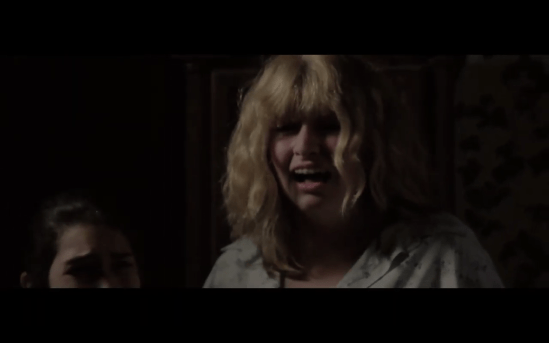
Typically, popular slasher will center mostly around the chased protagonists that naturally produces an ominous villain, examples would be Alice in “Friday the 13th,” Laurie Strobe in “Halloween,” Nancy Thompson in “A Nightmare on Elm Street, but “Rust” shares the focal responsibilities between protagonist duo of Heather and Morgan and an antagonist duo of Travis McLennan and his Stockholm syndrome sex slave, Valkyrie. Not only do we wonder about the bloody-cladded rooms of Hotel Hell with Heather and Morgan, but also see some dynamics and curiosities from their stalker. “Hot Tub Party Massacre’s” Corey Taylor and “Afflict’s” Taylor Kilgore become the besties Heather and Morgan and are staple actors in Lujan’s ensemble cache he’s collaborated extensively throughout his career. As an exposed midriff Kilgore loses out on Morgan’s weak character development that’s nothing more than an elevated whimper, Corey Taylor by default lifts up to be a quasi-strong female lead, but neither actress steps into that final girl role and are extremely overshadowed by Morlon Greenwood’s towering-might that converts to being the black-hearted killer Travis McLennan. The Jamaican born, former NFL linebacker has that “See No Evil,” Kane-like violence that bears an austere ravager who would make anybody crap their pants when going into full-throttle chase mode with machete in hand. Lindsey Cruz (“Meathook Massacre 4”), Raul Limon (“The Immortal Wars”), Isaac Rhino (“Blood Runs Thick”), Meek Ruiz, Paul Tumpson, Nycolle Buss, Lordis DePiazza, Brittany Enos, and Brittany Hoza round out the cast.

So, does “Rust” make for good silver screen slashery? One would need to snake between the rough McLennan backstory that doesn’t clearly sink in, the whimsical premise of a teen meet-up and wander through an abandoned horror theme attraction, and the hollow characters to declare that “Rust” doesn’t make the cut across the throat. Finding reasons to be concerned for characters was at a great time nil because of their bland design with nothing to strive or live for in a complete and total arc-less folly of development. Perhaps the purest form of a slasher is in Travis McLennan’s brutality which warrants some positive lighting as a more machine than man killer, wearing a fleshy mask skinned from his father, as he hoards young women for his unknown kicks, but whether the funds weren’t in the budget or an artistic preference was applied, all the kills were mostly done off-screen and implied. There were a couple of knife blows to the head and the neck areas that barely had discernible quality that subjected no veering of the eyes or garnished any dread into the full brunt of the kill blow. Lujan pens an obscured rape scene that has more oomph than the killing itself. We’ve seen box store horror films with scream attractions before, such as like “Hell Fest,” and even some enticing independent ventures, such as “Talon Falls,” both of which have filled the need for urban myth, meta-horror – horror actually happening in a horror theme park – but most of these films don’t pan out as expected and “Rust” simply falls into that latter unfortunate category.
Right on the coattails of a third film comes “Rust” onto DVD home video courtesy of Wild Eye Releasing that’s presented not rated and in a full frame 16:9 aspect ratio that’s varies in quality being two shorts combined into one. “Rust” first half suffers from an extremely low bitrate so much so that you can see pinpoint each frame. The coloring is faded beyond the brown on a Las Vegas desert and, at times, difficult to discern exactly what’s happening mise-en-scene, especially in the darker scenes as you can see in the screencaps. The second half fairs better with a higher bitrate, smoother frame transitions, and a cleaner, less muddle twitching inside the frame. The English language dual channel stereo sound mix also splits the difference, most notably with a shield and muffled dialogue track being drowned out by ambient and the Eric Dryer’s score, a score that’s possibly a highlight in “Rust’s” legacy. Again, audio regains some control over the levels, providing more efficient range and depth but still can’t overcome of the powerful score. Bonus features include an interview with Joe Lujan about the fabrication from beginning to end of “Rust,” the original Rust 1 and 2 shorts, and Wild Eye Releasing trailers. One bonus I was vying for was the Eric Dryer score, but no such luck. “Rust” might be more of tetanus hazard than a budding slasher ripe for the viewing, but director Joe Lujan has the potential if the filmmaker can chug foward gaining experience along the way and, perhaps, recap his Travis McLennan nightmare on a bigger, badder scale with a sharper machete.

“Rust” is included with Prime Video!

“Rust available on DVD”

 It's Bloggin Evil!