

From being stuck in stand still Floridian hurricane traffic to waking up in a hospital without any recollection of how she got there, Amy Barrett finds herself in a seemingly evacuated sanitarium on the verge of being hit by a category 5 hurricane. When she finally makes contact with the limited hospital staff, Amy discovers that the staff are not in the position to help, but desire to perform unnecessary surgeries. Then, she finds herself in traffic again. Then, she wakes up in hospital…again. Amy, and other patients, find themselves trapped in a nightmare loop forged by the powers of the massive hurricane. Before the storm passes over, Amy must find a way to end the corkscrew of timelines that propel her limbo hell or else she will be trapped in the hospital forever.

To the O.R. stat! From writer-director Christopher Lawrence Chapman comes “Inoperable,” the horror equivalent to Bill Murray’s exceptional dark comedy “Groundhog Day.” As Chapman’s sophomore directorial, first in the realm of horror, the director takes “Inoperable” to rebrand the quantum paradoxical plight by introducing a medical butchers with hours upon hours, days upon days, years upon years of experience with exploratory surgery and ghastly invasion procedures. Behind the wormhole of terror script with Chapman is co-writer, the b-horror screenwriter, Jeff Miller whose extensive credits include “Axe Giant: The Wrath of Paul Bunyan” and “Jolly Roger: Massacre at Cutter’s Cove.” In this go-around, Miller explores the space-time-continuum, or does he, with Amy reliving the same moment, experienced slightly differently, in an endless loop of grisliness.

Starring in “Inoperable” is the “Halloween’s” franchise third favorite star, behind Jamie Lee Curtis and Donald Pleseance, being Danielle Harris (“Halloween 4,” “Halloween 5,” and Rob Zombie’s “Halloween” remakes). Harris keeps and maintains the tension, supplementing an increasing annoying and frustrating tone with each and every reset, and does superbly in extended takes running through the hospital’s dark corridors. Amy’s center storied character really puts Harris to work on her ability to flex in sequentially illogical scenes that go in various tangents and come to a dead halt in the end, flipping the script that forces the modern day scream queen to relive some of those killer “Halloween” moments. Harris is accompanied by Katie Keene and Jeff Denton, both whom worked with Chapman previously on the clownsploitation slasher “ClownTown.” Keene and Denton’s characters are also caught up in the same situation as a Denton plays a beefy good looking cop named Ryan who brings in a witness, Keene’s JenArdsen, a dolled up blonde who while in his custody, to the hospital following a multi-vehicle pile up; the very exact incident Amy in which Amy was involved. The two fall for each other more and more with each and every restart and that pain coldly passes over when to bare witness to each other’s demise over and over again is disturbingly twisted. Rounding out the cast is Chris Hahn “Axe Giant: The Wrath of Paul Bunyan”), Cher Hubsher (“The Amityville Terror”), Michelle Marin (“Bloody 27”), Philip Schene, and Crystal Cordero.

The trio of resetters formulate a wildly speculated theory that a nearby military compound, experimenting in spatial physics, was ravaged by the hurricane that oozed out their experiments that disrupted timelines, affecting this particular hospital, and the only way to escape the madness is by displacing the same energy that was put into it; so for example, since Ryan and JenArdsen arrived together, they would have to escape together. As long as Amy doesn’t die, every trapped soul is eligible for escape. Wait, what? Like aforementioned, Amy is the centerpiece to the puzzle and the whole entire situation actually revolves around Amy, intentional or not. Even though clues try to put a monkey wrench in that notion, the story always seems to revert back to Amy much like the loop she’s caught in. That in itself is the biggest hint of all that funnels to a underwhelming ending in null and voids the rest of the story.

ITN Distribution presents “Inoperable” onto DVD and VOD. The DVD is presented in a widescreen to “preserve the aspect ratio of its original exhibition” and, yes, this was done so. Nothing too particularly to note about the image quality being a modern release, but the color palette is balanced and vivid. The English language 5.1 Dolby Digital track has some good range and clear dialogue that effective communicate all theories and explanations on why this is happen to Amy, Ryan, and JenArdsen. Extras are slim that include a cast and crew commentary and the theatrical trailer. The Zorya Films and Millman Productions’ “Inoperable” is open heart surgery gory and is unique in a deadfall environment that’s sublimely refreshing for the over saturated genre, but culminates flaccidly with a conventional finale too predictable for comfort.
Category Archives: Slashers / Survival
Evil Will Kill for a Thousand Likes! “Tragedy Girls” review!
A small mid-western town has been terrorized by a string of gruesome murders and two local high school girls, Sadie and McKayla, seek to lure the killer out to not stop his onslaught, but to be put under his machete wielding wing. The best friends use their twitter page, @TragedyGirls, to platform their grisly kills as devastating tragedies and to be supportive outreaches in order to be beloved by all and to obtain social media stardom as a facade over being iconically elusive serial killers, but when their plan to capture a mentor fails, a wedge drives between them when Sadie begins to fall for longtime friend, and video editor for their twitter page, Jordan Welch. That’s all the fuel needed to spark McKayla into a deadly paroxysm in order to get her best sociopathic friend back by her side.
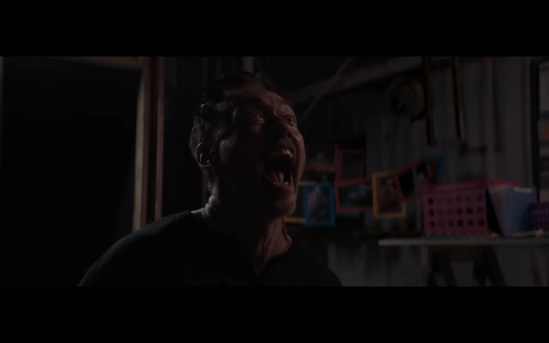
“Tragedy Girls” is the uptempo horror-comedy by writer-director Tyler MacIntyre along with fellow co-writer Chris Lee Hill, both whom previously helmed another horror-comedy entitled “Patchwork” in 2015. “Tragedy Girls” aims to put the slasher genre on it’s head by turning what should be two sweet high school girls into the sadistic hunters instead of the usual genre trope of hapless prey and incorporate the dark side of social media, using platforms, such as Twitter, to gain notoriety through exploitation of others’ very lives, but the use of social media doesn’t sticker MacIntyre’s film as tech horror. Instead, typical ditzy-dynamic adolescent drama is integrated into the gory melee Sadie and MacKayla fabricate for fandom. There’s plenty of blood and death to go around through a mix bag of slaughter with some being inspired by other horror films, channelling such classic as “Friday the 13th” and “Carrie.”
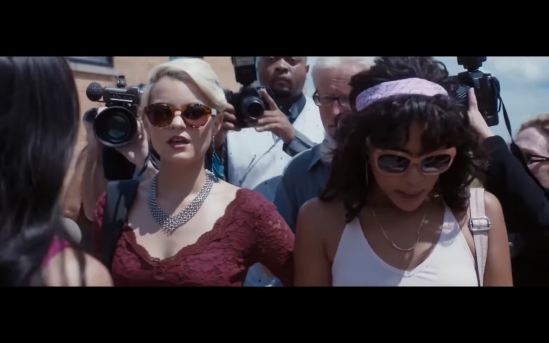
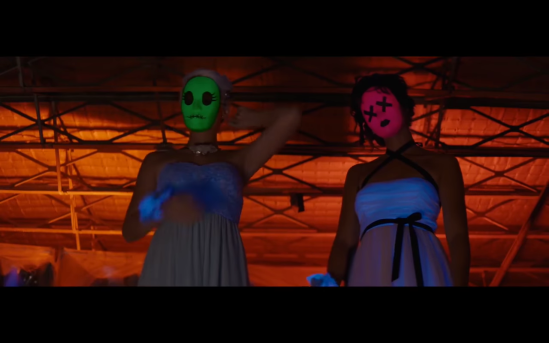
“Deadpool’s” Negasonic Teenage Warhead, Brianna Hildebrand, and Alexandra Shipp, who’s also a Marvel superhero in X-Men franchise as Storm in “X-Men: Apocalypse,” star as besties Sadie and MacKayla. Hildebrand and Shipp are doubly frightening as two sociopathic killers and equally as scary as silver screen teenage girls glued to their phones while keeping up with their good fashion sense, but their pixie cut and cheerleader personas are as embellished as their underlining dark craft to make “Tragedy Girls” over-the-top and shocking on a “Save by the Bell” level. Though the two are stone cold, homicidal maniacs, a love interest is added for Sadie. The “The Hunger Games'” Jack Quaid, son of Meg Ryan and Dennis Quaid, fills the shoes of the lovesick Jordan Welch and Quaid does a fine job being the smartest guy in the room, but still being blindly dumb to the situation unfolding around him and Sadie. Surprisingly, a number of various genre vets rear their heads in this film, starting with “The Strain’s” Kevin Durand. The 6’6” tower of pure muscle Durand embodies a Jason Voorhees like villain when masked; unmasked, he’s about as stupid as they come and Durand can do stupid very well. Part of the comedy, of this horror-comedy film, stems from an uncharacteristic role played by Craig Robinson as a very unfit, local firefighter hero, fittingly named Big Al. The “This is the End” and “Ghosted” star bores through his minor role of Big Al with very little dialogue as Robinson is well known for wit, but the comedian has one of the better scenes with a 2-on-1 fight scene with the two demented school girls. The last recognizable face being mentioned flames out as quickly as it’s flamed in from the Sci-Fi genre. Josh Hutcherson, another “The Hunger Games” star, goes James Dean as MacKayla’s emo ex-beau, Toby Mitchell. Hutcherson’s character doesn’t quite fit the “Tragedy Girl” mold that pushes the limits later on in the film and his portrayal of Toby Mitchell is awkwardly misplaced as overzealous and forgettable. Rounding out the remaining cast is Timothy V. Murphy (“The Frankenstein Theory”), Nicky Whelan (“Flight 7500”), Keith Hudson, Savannah Jayde, and Katie Stottlemire.
“Tragedy Girls” will do well as it’s a solid horror-comedy with a la carte gore. None of the characters seize the progression of the trope reversal story and with the exception of Hutcherson’s Toby Mitchell, the actors conform precisely to the animation of their character’s scribed personas. Hildebrand and Shipp are the epitome of that last statement. The pair of actresses have a real life proprietary appearance about them and to crossover those looks and meld them into Sadie and MacKayla will forever establish them as the true tragedy girls. “Tragedy Girls” isn’t just about flip-flopping the genre rear ended up; writers MacIntyre and Hill pen a film that’s also about female empowerment with two strong actresses filling the shoes of two self-sufficient badasses committed to doing what’s conventionally labeled male subversive behavior and accomplishing it on whole other level. Even if on the wrong side of the law, the tragedy girls stick together through the good and the bad to overcome various high school and beyond high school hurdles that attempt to thwart not just their friendship, but their cyberspace popularity.
Gunpowder & Sky proudly distributes “Tragedy Girls,” a film by fresh faced production companies like Its The Comeback Kid and New Artist Pictures, onto VOD now and DVD home video February 6th. Since provided with an streaming link for review, a well-rounded critique on the DVD’s technical specs, picture quality, audio tracks, and bonus features will unfortunately not be commented on, but the very film itself should entice the most casual horror film goer who usually doesn’t stray off the mainstream path. With familiar faces and plenty of bloodshed, “Tragedy Girls” holds water against competitors in a flooded genre. Don’t forget to follow them, #tragedy_girls or @tragedygirls, or else you’ll be next tragedy exhibited in their wall feed!
Another Door, Another Evil! “Beyond the Seventh Door” review!

Recently released from prison, ex-con Boris reaches out to his former lover, Wendy, to discuss the status of their relationship after her cold feet episode on a robbery job where she drives away the getaway car, leaving him red handed when the cops arrive. Wendy wants more than anything to live a normal, honest life and Boris aims to please her wishes, but needs to pull of one big job to set their future. Fortunately for him, Wendy happens to be the plaything of a wealthy paraplegic who owns a lustrous castle. Boris convinces Wendy to recon the inside, to find where the treasure might lay within the belly of the castle walls, and when the pair of thieves manage to break into the castle’s fortified basement, escaping is inevitable when a deadly game unravels. Trapped inside a chamber of terror, Boris and Wendy must go through a series of enigmatic riddles and deadly traps to move forward toward what they’ve broken into to steal, but when offered a chance to leave the game with their lives intact, will an acceptance to live be decided upon or will Boris and Wendy gamble for greed?

InterVision Picture Corp., has done it again with another stellar resurrection from the VHS video graveyard with the release and distribution of the Canadian gem “Beyond the Seventh Door.” The debut of B.D. Benedikt’s written and directed horror doesn’t display much of the elements associated with the horror genre with the exception of an acute dispersion of thrills and mystery; instead, Benedikt’s film breeds a mutt that commingles fear invoking atmospherics with the intensity of an unflinching, yet undetectable, moral essence that amusingly reestablishes the very Canadian stereotype of being too nice for the North American nation’s own good. The clearly expressed message of greed goes without saying in a plot that involves incurable thieves making life and death choices over materialistic riches despite the consequences that follow if to pursuing the latter. Another theme exposed is that working together will increase your chances to overcomes obstacles as Boris and Wendy mesh their strength and their smarts to solve puzzles and to escape traps before them and on the other end of the spectrum, going at the situation alone doesn’t work out for either one of them. The prominent themes intertwine effortlessly into a modest story that doesn’t become undercut by today’s inherent plot twists or fail to meet captivating interests as the themes are timeless and current as greed never goes out of style proven by the recent Oscar nominations for Ridley Scott’s drama “All the Money in the World.”

The cast quartet requires not one more soul to showpiece this Canadian cult classic. Leading the quaint pack is the Yugoslavian stud Lazar Rockwood and the rumors are true, Rockwood does look like the long time on screen villain Billy Drago, but Rockwood, as Boris, is no hard nose bad guy but along the lines of an anti-hero with his crooked conscious overtop a softer, tender heart for his past life lover Wendy. Bonnie Beck tackles Wendy as a woman pulled by two desires: her feelings for Boris and a normal life without lawlessness. Her more memorable scene consists of her stripping her red, thigh high skirt, exposing the lacy, black garter underneath, and comically trying to plug water spewing holes in order to not drown. Rockwood and Beck’s on screen chemistry doesn’t jive and, to be overly honest, their bond is substantially weak, but to embody and embrace a characterized scorn and torn twosome, the pair share a set ablaze with passion for accomplishment that oddly resembles Richard Chamberlain’s Allan Quartermain’s adventures sans the quirky comedic charm. Rockwood and Beck completely make up about 90 percent of the screen time as Gary Freedman, in his sole credit, dons the mysterious Castle owner and a local Canadian celebrity, a street performer, named Ben Kerr who only had to sit with his eyes open and act a corpse.

Modest as it was, “Beyond the Seventh Door’s” independent production couldn’t rival the end resulting magnitude of which the construction of the trap rooms and the characterization of the score would suggest a bigger wallet project, transforming that aforementioned simple story into a big ticket item. Behind the financial curtain is the responsible parties, the Herceg brothers Frank, Steve, and Tony and along with a fourth producer, Lubomir J. Novotny, Bozidar D. Benedikt gained the trust to pull off a no-budget thriller into a wild brain, catacomb horror that pre-dates the escape room element of “Cube” and Jigsaw’s lethally virtuous games. Now, I wouldn’t say “Beyond the Seventh Door” pioneered the genre, but merely had a minor influenced and sometimes that’s all it takes for inspiration.

Canada’s ambitious exploitation film “Beyond the Seventh Door” is now out for the first time every on DVD courtesy of InterVision Picture Corp., the sui generis distributor of rare independent genre films. Presented in a full screen 1.33:1 aspect ratio, the shot-on-video image quality retains an above VHS level quality with a clearer picture and refined details. BBlotchy moments are still prevalent, especially in long shots of Boris leaving the prison and walks along a cold path to the waterfront, but doesn’t kill the reflective moment. The audio 2.0 mono track has great clarity, range, and depth that showcases some of Lazar’s greatest lines of his hilariously read dialogue, such as “Screw you! You hear me, screw you!” The synthesized soundtrack emanates balanced LFE and range. There’s minor, but inconsequential, hissing during dialogued lines. Bonus features include audio commentary with director B.D. Benedikt, star Lazar Rockwood, and moderated by Paul Corupe of Canuxploitation.com. Also included are interviews with B.D. Benedikt, Lazar Rockwood, and Paul Corupe in a “Beyond Beyond the Seventh Door” segment and a look at Ben Kerr, a Toronto eccentric, in “The King of Cayenne” that delves into Kerr’s street performing life, his run for political office, and his overall love for a cayenne pepper cocktail. “Beyond the Seventh Door” is an anomalous, door-after-door misadventure with eccentric performances and an exceptional plot twist that only B.D. Benedikt could kook up and only Lazar Rockwood could pull off.

Own a copy of “Beyond the Seventh Door” today!

Evil Climbs the Cut-Throat Corporate Ladder! “Mayhem” review!

In a world under sieged from a highly contagious virus, known as the ID-7 virus, that blocks the uninhibited and explosive impulses, workaholic Derek Choe attempts to make a footprint at his ruthless, white collar firm, but lands on the receiving end of a frame job that results in a pink slip and being escorted out of the building. Before being able to walk through the exit by security, an ID-7 invasion as quarantined the office and symptoms are seeping to the surface. All hell breaks loose amongst co-workers, exacerbating the already highly caffeinated, extremely strung out, intensely coked up, and amoral aggressive behaviors of a volatile workplace environment, and an infected Choe aims to reach the top floor to violently express to the firm’s board on why they should reconsider his termination, but a drug-fueled, and also infected, boss strives to make that endeavor challenging with the assistance of his lower tiered, corporate suits.
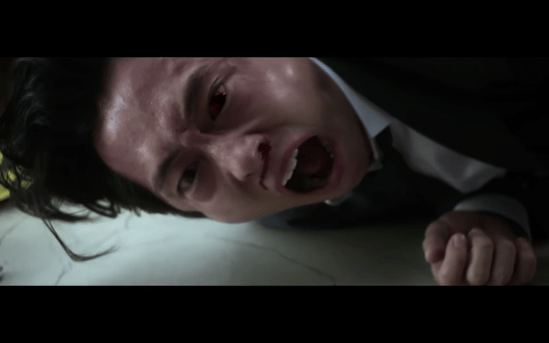
“Mayhem” is a HR nightmare! The Joy Lynch 2017 directed action-horror film is “The Firm” meets “The Raid: Redemption!” Luckily for the viewers, “Mayhem” is a hardcore insight into unlocking all of your deepest, darkest inhibitions to the tun of explicitly telling off your boss with every four letter expletive in the book, giving your rotten colleague a firm piece of your mind, or just knocking everyone’s teeth down their smug throat. Yeah, it’s that kind of movie. Lynch (Wrong Turn 2: Dead End) runs with the first time feature film from screenwriter, Matias Caruso, who designs a virus, called the ID-7, that removes or ceases to function what defines us as human, from compassion to sympathy, in order to frankenstein a demented rendition of Donkey Kong and Caruso’s characters basically all have singular mode – asshole – but that subversive level stems from an infection induced state and the characters, deep down, maintain a slither of their original selves in an extremely dark comedic sense.
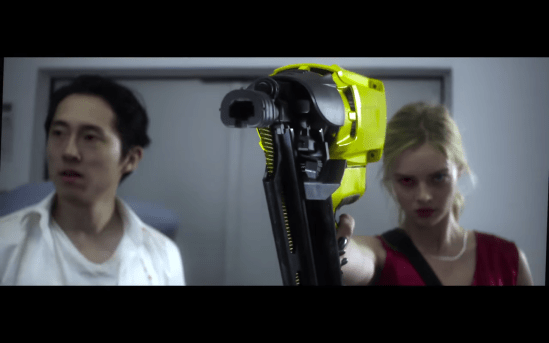
On the coattails of his character’s brutal demise on AMC’s “The Walking Dead,” Steven Yeun remains in an dimension plagued by a different kind of viral infection. Instead of blowing the brains out of walkers, Yeun brilliantly and entertainingly fills the ambitious workaholic shoes of account manager Derek Choe who literally battles his way to the top after being canned by his unscrupulous consulting firm and when the ID-7 overwhelms each and every employee. Choe is a far cry from Glenn on “The Walking Dead,” a pure hearted character with a good moral compass. Yeun’s character’s moral compass is skewed without doubt and double skewed with introduced by the virus. Choe forms an unlikely pact with a desperately disgruntled borrower Melanie Cross fighting against the firm, and the firm’s bank, looming foreclosure and the sassy, blond ass kicker, embraced by “The Babysitter’s” Samara Weaving, can chew gum and kick tail all at the same time. The pair are pitted against the some of the office’s most ruthless suits, such as a sociopathic HR enforcer known as The Reaper (played by “The Walking Dead” vet in Dallas Roberts), a manipulative snake charmer Cara Powell (Caroline Chikezie of “Æon Flux”) and at the top is none of than the big boss played by “Hellraiser: Revelations'” Steven Brand. Not only does “Mayhem” have colorful, well-scribed anchoring characters, but the supporting parts are just as well-quick-e-quipped too with Kerry Fox, Claire Dellamar, André Eriksen, and Mark Frost (“Faust”).

“Mayhem” relishes in the ferocity of that of a Mark Neveldine “Crank” franchise, but lacks a certain coherency untuned to seamlessly sustain the story to the end. Moments of purely poor editing don’t convey the full message intended, leaving much desired when considering the hero and heroine’s plight through the firm’s ruthless hierarchy to the top. These moments don’t make or break the story and are minuscule in portion size but are large enough to thwart going unnoticed. Another annoyance of how the story is told is the off screen violence. With a feature entitled “Mayhem,” by very definition states, “violent or damage disorder, chaos,” one would imagine that any and all violence would be in full display, showcased proudly and exhibited without ambivalence, and the beginning starts off energetic enough with an explosive scene of a conference room brawl involving the attendees in a all out melee, a half naked couple sexing right on the conference table, and ending the scene with a murderous gashing of one’s carotid artery. Narrating why these berserkers are killing and humping each other is Steven Yeun’s Derek Choe, setting up the ID-7 as the uninhibited virus. The violence that pursues goes into a hot or cold state where the latter involves off-screen violence, especially between Chikezie and Clarie Dellamar’s characters in a fight to the death between boss and assistant, but in a heated exchanges that had more girth in the dialogue, their actual bout screens over to Choe and Cross’ blank stare expressions and the determination of who bests who goes into a big question mark status.
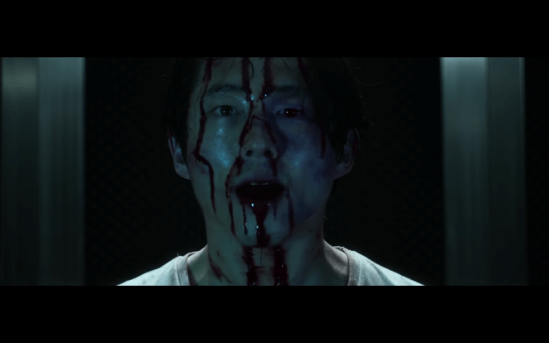
RLJ Entertainment releases “Mayhem” onto various formats include a not rated DVD, Blu-ray, and streaming platforms. I am unable to comment or critique on the audio and video qualities of the film as I was provided a streaming link that didn’t include bonus material; instead, I’ll comment on how Lynch and the rest of filmmakers did a remarkable job constructing an ambiguous building structure along with the help of the two Stateside based production companies Royal Viking Entertainment and Circle of Confusion. Though the film was shot in Bulgaria, the location could have been right in downtown of your nearest city and that fairs in “Mayhem’s” success to establish anywhere as a victim to the virus or a workplace go array in the world. The next time you want to take a heavy duty Swingling stapler to you’re supervisor’s noggin for assigning to many TPS reports to you, check out “Mayhem” to instill that visceral courage and audacity to do so all the while being entertained by utter, unadulterated violence and violent thoughts and actions that usually spur underneath the breath of a common office environment.
The Myth. The Legend. The Evil…. “Leatherface” review!

Texas 1955 – the pride of the Sawyer family was not their tattered farm, but a bloodline taste for something else – callous murder and a penchant for human flesh. Verna Sawyer sought to instill that pride into her children, especially her youngest, Jed, but when Hal Hartman, hard nose local Sheriff, learns that his daughter becomes victim of the Sawyer’s suspect nefarious carnage, he executes the law to his advantage, deeming the Sawyer house unfit for children and removes Jed from his labeled degenerate mother Verna. Ten years later, a group of teenage patients escape a mental hospital, kidnap a young nurse, and reek bloody havoc in their voyage to Mexico in an attempt to elude the very same lawman who put them away, but this time, Hartman isn’t adhering to the law, straying off his moral compass to pursue a vengeance mission against unprincipled youth that’s personally driven by Jed and the Sawyer family. Once the embattled Hartman catches up with his prey, a series of gruesome events lead to the creation and the construction of one of the most notorious killers Texas will ever see.

I love a good origin story. There’s something to be said about understanding the commencement of character, to be in the shoes of a long running icon, and to be able to sympathize with their story no matter how atrocious. Directors Alexandre Bustillo and Julien Maury’s 2017 “Leatherface” does just that with the film’s own origin enlightenment on how the chainsaw wielding, human skin mask wearing psychopath came to fruition inside a home of unspeakable brutality and influenced externally by a unforgiving society. From a script penned by Seth M. Sherwood, “Leatherface,” serving as a direct prequel to Tobe Hooper’s “The Texas Chain Saw Massacre,” briefly touches upon the preteen years to setup the catalytic road trip from hell, birthing a monster in a time of adolescence and if part of a legacy spanning over forty decades inspired by Ed Gein, the real life human skin wearing and notorious serial killer, then you damn well know “Leatherface” has to be genetically predisposed to be ultra-violent drenched in blood splatter. The French filmmaking duo, who’ve helmed 2007’s “Inside” and had directed the “Xylophone” segment in “The ABCs of Death 2,” nail the dark and gritty tone that not only breathes a gassy and exhaust fumed life into a massive flesh-ripping chainsaw, but also inflicts heartlessness across the story board into a heartfelt homage to the characters and to the story fathered by Kim Henkel and the late Tobe Hooper, both of whom were attached as executive producers.

Over the years, many actors have held the mammoth power-drive cutting tool in their hand that’s ready to chip away at flesh such as Andrew Bryniarski (“The Texas Chainsaw Massacre” 2003 remake), Bill Johnson (“The Texas Chainsaw Massacre 2”) and, most famously, Gunnar Hansen, the original Leatherface. However, I’m not going to divulge who the pubescent Leatherface is in the story because the film plays out as a who out of the group of degenerate teens is the son of Verna Sawyer, even though you can easily obtain the information in a simple click and search on Google. Instead, Sam Strike, James Bloor, and Sam Coleman portray the three escapees who are accompanied by an equally insane sociopath in Jessica Madsen and an eagerly novice kidnapped nurse by Vanessa Grasse. Amongst a sea of English actors are a pair of vets to shepherd the young cast and be the embattled bookends to the dawn of an icon. Lili Taylor (“The Haunting”) and Stephen Dorff (“Blade”) face off as Leatherface’s mother, Verna Sawyer, who butts horns with a longstanding sheriff, Hal Hartman, with a steadfast vendetta against the Sawyer family. Christopher Adamson (“Razor Blade Smile”), Nathan Cooper (“Day of the Dead: Bloodline”), and Finn Jones (“Wrong Turn 5: Bloodlines”) co-star.

Usually with a pair of directors, two different styles spawn to an end result. With Bustillo and Maury, styles merge into a seamless effort of elegant wonders. Each shot emerges a purpose to the story whether it’s painting an image of the Sawyer’s death house to pulling a one-eighty with characters, the filmmakers ability to combine each element into a single story, that has such a close knit cult following, and still manage to cinematically pull off the atmosphere, the grit, and the gory carnage of a Texas Chain Saw Massacre film is impressive. Cinematographer Antoine Sainer, whose worked previously with the directing duo on the “The ABCs of Death 2’s” segment “X,” has the ever so poised eye that’s able to well-round and solidify Leatherface’s terror tenor, particular exampled in a foot chase scene through a moonlit forest, smoke bellowing out of a growling chainsaw, and a tattered young girl bawling, screaming, and fleeing for her life from a deranged masked killer whose huffing, snarling, and growling during the pursuit.

Lionsgate Home Entertainment presents the Millennium Films produced “Leatherface” onto Blu-ray + Ultra-violet combo disc, a MPEG-4 AVC encoded disc with a 1080p resolution and presented in a widescreen, 2.38:1, aspect ratio that displays the Bulgaria landscape in a yellowish-brown, Texas-like backdrop. Details are noticeably fine that exquisitely reveal the death and destruction of the Sawyers and those who unfortunately surround the family. The English DTS-HD Master Audio 5.1 track evenly distributes and consistently a range of engrossing fidelity, ambient, and dialogue layers. Bonus material includes a play feature with an alternate ending that’s less superior in contrast to the final product, deleted scenes, and a behind-the-scenes making of that includes brief interviews with directors Alexandre Bustillo and Julien Maury, actors Sam Strike, Stephen Dorff, Lili Taylor, and others, and goes behind the scenes in creating the tone and style of “The Texas Chain Saw Massacre” while implementing their own vision. “Leatherface” forces the unsavory and unpleasant down the throats of TCM fans, jamming an attempt to exposition a futile chance to a destined maniac of cannibalistic proportions and manages to mix up the Tobe Hooper’s weathered franchise with a barbaric bruiser of a tale.

“Leatherface” on Blu-ray! Buy it here, today!

 It's Bloggin Evil!