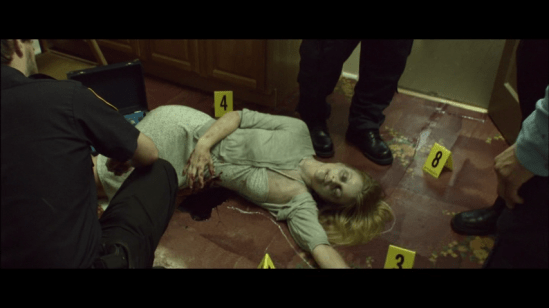
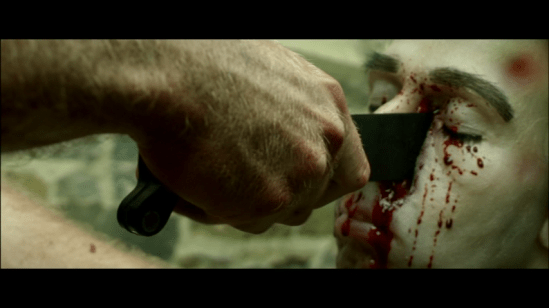
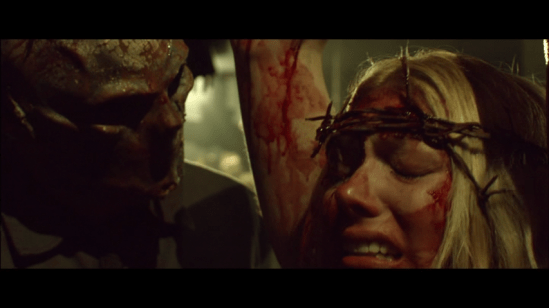
A small and sleepy town has a haunting and grisly past. Old man Robert Bowery, stricken with a degenerative eye disease, once believed his failing eyesight would return if he gouged and digested the eyes of young children. Younger the eyes, the better. Thought to be long dead, Robert Bowery’s legacy of sadistic evil has left a dreadful impact on the town, so much so that the young townie and Sheriff’s daughter, Helen Connolly, still feels the long lasting fright of the horrific stories of Bowery’s hide-and-seek hunt of his adolescent victims at his dilapidated campground compound which he knew every inch of it’s isolated wooded location. When Helen is persuaded by her father to babysit Lucas, a little boy whose family is new in town, she begrudgingly accepts to take care of the boy in Robert Bowery’s former home, but Lucas goes missing during the middle of the night. Helen tracks him down to Bowery’s rundown hunting ground where the child eater lies in wait to sink his razor sharp teeth into children’s eyes and burst their anatomical fluids!

Based upon the short film of the same title, “Child Eater” is director Erlingur Thoroddsen’s unholy birth of a slasher paragon. The subtle, patient approach Thoroddsen establishes stretches an unlimited amount of a brooding atmosphere that compliments the gangly stature and unpigmented color of the demon-looking Robert Bowery. With Bowery’s round, tinted spectacles, thin whipping cane, and bald top, the fragile elderly have a new heroic face when combating youthful brats. Thoroddsen, who also penned the script, purposefully leaves Bowery in an ambiguous light, never really obtaining a good solid shot of the villain’s icy and bleak veneer until near the very end, that mystifies a character with such a monolithic and infamous lore surrounding him. Every character in town knows one version or another the story of Robert Bowery and his sick obsession of regenerative eye method, but not one person can put truth to the plague of his affliction and that makes the town stain that more tough to remove.

Cait Bliss returns as Helen Connolly from the 2012 short as the conflicted heroine with change of heart toward her perspective on children, especially when feels obligated in her duty to serve and protect a snatched Lucas. Bliss feels a little too old for the role that involves her character living with her Sheriff father, but Helen might be part of the millennial group where you live with your folks until your thirty or older; yet Bliss teeters on the fine line of being a final girl, similar to Heather Lagenkamp’s Nancy in “A Nightmare on Elm Street,” turning her entitled life of aimless wandering into one possibly worth living and fighting for once the life changing ordeal is over. “You Can’t Kill Stephen King’s” Jason Martin provides the elephant ears, bald head, and lanky features that spectacularly builds Robert Bowery and Martin also provides a persona for a character whose always in the shadows, intoxicating the scene when visible with a nefariously bowie knife grin under a pair of Nazi-era mad scientist eyewear. Melinda Chilton, Brandon Smalls, Colin Critchley, Dave Klasko, James Wilcox, Andrew Kaempfer, and Kara Durrett make up the remaining cast in “Child Eater,” a unforgettable dooming blood junket.

Thoroddsen masterfully crafts “Child Eater’s” unsettling composure with unrivaled pacing, well edited jump scares, and an unchained animalistic killer crutched on sense other than his sight and who wouldn’t love a wretch plucking out peepers from eye sockets or ripping out jugulars with a single forceful bite? Robert Bowery could be a villainous idol and deservingly needs to be just that, but the vast weight of the Bowery mythos was attempted to be explained in too little of narrative run time, killing much of the hype that engulf’s his presence. The nearly unexplained death defiance follows into the trope trap similar to that of Jason Voorhees or Michael Myers, but the background provided on Bowery is unique, stemming from a vague portion of German and Polish folklore in which the latter may explain the child eater’s power, donned symbolically and, perhaps, even physically given his ability to be in the right place at the right time almost in simultaneous moments, that has been granted by the Devil.

Technically, I adore much of Thoroddsen’s slasheresque style blended with a calming patient that’s nearly unseen in the slasher genre. The only technical aspect I was not fond of was the fish eye lens used mainly in the beginning that spun a sickening wave of nausea through my corneas, the same sensation felt by viewers watching the jerky motions of a handheld found footage film. Still, Thoroddsen’s use of space, lighting, and special effects by Fiona Tyson states more than just another indie production and mesh those attributes with a superbly captivating and haunting string score by Einar Sv. Tryggvason and “Child Eater” strives further from being just another horrendously dubbed horror shunned aside for it’s nothing new attitude.

Black Stork Productions in association with Wheelhouse Creative and Blue Fox Entertainment deliver 82 minutes of toe curling fear in 2016’s “Child Eater.” MVDVisual distributes the Elingur Thoroddsen film onto a region free, not rated DVD that’s presented with an Anamoprhic Widescreen 1.85:1 presentation that’s definitely sharp even during the film’s mostly nighttime scenes. There are two audio options available: a Dolby Digital Surround 5.1 and a stereo 2.0. The 5.1 draws back the dialogue leaving more room for Tryggvason’s excellent score. Bonus features include a theatrical trailer, deleted scenes, and an audio commentary with director Erlingur Thoroddsen and stars Cait Bliss and Jason Martin. The deleted scenes leave good insight, explaining some scenes that might need more detailed clarification, and round out a rough edges. “Child Eater” eats into being an well played atmospheric horror on a budget with a rememberable child predator who can go eye-to-eye with foundational renaissance slashers!
Category Archives: Slashers / Survival
A Double Bill of Evil! “Murderlust” and “Project Nightmare” review!

During Sunday’s services, a calm and confident Steve Belmont heads the Christian Sunday school youth class and seeks to be the permanent director of the Church’s suicide crisis unit that’s coming to the end of the planning stage. On Sunday’s, Steve performs as the model citizen whose ready to serve and give back to his community. During the rest of the week, the horse race track security guard can barely sustain societal worth, arriving late for work, constantly drunk, and has disdain for people being a speed bump in his path to greatness. All Steve Belmont has in life is the potential director’s job and his thirst, his unquenchable thirst for strangling women and dumping their bodies in the excessive heat of the Mojave desert. The local newspapers label his killings that of at the hands of the “Mojave Murderer” and his lust for killing call girls and young women runs a thin line alongside his Sunday best and when he begins to trust a Church regular, Steve’s mistakes begin to catch up with him.

“Murderlust” is the first feature on the Intervision Picture Corp’s double bill DVD release from director Donald Jones and writer James Lane. The 1985 suspenseful horror-thriller comes to DVD for the very first time and doesn’t just boldly display a story of another run of the mill serial killer but does so with remarkable performances and a body of work that’s well crafted. Lane pens the center character focus on Steve Belmont and his delusion of power, being an overwrought sociopath with a belief he’s better than everyone else, and Belmont’s brazen lures to secure helpless victims is nothing short of a con artist’s trait. The ability of convincingly seducing the congregation to his benefit provides him pseudo mystical powers that pull the blinds over their God fearing eyes while he continues to slack through a meager life and holds tightly his reign of terror near the Mojave. Basically, in Belmont’s mind, he is God.

Eli Rich plays Steve Belmont, who can only be described as a twisted blend between Michael Beihn and Nick Offerman, and Rich canisters Belmont’s psychopathic tendencies in an terrifying performance of exact realism. Not many films can pull off the on and off switch of a serial killer, even Patrick Bateman in “American Psycho” was sensationalized, but the relatively small time actor produced a manufactured fearful reaction. Rich splits Belmont into two personalities while still managing to be contain a menacing aurora to feed audiences with dread, fear, and suspense and while Rich might be doing more than just one public service for his community by picking up and strangling local street walkers, Belmont never transitions into that role of the likable anti-hero as he manages to forthrightly ostracize himself from friends and family. As Steve’s square statured and responsible cousin Neil, Dennis Gannon epitomizes the upstanding citizen character, but maintains a soft spot for his unscrupulous next door neighbor cousin. Rochelle Taylor’s role is something of a love interest for Steve, who can’t bring himself to kill her even when the opportunity is present, but the one film and done actress Taylor can’t bring “Murderlust” to the promise land with an overzealous portrayal of an eager beaver, love struck Church girl that doesn’t fit the bill of Belmont’s world.

After a couple of quick Mojave Murderer victims, one including the scene illustrated for the DVD’s front cover with a topless and unchaste Ashley St. Jon, Steve, along with the flow of the story, banks into a suppressive funk. The narrative’s pace slows when Steve attempts to organize his life around his murderess hobby, turning the suspenseful thriller into a drama segment that is more or less of a laundry list on how to obtain rent money for an aggressive landlord, until the demand to hunt tugs heavily at his pant leg and he can no longer ignore the urge. “Murderlust”, despite the captivating title, is nearly a bloodless horror thriller. Steve uses his signature method of strangulation, leaving smartly no blood trail, and only at the finale does blood spill when Steve deviates from his unsympathetic hunt, kill, and dump program.

Woodland campers and best buds Gus and Jon wake up to discover their gear has been shredded and dispersed. They’re soon pursued by a frightening force of unknown origins. Lost and hungry, the two friends stumble upon a mountain cabin where cabin owner Marci shelters them for a night. Rested and resupplied, but haunted by their dreams, the two continue on foot in search of a town; instead, they become split up and Gus finds himself in the bizarre belly of a government facility that’s conducting an experiment and root of Gus and Jon’s predicament. Gus must confront the inner workings of his mind and take back control of his thoughts or else all that he knows, his friendship with Jon, and all that he desires, his passion for Marci, will soon be lost to the unchecked government secret known only as Touchtone.

The second film on the double feature, “Project Nightmare,” starkly contrasts in genre with “Murderlust.” “Project Nightmare,” otherwise known as “Touchtone,” is a science fiction thriller piggy backing as a bonus feature and the 1979 conduit for confusion showcases how scarily surrealistic director Donald Jones can achieve. An odd film that materializes shortly after Gus and Jon’s plight begins and doesn’t let up the enigmatic ambiance as the audience will surge deeply into the rabbit whole. Even though told linearly, “Project Nightmare” feels, in fact, like a nightmare, peppered with sporadic scenes of uncomfortable imagery and repetitive ambient noises and soundtrack that jar the senses. Jones’ direction and style denotes an appeal of black and white scenes, but, in color, the film works better to give an ominous a stimulating visual and without that color, the story just wouldn’t work.

Charles Miller and Seth Foster star as the baffled and lost campers Gus and Jon. They’re joined by Elly Koslo, as Marcie, and Harry Melching, as Carl the government scientist, who provide indifferent character roles or just products of the imagination to support the dreamlike atmosphere. As a whole, the actors’ dynamic was obsoletely rigged but in an unsettling Lynchian fashion causing your eye balls to stay with the scenes. “Project Nightmare’s” experience will make you feel you’re watching a film much older than produced with the costumes, the language, and the wood paneled elevator and granted that Jones’ isn’t big budget, but the director was able to deliver with the minuscule budget available to fruition a sci-fi odyssey.

Intervision Picture Corp has a snazzy, two-headed snake in “Murderlust” and “Project Nightmare” presented in full frame 1.33:1 aspect ratio with a single channel Dolby Digital mono track. The original prints looks great with “Murderlust” slightly heftier in the cyan department during it’s 98 minute runtime. The single channel had better luck with the 74 minute runtime in “Project Nightmare and “Murderlust” had moments of softness where dialogue became a strength in exercising one’s hearing. Both issues listed didn’t hinder the final product; in fact, I’m quite pleased with the end result on both features. “Project Nightmare” has a natural presence that’s appeasing and “Murderlust” blankets itself warmly in, well, the associated Mojave desert. The bonus content on the Intervision release include two audio commentaries with writer-producer James Lane. The “Project Nightmare” commentary has partial audio. In conclusion, “Murderlust” might not be this tour de force of bloodletting hookers. The sheer realistic characteristics of a serial killer among us are more alarmingly exploited and continue the terrifying ordeal with “Project Nightmare,” a sci-fi sensory conundrum overloaded with spastic psychological terror from the Golden Age of film.
Murderlust
Welcome to the Family. Resident Evil 7: Biohazard Review
I want you all to try to go back to 1996. You just got your Playstation and you picked up the newest game called Resident Evil. You know nothing about it and when you start playing you have a wave of emotions hit you. You feel fear, excitement, and anxiety; but yet you keep playing. You were just introduced to the world of Survival Horror. Now it’s 2017 and we are now into seventh main installment of the Resident Evil franchise and sort of a moment of truth for Capcom. Last few years have been rough for Resident Evil so lets see how the latest installment stands.
Resident Evil 7: Biohazard is a survival horror video game developed and published by Capcom. It is the seventh main installment in the Resident Evil series and was released on the Playstation 4, Xbox One, and PC.

The game takes place in the fictional town of Dulvey, Louisiana. You play as Ethan Winters who goes searching for his wife 3 years after her disappearance. The only information you have of her location is at the Baker estate, this is where your nightmare begins.
There is no denying that the RE engine is amazing. Resident Evil 7 passes with flying colors when it comes to visuals, the game is absolutely gorgeous. Realistic graphics with so much attention to detail really makes the atmosphere. Paired up with its excellent sound design which really puts you on edge, hearing random foot steps and loud bangs some where in the house can quickly make you stop what you’re doing and check behind you. Unlike older Resident Evil games, there really isn’t much background music. The only time i’ll hear music is either in the save rooms or during cut scenes, which is fine. No music really does build the tension and makes you listen to your environment.

The most controversial aspect of the game is its change to game play. Resident Evil 7 now puts the player in first person view, which this isn’t the first time they’ve experimented with this. Resident Evil: Survivor being the first one that was in first person, so I was quite interested when they said they were trying it again. As a big Resident Evil fan I can tell the skeptical fans that the first person view works. Resident Evil now feels even more immersive with it. The game still has its slow and sluggish movement, puzzle solving, save rooms , and combat just like the previous titles and the first person view fits perfectly. I haven’t played the game in VR because I’m broke but I have heard that game is even better with it, so now I guess I’ll have start saving up for one.

I feel I have to talk more about combat since I still see people complain how the game is like other non combat horror games, like Amnesia or Outlast. The combat feels just like an older Resident Evil, except Resident Evil 5 and 6. Thank god Capcom abandon the combat from the previous two and went right back to how Resident Evil 1 through 3 combat worked. Ammo and healing items are extremely scarce and you must manage your inventory to survive in certain situations. Enemies will move unpredictably and you must control your shots and keep your distance if you want to take down your foe. When it comes to difficulty, the game on normal is pretty easy, some parts can be a little challenging but if you’re careful and know where to go, then the game is a breeze.
Now Resident Evil 7 isn’t a long game. It took me about 7 to 8 hours to beat on normal difficulty my first time. It can easily be finished faster when you know where to go and what to do, There have been people who finished it in under 2 hours. But if you’re like me and like to explore then it will take you a while to finish. The story is where this game made me fall in love with it. This is by far my favorite Resident Evil story. The team they have behind this game is solid, the director behind the Revelation games is directing it and the writer behind the F.E.A.R 2 expansions made this a memorable experience and I hope Capcom keeps this team for future installments. Everything about the story is great, every character was interesting, and every location was awesome. The story to Resident Evil 7 is definitely more competent compared to the previous games.
As much as I love Resident Evil 7, I do have some minor gripes with the game. First one isn’t a big deal but I was a bit disappointed. Resident Evil has a tradition, when a player presses start on the main menu, they will hear a loud, deep voice reading the title of the game. Example:
Like I said this isn’t a big deal or a turn off for me but I was a bit bummed they broke tradition. Another gripe I had was the lack of variety with enemies. Before you always fought zombies, mutant dogs, and big hulking monsters. But now the only enemy you fight besides the Baker family are the ”Molded” which look very similar to Resident Evil 4 ”Regeneradors”. Yes these enemies are creepy and hard to take down but after a while you just get tired of fighting them and want something else. Hopefully in Resident Evil 8 we get a bigger cast of monsters.

In conclusion, Resident Evil 7: Biohazard is a great game. I’m so happy that Capcom put the brakes on the franchise and went back to how it originally was. Unlike other companies that have completely abandon their horror franchises. I’m glad that I stuck with Capcom all these years and going through many disappointments to finally see my favorite horror series come back on top. Resident Evil veterans would love this and for new people I highly recommend it. It is a great starting point for newcomers to get invested into world of survival horror.
My final score for Resident Evil 7: Biohazard is a 9/10
Dead Parents Create Good and Evil Children. “The Orphan Killer” review!

Audrey Miller is your borderline, but overall good, Catholic woman, but the Saint Michael’s Orphanage dance teacher withholds a dark secret from her past. Audrey, herself, is an orphan along with her estranged brother, Marcus. At the age of 6-years old, Marcus took the brutal death of their parents the hardest, transforming a young innocent boy into an emotionless and destructive shell of his former self and while they attended the orphanage where Audrey currently teaches, Marcus suffered at the hands of wrathful Nuns hellbent on forcing Marcus to repent for the sins he’s committed. Years have gone by and Marcus, donning the Nuns’ gifted mask to frighten other children away from him, has been confined to a neglected psych ward, but, now, Marcus has found an escape and seeks to hunt down his beloved sister, trapping her inside Saint Michael’s, to relay a message that blood never abandons blood unless it’s fatally punctured with a blade.

Matt Farnsworth’s 2011 “The Orphan Killer” is a cold-hearted, slaugtherfest, aiming to reap the Catholic church of sinners by committing the ultimate sin. Serial killer, Marcus Miller, becomes this generation’s misunderstood maniac, being the right hand of God and smiting blasphemous individuals in a one-night stint of blood drenched dirty work. Being the sophomore feature from writer-director Farnsworth, there’s plenty to be impressed with here from the setting up victim characters and the killing-ground stage to quickly canonizing Marcus after learning the atrocities his victims; Marcus blurs into the realm of anti-hero in a twisted sense of the slasher genre with religious undertones – such as Audrey wearing a barbed wire crown of thorns. He’s very familiar to that of iconic genre staples such as Jason Voorhees or Michael Myers, yet Marcus Miller’s unique origins background and murderous methodology doesn’t share with the already established grisliness. If Farnsworth is willing, this serial killer could be expanded upon with such a rich backstory.

Story wise, there are familiarities toward that of Michael Myers’ background with the bloodlines. Instead of Laurie Strobe being related to her coupled murderer, Audrey, played by stunning beauty Diane Foster, has, unbeknownst to her good fortune, to her still breathing psychopathic brother, Marcus, portrayed by David Backus. Both Foster and Backus have previously worked together on another Matt Farnsworth written-directed feature, his breakout indie film, “Iowa” in 2005 that also starred Rosanna Arquette {David Cronenberg’s “Crash”) and Muse Watson (“From Dusk till Dawn 2: Texas Blood Money”) and have great cat-and-mouse chemistry through love-and-hate sibling rivalry. Farnsworth also co-stars his own flick as Audrey’s cop boyfriend who becomes mixed up in the mess when Audrey doesn’t come home next morning. Unlike Audrey and Marcus, Officer Mike Hunt – yes, Mike Hunt – lacks substance and is portrayed a bit of a wild card when Audrey goes into dire stress. The cast rounds out with Karen Young, James McCaffrey, Charlotte Maier, Spencer List, Dana DeVestern, and John Savage.

The realistic, sometimes over the top, practical effects make the scene in a welcoming glorified shower of gore splatter. Marcus Miller’s killer tactics vary from victim-to-victim, whereas some slashers maintain one particular kill setting, making “The Orphan Killer” eye-catching and extremely engaging. The unbelievable production value for an offbeat slasher that’s so profane to religion temples and other holy aspect shouldn’t go unnoticed and I’m not just speaking highly solely of the special effects. The structural bones of a cathedral church setting and the amount of extras used in well choreographed dance recital and Miller kids’ flashback scenes show the committed financial backing put to work in Farnsworth’s film. Farnsworth edits his own work that’s slightly erratic at times, but overall successful with the action that’s involved and the displaying the severity of splicing together great practical kill scenes. I’d say his style is certainly earthy and sometimes there are glimpses of channelling iconic directors.

Produced mainly by Farnsworth’s company, entitled simply enough Matt Farnsworth Films, in association with Full Fathom 5, “The Orphan Killer” has rightfully found a friend at the Reel Gore Releasing home distribution label with a Hi-Def 1080p Blu-ray and DVD combo release. The 2.35:1 aspect ratio presentation sharply defines details, especially in the blacks, and does well with desaturating the hues to give it a gritty, dirty appearance that compliments the abandoned sections of Saint Michael’s. Two audio options are available, an English DTS-HD Master Audio 5.1 and Dolby Digital 2 channel; the 5.1 delivers a heart pounding score, but the soundtrack by Bullet Tooth releasing, featuring a slew of hardcore metal bands, oversteps into some dialogue sequences. However, Ventana’s cover of “Cry Little Sister” kicks off right after the opening credits; an early sure sign of good things to ahead. Bonus features include a “behind the Murder:” an exclusive video diary, teaser trailer, theatrical trailer, music clip, and a slideshow. “The Orphan Killer” has religious metaphors under a sacrilege of brutality and unleashes a retroesque Renaissance slasher for modern day terror.
Evil Smells, Has Lice, and Wants Your Spare Change! “Parasites” review!

Los Angeles’ skid row is the desolated and forgotten residence to countless displaced people living in tents or sleeping bags on the cold streets, fighting ever which way they can to live just one more day. When three University of Southern California students take a wrong turn onto the streets of skid row, a dangerous world opens to them where being young and privileged doesn’t warrant an easy pass through LA’s notorious “The Nickel.” A homeless gang, ramrodded by a vicious vagrant named Wilco, catches them trespassing under the unused sixth street bridge and detains them until the situation turns deadly wrong. When one of the students, Marshall, escapes naked and on foot, a chase ensues through the empty concrete jungle, and as he attempts to retrieve help, he encounters wretched night owls who are just as dangerous, or if not more so, than Wilco and his gang.

The very first impression from the films of “Parasites’” director Chad Ferrin came in the form of Ferrin’s 2003 underground cannibal dweller film “The Ghouls” and, retrieving past critiques or comments from past yonder, I wasn’t too thrilled with his indie sophomore feature. However, after sitting through “Parasites” and being a fan of the 2009 pleasantly berserk “Someone’s Knocking at the Door,” a second viewing might be warranted. The 2016 film, shot on location, defines Ferrin’s immense penchant for independent filmmaking that basically tells a story of one man’s perilous and herring marathon journey through the meat grinder of Los Angeles while also reminding and resonating viewers that the homeless are just an unfortunate alternate version of ourselves.

“Parasites” will suck every once of hope and happiness one might have for humanity to the point of believing in misanthropic perspectives. Purely oozing with cynicism in a nightmare scenario, the story couldn’t have reached such depths without a few key performances such by Robert Miano (“Giallo”), a bold and enduring role for Sean Samuels, and an always pleasant cameo by “Day of the Dead’s” most villainous captain, Joseph Pilato. Though, some exaggerated moments of peculiar over performances and prolonged montage scenes of Sean Samuels running through the barren Skid Row maze run their course with seizing captivation, but Miano steals many scenes with his spiteful portrayal of an overprotective, mad dog violent bum being the venomous snakehead of a 1980’s style street gang whose keen on hunting down and burying a college quarterback.

What I also found interesting about the Ferrin’s scripted-narrative is the severe lack of tension with race and gender relations between the eclectic group of characters. Much of the action and dialogue flows freely without much opposition as if the racial slang or the running down of a young black man is normalcy. Gang leader Wilco only cares about one thing, his dilapidated corner of L.A., and berates everyone in a fit of racism peppered with nihilism. Ferrin purposefully implemented a Hispanic and an Asian in Wilco’s crew to run rampant with obscenities from their leader, along with a hefty woman to whom Wilco objectifies constantly with chauvinistic nicknames such as “Sugartits” and “Sweet Cheeks,” and an athletic black character being the subject of a bizarro-world reversal characteristic witch-hunt that relates awfully too familiar with recent race crimes. The social commentary leaves an everlasting trail of uncomfortable goosebumps, working their way toward the heart’s core of human morality and packing a powerful punch when not nearly one single character has any redeeming value.

Crappy World Films in association with Girls and Corpses Magazine produces “Parasites,” an exhibition a do-or-die survival horror framed to point out the loathsome portions of past, and most certainly, current events. Ferrin’s low-budget film goes the extra mile with the brief, yet effective, violent special effects. I’m unable to critique on the audio and video quality of the 108 Media distribution release, nor the bonus features, as a screener copy was provided. “Parasites'” raw approach through characters, story, and cinematography, breathes life into a desolate place like “The Nickel” and gives power to the powerless, remarking upon the monsters we create by ignoring their existence and shunning their potential worth. The fear from this film is all too real.