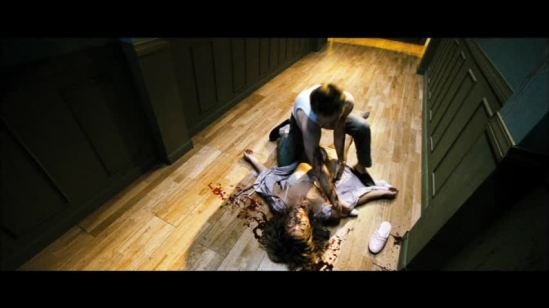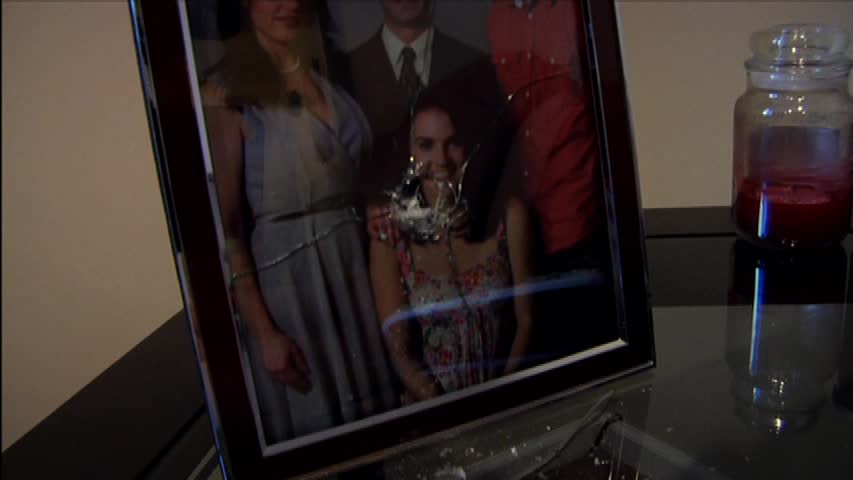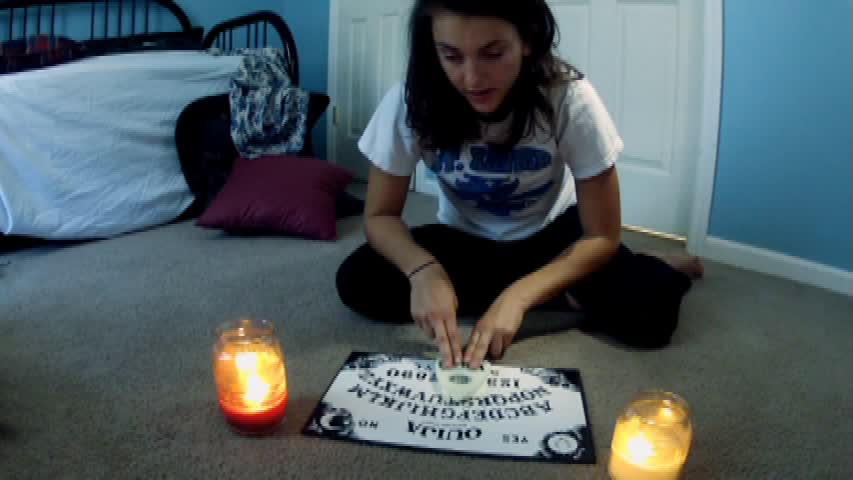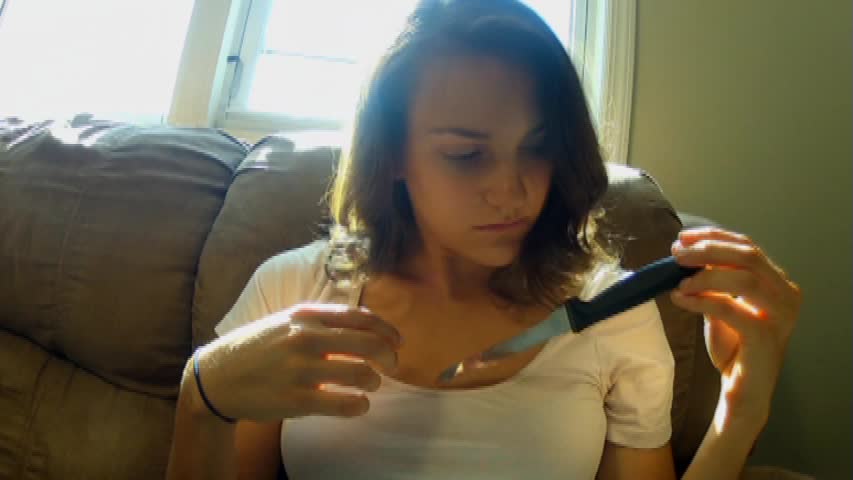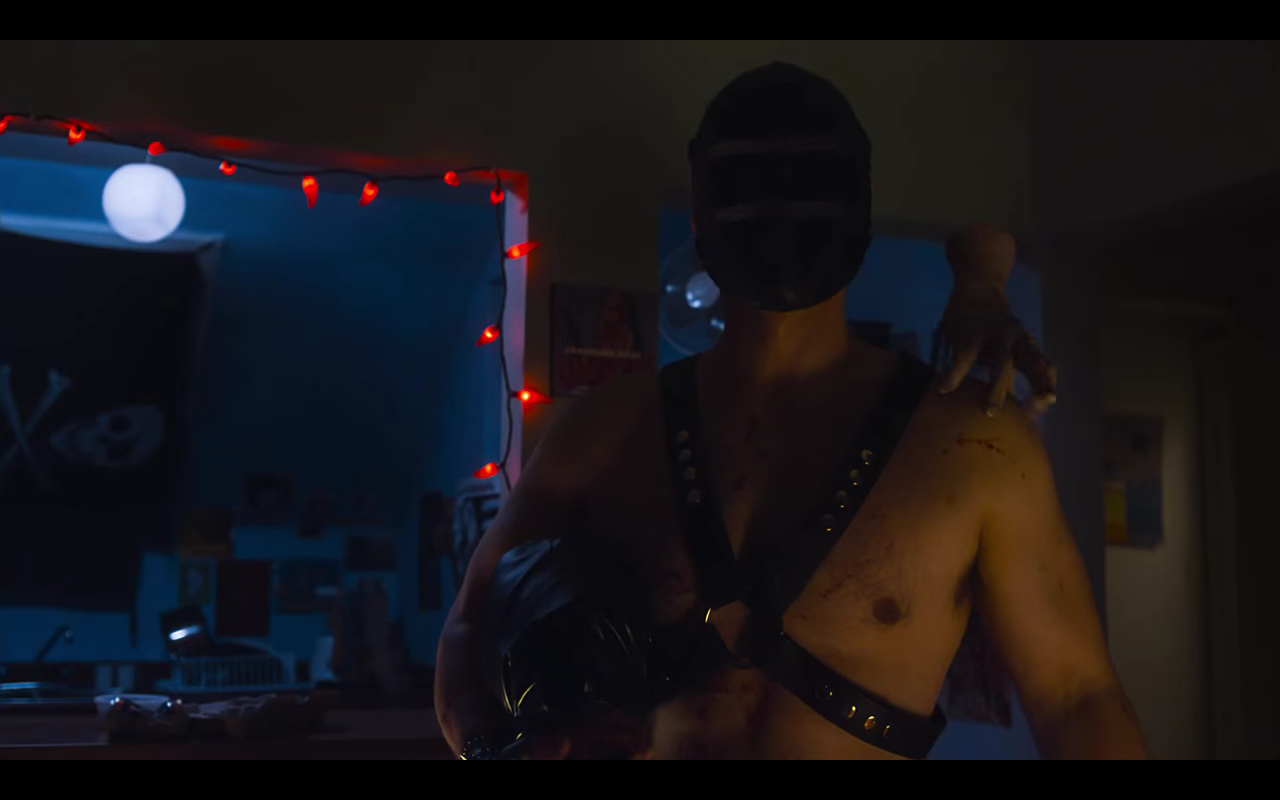
A young group of people are mysteriously texted an address for an unknown party. When they arrive, the address takes them to a dilapidated mansion with innards displayed as if time has ceased to exists. When the group tries to leave, all the doors to the outside won’t open, condemning them to the horrors of a magician’s vengeful spirit and his very large and frightening assistant who looms around the mansion’s endless corridors. As the group continues to butt against each other in distress and disbelief, one-by-one they fall victim to the magician’s gruesome parlor tricks behind every door and the only way out of the mansion may be dependent on their families’ legacies.

With a premise similar to the 1999 remake of “House on Haunted Hill” where a group of people are mysterious invited to a creepy house and end up in a death trap, I wouldn’t say director Kennedy Goldsby’s “Death’s Door” aka “The Trap Door” is entirely, 100 percent unique. In fact, much of the film is undeniably the same compared to William Malone directed remake, yet less entertaining and without an all-star cast and a vaster budget. “Death Door” lures with the headliners of more attractive and experienced stars with the Jamaican-born movie and television actor Obba Babatundé and the “Friday” franchise actor, and overall a big, badass monster of a man, Tommy “Tiny” Lister. Yet, like most smaller projects, I’m sure Obba’s and Tiny’s handful of scenes were the majority of the budget pie, leaving a few dollar bills at the bottom of the barrel for special effects that were desperately needed for a film about a ghoulish magician.

The effects were completely inadequate and can’t even equate to the same stature used for “House on Haunted Hill.” Off screen deaths, quick edits and cuts, camera angles, shoddy CGI, the over use of red tints, shaky camera, flash backs, and a prop skeleton tried to sell plausibility when really just added to absurdity. Aside from the lackluster effects, the Goldsby penned script logically doesn’t flow and fails to develop acts. While seeking for an exit, separate groups of characters aimlessly wander the house, trying door after door, and then the next scene could be one of those characters mixed in with another separate group, creating some continuity confusion. Also, much of the script settles to a stagnate, housing an unnecessary long montage of the group being bored, napping, looking glum, or walking from one part of the room to another. To put the cherry on top, a random nude scene is oddly inserted into a montage into the magician backstory portion. There’s no telling who the naked breasts belong to or why they’re naked to even begin with as the exploitive and titillating shot crops out the head and the setting is awfully generic, not placing the body in any familiar surroundings related to the mansion.

I will say that very few of the acting skill sets were not at a total loss. The fast-talking, wise-crackin’ Bruce played by Chico Benymon was entertaining; the character’s angst-fllled stand-up-comic style character goes against the grain, fleeting any ideas of ghosts or any form of malevolency. Tommy “Tiny” Lister is always top notch. The big man doesn’t even have to say a word and he’s downright menacing, even if his character, Jomo, stuffs emotionless Latina’s into tight spaces and fails to soil the pants of the mansion’s guest when quietly walking around them. Sarah Wagenvoord, who I was hoping had the mysterious naked breasts scene due to her massive…well, you know, should have played a more prominent role du in part to her character’s outcome. Actors Michael Bernardi, Felix Ryan, and Danielle Lilley maintained an average performance through a mirco-budget production. The rest foundered to capture any kind of terror or despair or just even trying to be a normal character, overacting the parts as if trying to put passion into reading straight from the script.

The video quality of the MVDVisual DVD comes with hardly any flaws in the video stock or any loss in the natural coloring. The stereo audio is a bit unbalanced between the LFE and the dialogue tracks, deducing to some loss dialogue over the pounding hammering sounds. The extras includes the Kennedy Goldsby directed music video of “Shorty Wassup” by Hip-Hop artist Sizzol Pop. The last piece of bonus material is a behind-the-scenes featurette from the actual haunted house set where the crew has personal encounters with the spirits. “Death’s Door” is a fools gold, a trap, that promises deadly snares, haunting ghoul, and many scares. The ending comes to a complete halt with only tall tales of what might have dastardly happened to most of the characters in the rickety mansion. I would recommend far better old mansion spook stories.
Category Archives: Trailers
Anybody and Everybody Can Be Evil! “The Summer House” review!

Markus lives the perfect life: a lucrative job in construction management, an adoring and faithful wife, and a beautiful and smart daughter about to tend a prominent English school. Yet, Marcus finds solace in a double life by living his true self as a bi-sexual man with a secret, younger male lover from one of his construction projects, leaving his wife frustrated and destructive in their foundering marriage. When Markus’s construction colleague Christopher finds himself being squeezed by the taxing agency, Marcus offers to help out a little. Christopher asks his 12-year-old son Johannes to be nice to and to spend time with Markus’s 11-year-old daughter Elisabeth in a show of good faith towards Markus’s good will. With Johannes around most of the time, Markus tries to keep grounded his uncontrollable desires for Johannes, but invites Johannes to Markus’s family’s summer house. Through the summer, Markus and Johannes form a relationship, but not everything is as it’s seems when hidden agendas and surprising outcomes could potentially destroy everyone involved.

An intense psychosexual, “The Summer House” zips straight out of Berlin from writer-director Curtis Burz who touches upon more taboo subject material than one might be able to withstand without feeling guilty, dirty, or rotten. Burz’s pen weaves through one man’s constant struggle between maintaining a barely afloat marriage to a wife he loves because of their daughter and his secretive bi-sexual life in an affair involving a much younger man. Burz also remarks on Markus’s wife Christine and her battle with near tragic depression; she’s complicit in Markus’s affair by allowing him, with only little resistance, to continue, yet Christine wants Markus to rediscover his love for her on his own. The pen continues to weave through the stories of the children, Johannes and Elisabeth. The very nature of a child feels exploited here in more ways than one, but the film’s end game takes an usual twist, one I can’t spill here without spoiling the finale fun. Burz continues to drop dark material presented and staged in a glowing-like and vividly colorful mise-en-scene throughout that would suggest happiness or perfection for all involved; however, the nagging, gloomy undertone remains behind the scenes and unseen and that’s the kind of sadistically gratifying contribution added by director Curtis Burz.

“The Summer House” is a socially controversial film without being overly in your face with it. Nothing is explicit with the subtleties being just enough to make your stomach feel uneasy and to make your jaw clench with anticipation. The scenes with Markus (the then 40-year-old Sten Jacobs) and Johannes (a certainly under 18-year-old Jasper Fuld) kept building the tension between them and Jacobs portrayed a creepy, over-anxious and over-persistent pedophile uncomfortably well whereas Fuld plays his part just as convincingly as a seemingly tolerable young boy who may or may not be curious about Markus’s intentions toward him. The vexation Christine discharges is all due in part, greatly toward, of the leading lady Anna Altmann’s performance. Altmann captures a wife in marriage limbo, looking to rekindle a broken family stuck in stalemate due to her husband’s mid-life sexual crisis while maintaining her daughter’s precociousness. Nina Splettstößer feeds off Atlmann’s motherly performance by portraying Elisabeth as quiet and intelligent, yet passive and conniving who sees her mother as someone who hates her because of how stringent her mother is toward her.

The story’s complex web becomes stickier and the spider draws even closer when Markus’s secret sleepovers become exposed, creating a twist ending not even M. Night Shyamalan could conjure up. However, the story behind Markus’s colleague Christopher and his wife Anne feels ignored and neglected. Aside from Christopher incidentally being the catalyst between Markus and Johannes, Christopher and Anne’s scenes seem unnecessary. One scene has the both adult couples seemingly in the early wine and dine stages of a swinger party, but once most of the kissing between Anne, Christopher and Christine is out of the way, the scene falls short with a quick cut to just Markus finishing off with his wife Christine with all their clothes still on. Christopher and Anne come and go in barely a handful of other scenes that don’t tie into much of the story and would have either been better if either explored further into their adventurous lifestyle to get a better understanding of Johannes or leave them out all together.

Overall, “The Summer House” is deserving of it’s numerous film festival awards and a solid release for not only Artsploitation Films, but also as a film that has been Berlin born even if the film released nearly 3 years ago. Certainly very relevant to today’s modern multi-societal problems including the dissolving of families, behavioral issues with not only pedophilia, but with depression, and to round out the pleasantries with scrofulous affairs. The Artsploitation Films, in a metaphorical broken and cracked pane glass over a solemn Markus family DVD cover, has a widescreen 1.85:1 ratio release with a German and English 2.0 audio track is accompanied with bonus features that include deleted scenes, cast and crew interviews, and a trailer; all content clocks in at around 195 minutes total – not bad all around for an independent feature.
Living Alongside Evil. “A Plague So Pleasant” review!

In the zombie post-apocalypse, the human discovered that by not firing their weapons allowed the flesh eating hordes to calm their desires, resulting in the protection of the zombie species and institutionalizing laws against the killing zombies for fear of another undead swarm attack. One of the many survivors Clay has lived in a zombie cooperation world for over a year after the initial outbreak along with his sister Mia, whose boyfriend Gerry didn’t survive, but still roams the Earth as the walking dead. With no one truly dying, the whole idea of existence becomes meaningless and where people, like Mia, won’t move on when they’re loved ones still feel very much alive. When Clay discovers his sister’s attachment to undead Gerry, he takes it upon himself to kill Mia’s zombie boyfriend, releasing a zombie swarm post-apocalypse apocalypse on the his town.

Unprecedented and gushing with rage, “A Plague so Pleasant” redefines the way audiences would view the zombie since 1968, constructing still a vicious species of man-eating undead while domesticating them to a lumbering land fixture much like the way pigeons amongst the birds. First time directors Benjamin Roberds and Jordan Reyes triumph amongst the modern zombie competition, spilling their heart and soul onto the script and onto the screen. With a story to match, a Romero-inspired social commentary zombie film held true to form by instilling normality to a post-apocalyptic world. Zombie and man living together. What was that Bill Murray line in “Ghostbusters?” “Cats and dogs living together… mass hysteria.” Clay and Mia were living a mundane life while the dead remained alive and protected, socially poking fun at how society maintain a normal livelihood with zombies: the U.S. Government made killing zombies a national felony, companies were mandated to go through a yearly undead awareness program as a formality, and there’s a guarded visitation area full of the undead much like a graveyard without graves.

Stunning cinematography added much needed life to “A Plague so Pleasant” which settles into an already over saturated zombie genre. Starting in black and white, Clay introduces his life in a offscreen monologue, conveying much of the post-apocalyptic and zombie information. The black and white symbolizes how simple and plain life has become with the living with zombies regulations. When Clay breaks the law by offing Gerry for good, thats when the movie turns to color and creating complications in a black and white life. The once unvarying and shuffling zombie nuisance goes into full berserk mode with “28 Days Later” sprinters thirsty to tear into anything with a heart beat. Only when the zombies turn calm is when life goes back to being black and white, considering the option that normality needs to be simplified to live peacefully.

The special effects by first timer Tyler Carver are a great effort clashing together a classic European Giannetto De Rossi style with Carver’s own settle flair by not being overly gruesome. There’s not an over-the-top, chart-topping special effects moment that defines the “A Plague so Pleasant,’ but there the solid effects subtly throughout satisfies. The zombies overall look are the usual stock type, yet they’re exhilarating to watch with an army of intense actors who are no doubt from the Athens, GA Halloween attraction named Zombie Farm where Tyler Carver has a connection. Not everything about the creation of a frightening zombie was accomplished as much of the audio tracks were out of sync and just too gaudy.

Actor David Chandler as Clay does a fine job portraying a bored survivor and a clueless big brother while also performing the second zombie swarm nearly without speaking during the entire engagement. Mia, played by Eva Boehnke, resembles the gorgeous Lebanese-American porn star actress Mia Khalfia with her giant nerdy glasses. Boehnke creates a free spirited, yet delusional, persona in Mia whose holding onto the past and coping the only way she knows how and that’s by not separating from her undead boyfriend Gerry. We round out the cast with Todd played by Maxwell Moody. Todd becomes the catalyst of the coming events by placing the idea of him and Mia being a couple and putting a bullet into Gerry’s rotting brain. Chandler, Boehnke, and Moody on paper are amateur actors in an estimated $1,500 budget, independent movie, but they own their performances and shine through budgetary constraints.

Another awesome release from Wild Eye releasing that would make a worthy and unique edition to a zombie fanatic’s movie collection. Don’t judge to harsh the production value with the slight aliasing, the out of sync zombie audio tracks, and the muffled off screen Clay character monologue. Instead, focus on the cinematography, the actors performances, and the genuine story telling of a socially awkward scenario. Let “A Plague so Pleasant” infect, let it sink it’s teeth deep, and let it help turn your undying attention unto a lively concept.
One Pissed Off Evil Crustacean! “Queen Crab” review!

Melissa discovers a massive King crab on her home’s shore off of Crabbe Creek, Nowhere, USA. Her fondness for the crab forces her to take it as her pet and naming in Pee Wee. Her scientist father works constantly and diligently in the basement, trying to create a genetically modified food source to nourish the billions of people that will overwhelm Earth in the years to come. When Melissa returns home with Pee Wee, she feeds the crustacean a handful of her father’s genetically enhanced grapes. The grapes cause Pee Wee to grow at a rapid rate, but when Melissa’s home blows up due to an experiment gone array that tragically kills both her parents, she’s left to be raised by naïve local sheriff uncle while she protects Pee Wee on her lake covered land. Twenty-years later, Melissa can no longer Pee Wee, who now goes by the name of Goliath, from slaughtering cattle, protecting it’s young, and seizing a small town full of trigger-happy rednecks!

Deep under the giant ocean of micro-budget directors, director Brett Piper is a name I’ve caught before on my critique fishing pole line. Nearly a decade ago, I viewed Piper’s biological terror film “Bacterium” and the estimated $30,000 E.I. Independent Cinema release had instilled hope in me that reviewing non-mainstream projects would be a promising venture and not an anguishing waste of time. Piper’s latest film “Queen Crab” distributed by Wild Eye Releasing continues to impress without the flashy green dollar signs. Working with “way less” than he had on “Bacterium,” Piper puts his unquenchable zaniness into hyper-drive, soaring through old time monster movies and creating one more lasting impression from a dying breed of late-night drive-in horror movies.

“Queen Crab” is a combination of Gordon Douglas’s “Them!” and Desmond Davis’s epic classic “Clash of the Titans,” cultivating similarities from both films. The stop-motion special effects animates the monstrous crab to life and creating a charming piece of movie magic. Pee Wee, the crab, is compiled of stop-motion animation, traditional effects, green screen, and literally minor computer imagery. Some scenes of Pee Wee look really fantastic while some obviously didn’t receive too much attention during post-production and that’s expected. Pee Wee, or Goliath when adult, looks phenomenally, and cheekily, stunning during stop-motion animation. Also, the superimposed backgrounds, creating an eerie atmosphere, adds to the bigger than life aspect of this small budget adventure.

A package like this comes complete with overemphasized, sometimes ear-aching, acting from a range of talented, yet novice, cast such as Michelle Simone Miller, Danielle Donahue, Rich Lounfello, Kathryn Metz, Steve Diasparra, Ken Van Sant and A.J. Delucia. When at first glance of the Wild Eye Releasing DVD cover, I wouldn’t have expected anything less from the multifaceted cast who look to be having just as much fun in being a part of the Piper project. The DVD cover does strike a familiar resemblance to Asylum Entertainment’s straight-to-DVD artwork with absurdity and does tell small tall tales with the explosive war zone artwork which is only half true, but Brett Piper and “Queen Crab” don’t try to create a facade and bluntly tells you, in the form of their artwork, that a giant crab ripping people to shreds and destroying stuff should be a film that never takes itself seriously no matter what the context the story is in.

The Wild Eye Releasing DVD cover defines the movie, but my real only gripe with this outside binding is why the synopsis. The backside synopsis doesn’t give an accurate portrayal of events and seems more tuned to classic monster movie scenario where a comet awakes a “centuries-old beast.” I don’t know what to say, but there’s certainly no comet involved. Other than that minor flaw, the DVD is accompanied with a good handful of extras that include a commentary with director Brett Piper and producer Mark Polonia, a blooper reel, behind the scenes featurettes, a sneak peak at Brett Piper’s “Tricyclops,” and trailers. “Queen Crab” creates larger than life horror, sci-fi, and fantasy fun for nearly all ages. I hope to see another Brett Piper creature feature film soon and hopefully it won’t take another decade!
Evil Gets Wild! “Cub” review!
A troop of cub scouts set out on a camping trip in the deep forests near an abandoned bus factory. At the helm are three scout masters overseeing a handful of lively young cub scouts. One of children, Sam, has been through a troubled and violent past and has been labeled the outcast amongst the rest of the troop. Sam encounters a feral young boy, who has been trained by a murderous psychopath whom has made the woods his deadly home. As nobody believes Sam’s run-in with the wild boy whose been stealing around camp, the troop hastily concludes that Sam is lying and stealing, resulting in the trop disliking him even more all the while setting up their fate for something far much worse: a killer camping trip.

Booby traps. Children vs. Children. Outside nude showering. An ingenious killer. Fun and newfangled horror has made it’s grand return since “The Collector!” Freshman director Jonas Govaerts, with a boat load of crowd funded money, has brought a keen eye to the campy, wooded survival genre with his independent film “Cub” aka “Welp” in the films original French/Flemish language. Going through the motions of setting up character development and moving the characters seamlessly into a ominous situation is what seems to come natural to director Govaerts. Unnaturally, Govaerts doesn’t explore the psychotic background of such an interesting, yet mysterious killer, leaving everything about the antagonist’s intentions to the imagination. This villain, only known as the “psychopathic mentor” on the Artsploitation Films Blu-ray back cover, maintains a dated, yet marathon technique killing spree operation underground in the dark woods, setting up crafty and deadly traps for those who embark on his land. There’s a little tidbit of setup on the killer from an officer explaining to the scout masters that the vacant nearby factory has made some previous employees disgruntled, making the land a cursed hotspot.

“Cub’s” success mainly stems from it’s actors. Gill Eeckelaert, who has only “Cub” credited under his name, phenomenally creates a superbly feral and masked boy, surviving on the land and in the trees. With a scrawny physique and zero dialogue, Eeckelaert has formed a eerily scary character, more so than the actual menacing mentor. In all honesty, the feral boy should have been the main antagonist pitted against the troop. This character’s counterpart, Sam, played by Maurice Luijten is the epitome of good, yet something is off with the character as told with seldom sharing of the information about his past, his foster parents, his damaged photograph, and the list goes on. While a clear picture of Sam never fully emerges until the finale, the good that bubbles up from his character couldn’t be any more prominent as he’s contrast next to the constant bully shadow of a scout master named Baloo and his mindless troop of followers, looking to be cool in the Baloo’s perverted and unorthodox eyes. With only a handful of ally accompaniments on this trip, those who wish Sam harm outweigh those who want to protect him.

With the “Lord of the Flies” similar attitude and with more than half your cast under the puberty requirement age, Govaerts ruthlessly places every single person in danger and places every single character on the chopping block. There’s no sugar-coated dancing around the innocent minors, making them actually part of the organic story instead of pussyfooting around them as if they’re made of fragile, non-tempered glass. However, I do feel the opportunity was completely wasted or missed to take out each individual character one-by-one with a signature death scene, but I don’t believe the effect of certain character or characters being dispatched watered down the “oh my god” value.

The Artsploitation Blu-ray has a beautiful 2.35:1 ratio, widescreen presentation with only very little aliasing detected and the night scenes just as clear as the day scenes. The 5.1 Dolby Digital mix flawlessly contributes to the overall impact of the story, creating a great balance between LFE and HFE, dialogue, soundtrack, and ambient tracks while providing accurate and well-timed English subtitles. The superb giallo-esque score by Steve Moore, who goes under the pseudo name of Gianni Rossi and worked on “Gutterballs”, delivers an intense, on the edge of your seat synth rendition of danger and chase. “Cub” director Jonas Govaerts and his crew earns their merit badges for constructing a bloody and innovative film. Another winning release for Artsploitation Films and another recommendation from this reviewer.