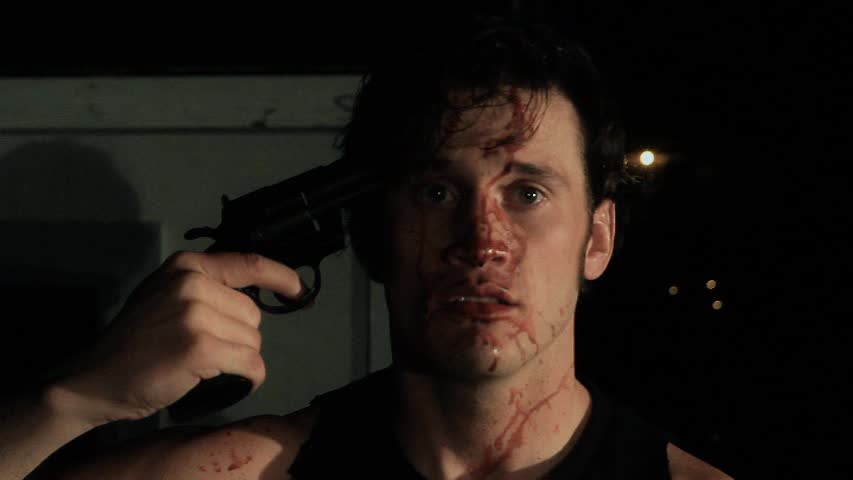
After the tragic and accidental death of their young son, Richard and Doreen escape from their painful memories by moving to a quick-sell, rundown house with their two children, Jen and Ben. The house holds a unfathomable mysterious past with the previous family disappearing without a trace, leaving many of their possessions behind in the house’s desolate rooms. Ben, who hasn’t spoken much after the untimely death of his twin brother, encounters humanoid creatures in the attic at night when they roam the house. Ben becomes unsuccessful communicating about the horrifying creatures to his parents and even his older sister, shrugging his warnings off as a sign of his continuous grief. When Richard and Doreen leave Jen and Ben home alone in order to go to all night work function, the creatures descend from their attic abode and seek to devour people they can get their hungry hands on.

“Above Us Lives Evil” is the freshman film of Jason Mills circa 2009 and transpires to be a visually interesting piece of creature feature horror cinema even though the story is a bit undercooked and the acting more than often feels like watching a robotic cluster, monotonously reading the script line-by-line. The story opens ambiguously enough with a glum looking man, sitting in his car with a young boy laying motionless at the foot of man’s front bumper while Doreen cries hysterically over him and another boy, Ben, stands in tragic shock over the dead body of his brother. The opening only connects the rest of the story by the segue of the family driving, moving away antagonistically from their tragic past, but the melodramatically written opening needs being revisited, perhaps in the third act, but doesn’t make a reappearance, missing the opportunity to explore deeper into the family’s separation, and becomes sorely adrift from the rest of story’s girth.

The story continues to plug along of a supposedly grieving family, starting a new life in a new home where we’re informed by the strange neighbors that the previous family just up and vanishes. That sums up the complete backstory revealed of the previous inhabitants. Similar types of voids also rear their ugly little heads. The development upon the creature’s existence isn’t forthright nor is there any explanation into their background, making their existence to be fixtures of the house. These human devouring beings could have been born in the house and lived in that house since the beginning of time for all we’re led to understand.

The Canadian based produced film stars 30 year old Vancouver native Nicola Elbro as the eldest sister Jen. Nicola maintains a solid performance throughout to pull off this low key creature feature and with a little elbow grease added on, I can see Nicola moving from low budget features to the major leagues of horror Hollywood. However, the rest of the cast shares similar generic performances that painfully lead us by the hand, as if we’re not-yet-ready-for-horror-movie toddlers, through the exposition of everything that could have been just simply implied. Even though being one of the more experienced actors on this project, Robert Duncan’s monotony only suffers more drastically from his dimwitted, excuse-ridden character as Nicola’s father Richard. Richard neglects his children’s immediate needs and fears, dismissing them as if they’re too young and naive to know how the world works. Combine everything said here about Richard and he becomes the worst character amongst the rest of underdeveloped characters and there are quite a few.
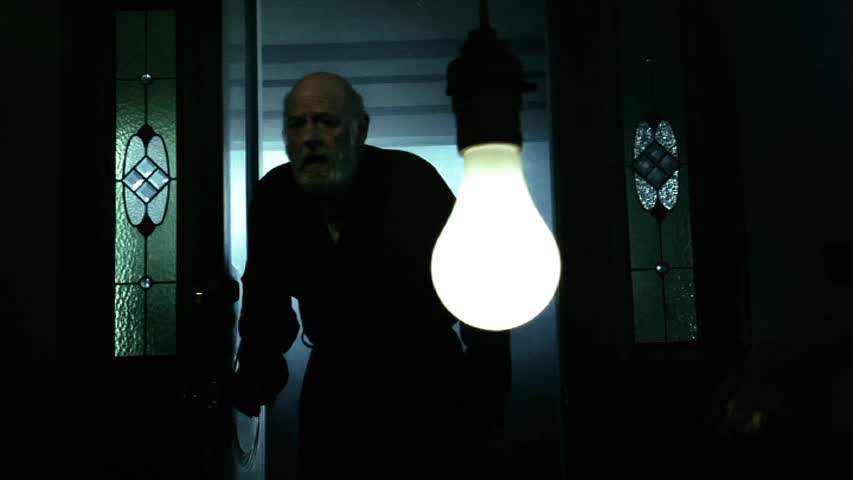
The creatures had more personality with their caveman-like gaits and ghastly limber appendages, chasing down quickly disposable characters (which inconsequentially are also the main characters). Jason Mills and his relative Simon and Johnny take on “The Strain” resembling creature roles; the Mills’ lanky builds added that extra something to the overall appearance of the creature. Jason Mills took the creature look and ability a bit further with the adjunct mandibles that cover the snake-like tentacles; the construction of this achievement is a mixture of practical effect and CGI. Usually, I’m not a big fan of CGI, but Mills strategically, and successfully at that, obscures much of the creature, hiding the full overlook in the shadows, in the quick cuts, and in the low-light. Many of the effects are obscured; the special effects team mainly uses slight CGI and a bucket of blood or two to create their desired creature attacking effect. Most of the attacks are implied or too far in a long shot, creating the allusion of vicious creature film.

The Sector 5 Films and Chemical Burn distributed home DVD release technically suffers. Digital interference plays havoc, graining certain portions of night scenes while also causing digital waves on other night scenes. The loss of frame rate during other night time moments result in an awkward slow motion. “Above Us Lives Evil,” much like the creatures, should store itself in the attic until ready to descend for blood and to be more captivating with the characters. Jason Mills and Nicola Elbro show promising attributes that can contribute to the horror community and while their contribution may not be with this particular Jason Mills film starring Nicola Elbro, I’m sure we’ll see more of the two in the near future either on another collaboration or separate projects that could, and probably should, begin to turn some heads.
Category Archives: Trailers
Movie Magic Evil Waters Down Real Evil. “House on the Hill” review!
Based on the true story of serial killers Leonard Lake and Charlie Ng, director Jeffery Frentzen (Black Dahlia) chronicles the speculated portions of Lake’s and Ng’s homicidal and psychopathic murders. Their murderous spree involved kidnapping young women, enslaving them, and eventually murdering them while also targeting their own relatives and friends, and even seizing the opportunities to abduct whole families. After Lake served in the Marine Corps, he met Charlie Ng and by the 1980s, the two men had constructed an isolated house where innocent people were brought to be tortured, ransomed, and eventually their demise at the hands of their materialistic and deviant captors.

“House on the Hill” is the Jeffery Frentzen directed and co-written with Nicole Marie Polec film that semi-documents the tragic events of Leonard Lake’s and Charlie Ng’s serial killing spree of the 1980s and incorporates actual footage of Leonard Lake speaking about his disturbing views on the world such as enslaving women and being prepared for the inevitable world apocalypse. Most of Frentzen’s movie is embellished as, like the majority of serial killer documentaries, most of what is unknown of Lake will never see the light of truth of what really happened on his ranch. The legend behind Lake and Ng states that there could have been as few as 11 murders or as high as 25; Frentzen attempts to showcase the latter by adding many fictional victims into his film to be representatives to those unknown victims who were never discovered or whose bones were severely untraceable.

However, some of the facts that are true, that we do know about Lake, didn’t quite make the cut because of Frentzen’s x, y, or z reasons. In the film, Lake’s wife is named Cat played by Rachel Devlin (Zombie Nation), but in reality Lake’s wife name was Claralyn Balazs aka “Cricket.” If Lake’s wife name is clear, why go with “Cat?” Also, Lake had constructed a bunker in the backyard of his ranch, but “House on the Hill” has a separate, well-locked shed in the backyard. Simultaneously, Frentzen’s movie has consistent filming errors that even the untrained eye can catch. Continuity glitches that are obvious (Naidra Dawn Thomson’s bra strap is in various positions between takes on a particular scene) and obvious props that are in more need of a convincing sell from the actors and to be well edited to not give the impression of false intentions. Lastly, the overly generic title doesn’t specifically speak much upon Leonard Lake and his accomplice Charlie Ng. “House on the Hill” title has no curb appeal and no real bite to entice viewership.

What I did find pleasurable about “House on the Hill” was the leads’ acting. Canadian actor Stephen A.F. Day and first feature film actor Sam Leung do an above mediocre performance of Leonard Lake and Charlie Ng. They manage to show and sell having no empathy when committing terrible acts, managing the ability to embody the evil within a killer on screen. Barring Frentzen’s epileptic editing and use of tints, lenses, and over exposers, I still was able to see the good in Day’s and Leung’s performances without the editing hoopla that attempted to make the events more dramatic, shocking, and traumatizing.

I’m a little disappointed in the distribution of this film. Not only does the jejune title leave a bleak taste, but the DVD cover doesn’t quite represent what is being sold here. On the cover, there is a dirt pathway leading up to a two story, mansion-like structure sitting on top of a hill and seemingly decayed and abandoned. On the DVD backside, a meathook pops right out at you along with a female victim strung up by her arms, screaming toward to the sky. Meathook does not make a credited or on screen appearance nor does the house in the film look like the mansion on the DVD cover. What is even more disappointing, and what I have to comes to term with every now and then, is the heavily edited cut in which “House on the Hill” was released. The DVD cover states, “Warning Explicit Content,” and does show some intense moments containing blood and torture with implied rape. ‘Some’ being the key word because I’ve seen more explicit content on the local evening news. This might be due in part of the post-production censorship which most noticeably focuses on covering up any and all nude scenes. Olivia Parrish’s topless scene was crudely censored by being blurred out and awkwardly cropped to show a low-resolution image, a forced zoom in, of her neck up as she’s being molested. The same cropping censorship goes against Laura Hofritcher’s topless scene as well during her torturous scene.
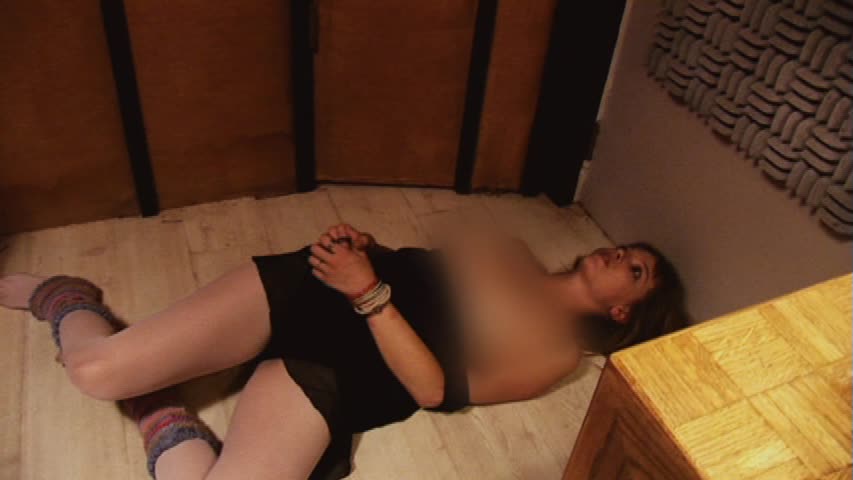
The North 40 Production film and MVD and ITN distribution DVD release doesn’t score to well for this reviewer. I’m able to look past the editing techniques, post-production effects, and unbalanced audio, but being a writer and a firm patron of freedom of speech, the censorship of the nudity and potentially the bloodletting has my blood boiling. However, even though Leonard Lake and Charlie Ng may have not been extensively covered on the silver screen or on entertainment television, I am glad Frentzen told partial of the notorious story and was able to tell his rendition of the unknown accounts.
Gun Woman vs. Evil! “Gun Woman” review!

A determined doctor pledges revenge after his wife fell victim to a crazy, sadistic, cannibalistic, sex-fiend killer. Known by only the Mastermind, his quest lures him to buy a junkie from an underground trafficking organization and trains her, without given her a choice, to be an lethal assassin. The Mastermind teaches her hand-to-hand combat, how to handle a handgun, and even how to survive surgical procedures in order to have the mechanical parts of a handgun implanted into various portions of her body and then abstract the bulky pieces when the time is right. The dastardly plan for assassination comes to fruition when the Mastermind’s target makes his rounds at a necrophilia and cannibalistic business called “The Room” where Gun Woman feigns her death to infiltrate and carry out the hit.

“Gun Woman” is an insane Japanese action-thriller concept from the mind of a relatively new director Kurando Mitsutake. From this reviewer’s point of view, Mitsutake’s film is much more tame compared to the other numerous Japanese’s extreme and unthinkable plot lines. Basically, the Japan film industry produces three solid genres that hover around outside the realm of their mega-popular Japanese Adult Video and Pinku markets: Dramatic noris involving a various range of characters from gangsters to samurais, the Americanized popular ghost films such as Ringu or Ju-on, and the outrageous, ultra-violent films, spreading amongst various sub-genres from action to horror. “Gun Woman” suits the latter category with it’s necrophilia, super-soaking blood, rape and torture, cannibalism, and the odd jobs of the reproductive body parts. Remember when I said that “Gun Woman” is the fairly tame?

The Maxam produced film stars the ever gorgeous actress Asami of “Machine Girl” fame. You may remember my last Asami film review for the Pink Eiga released “Prison Girls” starring the once former JAV actress turned phenomenal B-movie heroine. Asami’s uncanny ability to conform to any role heightens the film’s viewing and enjoyable factors and “Gun Woman” is the epitome of B-movie schlock, almost as if her role as Gun Woman was made just for Asami. Alongside Asami are Kairi Narita as the Mastermind and Noriaki Kamata as the heinous sex-fiend only known as Hamazaki’s son. Narita towers over Asami with a strong muscular face, proving to be a powerhouse character even though the Mastermind character is partially crippled. Kamata possesses such a freaky super thin, yet muscular build with defined facial features that his role as a necrophiliac, a cannibal, and a rapist-murderer wouldn’t be so far from the truth if bumping into Kamata randomly on the street.

While Asami’s character might be the heroine of the film, “Gun Woman” surely feels like an anti-woman film. Many of the female roles, no matter how minor, are subjected to some sort of abuse. Hamazaki’s son rapes and strangles various American women while also raping and killing the Mastermind’s wife. The Mastermind himself kidnaps an innocent woman and uses her as a tool to create a lethal weapon in Asami. Even Hamazaki’s female body guard doesn’t get a chance to have one line in the entire film, does really nothing at all, and ultimately meets her end and I can’t help but wonder why even have this character at all if the character serves so little a purpose? Like I aforementioned, Asami might be this kick-ass, gun-toting, deadly femme-fatal, but her mission for revenge isn’t even her mission for revenge; its the Mastermind’s and he’s using her, a junkie bought off a secret organization, with given a single choice: to either kill for him or die.

“Gun Woman” markets itself as a “no-holds-barred revenge flick” and has all the makings of a cult film. Blood gushes out of gaping wounds, intense fight and gun scenes, and naked women galore grace the film’s entire presence. However, “Gun Woman’s” enticing premise isn’t without major flaws including obvious plot holes, inaccurate medical procedures, and some unbalanced acting from not the Japanese, but from the English speaking Anglo-Saxons driving the car during the outer-story. Hey, this is the movie industry where anything can happen as long as someone can think of whatever it is up and as long as someone can construct it as well. The whole premise behind the film is bogus in reality and Asami’s character might as well be a part of the IMF because her mission is impossible. To provide an example, nobody could withstand having three parts of a firearm surgically implanted into their body and then live 22 minutes later after removing the said parts by reopening the wounds to assassinate everybody in “The Room.” Other factors are involved when contemplating blood loss and time such as what if Asami is additionally injured resulting in blood loss? What if her pulse rate increases during heart-pounding scenarios causing a faster blood flow?

Show business is all smoke screens, lengthy mirrors, and customized misdirection and Mitsutake’s “Gun Woman” certainly provides just that while pushing the boundaries of taboo subjects and being, what I consider, a chauvinistic perspective against women. If a viewer wishes to suspend disbelief for 87 minutes, witness a bloody-stellar end game, and see their fair share of naked and abused women, then “Gun Woman” would be right up their mentally deranged alley. The Scream Factor (Shout Factory) Blu-ray release is presented with little digital noise interference in a 1080p High-Definition widescreen 1.78:1 aspect ration with DTS-HD Master Audio 5.1 mix with English subtitles available. I’m not sold on the Scream Factory Blu-ray cover of a closeup of Asami’s face and holding two smoking sidearms in a criss-cross way (think Kate Beckinsail on the “Underworld Evolution” DVD). This doesn’t actually represent the movie as she never really garnishes two handguns. Other releases are more accurate with a naked and bloodied Asami, aiming one handgun. Still, the release is solid and I wouldn’t discourage anybody, especially Asami fans, of a good time.
All Evil Plans End Tragically. “Reckless” review!

Ex-cons Victor (Tygo Gernandt) and Rico (Marwan Kenzari) kidnap a young woman named Laura (Sarah Chronis) in hopes to extort a four million dollar cash payout from her wealthy father. The two men are methodical, precise, and focused on their task, constructing a sound proof room, buying burner cell phones, and keeping one step ahead of their captive’s thoughts on escape. Keeping her tied to the bed in a vacant apartment, Victor and Rico don specific roles in their plan; Victor leaves the apartment to negotiate the ransom while Rico oversees their money making hostage. When Laura cleverly works on getting the upper hand on one of them, she discovers that there might be a secondary plan involving her willing participation and leaving the other ex-con high and dry without a payday. Victor and Rico hold a surprising secret amongst themselves as well, making this crime thriller a cat-and-mouse game between the three where tensions are high, trust is low, and the end game won’t be pretty.

The Netherlands thriller directed by Joram Lürsen seems to be the polar opposite from the director’s previous directorial work. The “Reckless” niche focuses on being tight and concise. The film only credits three actors: Tygo Gernandt, Marwan Kenzari, and Sarah Chronis. That’s it and there isn’t even a voice over from a phone call or anything else of the sort, forcing the actors to only work off each other instead of being able to pick and choose who to bank off their banters and abilities. Secondly, the majority of the setting is in this small apartment that has become Laura’s cell which becomes another tight spot, literally. Finally, the story focuses on minor details with strict guiding dialogue that pieces together the story’s outcome and doesn’t make the plot wander into oblivion.

The story, which is a remake of the 2009 British thriller “The Disappearance of Alice Creed,” strives off being simplistic; a kidnapping for ransom gone awry. However, there lies a mid act twist that keeps the situation fresh where constantly guessing to the real intentions of the characters is more fun than actually watching the ploy play out. Tygo Gernandt perfectly fits into the shoes of Victor by portraying the role extremely well of a hardened and a rule rigorous ex-con. Marwan Kenzari as Victor’s accomplice Rico relieves the other half of the tension Tygo’s aura emits with his soft eyes and gentle appeal toward Laura, but Rico scrambles to keep Tygo under control and that creates nail biting scenes between the three actors. Sarah Chronis as Laura offers so much to the table being the golden nugget for Victor and Rico, being their ticket for a new life in another part of the world. Chronis conveys being naive, conniving, and afraid well and acts upon her forced nudity with proper accordance to the situation and also uses her nudity, seductively and convincingly, to plan her intended escape.

However, where “Reckless” strives on being a successful crime thriller, it’s also the film’s ultimate downfall and suffers sequentially from “Psycho” syndrome. Remember when Gus Van Sant remade Alfred Hitchcock’s “Psycho” nearly shot for shot and critics condemned Van Sant’s film? The same situation happens upon “Reckless” where nearly every character quality has become a carbon copy from “The Disappearance of Alice Creed.” Yes, “Reckless” is a true to form remake and a good reproduction as well, but for the Lürsen film to stand out, to be something more, “Reckless” doesn’t break the established mold. Instead, the film relies on it’s actors to accomplish a more riveting appeal and that’s hard to do when Eddie Marsan, Martin Compston, and Gemma Arterton already made a great first impression in the original.

The Artsploitation Films distributes “Reckless” in a widescreen 2.35:1 aspect ratio with super clear picture quality. The 5.1 Dolby Digital audio mix clearly appropriates the dialogue from the ambience form the soundtrack. The optional English subtitles sync well with the Dutch language track. I’m a little disappointed in the DVD cover as it resembles something that Dimension Films would have produced back in the early 2000s and doesn’t really speak to the film’s thrilling storyline. Overall, “Reckless” is a quality remake release for Artsploitation Films and for production company Topkapi Films that gave alternative, yet still quality, actors a chance to redo a role already grounded and established.
You Shouldn’t Pick On Evil! “All American Bully” review!
Three high school friends live in an online gaming and comic book world making them easy targets for sinister bullies. When one of them, Devon (Alexander Fraser), becomes the victim of extreme bullying, the gaming friends are forced to come together and cope with the brutal and aggravated assault laid upon their friend Devon. Becky (Alicia Rose), whose had a long lasting love for Devon, plans the ultimate revenge by teasing to expose a hidden secret on the world wide web about Devon’s bully neighbor John Brooks (Daren Ackerman). The circle of violence and secrets wildly spirals out of control to an extremely car-crash of a finale that will put Devon, Becky, and John in a trio of devastating destruction.
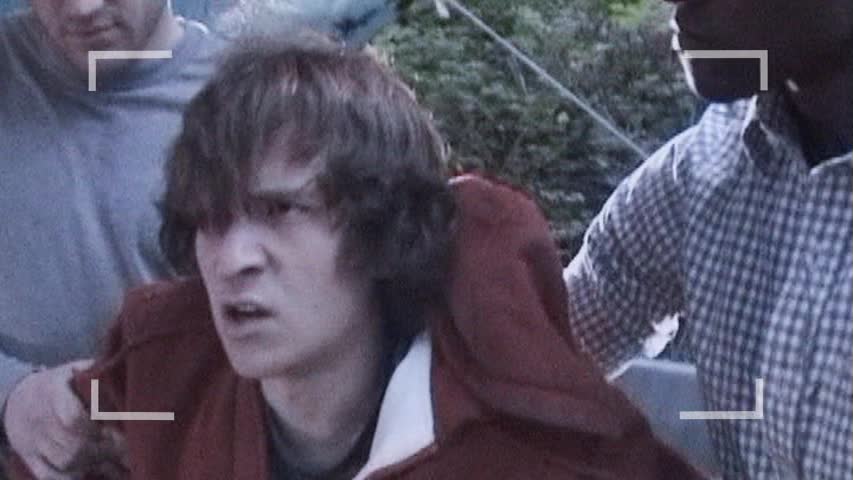
“All American Bully,” formally titled “The Innocent,” serves as not the typical bully-revenge film we’re aware of in such films as Gus Van Sant’s “Elephant” or Jason Buxton’s “Blackbird” and that creates a misleading film title, but doesn’t necessarily hurt the film’s integrity. Director-writer John Hawkins intentionally creates an unexpected twist that’ll take the film into a totally different direction. With the help of the elusive, yet recently fan-revived cult “Friday the 13th” heroine Andrienne King and the superb acting by Daren Ackerman who portrays complex character John Brooks, “All American Bully” becomes a unique hybrid with a cultural and social timeliness that will surely strike the core like a bully punching you in the gut and kicking you while you’re down all for just your lunch money.

The John Hawkins film is not solely about high school bullying, but also about mental illness and childhood abuse to which all comes to the forefront to bring the house down at the end. The repercussions from years of bullying results in kidnapping, rape, and murder. Actor Daren Ackerman’s has a wide range playing the disturbing character John Brooks by never backing down from the character’s various stages. Ackerman complete shadows his peers such as Alexander Fraser who can’t strain from a monotone tone, Alicia Rose who has range but just not enough girth, and even Adrienne King who, I felt, played an overacting Principal.
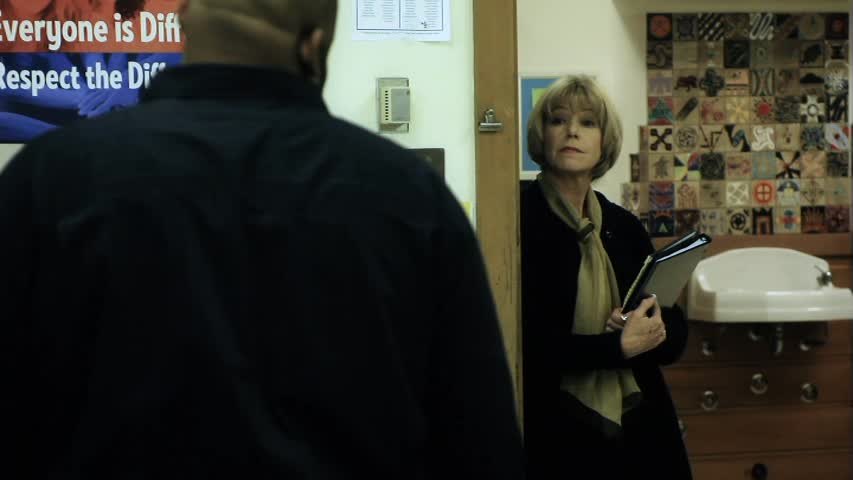
There seems to be a side story that goes unexplained to which we have to make our own conclusion. Adrienne’s Principal Kane doesn’t trust her employed teacher Mr. Taylor that’s somehow related to her son being gay. I concluded that Mr. Taylor and her son had some kind of relationship that’s not being explicitly explained and this drives Principal King unhinged, but her breakdown doesn’t feel connected to the story, feeling separate from the body and not bring the film to closure. Perhaps Principal Kane’s mental break parallel’s the psychotic break that John Brooks suffers, displaying and defining two various scenarios of pain.

Speaking of homosexuality, Hawkins hits many gay undertones and not only with Principal Kane’s son and Mr. Taylor. There’s also a past relationship, even if only one sided, between Devon and John when they were tiny kids playing army in the woods. The overuse of the word fag becomes repulsive and that might be intended to reveal the true ugliness of the word. I had always thought fag might have faded into oblivion, especially in the film industry, but I guess in independent ventures the word still thrives to bring out the tensions and angers out of the viewers. Lastly on the topic, John becomes the plaything to all his mother’s friends and some of them being men, creating more taboo and disturbing qualities that make me think Hawkins is one warped individual. When Becky, played by an absolute beauty named Alicia Rose, and Devon actually have a heterosexual scene together, the mood becomes ruined when John gets a hold of them, to punish them, almost for being happy because his life turned out tragic and hopeless.

Forget the misleading title “All American Bully” (as I believe “The Innocent” works better) and the misleading Wild Eye Releasing DVD cover where a person gripping a firearm at their side in a student filled hallway; instead, focus on the film as a whole where the acting is solid and the direction tells a stunning story of various facets of bullying. Check out this Wild Eye Releasing DVD and also take a gander at the cast interviews as you’ll learn more about the actors backstory and how their take on bullying motivated them to create this film.