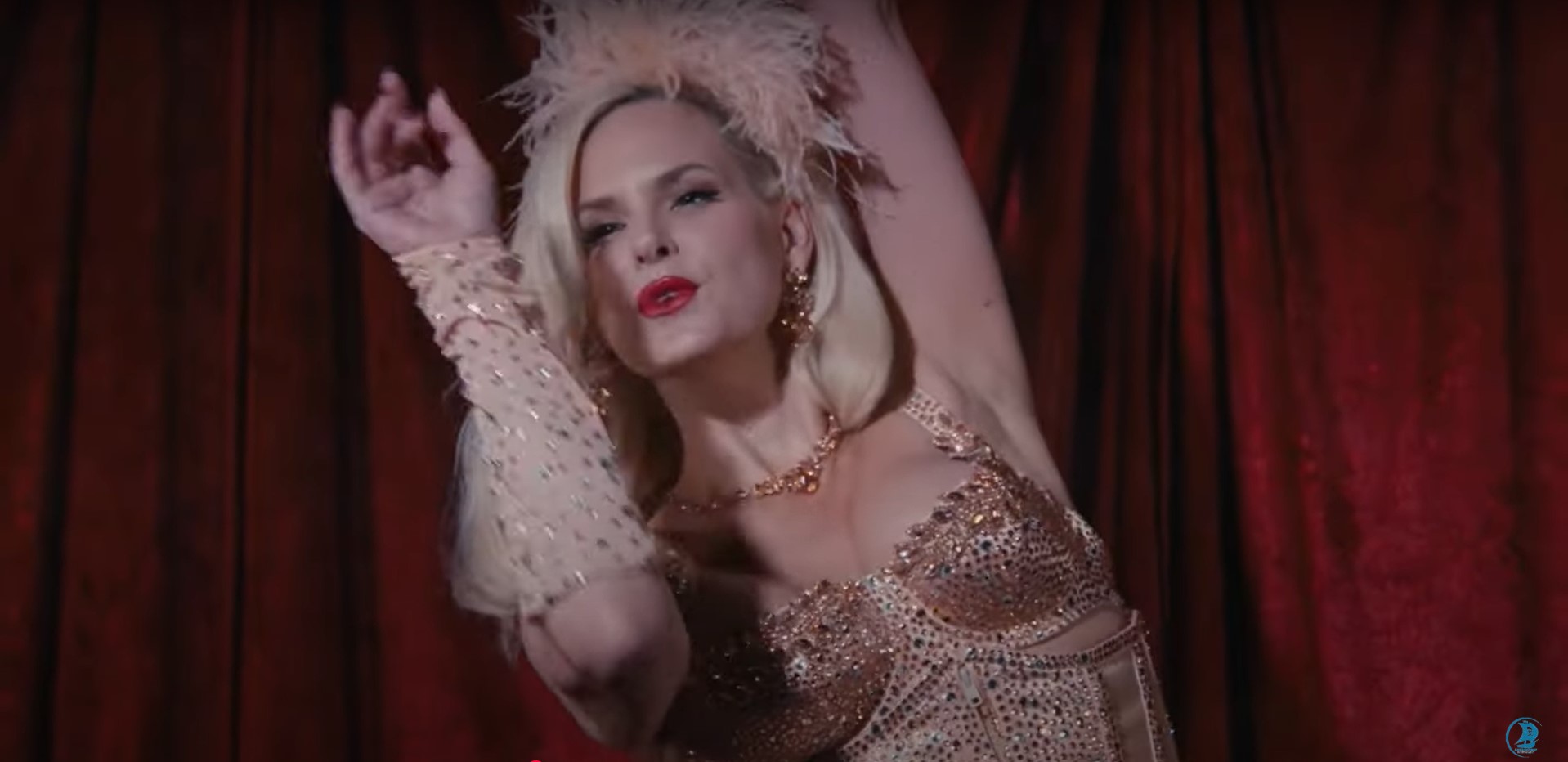
Gimme an E. Gimme a V. Gimme an I. Gimme a L. What’s that Spell? EVIL! “Cheerleaders’ Wild Weekend” reviewed! (MVD Rewind Collection / Blu-ray)

“Cheerleader’s Wild Weekend” Now Back Available on Blu-ray!

Three rival school’s cheerleader squads board a school bus heading to Sacramento to face off in an annual cheer competition.  Detoured to an isolated, less-traveled road late at night, the bus is hijacked by members of the National American Army of Freedom, a group of ex-football players given the shaft for their individualized reasons.  The play caller leading the group is Wayne Mathews, former star quarterback cut loose from his team because of a bum arm, kidnaps the bus full of teenage girls to extort a handsome ransom to get him and four of his terroristic teammates back into the game of life.  Not looking to harm one hair on girls’ heads, Wayne attempts to keep his colleagues from exploiting their bargaining chips while also keeping to the well-designed plan to evade capture and still obtain the cash prize, but when Wayne’s away, it’s up to the cheerleaders to put their differences aside, come together with their own plan, and give the kidnapper a school spirited taste of their own devious medicine.

An odd hybrid of a sexualized teen comedy, blackmail crime thriller, and sleazy exploitation, “Cheerleaders’ Wild Weekend,” also known as “The Great American Girl Robbery,” hails as a full out filching and fleshy feature from Jeff Werner as his debut feature before helming the dark comedy surrounding the atomic bomb formula-carrying monkey of “Die Laughing,” starring Charles Durning and Peter Coyote, and his subsequent move from fictional film to documentary for the remainder of his career.  The 1979 film is cowritten between D.W. Gilbert and costar and cult actor Jason Williams, “Flesh Gordon” himself.   Adult film executive producer Bill Osco (“Tijuana Blue,” “The Incredible Body Snatchers”) finances the lesser explicit skin flick after the success of “Flesh Gordon” and intense crime spree thriller “Cop Killers,” both films of which have Jason Williams in significant roles in their long time collaboration, and is produced by an onset Chuck Russell who would later go on to write and direct “The Blob” remake and “A Nightmare on Elm Street 3:  Dream Warriors.”

On the cusp adult film actor Jason Williams who didn’t mind showing some skin for “Flesh Gordon” or the parodical tune of the Lewis Carroll kid’s story with “Alice in Wonderland:  An X-Rated Musical Fantasy,” but “Cheerleaders’ Wild Weekend” was different for Williams who not only kept his clothes on for most of the picture but also tried to keep others from taking their clothes off as well.  As quarterback gone quintessential eyes-on-the-prize kidnapper Wayne Mathews, Williams co-drives the narrative from the perspective of the heist in a focused attention on staying one step ahead of the bumbling and birdbrain detectives (Marc Isaacs and Hugh Brennenman).  Kristine DeBell, who co-starred with Williams as the titular character Alice in “Alice in Wonderland:  An X-Rated Musical Fantasy, copiloted as Debbie Williams who became the representative portion of the defenseless, scared, and quite cheeky cheerleaders held captive in a rural cabin as Matthews hones in on the $2 million in ransom money.  While the black and white plan for Mathews is just that, crime comes in many shades of color, and sexuality, and in intelligence within his accomplice network of failed football teammates, a sexually pent-up buxom chaperone, and even the fleeting desires of his younger brother, Billy (Robert Houston, 77’s “The Hills Have Eyes”).  Mathews right hand man George Henderson (Anthony Lewis), Big John Hunsacker (John Albert), and Frankie (Courtney Sands) become the ultimate problem that buries the original crux of the kidnapping with sordid inclinations for physical abuse toward the girls than what Mathews has in mind and becomes the spur for the cheerleaders, including LaSalle (Tracy King, “Mansion of the Doomed”), Wally Ann Wharton (“Up In Smoke”), Deslyn Bernet, and others, to fight back against their deviant, hornier captors. 

Werner’s debut is literally a wavy rollercoaster of pulled back levity with good-time voluptuousness and a strong browbeating back-and-forth rivalry amongst of a few honkytonk barrels of laughs while, in the same breath, can be deeply troubling with its side dishes of attempted rape, verbal abuse, and sexual grooming of what’s supposed to be high school cheerleaders (or maybe College cheerleaders…it’s not very clear in the narrative).  You don’t know whether to laugh in relief or be tense with the unsettling advances.  Plenty of gratuitous nudity doesn’t help the matter as a handful of select leaders of the school packs are willing to bare skin albeit being held at gunpoint in this twofaced tale.  With lead principals Wayne Mathews and Debbie Williams, a firm position is held, a genuine felt love interest is formed, and their unspoken body language is clear to the end, providing much needed release from the grip of ebb-and-flow emotions.  Another push toward the accolades of comedy are the two detectives and a blatennt archetype of undercover cops who, in football terms, fumble their way through a sting operation to catch the crooks while the crooks, meaning the Mathews brothers, find reward and redemption, such as Wayne’s bum arm comes through tossing a bag full of $2 million through the air and into the getaway car, with their indifferent yet simultaneous compassion for the held cheerleaders.  $2 Million in $20 dollar notes is about 220lbs per my calculations so that’s one heck of a throwing arm! 

Rewind back to 1979 with MVD’s Rewind Collection label and check out “Cheerleaders’ Wild Weekend” on their new Blu-ray release.  The 1080p high-definition presentation comes onto an AVC encoded, BD25 with the widescreen aspect ratio of 1.78:1, cropped slightly from the original 1.85:1.  The print used for the transfer looks to be print from the now defunct label, Scorpion Releasing, for the company’s 2009 Blu-ray that’s been out of print for some time now.  Print care helps define a broader color palette with the occasional pop of red or yellow moments of higher contrast moments and details, such as glass speckling, groove shadows and textures of a varietal of hair color and consistencies, and other miniscule points of the milieu that emerge through, or pork through according to Courtney Sands’ large white shirt pokies, but leading into lesser light lends to a crushed blacks that swallow object definition and shape.  However, there is some print damage in the form of dust and dirt, a few instances of vertical scratching, and what looks to be cutting damage during a scene transition.  Unlike the Scorpion Releasing Blu-ray that encoded the DTS-HD MA audio codec, the MVD release uses an uncompressed English LPCM mono that sizes up fidelity of the original track.  Surprising being a 25Gig capacity, the uncompressed files appear to maximize the audio without compromising quality.  The verbose dialogue has elevated appeal without steeping to an imbalance, making every individual voice seem like they’re on the same plane of existence in the clean and clear rendition.  Ambience noise is inlaid with consideration for medium range and depth that’s required of this production, mostly close-range gunfire, tire screeches, engine noise, and chases through the brush, that are within arm’s length or a stone’s throw from the camera.  English subtitles are available for selection.  Special features are from the Scorpion Releasing’s archive with an audio commentary with director Jess Werner, actress Tracey King, and editor Gregory McClatchy, a second audio commentary with principal actress Kristine DeBell, an interview with Debell, an interview with principal actor Jason Williams, an interview with Tracey King aka Marilyn Joi, an interview with Leon Isaac Kennedy, an alternate title card sequence with “The Great American Girl Robbery,” a photo gallery, and the original theatrical trailer.  The primarily white and red colored, O-slip cover art has a retrograde façade of a VHS rental complete with mock peeling stickers and dirty edges overtop the film’s marketing of a half-naked cheerleader covered just in pom-poms.  Blu-ray Amaray case sports same image but cleaner without the faux VHS trappings. Inside is a folded mini poster of said art in the insert field and the disc is labeled pressed with the textured grooves of a VHS cassette.  The region free release comes not rated and has a runtime of 96 minutes.

Last Rites: Jeff Werner’s first feature is full of spirit and shapely misguided youth and frustrated former football players in this light sex comedy concealing darker, predatory behavior beneath the surface. “Cheerleaders’ Wild Weekend” will cause snickering and titillating excitement while also tense your gut in what’s an amalgamation of a jest and jostling, bare-chested, good-old-fashion American heist film.

“Cheerleader’s Wild Weekend” Now Back Available on Blu-ray!

No One Can Hear You Scream in EVIL Found Footage Space! “V/H/S/Beyond” reviewed! (Acorn Media International / Blu-ray)

Go Beyond the Limit with “V/H/S/Beyond.” Now on Blu-ray!

Six new tapes push the boundaries of what we know is true and what we know as reality.  Six new tapes confirm that we are not alone on this Earth or even in this universe.  Sex new tapes shows the horrors beyond our plane of existence and into another dimension of fear of the unknown.  A special tasked police force raids a house horded by violent, brainless baby-nappers only to discover the horrible creature lurking in the attic.  A megastar under the pressures to perform breaks from the mortal chains of human greed and power.  Skydiving friends encounter an alien attack miles above the Earth surface.  A doggie-daycare aims to transfigure and train people to sit, rollover, and behave like good, obedient hybrid canine creatures, a woman determined to find proof of extraterrestrial’s in the Mojave desert found curiosity didn’t just kill the cat, it also brought it back to life to kill it again and again and again, and a two flea market bought VHS self-tapings quite possibly reveal the horrifying truth of if we are alone in the world.

The next grand tour through “V/H/S” horror has entered orbit!  “V/H/S/Beyond” abducts and probes our fear receptors with invasive and terrifying cold instruments of science-fictional horror tales.  “Beyond” marks the 7th entry into the found-footage anthological franchise formed over a decade ago in 2012, created and produced by genre devotee Brad Miska under his founded, longstanding horror website Bloody Disgusting, and this entry’s theme “Beyond” denotes a sci-fi flare from the hellish man-made creations to vicious visitors from the void above.  Miska returns as producer alongside Josh Goldbloom, James Harris, and Michael Schreiber all of whom have been a part of the series since 2022’s “V/H/S/99.”  Cinepocalypse Productions, Studio71, Spooky Pictures, and Shudder serve as coproduction companies for the shorts directed by Jay Cheel “Abduction/Adduction,” Jordan Downey “Stork,” Virat Pal “Dream Girl,” Justin Martinez “Live and Let Dive,” Christian and Justin Long (yes, that Justin long from “Jeepers Creepers” and “Tusk”) “Fur Babies,” and Kate Siegal “Stowaway.”

“Beyond” introduces a variety of situations, mostly flipping between man-made mistakes to alien encounters, with a medley of spirited characters to shepherd the shorts where they need to end in a timely outcome.  Each found footage story is inherently different with no two situations nearly alike, keeping to the same synonymous rhythm that has garnered fandom for the “V/H/S” anthologies.  The wraparound segment has the facsimile of a mystery documentary of two flea market purchased tapes that are believed to be evidence of alternate life beyond this universe with mock interviews given by the actors casted in the film – Brian Baker, Gerry Eng, Sam Gorski, Mitch Horowitz, Wren Weichman, and Trevor Dow discussing the history of tapes and the house they’re filmed in, social alien background and perception, and determining if the tapes are authentic.  Like all the other wraparounds, story progression is interspersed between the five other shorts with the first being “Stork” where the special police task force W.A.R.D.E.N. takes the fight to the paranormal.  Officers Broome (Thom Hallum, “Bull Shark”), Aubert (James C. Burns, “Lake Dead”), Bennet (Jolene Andersen, “Doctor Death”), Ivy (Tyler Andrews), and E.T. (Vas Provatakis, “Children of the Pines”) storm an infested monster house with rookie Segura (Phillip Andrew Botello, “Devil’s Revenge”) to save stolen infants.  From here, paparazzi Arnab (Sayandeep Sengupta) and Sonu (Rohan Joshi) find themselves at the mercy of an all-powerful and vengeful goddess in megastar Tara (Namrata Sheth), birthday boy Zach (Bobby Slaski, “White Terror”) finds himself free-falling into an alien invasion, doggie daycare owner Becky (Libby Letlow) is dead serious about Frankensteining the purrfect fur babies, and UFO researcher Halley (Alanah Pearce) will find that discover the truth will be a painful purgatorial experience.  “Beyond” brings a wide range of talent to the table with ensemble casts, streamers, Bollywood actors, and solo preformists to exact another side of fear for the franchise with a principal supporting cast rounding the anthology with Virat Pal, Rhett Wellington, Hannah McBride, Matthew Layton, Braedyn Bruner, Phillip Lundquist, and Kevin Bohleber.

One would think an anthology series built upon the idea of a found footage would eventually become stale amongst the public who are feeling the fatigue of an overused subgenre, much like the zombie subgenre in the early 2000s to early 2010 where every George Romero wannabe with a handheld camera set out to either homage or hit it big with the next undead head success.  Found footage is currently, or rather vaguely, in the throes of being overworked because of how cost efficient and effective films of its ilk can be to those inspired to create.  However, the “V/H/S” series hits differently.  For one, it’s an anthology series that brings a fan of imagination to its whole and we’re not subjected the one type of found footage narrative as dissimilar styles, tastes, direction, writing, etc., converge by means of short films.  Another element of “V/H/S” staying power is the series created and developed by genre admirers, such as Brad Miska whose veins course with literally nothing else but the blood cells of the horror.  Lastly, “V/H/S” continues to evolve by colliding past and present, nostalgia and current, and myth and fact together with a serrated surrealism that can thrill you with, often times, hell on Earth entertainment as well as scare the living bejesus out of you.  “Beyond” maintains the trend by coming out of the 80’s and 90’s vibe from the last three installments and diving headfirst into beyond the scope of traditional monsters, terrestrial creatures, and iconic monsters for nothing born of his Earth, such as with the wraparound story, “Stork,” “Live and Let Dive,” and “Stowaway,” and nurturing more a mad-science madness in “Dreamgirl” and “Fur Babies.”  A possible detriment to “Beyond’s” ability to connect with fans of fear and frights with the latest entry leaning heavily on the physical side of action-gore that sometimes is a tall order of campiness rather than the instillation of underlaying, psychological terror aside from the Mike Flanagan (“Oculus,” “Doctor Sleep”) penned “Stowaway” that evokes some segregated space isolation and a death-defying situation that still feels the repetitive painful sting.

“V/H/S/Beyond” lights up the night sky with blood red intergalactic splatter and takes mad science to a whole new abominable level with a new Blu-ray from the UK label Acorn Media International.  The AVC encoded, 1080p high-definition, BD50 presents the film in a widescreen 1.78:1 aspect ratio with an occasion retro-slip into pillar box 4:3 for that VHS façade.  Image presentation ranges because of the home movie, handheld camera, and body cam found footage trope that’s this series bread-and-butter.  Through the intended static, interlacing and tracking lines, fuzzy darkness, quick movements, and mostly whichever video interference objects one can think of, minus authentic celluloid print damage, to pseudo-sell found footage realism.  The outcome is superbly effective and highly captivating albeit moments that are too agitated to understand and connect objects and sounds in the narrative, another part of the collective that makes it effective yet also makes it wasted runtime space for viewers.  What’s not wasted is the chainsaw point of view in “Stock” where ripping through and decapitating monsters has DOOM inspiration all over it. A majority English with some Hindi DTS-HD 5.1 surround sound mix is, too, designed to mimic the gimmick of handheld found footage. Distortions and other audio mic cuts and external interference on the audio system are included to sell the illusion and are often done at great detail in time, overlay, and spatial fractions in-between viewer and what the view is experiencing on screen. Depth is mostly front loaded within the context of first-person viewpoints while the surrounding channels take a subtle backseat but whisper through when there’s a sound behind the camera. LFE charges in during more rambunctious moments, which there are a lot of, and are not quelled for the sake of dialogue that’s mostly discernible when necessary. English subtitles are available. The encoded special features on a static menu include the pre-visuals of explosions, disintegrations, and free-falling bodies on the practical skydiving of the cameraman explain how many jumps were needed to put the pieces altogether for that breathtaking scene at 20,000 miles in the sky, actress Libby Letlow’s audition tape for Becky in the “Fur Babies” short, the making of “The Dreamgirl,” a behind the scenes of “Stork” with IGN, and the how the timelapse was created in “Stowaway.” Physical areas of the releases are about the same other Acorn Media Releases with the thicker UK Amaray casing that has the illustrated cover art of the “V/H/S” thematic skull worked into the swirling steller-laden of scary space. Inside is just the disc pressed with the same image art. UK certified 18 for strong violence and injury detail, “V/H/S/Beyond” has a runtime of 114 minutes and is not noted on the back cover in regard to the region playback, usually Acorn Media releases are hard encoded with region B, but this particular release play on a Region A setting and could be very well region free.

Last Rites: The “V/H/S” team continues to maintain a sustainable supply of fresh meat for the grinder in relation to its current theme. Plenty of splatter, mayhem, lunacy, and backbone quivering chills to get lost in “Beyond’s” cosmic Hell. Can’t wait to see what’s next in store for the anthology!

Go Beyond the Limit with “V/H/S/Beyond.” Now on Blu-ray!

Mother Russia’s Most EVIL Serial Killer is “Evilenko” reviewed! (Unearthed Films / Limited Collector’s Edition 4K UHD and Blu-ray)

Limited Collector’s Edition 4K and Blu-ray Available Here!

Kyiv, 1984 – An aging schoolteacher named Andrej Evilenko is stuck in Josef Stalin’s quickly dwindling sociopolitical communism party and finds himself dismissed from the school after being accused of attempted rape of one of his preteen students.  His release from vocation obligates him to write letters to the Communist party still clinging to control and from those letters comes a job with the KGB under the guise of a railroad inspector.  Evilenko’s empowerment by the party drives his dangerous urges to rape, kill, and cannibalize women and children over years around Kyiv and Crimea, using his position of inspector to travel.  In 1987, Magistrate inspector, Vadim Lesiev, is assigned by the D.A. to hunt down the serial killer who has by then murdered over 30 victims.  Over the course of the next eight years, Lesiev finds himself chasing his tail and fearing for his own family’s safety against a monster that has all of Kyiv frightened. 

Based off the true crime story of notorious Soviet Russian serial killer Andrei Chikatilo, “Evilenko” tells the fantastically frightful tale of the real “Butcher of Rostov” who did confess and was convicted for rape, murder, and the cannibalization of 52 young women and children, of both sexes, from 1978 to 1990.  The Italian-English production is spearheaded by Italian filmmaker David Grieco who directs the film as well as supplies the story’s base material from his own semi-biographical novel on Andrej Chiktilo, entitled “The Communist Who Ate Children” (“Il comunista che mangiava i bambini”).  Grieco, the son of the of the founding members of the Communist party, finds a financial means to produce a visual adaptation from Britain’s Pacific Pictures consisting of Michael Cowan and Jason Plette of “Killer Tongue” and produced by Italy’s Mario Cotone (“Malena”), representing the MiBAC, the Italian Ministry of Cultural Activity.

Who better than to portray a variant of the child molesting, murdering, and eating Soviet Andrej Chikatilo than Malcolm McDowell, the British actor who is no stranger to controversial films and performances having the lead roles in both Stanley Kubrick’s celebrated violence in a dystopian society in “A Clockwork Orange” and in the pornography spliced infiltrated titular performance film of the sultry period drama “Caligula.”  Being older and wiser doesn’t phase McDowell to shy away from committing to difficult scenes involving minor aged costars, especially scenes with sexually ambiguous dialogue and being pants less while speaking it, and while not a physically demanding role for McDowell nor is it filled with the intense-eyed actor’s usual fiery fervor, but in the shoes of Evilenko, he nails down the real serial killer Chikatilo’s exterior appearance, despite attempting to make McDowell appear younger with just only a wig to convince audiences of the 20-year span in the story, and touches upon the oddities and the quirks that make Chikatilo a delusionally faithful comrade, justified by his own investment into the communist party.  Evilenko’s archnemesis comes in the form of district attorney magistrate investigator Vadim Lesiev, played by the underutilized New Zealand born actor Marton Csokas (“Lord of the Rings,” “Cuckoo”).  “Evilenko” is clearly the Malcolm McDowell show but Csokas gives his all to a man not only doing his duty as an official of the Russian pervading prosecution but also as a family man haunted by his inadequacies and his inabilities to catch the perverted serial killer that might just strike close to home, putting Lesiev on edge with that nagging worriment.  Grieco’s editing and story development greatly undercurrent Csoka’s motivations and plights, distorting his complexities to a minor key of his true self, and letting McDowell have free reign over his subsidiary counterpart.   Yet, neither character is fleshed out definitively, none to compel a reason for their idiosyncratic methods and behaviors, which goes hand-in-hand with the purgatorial editing that is loose with the timeframe.  Ruby Krammer (“Alien Exorcism”), Frances Barber (“Superstitition”), Vladimir Levitskiy, Ihor Ciszkewycz, John Benfield (“Hitler’s S.S.:  Portrait in Evil”), and Ronald Pickup (“Zulu Dawn”) as a psychotherapist assisting tracking down the killer.  

As much as the Grieco and McDowell dynamic works to monstrously depict a coldhearted and crafty serial killer coupled with a sliver of slithering supernatural propensities to lure women and children in a fixed trance or, in more conventional means, into doing what he wants with an spellbinding combination of stares, manipulative conversation, or just overall emitting a towering communist cloud of authority, “Evilenko” is deflated by the story’s time lapsing.  Opening with Kyiv 1984 and then subsequently in Crimea five years later in 1989, the noting of years or periods is hereafter eliminated from the narrative that becomes a back-and-forth yarn between a select of Evilenko’s pied piper lures and kills and magistrate Lesiev always behind the eightball pursuit of the elusive, unknown killer.  There’s a loss of sight on Lesiev’s psyche that is very important to the story and more so at the climatic interrogation scene where both men are stark-naked in a power and controlling situation that harks back to Evilenko’s mesmerizing tactics used against the adolescent prey and Lesiev’s fear and obsession of losing his family to what once was an uncatchable slaughterer who hallmarked with mutilation and devouring.  Grieco’s willingness to be grisly is tamer than the expected based off the prologue scenes of Evilenko exploiting and nearly raping a preteen girl but doesn’t take away the effect that the entire narrative arouses an uncomfortable experience teased to always be on the edge of overly graphic but never breaking that threshold; “Evilenko” is one of the biggest blue balls instigators is in last 20 years and that rush of not seeing or knowing can be more thrillingly charged for some than anything totally explicit ever could produce. 

Unearthed Films limited collector’s edition has 2-disc, dual format capacity with a 4K UHD and Blu-ray.  The second 4K UHD from the label, behind their release of “The Guyver,” solidifies the extreme horror company a player in the ultra high-definition game.  The New 4K transfer restoration of the original camera negative is HVEC encoded, presented in a widescreen 1.85:1 aspect ratio with 2160p UHD, on a massive three layered BD100.  The Blu-ray comes AVC encoded, 1080p high-definition, on a BD50, presented in the same aspect ratio.  What’s gathered from both presentations is that there’s nothing to fault them with as both excel to their max output abilities.  In fact, the transfers are pretty much identical, integrally achieved by digital optimization of an already optimized digital camera, a Sony PMWEX3 with 35mm adapters, which at that time was the bigger brother and flagship model of the Sony line.  A slight grading reduction instills a sense of austere or lackluster coloring that mocks a communist Russia veneer.  Close ups on McDowell’s unique features and the expound of particulars in the surroundings, especially when engulfed in leaf-covered and tree-thick woods, tell of the emerged details and textures in a higher pixel count.  An English DTS-HD 5.1 Master Audio is the sole mix available.  The back and side channels are essentially used sparing for a few flakes of brief ambient hubbub in what’s mostly a frontloaded conversational piece of mostly McDowell in one of his great monologuing moments. We get some nice oblong orchestral pieces from the late David Lynch regular composer Angelo Badalamenti (“Lost Highway,” “Twin Peaks”) that incorporates haunting harmonies and soft, ethereal vocals that play into the loss of innocence theme. Dialogue’s healthy and prominently favorable next to the unchallenged low ran range. English subtitles are available for selection. The BD100 offers only the feature, and a new commentary track with director/writer David Griece and star Malcolm McDowell while the Blu-ray offers the same commentary plus Evilenko Dossier: Andrei Chikatilo, the examination of the real killer against the onscreen rendition, cast and crew interviews with Grieco, McDowell, and Badalamenti, a photo gallery, and the original film trailer all within the bonus content of a fluid menu with Badalamenti’s and vocalist Dolores O’Riordan’s main track “Angels Go to Heaven.” The limited collector’s edition is housed in a cardboard slipcover of one of the many variants of Malcolm McDowells face slathered in soviet red. The black Amaray has the same cover art with no reversible cover. The discs are snap-locked in place on opposite sides, pressed with another slathered in red image pulled from powerful interrogation scene between Evilenko and Lesiev. Both formats are not rated, locked region A encoded, and have a runtime of 111 minutes.

Last Rites: “Evilenko” is a heavy story that needed to be told. You don’t hear much about the USSR vulnerability and the real-life serial killer had frightened the proud, the stoic, and the impoverished alike as “Evilenko” seers as a case study mental illness, is a metaphor for deteriorating Communism, and a tale too terrible to forget and despite some pacing issues and timeline infractions, Grieco and McDowell pull off a rather nasty semi-doc of one of the worst killers to ever live.

Limited Collector’s Edition 4K and Blu-ray Available Here!

EVIL Manga to EVIL Movie! “Liverleaf” reviewed! (SRS Cinema / DVD)

“LIverleaf” Pushes Through the Bleak to Shine. On DVD Now!

The move from Tokyo to a dwindling rural town hasn’t been easy for middle schooler Haruka.  Most of her classmates have grown up with each other and formed vicious cliques that bully her relentless during and after school.  Mitsuru Abu, a photography enthusiast and Haruka’s classmate is also an outsider but has family ties to the area, is about her only friend and whom she finds attractive.  Upon returning home after spending the day together, Haruka finds her family home engulfed in flames, her mother and father dead, and her little sister severely burned over her entire body.  The loss of her family, her only emotional support, mentally compromises Haruka’s self-control and sends her spiraling into a revenge fueled murdering spree, targeting her bullying classmates who had a hand in the inferno of her family home.  The root of malevolence is not as it appears on the surface, and it will be up to Haruka to kill her way in finding the truth and reveal the secrets.

Adapted from the popular manga series, “Misu Misō,” written by Oshikiri Rensuke, the film version incorporates the indelicate dramas of being a school age teen in while reproducing faithfully the graphic gore, violence, and disturbing nature of character of the series in great detail.  Titled “Liverleaf,” as in the resilient, mountainous found three-lobe leafed flower that resembles the human liver and can withstand harsh winter conditions, is helmed by “Let’s Make the Teacher Have a Miscarriage Club” director Eisuke Naitô and penned by Miako Tadano of “The World of Kanako,” another manga-based film adaptation.  The 2018 film, which can be described as a revenge-drama with particle elements of horror, is shot in one of the snow-covered foothills of Japan’s mountain regions and is produced by Shigeto Arai (“We Are Little Zombies”) under the production banners of the Nikkatsu Corp. and the L’espace Film Co.

Anna Yamada is in the lead role that’s very familiar and culturally significant to Japanese cinema.  A scorn-born femme fatale that’s merciless and personnel, the kind of role that Quentin Tarantino exacted in his tribute to Asian revenge narrative with “Kill Bill,” starring Uma Thurman, hunting down the offending party and dispatching the scum from the Earth in a one-by-one fashion.  The “Suicide Forest Village” actress Yamada headlined “Liverleaf” as mid-to-late teen portraying the manga series’ preteen or early teenage girl Haruka Nozaki.  She isn’t the only nearly adult woman to play a teen in the throes of hormones, peer pressures, and angsty conditions sideswiped by wickedness and a taste for dominance as the whole student body pretends to be a youthful waste in a snowy, mountainside village on the verge of collapse.  Howling Village’s Rinka Ôtani, as Taeko Oguro, stands out with her bright orange hair and a sense of indifferent authority being the supposed head of the gaggle of bullying girls.  “Liverleaf” is Ôtani debut picture and Ôtani would eventually reteam with Yamada on “Suicide Forest Village,” but their first dichotomized performance as protagonist and antagonists brings a palpable tension to the screen.  Throw a boy both girls stoically can’t admit with a lot of expression and that pressure pot grows into an ugly shape of jealousy spurred love triangle.  Mitsuru Aibe is tall, handsome, kind, and a photography buff always looking for the raw and beautiful moment to capture on film.  Played by Hiroya Shimizu, “The World of Kanako” and “Sadako” actor instills that hope for the future and a glance of stability amongst the opposing craziness that has ensued between the rebirthed revenger Nozaki and the horrible highschoolers now fearing for their lives because of their responsible part for the monster they’ve created but does he really provide a safer, greener pasture Nozaki needs to return to once her retribution is complete?  Kenshin Endô, Masato Endô, Reiko Kataoka, Seina Nakata, Arisa Sakura, Aki Moita, Minoir Terada, Kazuki Ôtomo, and ReRena Ôtsuka are cast in one messed up and depressive high school student body that ends in a blizzard of bloodshed.

One thing about “Liverleaf,” if looking at and considering all the components of the feature as a whole, to take away from the adaptation is how Eisuke Naitô facsimiles the plot points of a manga series or, in more general terms, Naitô” has plucked the rudimentary concepts straight from any regular extreme manga series, not just from Oshikiri Rensuke’s Misu Misō.  Yet, “Misu Misō” is very faithfully extracted from the illustrated pages for live action execution down to many of the details with very few changes to the story’s original design. Gore has an extreme graphic nature juxtaposed against the snow, contrasting in homage to those historical revenge genre films set in the same harsh, white blanket, and like all the heroines, or anti-heroines, Haruka Nozaki speaks her soul in her outfit, dressed in a continuously deepening red after each gruesome dispatch of her classmates.  This saturation into crimson extends into this belief that Nozaki is bordering being supernatural, like most condemned women done wrong, who somehow find the superhuman strength, endurance, know-how, and resilience in their own disdain for blood and violence to slay beyond their normal means without batting an eyelash.  “Liverleaf” is not the chippiest of narratives with a coursing core of grim doom and gloom through a quickly dilapidating little town with an austere school, junk pits, and modest structures that inhabit indifferent teachers, brooding teens, and a mental illness that ranges from inherent sociopathy to social sociopathy of peer pressures and bullying. 

SRS Cinema brings manga pen and paper to the big screen with their unrated DVD release of the film adaptation titled “Liverleaf.”  The MPEG2 encoded, upscaled 1080p, DVD9 release is presented in a 1.78:1 aspect ratio.  “Liverleaf” stands out unusual from the other SRS releases, a company that prides itself on standard definition 480 and 720 resolutions and compressing features and their special features onto a packed DVD5 that creates eye artefacts on already low budget, commercial grade, inexperienced film.  Instead, “Liverleaf” has punchier colors and distinction on that segregates the austere from the vibrancy and the extra space helps allow for this decoding to be as smooth as possible on what some may now consider an antiquated format.  Decoding at a higher range of 7-9Mbps, compression imprudence doesn’t show itself here with a clean picture that retians inky voids, charted snow mounds and footprints in a white sheet of snow, and the colors and details on objects that natural enlarge themselves when in contrast, such as Nozaki’s red jacket or the red, orange, and yellow glow of house flames against the night sky.  The Japanese LPCM 2.0 stereo renders a clean mix of dialogue, ambience, and soundtrack.  Dialogue’s clean, crisp, and clearly upfront of a subdued diegetic sound mixed from the boom mic or from post and a Hisashi Arita soundtrack that scores Japanese revenge in non-traditional Japanese notes.  Post mix and action does create some separation that uncouples the visual onomatopoeia of the activity but remains negligible throughout.  The burned-in English subtitles synch well and are error-free.  Extras include a featurette from Manga to Movie that goes into the history of manga and the adaptation concept which most thought the film couldn’t be adapted, Elijah Thomas supplements with his own thoughts and opinions on “Liverleaf” as well as another featurette titled Liverleaf’s Obsession that looks at the character’s dangerous obsessive qualities, the trailer, a Oshikiri Rensuke, biography The Comically Twisted Mind of Oshikiri Rensuke with narrator voiceover going into the writer’s family history and “Misu Misō” genesis, the trailer, and talent files on Anna Yamada, Eisuke Naito, Hiroya Shimizu, Miako Tadano, and Rinka Otani.  These features house behind a static menu, that only has a play option alongside the extras, with a neat art illustration of a murderously ominous Naruka Nozaki.  The cover art hints at the film’s stark contrast aesthetics with a Naruka Nozaki wrapped her red coat and jetblack hair sprawled out on the white snow.  The Amaray does not come with a reversible cover nor any tangible extras inside.  DVD has region A only playback and has a runtime of 114 minutes. 

Last Rites: “Liverleaf” is a surprising, better-than-no budget teen revenge thriller that deals with obsession, depression, and a consternation that Haruka’s tragic journey through the pits of a lowly high school hierarchy will only get worse before it gets better.

“LIverleaf” Pushes Through the Bleak to Shine. On DVD Now!

There’s No EVIL Magic Cure for the Inevitable. “Bag of Lies” reviewed! (Dread / Blu-ray)

See What’s in the Bag! “Bag of Lies” on Blu-ray!

When everything seems to be going Matt and Claire’s way with a strong marital bond, a beautiful house, and rising careers, life throws them a nasty curveball – Claire is hit with inoperable, terminal cancer. Laid up in bed, her weak immune system and fleeting strength are spent on retching up the remains of the chemotherapy treatments she suddenly quits. Matt, under a considerable amount of pressure in losing his wife, has tried everything from conventional medical treatment to the snake oil practices of holistic cults. Desperate for a cure, Matt turns to a man and his bag. Not just any bag, but a bag given the right ritual and stated purpose will produce all that Mark desires and, in this case, the return of his wife’s good health. The man warns that rules must be followed and when Matt can’t uphold his end of the agreement, what he wishes for will still come true in a way most unpleasant.

“Bag of Lies” is the 2024 released supernatural thriller to boldly state that no matter whatever miracle cure is trialed or desperate attempted, one can’t stop the juggernaut of grim inevitability, and if somehow, someway one beats the momentous odds, nothing will ever be the same again or, perhaps, it will be worse.  Debuting his first feature, David Andrew James is the mastermind behind the screen treatment of the story, directing and writing the shooting script based off a story by Nick Laughlin, known for his art and props on “Wrong Turn” remake and “Bones and All,” and “Clever Girl” creator Joe Zappa that tackles one of the more painfully enduring occurrences of impending loss, the slow and excruciating rot of cancer that selfishly takes everything and all anyone, especially loved ones, can do is sit and watch the wasting away from internal consumption of being.  “Bag of Lies” is another Dread Presents and Traverse Terror collaboration, produced by Dread and Epic Picture’s Patrick Ewald and Matt Cleckner alongside Spencer Frazen, Joe Hui, Victoria McDevitt, Jake Heineke, and director David Andrew James.

One of the problems “Bag of Lies” has lies with the married couple Matt and Claire Quimby, played respectively by Patrick Taft and Brandi Botkin (“Bystanders,” “Wicked Ones”).  The problem is not chemistry as the affectionate teasing and relationship frustrations are the hallmarks done right to reflect any kind of amorous partnership on screen and the fact that Taft and Botkin have previously collaborated also makes establishing an already established couple a lot easier but the latter has been under different roles and conditions with Taft producing projects, such as “Wicked Ones,” and both also having roles in the same television series entitled “Wildfire” but overlapping only once in their own three episodes span.  The problem falls upon how their characters got to be where they are now and that creates an injustice to that particular unpleasant side of the story because the audience never experiences the good times the Quimby’s once had before cancer strikes at Claire, not even in a remote sense, and that ultimately fails them because its hard to fall long and hard if not privy to the height of their good fortune.  The lack of backstory extends to the supporting cast with Matt’s awfully empathetic cousin Harold (John Wells, “The Possessed”) who hangs around, brings over a 6-pack, and occasion reworks their basement to surprise Claire with an in-house music studio, more so the former two, and the mysterious man Al (Terry Tacontins) who offers or is sought out or is just happened upon, it’s unclear, the even more mysterious bag option to Matt with a vague understanding of instructions or the cost of what he’s about to unleash or sacrifice or both.  These supporting characters lack of reason for being a cog in the bigger machine seems happenstance rather than necessary to the progression or the problem in what evolves into more of a three-way triangle between Matt, Claire, and an unusual young woman sneaking into their house and property and has a quirky laugh and a dark circle on her palm, played by Madison Pullins (“Baby Oopsie: The Series”).  Aja Nicole and a Kayla Theis round out the cast as Matt’s doctor friend Gwen and local bartender Lilly who has loved one ailment issues that parallel to Matt.

The title “Bag of Lies” is a spin on the idiom a pack of lies, defined as a grouping of false statements or information led to deceit.  “Bag of Lies” plays and preys upon that deception of an all-in-one, quick-and-easy remedy aimed to be a cure-all when, in reality, the thing to solve all your problems is nothing but snake oil that builds hope out of desperation, that sees confidence stemmed from false promise, and instills blindness to the consequences it delivers.  David Andrew James favors suspending in disbelief more than what’s comfortable as Matt experiences haunting visions of ominous means to an end yet doesn’t seem too bothered to really dig into the background and so the story flounders in the second act with Matt just experience weird and frightening sights and sounds without even an attempt to explain, until near the end.  Frankly, if I kept seeing a quirky, quizzical madwoman constantly around and inside my house, the cops would be on speed dial.  Instead, Matt lets himself be silage for the taking, cut off from the rest of reality for the most part without ever going to the authorities, without ever confiding in his friends, nor without ever digesting his experiences and talking about it with his wife, who is usually part of the strange visional equation.  That isolation plays into the burdening effect of trying to beat the odds by doing it yourself and not asking for help, which is definitely being depicted here in Matt’s own surreal nightmare, but the lackadaisical effort and having one peculiar instance roll over him after another breaks down the story’s credibility.  Much like the cancerous rot that’s eating his wife from in the inside out, Matt’s own rot origins from being stagnant and it’s that do-nothing that bears the consequences of terrifying transfigurations in not only his sweet Claire but also in himself. 

“Invasion of the Body Snatchers” interlocked with desperation and a melancholic longing is how the “Bag of Lies” shapes fictional hope around a wrenched inevitability, similar to what the French author Guy de Maupassant once said,, “ the only certainty is death.”  Dread and Epic Pictures brings home an unrated, AVC encoded, 1080p high definition, BD25. Presented in a widescreen 2.40:1 aspect ratio.  Brandt Hackney’s shadowy cinematographer has a fairly nature presence in natural daylight sequences but utilizes a quite a bit of low-level, low-frequency lighting to create a soft incandescence and low-contrast shadows spreads.  Much of the same textures and colors are shown over and over and without that breadth of diversity, comparing scene-by-scene details are more than slim but what’s apparent is subordinate to the atmospheric lighting, or lack thereof, to create moody, broody dark house settings with little light to expose detail and color.  Even in bar sequences, the dimness doesn’t allow detail.  The English audio offerings are a Dolby Digital 5.1 and a Dolby Digital 2.0 Stereo. What’s uniquely about the “Bag of Lies” audio facet is the distinct distortional soundtrack by James Paul Bailey who, in his own words, could never recreate or repeat the score again because of the randomized tones and feedback produces by temperamental distortion boxes, overlayed and modulated to produce a one-of-a-kind soundtrack to parallel the rotting horror “Bag of Lies” corkscrews into. Dialogue does the job with a clean and clear rendering by an indifferently satisfying sort of humdrum performances unfazed by the surrounding sideshow of black bag magic and the curious curiosity that’s emerging vocally from within its capacity. There’s decent localized range within Quimby house with conversating interactions with a door or a vent in between, using post-production to fill in hurling diatribes from the basement below toward Matt in Claire’s voice. English and Spanish subtitles are optionally available. Special features include a brief behind-the-scenes featurette with cast interviews voicing their deconstructing opinions about the story. Though not listed on the back cover, there is a longer, more in-depth featurette around James Paul Bailey’s distortion oeuvre for the film that’s quite comprehensive, plus the film’s trailer and other Dread Presents film trailers. Physical features are just like all the other bare minimum Dread-Epic Pictures release with a standard Blu-ray Amaray and no inserts. The cover illustration has clunky written all over it with a photoshop job of what looks like a giant dirty taco, but it’s the titular bag, with a dirty disfigured hand reaching up and out. The release has a region A playback and has a runtime of 96 minutes.

Last Rites: Neither great nor is it terrible, “Bag of Lies” skips a few key steps toward being a promising indie horror and though the theme is poignant, fantastical, and infused with a jarring soundtrack, the ironic inevitability is there is no cure for what can’t be fixed.

See What’s in the Bag! “Bag of Lies” on Blu-ray!