Expectations Lead to EVIL in “The Cool Lakes of Death” reviewed! (Cult Epics / Blu-ray)

Set in the early 1900s, Hedwig’s childhood is filled with love, wealth, and innocence, but when her mother dies suddenly at the hands of typhoid, life turns complicated as death, draconian religious teachings, and an uncompassionate home clouds Hedwig’s mind on what exactly her relationship with men and with God should look like.  Punished for self-pleasure and scolded for her belief in fantasies, Hedwig enters adulthood as a conformist seeking to marry a well off man and have children in what was supposed to be the perfect union that reveals in sexuality the secret to marriage.  Prim and proper on the outside but a child on the inside, Hedwig misjudges her affairs with men and indulges in a pretense relationship with them.   When she finally finds happiness with a renowned pianist and the two have a child together, Hedwig’s hold on reality snaps as the child dies a few days later, sending the once elegant Hedwig into a tailspin of unhinged mental stability, drug addiction, and prostitution. 

“The Cool Lakes of Death” is the adapted film based off the Netherlands novel from the dual profession novelist and psychiatrist, Frederik van Eeden, entitled Van de koele meren des doods, which closely translates to “The Deeps of Deliverance,” a psychological period piece and melodrama with themes on the antiquated God-fearing expectations of a 19th century young woman, the solidity of marital unions, and a woman’s sexual liberation.  “The Cool Lakes of Death” is the follow up directorial from “A Woman Like Eve” director, Nouchka van Brakel,” off a screenplay written also by Brakel and co-written with Ton Vorstenbosch.  The exquisite tragedy of a woman submerged in societal misconceptions of love that can’t be forced and the mutuality of pleasures is yet another Dutch production from producer Matthijs van Heijningen and his company Sigma Film Productions, who have overseen a handful of Brakel films including “The Debut” and “A Woman Like Eve.”

Understanding the mixed emotions of a young girl in the throes of self-discovery, with a pinch for the dramatic flair, Renée Soutendijk gives a prismatic performance, glistened in a stringent social dogma, of hope and pity.  The Netherlands actress, who had the role of Miss Huller in the 2018 “Suspiria” remake, the inundated Hedwig, friends call her Hetty, who has inexhaustible amount of hope in her search for passion, but insurmountable roadblocks and obstacles corrupt Hetty’s mental processor.  Soutendijk’s elegance has a soft innocence to it, a naïve virtue that contrasts bleakly against the subtle and not so subtle influencers of Hetty’s life and Soutendijk really opens our eyes when Hetty’s full blown crazy in a clear and precise moment of snapping her rationality like a dried and brittle twig.  The performance digs at you and Brakel exploits the worst (good cinematically) parts of Hetty’s break that has her be a wild, naked woman thrashing, spitting, and puking in a locked room of a psyche ward, injecting needles into her arm night after night after selling her body to unscrupulous men, or even stuffing her newborn baby into a duffel bag and heads off to sea to search for her husband Gerard, a subdued, appearance concerned gay man that never cared physically for Hetty, played by Adriaan Olree in his debut performance.  Hetty comes across two other lovers; one a flyby and compassionate artist Johan (Erik van ‘t Wout), who would have matched her passion, but not her social status, and, eventually, she finds much of what she seeks in a renowned concert pianist Ritsaart (Derek de Lint, “When A Stranger Calls” remake), who refuses to admit their relationship in fear of scandal and ruin of his career.  Along the way, Hetty listens more to her blinded heart than she does her logical mind when intaking sound advice from advocates of her wellbeing as Ritsaart’s best friend Joop (Peter Faber, “A Woman Like Eve”), her best friend Leonora (Kristine de Both), and a hospital nun (Claire Wauthion) attempt to steer her toward a happier existence. 

I really can’t get enough of Hetty unable to secure her ideal happiness.  That might sound a little inconsiderate but what is a perfect relationship?  Brakel explores how an sought ideal can turn into a damaging expedition for the white whale.  Instead of being the ill-fated, hellbent Captain Ahab, Hetty’s land based monomaniacal drive of fairytale love becomes her ultimate downfall, sinking her deeper into the depths of despair, loneliness, and a cataclysmic separation from reality.  Gerard wasn’t perfect because he secretly longed for men, Johan didn’t have the right social stature for a lady of her status, and Ritsaart kept their love hidden below the public eye.  There’s a quite a bit of feminism loitering around in that last statement with a touch of selfishness to no fault of Hetty’s and all circulate back to some sort of suppression whether it’s sexually or emotionally umbrellaed by patriarchal doctrine, discourse, and discipline.  The culture toxicity is so severe that the older generation of women are beguiled by it’s power to be controlling others themselves under the thumb of a male-dictated society as we see in Hetty’s Governess in tattling on her pupil’s every move to her wimp of a widowed father.  “The Cool Lakes of Death” is a beautiful disaster in almost a sing-songy narrative delivered by director Nouchka van Brakel’s mighty delicate touch. 

For the first time in North America and single in a trilogy of Nouchka van Brakel releases from Cult Epics, as well as in a trilogy boxset, the 1982 downcast drama “The Cook Lakes of Death,” arrives on DVD and Blu-ray home video.  The New 4k High-Def transfer is scanned from the original 35mm negative with an impeccable and nearly blemish-free restoration.  The film is presented in the European matted widescreen, 1.66:1 aspect ratio, with plenty of good looking natural grain and a softer image in the trashy romance first act then to a harsher, grittier quality during the time of her ruin under the eye of Theo van de Sande who ventured from the Netherlands to the U.S. later in his career and worked on Joe Dante’s “The Hole,” “Little Nicky,” and “Blade.”  A couple of whip pans into deep focus shots enrich the production, a technique that has served Sande in his later work.  The Dutch language DTS-HD Master Audio 2.0 lossy audio is as good as this title will ever see without an actiony framework.  Dialogue is completely discernible with well synched English subtitles.  A few pops in the span but no major damage to the audio to speak about in length.  Soundtrack has barrier moments of muffled penetration.  Not too many special features to touch upon with the theatrical trailer, a poster and sill gallery, a 1982 newsreel unearthed from the Polygoon Journal archive, and a reversible Blu-ray cover. “The Cool Lakes of Death” is young and naïve adolescence transitioning into womenhood only to be tripped up every step of the way; Hetty’s eager to blossom turns to withering as the underdog in life’s kennel and Brakel’s purificatory rite of passage beautifully disembowels hope and dreams in a dreamy fashion until finding faith in life come full circle, well almost, in commencing with both feet standing into adulthood.

“The Cool Lakes of Death” on Blu-ray Home Video at Amazon.com

Two Movies, One EVIL. “House of Cruel Dolls” reviewed! (Full Moon / Blu-ray)

A perverse gang of sex traffickers kidnap beautiful women to be prostitutes for a hidden away bordello, known as the House of the Lost Dolls.  Gaston, a bordello regular, falls for sex slave Yvette and together they make a great escape to free Yvette from the gang’s clutches.  Yvette’s harrowing ordeal is given to the police.  What ensues next is the dispatching of secret agent Sigma to track down and eliminate the ruthless gang, but finding their hideout won’t be that easy as espionage tactics and killer assassins lie in wait around every corner, but agent Sigma will do everything in his power to see an end to their depravity. 

What a wild mashup of manipulation to work in a spy thriller around a sordid exploitation!  That’s the only way to describe French filmmaker Pierre Chevalier’s sleazy action-action thriller “House of Cruel Dolls.”  Also known as “The House of the Lost Dolls,” “The Panther Squad” director and A.L. Mariaux, one of “The Sexual Story of O” Jesús Franco’s pseudo names, penned 1974 released screenplay fills in the blanks with archival footage from the 1967 espionage flick “Agente Sigma 3 – Missione Goldwather,” starring “The Vampires Night Orgy’s” Jack Taylor.  Judging by the colorful, multi-national, grindhouse titles and the crew involved, you can bet on the “House of Cruel Dolls” to be a licentious and violence riddled romp, swanky in sexual severity and coarse with an untamed plot.  As a production of Eurociné, one shouldn’t be surprised of “House of Cruel Dolls’” shameless nature with the once legitimate Marius Lesqeur storytelling company that ventured into mass producing cheap, seedy classics, more around the uncomfortable context of Naziploitation or WIP (Women in Prison), with such films as “Angel of Death,” “Jailhouse Wardess,” “Hitler’s Last Train,” and “Helga, She Wolf of Stilberg,” as well as other European exploitations in “Diamonds of Kilimandjaro” and “Female Vampire” to capitalize on the rise of erotic in the 1970s through the 1980s. 

The Eurociné played the popular casting game of hiring American actors to star in their oversees produced films, but for “House of Cruel Dolls,” the hiring of an America actor doesn’t go as typical as you would have thought.  Instead of signing Oregon born Jack Taylor to be the leading man stopping a ring of evil sex traffickers, Chevalier, along with “Nude for Satan” editor, “Luigi Batzella,” spliced together Jack Taylor’s Italian-made spy thriller “Agente Sigma 3 – Missione Goldwather  fit into the extremely graphic and perverse scenes of rape, gang rape, and perversion narrative of the barely sticky adhesive “House of Cruel Dolls.  There’s actually one scene where Taylor’s character and partner run down a flight of stairs on a boat, but topside is definitely Taylor, but down the stairs inside the boat is a different actor with an extremely bad wig.  Co-starring, more or less, with Taylor are a blend of Italian and French actors from both stories that not necessarily share the same screen with their leading man.  The French actress Silvia Solar (“Cannibal Terror”) does share actual screen time with Taylor as the infiltrating villain in the cloak-and-dagger film whereas Sandra Julien (“The Shiver of the Vampires”) mingles deep undercover in the lion’s den of the sex trafficking master of ceremonies, Rasly, played by “Blue Rita’s” Olivier Mathot staged in actual “Cruel Dolls” territory.  Rounding out the patchwork cast is Magda Mundari, Raymond Schettino, Gillian Gill, and “Shining Sex’s” Claude Boisson (credited as Yul Sanders) who can’t seem to scratch his inch for lusting over helpless dames. 

I’ve seen worse cut and paste fuses of different 35mm reels and some not so terrible, yet oblivious a stretch at the seam, “Caligula” comes to mind with the inserted hardcore snippets, but “House of Cruel Dolls” flows and flows pretty well considering the rough segue cuts that blend the 1967 film with the 1974 film without much era style or stock degradation differences.  However, what Chevalier, and also most likely Franco, accomplished with their film had more attributes toward being a hardcore adult movie than being an action packed espionage thriller with prolonged and gratuitous sex scenes.  For example, Gaston rescues Yvette from sex slavery horror after a short-lived shoot out during the opening segment, the pair drive their way to the police station but stop along the way to cool down under the forest trees, lay out a blanket like they’re having a picknick, and have sex before going back to rushing to the authorities.  Plus, also experiencing Claude Boisson uncontrollably salivate over tied up and drugged women and easily make them look feeble as he ravages them is a trope norm of that character in the adult industry.  Plenty of skin makes “House of Cruel Dolls” a surefire sexploitation attraction, but much of the nudity is one-sided with the women baring everything while every man, except for one, keeping his clothes while committing the sleazy act and cinematographer, Gérard Brisseau, remains tight on focusing on two parts:  the clothed humping rear of the misogynistic rapist and the women’s bare nipples being forcibly suckled on. This makes the scenes not pungently powerful but more monotonously dull stuck on loop.  The latter is really laid on thick for the first act, saturating the skin-laden setup with Yvette’s escape and her flashback of how she become a lost doll in the lost doll brothel, but once Jack Taylor makes the scene, the action really starts with solid fight sequences that could rival the Sean Connery era James Bond.  However, you really receive a good chuckle when the big boss dies and story cuts-to Gaston and Yvette, hanging around Gaston’s pool, hugging and smiling that the gang has been wiped out in a drop off, that’s-a-wrap ending that table any coda gratification. 

For the first time released in North America and on Blu-ray home video, Pierre Chevalier’s “House of Cruel Dolls” comes uncut and remastered in Hi-Def, 1080p from the original 35mm transfer by our friends over at Full Moon Features as part of their Eurociné Collection.  Presented in a matted 1.85:1 aspect ratio, the pristine transfer really comes through without really a hint of damage or over the years degradation.  The color palette dices through the natural grain copiously vivid where needed to be character garments, hair, and vehicles.  Contrast has a whispery air about, heavenly almost, throughout without squashing too much of the textures.  The forced Dub English language audio tracks come in two formats – Dolby Digital stereo 2.0 and 5.1 surround sound.  Prepare to have side-splitting, cringe-worthy reactions to the incredible horrendous dubbing of baritone grumbling through the lossy audio tracks.  Even the Jack Taylor impersonator has a different dub than the actual Jack Taylor. Bonus features include trailers of other Euro cult titles. Considering being the only release in North America, “House of Cruel Dolls” is a rubbernecking sight to behold as the Eurotrash epitome of the Eurociné scene of the 1970’s, worth the price of admission just for that.

Own “House of Cruel Dolls” on Blu-ray or DVD!

Once You Let EVIL In, EVIL Will Never Let Go. “The Babadook” reviewed! (Second Sight Films / Blu-ray Screener)


Stage set six years after a car accident involving the death of her husband, single mother Amelia and her difficult six-year-old son, Samuel, struggle to find a harmonious balance in their mother-son relationship.  Samuel’s outbursts and aggressive behaviors deflate the boy’s sometimes sweet nature that has oppressed Amelia into her wits end, alienating her from connecting with other people, even her own sister.  For days Amelia can’t sleep as the stress mounds and Samuel’s erratic temperament continues to worsen, especially when Samuel discovers a mysterious book from the shelf entitled Mister Babadook.  A book he can’t shake from his mind.  The frightening book, filled with graphic imagery and popups, tells of an ominous, dark figure eager to be let into their lives and when the Babadook presence lurks from the pages to reality, hiding in the darkest corners of their home and leeching on the strained anxiety and fear, Amelia and Samuel must rely on each other to wade out the Babadook’s horrible wretchedness only to realize that the way to stop from succumbing to the Babadook’s wrath is to face it head on. 

I can not believe that nearly 7 years has gone by and I have not once sat with a viewing of Jennifer Kent’s “The Babadook.”  Well, luckily for me, genre UK curator and distributor Second Sight Films is releasing the golden egg of limited edition 4K UHD/Bluray sets and was able to snag a screener for review!  The Australian film is an emotionally complex and enormously identifiable thriller that demonizes the post-death states of those dealing with loss and struggling to live on tasked with what’s typically a two person responsibility of mutual support and care.  Kent, who wrote and directed the film, expands upon her original 2005 short entitled “Monster,” by keeping the wrenching core that close in tighter and tighter on the mother and son while upping the visual and audio stylistic elements to make an immersive sympathetic undergo and not just an empathetic one.  “The Babadook” is a production of a conglomerate of companies, including Screen Australia, Causeway Films, Smoking Gun Productions, The South Australian Film Corporation, and Entertainment One and is produced by “Cargo’s” Kristina Ceyton and Jeff Harrison along with “The 13th House’s” Kristian Moliere.

Tackling these performances of a suppressed grief-stricken mother on the edge of snapping and a young boy growing up without a father and innocently oblivious to his own autistic like behavioral issues come with layers upon layers of character depth and, in my firm opinion, Essie Davis and Noah Wiseman crush the roles with a heartbreaking dynamic.   “The Matrix Reloaded” and “Revolutions” star Davis has a tangible wearied performance of a single parent with no one to turn to for help as your unconditional love for her troubled son runs on fumes, dangerously low without an outlet for support, encouragement, or relief.  Samuel has more familiarity in the genre as a relatively new trope, an autistic child that becomes intertwined with a wicked presence that has popped up more recent films, such as Jacob Chase’s “Come Play” and Greg McLean’s “The Darkness,”  as researches learn more about autism and society has been able to authenticate the condition over the years.  The debut feature performance from young Noah Wiseman can get under-your-skin being a restless busy body, a screeching backseat thrasher, and a poke and prod child in constant need of attention, but Noah is able to switch right into a sweet natured young boy with lots of wonderment and love for his mother.  Noah’s inventive, creative, and has a knack for self-preservation when dealing with a looming evil hungry for his fearful submission but because Noah is different from other children, he’s society labeled “disadvantage” is actually advantage, a tool for survival, that keeps him fixated on what’s important.  Focally attuned to just Amelia and Samuel in the story, the film barely registers the supporting cast that rounds out with Hayley McElhinney, Daniel Henshall, Barbara West, and Tim Purcell as the obscured Babadook.

Right from the opening scene, director Jennifer Kent instills a visually stylish premise geared to layer Amelia’s troubled mindset with an etherealized environment nightmare of her husband’s tragic death followed with the reality-grounding energy drain of raising single-handedly a difficult child and the rest of Amelia’s social bubble imploding without a sense of compassion.  From Samuel’s school to her own sister, Amelia is bombarded with delineation of Samuel’s behavior, riddling her psyche with shot after shot of disparaging remarks compounded upon a lingering pain that goes all the way back to her husband’s death nearly seven years ago and to which she subconsciously assigns Samuel blame.  Culminating to a head on Samuel’s birthday, the exact same date of her husband’s death, is a flood of weary and breakdown overtaking Amelia’s last bit of hope for her child and for herself.  This manifests an internalized darkness protruding out into the exterior in the form of Mister Babadook, the embodiment of grief pent up and let loose, feeding off Amelia’s exhaustion and malevolently possessing her being to want to do the worst possible thing overly stressed and repressed parents can do – take out their pain on their children.  Kent masterfully crafts symbolizing grief as an atypical presence of our normal selves.  The sheer amount of dimly lit negative space for the Babadook lying in waiting goes not to waste as when you think something is there, perhaps the Babadook, nothing actually materializes from the ominous shadows, but, in the realm of the story’s reality, that sensation of feeling a presence in the room with you is beyond a tauten tangibility and Kent, playing with that construct, adds stomach knotting audible cues, a guttural discordance, that narrow the eyes, pull the covers over the head, and have you wait with bated breath.

Let the “The Babadook” in with Second Sight Films’ 3-disc limited edition dual formatted, region free 4K UHD and region B Blu-ray, release arriving in the UK on June 21st.  The 4K presentation, an upscaled 2160p, is mastered by the original post production facility and presented in a 10-bit HDR10.  Both 4K and Blu-ray have an aspect ratio of 2.35:1 widescreen.  Audio options include the an English language DTS-HD master audio 5.1 and an English LPCM 2.0, complete with perplexing creature roaring soundbites from the original Resident Evil game on PlayStation.  Since only a screener disc was provided for this review, I am unable to comment on the exact quality of the release’s audio and video outputs; however, the rigid slipcase, with artwork from Peter Diamond, sheaths an abundance of special features, including a new audio commentary by Alexandra Heller-Nicholas and Josh Nelson, “This is My House!” – an interview with lead actress Essie Davis working with the cast and crew as well as her impressions of the story, “The Sister:  Interview with Hayley McElhinney” who talks about her character’s uncompassionate sibling role, and interviews with producers Kristina Ceyton and Kristian Moliere, editor Simon Njoo, production designer Alex Homes, composer Jud Kurzel, and book illustrator of Mister Babadook Alexander Juhasz.  The release also comes with Jennifer Kent’s inspirational short film, “Monster,” the making-off “”They Call Him Mister Babadook,” featurette about production design and set location in “There’s No Place Like Home:  Creating the House,” special effects talk about the sole stabbing scene, segment on stunt work, “Illustrating Evil: Creating the Book” that was illustrated by Alexander Juhasz, and a 150-page hardback book with brand new essays, an achieved interview with the director, concept illustrations, and behind the scenes photos  and collectors’ art cards that were not included with the screener.   Broodingly topical and harrowingly acted with perfection, “The Babadook” is the epithet for silent deadly threats, squirrelled and suppressed away by innate survival instincts only to be a subsonic explosion when the unstable psyche’s flashing point is sparked. 

Pandemic EVIL Is Just Not For Dry Land Only! “Virus Shark” reviewed! (SRS Cinema / DVD)


Deep at the bottom floor of the ocean is CYGNIS, a research laboratory retrofitted to be a race against the clock in finding a cure for a world devasting virus called SHVID-1.  Spread by infected oceanic sharks, a handful of shark attacks on unheeding beachgoers turns the world’s populace into mutated marauders and blood thirsty, zombified killers.  Running quickly out of time, the handful of scientists, a maintenance chief, and a security guard find themselves under pressure, literally, as the 30-year-old antiquated CYGNIS station is beginning to show signs of buckling under the ocean’s immense weight.  Factor in virus-mad sharks chomping at the station’s life sustaining systems and a betrayal by the project leader looking for cure glory in greed, a perfect storm brews 1000 leagues down overshadowing the severe global pandemic that has swallowed the world whole.  Survivors must surface topside with the cure before all hope comes crumbling down on top of them.

Okay!  I’m pretty sure director Mark Polonia parallels or exceeds my own unhealthy obsession of the sharksploitation genre with his own series of outrageous D-flicks dedicated to the gross profit of the monstrous shark rampage stigma seen in the Pennsylvania born filmmaker’s previous works in “Sharkenstein,” “Land Shark,” “Amityville Island,” “Shark Encounters of the Third Kind,” and the soon-to-be-released, the vampire and shark alliance, “Sharkula.”    Polonia’s latest, “Virus Shark,” is written by Aaron Drake and echoes the pro-Trump public ideology of willful ignorance in snubbing governmental official warnings about staying away from large crowds unmasked during the COVID-19 pandemic.  Polonia throws Megalodon-sized shade at partygoers and right wing conspiracists with SHVID-1, an obvious play on the real virus, and the sun and sand worshippers who venture into the shark infected and infested waters despite the recommended counsels to stay on shore.  Aside from the social commentary lampooning, the rest of “Virus Shark” is in shambles as a super low-end indie production from Polonia Bros. Entertainment and produced by SRS Cinema’s Ron Bonk. 

Served up as chum for contagious sharks are a troupe of regular independent staples beginning with lead actress Jamie Morgan entering her second bout with a killer shark after surviving another SRS Cinema gem, “House Shark.”  In the role of marine biologist Kristi Parks, Morgan is not free diving into the vivarium pens and wrangling or bareback riding the maneaters like “Deep Blue Sea’s” Thomas Jane; instead, the actress has a more meek stance as her limiting character transforms into a protective shield over mankind’s last known hope – a cure for the virus.  Fellow scientists Anne Satcher (Natalie Himmelberger, “Shark Encounters of the Third Kind”) and Gregory McLandon (Natalie’s real life husband, Titus Himmelberger, “Sharkenstein”) don the lab coats and spectacles to look the researcher part without actually seemingly doing anything of importance, or anything that makes sense anyway.  The team is rounded out with “Queen Crab” actors Steve Diasparra as the maintenance man Rickter D’Amato, an homage to Joe D’Amato who has helmed a trashy sharksploitaiton film himself with “Deep Blood” (read our recent coverage review here!), and the awesomely 80’s hairdo’d Ken Van Sant the dated commanded-cladded security guard and horn ball, Duke Larson.  Deliveries and any sense of conveyed emotions are a smidge above forced as if reading straight from a cue card.  The off camera stare has to be my favorite gaze into space moments, especially when an aggressive Great White beelines right toward them and the reactions are nothing more than a gaping mouth.  Van Sant wins top prize for at least giving a half-hearted attempt at empathy for a character completing a character arc.  “Virus Shark” fleshes out with Yolie Canales, Noyes J. Lawton, and Sarah Duterte who are also a part of the tight knit celluloid circle of deep-six cinema. 

Speaking of deep six, as in “DeepStar Six,” a semblance toward notable underwater horror films of the deep really do crest through “Virus Shark’s” stagnant flat surface.  Little bits of adulation toward “”DeepStar Six” with the jettisoned escape pod, “Deep Blue Sea” with the shark pool, and “Leviathan” with the topside communication sans Meg Foster sprinkle a blanket of welcoming derivativity amongst a cheaply endeavor.  When I say cheaply, I mean “Virus Shark” scrapes the bottom of the barrel with embarrassingly bad shark hand puppets, interior locations of the underwater sea lab are about as realistic as the innards of your run of the mill High School building, and every single gunshot is the same soundbite stuck on repeat, no matter the gun or the caliber.  I do admire the innovation at times.  An example I would pull would be the two miniaturized pincers matted on top of a live-action still frame used as hydraulic clamps to pickup the rather rigid shark figurine from the “pool.”  You can call it sloppy, but on a pea-sized budget, I call it thinking outside the box.  Much of the story felt underdressed, missing parts pivotal to the impelling actions that either progress cataclysmically or just drop off the face of “Virus Shark’s” malfunctioning sonar.  Under the table deals and sexual innuendos made between project head Dr. McLandon and topside liaison Shannon Muldoon are skimpy at best as well as Kristi Parks’ all for naught endgame to saving the world.  Everything seemed and felt pointless, senseless, and without merit that the “Feeders” and “Splatter Farm” director shouldn’t be totally judged by as we’ve seen much better on much lower budgets from Polonia who he and his late twin brother, John, have been around for decades making movies up until 2008 when John passed away.  Mark Polonia continues to carry the torch but the lack effort has seemingly been replaced with chugging out one scab film after the next to the tune of tone deaf gratification.

Wash your hands, wear your mask, and maintain a social distance of 6-feet from the television when swimming with the “Virus Shark,” that has beached itself onto DVD home video courtesy of SRS Cinema.  The unrated DVD is an AVC encoded single layer DVD-5 and presented in a widescreen, 1.85:1 aspect ratio.  The image quality appears relatively sharp without a hefty loss from compression, especially around the spectrum of low-cost effects that range from rigidly clean to absolutely warped and absurd, but what do you expect from a release that has the cameraman’s reflection visible in the shot and spells region with an extra I – reigion 0 – on the back cover?  Underwater sea lab shots filtered through an oceanic blue hue make due the illusion of a domed research station on the sea floor bed whereas the insides lack a production manager’s personal touch as much of the interior scenes look to be a school with an obvious swimming pool setting and many insipidly sterile hallways and rooms.  Extras on the 74 minute film include a commentary track and SRS trailers with no bonus scenes during or after the rehashed intro credits for the end credits.  The English language 2.0 mono track isn’t the peak of fidelity with the lossy audio compression and inadequate mic placement made apparent by the limited depth and range in  dialogue tracks.  The overlaid narrow foley remains on one level from start to finish finished by stock soundboard snippets.   As far as Sharksploitation goes, “Virus Shark” ranks near the bottom of the food chain.  Of course, there have been far worse killer shark films threshing in the genre pool, but the COVID parodied subaqueous actioner wades underneath the skills of Mark Polonia.

Get Infected by the “Virus Shark” on DVD Home Video!

A Security Guard’s Terrifying Dance With EVIL in the “Morgue” reviewed! (Blu-ray / Well Go USA Entertainment)

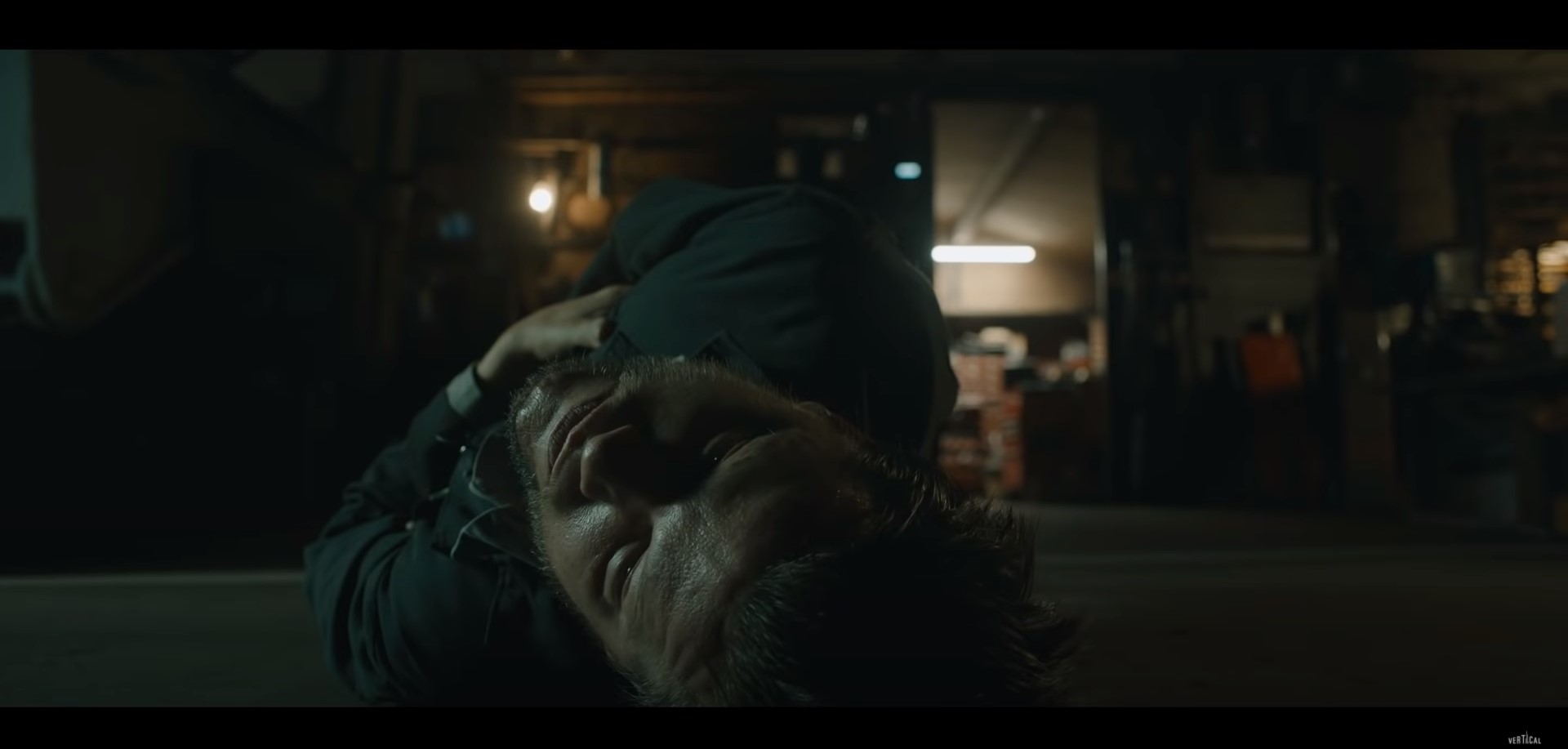
After fleeing a hit and run on his way to his girlfriend’s house, night security guard Diego Martinez is called to work a shift at the hospital morgue later that evening.  Seemingly showing very little concern for what transpired earlier, Diego goes through the motions of the night, checking doors and making sure the area is locked up tight and secure.  When a pursuit of a vagrant ends with Diego trapped inside the eight table slab morgue, he comes face-to-face with the malevolent paranormal in a terrifying night of survival.   Could what be happening to the scared night security be connected to the pedestrian he hit with his car or the transcendence of a purgatory afterlife from those who pass through the morgue without a pulse? 

“Morgue” is the Paraguayan poltergeist and purgatory thriller of high anxiety and tenebrific atmosphere proportions from the introductory feature film directorial debut of Hugo Cardozo.  The 2019 released horror film, which only recently made Stateside debut onto home video, is supposedly based on real events and written and produced for the silver screen by Cardozo and not only does the filmmaker showcase a hair-raising fright of a foreign film, “Morgue” also highlights the intrinsic South American infostructure and societal norms that’ll certainly be eye-catching details and differences to audiences from Paraguay’s northern neighbors.  From the Toyota Hillux trucks that are not sold in the U.S., to the wheel valve toilet flushes, to the open plaza compounds, “Morgue” is a down-to-Earth Latin American production that offers no unrepresentative notional misconceptions of other parts of the world.  Trust me, I’ve been to South America and to me, the city framework is authentic to the location.   With the support of FilmSharks’ subsidiary, The Remake Co., and HJ (Hugo Javier) Producciónes, a music video and film production company, “Morgue” is filmed in the district city of Encarnación, the capital city of Itapúa in Paraguay. 

Much of the story lands on poor Diego Martinez’s shoulders.  A cheapskate and a bit of an overall scoundrel, Martinez’s loafing life only has one thing going for it, his doting girlfriend who keeps him on thin ice because of his wandering eye and penchant for breaking promises.  Pablo Martinez has no problem playing a fool in Diego’s pitiful life as the actor shifts right into being indolent young man driving a beat-up jalopy and steel shavers just to keep ups his groomed look.  On the job, Pablo Martinez has to shift postures to a more diligent security guard which, for a character already established in a foundation without throwing down a trickster trope card, creates an uneasiness and a sense of empathy for Diego during his otherworldly ordeal as he follows his duties without much messing around.  Martinez, in both the character and actor, radiates fear once the tables turn and he realizes what he’s up against isn’t human or in figment of his imagination.  Or is it?  The role is written with some ambiguity on whether his experience might be guilt induced, but that’s for you, the audience, to decide.  “Morgue’s” one man show fleshes out with some strong supporting performances from Francisco Ayala, Willi Villalba, María del Mar Fernández, Abel Martínez, and Raúl Rotela.

Not many horror films hecho en Paraguay come across our screener desk; in fact, Cardozo’s “Morgue” is probably the first from the country and not too sound like a stuffy harsh critic, but I wouldn’t exactly say I’m more than pleasantly surprised by the overall design; yet,  I’m not not impressed either.  The middle of the road impression balances the bone-shivering atmospherics of a dark and tightly confining morgue where mischievous spirits seriously terrorize and toy with Diego’s physical and mental being with an about-face in Diego nonchalant behaviors and the established and recognized grim tone Cardozo slowly builds around the bonehead protagonist quickly fades at the very tail end with cheesy special effects and unfitting Latin rock music.  Without going too much into spoiler details, “Morgue” strongly reminds me of some elements of the “Creepshow 2” segment, “The Hitch-Hiker,” blended with Ore Bornedal’s “Nightwatch” while being stuffed with paranormal psychotic-nightmare fuel straight into the guts of story for gaslighting a terrified response.  The slow burn beginning might seethe a few eager to dive right into the you can’t-spell-pandemonium-without-demon action, but does set up perfectly, in a few suppressed laughs kind of way, Diego’s series of events that serve as a bread crumb trail to his frightening ordeal.  Cardozo utilizes various shooting techniques, many stunningly achieved in the manipulation of the film, to capture Diego’s fear and hikes the tension to a bite your lip in suspense level that’s well deserved. 

Light and spooky, “Morgue” is a lean, shivering supernatural story machine released onto digital and Blu-ray courtesy of Well Go USA Entertainment this past May.  The not rated, single-layered AVC encoded disc, 1080p Blu-ray is presented in a widescreen 16:9 aspect ratio, has a runtime of approx. 81 minutes, and has a region A playback. Director of photography, Blas Guerrero, discerns a softer touch that you can more or less notice around Diego’s face as the details are not as fine, but the deep blue and purples hued tints (and other lightly used color grades) and lighting make for elevated stellar direction toward the things that go bump in the morgue at night. Cardozo employs closed circuit cameras, extreme closeups, sped up playback, and a nifty deep focus of indiscernible corporeal silhouettes that is just creepy in itself. The Spanish and Guarani DTS-HD 5.1 Master Audio track has little to muster in the dialogue department with Diego having very little interaction with others, such as his girlfriend through a video call or the night guard he’s relieving, but the dialogue track does come through clearly. The captioning is synched well with no obvious errors aside for some translational preferences from Spanish to English. Catered to be a startling romp, “Morgue” is heavy on the ambient LFE effects that do a nice job filtering through and landing the desired whip-in scare and then quiet again, resetting for the next go around. In the background, there is a slight engine-esque hum throughout and I thought maybe it’s presence was just in the Morgue, the rumbling spans the almost the entire duration of the story and doesn’t seem to be emanating from the dialogue track. Bluntly, the Blu-ray release lacks bonus features with only a theatrical trailer along with preview trailers before the film. The physical release does have a cardboard slipcover but of the same images and stills as the snapcase. A good time can be had with “Morgue’s” karma emerged psychological torment of one man and the spooky energy swarmed in shadows and dodgy point of views that solidifies Cardozo’s Paraguayan thriller as a rival to most name brand counterparts, but because of the ending that kills the entire mood of “Morgue’s” misery lashing, that bad taste of an anticlimactic drop off finale cuts far deeper than expected.

“Morgue” Blu-ray is on sale now at Amazon.com!