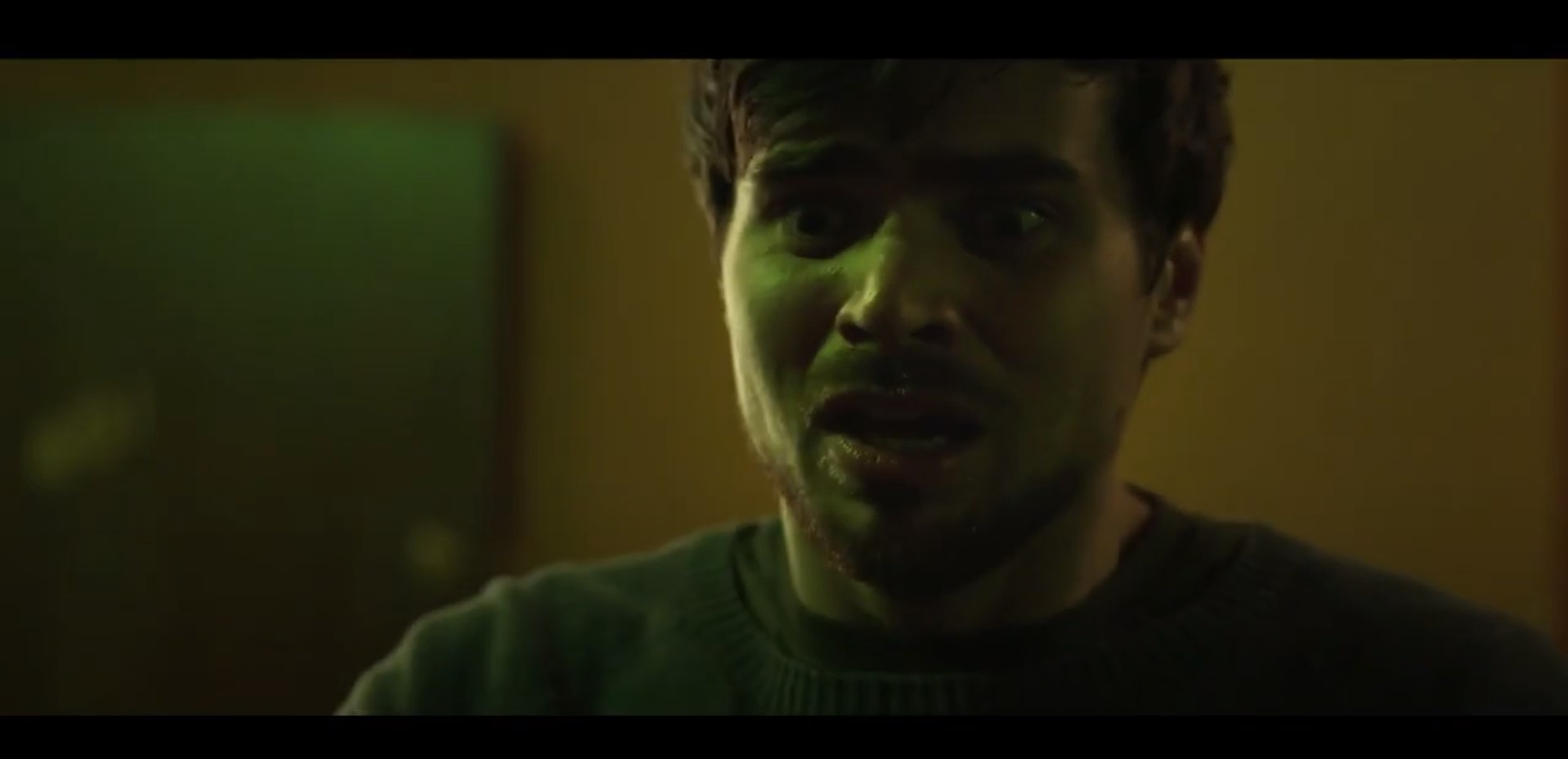
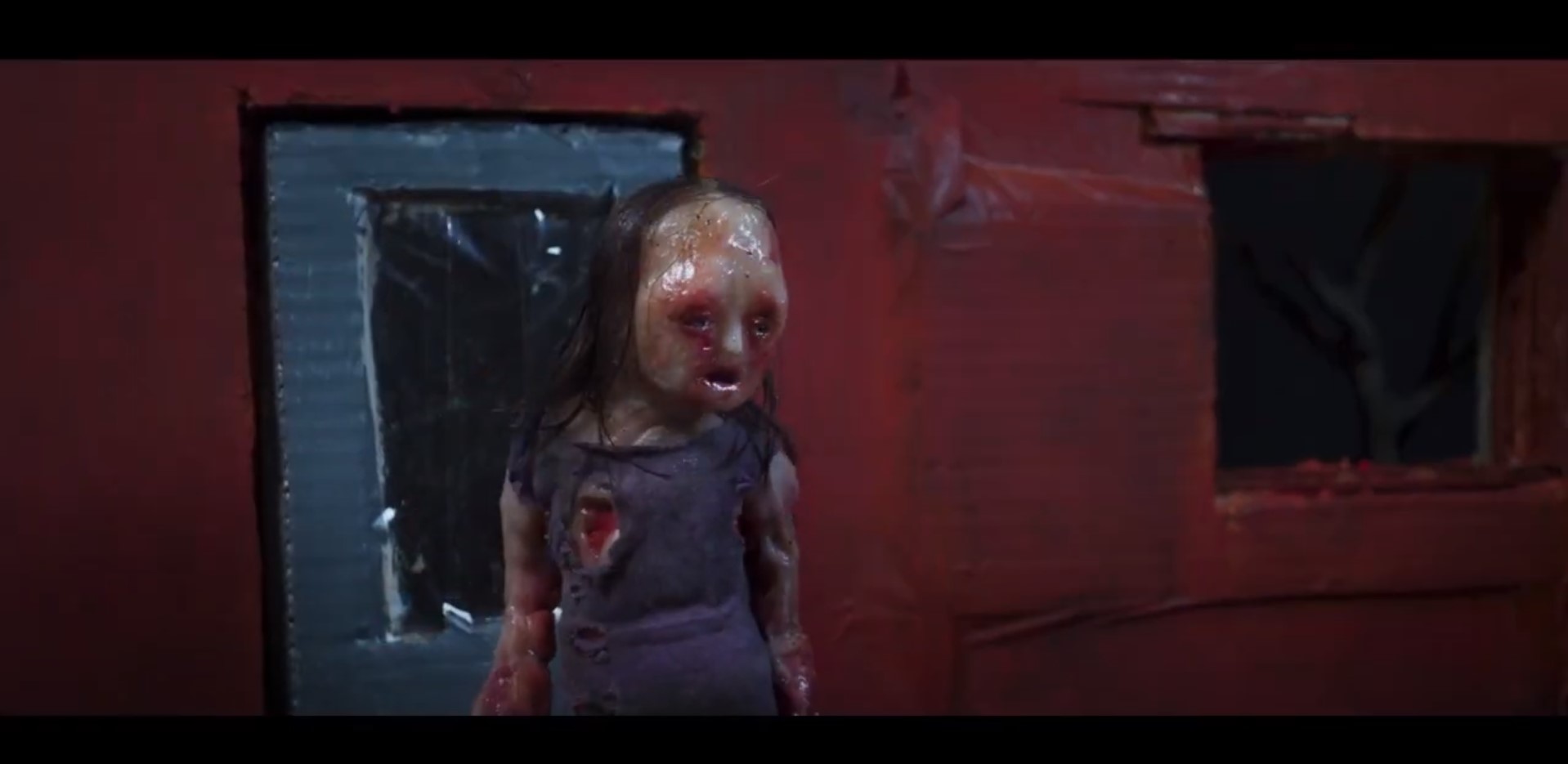
A Talking Black Lab with EVIL Red Eyes Target Children. “Where the Dead Go to Die” reviewed! (Mountain Oddities Home Video / Blu-ray)

“Where the Dead Go To Die” Now Lives on Blu-ray!

The first story in a disturbing 3-part omnibus tale concerns a little boy named Tommy.  Constantly at each other’s throats, Tommy’s troubled  parents don’t burden him down in their mini bickering wars and abusive verbal tirades where he becomes the passive aggressive fodder for each of them to shell the other with, but when Labby, a talking, red-eye dog proclaiming to be a messenger of God’s word, tells Tommy to kill unborn brother because he’s the antichrist, Tommy’s world is turned upside down when Labby murders both parents and the unborn child in the name of God.  In another story, a man steals liquid memories by killing people and extracting an intoxicating substance from their memory glands to inject them into his own body.  One particular liquid memory of a dying prostitute sends him through a warped nightmare of the underworld, one where he may never return to normal.  The last story focuses on a mask-wearing deformed boy named Ralphie, whose Siamese twin brother’s face protrudes out of the side of his face, and his infatuation with schoolmate and neighbor Sophia.  When trying to impress Sophia by relating to her father, Ralphie learns the father records VHS tapes of Sophia being molested by older men and is coerced to partake in an act Sophia is an unwilling participant.  At the behest of Labby, what Ralphie does next will put a fatal stop to the madness that surrounds him and his soulmate crush. 

In the same clunky spirit of crude early 1990’s computer generated imagery or in the early days of the original Playstation graphics, Jimmy ScreamerClauz’s “Where the Dead Go to Die” fully embraces the ungainly graphics in a 3D world of unimaginable horror where kids and demons intersect with wretched results.  The 2012 omnibus reflects three short narratives from ScreamerClauz and combined into one seriously screwed up tale, orchestrated by deal brokered wit Unearthed Films’s Stephen Biro who was sent two of ScreamerClauz’s short films – “Tainted Milk” and “Liquid Memories” – and challenged, or maybe even championed, ScreamerClauz for a third to build toward, and the eventual release of, a feature length product.  With the challenge accepted, the full-time musician and 3D animation artist succeeded with an unforgettable story that’s pure evil at heart and a surreal kaleidoscope of ghastly phantasmagoria.  ScreamerClauz not only writes, directs, and composes the film he also produces under the Draconian Films and Chainsaw Kiss production companies.  

As it has been already established Jimmy ScreamerClauz wears many hats in his production, we can add another with his voice acting of the demonic, fireball-eyed dog, Labby and along with the director’s voiceover participation, other genre actors and filmmakers are casted to voice one, or possibly more than one, of the crudely animated, disturbingly souled characters.  “Subject 87” director, “Reality Bleed-Through” actor Brandon Slagle tackles a double voiceover with the memory addicted man as well as Sophia’s sleazy abusive father.  As Sophia, the once upon a time softcore horror actress Ruby Larocca (“Witchbabe:  The Erotic Witch Project 3,” “Dr. Jekyll & Mistress Hyde”) has real innocent palpability up against Slagle’s aggressively toned, VHS-recording, and peeping perve that is her in character daddy.  Larocca also voices the mysterious advice-giver with the Lady in the Well and as the dying Hooker in the arms of the serial killer-for-liquid memories Man.  Another multi-voice player in the film and who also had a stint in the sex and violence category is Joey Smack with a string of strangler themed films (“Vampire Strangler,” “The Masked Strangler,” “The Bizarre Case of the Electric Cord Strangler, etc.,”).  Smack extends himself into a child and parent performance as the deformed Ralphie in “The Masks That the Monsters Wears” and Tommy’s dad in “Tainted Milk” that gives provides range albeit the quintessential grown man mimicking a child’s voice unmistakableness in the cracking high voice.  Much like Larocca, there’s something pleasant in seeing names like Linnea Quigley (“Return of the Living Dead,” “Night of the Demons”) and Devanny Pinn (“Nude Nuns with Big Guns,” “Bloodstruck”) be credited to voice because that takes the focus on their physical appearances and gives them a chance to actually be seen, or rather heard, with their dialogue performance.  In this instance, Quigley and Pinn embody the rancid maternity of Sophia and Ralphies’ mothers respectively.  “Where the Dead Go to Die” rounds out the cast with more B-movie actors in Trent Haaga (“Terror Firmer,” “Killjoy 2:  Deliverance from Evil”) as Ralph’s ashamed dad as well as Carlos Bonilla, Victor Bonacore, and Joshua Michael Greene. 

How a filmmaker chooses and utilizes his brand of CGI landscape is how that filmmaker’s film should be judged in the gelling of those areas, in my opinion.  “Where the Dead Go to Die’s” crude 3D animation is the intended result from Jimmy ScreamerClauz’s choice in conveying his short story narrative, but that intention won’t stop audiences and critics from browbeating and disparaging the film.  Yet, if accepting the former viewpoint and watch with understanding eyes through that recognition lens, “Where the Dead Go to Die” is one messed up and horrifying dystopia accentuated by the animation that gives each chapter more weight toward wretchedness and wrongdoing, gelling with tremendous intent to scramble the proverbial innocence with demonic forces and human perversions.  Some of the ideas and concepts swirling around ScreamerClauz’s head and make it into the three tales were just images he thought were visually neat but that speaks loudly on the dark mindset of creativity and many of those images are now temporally seared, scarred permanently into our long-term memory lobes.  Granted, tale transitions and recycling back to their sole connection with each other route into choppy territory at best, creating a windy, bumpy road in braiding the three chapters together under a single umbrella of animation style and storytelling, but “Where the Dead Go to Die” is a poignant and throbbing like touching a raw, exposed nerve through gouged muscle and tissue.  Every inch of surreal, sawtooth imagery is like a knife twisted into our virtuous side because upon closer look at Jimmy ScreamerClauz’s story containing children being hurt is only separated by the mere stylistic choice of cinematography. 

Out from the distribution shadows of Unearthed Films and in the hands of adult animation distributor Mountain Oddities Home Video, also in partnership with MVDVisual, for a new Blu-ray release, one we haven’t seen since Unearthed Films released the DVD and Blu-ray in 2012.  The first of two initial releases from Mountain Oddities Home Video, the Blu-ray comes AVC encoded, 1080p high-definition release, on a BD50 packed with extras.  Being mostly rudimentary 3D animation installed into a complexity of kaleidoscopic imagery, critiquing the quality is beyond our control but the compression is amply successful with no artefacts to note and the colorful saturation and grading levels provide an enriched, amalgamated dough of diabolic devil-bread, presented in a 1.78:1 widescreen aspect ratio that’s more compromised to its now out of print Unearthed Films counterpart from more than decade earlier.  Two English audio options are available:  a DTS-HD 5.1 surround sound and a DTS-HD 2.0.  At home audio recordings outside the sound barrier studio boxes are not as refined, capturing mic interference and hissing as well as the differences in varying audio volumes that don’t match between interacting characters in the same scene, creating that unshared space and gap.  Dialogue is unimpeded and clear and ScreamerClauz’s original gloomy-looming score fuels the deep morosity and malevolent themes.  English subtitles are option available.  Extras include a director’s commentary track with Jimmy ScreamerClauz, deleted scenes, an online video-conference interview with ScreamerClauz hosted by Quality Violent Cinema, behind-the-scenes featurettes of snipped dialogue recordings and interviews, including Linnea Quigley, Youtuber Diamanda Hagan’s video review of ScreamerClauz’s animated shorts “The Scuzzies,” and the director’s short film catalogue with “The Scuzzies” (that includes commentary), “Labby vs Mr. Pickles Rap Battle,” “Clinical Sodomy,” “Affection,” “Mutwa,” “Reality Bleed-Through Remix.”   Mountain Oddities Home Video’s Not Rated release is listed as the uncut version with a 95-minute runtime available with region free playback. 

Last Rites: An adult animation pushing the envelope with taboo themes involving kids and when you mess with kids, the public taste goes sour, but “Where the Dead Go to Die” swirls surrealism with poignant acting and strange fever dreaming amongst the basic, albeit creepy, animation.

“Where the Dead Go To Die” Now Lives on Blu-ray!

When the Artist Becomes the Art, EVIL Takes Over Their Soul. “Stopmotion” reviewed! (Acorn Medial International / Blu-ray)

“Stopmotion” Available on Blu-ray!

Living under her arthritis-enfeebled mother’s tremendous stop motion reputation and browbeaten into being the hands of completing her overbearing mother’s last film, Ella Blake can’t find her own voice in the animated art form.  During one already tension filled morning, Ella’s mother has a stroke and falls into a comatose state.  The unfortunate opportunity opens a door for Ella to complete her mother’s final masterpiece on her own as she moves out from the traumatic memories of her home and into a vacant high-rise apartment to be left in occupied solitude, but when a curious and brash little girl finds her mother’s story mundane and offers an alternative, more grotesque story, one which insidiously fascinates with disturbing themes and grisly creativity, Ella finds herself starting afresh, listening to the yarn of a young girl’s chilling vision, whole slowly cracking under the immense pressure of completing a film worth calling her own. 

With the timesaving, cost-efficient computer-generated imagery, many once popular animation techniques have nearly become a lost art in the recent feature film pool.  Stopmotion is one of those dangerously close to extinction animation styles, which has played a pivotal part in some of the most thrilling and magical films in history, such as, but not limited to, the live-action dominion of Desmond Davis’s “Clash of the Titans,” Sam Raimi’s “Evil Dead” films, and Tim Burton’s “Beetlejuice” to the fully animated features of Henry Celick’s “Caroline,” another Burton film in “A Nightmare Before Christmas,” and Phil Tippett’s “Mad God.”  Stopmotion animator and filmmaker Robert Morgan aims to add his entry to the dwindling, yet sustaining for now, artform with his 2023, debut full-length film “Stopmotion” co-written by Morgan and Robin King (“Mnemophrenia”).  The UK film is produced by Alain de la Mata and Christopher Granier-Deferrere under the French production company Blue Light and is presented by the UK’s British Film Institute, or BFI, with IFC Films and Shudder.

In the tragic lead role of spiraling down through pressurized suffering , trying to surface and take a breath from Ella Blake’s domineering mother’s shadow, is Aisling Franciosi, an Irish actress who also had a principal role in the segmented Dracula tale of “The Last Voyage of the Demeter” released the same year.  As Ella Blake, Franciosi plays into the young woman’s meek and submissive behavior as a subservient daughter to her conceited mother (Stella Gonet, “Spencer”).  All the while on the inside, Blake’s bottled voice contains lethal doses of self-destruction, barring her indefinitely inside the mental boundaries of her psyche, and never surfacing between the already emotional scarring and the grief for mother’s authoritarian parenting as Blake herself becomes very much like the armature puppet she manipulates into position for her film, needing that command structure to follow orders.  That need to be creative is so strong within Blake she fabricates another persona splitting soul into a dissociative disorder that takes the yoke and, ultimately, control over her and her project.  And, in some distressing and grim fairytale type of way, the voice recreates a story that parallels Ella’s life with the Ash Man (effects and prosthetic-cladded actor James Swanton, “Host”) chasing down and manipulating a wax puppet version of Ella in a grotesque mirror dynamic between Ella and her mother.  Tethering Ella ever so barely to reality is flexible boyfriend Tom (Tom York) and his flaunting animation corporate head Polly (Therica Wilson-Read, “Suicide Club”) to what’s in front of her rather to the voice inside of her but their truth is far too combative for Ella to stay fastened to a much strong influencing voice that’s far too close to her.   The upcoming “The Beast Within” actress, Caoilinn Springall, rounds out the cast as the little girl of the apartment building. 

As much as I wanted to seep and soak into “Stopmotion’s” one-frame-at-a-time madness, I couldn’t help but to think I’ve seen this story before.   A sort of déjà vu encircles me and hits me squarely in the gut as I lament over the possibility of feeling the same way I felt before with another film.  Then, it struck me like a bolt of lightning that this storyline shares similarities with the 2021, Prano Bailey-Bond film, “Censor.”  Now, I’m not saying “Stopmotion” is a direct carbon copy but follows a familiar pathway, a movie industry outlier forced by life and submersed under the weight to finishing what the heroines have started only to crack in deep obsession.  On a high level, character impetuses that lead to the same conclusion are in stark contrast and Ella Blake’s descent fathoms family trauma and fixation with trying to be an individual and not just a minor component of a bigger, more impressive, machine that overshadows the necessary cog that makes the whole operate.  Coupled with surreal imagery, otherworldly stopmotion animation, and physical effects that’ll make your skin crawl, or melt like wax, “Stopmotion” enlivens an animator filmmaker’s creativity outside the personifying vocation, blending genres and animations to exact a reality bending mania.  Morgan’s fragmented segues evoke an alternate reality that skips the portions where the audiences’ minds might fill in the gaps.  There is no gap filling, only essential, contextual moments, as if Morgan is the puppeteer to his story by arranging the movements one frame at a time reflect Ella’s poignant reminders and dour moments that mold her.

“Stopmotion” animates a living hell.  The Shudder exclusive lands onto a RLJ Entertainment subsidiary UK label, Acorn Media International, Blu-ray release.  The Blu-ray is presented in a widescreen 2.35:1 aspect ratio encoded with AVC, high definition 1080p, on a BD25.  Though in spartanly stark and gritty-glum set dressings, “Stopmotion’s” grading is on the lighter side of saturation diffusion, held mostly to a shade array of reds, greens, browns, and yellows.  There is numerous isolating, low key-lit scenes concentrated on the framed charactered and engulfing them in darkness but with that, there were no notifiable issues with posterization or banding.  Depth, especially in the stop-motion portion of reality, has spatial length and dimensional delineation, a testament to Morgan’s stop motion animator’s background and experience as some examples of the craft often look flat.  The English DTS-HD Master Audio 5.1 offers a lossless fidelity through the broodiness of Lola de la Mata’s compositional vocal and violin score, stringing through the surrealistic switch of cerebral crossfire.  Dialogue creates no challenges with a clear and clean presentation, range of effects heighten in animation’s Foley, and, again, depth creates that an enwreathed sound field through the back and side channels.  English subtitles are optionally available.  Special features include an interview with star Aisling Francosi, interview with writer-director Robert Morgan, and a behind-the-scenes featurette.  The Acorn Media release is rated 18 for Strong Bloody Violence and gore, has a runtime of 94 minutes, and, though not listed, played in region A playback so does seem to have at least dual-regional encoding between A and B.  The tangible Blu-ray comes in a standard Blu-ray case with a creepy, head-nesting puppet artwork.  The interior has standard appeal with just the disc inside, pressed with the same front cover art. 

Last Rites: “Stopmotion” depicts a tragic fall but not from grace in what is a more sad and sullen reality, and the escape is a freshly personified hell of one’s own making. 

“Stopmotion” Available on Blu-ray!

Creepy. Kooky. Mysterious. Spooky. All Together EVIL! “The Addams Family 2” reviewed (MGM and United Artists Releasing / Digital Screener)

RENT “THE ADDAMS FAMILY 2” ON PRIME VIDEO

Morticia and Gomez Addams have lived dangerously head on for all their grotesque lives and loving every second to the fullest with their strange family.  Nothing scares the macabre mother and father of Wednesday and Pugsley until their children begin to display the adversarial and angsty signs of growing up, creating a distancing wedge between them.  As Morticia and Gomez are missing the hideous and fright-filled family time once shared morosely and adventurously between them and the children, a zany road trip is planned across the deepest, darkest parts of the country to rekindle again that kooky Addams family bond, but when the threat of possibility that Wednesday may not truly be an Addams comes to light, Morticia, Gomez, Uncle Fester, Lurch, Thing, and even hairy cousin IT, will do anything, kill anyone, to prove Wednesday is a full-blooded Addams.

For over 80 years, Charles Addams’ creepy-crawly and spookily quirky family has been entertaining the masses with their avidity for danger and the deranged.  Now, one of America’s favorite bizarre families is back on the big screen with the animated sequel, “The Addams Family 2.”  Returning directors Greg Tiernan and Conrad Vernon delivered an origin story in 2019 that developed the who and how the demented Addams came to be one as one of the most lavishly and lovable lamentable families we all grew up with in popular culture.  The Canadian-American filmmaking twosome take the Addams’s on a road trip into a whole new direction with a standalone story separate from the first’s that revolved around inclusion and not judging a book by its cover.  “The Addams Family 2” is a production of Metro-Goldwyn-Mayer (MGM) and Cinesite Animation and presented by BRON Creative, a Jackal Group/Glickmania production, with Conrad Vernon, Gail Berman, Jason Cloth, Aaron L. Gilbert, Kevin Miserocchi, Andrew Mittman, Alison O’Brien, and Danielle Sterling return as producers and executive producers. 

The sequel reteams the loaned voice talents of “Dune’s” Oscar Isaac as Gomez, “Prometheus’s” Charlize Theron as Morticia, “Suspiria’s” Chloë Grace Moretz as Wednesday, “Big Mouth’s” Nick Kroll as Uncle Fester, and “Hocus Pocus’s Bette Midler as Grandma, picking up almost entirely where they left from the first film, voicing the core characters with twisted, haphazardly happy soul that keeps aligned the original concept with room for originality.  Hip-Hop and gangsta rapper Snoop Dogg also returns as the manipulated high-pitched voice of Cousin IT and lending his more vocational vocals on a couple original songs for the soundtrack, including “It Ain’t Nothin’.”  However, one original film voice doesn’t make an encore.  “Stranger Things” and the upcoming “Ghostbusters: Afterlife” star Finn Wolfhard is replaced by feature film newcomer Javon “Wanna” Walton as Pugsley Addams due to, supposedly, Wolfhard’s pubescent changes in his voice.  To circumvent an obviously different sounding Pugsley, Tiernan and Vernon reduces Pugsley amount of dialogue to nearly zilch with only an exclamation or two as Pugsley becomes more of the running gag, punching bag trope for Wednesday’s diversely ingenious methods to off a die hard Pugsley.  Also new is Wallace Shawn (“The Princess Bride”), who always manages to be typecast in animation as a pygmy, shrewd character – see “Incredibles,” “Toy Story,” and “Happily N’Ever After” for reference – playing a hired hand to “It’s” Bill Hader, who comes aboard as chief antagonist, Cyrus, with a master plan to make a lot of money off Wednesday’s unmatched smarts. 

Cinesite’s animation continues to be a tribute to Charles Addams’s original comic strip characters in appearance and keeping the action cutting edge with a variety of textures and fluorescent lighting to sustain a tightly spooky, yet still toon like, veneer without being chunky or plastic in appearance.  Frequent collaborators Dan Hernandez and Benji Samit are joined by “Cars’” screenwriter Ben Queen and “The Spy Who Dumped Me’s” Susanna Fogel with a script that hones in on the mad dash, madcap hallmarks of sword fighting, axe-throwing, flame shooting, and monster brawling that makes the Addams family THE Addams family.  The script keeps the action moving as the family traverses across the nation, evading Cyrus’s dissimilar henchmen, while the two Addams children find their place in pre-adolescence with Wednesday battles alienation and Pugsley attempts at wooing the opposite sex, but absent from the script is landed comedy.  Chock-full with slapstick humor, many of the jokes will go over the head of PG youngsters who won’t understanding Pugsley wanting dating advise from a Cousin It’s pimp-like status or the overabundant morbid humor that crosses the line, even for the Addams, with a Donner Party joke and one of the characters actually being killed off by Wednesday.  Considering the PG rating, the two latter bits really stick in the mind of an adult with children.  Also, the script honestly lacks something else, an important staple in Addams grim culture that can be challenging to apprehend if not present, and that is the Addams’s house.  Family and house are separated for nearly the entire duration, leaving the diabolical funhouse as an omitted character lost to the whims of Grandma’s large house party which is scarcely and sorely revisited.  Instead, Thing, who has an eyeball on the wrist by the way (never knew Thing had any sort of optics), and Uncle Fester, with a side-story of him metamorphizing into an octopus as a result Wednesday’s story-opening grandiose (mad) science fair project, drive an ostentatious camper that pales in comparison as the house substitute.

Hitting U.S. theaters nationwide today, October 1st, “The Addams Family 2” is a solid kickstart to the beginning of the Halloween season as a United Artists and MGM distributed release.  The sequel will also be available to rent through the following platforms:  Amazon Prime Video, Apple TV, YouTube, Vudu, DirectTV, Spectrum, Xfinity, and among other digital outlets and pay TV operators.  Aforementioned, the 93 minute, animated feature is rated PG for macabre and rude humor, violence and language with much of the more grave content flying over children’s heads.  Trust me, my 7-year-old and 4-year-old either didn’t understand the references or didn’t catch the intent.   Seeing the kooky antics of the Addams family back in the spotlight keeps the lovable ghoulish characters alive for generations to come, but with “The Addams Family 2” borders being insipid with a trying-to-impress out of the box and unconventional Addams road trip narrative that nearly creates the unthinkable to happen – making the adventurous Addams family a dull bunch.

The Crossover EVIL Has Been Fearing! “Straight Outta Nowhere: Scooby-Doo! Meets Courage the Cowardly Dog reviewed! (Warner Bros / DVD)


“Warner Bros. Home Entertainment provided me with a free copy of the DVD I reviewed in this Blog Post. The opinions I share are my own.”

A sub-frequency sound sends Scooby-Doo into a crazed and booty shaking fit.  So much so, Scooby runs away from the mystery solving gang and straight into the quaint, bizarre rural town of Nowhere, Kansas where he bumps into another canine, Courage, whose experiencing the same soundx and sensations.  When a plague of monstrous cicadas dig from out of the earth, Scooby and his friends, plus Courage and his lovable human Muriel and grouchy old farmer Eustace, must understand the copious amounts of the longstanding strange and unusual happenings in Nowhere to solve the mystery of the giant cicada attack that goes deeper into Nowhere’s roots…literally.  The two dogs have to peel off their scaredy cat shells and face fear head on while chowing down some of Nowhere’s delightful delicacies!

Finally!  The two most famous, fright-filled dogs make their cinematic crossover debut in “Straight Outta Nowhere:  Scooby-Doo!  Meets Courage the Cowardly Dog” that brings the terror tenfold to toon town!  Under the supervision of the serial animation director, Cecilia Aranovic, who helmed two previous Scooby-Doo installments, “Scooby-Doo! And the Curse of the 13th Ghost” and “Scooby-Doo:  Return to Zombie Island,” and tackled the action-packaged animation of “DC Super Hero Girls,” finds herself tackling a short-lived, Cartoon Network created cult fan favorite, “Courage the Cowardly Dog.”  Returning to the Scooby-Doo universe is the televised “Mystery Incorporated’s” writer and editor Michael Ryan penning a script with Courage the Cowardly Dog and creative mastermind of John Dilworth in mind to maximize all the grandstanding personalities faithfully.  Both lovable and yellow-bellied pooches are produced by Hanna-Barbera Productions, who do more crossovers of their cartoons characters than NBA’s Tim Hardaway, and are joined by Warner Bros. Animation and Cartoon Network studios. 

“Straight Outta Nowhere” reteams the “Mystery Incorporated” voice cast of Frank Welker as Fred Jones and Scooby-Doo, Grey Griffin as Daphne Blake, and “Scream’s” Matthew Lillard as Shaggy Rogers.  The revamped “Ducktales’” Kate Micucci replaces Mindy Cohn as the voice of Velma Dinkley with an apt Velma impression that easily transitions without discording the mystery solvers.  Courage voice actor Marty Grabstein reprises his quirky exclaiming hound whose full of heart and also returning Thea White stepping into the boots of Muriel, one-half of Courage’s owners.  Sadly, like original voice actor for Eustace, the late Lionel Wilson, who passed away shortly after the original show’s discontinuance, Thea White also passed away but the sting of her death was more poignant as White past July at the age of 81 and this crossover is presented in White’s memory.  Bugs Bunny and Daffy Duck funnyman Jeff Bergman voices the grouchy and sarcastic Eustace without missing a beat and with about as much cynicism as his predecessors even when unloading a boatload of scares with his giant and unsightly boogey-boogey mask!  A Eustace classic! To preface my character opinion, this movie is obvious about the Scooby and Courage spellbinding the little viewers about location gumption in themselves to face their fears when it matters, but Scooby and Courage’s friends and family provide pivotal, building black support that should render each mystery solver and podunk rural-ite as a mini-lead within the story. That’s not the case inside this crossover that lacks specifics with certain characters, such as the straightforward Fred, Daphne, and Velma who instantly fall way behind without much dialogue or screen time in favor of the more caricatured Muriel, Eustace, and Shaggy. Eustace even gets his own rap music video. Some minor characters from Courage’s past return to scheme and terrorize with the voice work rounded out by Jeff Bennett (“Friday the 13th Part VII: The New Blood”), Chuck Montgomery, and Paul Schoeffler.

Who would have thought it? Scooby-Doo has been a staple of Saturday morning cartoons, television specials, spinoff movies, holiday events, and has been reimagined animatedly and in live-action since 1969. And Courage the Cowardly Dog? Well, Courage ran on Cartoon Network from 1999 to 2002 with little specials here and there in between, but virtually radio silent when compared to his over 50 year-old co-star. Yet, did you know, the 2021 film isn’t the first time these two hounds crossed paths? That’s right, Scooby and Courage (along with Shaggy, Mureil, and Eustace) were first seen in a brief Cartoon Network promo together that you current see on Youtube – search “Scooby and Courage Cartoon Olio.” To be honest, I had assumed Scooby-Doo, who has spanned over multiple generations, is practically known worldwide in every household, and has been an invaluable money-making machine for Warner Bros., would tip the crossover screen time into the animated Great Dane’s favor, but in a pleasant surprise, a good chunk and crucial portions of the story revolves around Courage and his immediacy characters who are brought to the forefront with Scooby and the gang clearly taking a backseat to the smaller, lesser known pup.  Even the animation sides more with Courage, preserving within a smoother veneer the intrinsically warped details familiar to the show, as seen with Eustace’s Courage-scaring mask or Courage’s fluid scared reactions, and we can be honest with ourselves that although Scooby works in Courage’s surrealistic macabre world, the Dane and his gang have been rendered countless times in many different animation styles throughout the last five decades.  Enigmatically familiar to one of the mysteries Scooby and his gang dive right into, the tale fashions a composite of two different protagonist dynamics to expose who or whom are behind the giant cicada attack and the hypnosis causing ruckus; however, like the original episodes of the early 2000s, Muriel and Eustace are present just for the ride as Muriel stumps a self-frustrated Velma with elementary riddles and Eustace mouths off like an old kook without as much as a care in the world around them or what’s happened in their own backyard of Nowhere. 

Witty, zany, and all of the above with a nostalgia high, “Straight Outta Nowhere:  Scooby-Doo!  Meets Courage the Cowardly Dog” will delight fans of both series with the hope for more team-ups in the future.  Warner Bros. Animation will release the film on DVD come Tuesday, September 14th with a G rating approved for all audiences and with a runtime of 78 minutes. The disc’s animation picture quality is about as animated and as lively in it’s vibrancy as the characters with no real cause for format concern as aside from a cleaner, more robust color palette, the colors translate nearly indistinguishably from it’s 1080, HD counterpart as the colors do saturate nicely, leaving little room for a potential washed or dull veneer. The English (and dog gibberish) language Dolby digital 5.1 surround sound mix boosts an energetic and immersive output with nonstop creature effects, explosions, laser zaps, etc. All the creepy ambience and score that make “Courage the Cowardly Dog” spookily alluring is right here on this DVD, filling out the channels with dichotic range and space with the depth. Screams take centerstage as the keystones to ever scary flick to maximize the intended feeling of fear and, in this case, laughter. One of the more disappointing aspects of the release is the special features and while three episodes, seemingly randomized picks – Scooby-Doo! Where Are You!’s – “Decoy for a Dognapper” and The Scooby-Doo/Dynomutt Hour’s – “The Gruesome Game of the Gator Ghoul” and “Chiller Diller Movie Thriller,” is a blast from the past and a bit of nostalgia watching reruns as a kid, I really wished there were interviews with the voice cast, especially Marty Grabstein, Thea White, and Courage creator John Dilworth to laud the show and let the fans their appreciate for the little guy…meaning Courage. “Straight Outta Nowhere:  Scooby-Doo!  Meets Courage the Cowardly Dog” wins on many levels: Courage the Cowardly Dog is back, Matthew Lillard is Shaggy once again, and the most petrified pooches in all of animation land bring two generations of people together for the whole family to enjoy their staple idiosyncratic gags and colorful personalities.

A Must Own “Scooby-Doo Meets Courage the Cowardly Dog” on DVD!

EVIL Presses the Reset Button For Killer Results! “To Your Last Death” reviewed! (Quiver Distribution / Blu-ray)

Miriam DeKalb has just survived a bloodbath inside her tycoon father’s high-rise, walking out shaken, bloodied, and carrying an axe.  When the police detain her in the hospital, construing a case against her for the death of her siblings and father based off her previously unhinged mental state inside a psychiatric institute, Miriam is visited by an otherworldly being known as the Gamemaster.  Miriam is given two choices:  stay at the hospital to be pursued as the murderous villain in her harrowing escape from near death or restart her traumatizing experience to save her siblings in an intergalactic wager by infinite being gamblers eager for amusement, blood, and a clear winner.  Miriam’s foreknowledge of how the events play out should give her an edge in saving her family, but the restart is the Gamemaster’s game with the Gamemaster’s rules as timelines and outcomes are determined limitless. 

“To Your Last Death” is a science fictional brawl of Darwinism in this eviscerating adult animated survival horror from director Jason Axinn.  Originally titled as “The Malevolent” during the crowd-funded Indiegogo campaign, which raised 114% above film’s budget, “To Your Last Death” is Axinn’s first full length feature from a script co-written by Jim Cirile (writer of horror-comedy “Banned”) and is the first credited work of Tanya C. Klein, both who’ve previously collaborated on the superhero short “Liberator” in 2016 starring the original Hulk himself, Lou Ferrigno  With an animated direction similar to that of FX’s “Archer,” Cartoon Network’s “Metalocalypse,” or an even slightly more advanced version of “Space Ghost Coast to Coast,” but, in fact, the hand-drawn, puppetry style animation is the first ever 2-D animated horror under the meticulous art direction of Carl Frank along with lead artists Luca Romano and Vicente Saldivar, who interned on “Metalocalypse,” that keeps in tune with the adult themed animation trend, but levels up the explicit nature that kisses the sordid substance of “Heavy Metal” with strong bloody violence and some nudity.  “To Your Last Death” is the first feature film of Jim Cirile and Tanya C. Klien’s Coverage Ink Films, a subsidiary of the screenplay analysis and development service group, Coverage Ink, and Quiver Distribution (“Becky”) with Cindi Rice, Paige Barnett and Jason Axinn taking on a producer role. 

The voice work is comprised of some of the most distinguishable voices in genre land; voices that carry the unparalleled weight in intensity, tenor, and madness to their darkly depicted illustrated characters.  You can almost feel the veins throbbing out of Ray Wise’s neck when spewing the murderous insanity of warfare kingpin and diabolical businessman, Cyrus DeKalb.  The “Dead End” and “Jeepers Creepers 2” actor’s inhumane avatar, who looks just like him, devises a plan to solidify his company’s legacy by eliminating his four children who, if banding together, can derail his egomaniacal runaway train.  His children are distinct individuals themselves, beginning with the BDS&M buff and death metal rocker, Ethan (Damein C. Haas), a pill-popping wrist cutter, Kelsy (Florence Hartigan “Phoenix Forgotten”), and a mirror-image disappointment and homosexual, Collin (Benjamin Siemon “Thankskilling 3”).  The fourth child, Miriam, is the principle lead.  Voiced with perpetual mixed reactions by Dani Lennon, a regular from the videogame-themed horror comedy and zombie apocalypse television series, “Bite Me,” Miriam’s complexities stem from a web of junctures that lead her to being a control freak amongst her siblings, an obsessive activist against her father, and a certified schizophrenic, but Miriam is also pragmatic with the strongest will to see through and survive her maniacal father’s abhorrence.  While everyone’s voice work is solid, Steve Geiger’s Eastern European accent replicated for the sadistic, warmongering henchman, Jurek, imprints a nightmare man unabashed by his decadent desires.  You wouldn’t think just be reading this review, but Bill Moseley (“Devil’s Rejects”) and William Shatner (“Star Trek” franchise) also have voice roles that are more cameo resembling as Moseley voices a short lived, facially disfigured hired gun and Shatner is the narrating voice in between the void as the Overseer, filling in with cryptic exposition of the Gamemaster’s existence, much like his narrative work on the reboot of the children’s show, “The Clangers.”   Mark Whitten, Bill Mishap, Rom Lommel, Paige Barnnet, Jim Cirile, Tanya C. Klein, Ruairi Douglas, Jason Axinn, and “Deadpool’s” Morena Baccarin as the Gamemaster round out the cast.

The way “To Your Last Death’s” story is structured runs along the same quivering line that’s equal to pure madness and this narrative path of unstoppable carnage is purposefully trekked to dislodge any judgements about what we, the viewer, think we know about the Gamemaster’s macabre game for galactic gambling.  Is the whole “Saw”-like designed bloodbath really a part of Cyrus DeKalb’s hatred and vindictiveness toward his children or is the lucid experience just a figment of Miriam’s break from reality?  Remember, Miriam was depicted to an ex-committed, living with and within the pressures of her father’s ever present, looming shadow. Miriam finds herself repeating moments but blueprinted differently than before or is manipulated by the Gamemaster’s gamer’s high for the adrenaline voyeurs betting on the outcome. The story’s effervescently fluid in pivots, tactics, and style; yet, the constant modify and rebuild was, perhaps, done one or two many times as staleness begins to set in and I eventually find himself anxious for a more linear goal for Miriam and her siblings to be out of limbo, out of being hacked to pieces on the fourth or fifth go-around, and reach the final stage, the final boss, to not be jerked back (or jerked around) to the beginning or midpoint like in unendurable game of chutes and ladders. Soon after that sensation of being uninterested in another rewind, the feeling immediately washes away as the story finally did progress, climax, finish, end, close, and put to sleep a rotunda of violence engendered by cosmic sadists that is “To Your Last Death.”

Like some warped version of “Clash of the Titans,” the insouciant Gods in “To Your Last Death” are not generous or kind in their gamble of human entertainment on this Blu-ray release distributed by Quiver Distribution. The feature is presented in a windscreen 1.78:1 aspect ratio with rich colors through but favor toward scenes splotched of dark red or saturated in full tints of blue. The animation can be a little jagged at times but tolerable and only one scenes stood out compromised with two character stuck still for a few seconds too long and color banding rear its little ugly head on their animated faces. The English Dolby Digital 5.1 surround sound renders equally gratifying that includes a pulsating and terror riddled soundtrack by Rene G. Boscio. Typical with animation, ambience is generally underused as the filmmakers control much of what’s in the frame and the same can be said with this film, but with the much of action stationary inside the building, the confinement fills in the auditory gaps in conjunction with lucrative and well timed effects, such as a ripping roar of gas guzzling chainsaw, the squirting sounds of blood sprays, and even with the lossless details of minor necessities, such as Jurek whistling, to build upon character development. Dialogue is prominent, clear, and syncs okay with the marionette animation. The Blu-ray case is sheathed in a cardboard slipcover, both arranged with the same front and back cover image and layout. The bonus features are lack as the bare bones release only comes with a high definition trailer of the film. “To Your Last Death” is this year’s cinematic graphic novel to knock back and lap up, loaded with transcendent selfish twists and second-chance carnage with dysfunctional family issues spot lit on center stage.


Pre-Order “To Your Last Death” for a October 6th release!