EVIL Sentences You to the Torture Dungeon and his Bedroom! “Night of the Blood Monster” reviewed! (Blue Underground / 4K UHD + Blu-ray)

“Night of the Blood Monster” on 4K + Blu-ray is Here and On Sale!

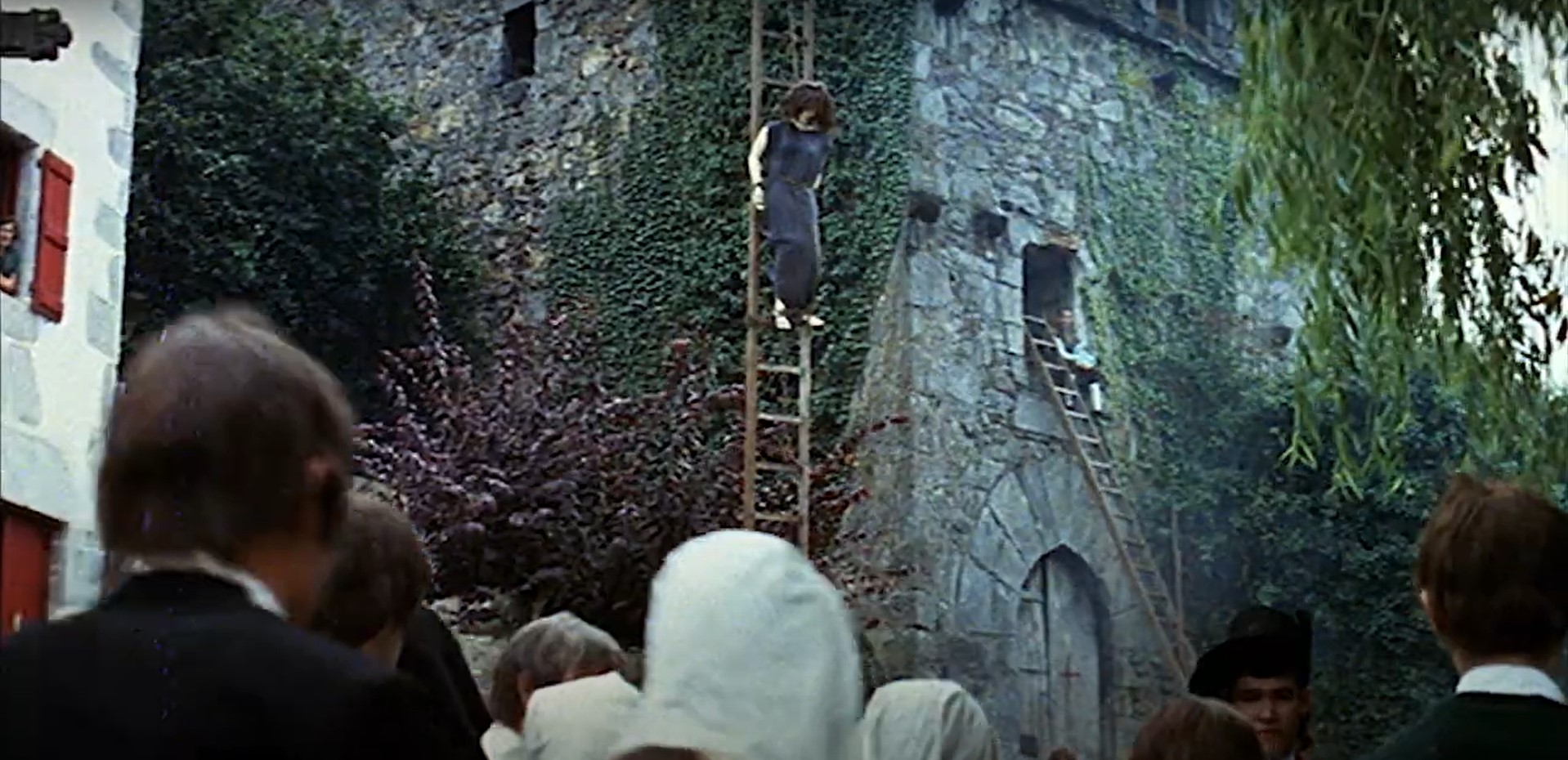
After the death of King Stewart, 17th century England went into asunder chaos with the ruthless, usurping King James and the rightful, exiled King William of Orange who sought to return and topple King James’s authoritarian rule of a false claim to monarchy.  During the beginning and at the height of the revolution, Chief Justice George Jefferies presides over witchcraft cases with extreme and unethical prejudice, subjecting them to the torture chamber for what is labeled a ‘thorough examination” of their heretic ways, and eventually sentencing to public execution.  When the sister of one of the condemned women attempts to flee the country with a nobleman’s son, Jefferies learns of their dissidence and sends his henchmen to fetch the lovely woman to exploit her within the context of his own licentious litigiousness but closer and closer do the rebels and William of Orange’s men come to men like Chief Justice Jefferies who believe their power, influence, and proximity to God will save them from the noose.

A 17th century Eurotrash period piece forged out of mostly flesh and wolfish self-importance, “The Night of the Blood Monster” is yet another reteaming of Jesús (Jess) Franco and Sir Christopher Lee based loosely on historical context despite Lee’s best efforts for the contrary.  Also wildly and otherwise known as “The Bloody Judge,” and not to neglect mention the exorbitant unofficial titles from around the globe like “Witch Killer of Broadmoor,” “Throne of the Blood Monster,” and “Trial of the Witches” to name a few, the Spanish-German-British coproduction, cowritten between Jess Franco and Enrico Columbo (“Hell Commandos”) is a biographical interpretation of the Chief Justice George Jefferies and the brief span of his cruel litigator’s life set against an epic regime kerfuffle and grimy, exploitation barbarity.  The storyline concept was imagined by longtime Jess Franco producer and overall B-movie votarist Harry Alan Towers (“99 Women,” “The Blood of Fu Manchu”) alongside Columbo and Arturo Marcos (“She Killed in Ecstasy”) under production firms of Fenix Cooperative Cinematografica, Prodimex Film, and Towers of London Productions.

In yet another instance similar to Jess Franco’s “Eugenie” of a prior year or two where Christopher Lee channels the spiritual embodiment of a pain-and-pleasure pundit connected to the Marquis de Sade yet is unaware of the actual skin-and-sleaze that’s happening all around him while he crafts his melodramatic character, “The Night of the Blood Monster” has Lee conduct a stern symphony for Chief Justice George Jefferies’ conceited righteous carnage, living true to the factual George Jefferies designation of a hanging judge.  Lee is ruthless and cold while proper in public as he peeps beautiful bosoms and skirts from afar.  His costar, the gorgeous blonde with soul pierce eyes in fellow “Eugenie” thespian, Maria Rohm, who was also Harry Alan Towers wife at the time, definitely wasn’t clueless about the more undressed scenes, going full frontal in a couple of occasions with one of the supposedly with Lee as the exploiter of her beauty and circumstances.  However, Lee is never shown and only Jefferies’ hands are seen caressing Rohm’s character’s, Mary Gray, bare skin with post-event moments alluding to the implied affect.  Yet, there’s plenty of well-scripted dynamic play for Lee to bounce off against, which Franco is good at in his work as long as his at least 75% of the work makes it to the screen and not too terribly chopped up and spliced for the sex appeal and gratuitous blood.  Milo Quesada (“The 10th Victim”) swings a mean bastard sword as one of Jefferies head knights of dirty work, Hans Hess (“X312 – Flight to Hell”) is more vanilla than complex as the rebellious nobleman son and Mary Gray paramour Harry Selton, and Leo Genn, who initially wasn’t supposed to play the Lord Wessex, really cements Lee’s genuine performance with his own as the aristocratical, oppositional counterpart to Jefferies sadism.  “Night of the Blood Monster” rounds out with Peter Martell (“The French Sex Murders”), Margaret Lee (“Asylum Erotica”), Howard Vernon (“Angel of Death”), and Maria Schell (“99 Women”) as the clairvoyant old woman Mother Rosa living in the hills. 

Like “Eugenie,” “The Night of the Blood Monster,” and most of Franco’s scripts and films, the historical accuracy you must take with a grain of salt.  Though the underline basis of historical figures and perhaps time periods are more-or-less on point, there’s a greater number of misrepresentation of events or an imprecise use of period appropriate props and costuming that is deemed close enough by a fast-and-loose industry standard. Yet, with any Jess Franco film, the modern-day consumer is not expecting award-winning and emotionally moving cinema but rather fleapit flicks of the fleshy kind with handfuls of equally perversive cruelty.  “The Night of the Blood Monster” fits the bill perfectly with a dressing that, to the untrained eye, would pass historical surroundings, give tribute to sordid bygone figures, and revel in its own unabashed filth outside the interpretations of its own core group of filmmakers.  On one hand I feel bad for Christopher Lee who didn’t know, maybe, that the edification of the character was being twisted into something more carnal but on the other hand, the man has been in quite a few Franco and Towers productions to have learned by then.  However, Franco does depict a remarkable presence of a low-level epic with fabricated Classicism set dresses and interior architecture while keeping the budget down by having multiple scenes of men on horses gallop through an unrecognizable, middle-of-world forest.  With that said, the story doesn’t have perfect fluidity with a choppy sense of tempo that fails to coordinate our specific concepts of time.  Seasons don’t change yet months pass between the wrongful execution of Alicia Gray and the impending arrival of William of Orange’s invasion. In all, there’s a brilliance in the behind the face value and a heart to make Chief Justice George Jefferies the worst person possible yet the timing feels off and the story suffers for it.
I’m curious to understand why Blue Underground used the title “Night of the Blood Monster” on their new 2-Disc 4K UHD and Blu-ray set instead of their previous DVD that had the less-generic-more-fitting title “The Bloody Judge.” No judge-ment here really other than “Night of the Blood Monster” isn’t as catchy. The 4K UHD is HVEC encoded, 2160p high-definition, on a double layered BD-66 presents a new 2023 Dolby Vision HDR 4K scan that is gorgeously sharp in detail of interior structures, brighter exteriors, and even the dungeon scenes invoke the dewy coldness and bloodletting squirms. The skin tones can get a little funky at times with an overly warm, and orange-ish, glow not conducive to elements around the ambiance. Other than a few instances of the skin tones, the grading is overall rich in saturation where we get some really nice and thick contrasting reds and yellows with no artefact inference that cause distraction in darker spots or around the edge of objects. The Blu-ray format offers a lesser immersive picture with a lower pixel count but the compression decoding around 35-38Mbps and the compilation of transfer as well as the high-definition pixels is worth the combo set alone. The English language DTS-HD Master Audio Mono track has lossless compression that renders a clean and unfiltered fidelity in dialogue and in the other audio composited audio layers. Granted, some actors are dubbed due to the international co-production with German and Spanish natives not speaking their native tongues but the dub itself, especially in Lee’s own dubbed track, is one of the better inlaid and integrated tracks compared to most with not a load of static feedback. Blue Underground was able to obtain a cut that is the complete and uncensored version of “Night of the Blood Monster” by combining multiple transfers but in adding additional scenes of nudity and blood from a German transfer, the English dialogue track does briefly switch over to German with burned in English subtitles for two segments. English, French and Spanish optional subtitles are available. The 4K UHD carries with it three historian audio commentaries: 1) Troy Howarth and Nathaniel Thompson, 2) Kim Newman and Barry Forshaw, and 3) David Flint and Adrian Smith. The Blu-ray carries a bit more. Including the aforementioned commentaries, there is also deleted scenes and alternate scenes that rework scenarios or add stylistic choices, an archival interview Bloody Jess with Jess Franco and Christopher Lee, an interview with Stephen Thrower, author of “Murderous Passions: The Delirious Cinema of Jesus Franco, in Judgement Day, an interview with Alan Birkinshaw and Author Stephen Thrower as they discuss producer Harry Alan Towers in In the Shadows, and rounds off with trailers, TV spots, and still galleries. What I love about this new Blue Underground UHD+Blu-ray combo release is not only the picture but also the cardboard slipcover, a remarkable blend of film factuality and gratuitous sleaze of half-naked and scared women chained up in the dungeon with the embossed tactile title “Night of the Blood Monster” in bold gothic lettering. The same image graces the front cover of the black 4K UHD Amary case but if you do want “The Bloody Judge” title, you can reverse the cover art and there it is but with a different, less fun front cover art that’s more in tune with the narrative. Each disc, punch locked into its own side of the interior case, is pressed with a different illustrated image, 4K being the same as the slipcover while the Blu-ray is more Lee and Executioner focused. No inserts or books included. The not rated, 103-minute release comes region free on both formats.

Last Rites: The verdict is in! “The Night of the Blood Monster” now has the best-looking, most-complete version possible with a new, uncensored cut from Blue Underground. Christopher Lee heralds in hopelessness in squalid measure while holding his nose up high as one of England’s most notorious magistrates to ever rule and the brazen Jess Franco brandishes brilliance that glints through the cracks of an overrun production.

“Night of the Blood Monster” on 4K + Blu-ray is Here and On Sale!

EVIL Lights Up When Peeling Skin! “Human Lanterns” reviewed! (88 Films / Blu-ray)


Own this beautiful release from 88 Films of the “Human Lanterns”

Two respected and wealthy Kung-Fu masters have a long rivalry, trying to one-up each other at any cost even if that means stooping into their personal life to gain the most public admiration.  With the annual lantern festive approaches, to have the best and brightest lantern would sustain at least a year of gloating over the other master.  When a lantern maker with a retaliation mindset against one of the more boastful masters is hired to make his festival entry, the lantern maker exacts horrifying revenge by fueling their feud behind the scenes. Kidnapping beautiful women who are dear to each master and exploiting their soft delicacies for his crazed creations, the maniac lantern maker turns the village upside down, forcing the local constable into an impossible investigate into the village’s most popular residents when none of the evidence points to the other.

“Ren pi den long,” aka “Human Skin Lanterns,” aka “Human Lanterns” is a grisly Kung-Fu murder-mystery that’ll make your skin crawl right off from your body. The stylishly colored and ethereally varnished 1982 Hong Kong film is written-and-directed by Taiwanese director Chung Sun (“Lady Exterminator) that blended the likes of a giallo mystery into the well-choreographed martial arts mania with the profound Kung-Fu screenwriter, Kuang Ni (“The One-Armed Swordsman,” “The Flying Guillotine”), co-writing the script alongside Sun. While not as ostentatiously gory or as cinematically profane as the 80’s released Category III certified films that rocked Hong Kong audiences, and the censor board, with shocking, gruesome imaginary and content, “Human Lanterns” does sit teetering on the edge with mostly a tame Kung-Fu feature that quickly turns into the blistering carnage of a basket case, or in this a lantern maker, who uses hiding as a double entendre. “Human Lanterns” is a Shaw Brothers Studio production executively produced by the oldest of two brothers, Rumme Shaw, and, then new to the Shaw Brothers’ board of directors, producer Mona Fong.

“Human Lanterns” starred two the renowned names in martial arts films from the 1970s and well into the 1980s with “Fist of Fury” and “The Swordsman and the Enchantress’s” Tony Liu as the impeccably arrogant Lung Shu-Ai with a self-image to protect more than the women in his life and “Bloody Monkey Master” and “Return of the Bastard Swordsman” Kuan Tai Chen sporting a sweet mustache as Lung’s longtime rival, Tan Fu. Shu-Ai and Chen have really spot on, well-versed, fight sequences together braided into their play off each other’s character’s haughty personas. While behind the curtain of overweening and defiance between the two masters, Chao Chun-Fang unceremoniously sneaks into the fold by happenstance as Lung offers him money for the best lantern this side of the lantern festival. Lung and Chao Chun-Fang, played with a demented, idiosyncratic duality from Leih Lo (“The Five Fingers of Death,” “Black Magic”), another master in the art of fighting in his own style, have an inimical past…well, at least thought so by Chun-Fang. In a sword dual over a woman, Lung defeats Chun-Fang and purposefully scars him above the left eye, causing him the inability to look up, and while the lantern maker has stewed for many years, training all the while to be the best fighter, his tormentor Lung Shu-Ai has nearly all forgotten about the incident and found trivial enough to ask Chung-Fang to make him a lantern and offer him out for drinks for being old buddies of yore. However, this yard pulls the wool over the eyes of self-centered, the upper class, and the unruffled nonchalant as Chung-Fang takes advantage of the Kung-Fu masters naivety and uses the rival as a screen to cover up his kidnapping deeds of the women in their lives, played by Ni Tien (“Corpse Mania”), Linda Chu (“Return of the Dead”), and Hsis-Chun Lin. “Human Lanterns” rounds out the character list with a hired assassin in Meng Lo (“Ebola Syndrome”) and a competent but out of his league village constable in Chien Sun (“The Vampire Raiders”).

The look of “Human Lanterns” is often dreamy. No, I don’t mean dreamy as in gazing into the strong blue eyes of your tall and dark fantasy man. The dreamy I’m speaking of is produced by cinematographer An-Sung Tsao’s luminescence that radiates of background and the characters through the wide range of primary hues. Tsao’s colorful and vibrant eye doesn’t clash with the vintage era piece consisting of impressively detailed sets, a costume design plucked straight from the 19th, and hair, makeup, and props (which I’ve read some of the blades were authentic) to bring up the caboose of selling the completed package of delivering a spot-on period film. When Leih Loh dons the skull mask, an undecorated and unembellished human skull, with wild, untamed hair sprouted from every side of the eyeless mask, Loh transforms into a part-man, part-beast jumping, summersaulting, leaping, and seemingly flying through the air like a manically laughing ghost. The visual cuts petrifyingly more than described and if you add an extensive amount of Kung-Fu to the trait list, “Human Lanterns” has a unique and unforgettable villain brilliantly crafted from the deepest, darkest recesses of our twisted nightmares. “Human Lanterns” has a wicked and dark side that balances the more arrogantly campiness of Lung and Tan’s hectoring rivalry. When Lieh Loh is not skinning in his workshop or Lung and Tan are not bullying each other into submission, there’s plenty of action with the heart stopping, physics-defying martial arts that just works into the story as naturally as the horror and the comedy. With shades of giallo and fists of fury, “Human Lanterns” is Hong Kong’s very own distinctive and downright deranged brand of good storytelling.

88 Films lights the way with a new high-definition Blu-ray of the Shaw Brothers’ “Human Lanterns” from the original 35mm negative presented in Shawscope, an anamorphic lensed 2.35:1 aspect ratio that more than often displays the squeeze of the picture into the frame. One could hardly tell the upscale to 1080p because of the very reason I explained in the previous paragraph of the airy An-Sung Tsao façade that softly glows like bright light behind a fog. Nonetheless, the image quality is still stunning and vivid, a real gem of conservation and handling on this Blu-ray release. The Mandarin dubbed DTS-HD 1.0 master audio is synched well enough to the action for a passing grade. The foley effects, such as the swipes and hits, are often too repeated for comfort, but adds to “Human Lantern’s” campy charm. The newly translated English subtitles are synchronous with the picture and are accurate but, in rare instances, come and go too quickly to keep up with the original language. The release comes not rated with a run time of 99 minutes and is region locked at A and B. Why not go full region free is beyond me? Licensing? Anyway, special features include an audio commentary by Kenneth Brorsson and Phil Gillon of the Podcast On Fire Network, “A Shaw Story” interview with then rising Hong Kong star Susan Shaw who talks about the competitive and easy blacklisting Hong Kong and Tawain cinema market, “The Beauty and the Beasts” interview with in story brothel mistress played by Linda Chu often harping upon not wanting to do nudity despite directors begging her, “Lau Wing – The Ambiguous Hero” interview with Tony Liu that comes with its own precaution title card warning of bad audio (and it is really bad and kind of ear piercing) as the lead man really regales his time on set and in the industry between Golden Harvest Productions and Shaw Brothers Studios, and rounding out the main special features is the original trailer. The package special features is a lantern of a different color with a limited edition cardboard slipcase with new artwork from R.P. “Kung-Fu Bob” O’Brien, a 24-page booklet essay entitled “Splicing Genres with Human Lanterns” by Barry Forshaw accompanied by full colored stills, posters, and artwork by O’Brien, a double-sided fold out poster, and reversible Blu-ray cover art that can be flipped from the same, yet still awesome, O’Brien slipcover art to the original release art. The new 88 Films’ Blu-ray set conjures a renaissance satisfaction like none other for a highly recommended, genre-ambiguous, vindictive affray.

Own this beautiful release from 88 Films of the “Human Lanterns”

One Subway Car, Two EVIL Thugs, And An Eclectic Group of Passengers in “The Incident” reviewed!


On the early morning streets of New York City, a drunken Artie and Joe delinquently roam the stillness of the Bronx after hours. After joyfully mugging an old man for a measly eight dollars and his wristwatch, their night leads them heading to the subway platform for more so called fun. A riotous Artie and Joe hop inside a railcar full of passengers that consists of two army privates on leave, a young couple on a date, an elderly Jewish couple, a young family with their 4-year-old daughter, an in recovery alcoholic, a passed out homeless man, a bigoted African-American and his wife, and a nervous gay. The passengers’ delineated diversity doesn’t thwart the two thugs’ harassment that holds the riders, in fear and in obstruction, from leaving the railcar and as personal limits are pushed to the edge, moral courage is effectively choked down by the helpless riders until one of them can’t take the bombardment of the perpetual daunting intimidation.

“The Incident’s” in your face, tell it as it is, hostage style dramatic thriller from 1967 barrels down an endless track of relevance and suspense inside the idealistic perception of New York City’s culture in the mid-20th century. Director Larry Peerce (“One Potato, Two Potato”) helms a masterpiece of a film that not only defied cinematic character standards but also defied the NYC transit authority who denied Peerce, along with cinematographer Gerald Hirschfeld (“Young Frankenstein”) to shoot in and on the NYC subway system. Taking a relatively guerrilla filmmaking approach to achieve railcar and platform exteriors, Peerce also managed to construct a true to size, if not larger, railcar to get the drama unfolding between the harmless transit riders and their two terrorizers. “The Incident” was the first feature film penned by teleplay screenwriter Nicholas E. Baehr whom also wrote the television movie version of the story entitled “Ride with Terror” a few years prior, but Larry Peerce clawed, scraped, and held together a cast and a crew that nearly dismantled due to funding and production issues until ultimately being saved by 20th Century Fox.

“The Incident” has such an ensemble cast that it’s difficult to even know where to begin. Two introductory feature film performances from Martin Sheen (“Apocalypse Now”) and Tony Musante (“The Bird with the Crystal Plumage”) as the errant ruffians is unequivocally good at being bad. Musante, especially, leaves a lasting impression as Joe Ferrone who oozes with slimy browbeating tactics by plucking that one sensitive nerve in each of the riders. As equally as good in comparison is in the injured Army private from Oklahoma, played humbly and genuinely by the baby-faced Beau Bridges (“Max Payne”), with a gosh-golly grin and a peacemaker wit about him that makes the private a prime target. Sheen, Musante, and Bridges are only the caboose when considering the train of highly trained styled actors that also include Thelma Ritter (“Rear Window”), Donna Mills (“Play Misty for Me”), Brock Peters (“Soylent Green”), Jack Gilford (“Cocoon”), Ruby Dee (“Jungle Fever”), Diana Van der Vlis (“X: The Man with the X-Ray Eyes”), Mike Kellin (“Sleepaway Camp”), Jan Sterling (“Women’s Prison”), Gary Merrill (“The Woman Who Wouldn’t Die”), and Victor Arnold (“Wolfen”). Ed McMahon makes his feature film debut as well! As an ensemble unit, the interactions evoke immense tensions and passion inside that railcar and from our very own couches.

Everything about Larry Peerce’s “The Incident” capitalizes on being nearly flawless. From the construction of the last act railcar set to the flash of urban realism, “The Incident” is high level on the suspense thriller hierarchy, but the characters and their personal baggage egregiously forced to the surface is utterly captivating and refreshingly cathartic to simultaneously showcase adult bullying engage enragement while also bubbling and bursting through thin layered passive aggressive convictions and attitudes. Joe Ferrone is symbolically a catalyst for the majority of riders, exposing internal loathsome, sham friendships, and tough guy personas, that naturally shreds down their ghastly facades and revealing their true, if not unpleasant, selves. Equally as compelling is the one scene with racial profiling and prosecution by the law enforcement that is heavily journaled in the today’s media and Peerce clearly believes in this injustice and adds the brief, yet powerful, moment at the tail end of the film that involves Brock Peters’ character.

Eureka Entertainment proudly presents the 20th Century Fox raw and intense New York based thriller, “The Incident,” onto a dual formatted, Blu-ray and DVD, home video as part as Eureka Classic sub-label, marking the first time on Blu-ray in the United Kingdom. Unfortunately, a DVD-R screener was provided for coverage so a review of the video and audio will not be covered, but from the spec information provided, the transfer is a 1080p high definition digital transfer with uncompressed monaural soundtrack on the Blu-ray. There are optional English subtitles available. What can be said about Gerald Hirschfeld cinematography is this, it’s a complete mastery of the trade with a penchant for black and white and seamless edited camera cuts. Bonus features listed are a brand new and exclusive audio commentary by film critic and writer Alexandra Heller-Nicholas, author of Rape-Revenge Films: A Critical Study, a post-screen Q&A session with director Larry Peerce from the 2017 Wisconsin Film Festival, the original trailer, and a collector’s booklet feature new writing by film writer Sam Deighan and critic Barry Forshaw. “The Incident” is searingly powerful and a societal wake up call of we’re all in this together or we’re all a part of the problem.\