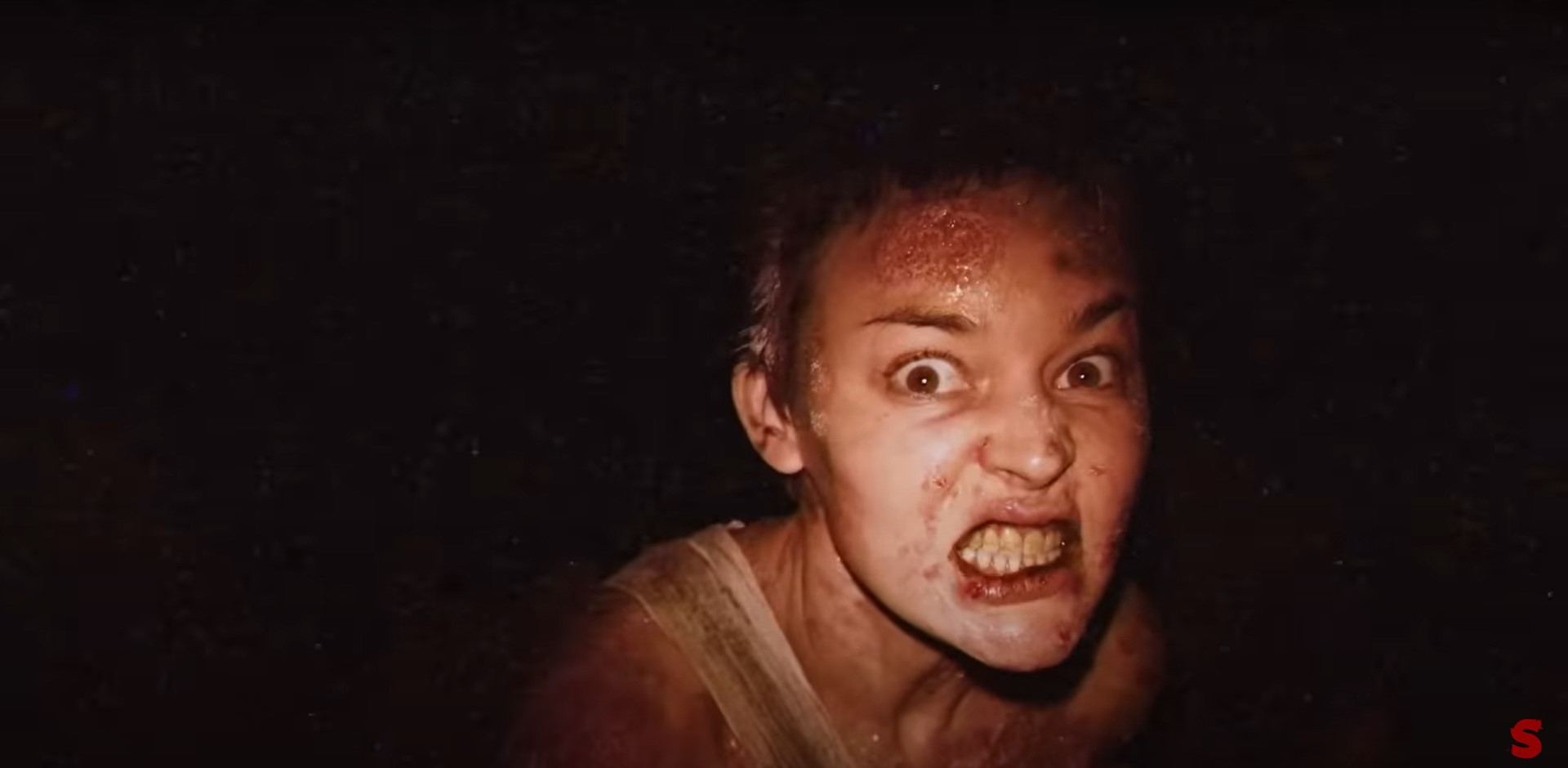
An EVIL Assassin Battle Royale! “Mean Guns” reviewed! (MVD Visual / Blu-ray)

“Mean Guns” on MVD Rewind Collection Blu-ray! Purchase Here!

A Crime syndicate mid-level enforcer named Vincent Moon invites professional hired killers and syndicate affiliates to a new, urban-centric prison constructed by the organization the day before grand opening.  The reason for this elaborate invitation is simple:  all those invited have betrayed the syndicate in one way or another and are brought into the locked down prison to battle royale to the death.  The rules of the competition clarify no one will leave the premises, unless being gunned down by a rooftop sniper is acceptable to them, and three contestants must survive the game to claim the prize, the prize being a three-way split of ten million in cash.  As guns, ammunition, and melee weapons are dumped onto the battle grounds, a scramble ensues, and factions are made with 6-hour clock to kill nearly everyone in sight to live and be rich or to be slaughtered by Vincent Moon.  However, there’s no honor amongst thieves and thugs and the rules bend in a rigged high-stakes game of kill-or-be-killed.

The late director Albert Pyun was an ambitious, fast-paced, and prolific director who dominated the late 1980s through much of the 1990s with eclectic, science-fiction action.  The “Cyborg” and “Nemesis” writer-director severed the line between reality and the alternate that brought science fiction to a more grounded realism, such as we see in the aforementioned films, mostly because Pyun was always short on funds and short on time to deliver a final, finished feature.  With his 1997 actioner “Mean Guns,” Pyun severed into another layer on the existential plane and took hold of different kind of alternative reality, one that is plagued by an all-powerful crime syndicate that has its insidious hands in everything, even in the personal and professional lives and secrets of its own employees and hired contracts.  Andrew Witham wrote the script that was produced by longtime Pyun collaborating producers Tom Karnowski (“The Sword and the Sorcerer,” “Cyborg”) and Gary Schmoeller (“Hong Kong 97,” “Omega Doom”), together the trio founded Filmwerks which became the production company under “Mean Guns.” 

Pre-“Law & Order: SVU,” which would define his career in the film and television industry, rapper Ice-T worked himself in from behind a mic to in front of a camera mostly beginning in the 1990s with “New Jack City,” an urban gangster film that matched his on stage musical presence and starred opposite Wesley Snipes (“Blade”), Chris Rock (“Jigsaw”), and Mario Van Peebles (“Jaws:  The Revenge”).  Ice-T found cult status in more pulpy thrillers with exploitation “Surviving the Game” as a homeless man hunted down by a group of rich sport hunters and playing a post-apocalypse beast in the graphic novel adapted “Tank Girl,” but his gangster persona had stuck with him, leaving him the legendary rapper seemingly encircled in the same kind of urban gangster films. This is the case with “Mean Guns” as he portrays a philosophical, upper-level syndicate criminal Vincent Moon spearheading a game of wetwork for the unscrupulous wetworkers associated with his organization.  Not the most prolifically dialogued or screen timed role, Ice-T does what he can to bring Vincent Moon into the fold of much more colorful characters.  “Highlander’s” Christopher Lambert receives co-top of the bill as a psychotic assassin looking to atone for a careless sin.  Lambert is wonderfully unhinged while calculating as he integrates his “Highlander” sword skills and maniacal grin into his character of Lou, who through flashbacks had accidently killed a child on one of his hits and retrieves his biological daughter for an abusive stepfather to start life anew.  More pragmatic is Lou’s rival Marcus, stoically portrayed by Albert Pyun regular Michael Hasley (“Dollman,” “Nemesis 2”).  Together, Lou and Marcus must team up, along with the coldhearted D. (Kimberly Warren, “Blast”) and syndicate accountant turned informant Cam (Deborah Van Valkenbugh, “The Warriors’), to survive against the fray of likeminded killers.  “Mean Guns” cast fills out with Tina Cote (“Nemesis 2”), Thom Mathews (“Return of the Living Dead”), Yuji Okumoto (“Robot Wars’), Jerry Rector (“Vampire’s Kiss”), James Wellington (“The Evil Inside Me”), and introducing Hunter Doughty.

Like many of Albert Pyun’s caffeinated action films, “Mean Guns” is the epitome of vehemently slick dipped in a 90’s glaze of an alternative, unchecked free-for-all of bad hairdos, trench coats, and guns.  Lots of guns in a pre-computer-generated muzzle flash with real recoil and really bad, but good, one-liners.  What’s more surprising about this Pyun is that, unlike his previously mentioned films, “Mean Guns” is virtually bloodless albeit the shoot’em up melee violently lays waste to nearly 100 bad guys.  Pyun integrated a liberal use of blood squibs in his other guns-blazing and contentious conflicts, but “Mean Guns” takes a step back to a less severe tile like “Unkind Guns” with a comically coated film pulled straight out of a cheesy graphic novel.   For example, a combatant, thinking they just scored the briefcase full of millions, finds their head aflame and their face covered in black powder loony toon style after the opened briefcase explodes offscreen.  These moments provide a reality check to the already outlandish, yet highly entertaining, every man for himself game of death made willingly subjectable by its limited principals and Pyun style action. 

Getting ready to kill for this new Blu-ray of Albert Pyun’s “Mean Guns.”  The MVDVisual release, a part of their MVD Rewind Collection, is presented in a 2.35:1 aspect ratio, AVC encoded onto a 1080p, high-definition BD50.  Pyun and director of photography George Mooradian, who collaborated on many of Pyun’s films, such as “Cyborg” and “Nemesis” as well as standalone projects with “Bats” and “K-911,” utilized a spherical lens with steep drop-offs around the edges of the frame, almost looks like everything around the left and right sides should be falling.  IMDB states anamorphic lens but judging from the complete focus of the background and the severe oval-like nature of the frame, I’m leaning toward a spherical lens. For vast landscapes where length is nearly limitless, a spherical lens would be ideal to unify depth and main focus but since confined to a prison interior, compact hallways are squeezed in beyond a reasonable limit and often side-stance characters are warped in frame.  Details are generally fine with the hi-def pixel count that translates skin tones naturally pleasing with a few moments of corrective coloring aside from the occasional red hot temperature flashbacks that bath everything in color-varied reversal exposure.  The transfer isn’t perfect either with a couple of noticeable damage blips on the 35mm print.  The uncompressed English LPCM 2.0 stereo is a mambo-ladened, bullet-whizzing, melee-skirmishing, and depth-exacting design that’s well balanced and layered.  Dialogue remains free of audible blights and courses prominent throughout.  Optional English and French subtitles are available.  Special features, including an Albert Pyun introduction that’s encoded into the Play Film as well as the bonus content and to which had to be shot well before his death judging by the appearance of his rather healthy person in the video, includes an audio commentary by the director, a new interview with producer Gary Schmoeller, a new interview with executive producer Paul Rosenblum, and a new interview with composter Anthony Riparetti..  The original theatrical trailer is also included. I’m always elated to see the MVD’s throwback package design and the 59th Rewind Collection release continues the theme with a cardboard slipcover in mock disrepair with a corner edged torn and exposing the corner of a VHS tape cassette. Not to forget to mention the designed rental stickers to heighten the effect. Underneath the slipcase is a clear Blu-ray Amaray case with reversible cover art, each side promoted with a scaled down poster art bordered and backgrounded with a similar coloring shade. Inside, the disc is smartly pressed with a VHS-façade while the insert side has a mini-folded poster of the primary cover art. The region free release comes rated R and has a runtime of 104 minutes, which when watching the feature one can see perhaps some cuts were made for timing. Perhaps, Pyun had a longer version and had to edit and cut down for time.

Last Rites: A romping mayhem, “Mean Guns” is ballistically ceaseless and entertaining, if not also the touchstone of 90’s cheesy action, and is presented well here with in the latest, and greatest, MVD Visual Rewind Collection Blu-ray.
“Mean Guns” on MVD Rewind Collection Blu-ray! Purchase Here!

On the Verge of a New Millennium, New Faces and Stories Tell Their Terror on the Same Old EVIL Video Format! “V/H/S/99” reviewed! (Acorn Media International / Blu-ray)

Found Footage is all the 90’s Craze These Days! “V/H/S/99” Available at Amazon!

The year:  1999.  The format:  VHS.  The theme:  The most horrifying experiences caught on found footage camera.  A horror anthology for the turn of the century puts together five of the most terror-drenched short films that resurrects the punk-rock dead, turns urban legends into vindictive playthings, televises Lovecraftian game show frights, peers into the stone-cold eyes of a Gorgon neighbor, and goes to Hell and back!  All caught on camera from a first-person view as VHS vicariously relives the glory days through a digital world, capsulated by the horror realm and all its fanatical acolytes for the analogue video format to live undead forever. 

Living in the age of a VHS comeback is admittedly kind of weird.  VHS has become a hot collectible, especially and obvious the rate and obscure that mostly resides in the horror and cult genre.  Most recently, a discovery on a Brazilian VHS cut of Jaws 2 has a couple of minutes of shot footage that no other release holds to this day.  That, being just one example, is sought after power of VHS that saw various versions of one film be disperse far and wide across continents, which the same could be said about DVD that too saw a variety of different cuts due to the diversity of playback formats, distribute cuts, and numerous levels of censorship between countries.  VHS is also making a comeback in format style with gritty, faded, flat colored image veneer and tracking lines and the absent transmission signal of snow statically adorning the screen with beautifully hypnotical and flickering white dots.  So, it’s now surprise that on the heels of 2021’s “V/H/S/94,” another analog anthology is greenlit in 94’s wake with “V/H/S/99” for 2022, written and helmed by newcomers to the series but not necessarily newcomers to the horror scene.  The movie’s sequential lineup Is as follows:  Short filmmaker Maggie Levin writes-and-directors “Shredding,” taking a break from killer sharks is Johannes Roberts to oversee his “Suicide Bid” entry, musician Flying Lotus directs and co-writes with Zoe Cooper with “Ozzy’s Dungeon,” “Tragedy Girls’” director Tyler Macintyre writes-directs “The Gawkers” along with co-writer and fellow “Tragedy Girls’” screenwriter Chris Lee Hill, and the husband and wife tag team of Joseph and Vanessa Winter, filmmakers of “Deadstream,” helms-and-pens “To Hell And Back.”  The Shudder exclusive series latest is produced by Josh Goldbloom (“V/H/S/94”), David Bruckner (director of “Hellraiser” ‘22), Chad Villella (producer of the of 2022’s “Scream”), Bloody Disgusting’s Brad Miska, and “Scream” ’22 and “Scream VI” director Matt Bettinelli-Olpin under the production banner of Studio 71 and presented by Cinepocalypse Productions and Bloody Disgusting.

A new set of five tales of analog rendered terror invoke a new set of actors in each short film that carrier with them a broad range of experience. While a couple of the stories shred the narrative with hectic editing (I’m looking at you “Shredding”), performances throughout come over with blistering consternation and definitely a late 90’s grunge attitude with “Shredding” and “The Gawkers” delivering the full blunt force of period, heckling away in their baggy clothing, bohemian hairstyles, and a penchant for skateboard thrashing. The other films are merely timeless with only mere mentions of date, or their timestamped on the video tape recording, or are just a thematical proverbial nod to the specific point in time, lacking the keep it real essence that is quite idiosyncratic to the hop from a phasing out decade and into a whole new other. The cast of these shorts play their roles with exuberance and wackiness, which if you have lived in or can look back to the converging decades/millennium and see some of the gameshows or cultural shenanigans that defined America as people or, if you want to go smaller, just the pop culture, wacky is a pinpoint descriptor. The short films’ of “V/H/S/99” are comprised of a cast including, selectively, Steven Ogg (“The Walking Dead”), Ally Ioannides (“Synchronic”), Keanush Tafreshi, Jesse LaTourette (“There’s Someone In Your House”), Dashiell Derrickson, Isabelle Hahn, Sonya Eddy (“Blast”), Emily Sweet (“Castle Freak” ’20), Melanie Stone (“Deadstream”), Archelaus Crisanto, Luke Mullen, and Ethan Pogue.

Anthologies have been around for decades and are a great medium to showcase a multitude of individual storytelling from a variety of filmmakers walking different paths in life.  Fans can often salivate over these types of jump-the-shark formats that can start off with the zombie undead, transition 10 minutes later into a supernatural spooky, and then segue into a creature feature with a wraparound bonus story that may or may not connect them all and squeeze each episodic terror vision in a full-length feature runtime.  Though I enjoy a good collection of short and sheer frightful films, anthologies are not my cup of sanguinary tea.  Hopefully, no partisan takes seep out of this review as I attempt to examine “V/H/S/99” objectively.  Out of the five segments, three have landed strong with a right amount combination of style, gore, performance, narrative logic, and, of course, terror, and if you like comedic sugar in your black cup of horror then “To Hell And Back” is a perfect Venti-sized, well-blended mulatto of choice that thrusts two dimwitted demonic ritual documentarians into the pits of dark, gloomy, and malformed creature Hell and fight their way back to their own plane of existence.  Though one flaw some make catch when watching the caboose film of the anthology is that it doesn’t particularly reflect 1999 other than the small caveat, which is pivotal to the story, that at the turn of the millennia is when the veil between our world and Hell is as it’s thinnest.  The other two better entries capture more infinitesimally in detail of the late 90s, early 2000s clothing and discourse.  “The Gawkers” taps hard into the weird aggressive hormones of a teenage boy while exploring the newfound ways to use technology as spyware.   Webcams aboard big boxy desktops chauffeur in a whole new way to be creepy that lands them in hot water not by the law but by the wrath of ancient femme fatale of Greek mythology.  Johannes Roberts rounds out the better half with a sorority haze gone wrong that evokes an urban legend to become more than just a story and Roberts “Suicide Bid” offers, again, that period presence that feels like a tribute throwback to the 1998 “Urban Legend” film itself, but adds a supernatural surprise that utterly creepy and not as deep with only 6 feet underground rather than a 47 meters down, the director is slowing raising his fear to the surface.  The shorts left hanging below the bar are “Shredding” and “Ozzy’s Dungeon” and for reasons that have to do with their style and story. “Shredding” promising premise is plagued not by punk phantasms back from the dead but simply pilfered of focus with a hectic, if not severely chaotic, VHS-graded editing scheme that shocks the perception senses while “Ozzy’s Dungeon” is inspired by Nickelodeon’s Legends of the Hidden Temple gameshow where kids have to compete in toned down ancient society games to race up the temple to win the big prize. “Ozzy’s Dungeon” definitely is weird, sadistic, and Lovecraftian-inspired for sure but its story design loses motivation and often cheats rounding the bases in order to reach the shocking climatic finale.

Acorn Media International brings tape to the United Kingdom with a Blu-ray home entertainment release of “V/H/S/99.” Presented in a widescreen 1.78:1 aspect ratio, though doesn’t cater to the standard 4:3 ratio of video tape, the provided image quality purposefully varies to give audiences the titular analog experience. Faded grading, tracking lines, static and that jittery playback is all part of the visual environmental experience and even a few of the filmmakers shoot the film digitally to then run it through VHS to garnish with unnatural base video turbulence. The English DTS-HD 5.1 surround sound mix heightens the exposure and familiarity to of being that person behind the camera as all of these shorts of short POV. Intense and, often, cacophonous, the audio tracks still manage to level out, be discerned, and manage to relay the chaos no matter how much bedlam is thrown at the screen. From the zoom in-and-outs of the video tape recorder, there’s a clean sense of depth and the range is bountiful as the ambient track runs the gamut of omnifarious sounds that give each episode an individualized stamp. English SHD is optional. Bonus content includes an exclusive panel from New York’s Comic Con with guests producer Josh Goldbloom, “The Gawkers'” Tyler Macintyre, and “To Hell And Back’s” Joseph and Vanessa Winter as well as a total arc gag reel. After that encompassing project feature, the girth of the bonus content breaks down into the individual shorts with “Shredding” having a deleted scene and the complete fictious band BitchCat music video, “Ozzy Dungeon” has two deleted scenes, “The Gawkers” has a deleted scene as well as bloopers, camera tests, and The Making of Medusa, and “To Hell And Back” rounds out the features with a hefty look at the raw footage, scouted location, and a storyboard and blocking rehearsals. There are no bonus features for Johannes Roberts’ “Suicide Bid.” Physical features include a slightly thicker traditional Blu-ray snapper, a Europe standard, with a cover art that matches the North American RLJE release, a city being loomed over by skull made out of colorful galactic stars and a pair of video lenses for blank eyes. The disc art is pressed with the same front cover image. Though no mention of a region playback on the back cover, I suspect a region B encoded release as per usual with Acorn Media Interntional. “V/H/S/99” has a total runtime of 109 minutes and is UK certified 18 for strong blood violence/gore. “V/H/S/99” is not my kind of off the heasy subgenre, but the latest series anthology packs a punch and I would never discourage anyone from not experiencing firsthand an homage trip through terror.

Found Footage is all the 90’s Craze These Days! “V/H/S/99” Available at Amazon!