The Most Dangerous EVIL Isn’t the Hunter! “Slave Girls from Beyond Infinity” reviewed! (Full Moon Features / Blu-ray)

The future for beautiful women holds little promise as they are slaves across a patriarchal-oppressed galaxy.  Daria and Tisa are two of those women, scantily cladded and stowed away in shackles on a galactic starship.  Their harrowing escape crash lands them on the shores of a jungle planet where they’re recovered and hosted by game hunter Zed and his two robot servants in his lavish castle abode.  Dressing, feeding, and providing them comfortable room accommodations, Zed appears to be Daria and Tisa’s savior against those who have enslaved them and from the wreckage of their getaway ship, but along with another couple of salvaged survivors from another ship, Zed has nefarious plans for each one of them.  Plans that put the survivors back into the mutant-infested jungle where fervent game hunter Zed’s need for worthy sport aims to capture and kill his pampered and mount their heads on his trophy room wall.

In a male-controlled universe, the battle of the sexes rages on!  “Slave Girls from Beyond Infinity” takes gender warfare into the jungle thicket with assumed male insuperability going up against the strength and will of woman.  The amalgamating sex, violence, and horror director Ken Dixon, known for his credits in exploitation with “The Erotic Adventures of Robinson Crusoe,” “Filmgore,” and the documentary “The Best of Sex and Violence,” helmed his last entry in 1987 with this underclothed and campy science-fiction chase of human game.  Dixon, along with John Eng, Mark Wolf, and Don Daniel produce progressive gender boundaries with the film’s opposition to the laid ideology of Charles Darwin who once said man have a higher eminence, in whatever he takes up while woman intuition powers are characteristic of a lower race.  “Slaves Girl from Beyond Infinity” worked to balance the scale with women who won’t lie down and die because of man-favored gifts of sexual selection.  Beyond Infinity and Titan Productions served as the co-production companies and distributed theatrically by then Charles Band’s Full Moon Entertainment subsidiary, Urban Classics, until It’s sequential acquisition by Band and its assimilation into the Full Moon collective.

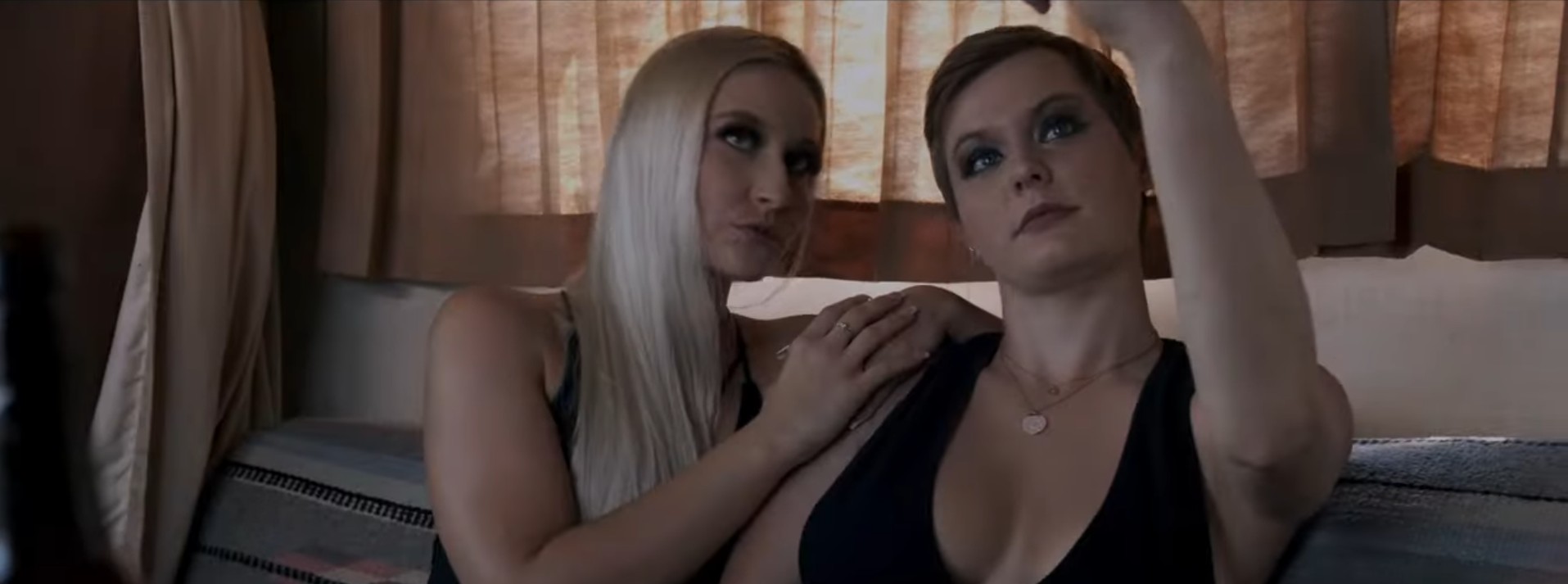
With the title like “Slave Girls from Beyond Infinity,” there better be a skimpy garbed cast of gorgeous women pew-pewing with futuristic laser guns and using their sexual promiscuity as a dangerous weapon.  Fortunately for us, Ken Dixon doesn’t drop the ball fulfilling the fantasy or, how I see it, is necessary for such a midnight showing title.  The film follows the imprisonment, escape, and into the hands of a human hunting madman story of Daria and Tisa, played by the super fit, super sexy blondes Elizabeth Kaitan (“Necromancer,” “Friday the 13th:  The New Blood”) and Cindy Beal (“My Chauffeur”).  Kaitan edges out Beal as the lead set early with Daria’s relentless confidence and better adept at taking advantage of a situation but both women play into the strong female heroine as they knock out well-armed and body-armored male guards, intoxicate the male, and even to the implied extent of a male identifying robot, gaze, and take on the murderous Zed in his own devious game albeit both barely having any clothes on for most of the duration in the cold of space and in the heat of the jungle.  Kaitan and Beal are not the only bodacious bods in the cast with the 80’s household scream queen Brinke Stevens (“The Slumber Party Massacre,” “Sole Survivor”) puts a foot out of the girl in a shower and other unnamed nude girl role and into a more principal character with Shala, a fellow planet stranded survivor from a previous crash told anecdotally, and in an opening, nonspeaking minor role, but definitely bursting with screams, and at the seams, of a barely covered flesh, is the unknown beauty Sheila White.  Stevens is sister to whom would become the “The Dark Half’s” special and visual effects supervisor, Carl Horner, as he plays Rik, a handsome, young man with a sneaking suspicion about their too-gracious of a host and a toying, on-the-brink love interest to a firm and more confident Daria in a steamy show sex scene to throw Zed off their conniving scent toward his do-no-good plans.  Zed’s a hard card to turn over and understand his true nature.  Played with impeccably classy and sporting glittery adorned, gun metal leather like a Niel Diamond on-stage outfit, Don Scibner has a traditional charm about him that he’s carried with him from his debut role in this Dixon film to other B-pictures laced with cult impression, such as “Moon of Scorpio,” “Night Shade,” and “Witchcraft XI: Sisters in Blood,” and really sells it as a game hunter giddy with the opportunity for new blood to track – male and female.  Between starship guards, robots, and planetoid mutants, Kirk Graves, Randolph Roehbling, Bud Graves, Jeffery Blanchard, Fred Tate, Jacques Schardo, Mike Cooper, and Gregory Lee Cooper fill in the supporting role gaps. 

“Slave Girls from Beyond Infinity” sounds like a busty-bust-up from the likes of Jim Wynorski but whereas Wynorski goes after a blend of buffoonery and boobs, and we’re talking about to the likes of really big, Russ Meyer-sized voluptuousness, Ken Dixon’s takes on a more earnest and natural approach, to an extent that “Slave Girls from Beyond Infinity” feels like a science fiction film of yore, circa 1950s with starship models, impractical attire, men in creature suits, and a timeless tone that is at odds with a futuristic setting.  A subtle whiff of campiness keeps the film from being monotonically stale.  The story itself is constructed from a historical literary framework, loosely based off the 1924 short story “The Most Dangerous Game” by Richard Connell with a big Russian aristocrat and game hunter, bored out of his gourd hunting animals, has turned to hunting shipwrecked people that find themselves stranded on his island.  Dixon replaces the Russian aristocrat with a lavishly leathered bachelor served by robots and skilled with a laser crossbow and the prey is technically shipwrecked but no longer worthy game man bur rather half-naked women comfortable in their loincloths and confident in their survival in an alien jungle amongst mutants, zombies, and a deranged hunter.  “Slave Girls from Beyond Infinity” certainly has that sublevel of sexual objectification and fantasy, or even perhaps is on par level with the murder of another human for sport premise as Kaitan, Beal, and Stevens not only bare most of their bodies, but their bodies are used as tools to subvert Zed’s snooping and are used by Zed in an exploitational sex act stemmed for this post-hunt thrill.

Full Moon delivers the most dangerous game in space down to insatiable fans of 80’s sex symbols and sci-fi oddities with a new Blu-ray release.  Unlike previous re-issue catalogue releases, either from standard definition to high-definition or high-definition to high-definition, “Slave Girls from Beyond Infinity” does not notify of any restoration or remastered efforts onto the AVC encoded, 1080p resolution, BD25.  However, not much needed to be improved on the already stellar picture from a virtually clean 35mm film.  I will say that the transfer did buffer out the natural grain of the film stock, but the details appear greatly featured amongst bronze and near blemish free skin tones from the model-esque actresses with big, teased hair down to the stubble and scarred faces of Rik and Zed, respectively.  Fabrics also come out on top with Zed’s outfit showing the stress marks of a leathery hide to the entirety of jungle epidermis, and even the forced perspective effects of composite mattes to enlarge the jungle setting, though an obvious matte effect, looks positively punctuated in detailed.  The soft lighting used to make the women stargazing eye candy does go against the detail grain but more accentuates the warm tones of a portrayed early science-fiction capture-and-kill.  The English LCPM audio comes in two formats:  a 2.0 stereo and a 5.1 surround sound mix.  The latter immerses you quite effectively but keeping the bass level and handled by the subwoofer reigns, dialogue comes over clean and clear in the front channels, and the sides offer atmospheric chitter of a strong world jungle.  Plus, all the laser fodder presents a satisfactory electric discharge familiar with the genre over the decades.  This suggests an optimization of the audio design for a full package of a sci-fi sonic palette.  This release does not contain a subtitle option.  The modest special features bundled with the feature include a skin-idolizing tribute to Elizabeth Kaitan that showcase her most memorable clothes-on and clothes-off moments from her film credits, the original theatrical trailer, and other Full Moon Features trailers.  The new HD suffers from the company’s consistent business structure of re-issue the film onto just a standard release with barely an encoded special features and little-to-no physical content, but the original film one sheet for the one-sided cover art offers an illustrated sexy and science-fiction splendor and the disc is pressed with select faces from the cover art floating amongst the stars in near translucency.  “Slave Girls from Beyond Infinity” Blu-ray is the R rated cut with a well-paced 75-minute runtime and is region free for global players, presented in a 1.78:1 aspect ratio.

Last Rites: Entertaining and easy on the eyes, “Slave Girls from Beyond Infinity” is an homage to the old science fiction psychotronic that’s vixenly sexy and savagely saucy under the guise of a cruel and deadly hunt on another world.

“Slave Girls from Beyond Infinity” Blu-ray Now Available! Order Here!

EVIL’s the Bacon, the Pork Roll, and the Scrapple All Mixed and Slashed together! “Butcher’s Bluff” reviewed! (Breaking Glass Pictures / DVD)

“Butcher’s Bluff” on DVD from Breaking Glass Pictures!

Film students Rodger, Nicole, and Derrick decide to head to the rural Texas town of Emerald Falls and make their class project documentary around the 28 missing persons over the years and the Hogman, an urban legend of an escaped killer now roaming the woods of Butcher’s Bluff.  Bringing along their friends to make it concurring party getaway at Rodger’s family vacation cabin, the trio conduct interviews with the eccentric town locals to build a story around the Hogman myth, even ascertaining the original location for the mask Hogman wore during his first kills before escaping psychiatric prison.  The more they investigate into the Hogman, the more the locals warn them to stay away from Butcher’s Bluff but in a case of curiosity killed the cat, the documentary film students and their drug-fueled, sexed-up friends find themselves being hunted with no cell service, no help within miles, and no way out of the Hogman’s kill radius. 

Co-directors William Instone and Matt Rifley helm their first collaborative feature “Butcher’s Bluff,” a 2023 small town slasher reminiscent of the renaissance slasher movement of the 1980s, packed with practical gore effects, odd backwoods characters, a campy party of vice-riddled youth, and, moist importantly – excuse me – most importantly, T&A.  Instone, whose all-in director, writer, and producer debut horror “Jon” from 2012 brings one man’s delusions into horrifying reality, cowrites his latest grim story with writer, painter, and overall liberal arts connoisseur Renfield Rasputin.  Filmed in Texas with principal locations taking place in Bastrop, New Braunfels, and San Marcos to composition a story set in the fictional town of Emerald Falls and its rural woodland of Butcher’s Bluff.  The film is a crowdfunded venture that raised an approximate $60K to cover principal shooting and post-production costs with Instone and Rifley serving as primary producers amongst an amalgamation of crowdfunded producing backers   Instone’s Thunder Mountain Films, in association with Dull Knife Productions and Spicey Ramen Productions, go hog wild with their slasher horror. 

As if he doesn’t have enough on his plate writer, directing, and producing “Butcher’s Bluff,” Instone also portrays the main antagonist Hogman, masked with a stitched together pig head complete with cockeyed tusks and garbed with a dingy mechanic jumpsuit and tan jacket.  The Hogman is a walk-and-run chaser with a duel-sided axe and rusty, broad curved knife as main melee weapons though he’ll get his bare hands dirty from time-to-time.  Instone’s not flashy with the villain and doesn’t key-light any iconic poses, stances, or stares to incite a nerve coursing fear.  Hogman’s victims are anyone and everyone who enters the Butcher’s Bluff forest, from necking lovers (Jacqueline Hays and “Mallrats’s” Jeremy London), to lost pot farm thieves (“You’re Next’s” L.C. Holt, “Scare Package’s’” Christopher Winbush, “Girls Gone Dead’s” Shawn C. Phillips), to finally, but not limited to, the Rodger’s friends and classmates on their excursion investigation and party.  Fortunately, the group displays different caricature tropes without going full-blown cliché.  Between them you have the exuding sexy yet overly bitchy duo of Sam and Tina (a cut pixie cut but broodingly built Samantha Holland and a slender yet high-end platinum blonde Kayla Anderson), Rodger’s sex-driven, dweeb cousin Bobby (Dakota Millett) who Sam and Tina torment, the polar opposite to Bobby stud with Jake (Santiago Sky) and of course the three documentarians:  Rodger (Michael Fischer), Derrick (Johnny Huang), and Nicole (Paige Steakley), each reside in their own attribute world consistently, dying the way they live, that’s very telling of their moral fiber.  In additional to Jeremy London and Shawn C. Phillips, who have worked themselves into being staples of the indie genre films, other notable names to mention for their brief but key roles are Brinke Stevens (“Nightmare Sisters”), Paul T. Taylor (“Hellraiser:  Judgement”), Bill Oberst Jr. (“3 From Hell”), and Bill Johnson (“The Texas Chainsaw Massacre II”) peppered into the rest of the supporting cast to draw in fandom.

“Butcher’s Bluff” has the necessary bone structure to be a digestible slasher, checking all the elemental boxes, and Instone and Rifley manage to technically pull off a nearly 2-hour film on a crowdfunded budget.   The problem is “Butcher’s Bluff” has a hackneyed routine about it.  Instead of creating something new and wonderfully, gory and diabolical, under a distinct flag of novelly progressive storytelling, every scene feels all too familiar, a telltale sign to horror fans that we’ve seen this kind of story before.  From Hogman’s stony silence and indiscriminate aggression bores him as a Michael Myers carbon copy, a family in cahoots with a s flesh-stitched maniac plays the tune of “Texas Chainsaw Massacre,” and there’s even a character moment of yelling What Are You Waiting For? aimlessly into the dark forest while spinning around with arms wide apart that oozes Jennifer Love Hewitt vibes.  Add in some rather uninspiring frame, shot design, and editing and “Butcher’s Bluff” very much embodies the crowdfunded costs rather than the intended crowdfunded spirit.  Now while all of this portion of the review sounds grossly negative, don’t just run for the hills to the next slasher film in line just yet as Instone and Rifley still manage to keep an engagement lock on what makes the slasher film enjoyable to behold with some decently inlaid practical gore effects, including a pleading head being sliced horizontally through from mouth to hair or a posthumous, lawn chair display of one fine girl’s nipples and eyes plucked from her body and posed on her eye-gouged out person as if giving a blood offering to the audience Gods.  There’s also the inviting gratuitous T&A from Samantha Holland, Kayla Anderson, and Jacqueline Hays that keeps the old theme motif alive within the campy slasher genre as well as keeping young boys’ dreams from becoming dry.

Breaking Glass Pictures distributes the archetypical slasher “Butcher’s Bluff” onto DVD home video.  The MPEG2 encoded, 720p upscaled standard definition, DVD9 really has a tough go with the compression capabilities as there’s quite a bit of data to encode/decode within a near full-time night shoot picture and color accompaniments that blend right into the darkness, melding out of a clean definition.  Presented in a widescreen 1.78:1 aspect ratio, banding and splotching render a difficult deciphering of data in inkier fields.  When colors do contrast or arise into lighter hues, there’s a pop of demarcation with its full potential held back by an ungraded layer.  Textures are extremely fluid throughout with the prominent skin scenes offering a decent, natural look but most scenes are fuzzy as if the upscale fights the downscaling for supremacy.  The English Dolby Digital 5.1 surround sound offers an adequate compression for a routine slasher with mid-level range with clear and clean dialogue overtop eerie forest soundscape of breaking branches, tree knocks, and leave crunching footsteps.  The mix doesn’t convey much depth with dialogue and ambience hanging around the front channels while medium shots and some tree knocking flirt with the side channels.  A mainstay slasher should have a memorable, tense-riddles soundtrack for the chase or create omnipresence fear but “Scream, Queen!  My Nightmare on Elm Street” and “Dinner with Leatherface” composer’s Alexander Taylor’s insipid inspiration can’t be held in the memorable bank and fails to elevate the Hogman’s imposing sheer terror.  English closed captioning is available.  Special features include a proof on concept trailer for the crowdfunding campaign that stars a handful of the actors from the feature film, such as Michael Fischer and Paige Steakley, and a behind-the-scenes music video that contains behind-the-scenes footage.   The DVD presence is standard fair for Breaking Glass Pictures with a DVD Amaray and a one-sided front cover art, which subjectively pleasing in its retrograde mockup of an illustrated Hogman looming over a scared, running Steakley (supposedly) in her white tank top and high cut shorts.  There is at least one noticeable error on the back cover that spells Paige Steakley’s name incorrectly in the credits, listing her last name as Steakely.  The Not Rated release is hard encoded with region 1 and has a two-hour runtime which can appear quite long, but the pacing was not terrible and the long runtime for an indie slasher didn’t feel overly immeasurable. 

Last Rites: “Butcher’s Bluff’s” has little to offer as far as the next novel and generational slasher but scratches the genre itch with a large body count, solid kills, and campy campers looking to buy, sell, and trade their vices for being violated.

“Butcher’s Bluff” on DVD from Breaking Glass Pictures!

Recalled to Nam is a Return Tour of EVIL! “Kill Zone” reviewed! (MVDVisual / Blu-ray)

Enter the “Kill Zone” on a New Blu-ray Home Video!

Combat POWs are captured by enemy forces, imprisoned in an outdoor internment camp.  Tortured for information, the prisoners are held without water in the scorching heat, strung up for hours on posts, beaten to a pulp, and stowed away in a hotbox if they do not cooperate with interrogators.  When Lt. Jason McKenna snaps and loses grip on reality, he breaks free from his confinement and kills four guards during the process when the soldier believes he’s back in Vietnam.  The only problem for McKenna is that the enemy imprisonment was a his own military’s roleplay training exercise for POW-survivalist.  The commanding officer, Colonel Crawford, had pushed McKenna too hard, making the exercise realistic as possible despite the warnings of fellow trainee and McKenna’s friend, Mitchell.  Now, the incensed Colonel is out for blood, covering his tracks with military leadership as he and the gung-ho soldiers seek to put an end to McKenna and it’s up to Mitchell to find his troubled friend first. 

The high-body count film that became the launching point for what would form Action International Pictures, 1985’s “Kill Zone,” an American-made, military actioner written and directed by the late David A. Prior (“Sledgehammer,” “Killer Workout”), opened the production door for a string of both action and horror ventures that spawned cult followings over the decades to come, especially when obscure titles such as “Kill Zone” never made it passed the release of its VHS format – until now.  John Saxon’s “Death House,” “Teenage Exorcist” with scream queen Brinke Stevens, and even the pint-sized creature feature “Elves” are just a few titles that owe “Kill Zone” some ounce of ground working thanks.  Prior cowrote the script with Jack Marino, who also produced the film under the limited formation of Spartan Films, and was shot in and around what is now Prado Regional Park in Chino, California.

Trekking from internment camp to civilization, aka the kill zone, and fighting and fleeing for their very lives from their own crooked military unit are McKenna and Mitchell, played correspondingly by “Killer Workout’s” Fritz Matthews and Ted Prior, younger brother of director David Prior.  Though Matthews has the emotional range of a tree stump, the leading man more or less fits the bill as a tall and stocky soldier protagonist while Mitchell does all the emotive heavy lifting of the pair, reflected in his large and muscular Stallone-sized biceps.  The comrades’ necks fall under the boot of Colonel Crawford from an aging David Campbell (“Scarecrows”) whose ridicule onslaught is dousing and his ruthlessness remains constant but can’t top the baseline he cemented early on into the story, diluting his villainy with not much formidableness, and becomes a feeble opposition.  Colonel Crawford is backed by his equally inadaqute military unit, former fellow trainees that divide themselves into a clique against the diverging outliers McKenna and Mitchell who separate themselves from the apathetic herd thinking either by post-traumatic mental illness or for concrete concern for a life-saving friend.  Either way, the rest of the unit bully their way into Crawford’s good graces albeit the Colonel’s lack of interest in the lives or death of his men in a nationally organized armed force that breathes the creed to keep the peace, but the Colonel’s men are just as complicit to their commanding officer’s callousness when they begin to rough up and snuff civilians in what is the most cold-blooded aspect of “Kill Zone’s” torrent.  Dennis Phun (“Surf Nazis Must Die”), Rick Massery, Richard Brailford, William Zipp (“Mankillers”), Richard Bravo (“Killer Workout”), and Larry Udy fill out the Colonel’s men while Ron Pace, Tom Baldwin, Jack Marino, and Sharon Young round out the civilian contingent.

On the surface, “Kill Zone” has the presentation of a direct-to-video, low-budget rip of “First Blood” but like the Sylvester Stallone John Rambo thriller, commentary undertones rise to the top with an additional few bobbing and freestanding from 1982 film.  Producer Jack Marino admits watching “First Blood” prior to writing the script that obviously become appropriated from the Ted Kotcheff picture in what is an underlining post-traumatic syndrome plagued individual in a dormant stage of the affliction then becomes pried open by aggressive, misapprehending authority with no time for a condition they’re ignorant too.  What follows is a deadly resistance against a barbaric enemy and the starkly different situations both characters John Rambo and Jason McKenna find themselves caught up in parallel their hellacious Nam tour in many synapse-snapping and physically scarring aspects to a point where the line blurs between being back in that Hell in reality and being back in that Hell in the mind.  What “Kill Zone” adds to its own version of the tale is no pedestrian anti-war pushback like we see with Brian Dennehy’s Podunk sheriff and his deputies but rather a shift in commentary toward the military’s once push harder and neglectful treatment on PTSD in what becomes an anti-military production to the extreme.  John Rambo had military sympathizers in Richard Crenna’s Colonel Trautmann but Jason McKenna’s Colonel spat flak with nothing but contempt for what he considers a weak soldier.  While military criticism is large and in charge, what negatively impacts “Kill Zone” is the no flare for technical military behavior or jargon.  The opening combat scene exemplifies the inexactitudes with Mitchell and his team storming through brush and across a river toward an unseen enemy’s stronghold guns blazing like little boys with popguns and mouthy explosions sounds of amateurism splayed all over as he and his team run wildly, hop like a bunny into fire stances, and point rifles with no line of sight.  Prior is able to achieve some nice shots of ammunition exchange with slow profile pans and aerial assaults filmed up from the ground, but there’s too much downplay to take this low-rung action film seriously and to really get a viewer the headspace of “Kill Zone’s” deathtrap montage that warrants more respect than what the rest of the presentation layout provides.

Missing in action from contemporary formats for over three decades, “Kill Zone” finally becomes rescued from inferior definition captivity and arrives onto DVD and Blu-ray (reviewed) courtesy of MVDVisual’s Rewind Collection series.  The Blu-ray is an AVC encoded, 1080p high-definition transfer scanned and restored in 4K from the 35mm interpositive print.  Presented in a widescreen 1.78:1 aspect ratio, the new transfer breathes new life into the lost but not forgotten feature with an enriched color grading and a sharpening of details, especially textures of the foliage and rocky terrains and assorted skin features.  Not entirely impeccable, contrast often teeters in the same frame and there’s an abundance of saturating grain, like large raindrop grain, in nighttime image that wash out details to great extent, but we’re always reeled back in with warm and pleasant color palette that flushes the previous VHS release quality down the core memory exiting drainpipe.  There’s one or two moments of vertical scratches, indelicately faint, and rough editing patches that distort to a blip that may be more problematic and age-related from the interpositive print than the dynamic restoration that was done.  The English language LPCM 2.0 mono track suffers from the low-quality sound recording equipment or placement that renders dialogue soft and nearly unintelligible as volume levels severely spike depending on how much the actors are projecting their voices.  There is some minor, unobtrusive popping throughout the fidelity faithful ambient and dialogue track, the latter, though softly wavering at times, does ultimately prevail to the forefront.  Optional subtitles are available.  Special features include a new audio (and optional video) commentary with producer Jack Marino, moderated by Cereal at Midnight host Heath Holland, a new Making-Of Kill Zone” featurette with clips interview with Jack Marino moderated by “Kill Zone” restoration project producer Steve Latshaw, the Vestron Video VHS version of the feature in standard definition, a photo gallery, and the original theatrical trailer redone with restoration elements.  The action-packed original poster art obtains a renewed look for the Blu-ray’s retro cardboard O-slip that resembles a torn, scuffed, and stickered VHS box art. Underneath the slipcover, the same poster art is on the front of the clear Blu-ray snapper case with latch and on the reverse side a back-the-scenes still images of Ted Prior and costars in character form.  The insert holds a folded mini-poster of the original poster art and the disc is pressed with the ridged gridlines of a VHS shell cassette with insert this side directions at the top.  Pretty neat design that further leans into “Kill Zone” VHS cult following purgatory.  MVD’s 50th release of the Rewind Collection is rated R feature has a runtime of 91 minutes and the Blu-ray is region unlocked for everyone’s viewing pleasure.  No longer destined to live out its shelf life on VHS, the wonderful contributors to obscure movie restoration brings “Kill Zone” back into action with a rejuvenated hi-def release that’ll blow you away. 

Enter the “Kill Zone” on a New Blu-ray Home Video!

EVIL Masked as a Religion. “Bryan Loves You” reviewed! (MVD / Blu-ray)

All New Blu-ray release of “Bryan Loves You” on Amazon.com

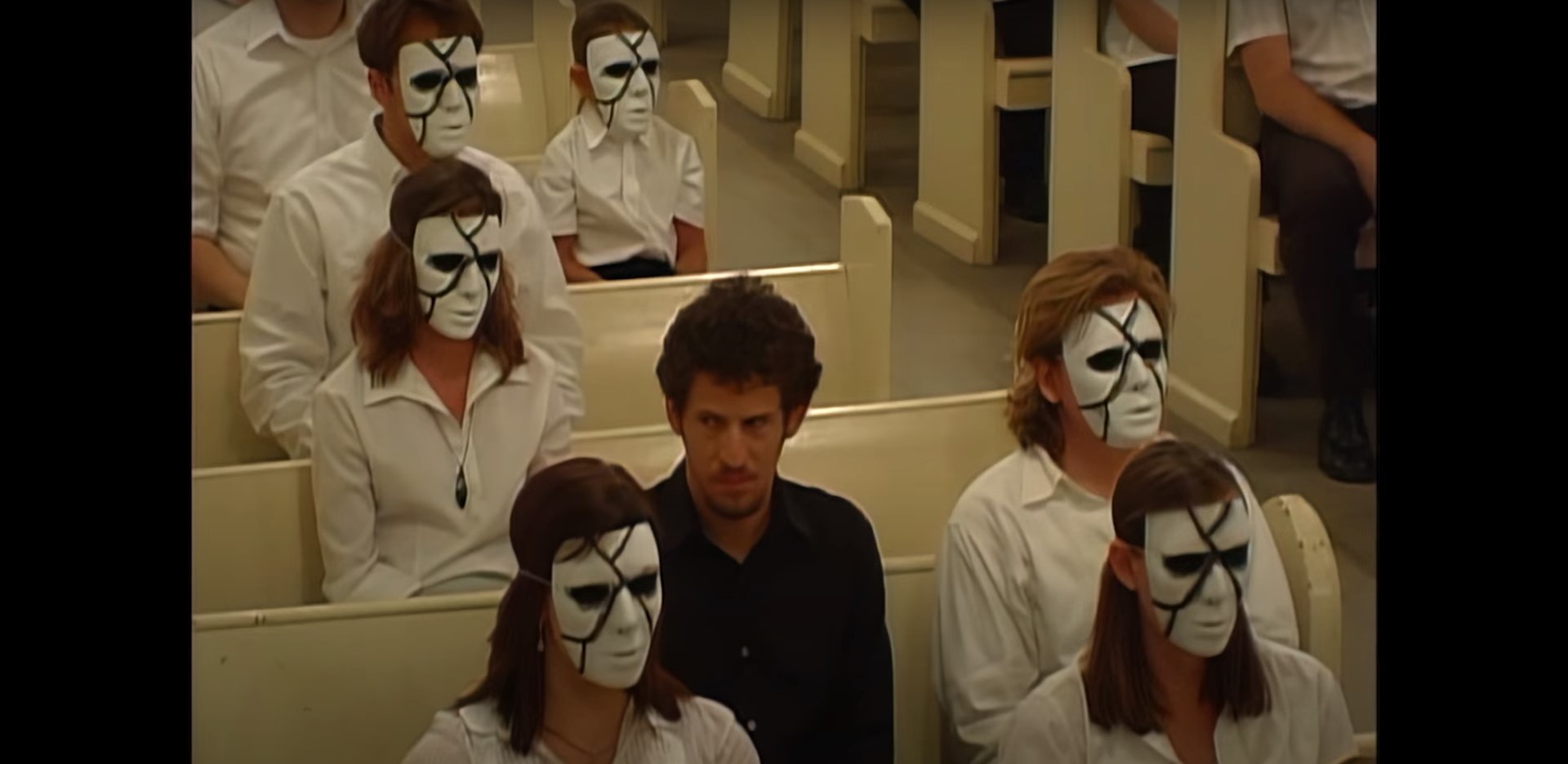
Something weird is spreading across a small Arizona town.  A chapter of a new religion has influenced most of the community into believing in Bryan, a pure and pious young boy from long ago who was brutally slain by the devil.  Jonathan, a local psychotherapist receives a camera from his uncle, also a health professional, with a self-recording that warns Jonathan that Bryan zealots are a dangerous, violent cult.  Deciding to document the situation himself, Jonathan repurposes the camera to clandestinely record the widespread Bryan gatherings and even infiltrate their church where they speak in tongues and wear the scarred mask of Bryan.  As Jonathan goes deeper into the uncomfortable insanities of Bryan’s world, the more Bryan followers takes an interest in reconditioning Jonathan. 

“Bryan Loves You’s” grainy SOV pseudo-documentary lacquer not only captures the icy blank stares, the unabating drone chanting, and the brainwashed coup of an insidious cult assimilating small town America, but the Seth Landau written and directed film also homogenously captures, all too presently well, that sense of ambivalent and conspiracy dread that knots apprehension uncomfortably in the pit of the stomach.  The 2008 released “Bryan Loves You” has the story set in 1993 Arizona made out to be a historical home video and CCTV recorded account of the analyzed and dissected suppressed footage coming to light for the first time incomplete with censored last nights and specific addresses to make the pseudo-doc appear more genuine and shocking.  Filmed in and around the suburbs of Scottsdale and Phoenix, Arizona, “Bryan Loves You” is a found footage subgenre production self-produced by Mike Mahoney and Seth Landau, under the filmmaker’s Landau Motion Pictures, and marks the debut feature film of Landau’s humble career that started roughly around 2003 as a production assistant on “Arrested Development.”

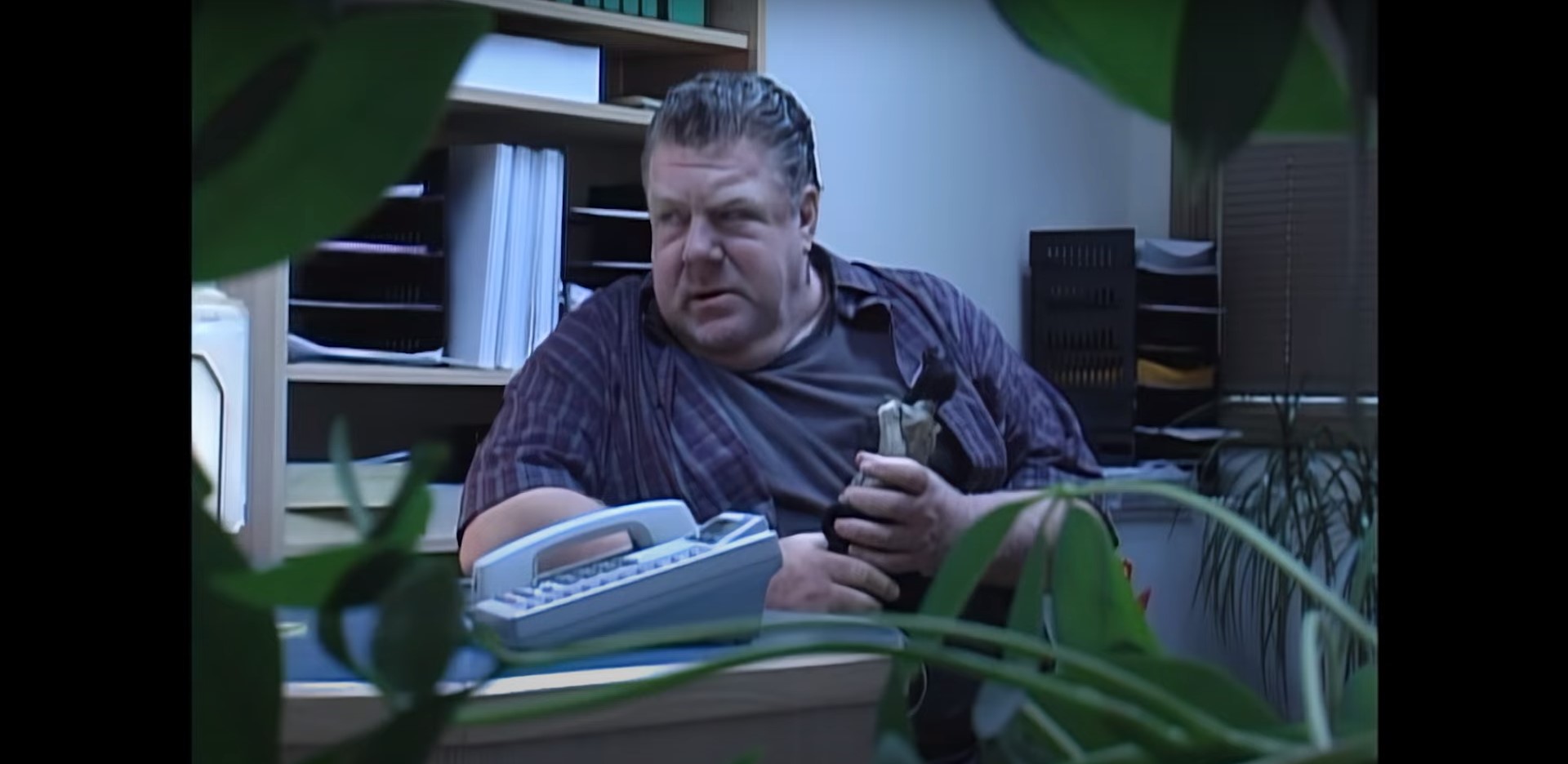
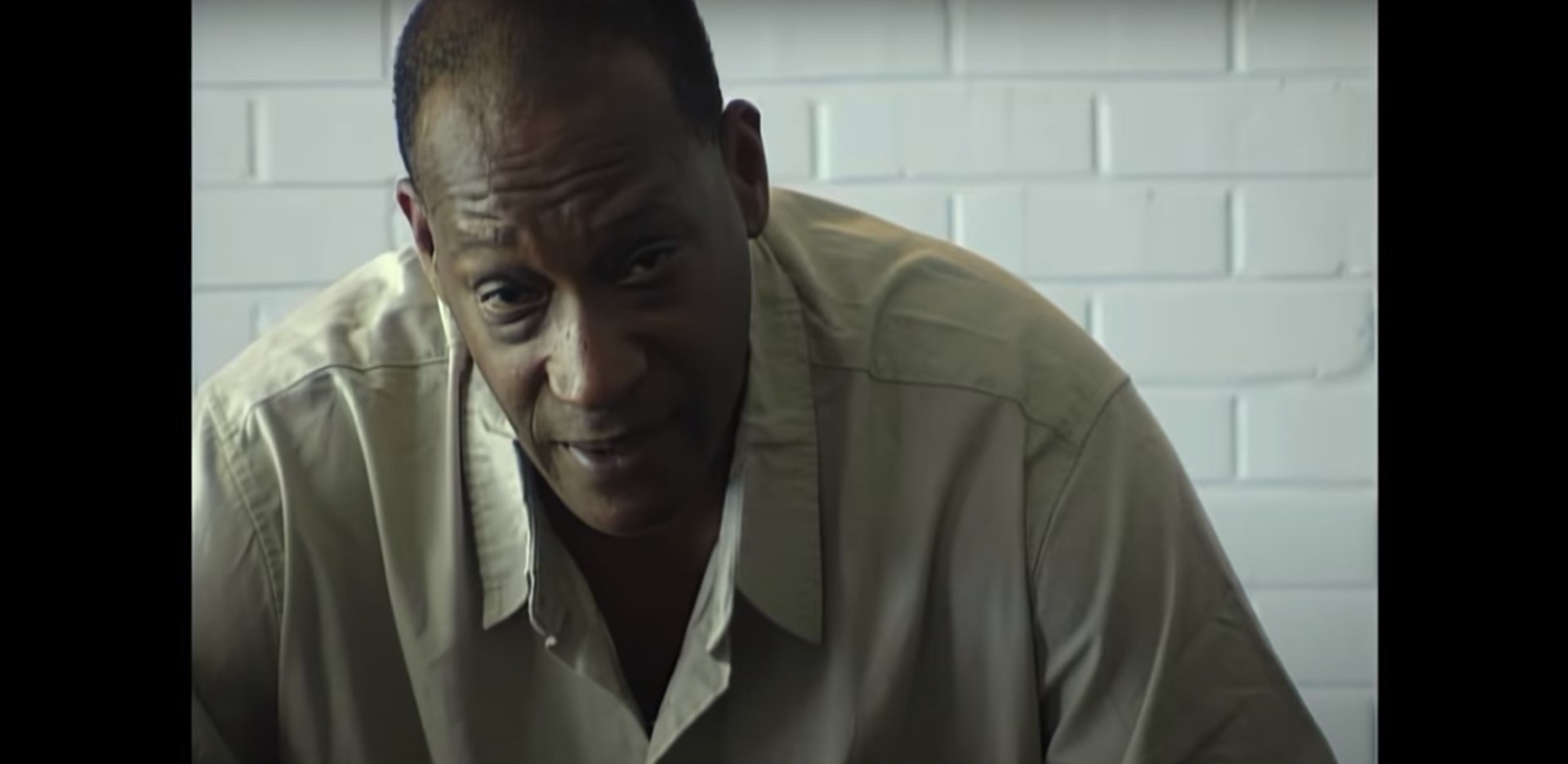
For the average popcorn movie goer, “Bryan Loves You” is about obscure as they come with a no-name director and a cast with relatively no-name actors with the exception of one that might have a chance of recognition by the common Joe Schmo.  Old heads may recognize George Wendt, one of the barflies from the sitcom “Cheers” and the Saturday Night Live sketch of Super Fans, in his brief and strange scene as a patient holding a doll that speaks to him about people who talk about him.  For chin-deep genre fans, Wendt is about the biggest A-lister you can have in an indie film and what’s unusual about “Bryan Loves You” is the stacked list of iconic made-by-horror names that make up the cast list.  It’s impressive.  Landau’s connection to the late great master of horror Stuart Gordon (“Re-Animator”) opened the door to George Wendt, who starred in Gordon’s “King of the Ants,” and, likely, led to the onboarding fan favorites such as Brinke Stevens (“The Slumber Party Massacre”), Tiffany Shepis (“Tromeo and Juliet”), Lloyd Kaufmann (“The Toxic Avenger”), Daniel Roebuck (“The Devil’s Rejects”), Chuck Williams (“Demon Wind”), and Tony Todd (“Candyman”).  Now, with these many names, none of them have starring roles and few have reoccurring scenes, but they are headlined to draw attraction for “Bryan Loves You.”  Honestly, the performances are hardly worth nothing.  Steves and Kaufmann have little dialogue and are shot at weird angles that makes them hardly recognizable.  Best scenes go to Tony Todd as a hesitantly disturbed and full of fear narrator standing in an empty board room and talking directly into the camera about what we, the audience, are about to witness, even directing viewers to turn away or to be ushered out of the theater (did this get a theatrical release?) if the content becomes too shocking to behold.  Seth Landau stars as the principal lead Jonathan who can’t be taken seriously as a psychoanalyst as there is no depth to the character in those regards.  Plus, as someone who’s supposed to uphold ethical standards, Jonathan breaks quite a few HIPPA regulations and breaks into houses with a camera, filming Bryan acolytes without their consent.  “Bryan Loves You” rounds out the cast with Tori King, Candy Stanton (“Exit to Hell”), Shane Stevens (“The Graves”), Jilon VanOver (“Bad Blood”), Tom Noga (“Anonymous Killers”), Jesse Ramiawi, Jacqui Allen (“Blue Lake Butcher”) and Daniel Schweiger (“Die-ner”)

Seth Landau’s found footage cult film is a rough cut of rudimentary psychological suspense restrained by its limiting low-ceiling budget.  The acutely hard cut editing and wonky framing is enormously puzzling within the narrative’s supposed single camera source documentary structure that suddenly diffuses into being a splice between Jonathan’s camera, which he loses halfway through the story, and a bunch of randomly placed CCTV footage across all of Arizona, in which some scenes are randomly placed in the desert where no structures are seemingly present to house a camera.  Who gathered and edited all this multi-video footage together?  Or does that play into the mystery, no matter how illogical, of adding to “Bryan Loves You’” unsettling allure?  What Landau does accomplish compares closely to what directors Eduardo Sánchez and Daniel Myrick were able to profoundly achieve with their unexpected breakout found footage blockbuster, “The Blair Witch Project.”  Now, I’m not saying “Bryan Loves You” had the audience gasping power as the “The Blair Witch Project” but the air in the story still feels very uncomfortably still, like in holding your breath, because something sinister is closing in and that type of disturbing presence, coupled with the erratic demonic behavior boiled to the surface if love for the almighty Bryan is absent, is all too relatable in today’s political climate.

Though “Bryan Loves You,” MVD Visual really loves Bryan right back with a high-definition Blu-ray release, remastered and upscaled from the original master source, a digital recorded standard definition, with an approved up-conversion of 172,800 pixels to over 2 million pixels per frame to achieve full HD.  For SOV, the handheld cam footage turns out more detailed than expected with suitable tinctures that are often less vivid in the found footage genre; however, there are still varying levels of quality from lower quality posterization to better than mid-grade delineation.  Though stated as presented in a widescreen 1:78:1 aspect ratio on the MVD Marquee Collection back cover, the actual ratio is a pillarbox 1:33:1 without straying from that display. The English language dual channel stereo track also has varying fidelity levels using the inconsistency of a built-in handheld mic but the good bones behind the range and depth retain the natural auditory proportionate. A few augmented audio tracks are snuck in for effect, such as the preacher’s demon-speak and the school PA system. English subtitles are optional. With a new Blu-ray release comes all new special features with a few short film-length interviews between filmmaker Seth Landau and George Wendt (44:50 minutes), Tiffany Shepis (50:49 minutes), Daniel Roebuck (59:35 minutes), and Brinke Stevens (31:46 minutes) touching upon more than just “Bryan Loves You” but also various career moments and other media cultural topics. Also featured are two commentaries: a 2008 commentary with Landau, select cast and crew, and JoBlo critic James Oster and a new 2022 commentary with only Landau. Plus, a brand new 2022 theatrical trailer. “Bryan Loves You” draws parallels to the 1993 Waco, Texas cult led by David Koresh of the Davidian sect preaching fire and brimstone, but writer-director-product Seth Landau adds his own supernatural concoction in a trade-in of doom and gloom for mindless devotion and diabolism that turns folks into followers and flesh-hungry fiends at times. Maybe not the prime cut of the cult genre but does stand out even if you don’t really love “Bryan.”

All New Blu-ray release of “Bryan Loves You” on Amazon.com

Evil Isn’t Home. “Death House” review!


Top law enforcement agents, Boon and Novak, achieve special access through steep sacrifice during job assignments and are permitted to tour their upcoming placement in the highly exclusive Death House, the ultimate maximum and multi-level penitentiary home to the nastiest criminals known to society and the deadly threat to mankind in a metaphysical way. Death Houses uses virtual reality to keep inmates stimulated to the point of calm submission as well as drugging the homeless and the unwanted to supply killers with victims upon victims in an their personalized virtual surroundings, but when an outsider uses an EMP to knock out all power within the facility, the cages are open and the ruthless animals are free to overrun, beating to death the guards and staff. Boon and Novak must fight their way to the bottom level that hold the Five Evils, criminals with grotesque supernatural abilities and a wickedly grisly past, where the two agents believe the Evils are their best hope for survial against a Five Evils acolyte named Sieg and his faithful jailhouse followers.

Considered as “The Expandables” of horror, “Death House” had gained almost instant fandom solely from the long-list of horror icons in the cast. Director B. Harrison Smith (“Camp Dread”) re-writes most of Gunnar Hansen’s original “Death House” story produced by Cleopatra Entertainment and Entertainment Factory. Cleopatra Entertainment is more notably a music label that has delved into films the last few years and, in my opinion, haven’t faired positively in the horror genre, but “The Texas Chainsaw Massacre” star fought tooth and nail to try and get his script off the ground, even in the face of death. “Death House” saw release after Hansen’s death, but from interviews with the filmmakers, Smith had almost totally revamped the original treatment, leaving The Evil’s at Hansen’s request if his script was to be entirely cleaned. Shot right in this reviewer’s backyard of Philadelphia, Pennsylvania at the historic Eastern State Penitentiary, the defunct prison is an ideal location as the “Death House” due in part to John Haviland’s separate cell design and gritty appeal that was once of the home of Al Capone, but more of the focus is on the interior than exterior with green scenes and Los Angeles shots constructing the story-lined scenes.

Like aforementioned, “Death House” has been called the “The Expendables” of horror. An immense, if not soaked, cast of horror fan favorites are peppered about around the main characters of Agent Boon and Novak. “Sushi Girl” and “Zombeavers” star Courtney Palm embodies the Agent Boon character with G-man toughness, but finds difficulty leaving that b-horror mentality with shakiness in working climatic scenes. Palm’s also roped into doing an extremely gratuitous shower scene with Cody Longo (“Piranha 3D”) as Agent Novak. Novak’s a hotshot and Longo has the looks and the talent to out perform his character, but Smith’s script doesn’t do justice to either Boon or Novak’s character that blatantly underwhelms their performances with cameo star power and a shoddy narrative. Dee Wallace (“Cujo”), Barbara Crampton {“Re-Animator”), and Kane Hodder (“Jason Goes to Hell”) have prominent roles that are pertinent to the story and are enjoyable to see them in more of a supporting capacity. Andrenne Barbeau {“The Fog”), Sid Haig (“The Devil’s Rejects”), Vernon Wells (“The Road Warrior”), Bill Moseley {“The Devil’s Rejects”), Lloyd Kaufman (Mr. Troma), Michael Berryman (“The Hills Have Eyes”), Tony Todd (“Candyman”), Sean Whalen (“The People Under the Stairs”), Debbie Rochon (“Killer Rack”), Bill Oberst Jr. (“Deadly Revisions”), Felissa Rosa (“Sleepaway Camp”), Danny Trejo (“Machete”), Tiffany Shepis (“Abominable”), Brinke Stevens (“The Slumber Party Massacre”), Camille Keaton (“I Spit On Your Grave”), Gunnar Hansen (“The Texas Chainsaw Massacre), and R.A. Mihailoff (“Leatherface: Texas Chainsaw Massacre”). Whew. Rounding out the remaining cast is Lindsay Harley (“Nightmare Nurse”), Vincent M. Ward (“The Walking Dead”), and Bernhard Forcher.

While the genre star-studded ensemble cast is a wet dream for horror fans, “Death House” fails in numerous filmmaking categories with the first being the most important, the script. Smith’s re-work of Hansen’s original story requires another drastic once-over, or two, as the final result attempts to push, stuff, and cram 100 lbs of multi-subgenre elements into a 10 lb, inflexible bag, cramping the ambitious project with dis-connective storyline tissue braced together with shoddy visual effects, like the two agents free-falling down a bottomless elevator shaft and able to precisely shoot their targets on each level. The overall result of “Death House” just endures an unfinished varnish and seems slapped together with pre-schooler glue and claggy spit. Singular moments surface as diamond specks amongst cubic zirconias, like the Mortal Kombat fatality-esque practical effects, but are too far and in between to muster up an enjoyable film. The Five Evils definitely and desperately needed more presence in the story instead of just flexing the talking heads muscle; well, the only two Evils to say anything at all were Bill Moseley and Vernon Wells. The Five Evils didn’t quite have that oomph to be a force to be dealt with as Gold-described beings who philosophical interpretations on the concept of good and evil.

Cleopatra Entertainment and MVDVisual present B. Harrison Smith’s long-anticipated “Death House” onto DVD home video. The unrated, all-region DVD is presented in a widescreen format that displays some frayed flaws like contrast; there’s way too much inky black in the dark scenes and little-to-no definition in more visible sequences. The compression suffers from blotchy artefacts at times too and lacks hues, which works with the gritty tone inside the Eastern State Penitentiary’s decomposing walls of rubble and decay. Visual effects are glossy with virtually no textures to give detail or, essentially, life amongst the continuous death. Bonus features include multiple interviews with director B. Harrison Smith, Courtney Palm, and more. Also included is a behind-the-scenes feather, a gallery slideshow, and theatrical trailer. Despite being true to the title and highly anticipated since it’s inception into the public market, “Death House” ultimately disappointments as an unfurnished mess enlisted with big names in the horror domain that’ll unfairly sell the film on it’s own, but all-star cameos won’t establish “Death House” as a solidified cult favorite, being unfortunately one of the biggest release flops of 2018.