A Bond of Friendship Formed Over an EVIL Annual Contest. “The Long Walk” reviewed! (Lionsgate / Blu-ray)

“The Long Walk” on Blu-ray for the Holidays!

Over a decade ago, a divisive civil war nearly tore the United States of America apart, leaving in it’s wake a country on the brink of financial ruin and its place in the world behind other nations.  To help heal the nation back into an industrial superpower, an annual long walk was enacted to be a show of encouragement, an act of bravery, and to instill a sense of duty and production amongst the citizens of America.  Voluntary participants of young men, one from each state, must walk continuously at 3 ore more miles per hour with a military escort.  Last man standing will be bestowed a large cash prize and granted one wish of their choosing.  Those unable to continue their trek at the required pace will be issued three warnings before being gunned down, punching out their ticket.  Home state’s Ray and Georgia’s Peter form a bond on their walk that’ll test not only their friendship but their will to live in hopes to change the contest’s cruelty.  

“The Long Walk” has itself been on a long walk to being adapted on film from the first official novel by the prolific and renowned suspense writer Stephen King under his pseudonym of Richard Bachman.  I’ve italicized official because the late 60’s novel wasn’t published and released until 1979, five years later after “Carrie” was published in 1974.  Through the hands of George Romero and Ridley Scott, neither could materialize a filmic rendition of what is considered his most grim work.  That is until “Constantine,” “I Am Legend,” and “Hunger Games” director Francis Lawrence came along, acquired the rights, hired “Strange Darling’s” JT Mollner to script the project, and produced perhaps the most disturbed dystopian film of 2025.  “The Long Walk” feature is a collaborative production from Spooky Pictures, Electric Lady, and Miramax, is produced by Steven Schneider, Francis Lawrence, Roy Lee, Cameron MacConomy, Rhonda Baker, Ellen Rutter, and Carrie Wilkins, and has been given executive producer Stephen King’s blessing for minor, yet impactful, creative control.

“The Long Walk” courses with a young but up-and-coming cast with a veteran icon bringing up the rear as coxswain spurring the unpleasant action.  “Licorice Pizza’s” Cooper Hoffman, son of the late Philip Seymour Hoffman, and English actor David Jonsson whose just came off his part in a big science-fiction horror franchise with “Alien:  Romulus” from last year.  Together, Hoffman and Jonsson play the central characters of Ray Garrity and Peter McVries, two young men who formulate a bond while voluntarily participating in the annual deadly contest that traverses for hundreds of miles through heartland portions of an undisclosed state.  Right from the get-go, Ray and Peter hit it off as the check in for the contest simultaneously upon arrival with the story quickly introducing and discerning a select sundry of other walkers that are either in it to make friends, be an in-it-to-win-it antagonists, or be a formidable indifferent with a spectacular end to their ticket or otherwise arc toward either direction.  In these walk-along parts are Ben Wang, Charlie Pummer (“Moonfall”), Joshua Odjick, Tut Nyuot, Roman Griffin Davis, Garrett Wareing (“Independence Day:  Resurgence”), and Jordan Gonzalez supporting the Ray and Peter narrative with their own in-state regionalism and dialect backstories and motives for sacrificial strutting, which their exit that much more poignant.  Then you have Mark Hamill, who needs no introduction, in a performance on a totally different plane of existence than the young man walking for their very lives.  Blind to compassion and stern on his belief sacrifice is necessary for the greater good of the nation, Hamill as no nonsense brass, known only as The Major,” is a mythical figurehead initially held in high esteem and awe or overall indifferent amongst the young men.  All except one with Ray being the firm outlier of contrarian using passive aggressive measures that build to an endgame goal.  Sporting large aviators, green fatigues, and occasionally holding and firing a sidearm, Hamill’s method ways really come alive within The Major’s gung-ho disposition inside an authoritarian America.  Judy Greer (“Jurassic World”) and Josh Hamilton (“Dark Skies”) round out the cast as Ray’s parents. 

No matter how grim “The Long Walk” spans the 108-minute runtime, the story isn’t necessarily all bleak.  While the time period is unknown and the war that has seemingly divided the nation goes unsaid, one can assume the decade is late 1960s to early 1970s based off the military fatigues and weaponry, the dialect and slang vernacular, and the outer shell of the world with clothing, cars, and storefronts that speak to a simpler time where no cell phone exists, transmitter radios are the news and music, and the presence of any modern-day convenience lost amongst the vast fields and deprived brick-and-mortars of small town America.  Yet, the story walks along the lines of some alternate, dystopian reality, pre-dating a “Hunger Games” like contest involving the permanent elimination of young people in effort to better society.  Fortunately for “The Long Walk,” director Francis Lawrence directed “Hunger Games” and that gives him a leg up on the tone this adaptation needed for the big screen but although the two share a similar theme, the differences between them are vast with “The Long Walk” set in a past instead of a future dysphoria, objects and places are established and grounded by reality rather than creative fiction, and the violence is by far the grislier.  Often, violence can be gratuitously supplemental and unaffecting but Lawrence’s intention to show closeup executions contrasts with weight against the boys’ bond building during their fear and their ambition test.  With every explosion of brain matter and bits of flesh the stakes are real and the tension is thick even if the panic is subdued amongst the walking competitors.  Yet, with every ticket punched, that tightness starts to show signs of shuttering in conjunction with fatigue and that carries on for miles.  Much like the film adaptation of Frank Darabont’s “The Mist,” the ending for “The Long Walk” has been altered from the novel with prior Stephen King approval and while “The Mist” absolutely shatters all the hope with tons of despair and irony in a blaze of glory ending where one’s heart drops like a cannonball in the ocean, “The Long Walk’s” finale barely fizzle to make the same impact and can even be said to be a predictable modern moving ending. 

“The Long Walk” puts one foot in front of the other toward a new Blu-ray release from Lionsgate.  The AVC encoded, high-definition presentation in 1080p, is stored on a BD50 with a widescreen 1.39:1 aspect ratio.  Sharp detail in the small percentage desaturated picture offers a mid-20th century America air along with the costuming and production sets and locations.  Fabric textures result better in sweat-induced cotton Ts overtop a variety of muted shaded pants and solid army fatigues while the rest of the landscape has a green, brown, and tan landscape of a scarce Midwest, harnessing widescreen and medium shots for the open terrain that equally freeing and beautiful yet also confining and harsh in the grim, dystopian contest; however, the textures take a back seat to the chunky bits of exploded flesh, blood, and brain matter splattering either in gray and painted asphalt or spreading amongst the wind.  While the detail doesn’t provide all the gory bits and pieces there’s enough there to really cause alarm from within.  The English Dolby Amos is the primary English track for best to enclose the immediate space surrounding the 50 State participates feet hitting the pavement and the escorting military convoy tank and wheel tracks.  Gun shots are jolting that tear into the audio senses in step with the graphic nature of the scene of apathetic militaristic executions.  There are curious post-execution sounds from the blood pooling on the street in what sounds like a continuous gush of blood that hits the side channels; its an odd action for sound to take audible shape, especially in scenes that are not an extreme close up but rather materialize out of medium shots.  Dialogue is perfectly suitable in the conversational piece between the young men and the gruff Major.  Other audio format choices include a Spanish Dolby Digital 5.1 and a French Dolby Digital 5.1.  There are also an English 2.0 descriptive audio and subtitles in English, Spanish, and French.  Special features include feature length documentary Ever Onward:  Making the Long Wal” with crew – such as director, writer, and DP – and cast – including Cooper Hoffman, David Jonsson, Garrett Wareing and more – interviews discussing the depths of “The Long Walk” from A-to-Z, from it’s previous adaptation concept rights held in limbo down to the individual character mindsets.  Two theatrical trailers are the only other special features encoded.  Lionsgate Blu-ray Amaray case is encased a O-slipcover with straightforward (pun intended) artwork that’s also on the case artwork.  The digital copy leaflet is inside for digital moving watching pleasure.  The 108 minute film is encoded region A and is rated R for strong bloody violence, grisly images, alcohol, pervasive language and sexual references. 

Last Rites: An intense and somber America born out of division and fear is a reverse reality, an alternate take on what could have been or could be soon, as “The Long Walk” glorifies sacrifice as a scapegoat for national pride, strength, and the greater good in a warped sense of authoritarian rule and industrial encouragement.
“The Long Walk” on Blu-ray for the Holidays!

This Toyish EVIL is Definitely Not a Toy! “The Monkey” reviewed! (Neon / Blu-ray)

Own “The Monkey” on Blu-ray from Neon!

When twin brothers Hal and Bill, who personably couldn’t be more different, come across their deadbeat father’s windup toy grinding monkey amongst his left behind things, every time they wind up the monkey’s rat-tat-tat tune, at the last stroke someone close them dies a gruesome, horrible, seemingly accidental death.  As the deaths hit closer to home, such as the violent aneurism that takes their loving mother, the boys decide to toss the sinister toy into a deep well to stop it’s dooming of another soul.  The boys diverging personalities drive them apart and for many years they don’t speak until Bill calls Hal about the accidental death of their aunt.  A new string of death begins as the toy resurfaces to play its portentous tuneful rattling once again.  Hal, who’s now trying to connect with a son he’s kept at arm’s length in fear of the monkey’s return, must reunite with Bill to stop the carnage before it’s too late for them all.

Stephen King is so hot right now.  Hell, Stephen King has been hot for decades as one of the still living novelists to have numerous film and television series adaptations.  This year alone proves how influential and craved King’s work is amongst filmmakers and fans with “The Long Walk” and “The Running Man” feature films being released in the months to come.  There’s even the upcoming film rendition of “The Stand,” a novel that’s been adapted twice already set to receive a third account.   Since 1976 with his first adapted novel “Carrie,” King has been the king of having his work reimagined for visual scares and entertainment.  Earlier this year’s “The Monkey” is another example of the prolific author’s short story of the same title from his “Skeleton Crew” collection, coming to life on the big screen being helmed by one of the hottest new directors in modern horror, Osgood Perkins (“Longlegs”).  The horror-comedy is written and directed by Perkins in British Columbia, Canada and produced by “Saw’s” James Wan as well as Chris Ferguson, Dave Caplan, Brian Kavanaugh-Jones, and Marlaina Mah.  “The Monkey” is a company collaboration between Atomic Monster, The Safran Company, Oddfellows, Stars Collective, and C2 Motion Picture Corp. with Neon presenting theatrical distribution.

English actor Theo James is also no stranger to films adapted from literary works as The Divergent Series film star steps into “The Monkey’s” killing sphere by playing not one but two roles as the Hal and Bill Shelburn, twins with a tragic history that runs integrated with the windup, grinder monkey.  James caters to both personalities with mild-mannered energy that does transition exactly from the children counterparts (Christian Convery, “Cocaine Bear”) in the first half of the 30-year time span. Older Hal is joined by his son, lightheartedly named Petey, played by “Wonka’s” Colin O’Brien with the same deadpan deliveries as Theo James that greatly adds to their combined relationship and antagonism.  There’s plenty of self-deprecating and bullying upon Hal who, amongst the monkey’s supernatural selection-for-death drumming, is fashioned to be a loser but the narrator of the story in his slow burn rise to overcome the blood splattering challenges ahead, turning one-half of the twin duo into a lead principal and the feeble hero of the tale mostly setup by the character’s voiceover of the past and his action of the present.  In a rare showing amongst conventional character work, there is no love interest to note to either Hal or Bill other than possibly the Shelburn mother Lois in a doing in the best with what I got single mothering act by Tatiana Maslany (“Diary of the Dead” ).  Lois’s rough around the edges attitude is more shaved down by her airline pilot husband who left her and the boys and comes across as a guiding light for her twins on the rough, diverging path.  Once she’s removed from the picture, whatever threadbare connection between the twin boys had was severed that day, creating underlining turmoil and bloodshed decades later.  The cast fills in with Rohan Campbell (“Halloween Ends”) a teen obsessed with the monkey since his first encounter, Osgood Perkins as the blunt uncle, Sarah Levy as the unfortunate aunt, and a couple of powerhouse names with cameo appearances in Elijah Wood (“The Toxic Avenger”)  as Petey’s soon-to-be stepfather and Adam Scott (“Krampus”) as the Shelburn deadbeat dad.

Through the mysterious monkey business of randomized, accidental deaths is this dark theme of everybody dies and everybody dies at different times in various ways.  Through Theo James’s Hal narration and a few character jawing harps upon a zero set expiration date for people and really nails the head on the lack of preconceived set of parameters and time span of how long a person should be alive before they die, setting a concentrated focus on the way a person dies, as mentioned in Lois’s post funeral service monologue while holding her two boys that some die screaming in blood curdling agony and some parish peacefully without a blip of hoopla.  The grinding monkey toy (never call it a toy!) represents the sardonically absurd aspects and happenstances of death with its selective process and imminency; in essence, the grinder monkey is a materialized grim reaper.  Stephen King wrote “The Monkey” 45-years ago in 1980 but the film shares similarities to the modern-day horror of the “Final Destination” franchise that provides ominous premonitions precipitating subsequent deaths of those who weren’t supposed to survive a major mass causality event.  Yet, what the two entities possess is their love for the absurd, Mouse Trap ways those in the crosshairs come to end with “The Monkey” rivaling the exploding of gore, gruesomeness, and ferocity that’s made the “Final Destination” franchise rocket with cult fandom. 

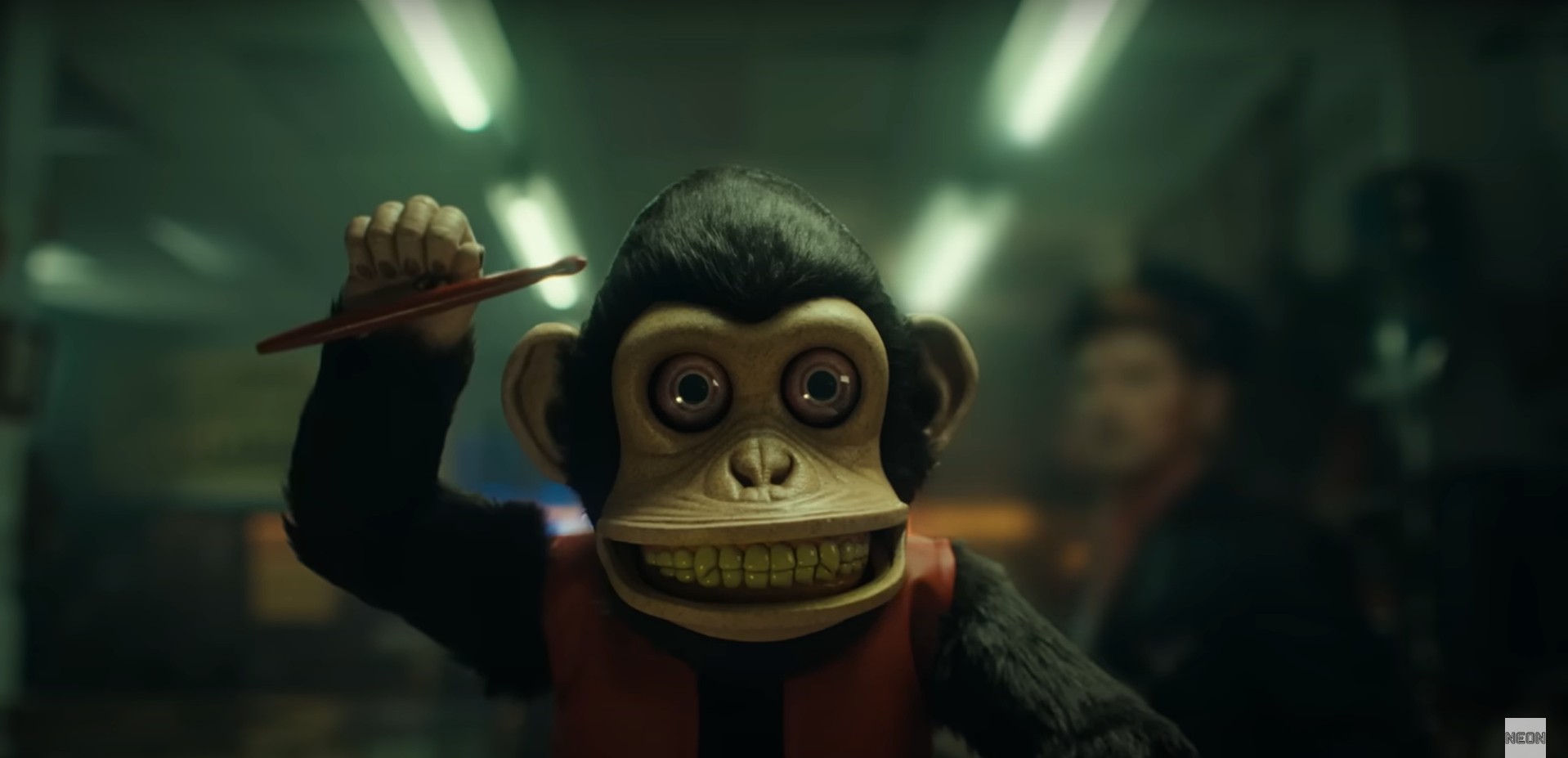
Beyond bananas, “The Monkey” shines as an adept and agreeable anarchial Stephen King adaptation.  Neon brings the blood with a standard Blu-ray with an AVC encoded, 1080p high definition, BD25, presented in a widescreen 2:00:1 aspect ratio.  Technically, “The Monkey’s” a sound example of competent compression on a lower capacity format with no evident artefacts of any size.  “Witch Hunt’s” Nico Aguilar’s semi-dark gloss adds a sheen to the elements inside a middle-of-the-road contrast.  Coloring is diffused distinctively into the well-lit scene, providing separation and delineation amongst objects, while the lower lit, more obscure moments, are sprawled by a mellower shadow that is inky or just a void but a stylistic choice to create atmosphere rather than be a menacing presence or a gape of mystery.  The English DTS-HD 5.1 Master Audio equates much of the same caliber with a clean, clear, and robust dialogue layer with a step down for the ambience, accentuated by range and depth where necessary, and a soundtrack that’s not engrossingly ear-catching but is still full-bodied and present from Edo Van Breeman (“Afflicted”).  Also listed is a Descriptive Audio 2.0 Stereo and there are English and Spanish subtitles optionally available.  Encoded bonus features are a condensed cut of behind-the-scenes featurettes, including Becoming Hal and Billi with Theo James conversing about getting into the mindsets of two completely personalities of twin brothers, Funeral Gallery provides insight on the funeral programs for the multiple services of accident deaths, Outrageously Gory and Thoroughly Gratuitous takes a dive into the cartoon-like graphic violence full of blood – lots of blood and body parts, and The Cast of The Monkey rounds out with in-depth look at the cast playing the cast of eclectic characters.  An assortment of trailers is also in the mix with an included announcement teaser, teaser, and the full theatrical trailer.  Neon’s Blu-ray is standard fare with a conventional Blu-ray case from Viva Elite housed inside a delicate slipcover with a hard detailed look at the grinder toy monkey (again, don’t call it a toy!) in full smile and ready to rap his drum, the same image of stark red and black contrast that’s also on the front cover of the Blu-ray cover art.  The insert section does not contain any physical supplements nor are there any other physical supplements included.  Locked in a region A playback, Neon’s release has a runtime of 98 minutes and is rated R for strong bloody violent content, gore, language throughout, and some sexual references. 

Last Rites: Banging away as a harbinger of death, ‘The Monkey” drums up an honest day’s work as a solid Stephen King adaptation twisted by Oz Perkins’s black comedy and high-level gore only the filmmaker could devise.

Own “The Monkey” on Blu-ray from Neon!

Experimental, Recreational Drug Use in College has Killer, EVIL Effects! “Blue Suneshine” reviewed! (Synapse Films / 3-Disc 4K UHD, Blu-ray, and CD Limited Edition Set)

Trip Out on Synapse’s Limited Edition “Blue Sunshine”

A party between friends turns deadly when one of them goes into a violent frenzy after being reveled his loss of all his hair.  Blamed for the murders, floating through life Jerry Zipkin is evading police investigators while also trying to connect the pieces on why a good friend of his would suddenly turn into a madman with no body hair and with five times the strength of any ordinary man.  His own investigation leads him to Blue Sunshine, an LSD variant connected to every transgressive event similar to the party, and at the center of it all is congressional frontrunner Edward Flemming who peddled Blue Sunshine 10 years ago at Stanford.  The latent consequence is now slowly surfacing to a head and more people are starting to experience the aggressive, alopecia effects, all Zipkin has to do to prove his innocent and a major ticking timebomb is to take a sample from a living specimen to show aberrant chromosome damage caused by the designer drug. 

Before becoming outed and investigated that the U.S. government experimented LSD on human subjects and it’s unknown but possible dormant side effects of years later, writer-director Jeff Lieberman put theory into sensationalized practicality with his post-psychedelic horror “Blue Sunshine” that turned ordinary, friendly people into headache-induced phonophobia sufferers and hairless, homicidal maniacs with super strength.  Lieberman’s 1977 released film snugs in between his killer Earthworm creature feature “Squirm” and one of the better backwoods slashers titled “Just Before Dawn,” tackling with themes of adverse effects from manmade drugs, political corruption, and to never judge a book by its cover.  The film is produced by “Squirm’s” George Manasse with “He Knows Your Alone” and “The Clairvoyant” producers Edgar Lansbury and Joseph Beruh serving as executive producers on the Ellanby Films production.

While the plot point that pushes Jerry Zipkin in the direction of investigation of the sudden fury and death surrounding his friend treads a threadbare rope with little background to suggest Zipkin is characteristically dedicated, loyal, curious, or all of the above to find out what happened, Zalman King’s overall performance as the path unaffixed Zipkin overshadows those missing background pieces and motivations.  In more key precise terms, Lieberman’s misdirection toward King’s erratic and strange behavior puts a lot of the focus on Zipkin rather than obvious derangement of the latent LSD maniacs with corrupted chromosomes in what was meant to puzzle the audiences in believing Zipkin himself might be the loose cannon cause behind the murders or, even perhaps, another ignorant victim of blue sunshine, which the latter would have been more intriguing and powerfully motivating for the Zipkin character as what drives him to solve the mystery and save himself.  None of the relationship resolve any type of secure or genuine interactions, specifically with Alicia Sweeney (Deborah Winters, “Tarantulas:  The Deadly Cargo”) with an unrealistic strong undying love for Zipkin despite only knowing him for a couple of months and the entire Stanford contingent from a decade earlier who Zipkin was able to easily link together within a matter of seconds of either examining a bloody crime scene or meeting a pair of the blue sunshine fiends.  One of the better, solid bonds is between the will-do-what-it-takes congress candidate Ed Flemming (Mark Goddard, Lost in Space) and his towering former college football buddy Wayne Mulligan (Ray Young, “Blood of Dracula’s Castle”) who becomes Flemming’s 6’6” advisor and bodyguard.  While might not seem like a well-rounded bond, Flemming and Mulligan have something tangible one can grab and understand when compared to other dynamic relationships that float in arbitrary.   Robert Walden (“Rage”), Charles Siebert (“Tarantulas:  The Deadly Cargo”), Ann Cooper, and Stefan Gierasch (“Carrie”) costar. 

“Blue Sunshine’s” premise has long stood the test of time because its more relatable now than ever as scientists and medical experts are in a fluid state of studying the effects of drugs digested, snorted, injected, or smoked weeks, months, years, and decades ago.  This premise also translates over to contaminants that cause sicknesses, such as the link between asbestos and cancer were tumors form years after exposure.  Lieberman catches wind early of the dangerous latent effects and manipulates it for the basis his film that is more fact than fiction.  Lieberman’s ability to minimize assurances on who is transfiguring into a killer is all in his characterizing nuances, shading in gray areas with excellently crafted character profile vignettes in between the opening credits that instill suspicion, fear, and some unknown stemmed danger ahead.  The unique setup is the filmmaker’s only real unconventional course in the narrative that plays out mostly a routine hand in a natural style albeit the surrealism of extreme closeups and angles on bald headed balefulness when the rage takes over or the slow, insidious madness that seeps into Zipkin’s mind causing hallucinations to exact an audience experiencing disturbance in the envisaged air.  Engaging and self-security eviscerating, “Blue Sunshine” is carbonated madness in a bottle, shook up and ready to pop. 

Synapse continues to upgrade their catalogue with Blue Sunshine next on the augmentation block with a new and mighty 3-disc Blu-ray and 4K UHD restoration release.  Presented in Dolby Vision HDR10, the restoration of the original 35mm camera negative sees it’s 4K transfer compressed with a HEVC codec that produces 2160p and is stored onto a BD100 while the Blu-ray is a compressed AVC, 1080p resolution, on a BD50.  The restoration will blow you away with diffused color palette and organic details that by far are the best they’ve ever looked with a balanced, natural grain level that keeps the speckling down in darker portions of the film to retain inkiness while securing the authenticity of the film stock without any smoothing over and artificial enhancements.  Vivid coloring, immersive details, and natural skin tones, when not softly grayed by the drug’s effects, throughout are appreciatively stable with no qualitative loss between cuts, creating a pleasurable and seamless visual experience on both formats.  Each format comes with two English audio options, a lossless DTS-HD master audio 5.1 surround sound, supervised and approved by director Jeff Lieberman, and a lossless DTS-HD master audio original theatrical mono 2.0.  While the amplification of the same sound output through the dual channels is inviting for purist, I highly recommend the immersive 5.1 surround sound that retains the genuine article of audio fidelity.   Charlie Gross’s orchestral strings instruments, percussive gongs, and synthesizing score fully engrosses the characters and audiences alike into a fold of unnerving, lingering tingles that evoke the monstrous maniac effect possibilities beyond the Jerry Zipkin tale.  Dialogue renders over with fine precision that hangs on every word and sentence with no hissing and crackling to obstruct it’s sweeping clarity.  A bountiful amount of Mind-Altering special features that fill this limited to 4000 copies set that include a new feature prologue introduction with director Jeff Lieberman.  There are two audio commentaries, an archived 2003 interview with Lieberman, a Channel Z Fantasy Film Festival ”Lieberman on Lieberman” interview with the director hosted by “Sleepwalkers” Mick Garris, a Q&A video from the Fantasia Film Festival 4K premiere moderated by Michael Gingold and Lieberman, an anti-drug scare-film “LSD-25” from 1967 and “LSD:  Insight or Insanity?” From 1968 from the American Genre Film Archive, Jeff Leiberman’s first film “The Ringer” with two cuts of the film, the original uncut version from the projection print source and the final release from the remastered Synapse Films 4K transfer with audio commentary included on the uncut version by Jeff Leiberman and moderator Howard S. Berger, still gallery and theatrical trailers. Synapse’s limited-edition boxset is nothing you’ve ever seen before from the company with not only a rigid slipbox case but there’s also a cardboard O-slipcover, both housing the clear, inch-thick Blu-ray Amaray case and both showcasing new illustrative, compositional, air brushed artwork of some of the key character scenes and expressions by Wes Benscoter, which is a real thing of beauty. The Amaray cover art is the regular 70’s grade cover art seen on previous releases from DVD to Blu-ray with a reverse side an image of the tripped-out Ed Flemming icon photo of his drug peddling days at Stanford. Overlapping 4K and Blu-ray discs display graphic presses in story moment compositions, though I don’t recall a half-naked woman in the film yet is on the cover. Not quite yet done with the bonus material, the 3rd disc is a 13-track Soundtrack CD of the score and laid overtop is the 11-page liner note booklet from Jeff Lieberman’s 2020 memoir “Day of the Living Me: Adventures of a Subversive Cult Filmmaker From the Golden Age,” plus the CD track listing, production credits, and special thanks on the backside. A reproduction of the original one sheet poster is stored in the insert as a mini-folded poster along with Synapse’s 2024 catalogue for your perusing pleasure. The rated-R film has a runtime of 95 minutes, and the limited edition doesn’t limit itself to a confined playback with region free decoding.

Last Rites: In order to snag a copy of this stellar Synapse set, muscles are required as this heavy boxset feels like 5lbs of software and hardware special features regarding Jeff Leiberman’s drugs-are-bad thriller “Blue Sunshine” with chrome dome, blank-stare killers doing the dormant bidding of 10-years-old recessed LSD.

Trip Out on Synapse’s Limited Edition “Blue Sunshine”

Invisible As They May Be, Their EVIL is Palpable. “Imaginary” reviewed! (Lionsgate / 2-Disc Blu-ray and DVD Combo)

Chauncy Wants You To Be his Friend! “Imaginary” on Blu-ray DVD/Combo set!

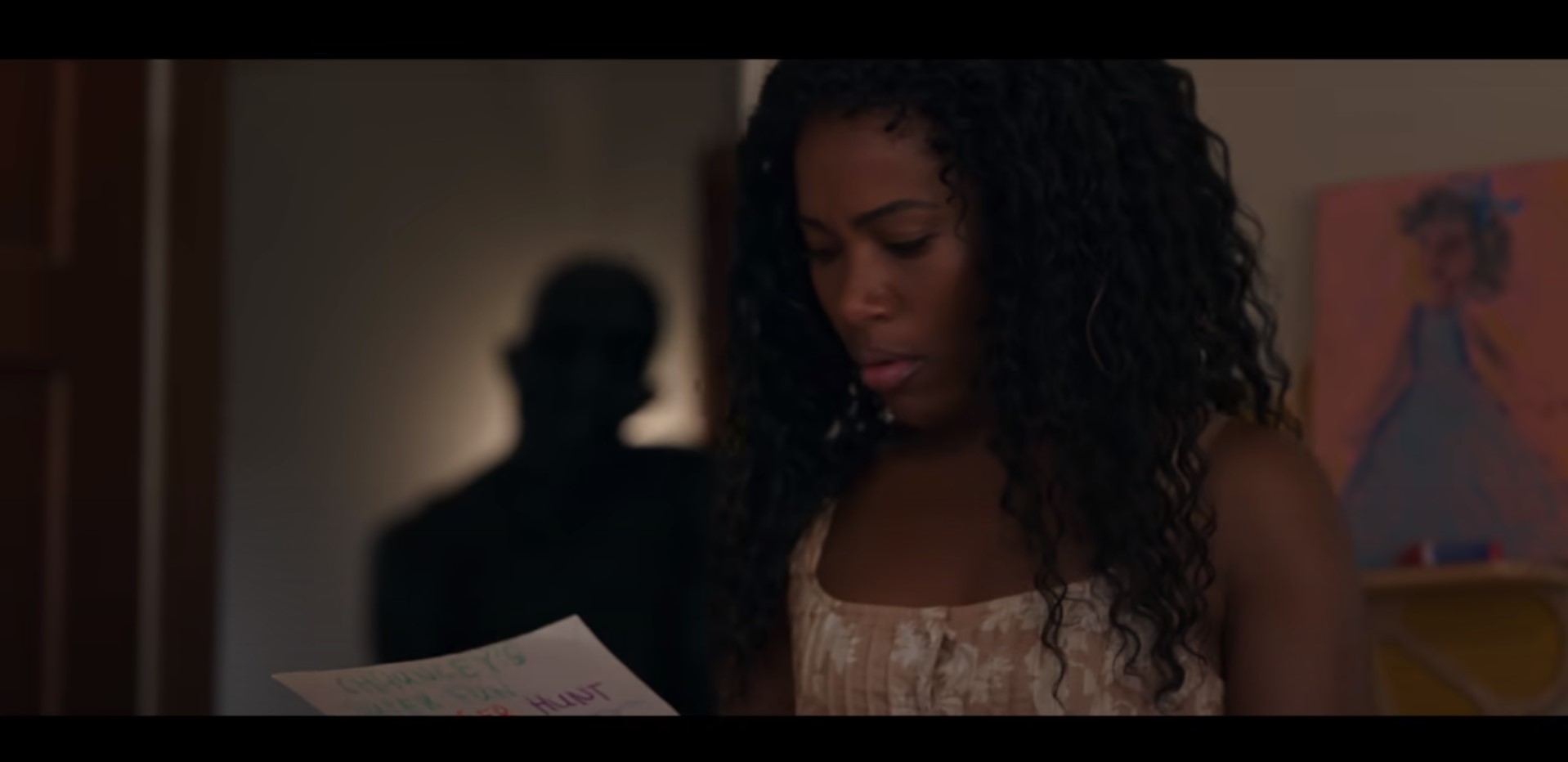
Jessica purchases her family home, moving in with her new husband and stepchildren where she reminisced being happy once as a child up until her father’s mental breakdown forced her to move out of the house and live with her grandmother.  Returning to her childhood home might have suppressed most of memory but has also spurred a few good recollections she aims to share with the conflicting attitudes of her stepdaughters, the angsty, teenager Taylor and her little sister, Alice, who suffers from a traumatic past.  When Alice discovers a stuffed bear in the basement and conjures up an imagery friend named Chauncy, Jessica feels content knowing Alice is coping with a new friend outside intense therapy sessions but when Chauncy’s seeming innocent scavenger hunt turns to hurt Alice, all the forgotten, difficult memories of her past surface and Chauncy is more than an Alice’s imaginary friend but spurned entity seeking to reconnect to Jessica, feed off her unique creativity, and keep her always in the Never Ever world of imagination.

At least once during our childhood, we all had an imagery friend to lean on, to play with, to cope with difficult situations.  For me, my imagery friend was an 8-foot white teddy bear I would snuggle into its lap and read my adventurous stage one or two books to.  For Lionsgate and Blumhouse, their imagery friend is much, much more sinister!  “Imaginary’s” dark twist on the juvenile fantasy is the brainchild of writer-director Jeff Wadlow, the filmmaker behind 2018’s “Truth or Dare” and 2020’s “Fantasy Island.”   The Charlottesville, Virginia native seemingly has thing for spinning games and fantasies into crooked, ill-fated variants.  “Princess and the Frog” writers Greg Erb and Jason Oremland cowrite the script with Wadlow, adding their experiencing in writing children stories for Wadlow’s eviscerating of childhood joy.  Lionsgate Films and Blumehouse Productions distributor the Tower of Babble Entertainment film with Jason Blum, Sean Albertson, Paige Pemberton, Paul Uddo, Jennifer Scudder Trent, and Jeff Wadlow producing.

In the crosshairs of a targeting imaginary friend is Jessica, a successful children’s book author on the outside of trying to assimilate herself into a new family while, at the same time, struggling to understand her nightmares and troubled childhood past.  DeWanda Wise (“Jurassic World:  Dominion”) stars the struggling, but good-natured stepmother Jessica who’s married to “The Walking Dead’s” Jesus, I mean Tom Payne.  Taegen Burns and Pyper Braun play Payne’s sibling daughters in their respective roles of Taylor and Alice as they make their horror film debut.  Detrimental to “Imaginary’s” silkiness of a happy couple is the artificial interactions between Wise and Payne who appear to be just going through conventional motions of a very awkwardly scripted and painfully garish couple.  When Payne departs the entire climatic acts for his character’s musical tour, other characters begin to flourish more naturally from between Wise, Burns, and Braun who become entwined into a certain teddy bear’s revengeful plan and this fountains a pleasant range of character arcs with overcoming fears, building character emotions, and settling the tension between them within the context of a common foe narrative.  One crucial, tell-all character goes critically by the wayside because, at the very last possible moment, Betty Buckley (“Carrie”) as the longtime neighbor Gloria becomes a deluge of exposition and she’s only introduced in full much later into the story because the writers had no idea how to integrate her earlier and make the information Gloria sits make sense until desperate moments arise.  Buckley, though monotone at times, makes for a good crazy lady.  “Imaginary’s” cast fills out with Veronica Falcón (“The Wind of Fear”), Samuel Salary, Matthew Sato, and Alix Angelis (“The Cleansing Hour”).

Audiences will need to expand their imaginations to get immersed into “Imaginary’s” interdimensional, child creativity-eating plot that careens through the specifics and details.  “Imaginary” suggests children have this invisible pal that snake tongues into their ears, feeding them childish ploys and harrying shame to get them to do what they want, and, inevitably, suck them into the Never Ever world through a checklist bizarre ritual.  The story suggests a globally subversive circle of these entities have been explains that every culture has a take on the imaginary friend concept and even throws into the dialogue other children having disappeared shortly after speaking of the Never Ever but the shorted change of the widespread disappearances background and the fact that crazy old, neighbor lady Gloria somehow surmised a pile of information on the subject, self-published knowledgeability on the ritual, being, and even the Newer End world, provides threadbare, credulous support for the storyline.  Stylistic and visually, “Imaginary” endorses its own title with tactile manifestations of the entity’s power.  Men in nightmare costumes is always preferable over overly silky-smooth and impalpable computer-generated monsters and the work done by the effects crew greatly engenders childish fears with an overgrown, toothy, scary teddy bear and a topsy-turvy world that are magical yet foreboding. 

Snuggle up with your Teddybear and get ready to be scared in “Imaginary” on a 2-Disc DVD and Blu-ray set from Lionsgate Films. The AVC encoded, 1080p high-definition, BD50, presenting the film in a 2.39:1 widescreen aspect ratio, is a solid showing of image integrity with crafty cinematography from James McMillan (“Twisted Metal“) that avoids the seams of the monster suits, keeping them in a considerable degree of low-level shadows, and using odd angles to make contradictory scenes flush in the Never Ever. Yet, despite the max storage capacity of a 50-gigabyte disc, compression banding still rears its ugly between gradient tones contrasting dark and lit scenes; problematic areas are not entirely throughout the picture but intermittently spotty to say the least. The DVD9 is MPEG-2 encoded with an upscaled 1080p. The English language option is a three-dimensional Dolby Atmos surround sound and if Dolby Atmos was going to be used for anything feature, “Imaginary” would be that feature with tons of range and depth mechanicals to float audio into the spatial fields above and below. When Never Ever doesn’t formulate a logical structure and up is down and down is up, Atmos caters and evolves to the fluid environment, emitting pinpoint ambience to be shaped to the size of television room. Dialogue comes over clean and clear, established in the forefront amongst the other audio layers. Spanish and French 5.1 Dolby Digital surround sound are also available audio options with English, Spanish, and French subtitles to select from. Special features include a feature length audio commentary by director, and cowriter and producer, Jeff Wadlow with producer-actress DeWanda Wise. Also, encoded into one long featurette, are four medium-short mini-featurettes of Meet Your New Imaginary Friends of getting to know the characters of “Imaginary,” Frills and Thrills of taking a child’s joyous creativity and twisting it into a creature-laden nightmare, Crafting the Beast of Imaginary is a look at the tangible creations of “Imaginary’s” monsters, and Bringing Nightmares to Life looks at how the Never Ever is constructed and shot to get the illusion of an upside down interior slice of another dimension. Sheathed inside a glinty, nearly lenticular, cardboard slipcover is the traditional Blu-ray Amary, both with the innocently, ominously looking Chauncy bear on the front cover. In the interior, each side houses a respective format within a push lock. A digital copy does come with the release within the insert clasps. “Imaginary” is a PG-13 horror (are they trying to appeal to kids?) with a runtime of 104-minutes and a region A playback.

Last Rites: I Imagine “Imaginary” could have gone over ten times as smoothly and more coherent with a longer runtime time to flush out more characters and a better designed narrative. Instead, pacing is quickened to race through unpacking more complex themes: childhood abuse, childhood trauma, the division of the original and regluing of a new nuclear family, family history of mental illness, the concept of imaginary friends, and so forth. The result is a less than desirable bastardization of an imaginary friend that leaves us high and dry for more context and substance than just a puppeteered scare bear.

Chauncy Wants You To Be his Friend! “Imaginary” on Blu-ray DVD/Combo set!

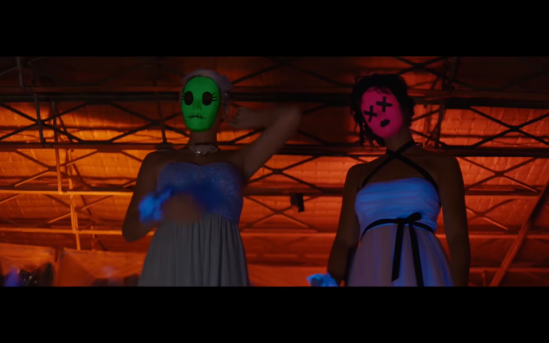
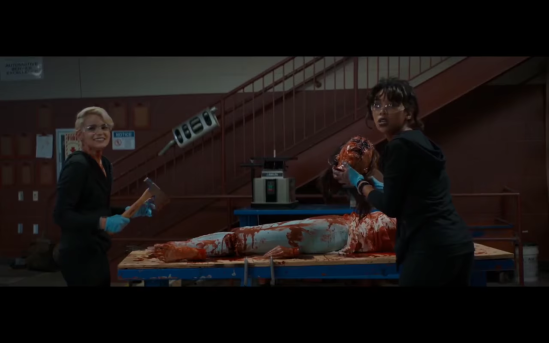
Evil Will Kill for a Thousand Likes! “Tragedy Girls” review!


A small mid-western town has been terrorized by a string of gruesome murders and two local high school girls, Sadie and McKayla, seek to lure the killer out to not stop his onslaught, but to be put under his machete wielding wing. The best friends use their twitter page, @TragedyGirls, to platform their grisly kills as devastating tragedies and to be supportive outreaches in order to be beloved by all and to obtain social media stardom as a facade over being iconically elusive serial killers, but when their plan to capture a mentor fails, a wedge drives between them when Sadie begins to fall for longtime friend, and video editor for their twitter page, Jordan Welch. That’s all the fuel needed to spark McKayla into a deadly paroxysm in order to get her best sociopathic friend back by her side.

“Tragedy Girls” is the uptempo horror-comedy by writer-director Tyler MacIntyre along with fellow co-writer Chris Lee Hill, both whom previously helmed another horror-comedy entitled “Patchwork” in 2015. “Tragedy Girls” aims to put the slasher genre on it’s head by turning what should be two sweet high school girls into the sadistic hunters instead of the usual genre trope of hapless prey and incorporate the dark side of social media, using platforms, such as Twitter, to gain notoriety through exploitation of others’ very lives, but the use of social media doesn’t sticker MacIntyre’s film as tech horror. Instead, typical ditzy-dynamic adolescent drama is integrated into the gory melee Sadie and MacKayla fabricate for fandom. There’s plenty of blood and death to go around through a mix bag of slaughter with some being inspired by other horror films, channelling such classic as “Friday the 13th” and “Carrie.”

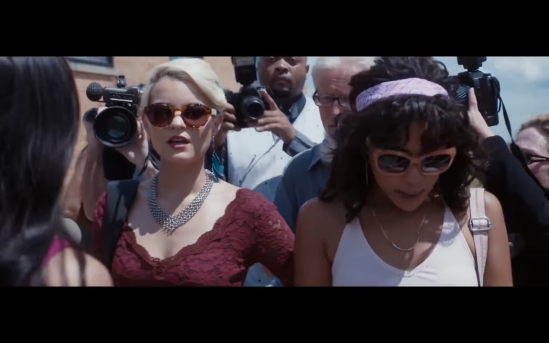
“Deadpool’s” Negasonic Teenage Warhead, Brianna Hildebrand, and Alexandra Shipp, who’s also a Marvel superhero in X-Men franchise as Storm in “X-Men: Apocalypse,” star as besties Sadie and MacKayla. Hildebrand and Shipp are doubly frightening as two sociopathic killers and equally as scary as silver screen teenage girls glued to their phones while keeping up with their good fashion sense, but their pixie cut and cheerleader personas are as embellished as their underlining dark craft to make “Tragedy Girls” over-the-top and shocking on a “Save by the Bell” level. Though the two are stone cold, homicidal maniacs, a love interest is added for Sadie. The “The Hunger Games'” Jack Quaid, son of Meg Ryan and Dennis Quaid, fills the shoes of the lovesick Jordan Welch and Quaid does a fine job being the smartest guy in the room, but still being blindly dumb to the situation unfolding around him and Sadie. Surprisingly, a number of various genre vets rear their heads in this film, starting with “The Strain’s” Kevin Durand. The 6’6” tower of pure muscle Durand embodies a Jason Voorhees like villain when masked; unmasked, he’s about as stupid as they come and Durand can do stupid very well. Part of the comedy, of this horror-comedy film, stems from an uncharacteristic role played by Craig Robinson as a very unfit, local firefighter hero, fittingly named Big Al. The “This is the End” and “Ghosted” star bores through his minor role of Big Al with very little dialogue as Robinson is well known for wit, but the comedian has one of the better scenes with a 2-on-1 fight scene with the two demented school girls. The last recognizable face being mentioned flames out as quickly as it’s flamed in from the Sci-Fi genre. Josh Hutcherson, another “The Hunger Games” star, goes James Dean as MacKayla’s emo ex-beau, Toby Mitchell. Hutcherson’s character doesn’t quite fit the “Tragedy Girl” mold that pushes the limits later on in the film and his portrayal of Toby Mitchell is awkwardly misplaced as overzealous and forgettable. Rounding out the remaining cast is Timothy V. Murphy (“The Frankenstein Theory”), Nicky Whelan (“Flight 7500”), Keith Hudson, Savannah Jayde, and Katie Stottlemire.

“Tragedy Girls” will do well as it’s a solid horror-comedy with a la carte gore. None of the characters seize the progression of the trope reversal story and with the exception of Hutcherson’s Toby Mitchell, the actors conform precisely to the animation of their character’s scribed personas. Hildebrand and Shipp are the epitome of that last statement. The pair of actresses have a real life proprietary appearance about them and to crossover those looks and meld them into Sadie and MacKayla will forever establish them as the true tragedy girls. “Tragedy Girls” isn’t just about flip-flopping the genre rear ended up; writers MacIntyre and Hill pen a film that’s also about female empowerment with two strong actresses filling the shoes of two self-sufficient badasses committed to doing what’s conventionally labeled male subversive behavior and accomplishing it on whole other level. Even if on the wrong side of the law, the tragedy girls stick together through the good and the bad to overcome various high school and beyond high school hurdles that attempt to thwart not just their friendship, but their cyberspace popularity.

Gunpowder & Sky proudly distributes “Tragedy Girls,” a film by fresh faced production companies like Its The Comeback Kid and New Artist Pictures, onto VOD now and DVD home video February 6th. Since provided with an streaming link for review, a well-rounded critique on the DVD’s technical specs, picture quality, audio tracks, and bonus features will unfortunately not be commented on, but the very film itself should entice the most casual horror film goer who usually doesn’t stray off the mainstream path. With familiar faces and plenty of bloodshed, “Tragedy Girls” holds water against competitors in a flooded genre. Don’t forget to follow them, #tragedy_girls or @tragedygirls, or else you’ll be next tragedy exhibited in their wall feed!