The Holidays Are Over, but the EVIL Remains With Us in this Cookie-Cutter Classic “The Gingerdead Man” reviewed! (Full Moon Features / Blu-ray)

Get Ready to Chomp on this Cookie! “The Gingerdead Man” Blu-ray Available Here!

Cold-hearted, mama’s boy killer, Millard Findlemeyer, brutally gun downs Sarah Leigh’s father and brother before wounding during a diner robbery.  Two years later, Findlemeyer is executed with the help of Sarah’s damning testimony and the traumatized survivor attempts to pick up the pieces of her life by keeping her crumbling family bakery business afloat.  With her mother a raging alcoholic and a competing business threatening to shut the business down, Sarah doesn’t realize the gingerbread seasoning dropped off at her doorstep is actually the ashes of the evil Findlemeyer.  Thrown in a gingerbread mix and baked to live again, Findlemeyer returns to continue his carnage but as a delectably devilish cookie sporting candied buttons and wielding a knife.  Trapped inside the bakery, a handful of survivors are being more-than-gingerly picked off one-by-one by Findlemeyer’s possession of a pint-sized cookie and Sarah must face again the evil that destroyed her family.  

“The Gingerdead Man” is one of Full Moon’s more contemporary repeat villains this side of the century.  Christmas may be over, but the holiday cookie carnage doesn’t just pack on the pounds, it also can shred and cut the waist, literally, with guts spilling out everywhere.  The Charles Brand directed, 2005 film that kicked off the icing for not one, not two, but three sequels and a timeline intertwinement with Full Moon’s “Evil Bong” series.  Pot and cookies, a perfect combination when blazed.  The script was penned by Full Moon regular and “Night of the Living Dead” remake actor William Butler, under the pseudonym of Silvia St. Croix, and fellow Full Moon regular Dominic Muir (“Critters,” “Doll Graveyard”), under the pseudonym of August White.  Filmed in Los Angeles, the indie horror-comedy is a Shoot Productions and Full Moon coproduction venture with Band producing and Dana Harrloe serving as executive producer. 

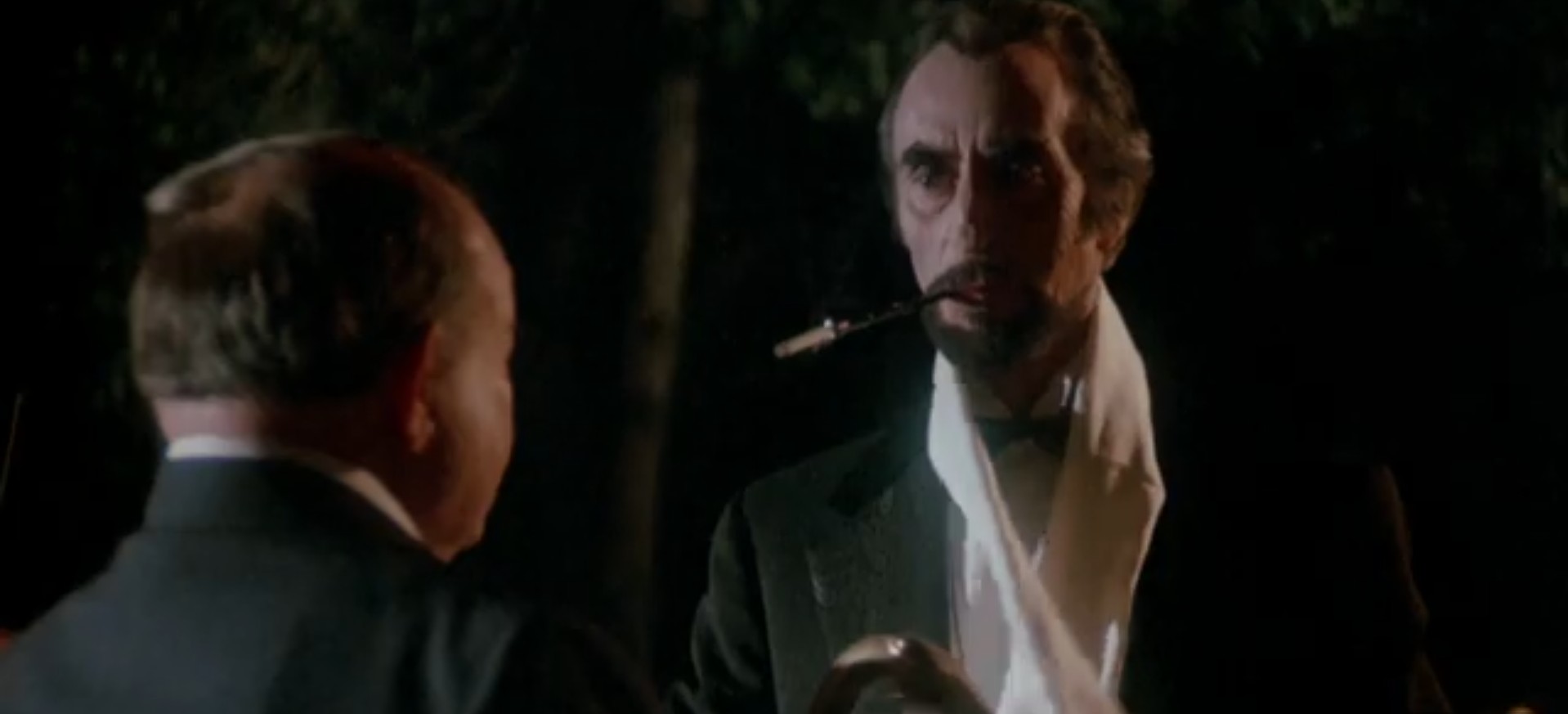
Adding to “The Gingerdead Man’s already zany resurrecting the evil dead into a baked good concept (there’s nothing good about this cookie monster), the untamed energy and distinguished voiceover from Gary Busey is better than self-rising flour for this doughy production.  The “Predator 2” and “Lethal Weapon” actor headlines as the despicable killer Millard Findelmeyer but only in the flesh for the opening diner sequence that establishes Findelmeyer as a coldblooded murderer.  The backstory of his apprehension, trial, and execution is whisked into a frothy afterthought after the title credits to establish more of Robin Sydney’s Sarah Leigh character of rebuilding her life.  Sydney, who would become Charles Band’s wife nearly two decades later after debuting in this role, reserves Sarah into a stasis of plugging along into a woe-as-me state as a setup for her to be heroine nemesis to Findlemeyer’s flaky, killer crust.  What’s neat about her character, along with a handful of other principal characters, is they’re subtly and smartly named after notable cookie making companies.  Sarah Leigh is an obvious rework of the frozen desserts company Sara Lee, Ryan Locke, an unlikely Sarah Leigh love interest cladded and carried by all things from early 2000s, is Amos Cadbury, a mixed play on Famous Amos and Cadbury confectionary, and Jonathan Chase as commercial wrestling enthusiast Brick Fields lends to believe the character’s name pulls inspiration from Mrs. Fields soft baked cookies.  There’s also the corporate-commercial takeover statement with an adjacent restaurant that threatens to put Sarah’s bakery out of business and the owner’s name is Jimmy Dean, as in the sausage company, with Larry Cedar (“The Hidden,” “C.H.U.D. II”) in the role.  Alexia Aleman, Margaret Blye, Daniela Melgoza, and James Synder fill out the cast.

Kitschy personification horror is all the rage in the independent genre circle.  Murderous dolls at are dime a dozen, but a few outliers stray into something more risking and adventures, like an evil llama pinata in “Killer Pinata,” a wicked snowman in “Jack Frost,” or even a killer unicorn standing figure in “CarousHELL” that make the niche subgenre fascinatingly tacky for all the right reasons.  Charles Band and team tap into that peculiar ripe vein to extract their own usually joyous, kid-friendly object and transfigure its G-rated image to a hard R with death, sass, and a whole bunch of mischief and what better wholesome inanimate object to vilify than a scrumptious gingerbread man?  Voiced by Busey and animated by the always preferred practical means, “The Gingderdead Man” evokes promises of a so-bad-its-good composite, especially since the antagonist for this franchise starter fits right into the Full Moon small things come in killer packages niche, and while half of “The Gingerdead Man” delivers on a havoc-wreaking spiced cookie, the execution, as a whole, leaves much to be desired by whirling through a two year story gap of the capture and execution of Findlemeyer and how and why his malevolent essence is mixed into the batter for resurrection.  The slapdashedly before and after title credits causes a brief loss of thought as the brain frantically tries to catch up and fill in the gaps as much of the images and exposition haphazardly piece together.  The Gingerdead Man isn’t also quite as quippy as his human form counterpart, but a ton of appreciation goes into the multiple renditions of the distorted faced Gingerdead Man character from hand puppets, to animatronics, to full size human suit provides that breadth of range in angles, perspectives, and appearances that shape a personality package to where dialogue can nearly be neutralized altogether.  “The Gingerbread Man” lives and breathes as its marketed image, a mediocre kill possession-slasher with a bunch of characters scratching their heads instead of building upon who they are and what hurdles, figuratively and literally, to jump, the latter mostly falls into the hands of Sarah Leigh and her depression-induced fear, an aspect she has to face when being revisited by the man who killed her father and brother. 

An all-new transfer and remastered from the original 35mm elements, Full Moon Features re-bakes “The Gingerdead Man” onto a new physical media cookie sheet.  The AVC encoded, 1080p resolution, BD25, presented in a widescreen 1.78:1 aspect ratio, had elevated some lower resolution complications with better definition appeal but the overall package isn’t an epitome showcase of the format possibilities with softer contrasts that leaves voids and shadows milkier, textures fluctuate during decode that sways in a range between 15 to 25 Mbps, and minor damaged portions, such as light scratches and speckling, are not touched up in the restoration.  Skin tones and other colorist applications appear organic and, when reaching peak performance, displays a nicely diffused sweat sheen in the lighting.  Two English, lossy audio options are available, a Dolby Digital 5.1 and a Stereo 2.0.  A clean and clear presentation on all layers with an amalgamated cast that just as good as any other solid sound design with powerful forefront and intelligible dialogue, an above par ambient dispersal that has suitable depth and range, and a Roger Ballenger carnivalesque score that isn’t from Richard Band but is a great mimic.  English subtitles are available.  Extras include an archival behind-the-scenes featurette with interviews with cast, crew, and Charles Band with some BTS-footage in creating the cookie monster, a blooper reel, the original trailer, and trailers for other Full Moon features.  Front cover on the Amaray Blu-ray is an illustrated composition of characters that clue in a sense of what to expect but other than that, this standard re-release has physical bare bones.  The region free release has a runtime of 71 minute and is not rated.

Last Rites: Though doesn’t reinvent the recipe nor does it not make this naughty killer cookie stale, “The Gingerdead Man” has come a long way with a new, revitalizing release onto a high-definition format pulled from the extensive and vast Full Moon catalogue that’s slowly but surely updating the filmic cache. This schlocky bad baked good should surely be in everyone’s holiday horror collection.

Get Ready to Chomp on this Cookie! “The Gingerdead Man” Blu-ray Available Here!

Dolly Deadlies Exact an EVIL Revenge! “Doll Graveyard” reviewed! (Full Moon Features / Blu-ray)

“Doll Graveyard” Available for Purchase Here!

In 1911, little Sophia is accidently killed by her verbally abusive stepfather.  He buries her lifeless body in the backyard dirt along with her favorite toy dolls that were the subject of his current tirade.  Nearly a century later and in the same house, Deedee, a teenage high school girl, throws a small party with friends while her father is out for the night.  Her action figure-enthusiastic little brother Guy discovers one of buried dolls in the backyard.  When a couple of older high school boys bully Guy, the spirit of Sophia emerges and pendulates possession of Guy’s mind and body, resulting in the turning of inanimate dolls into killers come alive to protect a hurt Sophia.  Drugs, alcohol, and teen sex quickly come to an end by a seize of small, dangerously armed toys hellbent on spilling blood just to protect a hurt little girl.  Those left still standing must find a way to reverse Sophia’s revenge.

Charles Band’s obsession with toys, dolls, dwarfs, goblins, or a sundry of the mix has yet to slow down his 50-year-career in making independent movies.  The now 72-year-old Band can sit on top of his Full Moon empire and enjoy his repertoire of ravenous rascal horror, including “Doll Graveyard,” the 2005 standalone doll slasher that’s not too dissimilar from the likes of Band’s foremost and unremitting doll franchise, “Puppet Master.”  Band directs the film based off his story and a screenplay treatment by the late director Domonic Muir, credited under the pen name of August White, in what would be one of his first few films with Full Moon in the first decade.  Muir also wrote “Critters,” “Evil Bong,” and venture into the “Puppet Master” series before his untimely death with pneumonia.  Band would produce the feature alongside Jeremy Gordon and Jethro Rothe-Kushel, filmed in Hollywood, California.

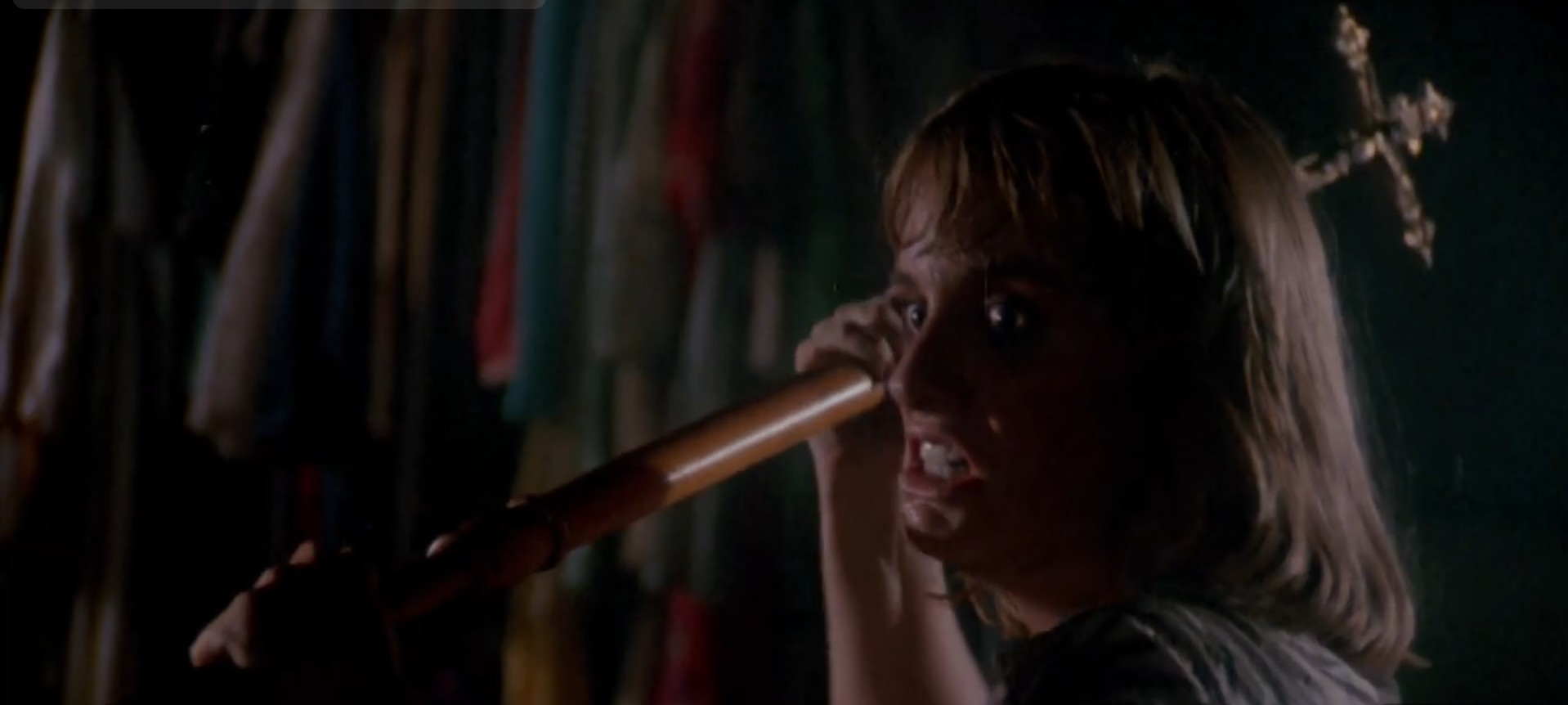
A small cast is all that’s required when the dolls resurrect and begin their assault on the youth with their individual ability.  At the story’s core is Guy, an action-figure enthusiast played by Jared Kusnitz (“Dance of the Dead,” “Otis”), and his older sister Deedee, an angsty, boy-hungry, rule-breaker played by Gabrielle Lynn.  Guy and Deedee play the trope fatigued dynamic of a feuding brother and sister complete with blackmail attempts and lots of name calling, opening the door of opportunity to connect in a time of great adversity – in this case, a living doll assault.  Then, of course, no slasher can go without the kill fodder and “Doll Graveyard” has a group of partying teens who come over after Guy and Deedee’s single parenting father, played by Ken Lyle (“Foreseen”), goes off on a date.  Their sneaky, adolescent transgressional gathering of beer drinking, pot smoking, and foreplay into possible copulation is driven by Deedee’s promiscuous best friend Olive (Kristyn Green, “Evil Bong”), a tagalong, morally incorruptible Terri (Anna Alicia Brock), and party-crashing jocks with the insatiable horny Rich (Brian Lloyd, “Candy Stripers”) and Deedee’s lover boy Tom (Scott Seymour, “Garden Party”).  Muir’s story does attempt to branch out from the conventionally themed pathway of authorized partygoers meet their doomed fate with sidebar weaving of past, present, and future relation connections.  Olivia and Rich once had a casual romp that has faded and Rich seeks more difficult challenges with the more prudent Terri while Terri has puppy dog interests into the younger Guy as they share some similar interests.  Meanwhile, Deedee and Tom take their relationship to the next level with precuring steps toward the bedroom that signals the beginning of he end, as the old recurrent theme goes.  The “Punk’s Dead: SLC Punk 2” and “The Amazing Spider-Man” actress Hannah Marks, who makes her film debut in the Charles Band’s film, rounds out the cast as young and unfortunate Sophia.

Eventually, one must ask themselves how many times can someone reinvent the wheel and still think it’s new, innovative, and fresh?  With Charles Band’s proclivity for small malevolence, especially in dolls or puppets, the one of the faces in venerable horror filmmaking has, in a broader sense, regurgitated the same movie over the decades now, tweaking bits and pieces here and there to make it ever so delicately unique.  Yet, “Doll Graveyard” feels very much like an extension of “Puppet Master” without bringing new elements to the table or even really linking “Doll Graveyard” to Full Moon’s more popular, longstanding franchise “Puppet Master,” which is essentially the face of the Band’s company.  We see Blade, we think Full Moon.  We see Six-Shooter, we think Full Moon.  We see Tunnler, we think Full Moon.  But if you show me “Doll Graveyard’s” rustic Samurai or The German with spear tipped helmet, coming around to Full Moon may not be the first to pop into the old thinker.  The story also feels a bit half-baked with the dolls coming to life by unexplained means and audiences would really need to put effort into surmising a reason, such as my own theory that Sophia’s departing soul, trapped beneath the dirt, absorbs into the dolls, giving them animated life and loyalty to Sophia.  None of that hypothesis is authenticated and we’re stuck with little-to-no answers in a film created for the sake of creepy dolls doing creepy things to creep out some cretin kids.

Those suffering from pediophobia probably should stay far away from “Doll Graveyard.” For everyone else, “Doll Graveyard” is now available on Blu-ray home video from Full Moon Features with AVC encoded, 1080p high-definition, single-layered BD25. Presented in a 1.78:1 widescreen aspect ratio, back cover states transfer elements were remastered from the original 35mm negative. The original negative print has withstood the test of time with no visually acute damage, granted the print is less than 20-years-old; however, there is noticeable dust and dirt speckles, some of which measure more toward a vertical tilde. Textures are softer than expected for a rather young film in the grand scheme of cinema with rounded and smoothed over contours, especially around defining facial features, that create more of a splotch than an edge. A bright spot is the palette with a diffusion and delineation balance around stock lighting. The lossy English Dolby Digital 5.1 mix is difficult to distinguish between the other audio option available, a Dolby Digital 2.0, as there’s not enough atmospheric or ambient rampage in the side and rear channels when dolls go deadly, which is mostly in the medium closeup to extreme closeup range. Taking hold of the audio reigns, mostly, is the District 78 soundtrack. Likely where the remastered elements come into play with its gothic rock opening credits score, this Charles Band production trades the jaunty carnivalesque for reinforced horror theme elements of isolated piano and electronic notes the musical production has accolades for and this translates throughout when presenting the dolls ominously and when they strike and into the coda credits with a full-on instrumental rock and wordless vocal background piece that’s very circa 2000s. English subtitles are available to select. Special features include a making-of featurette with snippet interviews from the cast with an introduction from Charles Band, a blooper reel, and the trailer amongst other Full Moon prevuews. There are no after or during credit scenes. The traditional blue Amaray goes along with the current Full Moon remastered trend of their horror catalogue with yellow-green primary art, no inserts or tangible features, and a disc press cropped of the focal primary cover art. The region free release has a brisk runtime of 73 minutes and is not rated.

Last Rites: A pedestrian, pale comparison to Full Moon’s maniacal line of moppets, “Doll Graveyard” stands far too short being the lower rung runt among giants in the company’s lineup.

“Doll Graveyard” Available for Purchase Here!

At Odds With Each Other Can’t Stop the EVIL That’s Coming for Them! “House of Dolls” reviewed! (VMI Releasing / Blu-ray)

“House of Dolls” Is Ready to Play! Blu-ray Available at Amazon.

Estranged sisters Jenn, Diana, and Adalene are summoned to reunite by their dying father.  Greeted by their grandmother and a lawyer informing them of an inheritance within their father’s will, the verbally combative sisters are more than eager for their fair share of the will and be happy to never see each other again as they go on with their lives, but the will’s stipulation states the sisters must work together and revitalize the long severed kinship within the walls of his hand-built estate, a life-size representation of a doll house constructed for the love of his life where clues to their inheritance lie hidden inside.  Before even the first ounce of hope to mend their broken bond, one of the sisters is found brutally murdered in one of garish rooms and a masked maniac hunts for not only the two remaining sisters but also those close to them outside the house of dolls.

Juan Sala’s “House of Dolls” is the return to horror for the Texas taught director since his urban-thriller “Alp” in 2016 and the first independent story helmed that didn’t involve Sala’s going pen-to-paper with a script.  That task was handled by another Texas film school graduate, Iv Amenti, in her first feather length screenwriter credit aimed to label itself as a mystery-slasher under the guise of grueling family rejuvenation.  The 2023 released film’s story was shot on location in Los Angeles with Juan Salas solo producing the feature.  Salas is no stranger producing his own work as he’s done with most of his own repertoire (“The Triple D,” “The Wolf Catcher,” and “The Devil’s Ring”) while also branching out occasionally to support and/or fund other creative minds, such as with Brian King’s “Hell of a Night.”  Polar Bear Films produced the film along with Vantage Media International, or VMI Worldwide, who produced and distributed the film.

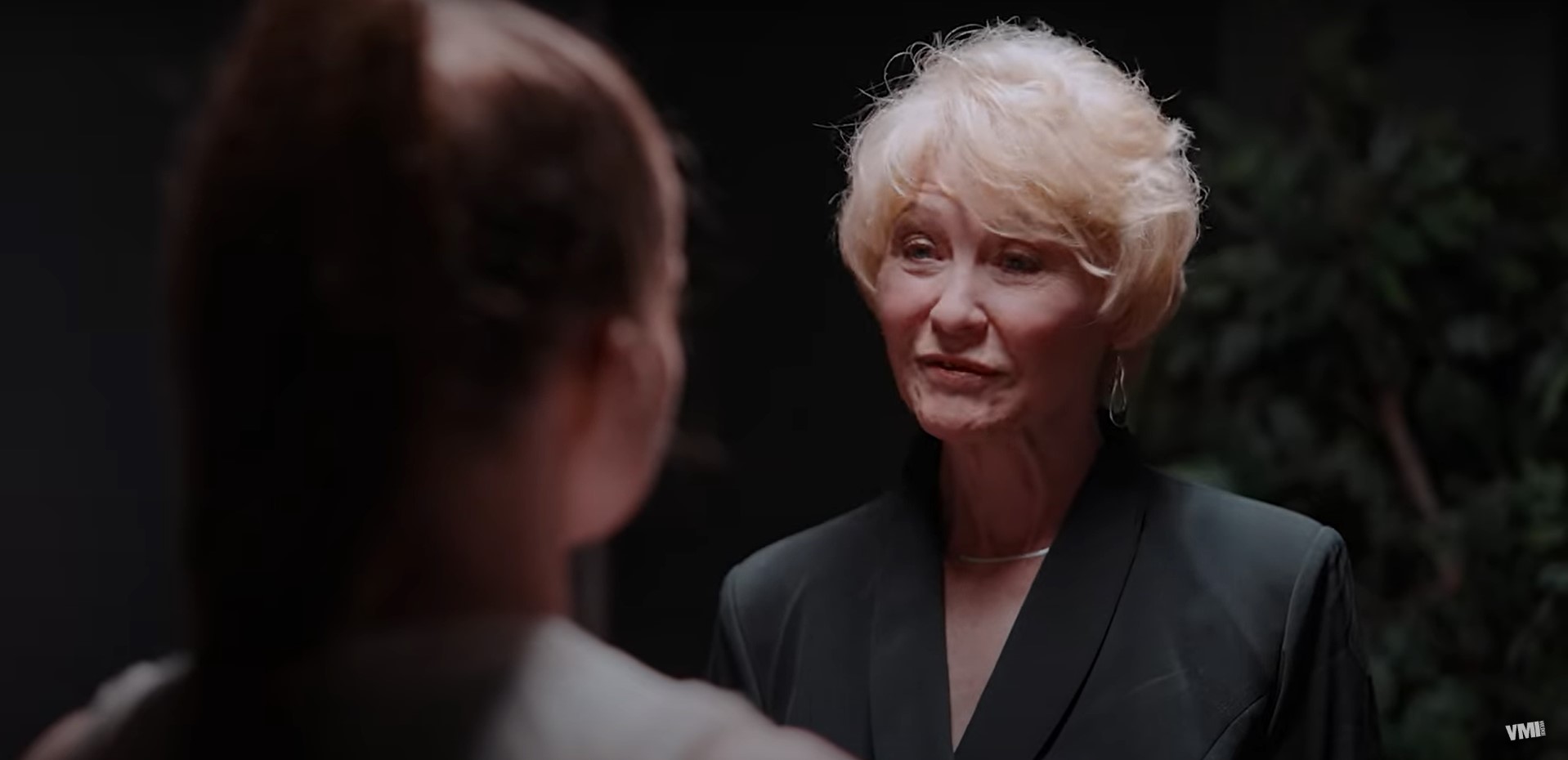
Powering “House of Dolls” vessel into explicit view is headliner Dee Wallace.  The “Cujo” and “Critters” scream queen has been on a junket of mom-and-pop productions for the better part of the last decade for aspiring horror filmmakers to leech off that eye-catching and weight-bearing Dee Wallace name.  Wallace reminds me of Linnea Quigley once said in an interview, if producers meet her price, she’ll star in pretty much anything.  Wallace seemingly has the same philosophy with a continuous stream of projects that screen her for no more than a total of 15-minutes, tops.  While this works to an extent, based off the prominence or the memorability of the role, most of that bankable name and face do little elevating the film, resulting in just a paycheck performance.  Sure, Wallace’s fans will check it out for the sake of Dee Wallace but for “House of Dolls,” as with the story or just as with the entity of the film, the gimmick doesn’t leave a mark.  The plot crux favors the three bickering sisters, Adalene (Violeta Ortega), Jenn (Stephanie Troyak), and Diana (Alicia Underwood).  Sibling diverging personalities uphold their seething hate for each other, that is much as obvious, but for what specific reason is never unfolded, or is unfolded but made unclear in the wake of its untidy heap.  What’s definingly unclear is the mother of these unlikeable brats.  Mentions of individually owning the unfortunate event of a mother’s death makes the ambiguous ruling that there is at least one half-sister.  They could all be half-sisters, but the unbridled dialogue and no conveyed backstory strays away from important pieces of the puzzle that make it as frustrating as trying to match a 2D puzzle piece within a 3D puzzle scheme.  The story also incorporates flimsy relationships with the sisters, Jenn’s drug buddy Justin (Jack Rain) who unexpectantly arrives with the sisters at their father’s estate, Adalene’s semi-sweet boyfriend Caleb (Phil Blevins), Diana’s vague friendzone coworker or perhaps boyfriend Lenny (Matt Blackwell”), and Diana’s out-of-nowhere go-to detective who just happens to be at her father’s hospital, dressed in beat cop fatigues, in Det. Ramierz (Meeko).  All these seedling characters are detached in their gravitational encircling around the sisters, pulling in zero weight on a story that’s quickly deflating.  Rounding out the fleeting supporting cast is Trey Peyton. 

Following “House of Dolls” plotline might as well be riddles with attention deficit disorder.  Too much is happening without the ease of transition or even sense to hold down a floating story that’s constituting forced uniformity and civility amongst rival siblings by way of a mysterious house with mysterious clues. Yet, those clues don’t flesh out and intrigue over what could have been a backstory backbone turns into gelatinous indiscretion of kill-after-kill by a leather coat-wearing masked-maniac with knives that offers up in the end being nothing more than surface level, superficial slasher.  Salas pulls off some decent, gory kills, such as a slimy disembowelment and a bisected torso that spills guts, to add some value to the production that’s ultimately equalized by areas of cut-rate props, such as the obviously flat and dull large knives that look more like cardboard than metal.  Like in true slasher tropes, the killer is seemingly everywhere at once, hopping from one location to the next, even if the other locations are across town, but this punk-cladded, homicidal maniac appears in-and-out of the alternating scenes too lackadaisically without systematic care to at least in try and make it plausible.   

VMI Releasing and MVD Visual handle the physical media distribution with a 1080p, high-definition Blu-ray.  The AVC encoded BD50 has the capacity for the eclectically ranged front lit key lighting and neon lighting, delivering a clean picture without compression issues.  Details waver between certain aspects of lighting, which is expected, but the details that do emerge pinpoint textural qualities and the key lighting reveals appropriate, vivid coloring and skin tones when contrasted against heavier background shadows.  Jorge Villa’s sizzling neon gives a warm glow in purple, blues, reds, and orange that enhances to a near music video quality outside the normal lighting and production parameters.  The film is presented in a 1.78:1 aspect ratio.  The uncompressed DTS-HD 5.1 English audio mix is an upbeat combination of verbal jabs, deregulated dialogue, and a medley of pop music and low-tone beat creator for the villain peppered with hip-hop rhythms, violin and piano down tone, and some suspense synthesized keyboard notes that do lean into what makes a decent horror soundtrack.  No complaints on the dialogue track that’s fairly level but doesn’t explore much in depth as characters are often up front and center on the camera.  There’s also not enough range to really utilize the multi-channel network and so the lack of miscellany fight for audible supremacy. Subtitles are available in English only.  Bonus features are aplenty on this larger capacity disc with Juan Salas commentary track that runs parallel to the feature, Juan Salas and Dee Wallace have a Halloween special video chat to converse about their time in production, a Natasha Martinez hosted cast Q&A for the U.S. premiere, a making-of featurette, and a MiB Legacy music video The Man Who Was Death.  On the outside, VMI’s standard Blu-ray comes with an appealing touchup of the killer in full dress from the chest-up, singled out by a black background and the title just overhead.  The disc is pressed with the same image with no other tangible features.  The film is not rated with region free capabilities and has a runtime of 84 minutes.    

Last Rites: “House of Dolls” crumbles as a clunky attempt at a slasher with a twist ending. The story shatters like someone pulling a pin on a grenade and pieces of act structure shrapnel propel in all different directions and never once hit target in the latest from director Juan Salas.

“House of Dolls” Is Ready to Play! Blu-ray Available at Amazon.

Bite Sized Evil With a Real Bite! “Ghastlies” review!


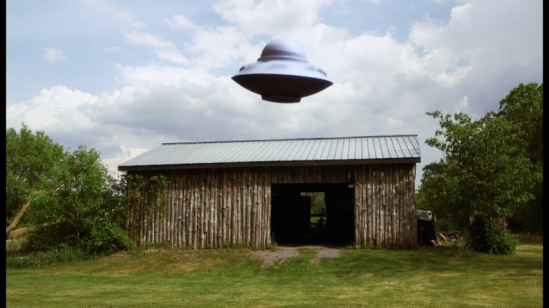
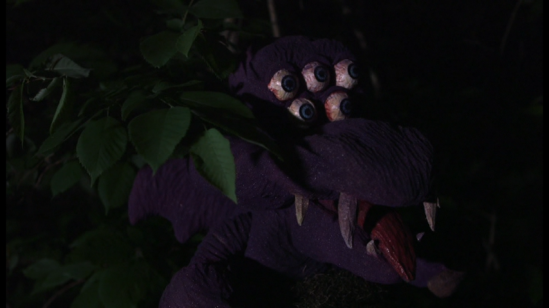
Four sorority sisters embark on a isolated cabin vacation for an all girls’ weekend in the quiet woods. Through all the booze and the trips to the lakeside beach, Sloane, Abby, Margot, and Lulu reap the benefits of solitude and sisterhood and just when everything seems to be going delightfully swell, even when Sloane’s perverse boyfriend and his friend show up unexpectedly, trouble brews beneath their feet, under the leaf-riddled surface, when Abby unwittingly unleashes three space originated, pint-sized ghastly ghouls. As the miniature and ferocious creatures rip through unlucky victims, nobody knows how to stop, let alone escape, their woodland carnage, especially when they’re being aided and abetted by human caretakers.

In the filmmaking fashion of Brett Piper (“Queen Crab”) or Mike Lyddon (“First Man on Mars”), Brett Kelly offers his low-rent talents in construction an 80s-esque creature feature on a pygmy scale in more ways than one. The Ontario born director has helmed a vast amount of independent b-horror prior to, including such great titled credits as “The Bonesetter,” “Attack of the Jurassic Shark,” and “Raiders of the Lost Shark.” Now, released for the very first time on any format, anywhere, is “Ghastlies,” a “Gremlines” or “Critters” creature feature that aims to rain down terror when all hell breaks loose with ankle biters running around and while the low budget production or creature value doesn’t par with the more popular Joe Dante or Stephen Herek films, the heartfelt attempt in this modern day feature accomplishes the intended effect of a 1980’s horror comedy, complete with synthesized score and era correlating attired.

“Ghastlies'” lineup consists of Brett Kelly regulars such as Jessica Huether and Kendra Summerfield from “Raiders of the Lost Shark.” Huether’s and Summerfield’s performance as the nerdy, yet overall good girl Abby and the snobby, superficially rich bitch Lulu, instilling the yin and yang personas of the group, and their joined by Julie Mainville and Kim Valentine as the unforgettably clueless Margot and the sisterhood leader in Sloane. Mainville more memorable out of the four sisters as she has spot on timing and delivery with the witless and likable Margot. John Migliore, known more for slabbing on the prosthetics and makeup to be a zombie, has a minor costarring role as a dimwitted bike cop Officer Vinnie and Migliore, whose donned zombie wear in films like “Land of the Dead” and “Ninjas vs Monsters,” filled multi-faceted shoes for the Kelly film by dappling into the spaceship special effects and providing the Ghastlies puppetry. Migliore’s Officer Vinnie is paired with another similar goofy character in Peter Whittaker as Officer Frank as well as Joel Elliott “Countrycide,” Eric Deniverville, Stephanie Moran, and Kyle Martellacci who also co-star in the zany trope-ladened homage. As his first feature credit, Chris Bavota’s script creates no real dynamic between the characters who all pertain to a self-serving purpose under a guise of slapped together dialogue that’s no more substantial than a boulder in outer space.

And there in lies the rub. “Ghastlies” inability to click together to fulfill the allusion of was what-once-was is the film’s weakness. The cartoonish hand puppets, the implausible effects, and the technical inconsistencies can all be overlooked as campy charm, passed aside to enjoy “Ghastlies” for what it’s worth, but what can’t subside is the wonky connection between the cast that doesn’t favor well that’s diluted at the end by the starkly questionable and abrupt editing, resulting in a presumed unfinished film that seeks to either be an open ended invitation for a potential sequel, defined by one of the characters standing up with a makeshift mini-gun and garbed in Rambo-like gear, or a hasty cut that provides a lukewarm, satisfactory, and budget friendly finale that actually invokes more confusion than viewership appeasement. Shortly following the live-action wrap up, a short animated comedy, illustrated by the multitalented John Migliore, in the same vain as the quirky Looney Tunes but with Ghastlies.

The lovely, cuddly, and ghoulish “Ghastlies” is released onto DVD and Blu-ray combo from Camp Motion Pictures. Image quality for the Blu-ray format is by far stunning for a low-budget feature presented in 1080p encoded MPEG-4 AVC BD 25. The coloring naturally displays and even the darks had great depth without distortion or inconsistencies. The English Dolby Digital 2.0 is another story as, unlike the image quality, the presentation is inconsistent with imbalanced levels that make a few scenes difficult to comprehend. Clarity isn’t necessarily an issue with no blights on the tracks, but the technical placements could have been smoother. The electric score score by Tomb Dragomir, the composers first score ever, manages to engross and re-illuminate the decade that inspires “Ghastlies.” Bonus material includes a special effects interview with john Migliore’s helping hand into Ghastlies’ FX, Tomb Dragomir discusses his experience scoring his first feature, “Ghastlies'” music video, the trailer and Camp Motion Pictures’ trailers, and an audio commentary with director Brett Kelly. “Ghastlies” is part “Gremlins,” part Lovecraftian, and all borderline shlock-y fun, but the loose character interactions and out of kilter editing embargo the full bodied experience.

“Ghastlies” available on Blu-ray!