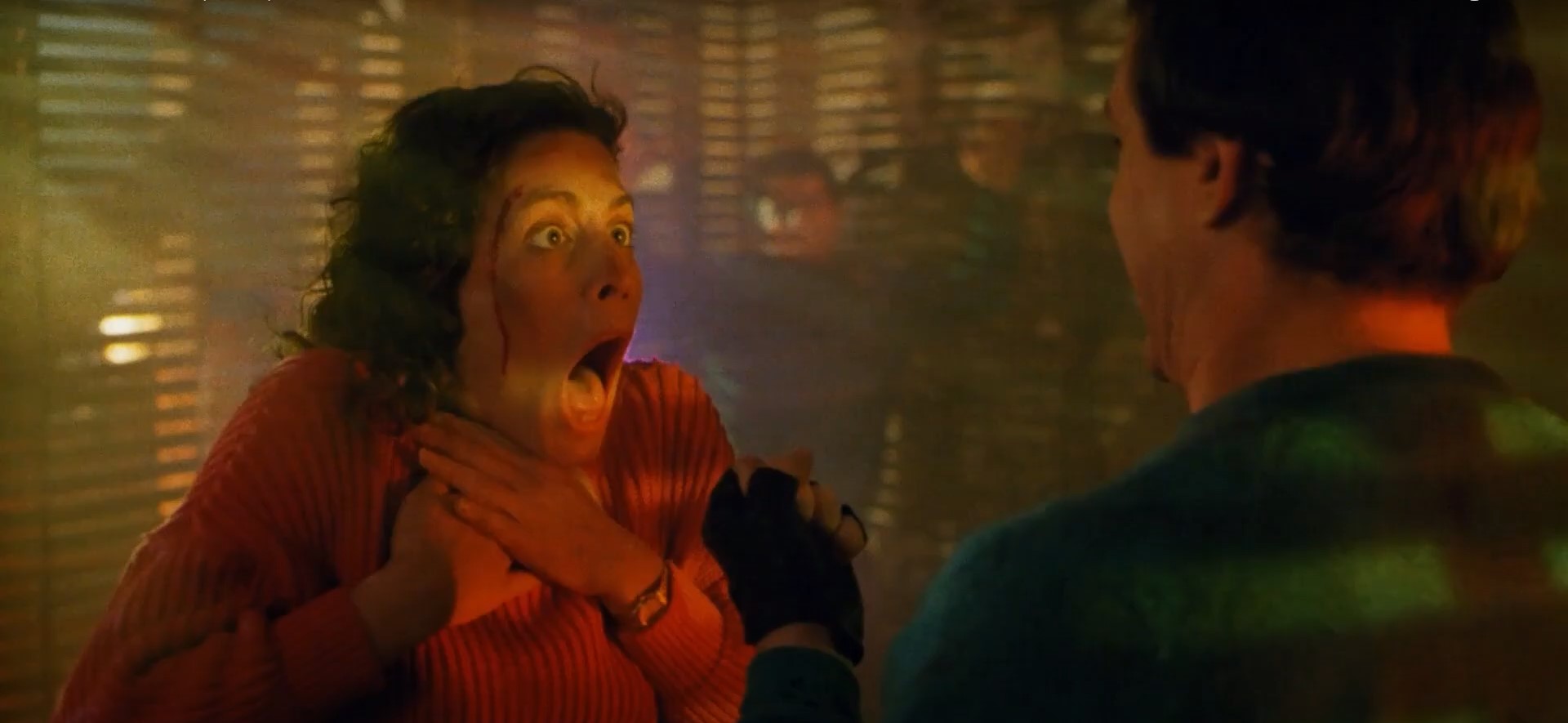
Black Mamba Wriggles Only for EVIL! “Venom” reviewed! (4K UHD and Blu-ray / Blue Underground)

Slither into “Venom” on 4K UHD and Blu-ray Combo Set!

American family, the Hopkins, live in London and while Mr. Hopkins travels the globe to attend to his international hotel business, Mrs. Hopkins and son Philip, live wealthy in their three-story row home along with visiting, Safari-expert grandfather Howard Anderson.  When Mrs. Hopkins plans a trip to see her husband after a month a part, she’s worries for Philip’s severe asthma attacks but with the assurances of the grandfather, the housekeeper, and Philip’s rudimentary zoo in his room, full of furry creatures in vivarium cages, Mrs. Hopkins half-heartedly boards her international flight.   Not everything is going to fine, however, when the housekeeper schemes with the family chauffeur and an Interpol criminal Jacmel to kidnap Philip for ransom.  The foolproof plot commences to plan with departure of Mrs. Hopkins and the arrival of Jacmel but one little mishap causes the plan to quicky unravel when a Black Mamba, one of the most aggressive and poisonous snakes in the world, is mistakenly crated and provided to exotic animal enthusiast Philip instead of his harmless ordered common variety garden snake and when the Black Mamba gets loose, it slithers in the house’s ventilation system, the house they’re all hold up in when the police swarm the outside perimeter. 

What was once going to be a Tobe Hooper (“Texas Chainsaw Massacre”) directed production before his eventual and sudden departure from the film after a few weeks, the 1981 crime-thriller with a creature feature twist, “Venom,” is then picked up by the late director of  “The Blood on Satan’s Claw,” Piers Haggard, to finish the Robert Carrington (“Wait Until Dark”) adapted screenplay off the Alan Scholefield novel of the same title.  The American screenwriter Carrington writes nearly a faithful iteration of the Scholefield novel but with more emphasis on the serpent’s over-lurking presence as an important reptilian character to the story, serving as a catalyst for the upended kidnapping plot and determining the fate of certain characters.  The UK film is American produced by Martin Bregman, the spear runner for “Dog Day Afternoon” and “Serpico” as well as “Scarface” and “The Bone Collector” later in his career.  Morison Film Group served as production company on the mostly LLC entrusted venture.  

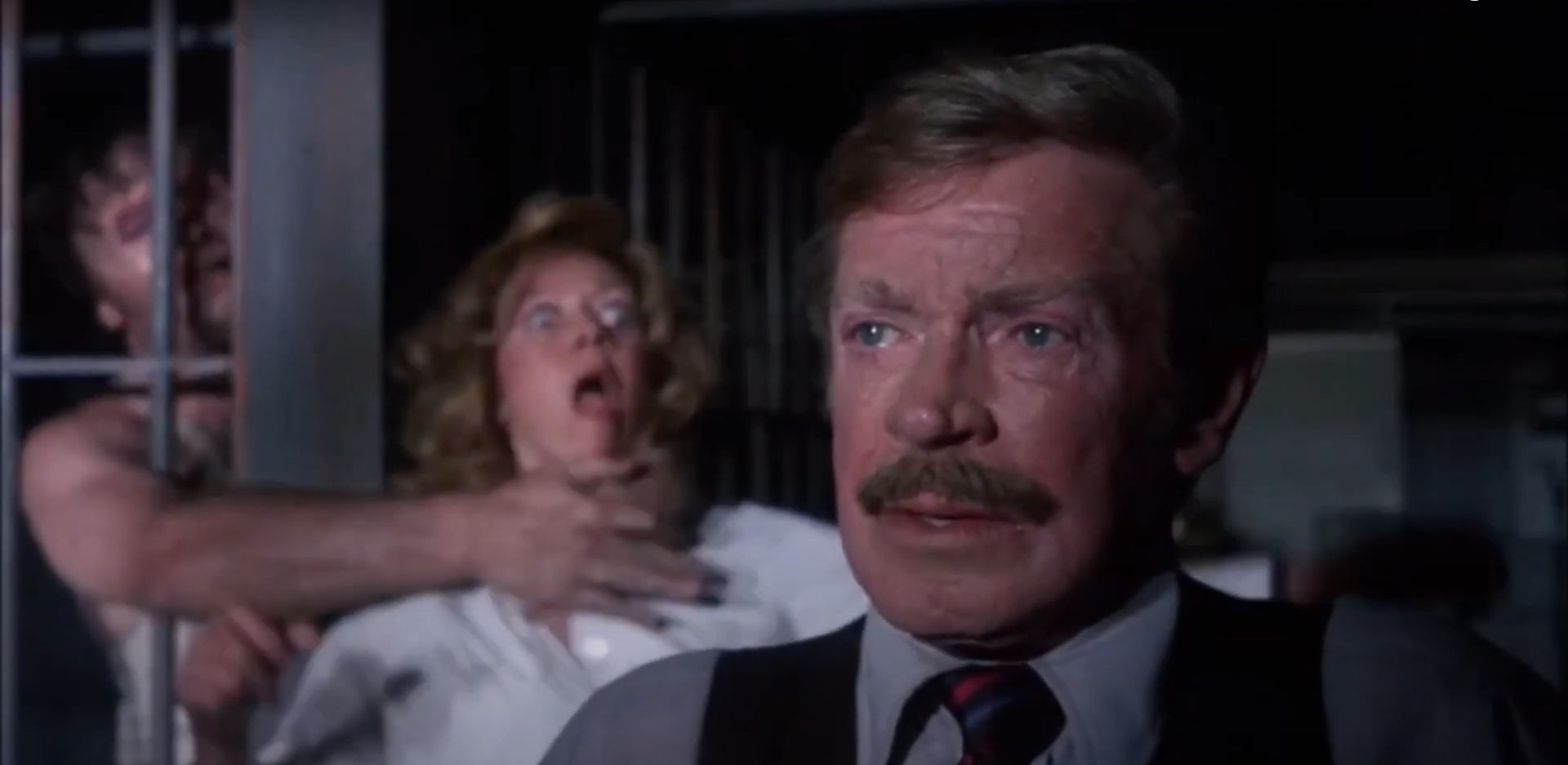
If the American Tobe Hooper did helm this picture, directing Leatherface as an actor would been child’s play in comparison to what would had been if he had to corral a pair of strong-willed, A-type personality Europeans in Germany’s Klaus Kinski and Britain’s Oliver Reed, both with well-known and formidable career of not only in genre films but also to be problematic and difficult to work with.  The “Nosferatu the Vampire” and “Aguiree, the Wrath of God” Kinski was perhaps mostly misunderstood for his not understanding of inflections, innuendos, and gestures of the English language that made him often sounds gruff and antagonistically questioning the director’s every choice whereas the “Paranoiac” and “The Brood” Reed was plagued with alcoholism and was equally gruff in his own right as a dedicated actor saturation with austere method stratagem.  Yet, on screen, Piers Haggard manages to get the two hurricane forces to be on-the-edge cooperating, backed-into-a-corner kidnappers without cutting any tension when interacting with each other.  Distinct in demeanor, Kinski as a calm, trench coat KGB-type and Reed as an anxiously and trigger-happy, hotheaded brute put on a good show in their respective performances and beat the odds of two notorious personas colliding.  Haggard doesn’t coddle them either and lets them loose to exact the carrier in their own right even if off-book and they’re even more vilified by taking hostage a young boy Phillip, the introduction of Lance Holcomb (“Christmas Evil,” “Ghost Story”), his Safari-seasoned grandfather Howard Anderson, played by beard-laden and serial gesticulating Sterling Hayden (“Dr. Strangelove,” “The Long Goodbye”), and a zoo toxicologist named Dr. Marion Stowe who is caught in the middle when checking up on the mishap switcheroo of the snake, played by Sarah Miles (“Blow-up”), neither in shape or in vigor to be a proactive hero.  The no-nonsense Police Commander William Bulloch, shoed with “The Exorcist III” actor Nicol Williamson, a brazen candor and stoic expression with Williamson offering frank wit and a sarcastic dryness that barely gets him one step into the house; instead, it’s the Black Mamba that’s the real and unintentional hero that seemingly only has a fork tongue and fangs for villains, leaving the other hostages alone.  “Venom’s” also has Susan George (“Straw Dogs”) as the traitorous housekeeper, Mike Gwilyn, Paul Williamson, Hugh Lloyd, and the first Butler of the 1980s-1990s Batman quadrilogy Michael Gough playing real life snake wrangler David Ball in tribute. 
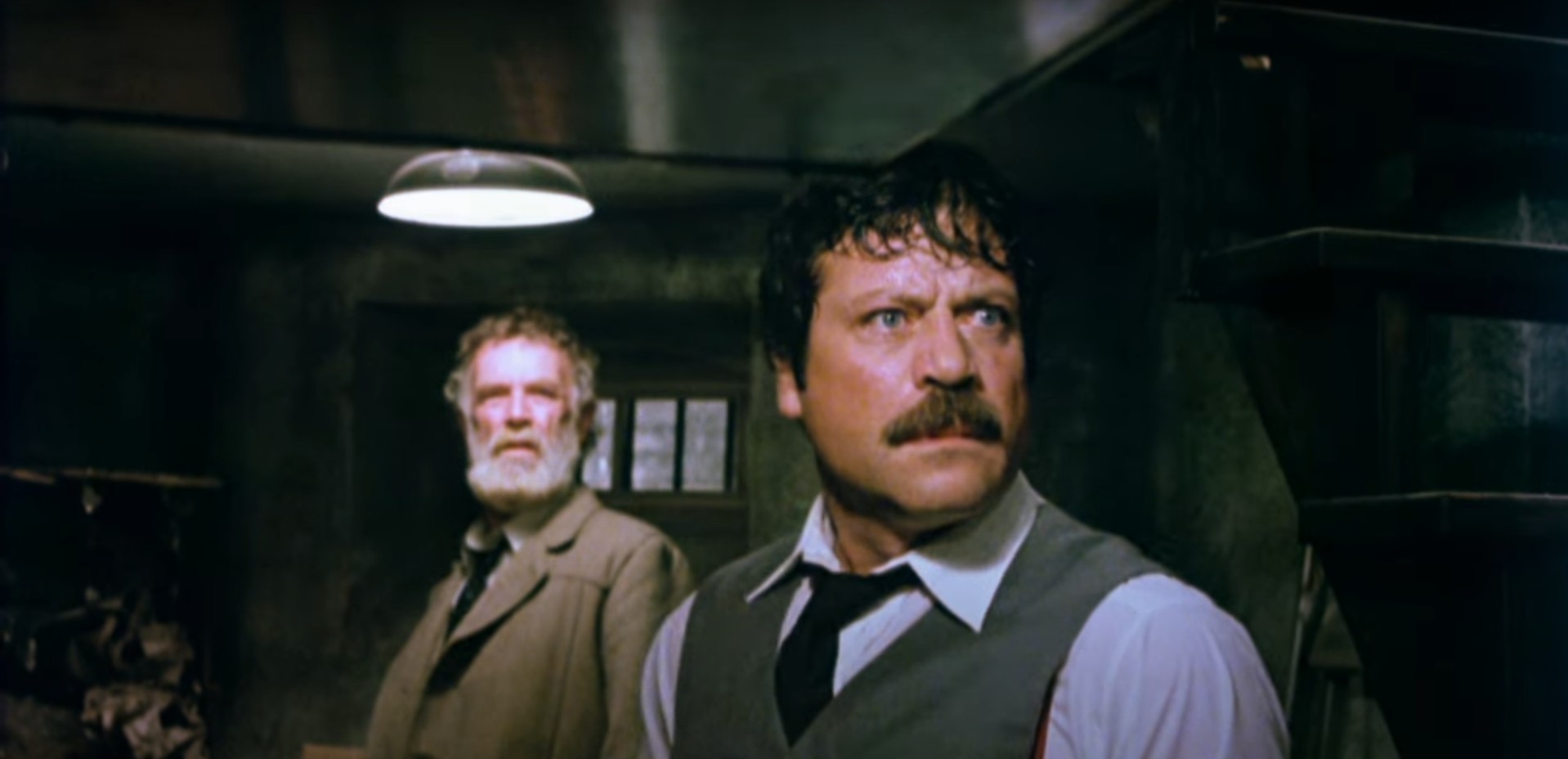
From the pages of Alan Scholefield’s novel to the big screen, “Venom” has a slithery way about slipping into between the crosshairs of a crime-thriller and a venomous creature feature.  Leading “Venom’s” charge is an undoubtedly great, if not iconic, cast giving their all to a farfetched plot of bad luck Ophidiophobia.  While the snake seems to have heat vision eyes only for the Klaus Kinski, Oliver Reed, and Susan George trio of kidnap-for-ransom criminals, who amongst themselves are in a deceitful love triangle that’s doesn’t quite come to a head as one would expect, there’s no animal kingdom peril to the other victimized threesome who, on a physical, first glance surface, are less equipped to handle a dangerous snake with a young, asthmatic-plagued boy, an elderly grandfather, and a nerve-bitten woman but, in reality, Phillip Hopkins, Howard Anderson, and Dr. Marion Stowe are respectively the best equipped to handle the black mamba as an small animal atrium hobbyist, a former African safari survivalist and animal expert, and a venomous snake toxicologist.  Perhaps, this is why the Black Mamba avoids these three at all costs and never interacts with them on a perilous level.  The fantastical mist that’s sprays us lightly with a crimefighting snake has comical properties that standout against what is a palpable thriller involving an international criminal, cop killing, child abduction, and the mutilation of a corpse. 

Blue Underground continues to update their catalogue with a 2-disc, 4K UHD and Blu-ray combo set of ‘Venom.” The UHD is HVEC encoded, 2160p ultra-high-definition, BD66 and the Blu-ray is AVC encoded, 1080p high-definition, BD50. In regard to picture quality, both formats are nearly identical transfer that’s stems from an all new 4K 16-bit restoration from the original 35mm internegative, with the UHD receiving Dolby Vision HDR. UHD is slightly sharper around delineation when gliding between dark and light, which is often inside a merge of a half-lit house to draw more tension toward the potential presence of a deadly snake. The 1080p presentation also provides a pleasing clarity that offers little to negatively note. Color grading and saturation between the two formats show signs of varying quality by a thread with the 4K saturating that much more intently across the board with a better control over the grain levels with the Blu-ray appearing a touch thicker for the pixels to flare optically. The native 4K and 1080p come with an English Dolby Atmos as well as options for either an English DTS-HD 5.1 or a DTS-HD 2.0 stereo. Speaking only to the Atmos, the all-encompassing mix shepherds in a clean, discernible quality without any audible seams. Skirmishes, dialogues, and all the commotions in between find isolated channels of distinction that can put you immerse you into the action. And there’s plenty of action to be had coupled with a Michael Kamen’s brass horn and string score that’s both memorably building with excitement and thrilling that preludes Kamen’s orchestrated composition work of “Die Hard,” starring Bruce Willis. Despite the circumference of sound spaced mostly in interiors with a hodgepodge medley of a street full of police, reporters, and gawkers, the dialogue is equally distinct, discernible, clean, and clear without signs of hissing and crackling strains. Subtitles included are in English, French, and Spanish. The 4K special features include a new audio commentary with Film Historians and Blue Underground commenting regulars Troy Howarth, Nathniel Thompson, and Eugenio Ercolani, an archived commentary with director Piers Haggard, and film trailers. The Blu-ray disc contains the same commentaries and trailers but extends further with new exclusives in an interview with editor-second unit director Michael Bradsell Fangs For the Memories, an interview with makeup artist Nick Dudman A Slithery Story, a film historian point of view interview with British critic and author Kim Newman, and an interview with The Dark Side’s Allan Bryce providing his in-depth two cents and historical surveying. TV Spots are finish out the encoded extras. “Venom” 4K and Blu-ray combo set is physical appeasing to hold and behold with a muted black slipcover with tactile elements on both sides of embossed letters and stark coloring that’s striking in its simple snake fang design arraignment. The black, thick Amaray case has the original “Venom” artwork with the optional reverse cover art. I’m not a fan of the inside design that houses a disc on both sides as there is no room place for 18-page collectible, color picture booklet which just floats inside. The booklet features an essay by Michael Gingold, cast and crew acknowledgements, and chapter selection on the back. The discs are pressed with one or the other cover arts. This gorgeous-looking release, on the outside and inside, comes region free, has a runtime of 92 minutes, and is Rated R.

Last Rites: “Venom” might have been snakebitten back when selling book adaptations of crime capers stopped by a single snake might have seemed farfetched but, today, the 1981 film remains a cult classic of the ophidian nature being one of the earliest serpentine creature features with an imposing, impressive cast. Blue Underground proudly presents the film with a new, and improved, ultra high-definition release.
Slither into “Venom” on 4K UHD and Blu-ray Combo Set!

EVIL is in the Eye of the Beholder! “Mansion of the Doomed” reviewed! (Full Moon / Blu-ray)

“Mansion of the Doomed” on Blu-ray.  Hold Onto Your Eyeballs!

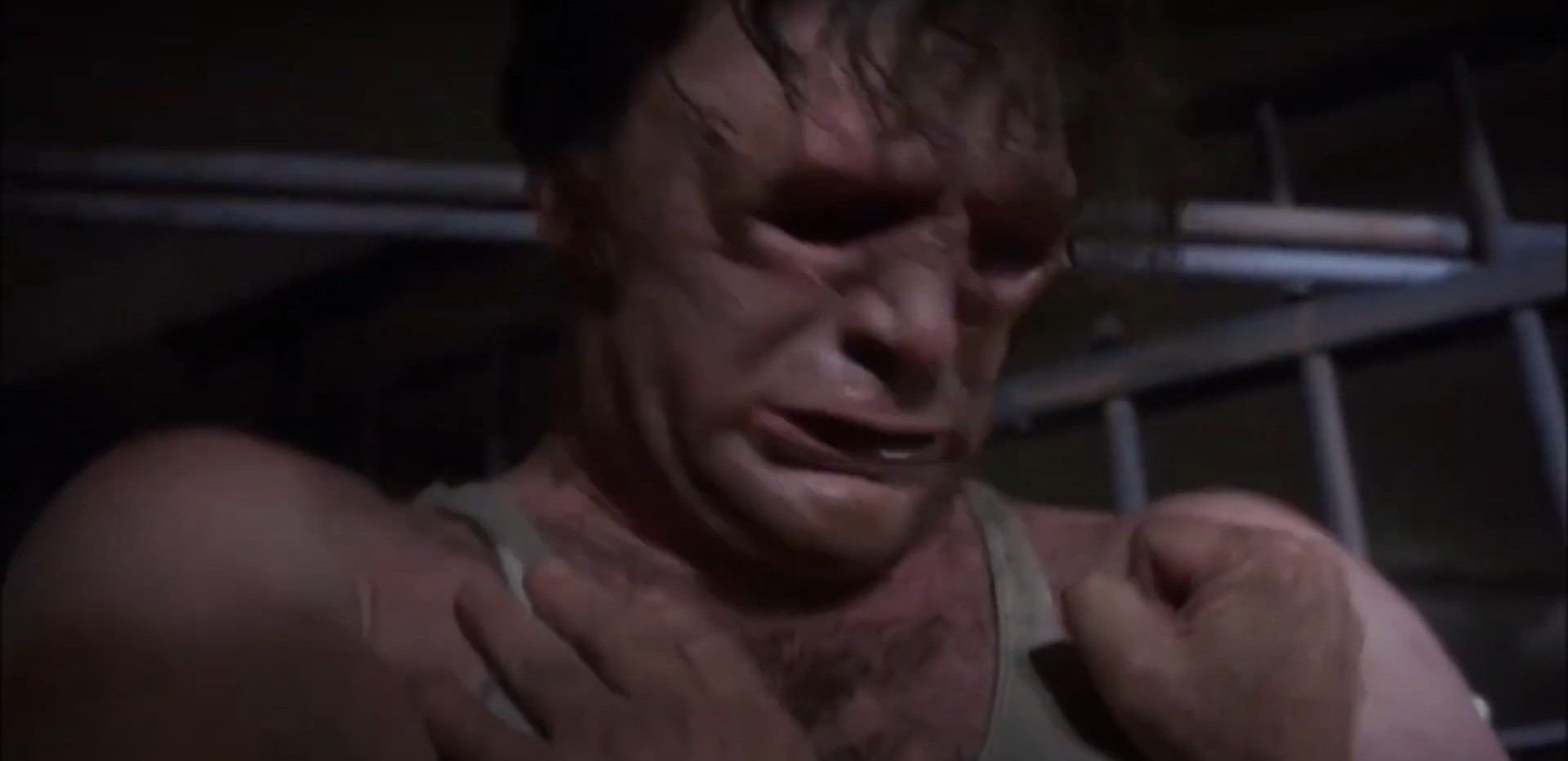
In a stroke of irony, renowned optometrist surgeon Dr. Leonard Chaney had a car accident that accidently causes his young adult daughter permanent blindness.  Obsessed by guilt and determined for her to see again, Chaney moves toward a not only radical procedure but also unethical one of a full eye transplant.  The catch for this type of surgery to be successful is the eye has to be extracted from a living patient.  Unwilling to wait for a donor, Chaney employs every deceptive tactic to lure unwillingly healthy and beautiful globular organ donors into his dark basement where he drugs them unconscious, surgically plucks out their entire eyes, and leaves them locked in a cellar cage, blind and crudely healed with scar tissue but still alive.  With each failed attempt at restoring her eyesight, the reminders of his experiments linger down below, screaming in pain, and pleading for their lives.  Soon, those pleas will ultimately catch up to him. 

Before his fascination with mini-sized maniacs of killer animated toys and malicious experimental oddities, Charles Band used to produce other types of original horror and the “Mansion of the Doomed” was one of them.  The 1976 Frank Ray Perilli (“Dracula’s Dog,” “Alligator”) written and the “Dead & Buried” and “Halloween 4: The Return of Michael Myers” actor Michael Pataki directed mad surgeon “Mansion of the Doomed” was the first feature film Charles Band officially stamped his actual name onto along with father and western screenwriter, Albert Band, as financial executive producer.  While “Mansion of the Doom” is known by various other titles around the world – “Massacre Mansion,” “Eyes,” “Eyes of Dr. Chaney,” “House of Blood,” “Eyes of the Living Dead,” and “The Terror of Dr. Chaney” – the one aspect that the film is firm in is its Hancock Park and estate shooting location in Los Angeles as one of the very first features to come out of Charles Band Productions company.

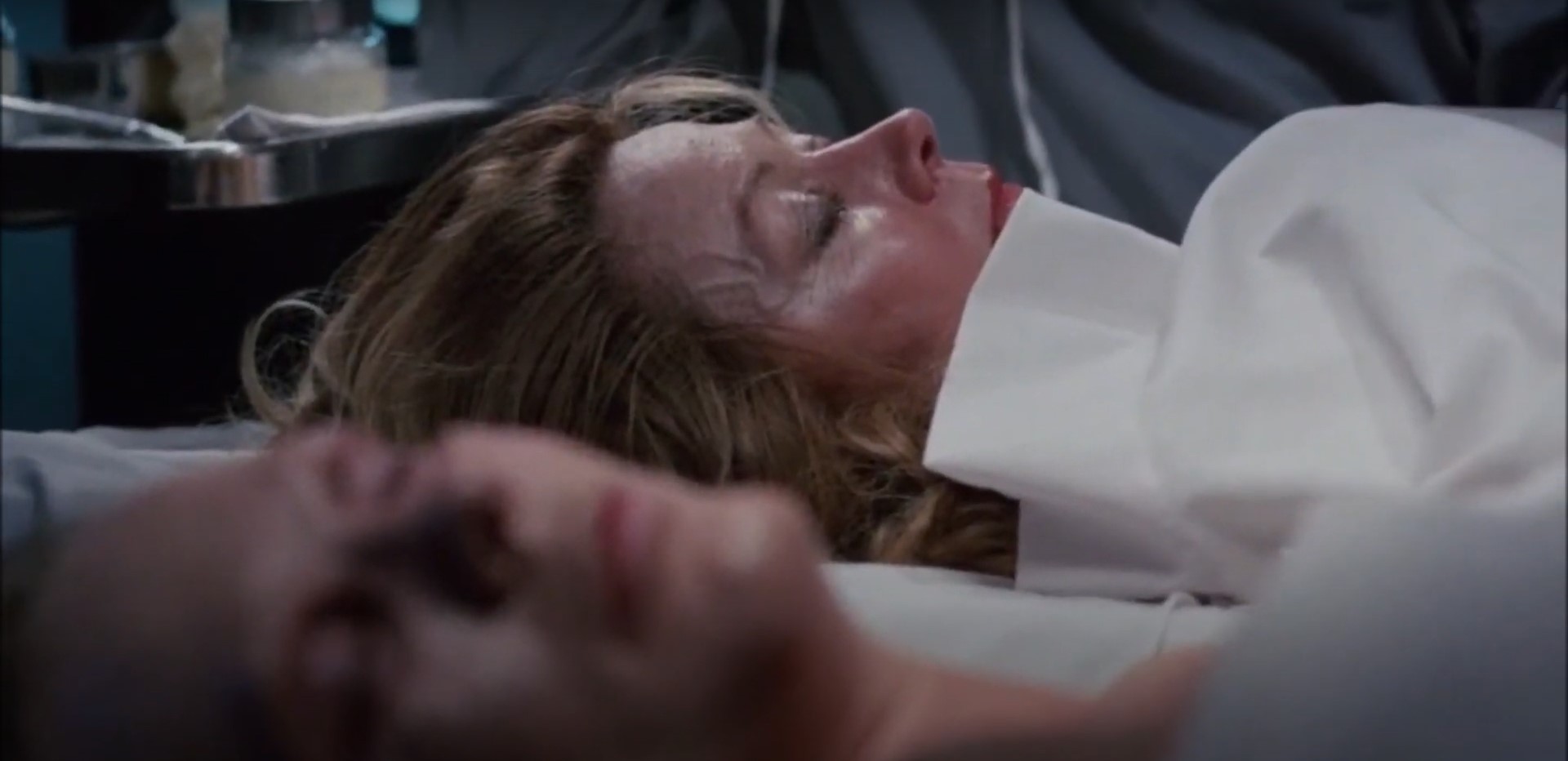
Lance Henriksen.  You know name, right?  Sounds familiar, yes?  The “Aliens” and “Pumpkinhead” actor, hot off the success of “Dog Day Afternoon” with Al Pacino, begins his tour de force of horror and dark science fiction with the Pataki mad doctor eye opener.  Dr. Chaney uses his misguided experimental expertise first on Dr. Dan Bryan, played by Henriksen, after Dr. Bryan’s recent romantic relationship breakoff with the recently blind daughter of Dr. Chaney, Nancy (Trish Stewart).  Before he became the narrating voice in TV’s “Knight Rider,” the veteran actor Richard Basehart, who also had a role in the 1977 “The Island of Dr. Moreau,” became his own inhumane medical malpractice physician in Dr. Chaney.  Though Basehart makes for the epitome of a professional doctor, his performance was the weakest link in the cast’s locks that didn’t exhibit the stress and desperation of a man continuously exploiting and disfiguring people for his own personal guilt release.  The guilt was not compounding as much as the story wanted to suggest, but we feel more empathetic to Dr. Chaney’s longtime assistant in Gloria Grahame (“Blood and Lace,” “Mama’s Dirty Girls”) who we can see her character dissolve with each abducted patient and affected to the core by their sightless screams.  “Mansion of the Doomed” rounds out the cast with Al Ferrera (“Dracula’s Dog”), Marilyn Joi (“Black Samurai”), Donna Andersen, JoJo D’Amore (“Dracula’s Dog”), and Katherine Stewart.

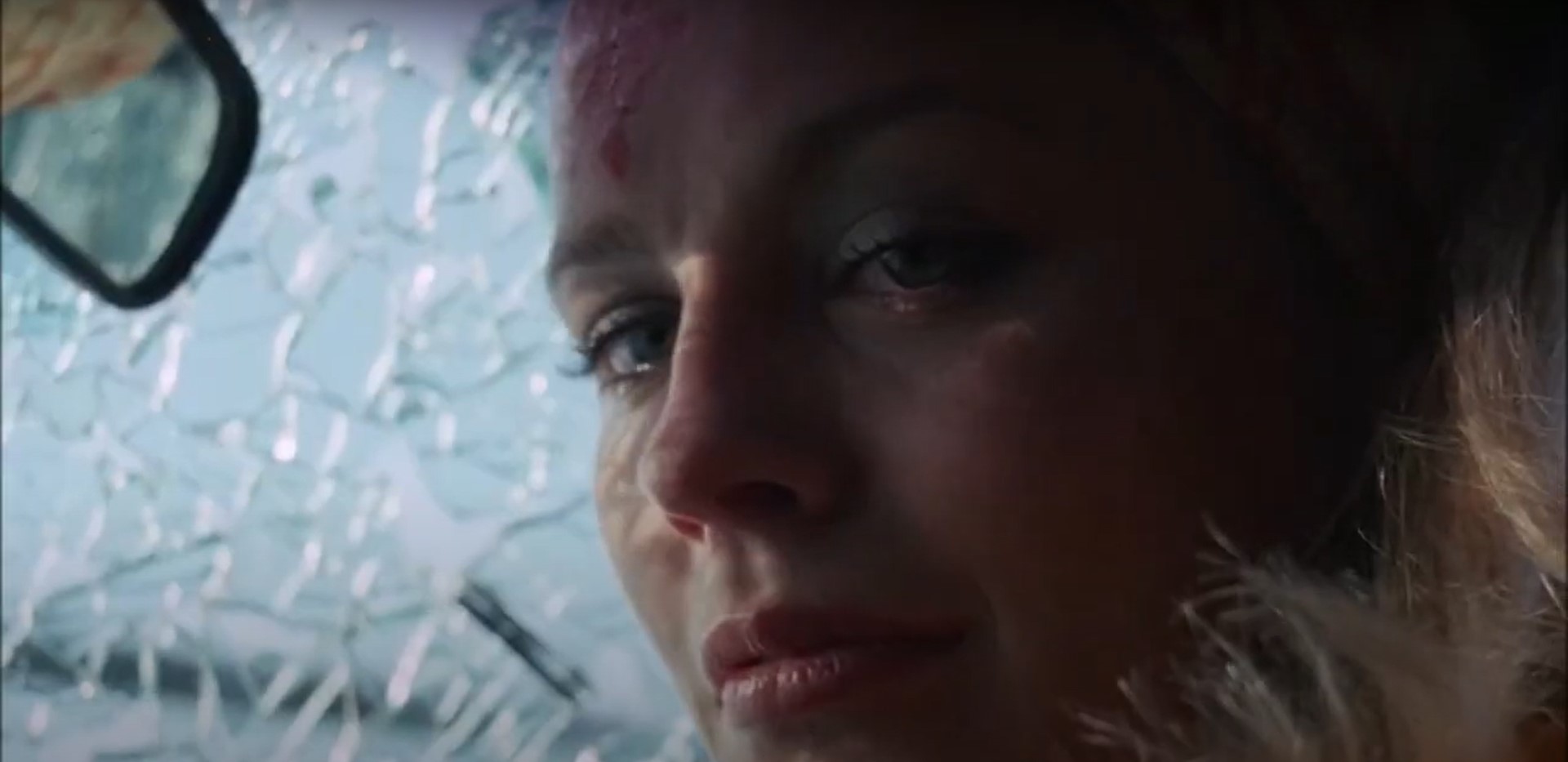
Michael Pataki’s “Mansion of the Doomed” is an eye-peeling shocker that’s dark and grim to the core and has an eye for cynicism. I could keep the eye puns going but that would be too easy to pluck out. Perilli’s story is rather plainly spoken with not a lot of fluff diving into medical or procedural jargon to bore you down into a loss of interest. Instead, the good doctor character goes right to work getting his hands elbows deep into the eye sockets of his victims and that’s how this particular exploitation perfectly crafted the balance by tabling the under stimulating medicalese with caged disfigured patients left to live in agony. Where Pataki and Perilli faltered some is in the preface by skimming the surface of the Dr. Chaney caused accident that rendered Nancy blind when she face-planted right into the doctor’s windshield as he swerves to not runover a mutt. In driver’s ed, you’re supposed to hit the small animal that runs in front of you in order for these kinds of accidents don’t happen! Told in the inner thought of a flashback, the force between the two immovable objects shatters the glass but leaves Nancy unscathed physically yet, somehow, she loses her sight in both of her eyes and while Dr. Chaney is unable to best the blindness with everything the surgical optometrist throws at it, perhaps that’s the unsolvable mystery that beleaguers abashedly an expert at the summit of their excellence. ‘Mansion of the Doomed” is not a feel-good film as not one single character has a positive outcome and having lost more than just their sight but also, to name a couple, their humanity and their hope.

Uncut, restored, and remastered onto a new Blu-ray release, Full Moon Features re-release “Mansion of the Doomed” onto 1080p, full high definition, from the original 35mm negative. Source material held up over father time with a pristine 85-minute uncut transfer to retouch in a pop of color and refine the details in a softer, more airy-soft image, presented in a widescreen 1.85:1 aspect ratio. Full Moon offers two audio options available with an English Dolby Digital 5.1 surround sound and a Dolby Digital 2.0 PCM. Though slightly staticky in the ambient and dialogue tracks, the balance works and is full-bodied around more essential scenes of surgery and the cries of anguish. Dialogue doesn’t sound overly boxy or hissy and the cult composer Robert O. Ragland’s (“Deep Space,” “Q”) classic orchestra score come across with a powerful range that speaks the scene without exposition. The region free Blu-ray has no extra features, leaving this release as a bare bone, feature only. “Mansion of the Doomed’s” harrowing ending induces stupefying blank stare and feels like a brick just walloped you in the face knowing that every pawn in this story loses at the hands of man disillusioned in playing God.

“Mansion of the Doomed” on Blu-ray.  Hold Onto Your Eyeballs!

EVIL is Only in Your Nightmares. Or is it? “Retribution” reviewed! (Severin / Blu-ray)

Severely depressed artist George Miller attempts suicide by jumping off from his apartment building.  During the exact same time, a low-end gangster is brutally killed by cruel loan sharks.  Being both born on Aril 1st and dying at the same time, the tortured spirit of the gangster possesses the meek artist’s body right before being resuscitated by EMTs.  After a long recovery filled with horrific nightmares, the affable artist returns to his apartment building where he’s welcomed by fellow tenants and an overly warm landlord.  Still plagued by nightmares that have seeped into his awake conscious state, George medicates himself to sleep but the nightmares continue as he sees himself using psychokinetic powers to kill random individuals with extreme malice.  The nightmares are so real he wakes up in a sweaty panic to find out that that exact person was killed the night before the very way it played in his dreams.  When George realizes the gangster has inhabited his body for revenge, he and his friends take measures to put an end to the vindictive carnage. 

Santa Maria.  Mother of God.  Help me!!!  That phrase, attached to the very last seconds before a gruesome death and announced blankly from fiery, dagger eyes, has forever been seared into the recessed corners of my eardrums as the death cry that echoes throughout Guy Magar’s 1987 gory and visceral possession identity crisis, “Retribution.”  Magar’s ultra-violent and super-chromatic film is the filmmaker’s grand inaugural entrance as a full-length director following up behind a string of director chaired television episodes, including episodes from “The A-Team,” “Blue Thunder,” and “The Powers of Matthew Star” that regularly contained quickly charged, action packed sequences.  The Egyptian-born director translates those intense moments of frenzied disturbance into his mean-spirited and unforgiving vindicator of a script cowritten with then first time screenwriter, Lee Wasserman.  Shot in Los Angeles, “Retribution” is a virtual tour of the city, using the streets of L.A. and real locations, such as the Don Hotel for George’s residence and the nearby House of Neon Art, as a lively, eclectic, and wallet-saving convenient giftwrap for the film’s Dr. Jekyll and Mr. Hyde complexion that feels totally normal compared to L.A.’s divergent glamour.  Magar and Wasserman produce the film with Renegade and Unicorn Motion Pictures serving as the production companies and presented by Taurus Entertainment, formerly connected with United Artists. 

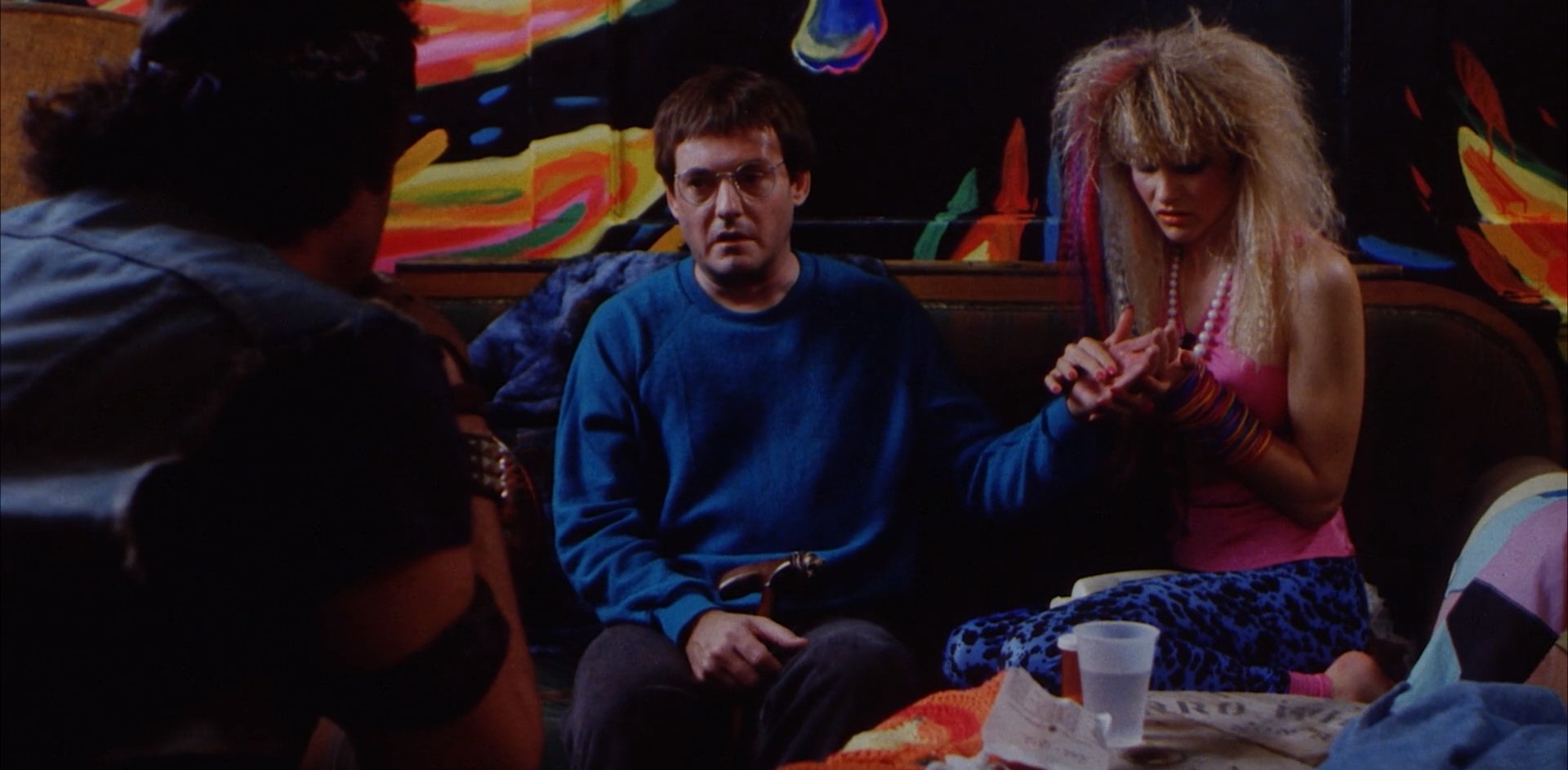
There are probably many actors that could been imagined for the role of George Miller, the suicidal artist plagued with visions of him committing murder, but it’s hard to imagine that venomous stare of complete satisfaction in madness spread across the face of anyone else other than Dennis Lipscomb.  No disrespect to the “Eyes of Fire” and “Wargames” actor but Lipscomb isn’t a chiseled-jawed and muscular leading man; in fact, Lipscomb is quite the opposite, but his range into mild-manner, all around nice guy George Miller into the lust for hatred and murderous revenge George Miller hangs on with complete chasmic permanence.  However, George’s love interest with the street working prostitute and fellow Don Hotel resident, Angel (Suzanne Snyder, “Return of the Living Dead II,” “Killer Klowns from Outer Space”), hardly ever seems natural in not only in the characters’ surreal age-yawning dalliance but also the chemistry looks and feels flat between Lipscomb and Snyder.  Magar and Wesserman neglect diving more into that bond between them but their enamored gleamy eyes for one another is apparent and strong without the context to back it up.  “The Dungeonmaster’s” Leslie Wing also is placed as a George Miller sympathetic advocate in her role as hospital psychologist Dr. Jennifer Curtis, but Dr. Curtis has more background to contend with in comparison to the suddenly conjured fondness from Angel as Curtis is a mental health professional caring for a suicidal patient from at his rock bottom worst to a complete positive turnaround in his mental transformation.  Curtis has more skin in the game with George’s supposed delusions of actually killing people in his nightmares as she defends not only George’s unique supernatural circumstances, but, in a way, herself as a licensed medical profession following HIPAA laws.  “Retribution” holds many dear and unforgettable characters that essentially captures the entire 1980’s spectrum of personalities and, even for a brief scene, the cast gives each role their all, including performances from Susan Peretz (“Dog Day Afternoon”), Clare Peck (“Teen Wolf”), Chris Caputo (“Ghost Warrior”), Danny Daniels (“Voodoo Blood Bath”), Ralph Manza (“Godzilla”), George Murdock (“The Sword and the Sorcerer”), Mike Muscat (“Hunter’s Blood”), and Hoyt Axton who doesn’t stray too far from his good intentions, but naïve, father role in “Gremlins” to being a detective tracking down suspect George Miller. 

I’m in total awe of Guy Magar’s “Retribution.” That opening scene of the suicide attempt with Alan Howarth’s building tension score drops not a single piece of dialogue yet opens with a gripping life and death situation, musically synced to progress toward a harrowing climax, and every frame is dripping with vintage 80’s appeal. Magar definitely knew what strings to pull to get the blood pumping, to get you excited, and to drop an excellent mystery right in the lap, or the middle of the street in this case with George Miller’s body after it flops off the car it just smashed onto. From that point on, “Retribution” peddles forward following the recovery, recouping, and ruination of George Miller’s life at the unseen hands of an exploiting, malevolent spirit that seeks to track down the top-tiered gangsters that shot and burned him alive and exact his own brand of harsh psychokinetic justice. Does it matter how George and this gangster, both born on the same day and both nearly died at the same time, came to fuse transcendently together? Don’t worry. Magar didn’t think it was important either and he’s right! “Retribution” snags all the attention for the sole purpose of the ride and that ride being a beautiful, color-coded daymare. The one aspect that ultimately retracts the buzzing high, stemmed from most 80’s films, is the sluggish love interest subplot between George and Angel stutter stepping into an awkward phase of interactions that hard stops much of core plot and though the plot is neurotically nonsensical to begin with, George and Angel’s desires for each other are about as cringeworthy as they come. Stick with the gore by honing in on Miller’s subconscious alter ego of a gangster serving his killers their just desserts via Kevin Yagher (“Nightmare on Elm Street 2: Freddy’s Revenge”) and his highly effective special effects on a low end budget that, along with a brilliant showing of cinematography by Gary Thieltges, tips into the categorical likes of “The Evil Dead” or “The Exorcist.”

“Retribution” delivers a fervency unlike ever seen in one of the utmost, must-see, shamefully overlooked horrors films of the 80’s.  Now, with a deserved boost and in style, “Retribution” gets the royal restoration treatment with a jammed-packed and sleek 3-disc Blu-ray set from Severin Films and distributed by MVD Visual.  Disc one’s theatrical cut, clocking in at 107 minutes, comes from the recently discovered 35mm pre-print elements, shot on an Arriflex 35 BL3 per IMDB, and has been digitally scanned in 2K, presenting the region free film in 1080p Full High Definition inside the original widescreen 1:85:1 aspect ratio.  “Retribution’s” image pleasingly pops with fine delineating attention to the details that reach out to the point where they’re nearly tactile textures.  Every single setup of Robb Wilson King’s production designs are rich to begin with but are even figuratively injected with a smoother compression growth enhancing hormone, adding more layers of surface level details that personify and personalize the space.  Magar’s chromatically fluorescent vision is a literal tilt-a-whirl palette blast of phantasmagoria.  Disc tow is the extended Dutch video version that adds back in the extended seconds on the longer, gorier kill scenes.  The English language DTS-HD Master Audio 2.0 is the sole mix on the release and, honestly, sates the need with the dual channels.  You obviously don’t get the surround sound, which considering this release would have been ideal, but the stereo mix, as well as the dialogue track, is still full-bodied, identifiable, and spotless of blemishes.  John Carpenter understudy Alan Howarth scores his solo synth-laden story on tenterhooks with a tinge of a Miami Vice theme as well as setting tonal moods that add depth to character layers.  If you want the entire OST, you’re in luck!  The third disc is a compact disc of the entire soundtrack.  Special features includes over two hours of content with Severin exclusive looking back at the experiences with the late director Guy Magar and the ins-and-outs of making “Retribution” interviews with co-writer Les Wasserman Writing Wrongs, actress Leslie Wing Shock Therapy, actress Suzanne Snyder Angel’s Heart, actor Mike Muscat Santa Maria, Mother of God, Help Me!, soundtrack composer Alan Howarth Settling the Score, special effects artist John Eggett Visions of Vengeance, artist Barry Fahr The Art of Getting Even, production designer Robb Wilson King Living in Oblivion.  Other special features include Guy Magar’s student film “Bingo,” stills and poster galley, and the theatrical trailer all packaged under a cardboard slipcover and a reversible snap case cover. Severin Film’s “Retribution” release is a triumph, a proper regenerarcy of revenge cinema, with all the gory details being the star of the show.

Own this Amazing 3-Disc set of “Retribution” from Severin Films!