Never Trust an EVIL Trucker with a Drug and Prostitute Addiction! “The Bunny Game” reviewed! (Jinga Films, Danse Macabre, MVDVisual / DVD)

“The Bunny Game” is Not for a Weak Stomach! Now on DVD!

Bunny, a prostitute on the streets of Los Angeles, subjects herself to the lowest of clientele lists looking to exploit her services with their own abusive fetishisms.  Just to get by to her next meal.   Bunny is constantly in coked out state when tricking becomes nearly unbearable.  Manhandled, abused, and unconsciously raped, there seems to be no end, and she must persevere to survive the streets, beautifying and feeding herself physical and mental nourishment to keep up strength.   When she encounter’s a trucker named Hog, Bunny’s just looking to endure another insufferable John, but Hog has other plans for Bunny, kidnapping her, driving somewhere isolated, and chaining her up deep within his trailer, and tormenting and torturing her to a different kind of no end Bunny has never experienced.  Hog’s derangement is fueled by his extreme drug use in what is not his first rodeo with working in whores for his own personal enjoyment and the girls’ own personal Hell. 

Banned in the UK, “The Bunny Game” is an extreme torture porn horror based off the real events that happened to principal star Rodleen Getsic with being abducted.  There’s not much publicly known on her own horrible experience, but the “The Bunny Game” is a baseline shockumentary written in collaboration between Getsic and filmmaker Adam Rehmeier with in the director’s chair of his debut feature film.  Rehmeier, director and cinematographer of numerous music videos and shorts, conjures up a story and a completed film with singer-actress Getsic without ever materializing an official script.  Instead, improvising and extemporizing fluff up Rehmeier’s storyboarding bullet points of where people and places should be in the narrative construct, hence why much of the story goes without dialogue, replaced with frenetic visuals and montages of recalcitrant convention.  Rehmeier co-produced the film under his company Death Mountain Productions alongside Rodleen Getsic.

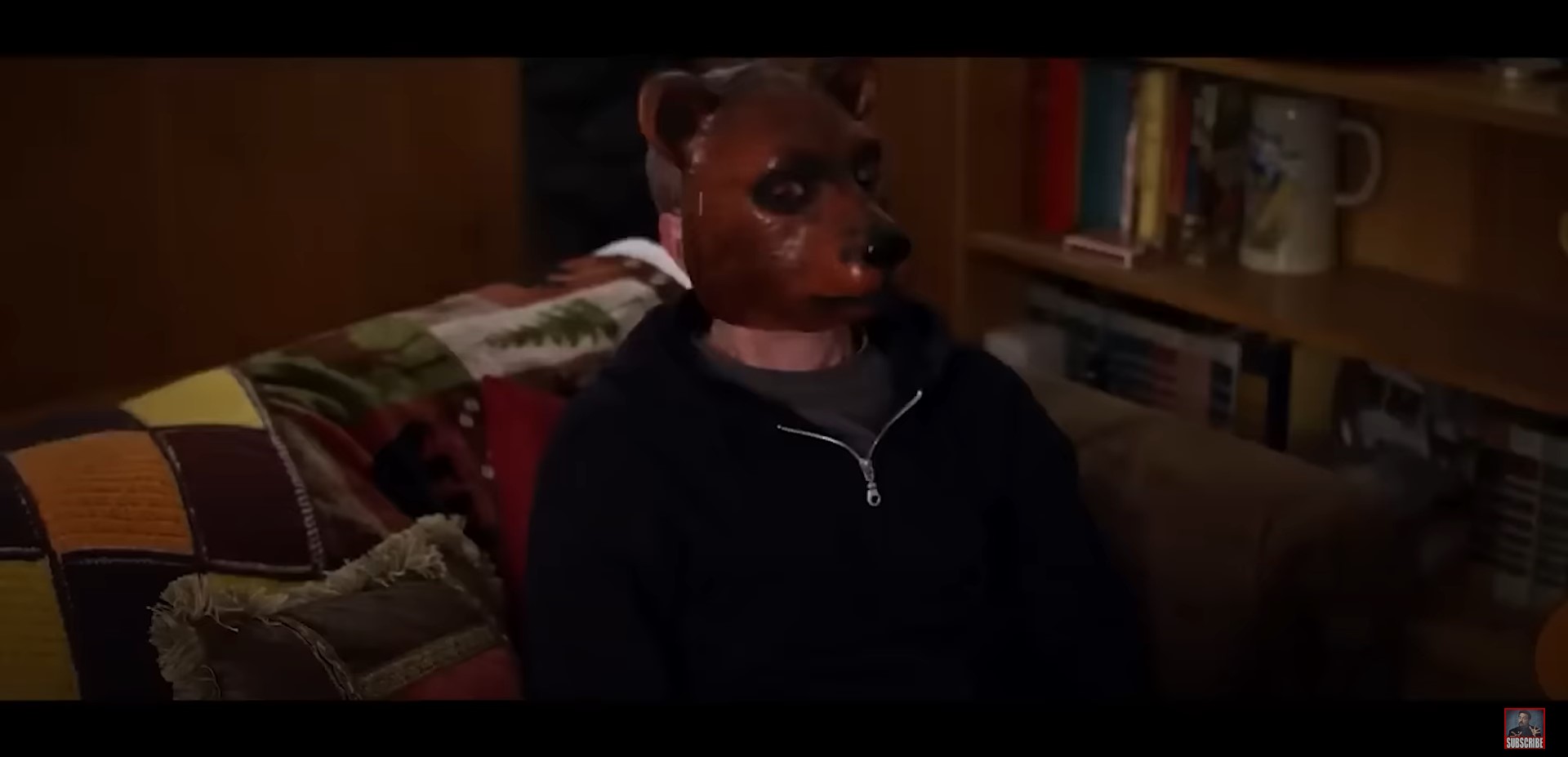
For having been abducted herself and for the film to be an overemphasis of it, Getsic steps into the main role’s fishnet stockings to be the used and abused sex worker, known only in the credits as Bunny, and the role is no walk in the park or for the faint of heart.  Bunny is a self-inflicted punishing performance and mostly what you see on screen being inflicted upon Bunny is genuinely be done to Getsic which includes branding of the caduceus symbol on her back, as well as the same symbol seared into the flesh of Getsic’s friend, Drettie Page, who was game to receive much of the same for-the-story, for-the-film punishment as another victim of Hog in, supposedly, flashback sequences.  Hog is played by Jeff F. Renfro, a regular in the industry for his transportation services owning a big rig and tractor-trailer, but as the formidable serial killer Hog, Renfro brings and matches the intensity of “The Bunny Game’s” near free for all improvisation and experimentation provocation.  Getsic’s willingness to go the extra mile, from being branded, lighting scored by knife play, having her head shaved, is equally matched by Renfro’s being the recipient of being spit in the face, handling the fondling and the other physical exploitation of Getsic and Page, and being a total wild eyed, masked and shirtless, top of his lungs maniac with a mindset that’s cruel and oppressive with another human being’s life in his hands.  Dynamically, it’s a cat playing with a mouse, a deplorable show of chauvinism, and a callously cruel picture of control with the players in full control and full acceptance of their characters.  Gregg Gilmore, Loki, Curtis Reynolds, and Norwood Fisher cast a supporting line to trawl the Rehmeier, and what Rodleen Getstic refers to, monsterpiece

Rehmeier and Getsic have both been recorded stating every action on screen, aside from the excess drug and alcohol use, is 100% real.  Now, “The Bunny Game” immediately slaps viewers in the face with Bunny on her kneeds giving extended, adult industry-enthusiastic, fellatio to some unknown man only shown from his clothed backside at mid-section down to the top of the knee.  While not as sloppy as one might think despite Getsic’s vigorous efforts, the opening oral provides that provocative, eye-opening, banned-in-the-UK scene that now has snuck insidiously in the recesses of our minds and, in conjunction with the previous Rehmeier and Getsic authentic claims that never really specifying sex as one of them, audiences will wonder if what they’re subjected to is in fact a real act of oral sex.  To digress briefly, what’s the deal with movies with Bunny in the title (“The Bunny Game,” “Brown Bunny”) and oral sex?  From there, if you’re not disgusted by the voyeurism and chauvinism of sex work and misogyny, you’re digging Rehmeier’s film and hooked with curiosity tied to Bunny’s unfortunate fate, but what ensues embodies the essence of a crazed industrial music video of minor, discordance chords that produce harsh sounds and tones to envelope the choppy and cutting editing that shatters linear time, as well as the struggling soul, especially in montages of maniacal torture and onset introspective  between the punishment giver and taker in the Hog and Bunny intersection that will instill a catalytic crossroad for one of them.   There’s plenty of empathy to be had for Bunny, or maybe even sympathy if one has gone through similar abduction, torture, or has had a previous life on the streets, but the coarse nature of Hog’s slow and measured wrath can certainly be felt in the 1 hour and 16-minute runtime as revisiting Bunny for another dash of screaming, laughing, and misuse of her body and being at the hands of Hog is often on a wash, rinse, and repeat cycle of cynicism, an unavoidable problematic staleness often associated with films that do not have a shooting script, or any script for that matter.  Ideas tend to run dry and the then cornered concept is to bedazzle with nonstop bedlam but the fresh frenzy of exploitation is often fleeting and expires a lot quicker than the film’s runtime does.

A tale of street tragedy and what should be an always constant reminder that deranged killers are here, there, and everywhere, “The Bunny Game” scores high in extreme exploitation within its experimental execution.  Jinga Films, Danse Macabre, and MVDVisual bring the corrosively cuddly film back onto DVD after the original Autonomy Pictures release has been out of print for a while.  The single layer DVD5’s codec is of MPEG-2 compression and presented in 720p resolution in a widescreen 1.85:1 aspect ratio.  The achromatic black and white image stacks additional bleakness to the already soulless content with a low field of contrast creating borderless shadows but the use of handheld key lighting, aka flashlight, does create a miniscule delineation at times when under a blank of black.  Blacks succeed in being solid for the most part with only a couple instances of minor banding which is pretty good DVD compression, likely a result of the zero color to encode and decode.  The English LPCM Stereo is not a girthy mix of dialogue, soundtrack, and ambience.  Now, all three elements exist, but since “The Bunny Game” has zero script, there’s not much in the way of conversating and what’s there is prominent enough amongst the layers of industrial jarring dissonance that, at times, beats in sync with the visceral montages.  Inside the mic recording scope, ambience comes and goes based off the intensity of the scene and score but there are quieter moments to reflect on the improper handling of Bunny with Hog and the other indiscriminately disgusting Johns her life as a prostitute absorbs.  Special features include an archival Caretaking the Monster behind-the-scenes interviews with cast and crew, including actors Rodleen Getsic, Jeff Renfro, Greg Gilmore, and director Adam Rehmeier, discussin the original concept that was more aligned with Getsic’s personal abduction accounts but then evolved into something more horrifying that lead to the casting of Renfro, their isolated locations, and the realism inflicted upon Getsic as well as the teaser and theatrical trailer.  The DVD packaging is much the same as previous editions with a video aesthetic resembling black and white contrast but unlike previous releases, the cover art shows off its graphically artistic masked bunny in shackle design that speaks to the content.  The Jinga, Danse Macabre Danse, and MVD release lists this as a rated R release whereas the previous version was unrated; however, both releases have a 76-minute runtime.  A quick review suggests this “R” cut is actually the same as previous versions.  The DVD also has region free playback.

Last Rites: This game is not for the faint of heart. “The Bunny Game” tests willpower to stay through to the end, through the torture, rape, and the real violence in a one-sided acrid affair. If you can survive the brutality, this game is for you.
“The Bunny Game” is Not for a Weak Stomach! Now on DVD!

An EVIL Drug That Can Cure Your Crabs and Boil Your Insides! “Private Blue” (SRS Cinema / DVD)

“Private Blue” is on the case! DVD Now Available.

A new drug is on the streets of Edmonton, Alberta.  Call Shrink, the drug can produce a massive high and contains a high level of antivirals that can cure any sexually transmitted disease, but there’s a side effect.  If taken in a single excess amount, the drug can boil your insides, leaving nothing left.  The Edmonton police are stuck on the case with no leads and to make progress on the fast-moving drug epidemic that has now claimed the life of a daughter of a prominent sports booky, the department hires Tony Blue, an ex-cop now private investigator who can use unconventional means outside the scope of police authority to get the needed information, such as where Shrink is being peddled and produced.  Working down the vine, Blue runs through the hierarchy from street pushers to the manufacturing kingpin, a brusque and brutish strip club owner named Wanda who will stop at nothing and will not let anyone get in her way to fill the streets with her deadly, venereal disease-curing drug.

A comedic spin on the 1980’s lone wolf cop-thriller, “Private Blue” immerses itself into every trope manageable inside its indie budget with business in the front, party in the back mullets, bad guy chases and beatdowns, and a smoke-filled and color gel-brightened assortment of atmospheres that propagates the cop film neo noir aspects.  The accountable party behind this crass cop caper are a pair of brothers, Devin and Robert Burkosky, based in Edmonton, Alberta, Canada.  The brothers produce, write, direct, and one-half star in what is their sophomore feature film behind the 2018 comedy-horror “Load Shark Massacre” that’s about a murderous loan shark who bites off more than he can chew.  Continuing the trend of drugs, violence, and psychotronic absurdities, “Private Blue” is an extension of their creative effort into crime action with a horror edge but with this time, they add a science-fiction element straight out of the boondocks of left field.   The feature is produced under the Burkosky company, Beechmont Entertainment. 

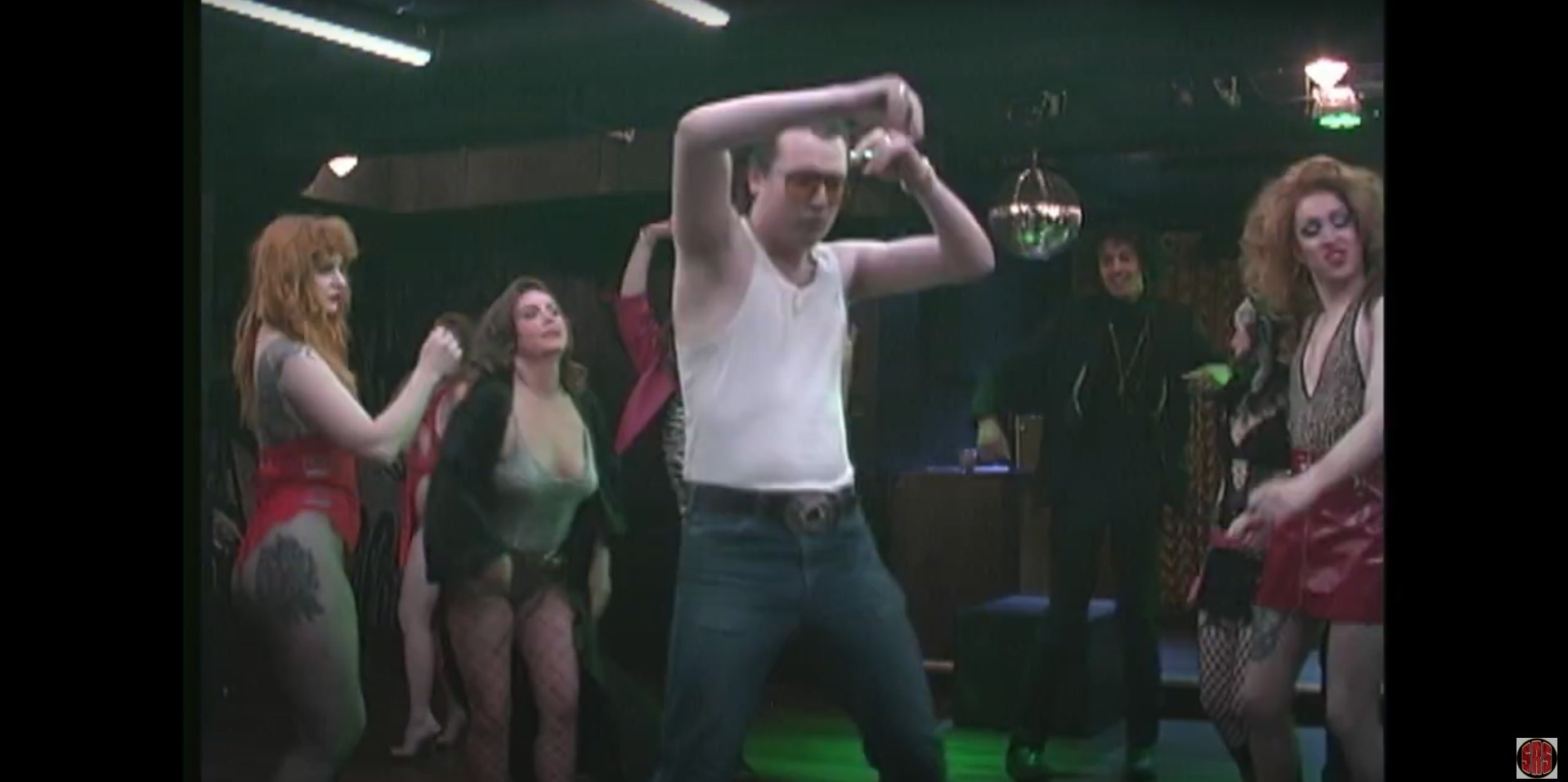
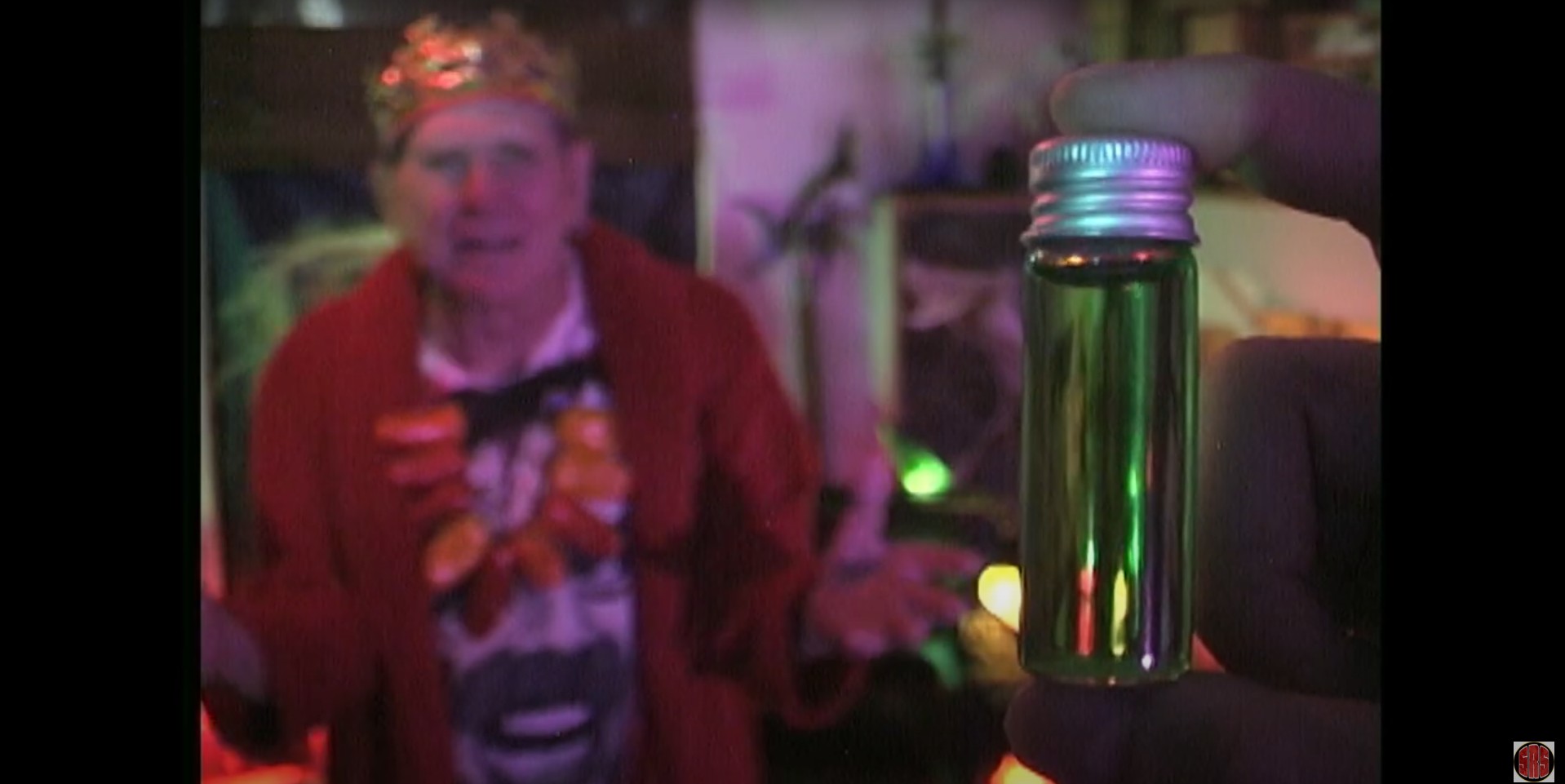
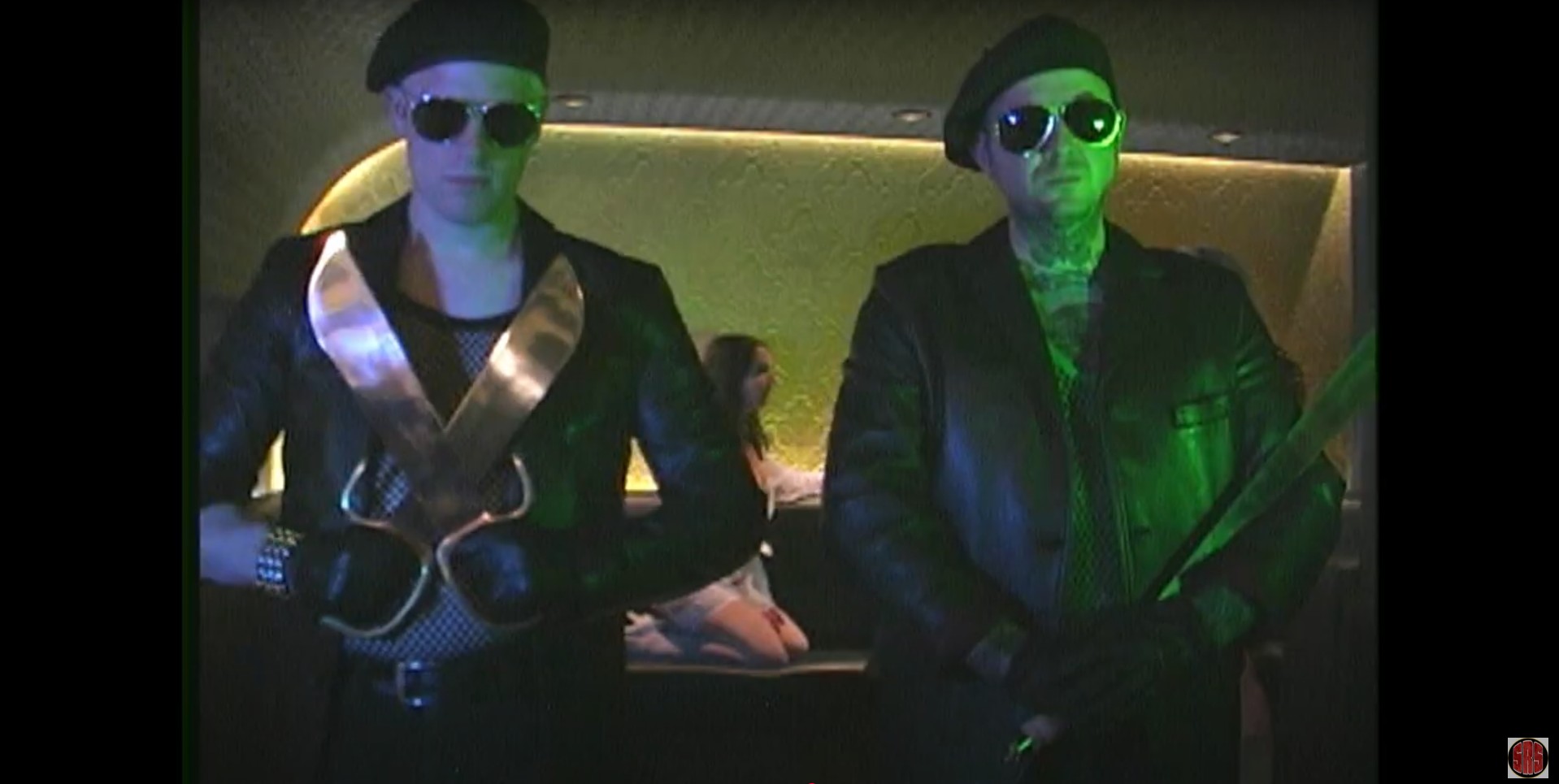
Robert Burkosky jumps into the titular role of “Private Blue” as a wisecracking and arrogant Tony Blue, an expelled detective because of his purloining of the evidence locker for his own needs, but Blue is a great chase-down detective, if not the best with his quick wit and adept situational skillset that makes him valuable.  Burkosky hams up Blue’s cocky attitude and Miami Vice-lite dress with linen blazer overtop a white tank top, sporting aviator glasses, and flaunting a greasy-looking mullet to accentuate the arrogance and confidence.  Opposite Burkosky is Moira MacKinnon as the larger-than-life adult industry head honcho and criminal mastermind Wanda who’s behind the manufacturing and distribution of the Shrink drug.  Having had a role in the Burkosky’s debut feature “Loan Shark Massacre” and was recently in their last film, the 2025 “Heat Score” that’s currently in post-production, MacKinnon’s a Burkosky go-to regular and her performance in “Private Blue” is perhaps my personal favorite with the Rita from “Power Rangers” voice and cackle and a maniacally expressed face as she bulldozes people into what she wants, no matter friend or foe.  “Private Blue’s” colorful cast doesn’t end there as there’s plenty of outrageous personalizes that are typical of a Burkosky brothers production, such as Tommy Grimes in drag playing the role of a female assigned stripper named Candy, Wolfgang Johnson as a low-level, guitar-playing, drug pusher, and Rod Wolfe as an older, mid-level dealer who wears various peppers around his neck like a necklace.  Dean Lonsdale, Ian Rowley, Dave Qurik, Kaley Leblanc, Jesse Hicks, Arielle McCuaig, Christian Stahl, and Brandi Strauss fill out the cast.

For what the Burkosky’s try to achieve in churning out “Private Blue” as a throwback of hard-boiled sleuth work, there’s success is select areas.  One of those successful portions is the phenomenally pastiche 80’s soundtrack by Robert Burkosky and the general aesthetic of the said decade with smoke-filled room illuminated by the gel lighting.  Wardrobing occasionally lands in the same era but there’s really no set point in time the story takes place but rather a mishmash of decades.  Devin and Robert, the latter quickly establishing himself as nearly a one-man show for the entire production, are competent editors that make “Private Blue” an easily digestible narrative.  What’s not easily digestible are the jokes that, for the most part, land flat.  The colorful characters do indeed entertain in their ineloquence and idiosyncrasies, but the script lacks that gut punch humor.  Instead, the script is riddled with fart gags, which personally I’m not a terrible fan of its audiological stink, and the jokes continue periodically throughout in every, or every other, scene of just randomized farting when a character sits, squats, or actually flatulates purposefully as a way of gag-inducing defense.  While most jokes don’t jive in jest, there are a handful that do, such as Tommy Grimes convincing our sexuality as dolled up sex worker Candy or Robert Burkosky’s lengthy slow-motion dance scene with a bunch of strippers at Wanda’s club.  Hilarity, as well as spurts of graphic violence, continue through whenever the story perversely changes course and mostly for the better. 

“Private Blue” is on the case.  Or, rather, is inside the case of an DVD Amaray with the release from ultra-indie underground label SRS Cinema.  The MPEG-2 encoded, standard definition 420p, DVD-R with the purple underbelly has a less-than-desired picture quality that’s par for the course with SRS Cinema.  Yet, all the sub-def eyesores are not terribly off-putting thanks to some decent camera equipment and know-how by the Burkoskys.  The palatable image has a flat grading only targeting contrast during it gel-lit scenes and the film is presented in 1.33:1 full screen that’s shot-on-videotape with uniform moments of interlacing.  Imaging produced is a result of a macro lens, encompassing even less within the standard framing and providing a flatter field that loses a bit of the depth.  The LPCM stereo mix that offers an ample dialogue track and range of audio layers that create a fair separation.  Robert Burkosky’s soundtrack epitomizes the balance between the layers when amplifying to make it the star of the scene.  Gun shots, thrown punches, and, even to an extent, the fart gags find the relative right level within a campy mix.  English captioning is available on this DVD.  Special features include a paralleling director’s commentary track, a blooper and outtake reel, the film’s trailer, and other SRS Cinema trailers.  SRS Cinema’s physical copy is standard fair but does showcase a blue-hued illustrative artwork that’s appealing and accurate with the same, but cropped, design pressed on the disc.  The 96-minute film comes not rated and is region free.

Last Rites: A debased tribute to the hard-boiled 80’s cop actioner, The Burkosky Brothers “Private Blue” has potential to be a great accolade of the subgenre as well as be funny but falls short with an overuse of pass gas gags and its inability to surpass that tenor.

“Private Blue” is on the case! DVD Now Available.

A Father Goes Looking for His Missing Daughter but All He Finds is EVIL! “The World of Kanako” reviewed! (Drafthouse Films and MVD Visual / Blu-ray)

Purchase “The World of Kanako” From Drafthouse Films and MVD Visual

A washed-up former lieutenant detective now working as a lowly security guard becomes the first person to stumble into the aftermath of a gruesome, convenient store triple homicide.  After being questioned by police who suspects him of being involved because of his manic-depressive disorder, stemmed by his historical violent behavior and ugly divorce that virtually left him with nothing but his medication, the indecorous alcoholic floating through life receives a frantic call from his ex-wife about their teenage daughter, who he hasn’t seen in years and has suddenly gone missing for nearly a week.  Eager to have his family back in his life, he takes on the responsibility of investigating his daughter’s disappearance but the deeper he digs into her whereabout the more of the ugly truth surfaces between his daughter and the criminal underworld where deception, prostitution, and murder tells a different story than the one in his muddled head. 

In 2004, novelist Akio Fukamachi wrote “Hateshinaki Kawaki,” the rummaging into a lurid and pulpy underbelly of crime network through the eyes of one charismatic high school girl and her former detective father pursuing answers to her disappearance.  Fast-forward a decade later to 2014, director Tetsuya Nakashima (“Kamikaze Girls,” “Confessions”) adapts the novel’s darkness into a visual descent into lunacy under the title “The World of Kanako” from a script by Nakashima cowritten with collaboration writers Miako Tadano and Nobuhiro Monma of “3 Year Pregnant.”  The adaptation retains fidelity to the original Fukamachi story filled to the brim with violence, yakuza, sordid themes, and coldness that translates effortlessly and is well received in the likes of Japanese cinema that has decades of trenchant crime films under its wing.  “The World of Kanako” is no different yet still stands alone as an engaging entry produced by Satomi Odake (“Himizu”) and Yutaka Suzuki (“Confessions”) under the production of Gaga Communications.

The film interweaves the past and present with a bi-story to help unearth cruel intentions from what starts off as a seemingly routine plotted mystery with a degenerate, deadbeat father looking to make recompences using his investigative skills to find his daughter to quickly spiraling recklessly into an abyss of bombshell revelations.  Yet, Akikazu Fujishima continues his crusade out of his own self-pity to a more deserving, rewarding, and if not, diverting objective that reveals just about as much of his cataleptic state of being than the exhuming of his daughter’s disappearance from out of the criminal underground.  Veteran, international actor whose had roles in such films as “Memoirs of a Geisha,” “Pulse,” and “Babel,” Koji Yakusho gives a conscious performance of a flawed man with flawed tactical awareness charging headfirst and sternly stubborn into a complex web where the giant carnivorous spider of seediness hides behind the veil.  At the opposite end of the casting table is then newcomer Nana Komatsu (“Destruction Babies”) making her filmic debut in a past timeline as the titular Kanako, paralleling her father’s story by accompanying fellow high school student and constantly bullied narrator of the historical account in Hiroya Shimizu (“The Outsider”).  Kanako’s story unfolds a yakuza narrative that’s nasty and perverse while shepherding in Kanako’s role that teeters upon the audience’s perception throughout.  What Akikazu fleshes out and discovers is the reason for all the mayhem that has, more-or-less, started with him, retorting whatever sliver of moral intentions he had begun with with the fact we can’t change who we are and the children we raise in a Darwin nature or nurture, or perhaps in this case both, environment.  Akikazu and Kanako meet a variety of unsavory characters along the way that ends shockingly and cynically, completely obliterating the happy family and happy ending conventionalities.  Satoshi Tsumabuki (“Tomie:  Re-Birth”), Asuka Kurosawa, Ai Hashimoto (“Another”), Fumi Nikaidô (“Lesson of the Evil”), Aoi Morikawa (“The Killing Hour”), Miki Nakatani (“Ringu”), Mahiro Takasugi (“12 Suicidal Teens”), Munetaka Aoki (“Godzilla:  Minus One”) and Jun Kunimura (“Ichi the Killer”) portray some of those uncharacteristic archetypes.

Stylish, pulpy, and darkly themed, “The World of Kanako” has a modern grindhouse pastiche of the hardboiled Japanese noir.  The story is a wrecking ball of all good ideals and hopes, a genuine cynical representation of an unpleasant situation.  An 80/20 mixture of live action and animation splice ins, Kanako’s world is certainly represented as a chaotic coup d’état over pedestrian storytelling and dissects the human condition to test family ties, reveal lost bonds, and really scrutinize hereditary genetics.  The film’s opening is a flurry of converging images, past and present, live and animation, and narration, soundtrack, and bits of dialogue that open with the gruesome convenient store murders of three people, seemingly strangers, setting the stage and tone for the rest of the Tetsuya Nakashima’s film that’s bleak to the dying core.  The rapid editing style doesn’t incur fluff or filler moments in a slimmed down for exactly what we’re supposed to experience.   While Akikazu Fujishima may not be the best example of a hero, a loafer with anger issues, physical abuse tendencies, glutton for food, alcohol, and manic-depressive pills, a rapist, and perhaps even engaging in incestual pedophile, the protagonist majority pushes forward with relentless determination and beyond the scope of being a good father to find his daughter, but for what purpose is about as ambiguous as the imbalanced human mind and Akikazu mind sizzles with insanity that affects his legacy to the point where he feels responsible for taking care of his own.  On the flipside of the protagonist narrative, Kanako begins as a savior of bullies, working to remove the threat from those too weak to defend themselves only for them to be exploited by that defenseless and vulnerability when the yakuza and more extremists take from their emotions and bodies.  

Tetsua Nakashima speaks an entirely new language in “The World of Kanako,” derived from a mix of the compellingly twisted story of “Old Boy” and the appalling violence of filmmaker Takashi Miike.  Drafthouse Films and MVD Visual re-release “The World of Kanako” on a high-definition Blu-ray.  The 2024 release comes with AVC codec on a dual-layer BD50 and presented in a widescreen 1.78:1 aspect ratio.  The various animation styles spliced into the live action coupled with some choice primary color grading in the opening gives “The World of Kanako” a very nostalgic touch of passé pink films of the 1980s and slight arthouse surrealism feel to the likes of Nobuhiko Obayashi (“House”).  The mixture doesn’t meld into one another with detrimental effect and leaves a stark impression between the formatted visuals that creates definitive delineation.  Details also don’t bleed in the sharp textures of character faces and clothing with objects being distinct and well defined.  Darker scenes are enshrouded in intentional shadow amongst grittier interiors to better understand the gritty context, losing some details but no issues with compression, such as blocking or banding. Two audio options are available, and both are in Japanese with a lossless DTS-HD Master Audio 5.1 and a DTS-HD Master Audio 2.0. Presented with fidelity, “The World of Kanako” produces no issues with either audio track with a clear and absolute. The ambience denotes a nicely spaced standard fare of common routine movements and actions around the environment setting. Outside of that, punches and kicks knock with an authenticity and same goes with gunshots and the hit-and-runs during more tense and thrilling heights. Yes, there was a lot of hit-and-runs with Akikazu behind the wheel for most of them. English subtitles synch well and appear to be error free. Bonus features a making of featurette in Japanese with English subtitles, an equally as long interview with principal leading actress Nana Kamatsu, an interview with Akio Fukamachi, and the theatrical trailer and teaser for the film. Physical features pale in comparison to Drafthouse’s first release that came with a 11″x17″ folded mini-poster and color booklet with essays and acknowledgements. This re-release favors the slimmer model with no tangible goodies inside. The standard Blu-ray Amaray has a stark front cover image of Kanako starring forward with a blood smear behind her; the disc is also pressed with this image. The Not Rated presentation has a runtime of 110 minutes and has region A playback.

Last Rites: Welcome to “The World of Kanako,” a savage acceptance of responsibility down the rabbit hole of malfeasance. Family ties be damned as one father takes it upon himself to ensure the deed is done right by his own destructive hands.

Enter “The World of Kanako” On Blu-ray Now Available at Amazon!

Is this EVIL Real or is it a “Deathdream” reviewed! “(Blue Underground / 4K UHD and Blu-ray Combo)

The Nightmare is Here. “Deathdream” on 4K UHD Blu-ray!

The Brooks family just sat down for dinner before receiving a personal house call by a military commander, conveying the tragic killed in action telegram of their son Andy during a Vietnam War skirmish.  Very early next morning, Andy inexplicably arrives at their doorstep and the whole family is elated with his return and relieved in the military’s gross error about his death.  But something isn’t right with Andy; he isn’t the same affable young man his family and friends knew.  All day, every day Andy sits in his room, gliding back and forth in his rocking chair, won’t eat or drink anything, and has the social personality of a slug.  While his father can’t grasp Andy’s bizarre behavior, his mother defends him, being overjoyed, comforted, and relieved by her son’s safe return.  Anybody who comes close to discovering what Andy has done or has become is preyed upon by Andy’s need for concealment and need for blood. 

If there was ever the quintessential anti-Vietnam War film, Bob Clark’s “Deathdream” is it.  The 1974, Alan Ormsby (“Cat People,” “The Substitute”) scribed grindhouse classic introduces combat shock to audiences through a macabre and ghoulish lens as the U.S. involvement in the Vietnam War came to an official end in 1973.  Before becoming one of the holidays’ household names with “A Christmas Story” and “Black Christmas,” Bob Clark sat in what would be one of his first films as a director, a film that wasn’t sold in taking just one title having also been bestowed “Dead of Night,” “The Veteran,” “Night Walk,” and “It Came from the Grave.”  The U.S.-based shot and crewed feature, filmed in and around Brooksville, Florida, is a production of Quadrant Films and Impact Films with United Kingdom producers Gerald Flint-Shipman, Peter James (“Children Shouldn’t Play with Dead Things”), and Geoffrey Nethercott (“Blue Blood”) with John Trent and Bob Clark coproducing.  

For the ambiguous terror of “Deathdream” to work without baffling audiences to a nonsensical death, the cast had to really give it their all and not only that but also sell the deteriorating dynamics of an American nuclear family when the son returns home strangely different from then when he left for war.   The debut film of Richard Backus, playing the reclusive and uncharacteristic Andy who has returned home from the battlefield, is complimented by the heart-wrenching performances miseries of his onscreen parents in John Marley (“The Dead Are Alive!”), as the distraught father over Andy’s peculiar behavior, and Lynn Carlin (“Superstition”), as the denialist mother who can’t or won’t see the issues with Andy, the gift of her little boy returning home. Not only does Andy’s return ignite a slow-burning divisive wedge between parents and child but it also exposes pre-war schisms that were long established years ago.  We’re initially introduced the family sitting around the dinner table filled with compassion, hope, and happiness but Andy’s return kicks the wasp’s nest and we can see their true nature.  The father is a crotchety, dogged man who can’t connect with a more sensitive son and the mother spoils his only boy the point where Andy must enlist himself voluntarily to prove something to toward his father’s disappointment.  Then, there’s sister Cathy.  Poor sister Cathy, the gentle, positive, and sweet daughter who is all buy nearly forgotten by her parents as they push her out of the way by her father stating to mind her own business or is exclaimed in so many words of her little worth in compared to her brother by her mother.  Yet, Cathy, played softly and attractively by Alan Ormsby’s then wife, Anya Ormsby (“Children Shouldn’t Play with Dead Things”), continues a cool and level head about her shoulders as the only true family member willing to give Andy time, to let him be himself, while acclimating back into society, let alone his family.  However, the family’s opposing forces is ultimately what destroys them in conjunction with Andy’s terrible, morbid secret.  Henderson Forsythe, Jane Daly, Arthur Anderson, Michael Mazes, and David Gawlikowski fill out the cast.

All of the costly signs of shell shock and PTSD are present within the context of “Deathdream,” blanketed under a sensationalized, representational guise, but the film’s cinematic façade of Tom Savini’s rot and decay special effects and the appalling imagery of living death doesn’t alleviate or even dilute the horror of the revenant in the actual disorder.  In fact, it pales in comparison if you ruminate on it for a while.  Andy’s withdrawn from the likes of acquaintances, friends, and family alike and is severely impassive at signs of cordiality.  Director Bob Clark emphasizes the effect even further in one scene where a World War II veteran anecdotally describes in nonchalant detail the death of a brother in arms and this flashes images in Andy’s mind of him and his friend’s own mortal wounds in the jungles of Nam, sending the young man into a minor fight or flight moment, two of the associated signs of shell shock:  fight and flight.  Within the sensationalized horror context, Andy requires blood to keep his body from decaying, like a reanimated corpse trying to hang on a little long before his skin and muscle tissue just seep and ooze off, and in one scene of attack, Andy shoots up his victim’s blood with a hypodermic needle in a reminiscent drug addiction scene of shooting up narcotics right into the vein of one’s arm, an experience afflicted on many PTSD vets. Ormsby’s script might be specific in the anti-Vietnam War propaganda but is not so detailed in the narrative’s whys and wherefores as much of Andy’s unlikely, and undead, return to his family falls into that inexplicable, ambiguous, “Twilight Zone,” and “Tales from the Crypt” category to foster a greater cloud of mysticism and darkness around the story, one in which has a hopeful, desperate mother conjure will and desire in order to see her son come home again.

In continuing to upgrade their catalogue to the best possible format currently available, “Blue Underground” pulls an Andy and returns “Deathdream” from the dead, heading home to the nearest ultra high-definition player. The 2-disc 4K Ultra HD and Blu-ray combo set arrives with a brand-new restoration, scanned in 4K 16-bit from the 35mm negative with Dolby Vision HDR in honor of its 50th anniversary. The UHD is HVEC encoded onto a 66GB Blu-ray with 2160p resolution while the Blu-ray is AVC encoded, 1080p resolution, on a BD50, both presented in a widescreen 1.85:1 aspect ratio. A grainy 35mm print is ingrained with superior color saturation and understanding of how to manage the perceptibility of image. Blue Underground’s previous restorations show a spectrum, step-by-step improvement to get to where the film is today in a higher, upgraded format. “Deathdream” can be a very dark film at times and often, but this release eliminates speculation of events without collapsing the contrast integrity, providing a clear and concise image for its spot in history. Blu-ray is a step down albeit only minorly and with some color stability shimmer, more notably in the finale with a less than standardized and wear-showing deleted scene that is integrated back into the story. A single, English DTS-HD master audio mono track is available. The lossless option doesn’t need any more or any less to effectively be the overlaid track. Distinction runs through the single channel with managed assurances that dialogue, ambience, and soundtrack divide and conquer their respective uniquities. English SDH, Spanish, and French subtitles are available. Due to space on 4K UHD disc, all of the package’s special features are encoded onto the standard Blu-ray. The UHD Blu-ray includes an archival commentary from director Bob Clark, a commentary by writer Alan Ormsby, and a brand-new commentary with a pair of film historians Troy Howarth and Nathaniel Thompson, plus the theatrical trailer. All that and a slew of previously recorded content, including a recollection featurette with Alan Ormsby and star Anya Liffey (Ormsby), an interview with composter Carl Zittrer Notes for A Homecoming, an interview with production manager John “Bud” Cardos Flying Down to Brooksville, an interview with star Richard Backus Deathdreaming, an interview with Tom Savini regarding his early years in special effects, a screen test of the original Andy actor Gary Swanson, an alternate opening title sequence, Alan Ormsby’s student film, theatrical trailer and still galleries. The only other new content is an interview with the original Andy actor Gary Swanson The First Andy. The same illustrated cover art composite from the 2017 Blue Underground Blu-ray is recycled for the 4K UHD Blu-ray with tactile elements of a raised title and taglines on the cardboard slipcover. The primary art also resides on the black UHD Amary but the reverse side has retro traits of the film’s starkly contrasted yellow and blue poster art and the “Dead of Night” title to which, once again, is preferrable for me to have diverging slipcover and case cover arts. The two discs reside on their respective sides of the interior with the 4K UHD pressed with the illustrated art and the Blu-ray going contrarily retro like the reverse cover art. There are no loose insert materials. With an 88-minute runtime, Blue Underground release comes region free and is rated R.

Last Rites: Andy didn’t destroy his family. He was only the last straw, a catalyst that tipped the boat over into a sea of slowly brewing tempest. Doesn’t help that he was also decaying right before their eyes as the embodiment of walking death and looked good doing it too with the help from Blue Underground’s sharp-edged and solidly sound 4K upgrade.

The Nightmare is Here. “Deathdream” on 4K UHD Blu-ray!

Punk Rock EVIL For All the “Wrong Reasons” reviewed! (MVD Visual / Blu-ray)

“Wrong Reasons” is this Year’s Punk Rock Film!  

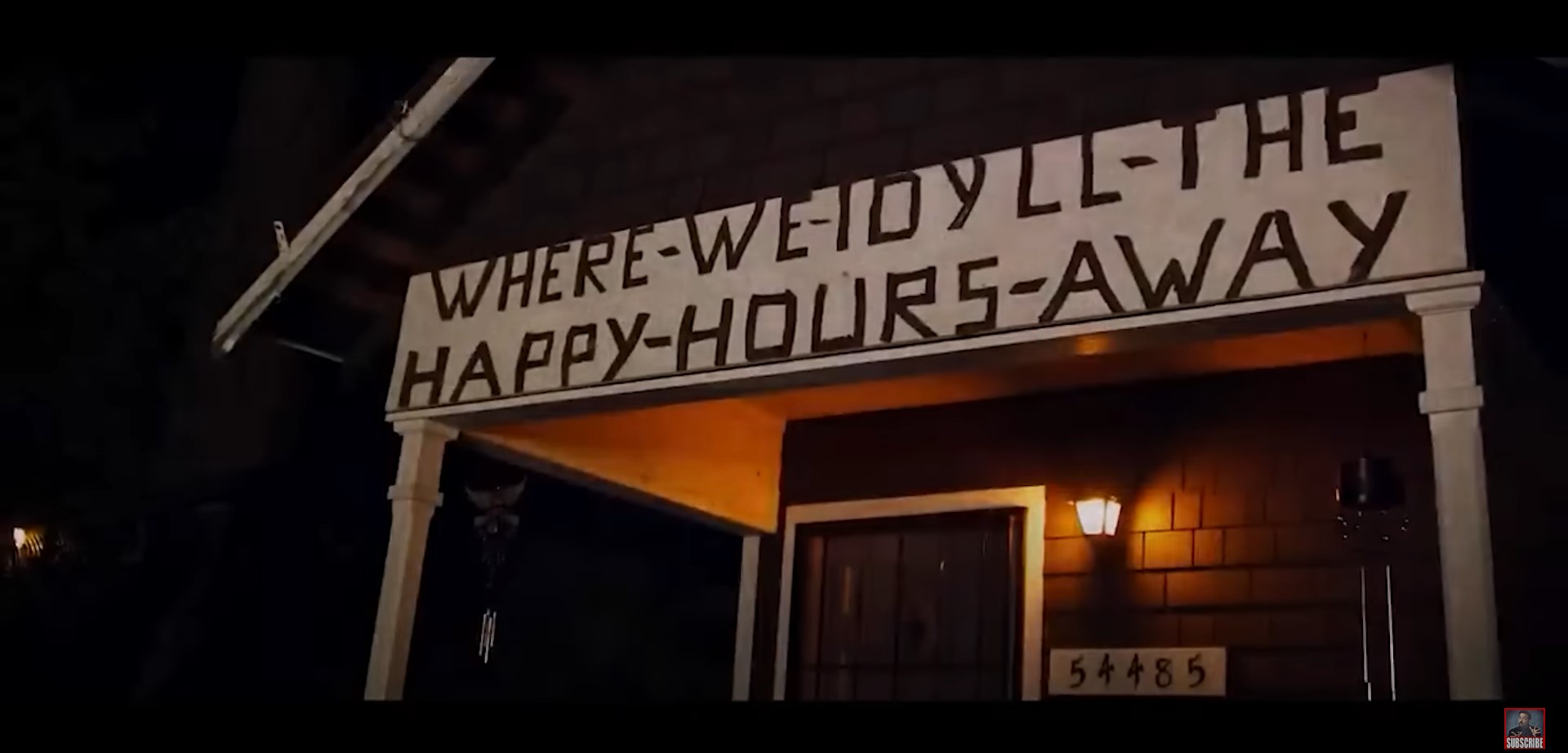
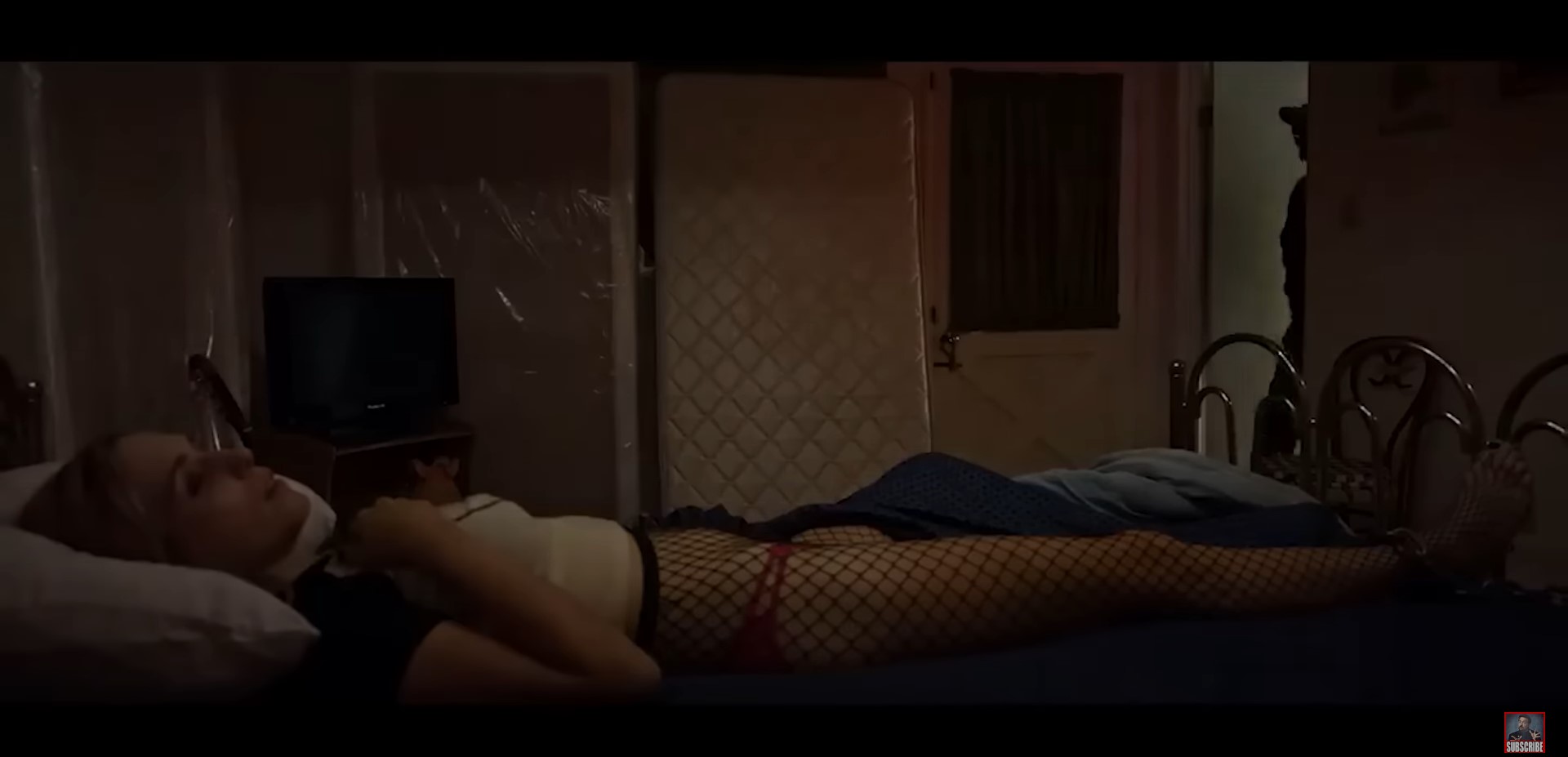
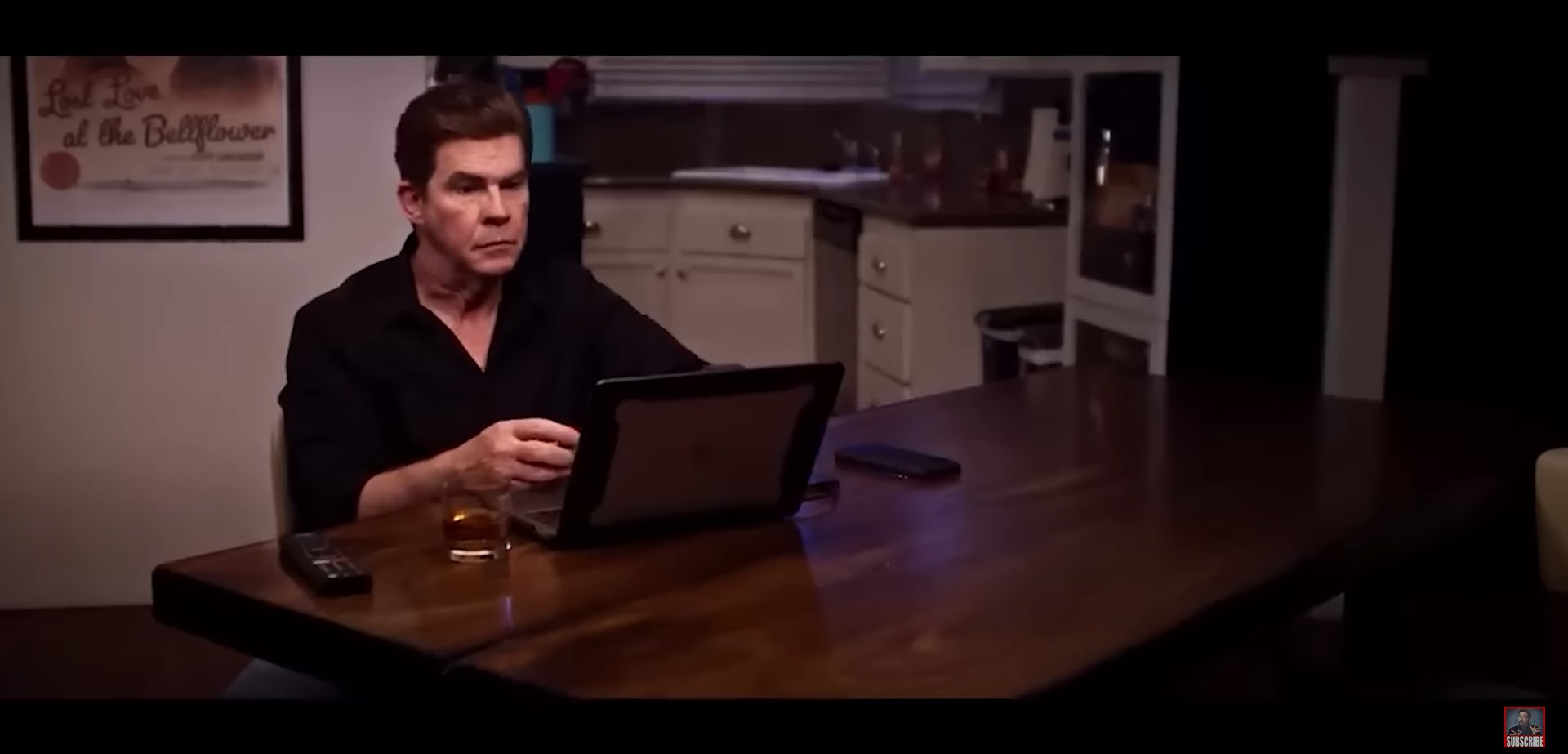
Australian punk rocker Kat Oden has fame in her home country and is steadily trending in the U.S. but when a masked man kidnaps while she lays unconsciously high in a drugged-out stupor, she wakes up being chained to a bed far away from where she was abducted.  Her mild-mannered kidnapper’s intentions revolve around getting Kat clean of narcotic impurities while the media circus explores wild theories, interviews her self-centered parents, reveals ugly secrets of her American rocker boyfriend, and follows the browbeaten investigation of an actor-turned-detective handling the Kat Oden case.  When the detective goes rogue, burned out by constant belittlement from his chief and being blamed for the inadequacies of his clownish subordinate officers, he makes a deal with an eager news reporter to give them the exclusive solving of the case for his own news show.  As he inches closer to finding Kat, the kidnapper and Kat dynamic undergoes significant strides to understand one another’s wayward reasons. 

The one major difference between major studio productions and the micro independent features shooting during peak COVID weeks, months, or years was the indies made use of the time whereas the bigger budgeted and the hundreds of cast and crew employed were virtually on furlough, hiatus, or just plain scrapped future movie ideas altogether.  Independent films had structural concept advantages, such as a smaller cast and crew to lessen the changes of infection, locations were typically limited so travel was not necessary, and indies sometimes would shoot guerilla style anyway to capture the scenes required for the story.  Writer-director Josh Roush, who lived and breathed producing Kevin Smith documentaries for the “Clerks” and “Dogma” director’s more contemporary credits, decided to pivot into the fictional route and just as soon as his dark comedy script for “Wrong Reasons” was about to start principal photography fruition, the world shut down in a pandemic lockdown.  However, a global emergency didn’t hinder Roush’s ambition and scaled down his crew and cast on set to get the job done. Executively produced by Landon Thorne, Kim Leadford, and Kevin Smith doing his version of Cameo appearances as well as David Shapiro contributing the other half of the funds, “Wrong Reasons” is a production of Rousch’s AntiCurrent Media, with Liv Roush and Matthew Rowbottom producing, and Shaprio’s Semkhor Studios.

In the role of Kat Oden, a real life Australian making her full-length feature film debut, is none other than director Josh Roush’s wife, Liv Roush.  Co-producing the numerous Kevin Smith making-of featurettes and other independent productions, including her husband’s music videos, Liv Roush has always been a face behind the camera and now she’s stepping Infront of the camera, mainstage as the center of a kidnapping ordeal being a promising up-and-coming punk rocker who has lost her way by sinking into drugs and an objectifying relationship with an egotistical American rocker.  While Roush can obviously handle her own being chained to bed in fishnet stockings and dip into a range of rage, fear, hurt, and acceptance, “Wrong Reasons” splits the story with another centric character in Detective Dobson.  Kevin Smith film regular Ralph Garman has a grip on the competent yet pent up case detective Charles Dobson but the detective goes through a series of case mishaps to scheming his own rogue operation that pulls away from the Kate Oden kidnaping ordeal perpetrated by James Winandi, an ambiguously misunderstood role by James Parks (“Red State,” “The Hateful Eight”), son of the legendary actor Michael Parks (“Nightmare Beach,” “From Dusk Till Dawn 3”).  The connection made between Winandi and Oden faces challenges in fully fleshing out what Winandi is trying to accomplish in by removing the lyrically strong and influential rocker toward a path of permanency for other listeners to experience the epiphany that befell Winandi.  It’s a motivation that couldn’t be grasped fully because we’re more invested in this parallel plot of Dobson’s working of an advantageous angle for himself that the message or the theme becomes lost in the superficiality for one’s own sake.  The cast rounds out with perfectly suitable supporting cast including Teresa Ruiz, Daniel Roebuck (“Final Destination,” “31”), David Koechner (“Cheap Thrills,” “Snakes on a Plane”), Matt Passmore (“Jigsaw,” “Come Back to Me”), John Enick (“Project Eve”), Harley Quinn Smith (“Once Upon A Time in Hollywood”), Kym Wilson (“Deadly Cheer”), true to form punk rocker Donita Sparks of L7, Darren Hayes of duo band Savage Garden, as well as a relatively quiet genre icon Vernon Wells (“Commando”) as Kat Oden’s dad and Kevin Smith as the a news cameraman in cargo shorts.

The divided narrative limps unbalanced between the two parallel storylines soon to collide in eventual finality.  We don’t really receive much wisdom, clarity, or even any kind of progressive dynamic between Oden and Winandi who quickly and quirkily come to a sensible understanding with Winandi’s masked kidnapping and Oden being chained to the bed. There’s also piped in televised news reporters covering the kidnapping case or verbally attacking the president or something enthusiastically bias and gospel from the news channels in what becomes a motif of media circus frenzy, corresponding also with the live news coverage that vultures around the Oden case. What Roush is attempting to convey through the unlikely kidnapper and kidnappee pairing doesn’t strum the right chords and flutters in place to where we’re not exactly sure how Kat Oden’s music affects her kidnapper given little-to-no backstory on him and not foreseeing a future outcome of his act in what is almost an akin to winging the situation.  Instead, we’re more engrossed into Detective Dobson’s downtrodden investigation.  A seemingly capable detective with good instincts, negotiating with suspects, and even has a new woman in his bed every night, the luck he has with his professional counterparts, subordinates, and report-to doesn’t necessarily reflect his personality.  When Dobson starts scheming to finally be the one top, the audiences’ attention shifts from the fluttering wrong reason to kidnap your idol to the wrong reason for turning into a self-serving public servant.

“Wrong Reasons” has all the right A/V and bonus content moves on MVDVisual’s Blu-ray release.  The AVC encoded, high-definition 1080p package is presented in a widescreen 2.85:1 aspect ratio.  Cinematography by Josh Roush and Matthew Rowbottom ensure the look Roush wants to obtain for his first feature length fiction, a clean less-is-more, truth-in-practicality visual that often echoes Kevin Smith’s earlier body of work on the indie scale.  The Blu-ray’s BD50 storage capacity handles compression well to thwart any artefact popups and the limited variety of color range, aka a more natural grading, doesn’t pressure the digitally shot film to crumble under the compression.  Details are sharp and textural in what is a solid visual presentation.  The English DTS-HD 5.1 surround sound is equally comparable with a dialogue first clarity.  There’s slight continuous feedback on the underlay, perhaps equipment interference picked up by the mic as it becomes a constant throughout.  Range is also limited to what is essentially a talk head picture with bits of action here and there with “Wrong Reasons” driven by the performances rather than by action.  “Wrong Reasons” is made for and presented by punk rockers with a film that’s very much dedicated to the music genre.  The soundtrack highlights a faction of the punk rock with bands such as Tim Armstrong, L7, The Wipers, Channel 3, The Unseen, Black Flag, and Bi-Product having tracks on the production.  Optional English subtitles are available.  Special features include an lengthy but informative Kevin Smith introduction in his very animated and enthusiastic Kevin Smith style, an audio commentary with director Josh Roush, producer Kevin Smith as well as another a second audio commentary with the director alongside co-producer Matthew Rowbottom, composer Cam Mosvaian, and wife/star Liv Roush, a Q&A session with the Roushes, Kevin Smith, Ralph Garman, and James Parks, deleted scenes and outtakes, Josh Roush’s short film “Idiot Cops,” and the original theatrical trailer.  The exclusive MVD release comes with a cardboard O-slip of a generically staged, or promo-esque, Liv Roush ankle-chained to a chair with a masked man standing next to her in non-menacing positions.  Inside is a reversible front cover of the same image, but I prefer the reverse side of the black and red illustrated silhouettes of the same character inside the clear Blu-ray snapper as it invokes more intrigue and suspense.  The disc art misleads with a horror composite of Kate Oden screaming, looking afraid, and the kidnappers mask hard lit to look more dramatic.  There are no insert materials.  The not rated film has a runtime of 97 minutes and has region free playback.  Josh Roush’s debut dark comedy has transference troubles, perhaps I’m not too punk enough to fully absorb how the music should move me, but we see acting veterans and greenhorns mix it up fitly for this COVID era picture.  

“Wrong Reasons” is this Year’s Punk Rock Film!