EVIL Does a Little Bathhouse Wet Work in “Melancholic” reviewed! (Third Window Films / Blu-ray Screener)

On nights when a humble Japanese bathhouse is supposed to be closed for business, the lights remain illuminated, gleaming off the crimson covered ceramic tiles of Mr. Azuma’s bathhouse floors as body’s soak in a pool of blood.  The proprietor, Mr. Azuma, is in severe financial debt to Yakuza boss Tanaka who turns his meager business into a nightly slaughter house to dispose of Yakuza opposition or those just on the syndicate’s bad side.  When Tokyo University graduate, Kazuhiko, applies for a job as an attendant to see a girl who regular attends the bathhouse, the reserved model employee becomes enthralled with the disposing and cleaning up of the corpses, working alongside a couple of professional hitmen, Matsumoto and Kodero, but when the job he’s so passionate about requires him to be more hands on with the assassination assignments and the endless pressure from the Yakuza bares down on his colleagues and friends, Kazuhiko’s radical plan to eradicate the woes of his newfangled position just might mean his very life. 

Seiji Tanaka’s self-esteem building and identity attaining crime drama, “Melancholic,” might not reside as absolute horror, but any film involving the Japanese Yakuza is an unpredictable, Machiavellian expo worthy of every second.  Originally titled in Japan as “Merankorikku” or “メランコリック,” writer-director Tanaka retains a bloody disposition of the historically violently depicted Yakuza-storied narrative, but is asymmetrical with a converging love affair, complementary conflicting the dark and light with clarity of the centric character’s unintended double life into the criminal enterprise of cleaning a bloody bathhouse.  Based off Seiji Tanaka’s short film of the same title, “Melancholic” mops up as an immersive black dramedy from Seiji Tanaka as the filmmaker’s first credited feature film produced by One Goose production in association with Uplink and JGMP.

The story concentrates most of the effort around Kazuhiko, a graduate of the prestigious Tokyo University who doesn’t have a good job and lives with his pampering parents, fitted by Yoji Minagawa as a social misfit living on the outskirts of the Japanese mantra of diligence and integrity.  Minagawa bores out Kazuhiko’s diffidence, chocking up his damp disposition to the indecisions toward his future, that forces other characters to influence his choices, such a former high school classmate in Yuri with an effervescent performance by “Tag’s” (“Riaru onigokko”) Mebuki Yoshida.  Yuri’s infectious affection for Kazuhiko and her regular attendance at the bathhouse encourages Kazuhiko to apply and become hired for a cleaning attendant position alongside a blonde, and undereducated in comparison, counterpart in Matsumoto (Yoshitomo Isozaki), but to Kazuhiko’s surprise, his overqualified ego is shattered when he discovers that the bathhouse is a Yakuza place of execution and those all around him are more experienced in that trade, detonating a plume of black comedy, work place haughtiness that Kazuhiko has to balance with his personal relationship growing with Yuri.  Most of the exchanges are straight forward and culturally inflection heavy, especially when dire moments rear their heads, but some more compassionate and delicate scenes rouse through the overt inflections with Minagawa and Yoshida at the helm of their blossoming onscreen romance, adding to the stark contrast to the opposing narrative. Stefanie Arianne, Makoto Hada, Yasuyuki Hamaya, Takanori Kamachi, Hiroko Shinkai, Masanobu Yada, Keiji Yamashita, and Yuti Okubo fill out “Melancholic’s” cast.

“Melancholic” is a rather odd title integrated into the briefly pensive struggles of Kazuhiko to an intrinsic network of assassination gunplay and backstabbing knavery, offering little profound sadness and despair and more shrewd hostility when those in charge ask for an inch but take a mile out of the personnel pool. For a Yakuza film, Tanaka’s bath and butcher story has barely a budget to entertain technical action sequences in tight spaces, but the action is kept taut and intense and despite the lack of a Yakuza presence, with only one single boss representing an entire faction, the transposing of Kazuhiko’s personal and professional stations washes away much of budgetary concerns down the drainpipe as an irresistible curiosity to see how our hero softly stumbles through a sudden confluence of the two repelling paths will play out. Most audiences will overlook the comedy for a countless reasons as “Melancholic” up plays into the satirical rigors of the Japanese sullen humor. The fact that that the subject matter is also about mercilessly murder people in a bathhouse will undoubtedly pigeonhole the film with pre-labeled genre. Tanaka slips in gallons of subdued irony ripe for the complex circumstances hazardous to all bathhouse employees and their pryingly oppressive management.

The award winning Japanese film (aggregated wins from multiple Eastern Asian film festivals) “Melancholic” arrives onto a dual format DVD/Blu-ray from UK distributor Third Window Films, a loyal provider of extreme Asian cult and horror. Since the Blu-ray was a screener, the A/V aspects won’t be reviewed in it’s entirety and the specifications weren’t provided with the screener. Ryô Takahashi’s cinematic vision brings out the beauty in simplification without being ostentatious with camera angles or relying heavily on tint boxes; yet, the blend of steady cam and handheld tilts to the one side with the jitteriness of the handheld seizing the stage. Bonus features were included on the screener, including a behind-the-scenes of a documentary-style shot look at moments before, during, and after takes, a Q and A panel with the cast and crew, and the “Melancholic” short film. Seiji Tanaka’s breakthrough bloodbath, “Melancholic,” sounds more despondent than the dismal thought of a cold shower on a freezing day, but the heated ferocity rite into adulthood keeps this Japanese dramedy warm with tension and cozy with vortex humor.v

Purchase “Melancholic” on Blu-ray / DVD!

They Say There Are No Bad Children, But This is One “EVIL Boy” reviewed! (Well Go USA Entertainment / DVD)


Igor and Polina suffer through every parents’ worst nightmare; their son, Vanya, has gone missing. Three years later, Igor arranges an orphanage visit on the outskirts of Moscow to make Polina happy again by possibly adopting a young child, but their visit is cut short when Polina discovers the gruesome dead body of a basement keeper and a savage child barred away in a dungeon-like room. Polina is instantly imprinted by the child and convinces Igor to adopt him despite the difficult malnourishment and animal like behavior, but over the course of time, the child exhibits signs of behaving like their missing son and even starting to look like Vanya, their missing son’s name Polina has now bestowed upon the child against Igor’s wishes. As the feral child shows more signs of acclimating to his new life, Igor and Polina sense something more sinister from the child whose resembling more and more like Vanya every day and begin investigating into their adopted son’s origins, a well-kept dark secret guarded by the convent orphanage.

From examining horror films from our Northern neighbors in Canada to crossing the oceans and landing in Eastern Europe of the birthplace of Vodka, Russia, we’ll be taking a look at two recently released and storied dissimilar upcoming horror movies from Russia Federation, beginning with the belief that no country is exempt from the creepy kid genre in this Russian 2019 allegory entitled “Evil Boy” as the debut film from writer-director Olga Gorodetskaya. Also known as “Stray” world-wide or “Tvar” in the original dialect, “Evil Boy” is straight-forward, focus group approved, vanilla title of a story from one of Russia’s celebrated modern novelist and screenwriter, Anna Starobinets. Also dubbed as Russia’s “Queen of Horror,” Starobinets is a prolific adolescent thriller writer whose credits includes the compilation of short, chilling stories entitled “The Awkward Age” with the featured tale of a young boy’s life diary expressed through the voice of an ant colony living inside his body and the queen his brain as a conduit for her commands. “Evil Boy” is a production from a conglomeration of companies including Yandex Studio, Cinema Foundation of Russia, Dublab, and Reason 8 Films.

The titular character of Stray or Vanya allows no audience insight and we’re impelled into the perception of the grieved parents, Polina Belova (Elena Lyadova) and more so with the father, Igor Belov (Vladimir Vdovichenkov). While director Olga Gorodetskaya is new to the scene, the chemistry of Lyadova and Vdovichenkov have well been established from a baseline foundation set from their prominent collaborative roles in Andrey Zvyagintsev’s powerful small town corruption film, “Leviathan.” Their dynamic transcends a range of individual performances from crime into the horror realm with parents going through the stripping loss of a child that has compromised their marriage to the point of desperation to the eventual short term passion that has rekindled with the adoption of the Stray, a primal role befitting young Sevastian Bugsev in his introductory feature film. Giving Bugsev credit would be such an underwhelming praise as the eight year old not only nailed the savage child performance, but also endured an aggregation of makeup that gradually transforms his character over time. What’s interesting between the three actors is that they form this family love-triangle of sorts, where Polina embraces the child, but then is frightened of it and in a role reversal, Igor is skeptical of the child, but then tries to love him unconditionally. Just in that square footage, the amount of flux emotions and mindsets can favor one side over the other; yet, the actors pull it off, almost too well, creating a an unrest of feelings, conversations, and approaches to their characters. Key supporting roles include performances another fellow “Leviathan” thespian, Evgenly Tsyganov, as well as Roza Khayrullina, Konstantin Topolaga, Anna Ukolova, and Evgenly Antropov.

“Evil Boy” has some psychology behind it. Hell, even a few of the film’s posters are composited of Rorschach tests and what “Evil Boy” ultimately boils down to is how we interpret our grief of a loved one. Polina and Igor are written to exhibit multiple signs of the clinically coined Complicated Grief that follow the patterns of avoiding the reality of death, persisting nothing has changed, and a bleak numbness to the event. The motif of trying to replace something dear with something else, as a comforting mechanism, is consistently brought to attention and goes as far as leaving a forlorn image of the same motif as a finale twist to drop an atomic loop of melancholic isotopes on you. The psyche portion of the “Evil Boy” is as equally important as the evil boy himself as it’s only a representation of our characters’ will and grief, but whether it’s Starobinets story or Gorodetskaya’s script or both, “Evil Boy” has a yawning plot hole regarding the boy’s origins that’s briefly represented with a dialogue-less scene of cataclysmic and ritualistic images jumbled together for your mind to piece. This sort of passive logic translates equally to the unpalatable editing that plunges the story into a fit of turnaround key moments unable to linger and build upon and stress character developments and form audience relations. Much of the psychology the “Evil Boy” tries to impress is squandered by Gorodetskaya fleeting approach structure that can’t even be tied together by the genuine abstract creature itself when it’s grossly mutilated CGI blunder finally makes a grand entrance.

In the height of the “Sputnik” invasion that’s currently sweeping the Russian horror charts world-wide, explore into the inner space of an anguished mindset melded with conjured up changeling European folklore and you get “Evil Boy” on DVD courtesy of Well Go USA Entertainment come September 8th. The DVD is presented in a widescreen, 16:9 aspect ratio, that renders Ilya Ovsenev’s eerie and shadowy atmospherics, distinct in their own rite, between the sterile urban Moscow and the wooded outlier town where the parenting couple has a home in each to be alien to not only the child but also to the inhabiting parents. Ovsenev’s framing is poignant and harrowing, adding dread much needed to stir into the creature child. The image quality is relatively sharp, but there are moments of obvious color banding, such as around headlights, that suggests a lower bit compression that comes and goes with the nature of the scene. The Russian language Dolby Digital 5.1 surround sound rollicks in an immense range of sounds from the primal animal snarls of the young boy to car wreckage to the soft cries of a whimpering mother despite seemingly having a even-keeled tone storyline that should simmer with tension rather than overflow with nonstop action. The dialogue is clear and forefront available and the soundtrack lulls as a sleepy version of standard genre fare. English subtitles and dub track are available with the former show no sign of asynchronous harmony and no sign of errors in spelling or in timing. The only bonus feature available in the static menu is the trailer amongst trailers for other Well Go USA Entertainment releases. Perhaps, what could be construed as the Russian equivalent to Stephen King’s “Pet Sematary,” “Evil Boy” buries to reanimate suppressed grief through inclinations of folklore and psychosomatic ringers embodied by one creepy as hell kid.

Pre-order “Evil Boy” on DVD!

A Lake Swimming With EVIL Off of “Mermaid Isle” reviewed! (WWMM and MVDVisual / DVD)


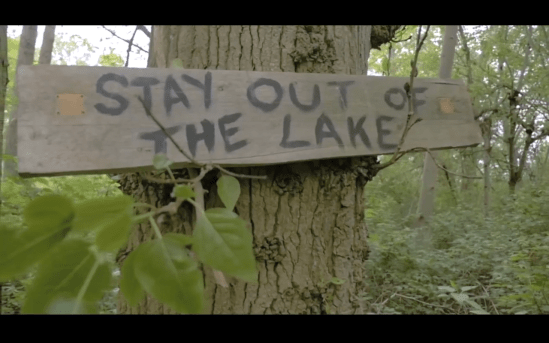
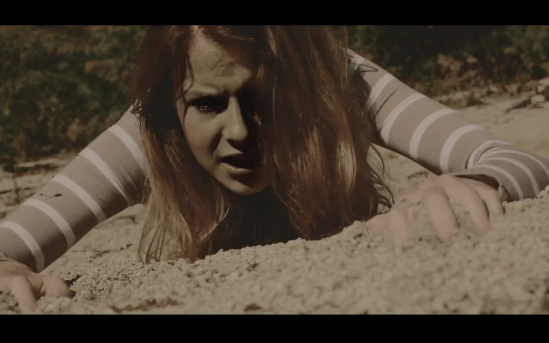
On a nearby island with an infamous past, four friends come to dock on the island from a pleasure craft cruise to explore the adjacent and serene lake surrounded by woods. What was supposed to be a fun, relaxing, and romantic getaway turns frantic when one of them accidently falls into the lake and is bitten by a mysterious unseen creature in knee high water. With a storm brewing and the bite affects worsening, the group takes shelter inside a seemingly abandoned lakeside cabin receiving an unwelcome and surprise greeting from an old woman who immediately wants to kill the injured party, but is bitten during the small skirmish and kills herself in total fear. Bewildered, the group remains in refuge from the storm, sleeping through the worst winds and rain only to wake up to find the injured and one other friend missing. Their search brings them back to the lake where they discover once bitten, there’s no saving you as the lake is a breeding ground for vicious, blood hungry mermaids, spreading their transformative contagion with a single bite. As the survivors contemplate next steps, the old woman’s delinquent adult son returns home to find mother dead and sets out to kill her murder.

Popping my mermaid horror cherry with the Jason Mills’ ravenous take on the mythical half-human, half-aquatic creature feature, “Mermaid Isle,” released in 2020. The writer-director debuted his first genre feature back in 2009 with an attic dwelling creature terrorizing an unsuspecting and already fragile and distraught family in “Above Us Lives Evil,” also more commonly known as “They Came from the Attic,” but it wasn’t until 2015 when “Above Us Evil Lives” came across our critical lap and was reviewed rather favorably for the filmmaker’s first credited venture with the following excerpt observing Mills as a “promising” director with “attributes that can contribute to the horror community” through the “strategical” use of knitting visual FX work with practical prosthetics to supply an effective heinous attic monster on a penny pinching purse string. Over a decade later, Mills continued his successful ability to turn around project after project of independent b-horror that includes the markings of spiraling madness with “The Changing of Ben Moore,” a joint home and alien invasion thriller with “Alone We Are Not,” and even tackling the mysterious and carnage-laden mythical sasquatch in “Bigfoot Country.” The director’s latest sea-faring fiends maintain the basic principle features of a fabled mermaid: an alluring, half-naked maiden on the top half with a marine flipper-tail at the bottom. Yet, “Mermaid Isle” explores the darker side of the mermaid mythology with a schlocky, self-funding of the plagued island concept with his own production company, Millspictures Studios.

“Mermaid Isle” is very character dependent to push the story along and toward the secluded residing lake since the story concept doesn’t involve any victims to be wound up stranded, buoying in the water, and surrounded by deadly and infectious mermaids creating a filthy amount of dire circumstances of harrowing survival. Instead, we doggie paddle along with bland, monotonous, and uninteresting characters played by bland, monotonous, and uninteresting actors riding the only wave of substance of the lead character (Mark Reinhardt) being rejected upon his proposal to his short term girlfriend (Kristina Soroff). The other two in the group, an assertive goth (“Bigfoot Country’s” Kiana Passmore) and tagalong friend (Samuel Buchanon), offer little to warrant their survival as they’re targeted for either mermaid chum or to be marked for warped evolution. The young cast never click together as on screen friends or form a frantic group with a correlating enemy, but rather seem underwhelmed by the lake inhabited by evil mermaids being the source of their dilemma. There was much more interested in the double sided danger foreboding around the old woman (Elinor Walker) and her bad new son (Dan Martinez), whose mysterious ruffian background surfaces to the top as he’s eager to turn his newfangled life of a straighten arrow path is squashed back into the miscreant he was once was by hunting down those responsible for his mother’s death, but that also fizzles into oblivion. Hope for the character emerges when he declares, “time to do some bitch fishing,” as an oath to, once again, contain the mermaid contagion from spreading by some noble crusade of, oh, I don’t know, spear fishing the hell out of the creatures or taking a dive into the depths of the unknown and do a little hand-to-flipper combat. Sadly, “Mermaid Isle” continues to miss chances rewarding viewers with potential much needed plights. The film rounds out with Liam Tait, Austin Richards, and Garnet Campbell in some unresolved, barely associating epilogue set four months later.

“Mermaid Isle” struggles to come up for air as an exalting mermaid horror, especially being released in 2020 amongst a sea of competing indie interests. Yet, Mill’s story spans over three and half decades beginning with a backstory, told through the words of newspaper clippings from 1983, honing in around a prefacing story of a father and son being murdered by a mermaid bitten daughter and transforms to ravage portion of the family. While the news clipping claim hoax, the mother, the old woman, who we visit in the story later at the cabin, is shuttled off by authorities to a psychiatric ward because of her rant and ravings about killer mermaids. While the slightly crafty, yet also chintzy soaked way to setup the film is engrossing enough to keep us interested at the start, the small budget stiffens any kind of any remotely rudimentary devices to then mingle man versus unnatural nature in a project too big for the budget’s britches. Further reaffirmations assume the assigning of multiple hats amongst the crew and cast, including Kiana Passmore is also the first assistant director, Garnet Campbell is the line producer, and the Mills and the Passmore families extending their services as credited Crafty and Location scouts. The story logical capsizes the moment the movie is popped into the player. For instance, the movie is entitled “Mermaid Isle,” but the Island is adjacent to a river and on the other side of that river is a lake so the premise really has nothing to do with the island, but rather a lake. The DVD back cover mentions the four friends attempting to conjure (spelled conjueron the back cover); yet, there’s none of that conjuring jazz and nothing to affix the detached epilogue to the rest of the film, as previous stated. Lastly, the DVD front cover has more gore, more skin, and even a shark in the water. Low and behold, none of those enamors exists. I will say this about “Mermaid Isle,” the mermaid itself looks convincing, obscured enough around the seams and the physical fish tale to pull off an effective mermaid creature with pitch black eyes and a face flush with hunger.

If feeling adventurous, jump into the deadly waters of Jason Mills’ “Mermaid Isle” on DVD courtesy of World Wide Multimedia Entertainment, an affiliate of Alchemy Works, and MVDVisual. The not rated, 80 minute feature, is presented in a widescreen presentation, 1.66:1 aspect ratio, and the overall video image quality is not too terrible, but lacks breadth of color, compressing the details of the woods, the rocky lake shore, the old cabin, and the snow-covered trees more favorably than would have expected. Some aliasing during more actiony sequences in the water with the mermaid swimming. The English language 5.1 surround sound mix is a complete lackluster in regards to dialogue. The muffled vocals are nearly indiscernible levels for more than half the dialogue track and heavily overshadowed by ambient mix and, a bright spot on the release, the Thomas Beckman viola that almost feels too Renaissance to be paired with “Mermaid Isle.” Aside from a static menu with chapters, there were no special features included. Having no point of refence having never seen “The Lure,” “She Creature,” or even “The Mermaid: Lake of the Dead,” “Mermaid Isle” sinks the aquatic humanoid subgenre deep into Davy Jones locker for greenhorn viewers, but bares intrigue at times with the idea of a menacingly unfathomable creature stirring in the blue waters, sloshing up enough to give you the creeps and not bother with the movie itself.

[https://www.youtube.com/watch?v=wWcq9bQGb6I]

“Mermaid Isle” available on DVD. Click the poster.

EVIL Metal vs EVILER Zealot! “We Summon the Darkness” reviewed! (Lionsgate / Digital Screener)


Set in the Midwest of the late 1980’s when a satanic cult has killed upwards of 18 people, slain in groups of threes, across the United States, three good girlfriends set forth on a road trip to a heavy metal concert. The girls bump into and befriend three aspiring musicians and fellow metal heads at the venue, inviting them to beers and some company while rocking out to killer show. The after show party moves to one of the girl’s father’s pastoral home for some late night boozing around the firepit, reminiscing about their favorite bands, and whatever else the dark night has in store for them, but the night of hedonism turns quickly into a night of terror when that satanic cult comes calling for three more souls. Some of the group isn’t truthful about their intentions and dead bodies pile up as the ritual killings aim to continue to spread.

Harking back to that killer trope oddity, a setup very keen in the 1980s, of a mysterious killer hiding behind a friendly façade, “We Summon the Darkness” is a modern day remembrance of such a subgenre in the slasher-survival field set along the drab bible belt of Indiana landscape, though, in actually, filmed in Winnipeg, Canada. At the helm is “My Friend DahmerMy Friend DahmerMy Friend Dahmer” director Marc Meyers from a script by Alan Trezza, who is the creative mind behind the short and feature film versions of another Alexandra Daddario comedy horror, “Burying the ExBurying the ExBurying the Ex,” that co-starred the late Anton Yelchin. May he rest in peace. Meyers moves his hand from the somber and inquisitive mutilations to murder of the Jeffrey Dahmer biopic origins story to the fanatical whims of pious psychopaths, daggering the crux of the issue into the misperceptions of stigmatic cultures and beliefs while at the same time being an extension of the dark comedy tone that worked charmingly with the tale of zombified ex-girlfriend hellbent on revenge. “We Summon the Darkness” is a product from a conglomerate of production companies, highlighting The Fyzz Facility,= (“47 Meters Down: Uncaged47 Meters Down: Uncaged47 Meters Down: Uncaged”), Grey Hawk Productions, Nightshade Entertainment, MEP Capital, and Common Enemy as well as Daddario, herself, pitching in into the producer pool that isn’t her first rodeo in that role.

If you haven’t guessed already, Alexandra Daddario (“Burying the Ex,” “True Detective”) stars as Alexis Butler, one of the three metalhead girlfriends cruising to the show, and sequestering herself the ringleader of the road tripping trio as a level headed, parental type with an edge to keep her ostentatious blond friend, Val, played to the fine tune of being uninhibited crazy well by Maddie Hasson, and the timidly sharp Beverly, a role docile to the point of uncertainty and shepherd well by “Hell Fest’s” Amy Forsyth. The three very attractive concert goers bump into another trio of friends, more haplessly hazardous, if not hopeless, band mates who try their hardest to be as metal as they can be, even if that meals throwing a chocolate milkshake out of the window of their speeding van onto the gals’ Jeep. Austin Swift, Logan Miller (“Scouts Guide to the Zombie Apocalypse”), and Keenan Johnson (“Alita: Battle Angel”) make up the group caught red handed in a stroke of coincidence that the girls find them at the very same concert. As much as the two groups mirror each other in personalities, matching up almost perfectly in the varying degrees of state, one group holds a darker secret that could cost the other their very lives. That level-headedness Daddario portrays onto Alexis’ mindset becomes ravaged with wild fires in her eyes and her laid back amount of patience becomes threadbare frazzled when the bodies start to drop in a satanic twist of murder and mayhem, frenzied with extreme ideology founded on multiple levels of greed. Daddario wears crazed well in a very different side to her usually starry eyed and elegant approaches, making all the others seem abhorrently normal in comparison. “We Summon the Darkness” rounds out with Allison McAtee, Tanner Beard, Harry Nelken, and that “Jackass” Johnny Knoxville as Pastor John Henry Butler.

Despite Daddario’s rising stardom and luminous performance, “We Summon the Darkness” falls hard into a mosh pit of despair. The concept is sound and promising, but the execution couldn’t rise to the occasion with limited secretion of the murderous evil that has spread like a pandemic across the nation that’s has sorely downgraded and diluting the nature of the news and media’s role in beyond hammering in the deaths. When story turns dark, the effect feels whiffed and not as jarring as hoped as little is then diagramed to help assist the viewer grasp just what these satanic cultist wish to accomplish. Also, Trezza’s script is highly predictable as the twist is unfolded fairly early on even before the catalyst transition to a darker tone, spoiling the unveil with too many gnomic sidebar conversations and a slew of obvious character tells that don’t exactly shield the truth of their true wolf in spiked studded, black jacketed, metal band patched sheep’s attire. Also, the film pulled too many punches, teetering on the balancing beam whether it’s an edgy killer comedy or a killer comedy with that’s soft around the belly area. Plus, I’m still trying to figure out why a walk-in pantry has a lock on the inside…?

Metal posers rule while the victims haplessly mewl in this Marc Meyers’ film, “We Summon the Darkness,” hitting retain and digital shelves this week on DVD, Blu-ray, and Digital courtesy of Lionsgate and Saban Films. Since the screener provided was a digital streamer, the video and audio aspects will not be covered; however, the Blu-ray specs will feature a 1080p High Definition, 16X9 (2.39:1) widescreen presentation with an English 5.1 Dolby True HD mix while the DVD is presented in the same aspect ratio and will sport an English 5.1 Dolby Digital Audio. Both releases with have optional English, Spanish, and English SDH subtitles. Special features will include a featurette entitled “Envisioning Darkness” and an audio commentary with director Marc Meyers and writer Alan Trezza. “We Summon the Darkness’s” cheekiness is fresh for an 80’s maniac homage armored with solid performances by Alexandra Daddario and an uncharacteristically stoic Johnny Knoxville as a devout pastor against metal music, but seizes up, derails off the tracks, and fizzles to a reduced version of the greater version it could have been.

“We Summon the Darkness” out now on Blu-ray / DVD/ Digital! Click the cover!

When The Earth Goes Silent, EVIL Begins to Conquer. “The Blackout: Invasion Earth” reviewed! (Shout Factory! / Digital Screener)


In a distant future, the entire Earth goes dark without warning. Communications are completely severed with no sign of life exists except for those scared and confused inside what is to be called The Circle of Life that has encompassed Moscow and other parts of neighboring countries. Reconnaissance teams venture out into the quarantine zones, discovering dead bodies as well as noticing people have gone missing. A month later, an outpost goes under siege by an army of bloodthirsty bears. These bizarre events go unexplained, leaving military jarred, and to find answers, seven teams are dispatched to various areas surrounding the outpost to locate signs of life. While the teams are scouting, an powerful alien reaches out to the outpost, warning them that Earth is in the middle of a four wave attack by his race looking for a new home. Before their 200,000 year trip ends with destination Earth, the last wave, 160 million mind-enslaved missing humans, will attack the Circle of Life at the command of the alien informant’s counterpart and it’s up to the ravaged scout team to band together to extinguish the extermination of mankind.

Nothing is more frightening than wiping out 95% of the world’s human population in the blink of an eye without so much of a sign of explanation. Welcome to “The Blackout: Invasion Earth,” which depicts just that very unfathomable scary episode of terra-loneliness and free-for-all, fear induced panic amongst the civilian population, tapping into the same vain of “The Day the Earth Stood Still” or “Arrival.” The big budget, Russian sci-fi action-horror, originally titled “Avanpost” or just “The Blackout,” is penned by television scriber Ilya Kulikov and directed by Egor Baranov. Released this past November in Russia, “The Blackout: Invasion Earth” touchdowns inside the North American market from genre distributor Shout! Studios come June 2nd, becoming a planet-sized contender for the biggest science fiction film of the year with relentless suspense, alien-on-alien hand-to-hand combat, and an encroaching bear blitz that can’t go unseen! The Moscow based TV-3 and Premier Studios serves as the production companies with studio heads, Valeriy Fedorovich and Evgeniy Nikishov, producing an estimated $4.3 million dollar film.

Unless you’re a no-life film buff whose up to speed with all the latest Russian thespians, many of us in the States will not recognize these Slavic actors; actors such as Aleksey Chadov, Pyotr Fyodorov, Artyom Tkachenko, or Svetlana Ivanova with no standing in the usual cache of domestic and international circle of ascertain identity that any joe can just look at a cast list and go, “aha!,” and put your index finger right on their name in recognition. However, if you look closer, you’ll unearth titles you might have heard of, such as “The Darkest Hour” (Pyotr Fyodorov) and Night Watch (Aleksey Chadov). Fyodorov and Chadov play Yura and Oleg, military comrades by circumstance who are pitted against an inexplicable and unknown occurrence. Though fighting the same war, the two friends contrast different backgrounds. Yura comes from a long lineage of military blood, but becomes somber in his soldier role as he suffers an immense loss at the moment of blackout and when he discovers love for a field medic, Olya (Svetlana Ivanova), his will to fight survives by a thread. Juxtaposed against Yura is the cab driver turned enlisted man Oleg whose only living relative, his dementia-malady mother, had survived the blackout and the event has given this man in a rut purpose and a fire lit inside him. Artyom Tkachenko plays the stoic alien savior with a nearly human form, all except the three slit vertical mouth, makes him deceptively trustworthy and Tkachenko eats into that cautionary persona of whether this being is actually assisting in saving the human race or angling his prey to work against an adversarial counterpart, Ra (lya Volkov) to gain dominance totality. Performances all around exact a fair amount of rigidness to them, but I blame the forced English dub that can seemingly thwart natural deliveries. The physical and range of action is choreographed with assiduity from the actors, making me believe root cause of the rigidness is certainly the dubbing. “The Blackout: Invasion Earth” closes out the cast list with Konstantin Lavronenko, Andrey Mezhulis, Artyom Markaryan, and Lukerya Ilyashenko.

“The Blackout: Invasion Earth” is a special effects juggernaut; some of the best, awe-inspiring visual effects I’ve ever witness has come from Russia, with love, that’s a projectile explosion of a thriller and, in true Russian fashion, a slew military grade heavy duty vehicles are heavily showcased through as if they’re on parade as modified tanks, BTR-70’s, and triple rotor attack helicopters for answers and rescue recovery. Being that the film is set in the future Moscow, Baranov didn’t oversell the evolution of technology and, in fact, made a stark contrast that hindered humanity still in the throes of a primitivism culture when up against otherworldly powers. Yet, there were still boots on the ground soldiers tossed into the meat-grinder that is the quarantine zone. Sure, there were some sentinel machine guns that shredded the enemy at the first sign of sensor, but despite all the flying gizmos, armed to the teeth choppers, and nifty gear, mankind had not strayed far into development. The stagnancy of man’s evolution became the highlighted theme as their deconstructed to being simply a virus that loves, hates, mates, etc. and without all that man has technically progressed throughout the years, man, itself, stays the same. The 160 million people caught in the blackout, turned into mindless slaves, and even before the war against an unknown force, rebellious and fearful groups pit brother against brother. The message suffers slightly from the cut-and-dry rigidness as aforementioned, but more so with the main characters with try to digest the alien’s, perhaps, too complicated plan of usurpation that has been 200,000 years in the works. While the story might be clunky and kind of claggy in the middle, the intensity clings to you from the moment of the alarming sound, troop mobilizing opening credits to to those BRT-70 trucks mowing down a horde of slaved individuals and never ceases with jaw-dropping, effects-driven cinematography to let you re-catch your breath for 128 minutes.

Witness mankind’s last stand against it’s first form in “The Black: Invasion Earth” being distributed on June 2nd by Shout! Studios onto DVD, Blu-ray, On-Demand, and digital streaming from these streaming services: AppleTV, Amazon, VUDU, GooglePlay, PlayStation®, XBOX, hoopla, Fandango Now, DirecTV, Comcast Xfinity, Spectrum, Cox, Charter, and AT&T U-verse. Since a digital screener was reviewed, the video and audio technical aspects will not be reviewed, but for the record, while the English dubbing is less desired and still hinders the story slightly, the dubbing isn’t all that terrible with crafty timing to stay in sync and maintaining some natural exposition deliveries. There were no bonus materials accompanying the release and there were no extra scenes during or after the credits. No bonus features were listed on the press release either. “The Blackout: Invasion Earth” bedevils with a population consuming reset laced with existential philosophies and the ups and downs of human nature set up behind the curtain of an impressive visual menagerie of brilliantly detailed special effects on the most grandest of scales.

Available on Blu-ray!

And Prime Video!!!