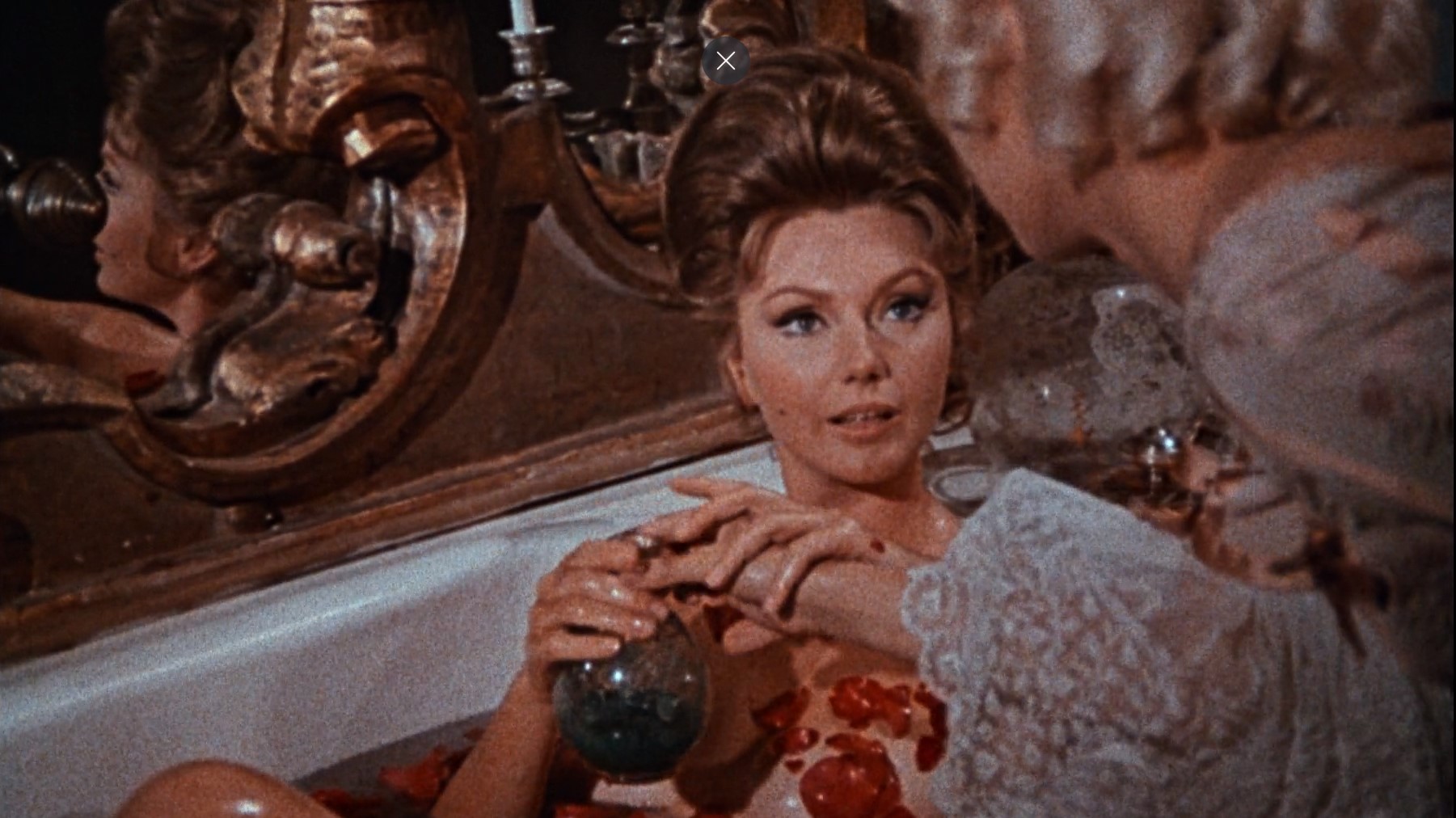
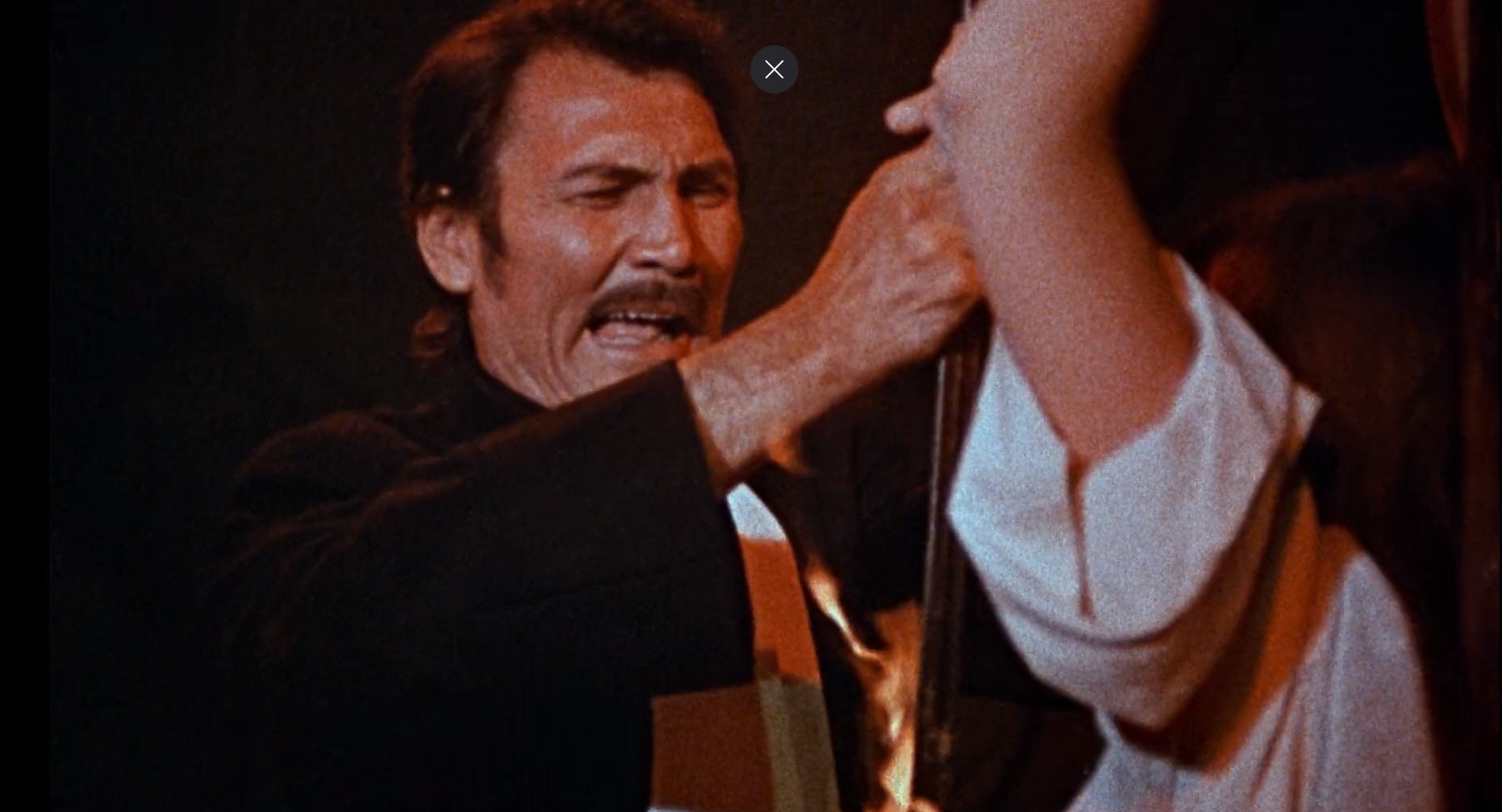
A Boy’s Imagination Can Conjure Up EVIL Death and Sex. “Viva La Muerte” reviewed! (Radiance Films / Limited Edition Blu-ray)

“Viva la Muerte” Limited Edition Won’t Be Around Long. Grab Your Copy Here!

At the peak low of the Spanish Civil War, naïve adolescent boy Fando doesn’t understand what is happening between the Catholic-blessed fascist takeover of his country nor exactly why his father was arrested and what has since happened to him.  He stumbles upon letters written by his mother suggesting that she had something to do with his sudden arrest because of his parents’ rival principles paralleling their nation’s bloody conflict of dividing beliefs.  Fando asks his remaining family questions, especially pelting his mother with detailed inquiries, about his father, death, and the fascist opposition, and while he’s lives under the draconian rule of a fascism reality and his family who abides it closely, the inquisitive boy intersperses his new, complex reality with his own way of comprehending, filling in the blanks with his vivid imagination of childish macabre, oedipal maturing, and an uninhibited interpretation of the evolving revolution surrounding him.   

“Viva la Muerte,” aka “Long Live Death,” is the 1971 surrealistic war horror from then debut filmmaker Fernando Arrabal.  Arrabal, who went on to modest yet esteemed career with such arthouse films such as “I Will Walk Like a Crazy Horse,” “Car Cemetery” and another Spanish Civil War set drama “L’arbre de Guernia,” also wrote the film that cemented his contributions to the surrealistic performance art movement known as the Panic Movement.  Though Arrabal was born in Spain and tells the story of the Spanish Civil War, the filmmaker had lived in France where the movement’s genesis began solely as street shock performances alongside fellow filmmaker Alejandro Jodorowsky (“El Topo”) and writer/actor Roland Topor, the latter had penned the novel of inspiration for what would be Roman Polanski’s “The Tenant.”  Eventually, the Panic Movement slid into cinemas and the French production/language “Viva la Muerte” was designed to not only exhibit chaotic, childlike account of the Spanish Civil War but also shock audiences with bizarre imagery.  Isabelle Films and S.A.T.P.E.C. fund the film under the producing credits of Hassene Daldoul and Jean Velter.

What better way to express an arthouse film than with arthouse performances from a blend of European actors and actresses from the French and Spanish territories.  “Viva la Muerte” couriers a perception through the eyes of a preteen child, a young boy of approx. 10 years of age, in Fando played with infatuation innocence and a model of child-to-adult growth in Mahdi Chaouch.  Fando’s virtue through the Spanish Civil War becomes shaped by not only the sudden loss of his father but also the quick onset of maturity being left and lifted as the man of the house.  Fando slips into a mix of fantasy and disdain for his mother, played by Spanish actress Núria Espert, surrounded and shaped by a political conflict climate as he interprets every statement she makes regarding his father’s irresolute fate between imprisonment and execution and every desirably suggested aspect of her action that drives him to internally create visuals of sex and death.  In the effect of one’s different self is the subtle infusion of the aunt whom Fando lives with for a while, a role by French actress Anouk Ferjac (“Hallucinations sadiques”) and mirrors the mother in appearances and in the same taboo risking amorous ways that creates thick, nearly line-crossing, sexual tension between adult woman and male child, especially topped by its incestuous nature.  Unknowns Jazia Klibi, Jean-Louis Chassigneux, Suzanne Comte, and Ivan Henriques as Fando’s dissident father round out the cast with a sense of authenticity for real world conflict. 

Arrabal’s “Viva la Muerte” becomes a beaconing example of merging stern reality with liberal imagination.  Though starkly apposition in film styles and surreal contrasts against the backdrop of a new world and bleak order of a fascism regime, reality and fantasy do blend to a degree as Arrabal sought to have one and the other bleed into one another to evoke questions of motives and symbolize with child caricaturizing the authoritarian oppression.  The overtly sexual fantasies of a naked mother and aunt in the presence of the boy can be egregiously sensed outside the dreamlike context with paused moments of starring and awkward touching.  Same can be said about Fando’s father’s demise as the boy goes through an array of grotesquely creative possibilities regarding father’s fate with most often being death and while Fando is spoon-fed lesser punitive measures by his mother, the chances of the father being alive after being arrested are likely zero based off earlier graveside executions of military firing squads for those with strong ideology opposition.  Fando’s mother plays a hefty role in his deadly, warped thoughts and just not sexually either as her role in his colorfully constructed explanations pin her as the chief executioner after reading her letters to the church about his dissident behavior.  Catholicism, or rather the Church, plays a huge role in shaping young Fando’s personal arc.  Religious imagery of his mother as the virgin Mary, a priest blessing fascist swords before battle, and also the same priest having his manhood violently removed and fed to him represents a way to explain how Catholicism has essentially failed stand against the violence to which, later exhibited in the story, molds Fando as a trouble instigator or rebel in his Catholic nun run school for the Church’s complicity in his father’s death.  Fando’s rejection of the Church confirms his character’s growth from the story’s beginning of his extreme self-penancing and opposition to such aberrant thoughts; thoughts that are not just sexual in nature but also incline themselves to be dirty, literally, with skin-covering mud and scat in playful mirth to signify enjoyment equates to being sinful and filthy.  Arrabal really does give you lots to unravel and the panic really starts to set in, hence his Panic Movement.

Limited to 3000 copies, “Viva la Muerte” arrives to the U.S. on its first Blu-ray release here in the States from Radiance Films.  The beautiful, new 4K restoration scan, with the collaboration of director Fernando Arrabal, pulled from the best elements of the original 35mm negative, 35mm French sound negative, and 35mm interpositive negative fathoms a rich spectrum of a diffused color palette on the AVC encoded, dual layer, BD50, presented in a high-definition 1080p and in the original European aspect ratio of 1.66:1.  Reality scenes are grounded by natural lighting, brighter contrast of the mountainous desert landscape, and a thorough macro-examination of the details and textures that pop the imagery between the grandfather’s bloodletting scene on the shaved portion of his fibrous head to the wet-slick and soapy naked Fando as he stands to get scrubbed down in the bath.  Blacks are solid without signs of a weaker compression encoding.  The surreal imagery switches gears, harshly, from 35mm film to an interlaced videotape, changing and reducing the quality down significantly but with the tape image is heavily colored in mostly primary colors to denote an artful way of imaginary explanations in Fando’s head.  No other issues arise from the video portion, retaining Radiance Films’ attention to detail and respect intact for their culturally valuable and extensive catalogue.  The French language uncompressed LPCM 2.0 mono track fairs well from a virtually damage free preservation.  A slight background hiss or hum can be found as the only audio blemish to note.  ADR dialogue is clean and clear throughout and with usually any post dialogue recordings there’s a bit of enclosed reverberations that don’t synch well with the scene that should sound airier.  Optional English subtitles synch fine and are error free with seemingly proper translational grammar.  Special features include an audio discussion between Projection Booth podcast’s Mike White, esoteric and horror film writer and former Video Watchdog contributor Heather Drain, and filmmaker-writer Jess Byard whom provide commentary overtop of the feature but not in synch with watching feature, a feature-length documentary on Arrabal by French novelist Xavier Pasturel Barron that contains interviews with friends, family, and fans of the director, an exclusive interview with cinema historian David Archibald, a new cut trailer from Radiance, and an image gallery.  Radiance continues to impress with the encoded special features and, not to be outshined, the physical features are also a bright light that reflects the essence of the Panic Movement with a clear, a millimeter thicker Amaray presenting the yellow and red background with provocative character imagery at the center that speaks the sex and death motif.  The reverse side has the same color scheme mixed up with an illustration of one of the characters displayed infamously in the film.  The insert contains a 35-page color booklet, bounded end-to-end with the strange and uneasy drawings of Fernando Arrabal, with a 1976 Arrabal interview by film critic and historians Peter Brunette and Gerald Peary and an exclusive essay from Sabina Stent.  Transfer notes as well as a complete cast and crew acknowledgement bookends the booklet’s main courses.  The disc is pressed in a solid, canary yellow with black lettering for the title.  Radiance’s 66th title comes region free release has a runtime of 88 minutes and is not rated. 

Last Rites: War is hell. For Fernando Arrabal, war is ambiguous and surreal. Radiance spotlights every ambivalent corner of Arrabal’s “Viva la Muerte” to light up its anti-nondescript digestion of one boy’s survival of his own maturity during a post-war fascist scrub, a task none too simple to undertake much like Arrabal’s storytelling.

“Viva la Muerte” Limited Edition Won’t Be Around Long. Grab Your Copy Here!
This Spy’s Sex Serum Will Drive Men EVILLY Mad! “Blue Rita” reviewed! (Full Moon Features / Blu-ray – DVD)

Own “Blue Rita” on Blu-ray and DVD Combo Set Today!

Misandrist Blue Rita owns a high-end gentlemen’s cabaret.  Her renowned nightclub is also a front for espionage activities.  With the help of a Bergen, her handling, and her right-hand club manager Gina, she’s fed male targets that are affluent and powerful to kidnap and torture to extract sensitive intelligence information.  As a side hustle, a perk that comes with exploiting the naked and chained up men in her underground boxed cells, Blue Rita uses her chemical powers of seduction to sexually torture her captives into withdrawing their bank accounts dry.  When new girl Sun is hired in to not only titillate the nightclub client with her erotic Pippi Longstocking performances, the Blue Rita pledger works her first mission to reel in a wealthy, international boxer as the next target but Sun’s own conflictions collide with Rita’s sworn hate for all men, cracking the door open ajar just enough for Interpol and the Russian intelligence agencies to try and undermine Blue Rita’s confrontational spy operations. 

What’s renowned most about eurotrash filmmaker Jesus (Jess) Franco is his diverse contributions to the European and American movie-making markets.  Though most of his work is regarded as schlocky, beneath the sleaze and sordidness is a carefully calculating psychotronic director.  True, Franco may not be famously esteemed as, let’s say Martin Scorsese or Steven Spielberg, but his infamy should not be ignored amongst the present company of similar filmmakers like Tinto Brass or even Roman Polanski.  One of the late Franco’s few spy game theme films, “Blue Rita” is a hot house of sleaze and deceit, written by the director.  Filmed in Germany with German actors and actresses, the film went under the original title “Das Frauenhaus” translated as “The House of Women,” referring to the Blue Rita’s distaste for men and keeping an all-femme fatale, and mostly nude, workforce for her clandestine affairs.  Elite Film is the production company with Erwin C. Deitrich (“Love Letters of a Portuguese Nun,” “Swedish Nympho Slaves”) producing.

Much like Franco’s diverse dips into a variety of subgenres, “Blue Rita’s” cast is also quite an assorted lot in talent from sexploitation, horror, and the XXX industry.  The German production also garnered not just homefield advantage with German actors but also lured into the fold some of the French cast cuisine to spice up the affair.  Martine Fléty is one of those French foreigners, embodying the lead role of Blue Rita.  An adult actress of primarily the 70s, “Blue Rita” became Fléty only titular role but wasn’t her last Jess Franco feature, having continued her X-rated run with the director in “Elles Font Tout,” “I Burn All Over,” and “Claire.”  Either half or entirely naked for the entire narrative, Fléty’s comfortability bare-bottom relays power in her performance as an unwavering femme fatale agent that has men begging for sex and begging for their very lives.  Back then, the lines blurred between porn and sexploitation, often times melding into European coalescence hitting the same marquee theaters until it’s eventual separation.  Esther Moser (“Around the World in 80 Beds,” “Ilsa, The Wicked Warden”), Angela Ritschard (“Jack the Ripper,” “Bangkok Connection”), Vicky Mesmin (“Dancers for Tangier,” “Love Inferno”), Roman Huber (“Girls in the Night Traffic,” “Sex Swedish Girls in a Boarding School”), Olivier Mathot (“Diamonds of Kilimandjaro,” “French Erection”) and Pamela Stanford (“Sexy Sisters,” “Furies sexuelles”) rode, among other things, that fine line between grindhouse gauche and the taboo and certainly do well to incorporate both traits in Franco’s equally indeterminate genre film.  German actor and one of the principal leads Eric Falk (“Caged Women,” Secrets of a French Maid”) too dappled between crowds as a tall, dark, and chiseled chin but the actor chiefly sought limelight in sexploitation and as the haughty boxer Janosch Lassard, who karate chops at lightning speed, Falk adds to “Blue Rita’s” sexy-spy thriller.  Opposite the titular vixen is “Wicked Women’s” Dagmar Bürger who, like the rest of the cast, have crossed paths in a handful of exploitation exciters.  Bürger has perhaps the least built-up character Sun as she’s subtly folded into Blue Rite’s innermost circle without as much as a single ounce of doubt in her character, perhaps due in part to Bergen, Blue Rita’s handler, was once Sun’s direct-to, but Sun becomes the impetus key to everything falling apart at the seams and her role’s framework feels unsatisfactory just as her crumbling infatuation that’s more arbitrary than motivationally centric.

“Blue Rita” doesn’t necessarily broach as a film by Jess Franco whose typical undertakings are coated with sleazy gothic and historical context.  The 1979 feature, set around the extraction of international intelligence data by way of chemical approach, not terribly farfetched considering how the CIA once used LSD as a truth serum, is about as sordid and sexually graphic as any Jess Franco film gets but brings about a futuristic air laced with not just super cool spy gadgets and weaponry, to which there are really none to speak of as an example, there lies a more ultramodern verge upon unseen in much of the earlier, Spanish-born director’s work.  A futuristic holding pen with a capacity no bigger than an industrial-sized washing machine with a descending spiked barred ceiling, a hyper-aphrodisiac goo that makes men so horny it puts them on the edge of insanity and death, and the sleek, contemporary sex room with translucent furniture and stark white walls all in the routine hustle and bustle of Paris, France. “Blue Rita’s” contrarian patinas add to the film’s colorful charisma of avant-garde stripteases and a black operations nightclub, two of which combined play more into the “Austin Powers” funky 1970s ecosphere rather than in the high-powered espionage world of James Bond, the Roger Moore years.

For the first time on Blu-ray in the North American market, Full Moon Features puts out into the world a fully remastered, high-definition, 2-disc Blu-ray and DVD set. The AVC encoded, 1080p, BD25 entails picture perfect image quality that sharpen “Blue Rita” with greater resolution in comparison to previous DVD versions with full-bodied color, in setting tones and in body tones, and a contour-creating delineation that establishes depth and texture better, presented in a widescreen 1.85:1 aspect ratio. Not flawless mind you with soft spots rearing up every so often in the variety of interior and exterior, organically and inorganically lit scenes but there’s distinct contrast that delivers a recognizing lighting scheme that deepens the shadows in the right places without signs of an inadequate compression, especially on a single layer Blu-ray, and the Full Moon release retains natural grain with no DNR or other image enhancements. The release comes with two audio options, a lossy Dolby Digital 5.1 and a French Dolby Digital 2.0 Stereo, both of which have a horrendously acted burned-in English dub of not the original actors’ voices. Banal dub does take the quality of Franco’s dialogue down a good peg or two, which the original dub track was likely spoken in native German and some French judging by the cast list nationalities and where the bigger distribution market was for the planned; yet, though the dialogue is verbose and ploddingly straightforward to make do, losing some of the depth in the process, the quality is voluminous to ensure no mistake is made in underemphasizing the story’s outline when necessary. Ambience and other design markers hit more than well enough to sell the surroundings and the action to make those qualities palpable. English subtitles are option but not available on the setup; they will have to added in per your setup’s options. The Blu-ray extras come with a rare photo gallery, an archived interview with Chris Alexander with Peter Strickland discussing Franco circa 2013, and a vintage Jess Franco Trailer Reel. The DVD houses a different set of special features, separate from the Blu-ray’s, with Slave in the Women’s House interview with Eric’s Falk plus the DVD also offers Eurocine trailers. Those interested in supplementary content will be forced to pop in both discs to fully abreast of all bonus material. What’s eye-catching about the Full Moon Feature’s release is the erotic front cover on the cardboard O-slipcover, sleekly illustrated for your kink and perversive pleasure. The Blu-ray Amary inside has a NSFW story still of Dagmar Bürger walking down a spiral staircase in the buff. The same Dagmar Bürger image graces the DVD cover while a new illustrated luscious lips are pressed on the Blu-ray disc opposite side. There is no insert or booklet included. The region free release has a runtime of 78 minutes and is not rated.

Last Rites: The late Jess Franco may have a cache full of sleaze in his repertoire, but the director had a sense of panache and intensity that’s sorely underrated outside his fanbase. “Blue Rita” shows Franco’s range, stylistically and genre, and Full Moon’s sultry release is now high-definition gold in the color blue.

Own “Blue Rita” on Blu-ray and DVD Combo Set Today!

EVIL Follows the Virtuous. “Justine” reviewed! (Blue Underground / 4K UHD & Blu-ray)

Own Your Piece of Virtue with this 2-Disc “Justine” set from Blue Undergrounda and MVD Visual!  

Unable to continue their religious education, left with a meager currency to afford room, board and food, and holding no station or options for social pursuit, Justine and her sister Juliette are put out to the streets of 18th century France.  While Juliette recruits herself into a Madame’s established brothel for money, shelter, and sleight of hand opportunities, leading a life sinful in flesh, murder, and exploit that reaps luxurious benefits into high society, a more chaste Justine finds her path to be far less desirable.  Her virtue becomes the object of obsession, lust, and is taken advantage of for other’s personal gain.  No longer protected by her parents or the convent’s shelter, Justine is exposed to the wickedness of the world in every form and fashion with only slithers of bliss here and there as a reward of her decency only to be immediately snatched from her grasp before she can even enjoy a second.  Accused of stealing and murder, tortured and branded, imprisoned and convicted, labeled an escaped enemy of France, and with her virtue corrupted by a cult of pleasure seekers, Justine questions a life led in chastity and overall goodness that has brought her nothing but pain and strife. 

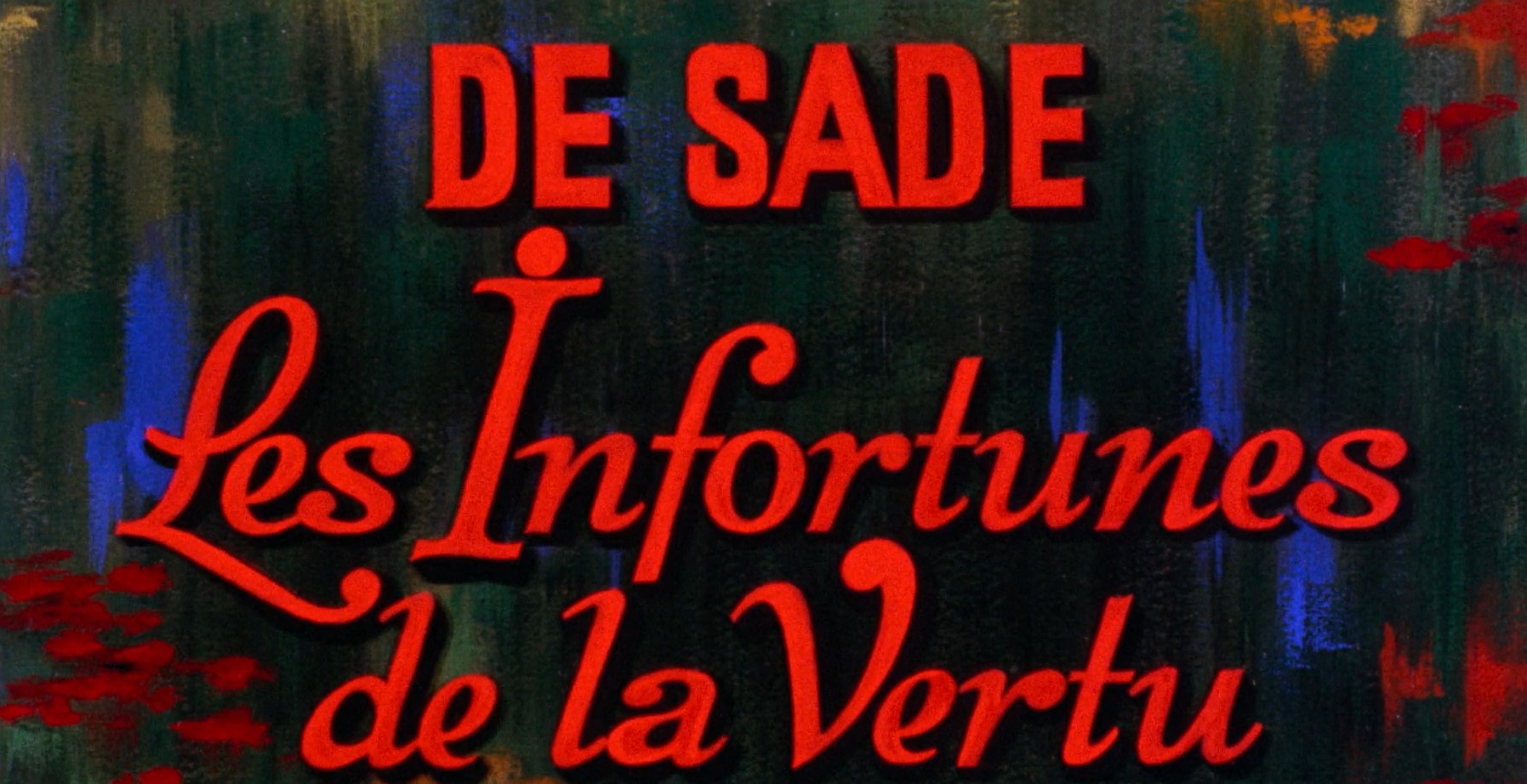
On the heels of my own personal overseas trip to France, a trip for pleasure if you must know, I found it timely and fitting that the Jess Franco directed film, the Marquis de Sade’s “Justine,” would be the next celluloid critique of enticing pulpy obscura.  A part of a pair of Marquis de Sade-themed productions from producer Harry Alan Towers, the other being “Eugenie,” the Eurotrash sexploitation is based off Marquis de Sade’s 1791 novel Justine, or The Misfortunes of Virtue and is adapted for screen by Towers from an original treatment penned by Arpad DeRiso (“Death Steps in the Dark”) and Erich Kronte. “Justine” is one of Franco’s most ambitious visual epics with ornate time period customers, elaborate and grand locations, and an anthology of sorts of the titular character’s misadventures through France that disenchant her chastity. Corona Filmproduktion and the Aica Cinematografica S.R.L. served as the co-productions of this Italian-Spanish 1969 film.

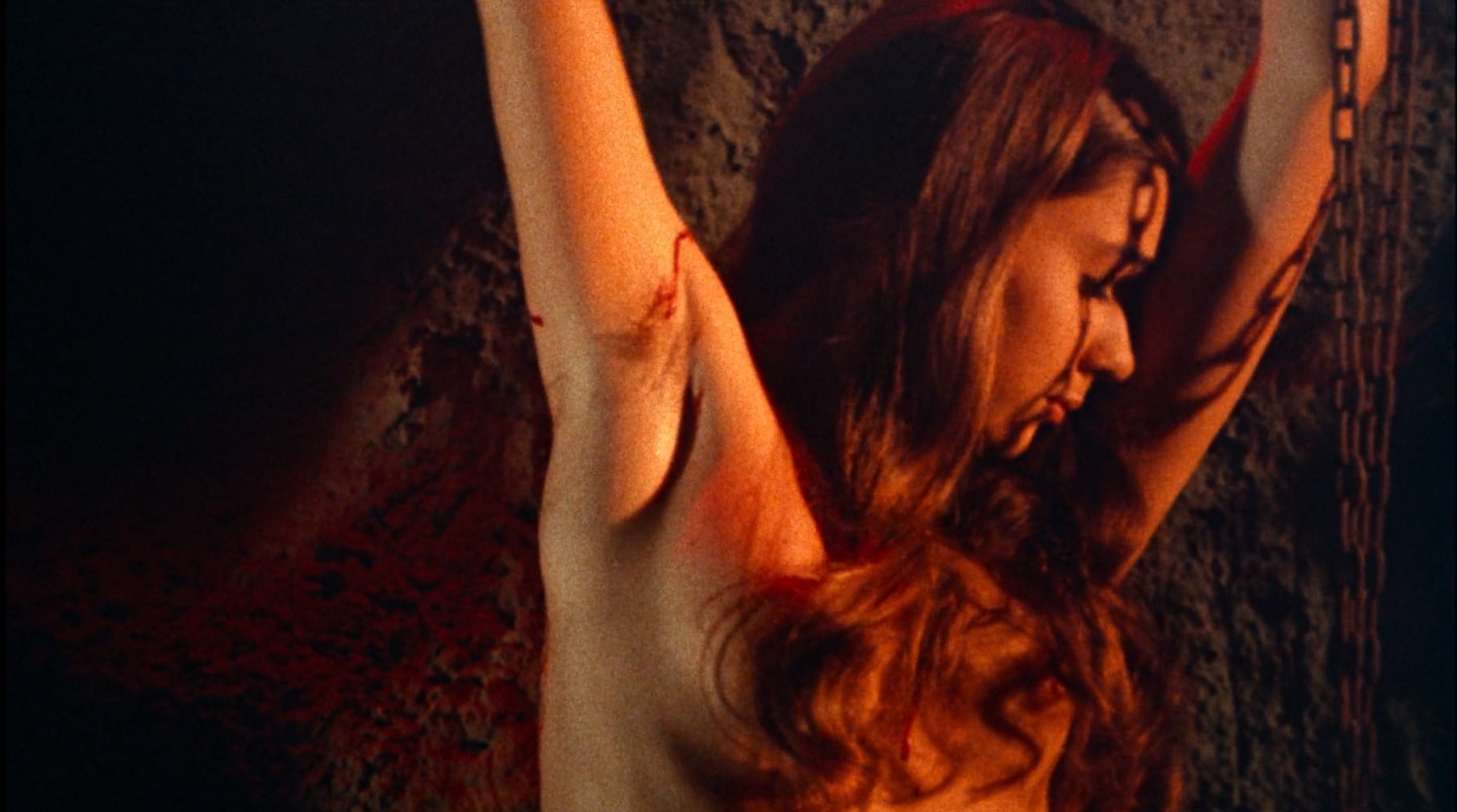
Perhaps the most recognizable and most notable adaptation of Marquis de Sade’s novel, “Justine” is also popularized by its identifiable cast with big names in not only Europe but also in America. The opening scenes with Klaus Kinski, in a wraparound narrative as the Marquis de Sade himself imprisoned and suffering visions of bloodied and bound naked women, immediately draws you into the “Nosferatu the Vampyre” and “Schizoid” actor’s character plight and muted damnation into writing about virtue, a misfortunate respectability. The other famous face in the film, one that spans from Europe to the U.S., is Romina Power as the titular “Justine.” Power, daughter of actor-songwriter Tyrone Power, was, in her own right, a well-known Eurovision singer after the release of the Franco film, but it was her father’s musical talents who landed the sweet-faced Romina into the denigrated young woman role. While Kinski acts on pure facial expression alone, using his iconic, distinct facial features, Power offered a more rigid approach like a child locked by confusion and while unintentional and usually not what any filmmaker wants in a devoid of relaying vicarious expressive emotions, Power naive innocence proves key to Justine’s, well dare I say it, naive innocence. Power’s beauty alone could have stood ground in making the attack from angles perversity film work like a charm. One of the more surprising casted members is Jack Palance. Yes, Curly from “City Slickers” or Jake Stone from “Cops and Robbersons” outlines the formidable pleasure-seeking cult leader Brother Antonin with such gusto flamboyance, the must-see and most-enjoyable performance seemingly feels alien to the usual stoic and stern typecasted actor who could rival Clint Eastwood with a fierce thousand-yard stare. Having co-starred in the Franco-de Sade film “Eugenie” a few years later, Maria Rohm, aka Harry Alan Towers wife, plays the role of Juliette and while the story is ultimately a dichotomy of virtue and sin, there’s an imbalance between the two characters for screen time. The Marquis de Sade’s novel was named “Justine” after all. For her alotted screen time, Rohm provides a suitable sinful scarlet woman climbing the aristocratic ladder by cheating, stealing, and killing her way to the top. The cast fills out with Harold Leiptnitz (“The Brides of Fu Manchu”), Horst Frank (“The Cat o’ Nine Tails”), Gustavo Re (“Horror Story”), Sylva Koscina (“Uncle was a Vampire”), Akim Tamiroff, Rosalba Neri (“The French Sex Murders”), and “99 Women’s” Mercedes McCambridge in an unforgettable role as a nasty gang-leading woman whose high-velocity cruelty rockets are so homed in on Justine it’s explosively devastating to watch.

Having seen the elegance of interior architectures inside Paris’s Opera house, walked the cobblestone streets surrounding the monumental Eiffel Tower, and taking in the laissez-faire of the French way of life, I can honestly say Jess Franco captures France impeccably well for an self-exiled Spaniard known more for his sleaziness and horror than his efforts in cinematic expressionism.   Arching with one big showcase revolving around the idea that virtue will get you nowhere and will be nothing but trouble, ultimately putting to question the validity of the decency concept, the narrative is broken up into a mini-scenarios, mostly of Justine being completely subjugated to the wicked whims of others and a handful of Juliette erecting a better life off the backs of others she’s duped or snuffed.  Franco mastered false hope and misconceptions with each of Justine’s encounters as they lure her in with promises of salvation to then only kick her when she’s down and reap full advantage of her inexperience and gullibility that the world is full of good people.  Sordid and cruel, “Justine” is a contradiction of actionable cynicism in the foreground of depicted magnificence in location, costume, and cinematography choices that hews into the coarse callousness; one particular scene comes to mind involves Jack Palance’s Antonin arranged with hand positioning that abbreviates the name Jesus Christ and as Antonin is holding this hand arrangement, he seemingly glides or floats down the stone corridors toward Justine, demonstrating religious imagery as a form of abusive power or corrupted guidance to serve one’s own deviant devices.  Though labeled in some circles a sexploitation film and certainly full of skin from Romina Power, Maria Rohm, and Rosalba Neri amongst others peekabooing their assets through cut potato sacks during the sex slave orientation scene, much of the sex is heavily implied with a limited gratuitous outcome.  Before going fully into an Eurotrash market by the late 70s and all the way through to the 90s, Franco made every effort to be a considerable filmmaker for a broad audience in numerous countries and his dislike for censorship shines through to his work, despite the likelihood of costing him acclaimed fame as a director. 

“Justine” arrives on 4K UHD in a Blu-ray combo set from Blue Underground.  The two disc set is AVC encoded Blu-ray 50gig and a triple layered Blu-ray 100gig with 1080p (standard BR) and 2160p (UHD) high-definition resolution, and presented in the original European widescreen aspect ratio of 1.66:1.  The brand new 4K restoration from the uncensored original camera negative of the 35mm film with Dolby Vision HDR is a foremost upgrade to the highest power, an ultra-balanced grading that reels in a wide variety of colors from interior to exterior that helps bring the ornamentation of 18th century France to a vivacious life on screen.  The saturation is enriched and finitely retuned to deliver the best and naturalistic grading as humanly possible, or as current technology allows.  The Blu-ray offers a just as reasonable presentation but does lack that high attention to detail because of the lower pixel count.  Bitrate decades are a comfortable average in the high 30s to low 40s.  The UHD and standard Blu-ray offer a clean and free from compression artifacts with immeasurable format capacity to render an unimpeachable picture. Both formats come with an English DTS-HD mono, dubbed in English by voice actors and not the original cast. No hissing, popping, and only a slight interference hum. Dialogue is dub boxy but clean, clear, and right forefront without question of what’s being discoursed and is well-folded into the ambient and Bruno Nicolai epic vein-coursing score that triumphs a military march over a classical base. English SDH are optional. In regard to special features, both formats include a new audio commentary with film historians Nathaniel Thompson and Troy Howarth and the French trailer, but the Blu-ray contains archive interviews with director Jess Franco and writer-producer Harry Alan Towers, an interview with author Stephen Thrower of Murderous Passions: The Delirious Cinema of Jesus Franco, a new interview with actress Rosalba Neri, in Italian with English subtitles, On Set With Jess, a newly expanded poster and still gallery, and a Jess Franco dreaded censored cut of the Americanized shorter version of the film under the “Deadly Sanctuary” title in HD and clocking in at 96 minutes, a nearly 30 minutes shorter. The physical features mirror the “Eugenie” 4k/Blu-ray release with a black Blu-ray snapper case with similar thickness. A shackled Justinne graces the front cover, as with the previous DVD Blue Underground release, and has the same cardboard slipcover with an oval shaped like mirror cutout to not block the half-naked Romina Power. Back covers are both the snapper case and cardboard cover have the same layout design but different still images on each. Inside, there is a disc on each side of the case held in by a push lock. The UHD is a sizzling infrared and sultrier posed version of the snapper cover while the Blu-ray, in the same red hue, is a composition of characters clustered together in a circular design. The film comes not rated, region free, and has the presentation feature with a runtime of 124 minutes. The Marquis de Sade divulges a sardonic, topsy-turvy belief that the more you stay virtuous, the more trouble follows as it’s the way of the world and the more you swindle, the more headway you make in life. Jess Franco brings the Marquis’s vision to cinematic life with a grand and sordid tale, dissevering the two ways toward their individual soul crushing path, and discovering morality within the immoral.

Own Your Piece of Virtue with this 2-Disc “Justine” set from Blue Undergrounda and MVD Visual!  

Beware the EVIL Bite of Silver Teeth! “The Cursed” reviewed! (LD Entertainment / Digital Screener)


Lord Seamus Laurent and the neighboring landowners show grave concern for the recent Gypsy encroachment upon their shared property.  In proactivity protecting the laboring residents and the pastoral farmland of the feudal system, Laurent and fellow landowners order the removal of the Gypsies by hiring ruthless mercenaries who slaughter every last Gypsy in cold blood and bury them in the land.  When every resident on the estate, from villagers to the lord’s family, share a common nightmare of silver teeth buried with the Gypsy corpses, an evil curse unleashes upon the farmland with a killer beast roaming, hunting every resident.  Gypsy chasing pathologist John McBride enlists himself helping Laurent and the villagers to not only relieve them of the cursed creature, but also face his own tragic past linked to the very same evil he pursues.  

Lycanthropy an allegory for the cholera outbreak in late 19th century Europe?  That’s the seemingly centric subject to Sean Ellis’s written-and-directed, folkloric supernaturally spun creature feature “The Cursed.”  Though narratively set and actually shot in France, “The Cursed,” or else better known internationally under the original title “Eight for Silver,” is comprised nearly of all English actors with very few from France and an American in the principal lead to wage war against a swift enemy that kills anyone without prejudice and without mercy.  No, I’m not talking about the wolfish creature that rips settlers and lords to shredded sacks of meat.  I’m speaking of the Cholera epidemics of the 19th century and while Ellis’s metaphoric intentions lean more toward the pains of broad-based additions, our modern pandemic plight felt more widespread linking both the past and present with an event that plagued countries like a curse with unsystematic cruelty and didn’t differentiate between the poor unfortunate and the opulent.  The Los Angeles based production company LD Entertainment finances and produces the feature under Mickey Liddell (“The Grey,” “Jacob’s Ladder” ’19) along with executive producers Alison Semenza (“Lost Boys:  The Tribe”) and Jacob and Joseph Yakob.

“The Predator’s” Boyd Holbrook walks the pathological shoes of John McBride, a man haunted by his past in his continuous pursuit of nomadic Gypsies, and it just so happens that McBride falls right into the thicket of, unknown at the time, Gypsy-made bedlam as missing children and ravaged dead bodies pop up.  Holbrook tries to corral in the pathologist’s inexplicable purpose as the character is often too withdrawn from his intent on what he’d actually do if he came across any Gypsies, which McBride never does.   Instead, McBride feels like a hero who’s dumped in the perfect place at the perfect time to be the hunter of what his pathological experience and instincts claim to be the death-dealings of a wolf while the village becomes the bewildered and unassuming hunted, led by the 2019 “Hellboy” actor Alistair Petrie as the noble estate lord Seamus Laurent stewing stoically in his own despair and desperate head space in search of his missing son (Max Mackintosh). The only character acting rationale in a conventionally proper manner in her reactions to the whole situation is Seamus’s wife Isabelle (Kelly Reilly, “Eden Lake”), with a blistering heartful longing for her son, and their daughter Charlotte (Amelia Crouch, “The Woman in Black 2: Angel of Death”), with a shock-induced and childlike response to her brother’s disappearance. Yet, Isabelle and Charlotte alter course. Isabelle weaves in and out of anguish to the point where her suffering is only implemented to benefit the story and Charlotte, well, Charlotte plainly disappears as a key supporting character who knows truly happened to her brother in the field and with a villager boy, Timmy (Tommy Rodge), who discovers the silver teeth etched with curse inducing rune symbols. The interactions between McBride, Seamus, and Isabelle never quite feel nature and complete, as if there’s an unspoken trust issue between McBride and Seamus or a mutual understanding or compassion between McBride and Isabelle that never leaves the hilt of the sword to see spark action. Nigel Betts, Roxane Doran, Richard Cunningham, Pascale Becouze, Simon Kunz, and Amazon’s “Hanna” star Áine Rose Daly, as farm hand girl turned white wolf, round out “The Cursed” cast.

Sean Elliss tweaks the werewolf mythos to try and shake up the genre, turning it up on its head to dust off a tired narrative of man bitten by wolf, man turns into wolf, wolf terrorizes villagers, and villagers kill wolf with silver bullet. Instead of silver weaponized for good, “The Cursed” weaponizes it as Gypsy revenge, a calling card that leaves bite marks with lasting impression until every single inhabitant, guilty or innocent in the crime against the Romanian wayfarers, is laid to waste by its transformative power. Though unexplained in why the Gypsies forge silver fangs etched with a curse other than a storm is coming, as if perhaps they’re clairvoyancy provided them with a disturbance in the air instinct rather than exactly what to expect, the teeth are a nice cinematic touch of menacing terror literally inscribed on each tooth. “The Cursed” atmospherics of folkloric superstitions blended into a broodingly dense landscape of low-lying fog and uncomfortably vast empty fields surrounded by a thickset of trees comes close to the likes of a Hammer horror setting, especially with the period of time in which “The Cursed” plays out in that has been Hammer’s niche era. The setting might be the only controlled aspect of Ellis’s take on the werewolf genre as the werewolf, if that is what we can even call the abomination of mutation, is written from out of our traditionally known contexts and into a new breed of metamorphism. Hairless, white, and somatically encasing, Ellis’s monsters radically redefine our expectations with a beast that literally consumes our very being and turns us into an unrecognizable fiend amongst the flock. Fast, agile, and ruthless, this newfangled fang-bearer up until the end never received any insularity resentment from me, but the ending abruptly diminishes the near mindless brute strength of a beast with a hint of intelligence in its ability to sound like person to draw the hapless into a trap and that’s where a line needs to be drawn, especially when the technique is used as an out of the blue device toward an endgame.

Whether be a narrative about an all-consuming addiction or about a precipitating plague of chaos in the time of cholera, the uniquity of “The Cursed,” semi-diverging from one of the most revered classic monsters in our history, may be an immediate turn off for many traditionalists, but the film does right by the savagery gore, the minatory threat that lingers in every scene, and that no one is immune from danger. LD Entertainment is set to release “The Cursed” this Friday, February 18th, in theaters. Since this was a digital screener, the audio and video will not be covered. No bonus mater or extra scenes during or after the credits were provided. Sean Ellis provides that creepy fog-laden and dense folky aesthetic of barnyard chic while still conditioning an upscale appearance of a beautifully crafted production from a native French crew of productions designers in Thierry Zemmour and Pascal de Guellec as well as costume designer Madeline Fountaine. “The Cursed” starts strong with visceral intent to be novel by offering callous over civility, a dysmorphic werewolf, and a new set of blingy chompers fit for Lil’ Wayne, but gaps riddle unignorable holes into the story and its characters that ultimately becomes the silver bullet obliterating the beastly nature this new breed of wolf desperately needed to survive unscathed.

Bestiality. Borowczyk Pushes the Boundaries with EVIL Themes. “The Beast” reviewed! (Blu-ray / Umbrella Entertainment)

“The Beast” Available on Umbrella Entertainment’s Beyond Genre label at Amazom.com

Marquis Pierre de l’Esperance, a French lord on the brink of financial ruin, is able to swing a deal before the death of the well-off English tycoon Philip Broadhurst. Under the conditions of Broadhurst’s will, his daughter Lucy must marry I’Esperance’s introverted, and equestrian obsessed son within six months after his death. Lucy, and her aunt Virginia, travel deep into the French forest to the deteriorating chateau to do a first ever meet and greet between the two soon-to-be married. Marred by centuries old local legend of a lustful beast who sexually defiled the Lady of the estate’s family lineage, I’Esperance aims to restore order by marrying into fortune and leave old cockamamie tales behind him. Yet, Lucy can’t shake vivid and stimulatingly graphic dreams of the romping woman and beast, leading to speculation whether the legends are true or not?

Certain types of filmmakers push the limits and exude their provocative talents to blur the lines between arthouse cinema and pornography. Those same filmmakers would argue that arthouse cinema and porn are, in fact, nearly one in the same if complimented with an intriguing story full of subversive subtext sure to outrage the status quo. Walerian Borowcyzk is one of those auteur artists basking in the absurdity and the arousing aspects of his films. The Polish writer and director wrote and helmed “The Beast,” aka “La Bête,” a one-part sex-comedy and one-part fantastical horror that is one-whole bizarre beyond our wildest dreams. “The Beast” was once considered to be a part of Borowcyzk’s short film collection of erotic stories known as “Immoral Tales;” however, the short film shot was scrapped from the project and then reimplemented into a full-length feature with outer rim narrative built around it’s very thematical essences of bestiality and the corruption of man due to woman’s virtue, the latter inspired by the French novella “Lokis” by Prosper Mérimée. The France originated film was produced by Anatole Dauman under the French studio, Argos Films, which produced much of Borowyczk’s work.

“The Beast’s” ensemble cast play intrinsic notes toward the fullest extent of the narrative’s shell machination as well as the saturation of eroticism from the grifting lord l’Esperance to the chateau’s only manservant, who when not answering his Lord’s beck and call, is fooling around secretively and lustfully with I’Esperance’s daughter. Veteran actor Guy Tréjan unearths the very ill-humored presence of a struggling lord seeking to reclaim fortune and glory to his estate and family. Most of the time, we feel sympathy for I’Esperance’s inability to catch a break, but on the deeper, darker scope, I’Esperance hides many truths, keeps many secrets, and even black mails his uncle, Duc Rammendelo de Balo, played by legendary actor Marcel Dalio (“Super Witch of Love Island”), making the lord a villain of his own haphazard design. I’Esperance’s nitwit and reclusive son Mathurin is played by Pierre Benedetti, who has worked with Borowcyzk later his career in “Immoral Woman.” Not much of Benedetti is profoundly showcased, leaving much of Mathurin in the dark despite being a principle figure in the plot as the husband-to-be for the aspiring romantic Lucy Broadhurst from “Le diaboliche’s” Lisbeth Hummel. Hummel, along with 1995 “Castle Freak’s” Elisabeth Kaza as Lucy’s aunt Virginia, are supposed to be affluent English women travelling to France in order to settle future marital affairs with the I’Esperances, but Hummel and Kaza have such thick accents that no matter how proper their English may be, there’s still present the French and Hungarian elocutions in their English dialogue. Hummel does capture Lucy’s free-spirited, free-form sexuality so inclined by Borowcyzk as the director envisions her as the clairvoyant trigger that unsheathes an age-old curse to light, but Hummel is not the only participant in “The Beast’s” amativeness with Hassane Fall, Pascale Rivault, Julien Hanany, and sex-symbol Sirpa Lane (“Nazi Love Camp 27,” “Papaya: Love Goddess of the Cannibals”) paving a more perverse course with illicit affairs, object sexuality, and, of course, bestiality. Though none of these aspects were more than disturbing in comparison to Roland Armontel’s version of a local priest setting an uncomfortably affectionate dynamic with two of his alter boys that Borowyczk focused and lingered on when the chief characters have left the scene.

Trying to understand Walerian Borowyczk’s “The Beast” is akin to trying to understand the wanton complexities of the human psyche. In all its whirlwind of implications, “The Beast” is heavily and artfully abstract in a non-abstaining manner as sultry desires, no matter how forbidden, are the superior playthings utilized for Borowyczk’s totality of storytelling. The uber-sexual graphic tale invests little into the imagination with vivid imagery of genitalia in all shapes and sizes in organic and mythical forms. Yes, there is a lengthy opening scene of horse copulation with emphasis on each of the bulbous male and female’s sexual organs. Yes, there is also a satirical creature chase that transforms into a frolicking romp between a human woman and a dog-bear creature with a miniature representation of an erect horse member ejaculating like a geyser without an end. The excessive vehemence towards sex is Borowyczk’s gift to the audience toward feeling a flurry of mixed emotions from being a little bit peed, to a little bit put off, to even a little bit strangely turned on all in one sitting. Though sex is unusually celebrated in “The Beast,” the beast itself is also the representation of perversion, an animalistic and libidinous savage horndog lusting after the chastity of virgin women that’s allegoric to spoiled bloodlines and cursed households in a path of ruinous destruction, especially in the downfall of a crumbling aristocracy. Borowyczk injects and interjects comedy to lighten the socially disturbing atmospherics of paraphilia and the social consequences that follow.

As part of their Worlds on Film:  Beyond Genres banner, Umbrella Entertainment releases Walerian Borowczk’s “The Beast” as volume #13 on a region free, 2K scanned Blu-ray in full 1080p High Definition.  Presented in the original aspect ratio of what once was the European theatrical standard widescreen 1.66:1 aspect ratio, the 35mm transfer provides a relatively clean viewing free of aging and blemishes albeit the innate agreement of healthy amount of grain that comes standard with celluloid film stock.  While color grading definitely looks non-existent in the release, a once over would have sharpened the image immensely from the slightly flat and natural color scheme.  The tri-lingual French, English, and Italian DTS-HD Master Audio 2.0 mono track is a compressed version from the 2015 Arrow Film’s Blu-ray release with an uncompressed LPCM 2.0 audio.  Virtually no difference in the lossless audio with also no difference in the synchronizing between visual and audio elements.  Dialogue runs smooth and clear with little-to-no hissing or pops and the same can be said about the more than adequate ambient track, the lively French Harpsichord piano soundtrack, and even the outlandish foley of beast sounds through the limited parameters of the two channeled output.  Special features pale in comparison to previous Blu releases, but are none-the-less impressive including 16mm behind-the-scenes, archival documentary footage in the making of “The Beast,” an introduction by film critic Peter Bradshaw, a featurette of Borowczyk’s beast sketches, letter of confidence to the producer, and a treatment to a potential sequel that never materialized The Frenzy of Ecstasy, an philosophical interview with the director Walerian Borowczyk, the director’s biography, a still gallery, and theatrical trailer.  Illustrator Simon Sherry designs new and exquisite cover art for the cardboard slipcover and snapcase cover that perfectly represents the tone of the story.  The cover art is also reversible with Hispanic poster art and praising critic reviews and quotes.  The release is certified R18+ for high level sexual themes and sex scenarios. “The Beast” is an upfront, artful, and confrontational film about bestiality and sexual corruption bred to challenge the formulaic narrative with a call of unbridled seduction and a flamboyant flare for a firm erect furry.

“The Beast” Available on Umbrella Entertainment’s Beyond Genre label at Amazom.com