Slacking Off at School is Grade A EVIL! “Cutting Class” reviewed! (MVD Visual / Blu-ray)

“Cutting Class” Available on 4K UHD and Blu-ray at Amazon.com

Paula Carson seems to be the eye of affection.  The popular, walk-the-line student and high school cheerleader finds fast-and-loose fun as the girlfriend of jock and overall jocular lesson slacker Dwight but is also pursued by Brian, a loner recently released from the mental hospital after killing his father, and even the quirky principal Mr. Dante who can’t careen his aberrant attention away from his lovely young student.  When faculty and students go missing and the vice principal is found brutally murdered, the recently released, convicted criminally insane Brian becomes the prime suspect and flees the scene, but days later coming out of hiding, Brian pleas with Paula to help convince people he’s innocent of the crime and not responsible for those missing.  Suspicions and accusations disperse in many directions as a killer continues to thin out the student body with Paula stuck at the center of the killer’s chaos. 

Many of today’s A-lister leading men have had a role in a horror film at one point in time early in their careers.  Before being the face of the latest “Ocean’s 11” films, George Clooney starred in “Grizzly II:  Revenge” and “Return to Horror High” in the 1980s.  Before being a lovable halfwit with good fortunate in “Forrest Gump” and the voice of Woody in “Toy Story, Tom Hanks’ debut feature was “He Knows You’re Alone,” a horror-thriller about stalked woman unable to escape a serial killer.  Then, there’s Clooney’s “Ocean 11” co-star Brad Pitt and he’s no exception to the rule with “Cutting Class,” an American high school melodrama with strong hints of the slasher genre helmed by a not-so-American director in “Excalibur” adaptation screenwriter Rospo Pallenberg from the United Kingdom.  The script is penned by Steve Slavkin which would turn out to be his one and only feature film work before remaining in television.  Shot in Los Angeles, the April Productions and Gower Street Pictures film is produced by Donald R. Beck and Rudy Cohen, who the latter went on to produce “Feardotcom” and “The Black Dahlia.” 

A youthfully green Brad Pitt joins the remake of the “The Blob’s” Donovan Leitch and “The Stepfather’s” Jill Schoelen in an unfolding love triangle of student shenanigans, peer pressure, and murderous suspicion.  Pitt plays Dwight, a popular basketball stud with a carefree attitude that’s slowly being chipped away by his parents, teachers, and even girlfriend Paula to be more responsible and forward thinking.  As Paula, Schoelen indulges herself into the perfect student who is studious, kind, and beautiful that attracts seemingly all walks of school hallway life from peers to teachers and doesn’t even bat an eyelash about it either by obliviousness or just likes to lap up the attention.  Leitch as the school misfit Brian Woods dons the oversized black blazer and soft-spikey hair to give his character more of an edge, but the script is thin on showcasing Brian to feel like an outcast or even makes the protuberant effort of a character convicted murderer, mentally unstable and recently deinstitutionalized.  Leitch crafts his own approach to elevate Brain Woods into that persona while teetering the line of being a suspected bad or good guy for the approx. 90 minute runtime.  Acting legends Martin Mull and Roddy McDowall are integrated into more cameo roles that are running gags on the comedic side of “Cutting Class’s” genre blend.  “Clue’s” Mull, playing as the district attorney and Paula’s father going duck hunting for the weekend, has an orbiting role that surrounds the whodunit trunk narrative with subplot intercut scenes after he’s been perforated with an arrow and crawls back to civilization, amusingly frustrated and weary as he continues to be passed by and stepped on while in the muck.  McDowell’s absurdity is illuminated in a different objectifying light as a sock-covering mic sniffer with a giddy perversion for Paula.  See McDowell gawk at the stretched panties of a bent over Jill Shoelen made me personally feel really uncomfortable, perhaps I still see McDowall as the heroic Fearless Vampire Hunter Peter Vincent from “Fright Night” and can’t unseen him to be anything else, especially a smirking, sexualizing oddball.  “Cutting Class” fills out the cast with Brenda James (“Slither”), Mark Barnet, Robert Glaudini (“Parasite”), Dirk Blocker (“Prince of Darkness”), Eric Boles (“C.H.U.D. II: Bud the Chud”), Nancy Fish (“Exorcist III”), and Robert Machray.

Prefacing this review’s analysis, I understand “Cutting Class’s” campy comedy intentions before its backlot slasher sublet.  The smell of teen palaver and mischievous comedy odorously laces the late 80’s production and its eccentric character, more so with the latter of the two.  This also includes sexual perversities to run rampant in what was then a free-for-all of anything goes types of behavior.  Character Paula Carson, the near epitome of good high school student, becomes the lust of every principal male character with a hypersexualization of her innocence.  Paula, cladded with a short skirt and white panties, can’t get through many of her earlier scenes without being objectified.  She’s penned to bend straight over, exposing her panties, and have Principal Mr. Dante gleaming with a grin and gawk in his hots for the student, caught half naked washing her hair over the bathtub, caught in a conversational scene with suspected killer Brian Woods, and is repeatedly pleaded with by Dwight to take advantage of her father being not home for extra circular activities.  Not to forget to mention constantly being googly eyed by all three throughout the picture.  It’s funny how this particular perception becomes the one thing to catch my eye and discuss as it speaks to the kind of depraved person, I am but also factors into what “Cutting Class” really is, a dumb movie.  The sit back and enjoy the ride type of teen-comedy, semi-slasher hits upon most of the benchmarks expected of a Pallenburg slasher made in a America with a fair amount of personal style and not enough connective tissue to strengthen the bond between the two battling genres.  For example, the out of left field satire of Martin Mull’s swampy trek back to civilization has the detached sensation of an out of place running gag, lost amongst the rest of the film by the lack of detail (Mull’s character is shot with an arrow but has seemingly healed miraculously as he’s able to crawl and walk back to the suburbs) and spatial awareness (Paula’s class fieldtrip to the very same swamp Mull’s character was shot, making the area appear in proximity to the high school and suburbs instead of isolated backwoods).

MVD Visual, through the MVD Rewind Collection, proudly presents “Cutting Class” on a new 4K UHD and Blu-ray 2-disc set. Both scans of the 35mm original camera negative are from the Vinegar Syndrome 2018 restored print; however, MVD’s LaserVision Collection edition is the first fully functional 4K resolution with a HEVC encoded, Ultra High-Definition 2160p, BD66 as well as tagging along an AVC encoded, High-Definition 1080p, BD50. Can’t complain at all about this print despite negligible differences other than the increased resolution in HDR10, a format that often misrepresents true image fidelity with irregularity. Yet, we don’t see that that really here with a shade darker image that results rounder delineation on the characters and objects. Same can be said about the 1080p, a crisp image defines mostly through. There are rough patches of varying grain levels within the 1.85:1 aspect ratio presentation that leave a scene or two looking optically haggard for a brief moment as if stretched and overly granulated. Grading design has a natural 35mm film saturation that’s robust with a vast range of hues that don’t bleed or run together, sticking to distinction rather than attempting to be fancy to a fault. The audio options on both formats include a lossless PCM 2.0 mono and a lossy Dolby Stereo. For better fidelity, the uncompressed PCM really opens up the English inlaid audio mix by appealing to vigorously clear and forefront dialogue with ambience and soundtrack firmly encroaching but stays firmly moderate in the depth. There’s a nice breadth of effects captured, such as the machine shop climax with isolating each cutting, sawing, and drilling tool’s specific sound in its specific space. English subtitles are optionally available. Special features mostly reside on the Blu-ray disc as the UHD’s capacity is limited to just 66 gigabytes, barely enough for higher dynamic resolution feature with the only additional supplementary being the HD theatrical trailer. On the Blu-ray, a quite a few Vinegar Syndrome produced content is encoded into this release in what practically a mirrored 1080p copy with an interview with actress Jill Schoelen who, in summing up her discussion of “Cutting Class,” would love to erase this film from her memory and career bank, an interview with Donovan Leitch and his experiences hired in on the role as well as working with the cast and crew, a Kill Comparisons featurette that contrasts the edited and unrated feature kill scenes with additional seconds added into for more gruesome, lingering effects, the VHS retailer promo Find the Killer and Win, and the original theatrical trailer. Also included is the 91-minute R-rated edit with the shorter death scenes, but I don’t understand why anyone would want to watch something edited. Like the first three MVD LaserVision Collector’s Editions, the fourth entry is incorporated with retro finesse that doesn’t stray away from original marketing elements. The cardboard O-slipover views as a porthole into the original poster art of the three principal characters. A black Amary cover houses the same cropped encirclement of the characters but with a solid black other rim while inside the 4K disc (right side snapper) and the Blu-ray (left side snapper) each pay tribute to the laserdisc era in their own way. The insert houses a folded mini-poster of the slipcover design. The front cover is reversible with a complete poster element reduced to fit centered on the design with a wooden school desk serving with pencil, paper, and ringlets of blood as the border design. Unrated, region free, and with a runtime of 91 minutes, “Cutting Class” is worth skipping your school studies.

Last Rites: A highly favorable and upgraded release for the Brad Pitt startup campy teen slasher that confirms to us the actor hasn’t changed his acting method in the last 35 years, but “Cutting Class” doesn’t stand out amongst the masses of similar 80’s ilk with a fickle way of handling the nebulous and illusory villain killer on school grounds and an obtuse comedy angle too out of alignment to be risible. The only option left is to sit back, hit play, and soak into the mindless meat-and-potatoes.

“Cutting Class” Available on 4K UHD and Blu-ray at Amazon.com

Heart and Body Reunited Forges Immortal EVIL! “Witchtrap” reviewed! (MVD Visual / Blu-ray)

Get Caught in the “Witchtrap” on Blu-ray!

A motley crew of parapsychologists and private security are hired to investigate the haunted house of powerful warlock and accused serial killer Avery Lauter.  Before the graveyard side home can be turned into a themed Bed & Breakfast by Lauter’s inheriting next of kin, the team is brought in to eradicate the infamous house of any kind of malevolent spirits after the mysterious and gruesome death of a magician who agreed to stay at the house as a test run of the level of malignance.  When the investigators make contact with a confident and evil Lauter, the warlock tricks them by using the team’s physical medium to murder a far-too-inquisitive investigator one-by-one in order to finish a satanic ritual he started before his death that will make him immortal.  It’s up to non-believer, and wise-cracking, private detective Tony Vincente to make sense of the murders and put an end of Lauter’s reign of terror from beyond the grave before it’s too late.

A necromantically-charged slaughterhouse of a film, “Witchtrap” is the 1989 phantasmal thriller of the omnipresent, omni-powerful dead versus a group of clueless living always one-step behind in attempting to make sense of everything.  Also known as “The Haunted” or “The Presence,” the Kevin S. Tenney written-and-directed film succeeds the director’s cult classic “Night of the Demons” and Tenney’s debut film “Witchboard,” which is not a sequel to “Witchtrap” despite a similar title and the hiring of some of the same actors.  Shot in Fairfield, California on a 400K budget, the independence production showcases topnotch gore and pyro effects from makeup artist Judy Yonemoto (“Dance or Die,” “The Newlydeads”) and special effects supervisor Tassilo Baur (“House,” “DeepStar Six”) and is produced by Tenney alongside Daniel Duncan under Mentone Pictures; Duncan also produced Tenney’s “Brain Dead” later in the filmmaker’s career.  Cinema Plus, represented by executive producer Ryan Carroll, serves as the presenting company.

Tenney has been noted saying “Witchtrap” was a gift for the actors who have stuck with him over the years, playing pivotal parts in his student films that pole-vaulted his career into being a cult horror director.  “Witchtrap’s” leading man, James W. Quinn, has worked with Tenny since grade school and was cast in a principal role in “Witchboard” as well as in a minor role in “Night of the Demons.”  Quinn’s Tony Vincente is by far the best dialogue deliverer of the principal ensemble with a smartass ex-cop script that highlights Quinn to be the good guy but while being a complete jerk.  The rest of the cast is painfully flat, with little-to-no inflections, and a severe lack of dynamism or gesticulation that, despite how interesting their character backgrounds are, are just too dull with monotone script-reading.  “Night Visitor’s” Kathleen Bailey is likely the second best to liven up her character of Whitney O’Shea, the religious and reluctant physical medium with shark thrashing spams every time Avery Lauter channels her for to violently wipe out a parapsychologist team member, spearheaded by an eager ghost trapper Dr. Agnes Goldberg (Judy Tatum, “Witchboard”) and her mental medium husband Felix (Rob Zapple), and the accompanying private security forces that also include Vincente’s partner Levi Jackson (Clyde Talley II) and boss man Murphy (Jack W. Thompson).  Dangerous ambitions and irrational greed stir the pot between each of these groupings that side with personal stake over the safety of their existence that make for better character building underneath the rickety performance framing.  And, of course, we can’t neglect mentioning Linnea Quigley bringing up the rear with her rear as the bleached blonde, cropped seater topped A/V technician that can capture ghosts with her ectoplasm detecting gear.  Quigley, and also Judy Tatum, provide a bit of T&A, especially Quigley with an eye-popping full frontal in the prime of her career.  The remaining cast includes Hal Havins (“Sorority Babes in the Slimeball Bowl-O-Rama”) as the creepy groundskeeper and J.P. Luebsen (“Witchboard”) as the cap-wearing and wild-eyed bearded warlock Avery Lauter. 

Oddly enough, what makes “Witchrap” entertainingly great, is Tenney’s attractive and amusing dialogue.  Between the quips, banters, diatribes, and the depth conversations, Tenney formulates a dialogue that can match or even surpass the outstanding special effects that course through the narrative.  Without Vincente’s brutal mockery of the entire paranormal research and investigation scheme as well as an unmercifully, nonstop degrading position toward his contentious boss, left with only the tedious prosaic to hear, “Witchtrap” would be one of those great-gore, dull-dialogue features that force your hand to fast-forward to the good parts in order to not pass out asleep from the in between drag.  Instead, “Witchtrap” is 80’s cult-horror treasure, comfortably embedded somewhere between the cinematic Earth’s lithosphere and asthenosphere layers just waiting for someone to unearth and dust off its sheening crimson colored cabochon.  Definitely not elevated horror that makes one think about the auteur intended message, the feature remains true to Tenney’s previous like-mad credits with an outlandish and mortally fair game theurgy that’s surface-level eye candy and audibly dulcet, despite the audio recording snafu that sent the entire dialogue track to the post-production recording studio.  Though producers and marketing attempted to cash-in on “Witchboard’s” moderate success with a similar, familiar title, “The Haunted” and “The Presence” are no more than generic designation fodder that lacked tremendous flavor; “Witchtrap’s” a kitschy and blunt title that works and literally estimates what audiences should and will expect although Avery Lauter is a Warlock and not necessarily a witch per se. 

A part of the Eric Wilkinson’s throwback video club and Rewind Collection series from MVD Visual, “Witchtrap” arrives a fully restored, high-definition Blu-ray, presented on an AVE encoded, 1080p, BD50 and in a widescreen 1.85:1 aspect ratio.  This transfer essentially mirrors the Vinegar Syndrome release a few years back that had reinstated many of the MPAA cuts the general public hasn’t laid eyes for nearly 30 years until 2016.  Picture quality retains a fresh, renewed look without compromising the natural characteristics, such as grain, of the 35 mm celluloid.  There are sporadic scenes that slip due to generational loss but, for the most part, a solid 2K scan restoration of the interpositive. The English LPCM 2.0 mono track is post-production concomitant due to an inexperienced sound mixer that resulted overbearing hum throughout the dialogue. ADR was introduced in post subsequently diminishing depth and creating an artificial sounding mix with a silver lining being a near perfect match for actor emotionality, inflections, and synchronization. Optional English subtitles are available. Bonus material includes a commentary track with director Kevin Tenney, producer Dan Duncan, Cinematographer Tom Jewett, and actor Hal Havins. Also included are interviews with Kevin Tenney, Linnea Quigley, Tom Jewett, and Tassilo Baur who more-or-less say a lot of the same retrospective accounts regarding “Witchtrap’s” sound issues, pranks on Kevin Tenny, cheap film hints outside of L.A., and how constrained the budget was. This release also comes with the edited VHS version at 92-minutes, same as the Blu-ray, a photo gallery, and the original trailer. Physical features include a sweet throwback cardboard O-Slipcover of the original poster compressed inside a 1-inch, matte red border that’s back and front. The O-slip covers a clear Blu-ray case that holds a reversible Rewind Collection cover art that’s roughly the same as slipcover poster art with cropped out credits for a vivid red filled, white-lined title. On the other side of the cover is alternative European cover art of a puffy white cloud merged with a demonic face hovering over a white picket fenced house, reminiscent of the MGM “Return of the Living Dead” or the original Columbia “Fright Night” DVD covers. Inside the case is a folded mini-poster of the factory-wrapped front cover. MVD’s release is rated R and comes region free. “Witchtrap” epitomizes restless ghost syndrome with a head coup de grace motif and is a seance that conjures potent witty dialogue to hoist Kevin Tenney’s third feature up to another plane of existence.

Get Caught in the “Witchtrap” on Blu-ray!

Never Cry EVIL Unless You Mean It! “Night Visitor” reviewed! (Ronin Flix / Blu-ray)

“Night Visitor” Creeping Onto Your Doorstep!  Now on Blu-ray!

Never-on-time high school senior Billy Colton can’t seem to catch a break in arriving to class on time. To make matters worse, Billy makes up a lame excuse for every tardy to his surly history teacher, Mr. Willard. On thin ice with Mr. Willard with only a few weeks left to graduation, Billy must keep his nose clean in order to not make any more waves that’ll cost him his diploma. When a new, extremely sexy, call girl neighbor moves in next door, Billy becomes entranced by her casual sexual affairs. So much so, Billy sets up a telescope from out his bedroom window to spy on her and convince his naysaying friends of her profession by sneaking a rooftop picture catching her in the middle of a tryst. What Billy sees is his neighbor being stabbed to death and the culprit is none other than his history teacher, Mr. Willard, continuing his conducting of Satanic rituals and sacrifices on local prostitutes. Because of his reputation for making up stories, no one believes Billy, not even the police, and he’s forced to attend Mr. Willard’s class with both parties having the knowledge of what really occurred. Billy’s desperation sends him to seek the help of a retired detective, Ron Devereaux, a close friend of Billy’s late father, and extreme measures must be taken by Billy to prove a killer’s identity and to stop Mr. Willard from coming after him.

“Night Visitor” is the 80’s alteration of the classic Aesop fable, “The Boy Who Cried Wolf.” The 1989 teen-campy cult horror is the first venture into feature length films by Rupert Hitzig, producer of “Wolfen” and “Jaws 3-D.” The twisted, modernized story derived from the fable was penned by Randal Viscovich to sought to provide nods to other films, one film in particular, “Fright Night,” shares a story parallel or likeness of an older teenage boy spying on the carnal rendezvouses of his alluring neighbor and ends up becoming involved in something far more sinister. At one point in time the film was under the working title, “Never Cry Devil,” a spin on the fable idiom cry wolf, Hitzig’s final product eventually landed on “Night Visitor” and the graphic nudity and cannibalism pared down for general audience consumption. Premier Picture Corporation served as the production company with Alain Silver (“Kiss Daddy Goodbye,” “Mortuary Academy”) producing, Randal Viscovich and Richard Abramites associate producing, and Tom Broadbridge (“The 13th Floor”) and Shelley E. Reid (“Nine Deaths of the Ninja”) as executive producers with United Artists serving as film rights distributor.

At the center of the story is a coinciding dual lead. One might be more prominent in the beginning, but the second soon catches up to run alongside in an even dichotomy of good and evil. Derek Rydall (“Popcorn”) plays into the stereotype of a hang loose teenage boy named Billy Colton on the edge of adulthood with a penchant for voyeurism as he spies on the late-night sexual commerce of her blonde bombshell neighbor. Rydall introduces mis makings of an energized, poofy-haired hunk who might be a little bit naive as a closeted peeping tom and looks to score with an older woman despite exhibiting and declaring feelings for his longtime friend Kelly (Teresa Van der Woude, “Killer Workout”). Who can blame Billy when Billy’s new neighbor was a Playboy Playmate? Shannon Tweed (“Cannibal Women in the Avocado Jungle of Death”, “Of Unknown Origins”) seduces, arouses, and paints by the numbers in what she does best – to be the sexiest woman on screen. Having never really dug herself out of being typecasted, Tweed humble horror beginnings is about the extent of her range before being cornered in the sex-thriller market and the Playmate of the Year 1982 is great fun to watch onscreen as her sex-working-kittenishness character, Lisa Grace, causes Billy Colton to steam in his pants. As much as it was a joy to watch Rydall and Tweed chart a possible older woman, younger man fling (fun fact: Tweed was supposedly playing a 26-year-old but was actually 31-32 and very much looks her age in the film), I thought Allen Garfield (“Diabolique”) and Michael J. Pollard (“Scrooged”) as brothers rollicking as Satan acolytes or rather just Garfield’s character Mr. Willard is the Satanist and Pollard as brother Stanley is just insane and fancies mentally manipulating the furniture as he calls the working girls him and his brother abduct and hold in the basement. Pollard is absolutely demented! All of the snarky quirks, plus a slew of scampish facial expressions and remarks, turn the fun-loving eccentric into a total maniac of truly scary proportions. Garfield’s method approach offers a different kind of demented, one that’s calculating and cunning to counter his brother’s outward lunacy. “Night Visitor” rounds out the cast with more gifted, recognizable talent in Elliot Gould (“Dead Men Don’t Die”), Richard Roundtree (“Shaft”), Scott Fults (“Hide and Go Shriek”), Brooke Bundy (“A Nightmare on Elm Street 3: Dream Warriors”), Henry Gibson (“The ‘burbs”), and adult film actress Teri Weigel giving Shannon Tweed a run for her money in the skinemax department as the basement-bound prostitute.

If you had told me “Night Visitor” was a strictly a chilling cut thriller, I would have not believed you and would recommend psychiatric help. Aside from the opening scene of a hooker being violently snatched and grabbed into a gothic black car, “Night Visitor” has the hallmarks of a teen comedy amped up on sex-driving hormones, teenage melodramatic antics, and parades light-hearted teen comedy up until throats are slit, chests, are daggered and Michael Pollard wildly wields a chainsaw with an impish grin. The blithe spirit soon turns dark and grim as the carefree attitude of the hero goes toe-to-toe with stern and Satanic teacher, a wonderfully metaphorical relationship to the extreme that’s universally relatable as everyone has had an encounter with a discontented classroom instructor at least once growing up. Surprisingly stark how bleak the film turns, an overwhelming sense of dread lingers after that second prostitute meets her maker in a ghastly way that, as far as kills go, isn’t very radical but the true nature of the subject matter is shaded so well that the moment literally hooks you into the story as you start to connect what just might happen next to the new neighbor. One aspect that felt lacking was that there isn’t much depth to the Willard brothers’ Satanism; a few upside-down pentagrams, a goat’s head, Baphomet’s goat head statue, a topless sacrifice with chant, and Allen Garfield’s robe and elaborate horned masked, which is an excellent design, are all the thin layer of thematic elements but still retains sufficiently the Willards connection to Satanism. Whenever the story moves from Billy Colton’s obsession to expose Mr. Willard, much of the narrative then focuses on the interrelationship of Zachary and Stanley Williard which is mostly a nonaggressive superior and subordinate kinship. Stanley, who caters to Zachary’s every request and even squeezes for him fresh orange juice, plays along with his brother’s inadequate display of being a disciple just to get his own malevolent kicks out of tormenting women of the night. There’s this unexplained fixation with prostitutes that puts forward less a Satan worshipper and puts forward more a pair of mania driven maniacs quenching a thirst for blood by offing the lower class of society that no one will miss. A brief scene backs up this theory of an angry prostitute chewing Captain Crane’s ear off about protecting the girls on the street and he just casually strolls along, waving her off as if to say, yeah whatever.

Ronin Flix, in association with MGM and Scorpion Releasing, urges you to never cry wolf in this tale of terror as “Night Visitor” lands on a Blu-ray home video, distributed by MVD Visual. The 1080p, high-definition release comes with a brand 2019 transfer master that’s clean as Mr. Willard’s rap sheet with no 35mm celluloid impurities, no aged wear or tear, and a healthy amount of unadulterated grain, presented in a widescreen 1.78:1 aspect ratio. Color grading has excellent appeal and defines the natural color palette greatly amongst the delineated details and appeasing textures. The DTS-HD Master Audio 2.0 stereo is on the only audio mix on the release and while it provides clean and clear dialogue track, the depth is often disproportion to the characters on screen. Much of the dialogue is in the forefront channel of the dual outputs, making every sentence feel closer than it should actually be in the stationary location of the character. Other than that, transfer’s hyper free of hiss, pops, and other audio blights. Option SDH subtitles are available. Bonus content has the original theatrical trailer and brand-new interview with director Ruport Hitzig, editor Glenn Erickson, and writer Randal Viscovich who all share a commonality regarding “Night Visitor,” the story was trimmed down of all of Viscovich’s nasty bits and shocking ending and made more upbeat for a better sell. Physically, “Night Visitor” comes in the traditional blue snapper keep case with brilliant red and illustratively glowing cover art of the sacrificial mask. The back cover claims the cover art is reversible, but it is not. The Blu-ray is region A encoded, has a runtime of 93 minutes, and is rated R. The cast alone is worth the price of admission as “Night Visitor” preys on the inculpability of Satan’s most righteous worshipper and on the power position of a role model with a secret life who has it out for the boy who cried wolf too many times.

“Night Visitor” Creeping Onto Your Doorstep!  Now on Blu-ray!

Evil Exes Never Die! “Burying the Ex” review!

output_5ZCxGv

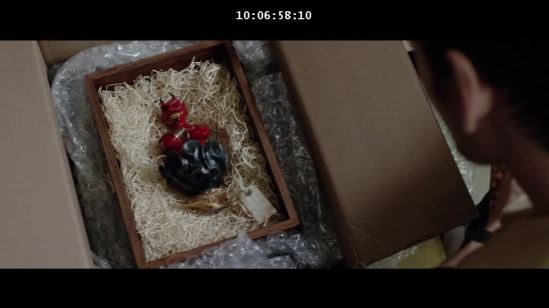
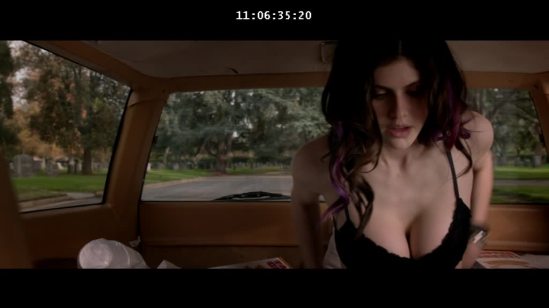
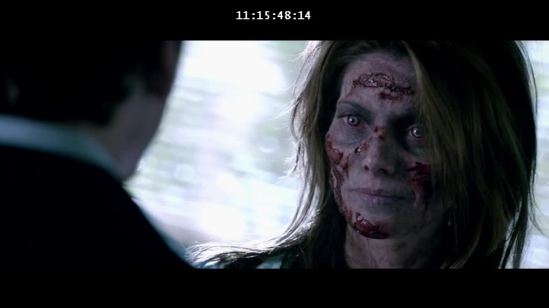
Max believes he’s found the perfect move-in girlfriend with Evelyn: she’s nice, she’s hot, she loves sex. However, when Evelyn’s over-protective, save the planet, go vegan or go home boorish attitude becomes too much for Max to bare, he attempts to break up their dwindling relationship, but ends up accidentally killing her long after making a solid promise, in front of a mysterious satanic genie figurine, to always be with her. Max’s regrets surge him into a depressive state until he meets the beautiful Olivia, the perfect opposite sex carbon-copy of himself. Everything seems to be coming together for Max until Evelyn digs up and out from her grave and returns to him as a decomposing and clingy zombie girlfriend, picking up right where their relationship left off.
vlcsnap-2015-11-19-23h13m52s0
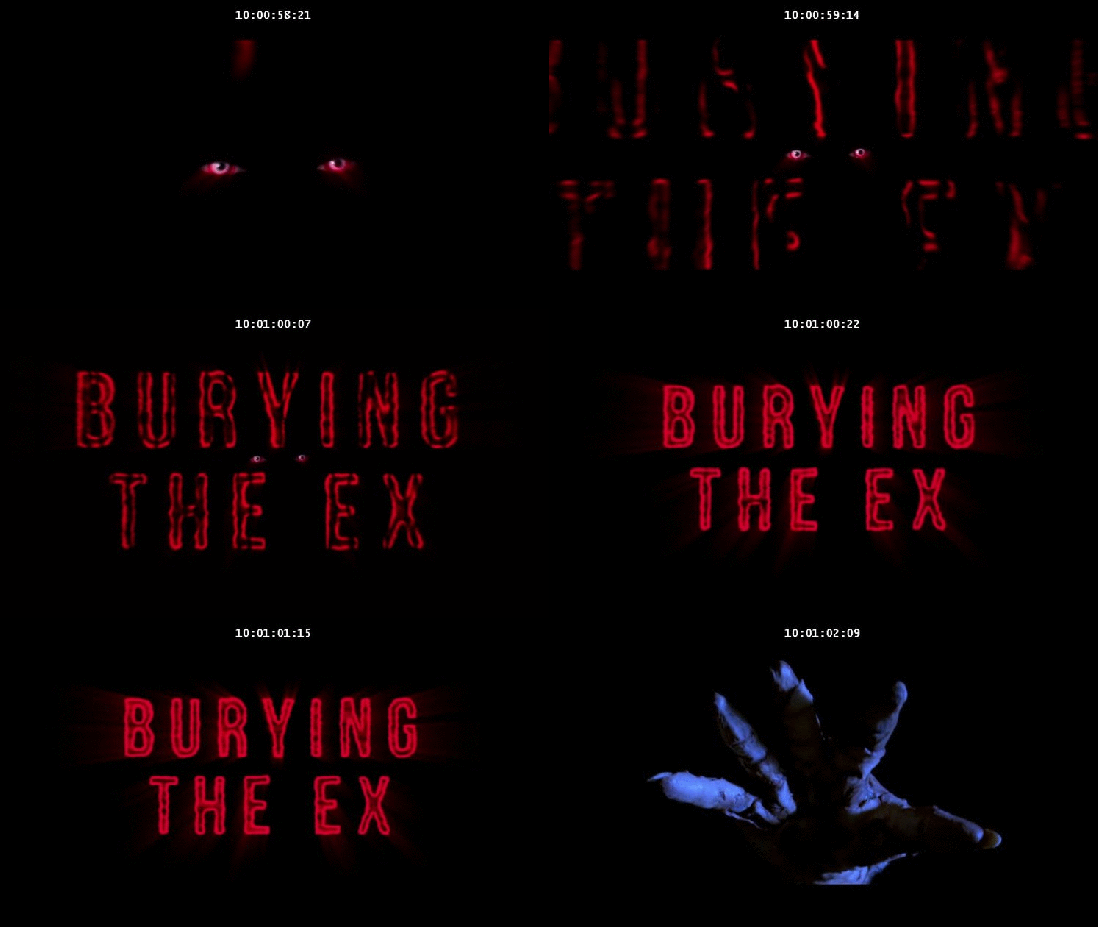
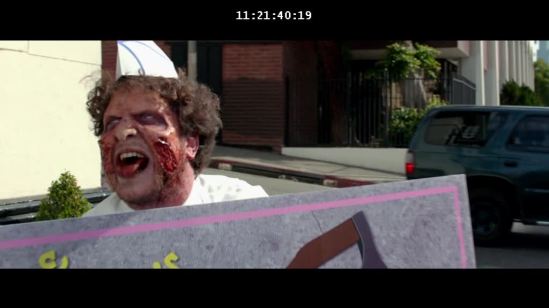
The 2014 romantic horror-comedy “Burying the Ex” is the first feature film from “Gremlins” director Joe Dante since 2009; a six-year stint that resulted in the outcome of this odd, but familiar blended genre film. Dante hasn’t kept his directorial hands too much in the horror genre pot in over two decades with the small exceptions of a “Masters of Horror” short film and 2009’s “The Hole,” the director hasn’t lost his signature touch of dishing out deadpan humor and fusing a knowledgeable palate of horror to go with it making “Burying the Ex” one of the most morbidly fascinating horror releases in the modern zombie age. Another trademark of Dante is casting a familiar face and sure enough, Dick Miller makes a cameo appearance. I swear I thought he was dead.
vlcsnap-2015-11-19-23h17m39s230
“Burying the Ex’s” cast is compiled of seriously underrated, but without a double awe-inspiring generating actors and actresses with the reboot of “Star Trek’s” Anton Yelchin headlining the way as the film’s main character Max. Max’s passiveness quality fits perfectly with Yelchin’s dry delivery and awkward mannerism style and Max’s passion for horror feels natural coming from Yelchin with the actor’s similar background work from “Odd Thomas” and the remake of “Fright Night.” However, aside from playing Chekov from “Star Trek,” this character is more of the same from the 26-year-old actor. Yelchin’s antagonist portraying co-star Ashley Greene, from the vampire romance series “Twilight,” marks well being the strong, opposing character against Max, portraying the snobby and overbearing girlfriend Evelyn. Though Greene is usually quite beautiful and stunning in other roles, the Evelyn character is a breath of fresh (or rotten in this case) air with a bit a sassy appeal. Greene casts an already slightly models-like thin appearance with features that strike well with the characters overall gaunt look, creating a well on it’s way decomposing zombie.
vlcsnap-2015-11-19-23h14m42s251
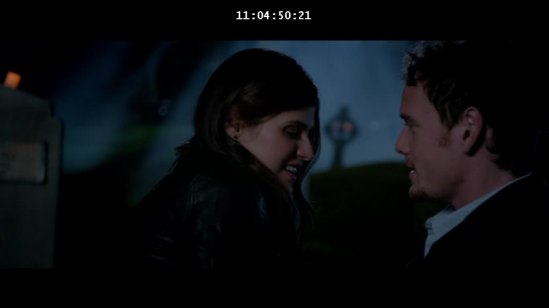
The supporting actor and actress completely round out Dante’s playfully twisted take on a stalking ex-lover. Oliver Cooper has Max’s back as his sex-crazed, exploitive half brother Travis. Cooper’s fast talking, negotiating-type personality reminisces his “Project X” work and though Cooper’s range as an actor feels limited, Travis works here as being the yang to Max’s yin. Finally, the absolutely gorgeous Alexandra Daddario’s relieves the, if any, thrilling tension and Max’s shortcomings with a quirky, adorable, and cute as hell horror-inspired malt shop owner. Though Daddario’s role might not spark a social media firestorm like her “True Detective” bare it all role, Daddario’s Olivia attempts and achieves an one-eighty, pulling off a split personality from the standard hot girl part in these types of romantic horror-comedies and showing that even the most nerdy of girls can be the girl of your dreams. Daddario is also almost unrecognizable in this role when compared to her previous works.
vlcsnap-2015-11-19-23h15m19s105
The script penned by newcomer Alan Trezza needs some fine tuning. This fantastic hard sell doesn’t fall to fault from with the cast as the story moves along at a roadrunner pace and fails, purposely I’m speculating, to explain the background on the satan genie statue that’s extends the root cause of Max’s problem. Not even a smidgen of background to alleviate any the tiniest inquiries of satan genie is revealed and just leaves the audience wondering just who sent the evil wish granting product. However, the subtle tongue and cheek manner of Trezza’s first feature revels in quirky contentment, leaving the horror and the comedy as equals. “Burying the Ex” shares a similar story we’ve all seen before – “My Boyfriend’s Back,” “Life After Beth,” “Warm Bodies” – but each of those tales told have a distinctive quality and a cast of a different caliber.
vlcsnap-2015-11-19-23h16m23s230
Since this a screener copy from UK distribution company High Fliers Films, I’m unable to review the picture and audio quality nor comment on the extras, but as far as a distributed film pickup for the company to release, “Burying the Ex” will live, and return, beyond the grave again and again and again. Dante’s romantic horror-comedy feasts on horror homage and dry wit while delivering surprisingly only little gore. “Burying the Ex” is available on UK DVD from High Fliers Films and can be purchased from most UK online retailers.

Acting Evil Isn’t Necessarily Evil. “Sins of Dracula” review!

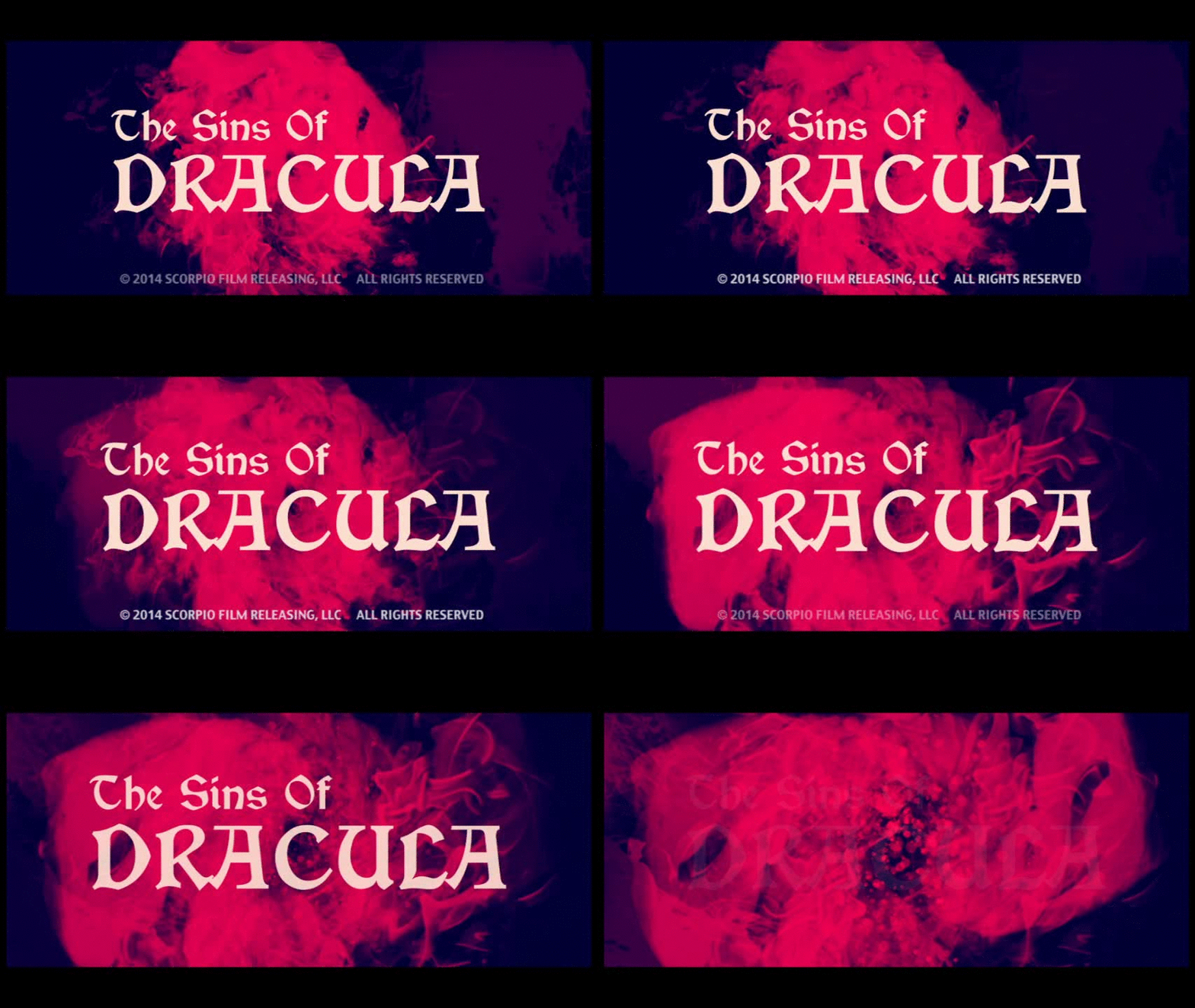
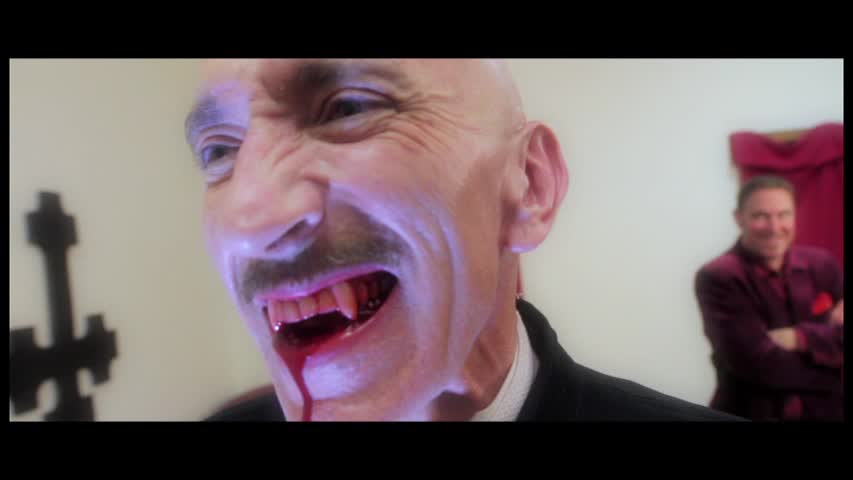
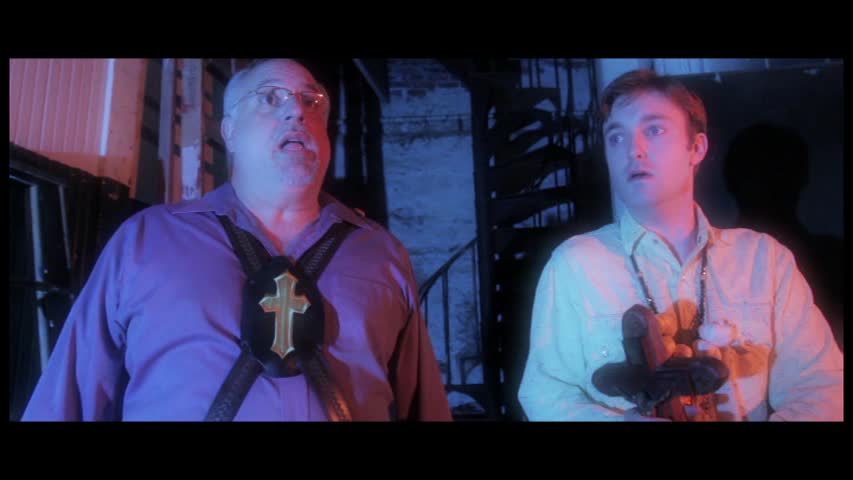
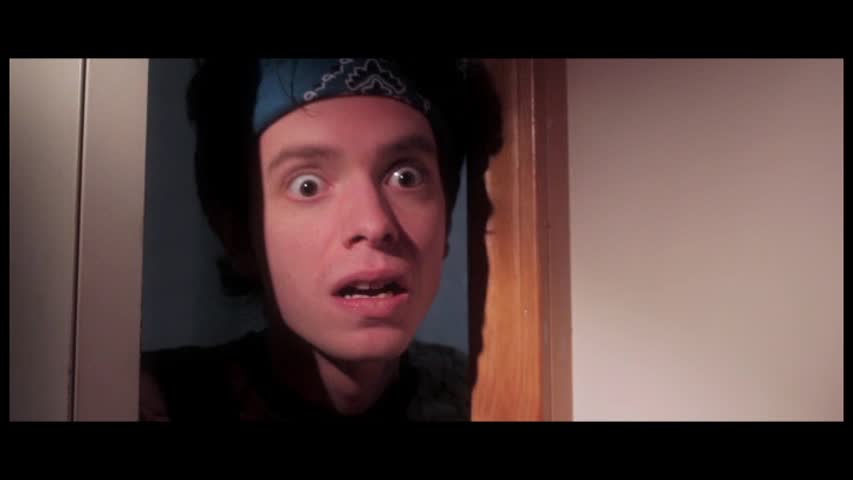
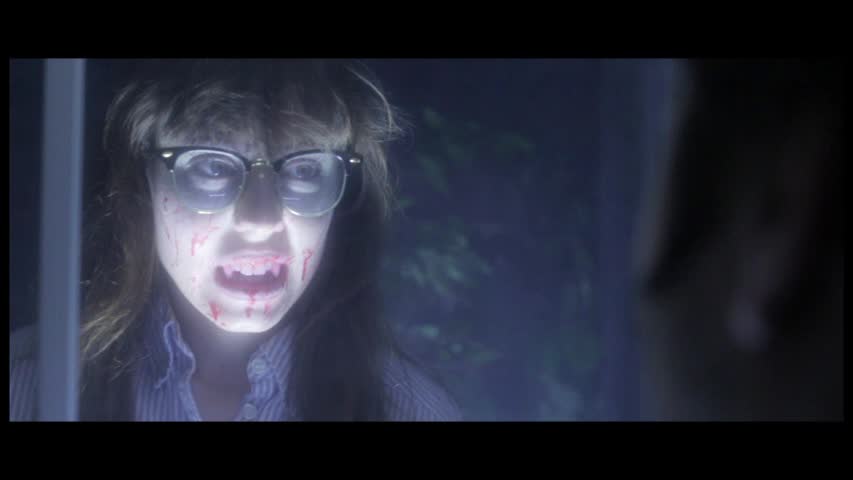
output_xnW8RJ Billy, a good church-going man, reluctantly leaves his choir to join the community theater at the request of his girlfriend Shannon.  What Billy doesn’t realize is that there are all different kinds of characters who partake in the community theater – the nerdy gamers, the anti-establishment antagonizers, the gays, and, of course, Dracula.  Yes, Dracula – the Prince of Darkness.  The theater’s director is a satanic worshipper who feeds off the sins of his actors to resurrect Dracula and start a whole new world order of vampires. vlcsnap-2015-03-27-18h46m37s8 “The Sins of Dracula” film is a homage to multiple horror genre branches. Decades including the 1970s and the 1980s source the brilliantly colored and expression heavy of the Hammer horror era and combine it with the gore of video nasties marking all present and accounted for in this ode to classic horror and that’s the creative style of director Richard Griffin and his Scorpio Film Releasing company which quickly produces many independent films that hit many media platforms. My previous film experience with Griffin includes “The Disco Exorcist” that implements film stock imperfections and the hardcore porn of the 1970’s. The other Griffin film, “Murder University,” aims to create a satirical look at a murderous cult gone collegiate. Lastly, my very first Richard Griffin film was Feeding the Masses wanted to be a social political zombie following in a George A. Romero fashion. So there is no surprise here that Griffin does what he does best, but after seeing “The Disco Exorcist” and “Murder University” both which I liked in previous reviews The Disco Exorcist review here and Murder University review here, “The Sins of Dracula” warranted high hopes for Griffin to do something new and cut ties with the old, regurgitated scenes. vlcsnap-2015-03-27-18h48m14s212 Enough about Griffin, let’s talk about “The Sins of Dracula.” Just from reading the synopsis alone, one can conclude that this horror-comedy will come off as a bit outrageous, delving into and dissecting the sins of certain kinds of people who walk in all kinds of life and exploiting them for the sake of our good boy Scott’s heroic journey and also exploiting them to awake the evil Dracula. The story doesn’t waste any time putting to waste the sinfully deemed characters and going on a Godsend vampire hunting spree. At the end, most peoples’ personal views are made light of in a satirical fashion. vlcsnap-2015-03-27-18h49m10s0 Michael Thurber, a staple actor of Griffin’s, does a solid job as a Hammer horror Dracula mirroring the likes of the vampire exposed Christopher Lee. Steven O’Broin, as Lou Perdition the satanist devotee theater director, had some excellent lines and quips and made his Vincent Price-esque character enjoyable when on screen. Another of Griffin’s minions, Aaron Peaslee pranced around fairly well as a gay theater actor and his raunchy sex scene with fellow actor Johnny Sederquist was the most controversial aspect of the film. I can’t say that about the other characters. Other characters fell a bit flat and didn’t convey their characters intentions well enough to pull off a spoofy-stereotype. The fact that their characters where put to death way too early in the film doesn’t give the character a chance to make their presence more well established. vlcsnap-2015-03-27-18h47m22s202 The blood letting could have been, well, bloodier, but there is enough letting to super soak and saturate one’s thirst. Some of the scenes are restaged from the likes of “Fright Night” and “Buffy the Vampire Slayer” the movie. Like I was saying early in the review about the film’s originality, the lack of new material makes the likelihood of repeating a viewing of “The Sins of Dracula” very unlikely which is difficult to say about a solid homage. vlcsnap-2015-03-27-18h49m25s152 “The Sins of Dracula” is good for a one time single viewing and but lacks new and fresh material to really captivate attention. The MVDVisual DVD cover also doesn’t explicitly want you to go out and rent this title, but the disc art is amazingly detailed and you shouldn’t judge a film’s material by the cover. I do strongly suggest to check out “The Sins of Dracula” if you’re into the Hammer horror scene and into Griffin’s Quentin Tarantino homage style of directing.