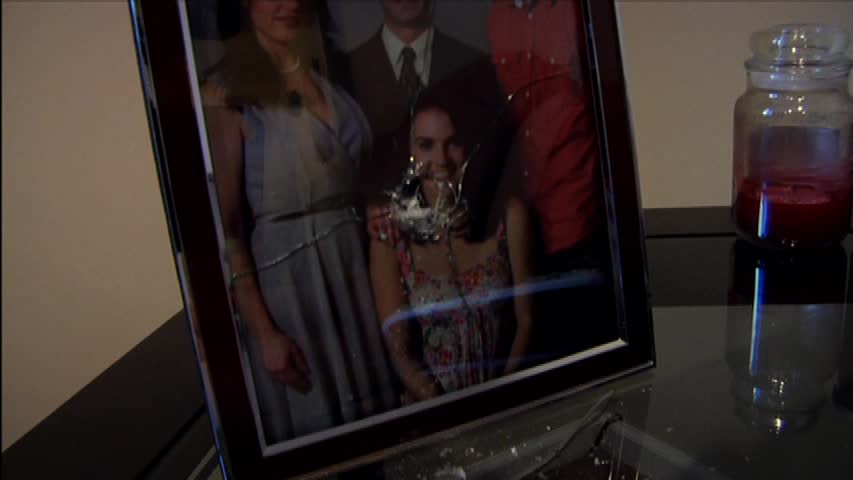
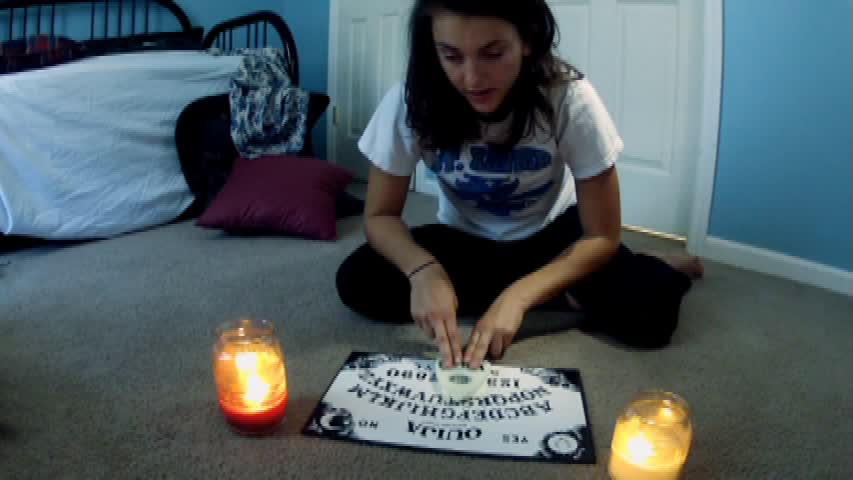
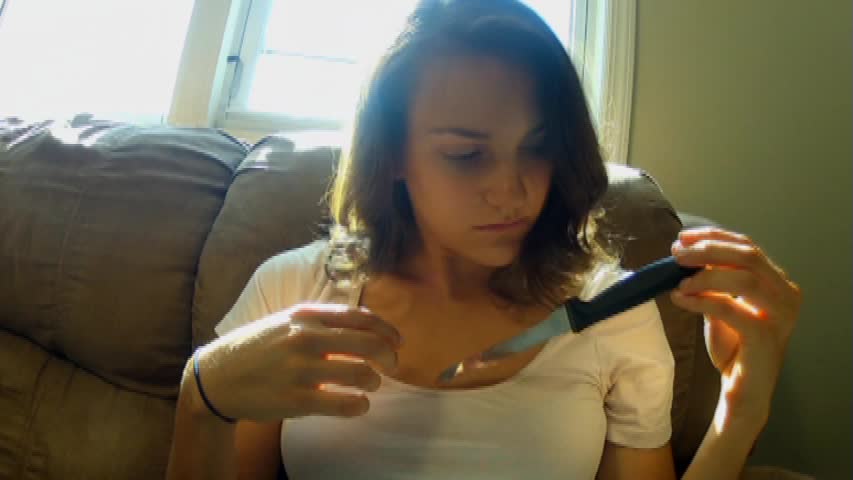
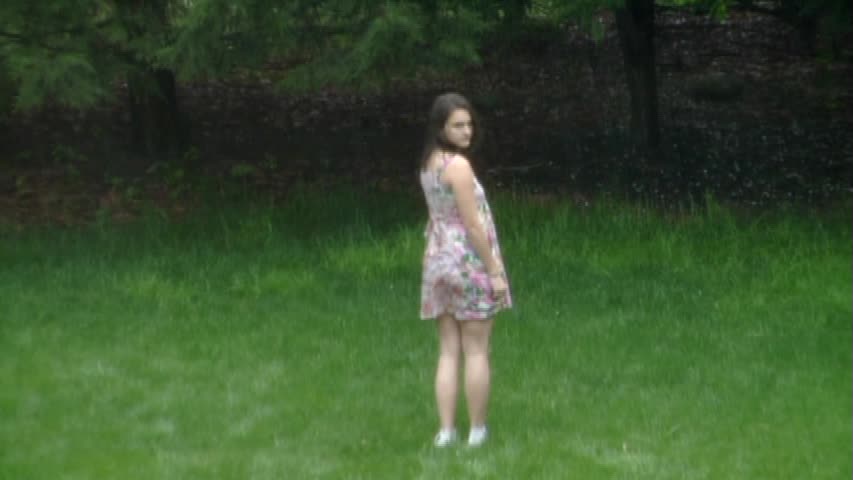
Married couple Jennifer and Luke move to Jennifer’s small hometown in Kansas suburbia after an incident with Jennifer’s pregnancy at their city home in Chicago causes concern for the baby from both Luke and Jennifer’s mother Meredith. Feeling not at home and isolated, Jennifer quickly detaches herself from everyone around her, but when spooky occurrences start to slowly reveal in their new home, Jennifer desperately needs her family and friends to eagerly believe that the house is haunted. When everything firmly believes that Jennifer might be suffering from another pregnancy episode like in Chicago, the young woman experiences a psychological horror that drives her into a blurred line of what’s she seeing is either frighteningly real or a nightmarish psychosis.

“The House on Pine Street” is a chilling, effective thriller helmed by twin brothers Aaron and Austin Keeling, who both also co-wrote the film with newcomer Natalie Jones. The Keeling twins, along with numerous short film cinematographer Juan Sebastian Baron, were able to capture alluring framing and uncomfortable camera angles, consisting of the use of medium and close up shots, that suit the film’s unsettling and haunting nature. The poetic beauty of the vibrant exterior contrasted with the bleak and rundown features inside the Luke and Jennifer’s home tell the harrowing story of where the dread begins and lingers to languish and the brothers were really able to set the entire pace of the film, prolonging out the story’s suspense, and able to create an engaging tale within about a two month time spatial difference and have it laid out logically.

Aside from the obviously talented crew, the phenomenal cast ranks this lesser known 2015 ghost film near the top. Emily Goss embodies Jennifer’s loneliness and fear through the subjection of constant ghastly occurrences. Whereas Jennifer’s husband Luke played by Taylor Bottles, even with the slick and enduring hipster hairdo, feeds off Goss’s non compos mentis situation, making the character Jennifer drown in darkness without any compassion. Personally, Jim Korinke captured my favorite performance as the neighborly quasi medium. With no acting credit to his name, Korinke’s ability to keep up and maintain with a younger, more experienced acting talent is beyond remarkable on screen and fun to watch.

Much like the film’s generic title, the story is simplistic; however, the story is without a mind blowing twist which most of Hollywood gets off on. “The House on Pine Street” speaks in underlining messages. The motif of energy keeps reoccurring throughout much of the plot, sparking the conversation that negative or positive energy will be the inevitable karma influence. If a person emits negative energy, bad juju will be the result and visa versa. While the story hovers around Jennifer’s locus, her negative, pessimistic attitude contributes to the tribulations toward other characters. The Keelings were able to subtly convey the energy message without being blatant and expositive.

“The House on Pine Street” works and works well regardless of the overused and lackluster title that has become more repetitive and an unfortunate eyesore to those scouring the retail racks, looking for an engaging thriller, but the Keeling duo are a pair of cinema prodigy twins, who with the right cast and crew can take a smaller project, like this, and polish it into gold. Second Sight distribution is set to release this spin-chilling “The House on Pine Street” thriller onto DVD home video in the UK on February 1st. Just in case you’re not completely sold, take it from me that goosebumps will occupy every inch if your chilled flesh when watching in the dark and the light.
Tag Archives: ghost
A Video Diary of Evil. “The Death of April” review!

Megan Mullen, freshly out of college life, feels a strong urge to pick up and move from her comfortable California family home to the new surroundings of New Jersey. She can’t explain her why to move, but she quickly finds an apartment in East Rutherford where she settles in easily, creates a video journal for her friends and family back home, begins her new job as a school teacher, and gains a wonderful boyfriend. Everything seems to be going perfect for Megan until unexplainable, seemingly paranormal, acts happen in her apartment: doors open and close mysteriously, objects move on their own, and her soul doesn’t feel like her own. As she continues to her video journal, she further believes her apartment was once rented by April, a young girl similar to Megan who ended up brutally murdered and found on a riverbank, and that she is haunting her. This is Megan’s story told through a documentary revealed by her friends and family to the supernatural speculation of what causes Megan’s torment and downfall.

In the spirit of new releases on or around horror’s big night of Halloween, Director Ruben Rodriquez’s 2012 paranormal mockumenatry “The Death of April” comes to life on for the first time on DVD from MVDVisual. Similar to the “Paranormal Activity” series, the pseudo documentary about a dangerous, abode dwelling spirit or spirits bombarding their supernatural havoc upon helpless inhabitants. While the release time is appropriate and has a modest appreciation for creepy atmospheres, “The Death of April” fails to bring something new to the genre table and I can’t see the easily overlooked “The Death of April” being the catalyst to spark more interest in a ghostly genre that becomes overpopulated, by the major studios, during the month of October.

Backed finically by the Mojo Creative Group that was founded by Ruben Rodriguez, the mockumentary introduces a modest talent of actors and actresses including Katarina Hughes as Megan Mullen. Hughes, in her first feature film, delivers the much needed energy to a slow, stagnant script, but the contrast exaggerates Katarina’s overzealous happy-new-girl-moving-to-a-different-coast attitude. Her co-stars Adam Lowder as her brother Stephen Mullen, The Knick’s Chelsea Clark as her best friend, RayMartell Moore as her boyfriend Tim, and Stephanie Domini as her mother, who by the way looks almost the same age as Megan, sold their story, their take, of Megan’s downward events. That being said, Lowder, Clark, Moore, and Domini couldn’t lift the script out of the deep trenches of the uninteresting and mechanical motions.

The script, which was also written by Ruben Rodriguez, could be considered to contain two interpretations, one literal and the other more concealed. The more literal interpretation is my least favorite of the two. Megan’s family constantly disowns the fact that she might actually be haunted by an apartment spirit; in fact, her family and friends negatively pelt her with denials and accusations, never once considering Megan’s theories of an aggressive April spirit. This is where the script becomes redundant as Megan’s brother Stephen and also her mother Stephanie reiterate over and over about how close their relationship with Megan was and how she had firm family roots in California and also proclaim the excuses of how she’s looking for attention or not coping with a new surrounding very well. Rodriguez’s script suffers by not displaying alternate ways in exploring how her family and friends should handle Megan’s paranoia or paranormal problem. Even when they’re is undeniable video proof with the video starting to distort and capturing uncontrollable movements from inanimate objects, nobody believes Megan and that would drive anybody to the loony bin. The second interpretation with, perhaps, a more underlying metaphor is that Megan is slowly going nuts. Her brother Stephen does mention her previous slightly creepy issues with Megan before her big impulsive move to the east coast. Almost like her impulsiveness and her energy-filled antics seemed manic and her sanity practically dissolved when she moved thousands of miles away from her support group in California. Megan’s mind could have invented April and her family, knowing that she’s had weird issues in the past, chalks this up to just being another mental issue. Of course, the video diary proof, even with her brother and friend witnesses, nearly excludes the second theory and that her “desire” to move far away from her family stems from April pulling her in that direction.

“The Death of April” won’t make waves on the PKE meter. The picture quality of the MVDVisual and ITN distribution DVD release looks clean considering that most scenes had intentional video quality posterization and distortion for the web and home video diary appearance. The front cover art is slightly misleading with a foreboding, rundown gothic style house in the background when actually Megan lives in a sectioned off duplex apartment in a suburban neighbor of a New Jersey home that doesn’t look necessarily evil at all. Also, who I’m guessing is spirit of April on the front cover with a Ouija board in her clutches sports sexy booty denim shorts as if to lure a certain audience to the release. We’re not sold on “The Death of April” as too many before it’s time have come across and planted their seed and sprouted firm in place.
Evil Reeks in an Old Magician’s Mansion. “Death’s Door” review!

A young group of people are mysteriously texted an address for an unknown party. When they arrive, the address takes them to a dilapidated mansion with innards displayed as if time has ceased to exists. When the group tries to leave, all the doors to the outside won’t open, condemning them to the horrors of a magician’s vengeful spirit and his very large and frightening assistant who looms around the mansion’s endless corridors. As the group continues to butt against each other in distress and disbelief, one-by-one they fall victim to the magician’s gruesome parlor tricks behind every door and the only way out of the mansion may be dependent on their families’ legacies.

With a premise similar to the 1999 remake of “House on Haunted Hill” where a group of people are mysterious invited to a creepy house and end up in a death trap, I wouldn’t say director Kennedy Goldsby’s “Death’s Door” aka “The Trap Door” is entirely, 100 percent unique. In fact, much of the film is undeniably the same compared to William Malone directed remake, yet less entertaining and without an all-star cast and a vaster budget. “Death Door” lures with the headliners of more attractive and experienced stars with the Jamaican-born movie and television actor Obba Babatundé and the “Friday” franchise actor, and overall a big, badass monster of a man, Tommy “Tiny” Lister. Yet, like most smaller projects, I’m sure Obba’s and Tiny’s handful of scenes were the majority of the budget pie, leaving a few dollar bills at the bottom of the barrel for special effects that were desperately needed for a film about a ghoulish magician.

The effects were completely inadequate and can’t even equate to the same stature used for “House on Haunted Hill.” Off screen deaths, quick edits and cuts, camera angles, shoddy CGI, the over use of red tints, shaky camera, flash backs, and a prop skeleton tried to sell plausibility when really just added to absurdity. Aside from the lackluster effects, the Goldsby penned script logically doesn’t flow and fails to develop acts. While seeking for an exit, separate groups of characters aimlessly wander the house, trying door after door, and then the next scene could be one of those characters mixed in with another separate group, creating some continuity confusion. Also, much of the script settles to a stagnate, housing an unnecessary long montage of the group being bored, napping, looking glum, or walking from one part of the room to another. To put the cherry on top, a random nude scene is oddly inserted into a montage into the magician backstory portion. There’s no telling who the naked breasts belong to or why they’re naked to even begin with as the exploitive and titillating shot crops out the head and the setting is awfully generic, not placing the body in any familiar surroundings related to the mansion.

I will say that very few of the acting skill sets were not at a total loss. The fast-talking, wise-crackin’ Bruce played by Chico Benymon was entertaining; the character’s angst-fllled stand-up-comic style character goes against the grain, fleeting any ideas of ghosts or any form of malevolency. Tommy “Tiny” Lister is always top notch. The big man doesn’t even have to say a word and he’s downright menacing, even if his character, Jomo, stuffs emotionless Latina’s into tight spaces and fails to soil the pants of the mansion’s guest when quietly walking around them. Sarah Wagenvoord, who I was hoping had the mysterious naked breasts scene due to her massive…well, you know, should have played a more prominent role du in part to her character’s outcome. Actors Michael Bernardi, Felix Ryan, and Danielle Lilley maintained an average performance through a mirco-budget production. The rest foundered to capture any kind of terror or despair or just even trying to be a normal character, overacting the parts as if trying to put passion into reading straight from the script.

The video quality of the MVDVisual DVD comes with hardly any flaws in the video stock or any loss in the natural coloring. The stereo audio is a bit unbalanced between the LFE and the dialogue tracks, deducing to some loss dialogue over the pounding hammering sounds. The extras includes the Kennedy Goldsby directed music video of “Shorty Wassup” by Hip-Hop artist Sizzol Pop. The last piece of bonus material is a behind-the-scenes featurette from the actual haunted house set where the crew has personal encounters with the spirits. “Death’s Door” is a fools gold, a trap, that promises deadly snares, haunting ghoul, and many scares. The ending comes to a complete halt with only tall tales of what might have dastardly happened to most of the characters in the rickety mansion. I would recommend far better old mansion spook stories.
Evil Review. DreadOut: an Indonesian Horror
Oh how I miss the good old days of horror games on the Playstation 1 and 2. Sure we may see the genre coming back this generation but it just doesn’t feel the same. All the classic horror games we have played are either dying, abandon, or just kept from us like how Nintendo is handling the Fatal Frame series. We shall not give up hope though, as there is a game currently out now on steam that is oozing with nostalgic horror goodness!
DreadOut is an Indonesian survival horror game that was developed and published by Digital Happiness. The game is heavily inspired by the Fatal Frame games and is centered around a group of students who are trapped in a cursed and haunted town. DreadOut focuses on real life Indonesian folk lore and ghost stories, much like how Slender: The arrival is based on western folk lore character ”Slender man”.
I was not kidding about how this game oozes nostalgia. The atmosphere of DreadOut feels just like a Fatal Frame game, with it’s dark atmosphere and slow paced gameplay. When it comes to graphics, DreadOut is visually lacking. It’s graphic are very low res and look like what you might see on a playstation 2 or PSP game. Still the graphics have a charm and add to the creepy feel of the game and I love it! The design of the ghosts is what makes this game terrifying, nothing like walking down a pitch black corridor with nothing but your phone’s light on and then suddenly having a ghost based on a real life folk tale scare you! This just makes the game too bad ass.
The gameplay is very simple. It plays pretty much like a Fatal Frame game, it is in a third person perspective and you must use your smart phone to battle ghosts and find hints to solve puzzles. The game does promote exploration since there are collectibles for the player to find in order to unlock achievements. The player can also collect power items that will aid them in boss battles. The game has two endings; both good and bad. So make sure you try to get the true ending on your first play through so things can make a bit of sense.
Difficulty wise this game can be hard for new players. I admit that I died alot during the first boss battle, but this is a good thing since it forces the player to find out what the bosses weakness is and use it against them. Once you know how to defeat the enemies the game is quite easy to play. Unlike classic horror games, this game is not very long and that was kind of a bummer for me. The game is about 4 hours long, even shorter if you rush through it. For me I wished it was longer since I was starting to get so immersed into the story and wanted more.
For music in the game, it was amazing. The soundtrack fits perfectly and sounds so awesome during boss battles. My personal favorite track has to be the cover of Gloomy Sunday by Sarasvat; Which serves as the game’s main theme.
All I can say about DreadOut is that the game is amazing and I hope to god we get a sequel. There is so much unanswered questions to the story and so much content here to make a franchise off of. My personal rating for DreadOut is a 8/10. My only complaint is that the game was way too short but with the story, music, and some pretty cool innovative parts in the game that I wish we saw in other horror games made up for the game’s length.
So if you loved the old Fatal Frames, Silent Hills or even Resident Evil games. Then please go play DreadOut you won’t be disappointed.
DreadOut is available on Steam and Playstation 4 for $14.99
Trailer: The Canal
David life is perfect. He has a beautiful wife and a wonderful, young boy. When David discovers that his home has an ugly past of ghastly murders, that’s when things start to fall a part. His marriage falls through the cracks and he begins to lose his sanity which he blames everything on an entity that lives in his house – the entity in the form of the murderer whom he believes committed the heinous murders at the turn-of-the-century.
I’m not one for overseas ghost films, but “The Canal” looks sharp and really seems to get into your mind, questioning whether David is actually seeing a ghost or he might really be going insane.
“The Canal” hits select theaters, iTunes, and VOD October 10th and starring “Hellboy’s” Rupert Evans.