This EVIL, Straight-Razor Killer Has a Novel Idea! “Tenebrae” reviewed! (Synapse / 4K-Blu-ray Combo Set)

2-Disc 4K UHD and Blu-ray Set Now Available of Dario Argento’s “Tenebrae”

While on a media book tour for his latest popular crime thriller novel, “Tenebrae,” American novelist Peter Neal is swiftly entangled in a killer’s puritanical wrath shortly after landing in Rome.  Using Neal’s story as an inspirational guideline to rid the world of what the fictional book labels as depraved people, the killer brutally murders women closely resembling characters in Neal’s book with a straight razor and sends Neal a deranged poetic message shortly after each death.  Police are on the case but always once step behind, even when the murders have seemingly stop connecting to the pages of Neal’s novel.  When the writer investigates by running through the list of possible suspects, the writer in him goes rogue by setting off to solve the case himself that would sensationalize and authenticate him as a crime writer, but the deeper Neal directly involves himself, the more the grislier the murders become and they’re starting to come closer to home than before. 

Dario Argento is unequivocally one of the best masters of horror for half a century, writing and directing not only some of the best Italian crime-mystery Giallos, splashed with hue vibrancy and caked in gruesome blood splatter, but also writing and directing those same films with major success internationally as his films connect with a global audience.  “The Bird with the Crystal Plumage,” “Deep Red,” and “Suspiria” have skyrocketed the filmmaker within the first decade of movie-crafting and Argento would not have been who is now without the guidance and the financial foundation constructed by father, Salvatore Argento.  Before his death in 1987, Salvatore produced one more of his son’s ventures in 1982 with “Tenebrae,” an emblematic mystery that brings Italian and American actors into the fold of Argento’s violent pulp puzzler.  Argento’s younger brother, Claudio, co-produced the feature under the Sigma Cinematografica Roma production company.

The Italiano-Americano production casts a pair of native New Yorkers in Anthony Franciosa (“Death Wish II,” “Curse of the Black Widow”) and John Saxon (“A Nightmare on Elm Street,” “Black Christmas”) who regularly crossed over the Atlantic for roles in international pictures.  Franciosa plays the novelist Peter Neal with Saxon as Neal’s newly hired agent Bullmer.  Their portrayed amicable relationship succeeds expectations of client and manager professionalism, but a good publicity campaign can be torpedoed by a sadistic killer with a throat cutting fetish and Roma’s best officers on the case intruding into the Neal’s personal promotion with Detective Germani, played by spaghetti western regular Giuiliano Gemma (“Day of Anger”), and his partner, Inspector Altieri, played by Carola Stagnaro (“Phantom of Death”).  The third English speaker is John Steiner (“Caligula”), a proper Englishman setup as an Italian television host on the docket to interview Peter Neal’s latest release success.  Steiner becomes an early favorite as the suspected killer with his odd pre-show questioning that falls in line with the Killer’s motives, but he isn’t the only person of interest as Neal’s estranged lover Jane (Veronica Lario) holds a lover’s quarrel with the writer who has seemingly become intimately close with his personal assistant Anne (Daria Nicolodi, “Deep Red”).  A conglomerate of characters gyrate Argento’s maelstrom mystery, each exhibiting profound performances that make each rich in their own right, and fill out with an assemblage of robust supporting characters diffusing through the story with Ania Pieroni (“The House by the Cemetery”), Lara Wendel (“Ghosthouse”), Eva Robins (“Eva man”), and Mirella Banti (“Scandal in Black”), the model most infamously on the front cover of most home video releases and poster one sheets with the iconic neck-sliced open and dripping blood along with her wavy hair suspended in a pose of vivid void and color.

“Tenebrae,” in Latin translates to darkness, describes Argento’s post-“Suspiria” feature intently.  Giallo lives within this time capsulated enigmatic madness, color-coated and visually complex to become an easy pill to swallow amongst all others in the Italian-reared niche.  Accompanying all the hallmarks of a Giallo construct – the killer’s gloved hands in POV, psychosexual tropes, mental instability exposures, violent and gory – Argento also impresses us with baroque mise-en-scene of lavish houses, detailed interiors, and extremely broad, emotionally phrenic individuals.  We also receive technical style wonders like a long boom shot that cranes up a house exterior to follow the idiosyncratic and opposing activities of two presently quarrelling lesbian lovers on a dark, stormy night in a tensely presage moment mixed with the synth-rock sounds of the “Goblin” theme track.  “Tenebrae” is chic in its ugliness and the patience Argento shows is formidably impenetrable without being flawed with lingering stagnancy.  While wallowing into what we’re led to believe, red herrings and other subterfuges to throw off audiences’ keen-to-solve sniffers, the story stirs a cauldron of coherent progression that is, more often than desired, lost in most gialli trying to weave through an intelligible punchy crime-mystery without becoming disoriented by the twists, turns, and topsy-turvy outcomes.   

“Tenebrae” hits 4K onto a 2-Disc, UHD and Blu-ray combo set from the genre-leading distributor, Synapse Films. The HEVC, mastered in Dolby Vision, encoding 2180p UHD and the AVC encoded 1080p high-definition Blu-ray are presented in a widescreen 1.85:1 aspect ratio in both the English and Italian versions of the feature.  One of the more gorgeously restored versions ever to be presented, with sharp delineation and organic popping colors within the narrow margins of infrequent gel lighting, the near flawless original negative is greatly elevated by Synapse’s ultra high-def facelift that resound the lavish textures of various sets, the expressional details of the characters’ face, and the glistening shine of the spraying blood.  There’s real balance between the colors in this presentation, offering not only a wide variety of hues but a great display of the mix.  Gels are not overly used and are more key lighting spotlights to heighten tension or introduce moods on an almost subconscious level.  Both English and Italian versions score a lossless DTS-HD Master Audio 2.0 mono.  This release caters to the very suspense Argento acoustically and phonically propounds that, in the same regard to the eyes, places viewers’ ears right in the middle of the action.  Every sound is distinct and unassuming during the throes of violence, a cleanly serrating effect that compounds killer consternation of being everything, everywhere, all at once.  Typical of the time and cost-efficient ADR usually retains some dubbing disharmony, but “Tenebra’s” tracks are neatly synchronous with Anthony Franciosa and John Saxon’s recordings timed exact and as if captured in the scene.   Some of the dubbing isn’t as in the bag, such as with Giuliano Gemma’s recording that’s does denote that space in between intensified by likely another voice actor’s reading overtop Gemma’s actual dialogue.  UHD offers English SDH on the English version while the Italian version has just regular English subtitles; the Blu-ray disc has the same.  Hours of bonus content, identical on both formats, begin with an audio commentary by Dario Argento: the Man, the Myths, the Magic author Alan Jones and film critic/historian Kim Newman, a second audio commentary by Dario Argento expert Thomas Rostock, and a third audio commentary by Maitland McDonagh, author of Broken Mirrors/Broken Minds:  The Dark Dreams of Dario Argento.  The fun doesn’t end there with a 2016 feature-length documentary “Yellow Fever:  The Rise and Fall of the Giallo” with interviews from Dario Argento, Umberto Lenzi, Luigi Cozzi, and Ruggero Deodato amongst the biggest names in film critic authoritarians, a newly edited archival interview with actor John Steiner, a newly edited archival interview with Maitland McDonagh, an archival featurette Voices of the Unsane with “”Tenebrae’s” Dario Argento, Daria Nicolodi, Eva Robins, Luciano Tovoli, Claudio Simonetti, and Lamberto Bava interviews, an archival interview with actress Daria Nicolodi, an archival interview with writer-director Dario Argento, an archival interview with composer Claudio Simonetti, an archival introduction from Daria Nicolodi, an international theatrical trailer, the Japanese Shadow trailer, an alternate opening credits sequence, “Unsane” end credits sequence, and an image gallery to wrap things up.  Inside the rigid O-slipcover, graced with a high quality and beautifully macabre illustration rendered by Nick Charge, is a Synapse Films’ black, 4K UHD labeled Amaray case with a double side disc lock and a reversible cover art with the Nick Charge graphic as default underneath the slipcover with the reverse side the Synapse Films’ standard Blu-ray cover art pulped with a famous death scene in pop art color. The insert houses a Synapse Films’ catalogue, and the discs are pressed with two notable kill scene frozen moments pulled in still image form. Feature runs at 101-minutes with an uncut presentation of the feature with a region free playback on both formats. ”Tenebrae” is Dario Argento in a cracked-up nutshell, paradoxically beautiful and horrible and burgeoning with suspense and color. The restored and remastered Synapse Films’ UHD and Blu-ray set is equally as such in its gorgeously grotesque packaging of film, its director, and its legacy that will outlive us all.
2-Disc 4K UHD and Blu-ray Set Now Available of Dario Argento’s “Tenebrae”

No Sam Raimi. No Bruce Campbell. Just the EVIL! “Evil Dead Trap” reviewed (Unearthed Films / Blu-ray)


Nami, a Japanese late night show host, is seeing her ratings dipping.  Though not in danger of losing her all-female produced show, Nami decides take her team on an investigation of a mysterious snuff tape that was mailed to her specifically.  Left for her is a bread crumb trail of directions to an abandoned military base, Nami and her crew explore the campus’s rundown structure, searching for evidence, a body, a story that they can televise.  Ignoring the dangerous presence around them, they dig deeper into the dilapidating labyrinth where they horrifying discover something waiting for them laid out in a cruel plan of deadly traps with a maniac pulling at all the strings. 

Bred out of a pedigree of pinkusploitations and a nation’s crisis of identity after the Second Great War, “Evil Dead Trap” is a greatly symbolized Japanese machination tale helmed by pink film director Toshiharu Ikeda (“Sex Hunter,” “Angel Guts:  Red Porno”) and penned by an equally historical pink film screenwriter and “Angel Guts” manga series creator Takashi Ishii (“Girl and the Wooden Horse Torture,” “Angel Guts” series).  Also known under its original Japanese title, “Shiryô no wana,” as well as, and my personal favorite, “Tokyo Snuff,” in Spain, “Evil Dead Trap’s” smorgasbord of rape, torture, and gory death naturally shocked viewers upon release and continues to do so as one of J-Horror’s branched out films that segued out from the brutal and depraved pink film inspired context into the new longstanding ghost genre we’ve seen over the last few decades with “Ringu” (“The Ring”) or “Ju-on” (“The Grudge”).  The production company Joy Pack Films, behind the 1980’s obscure Japan films, such as Genji Nakamura’s “Go For Broke” and Banmel Takahashi’s “Wolf,” houses the “Evil Dead Trap” from executive producer Tadao Masumizu.

If you recognize a couple cast members, or maybe just their naked bodies, then there’s something depraved about you!  With all kidding aside, but no seriously, if Rei (Hitomi Kobayashi) or Kondo (Masahiko Abe) look familiar, then you my friend are pink film aficionados as Kobayashi has starred in “Hard Petting” and “Young Girl Story” and Abe was in these pink film hits the “Pink Curtain” trilogy and “Female College Dorm Vs Nursing School Dormitory.”  If these faces didn’t touch you in any kind of sensual way, no worries, leading lady Miyuki Ono brings the star power.  The “Black Rain’s” Ono plays Nami, a go-getter television host/personality with her sights set on ramping up her late night show’s ratings, but also sucked into the posted snuff film’s darkest allure that’s personally calling her into to a precarious story lead.   Nami could also be a homage to one of screenwriter Takashi Ishii’s manga-inspired pink films entitled “Angel Guts: Nami” and the title might not be the only aspect paid honor to with that particular Nami written with a journalistic vocation drawn into and obsessed with a serial rapist’s attacks, making a striking parallel between the two stories that are nearly a decade apart. Eriko Nakagawa and Aya Katsurgagi fill out Nami’s investigating team as Rei and Mako. As a whole, the characters lack personality; Rei and Kondo tickle with relationship woes that are snuffed out before fruition, Rie’s timid innocence barely peaks through, and Nami and Mako’s thicker bond compared to the rest of the team is squashed to smithereens way before being suckled into note worthy tragedy. This late night show team has been reduced to slasher fodder and, honestly, I’m okay with that as we’re only here for the deadly traps. Noboru Mitani, Shinsuke Shimada, and Yûji Honma, as the mystery man looking for his brother, complete “Evil Dead Traps” casting.

“Evil Dead Trap” boasts a melting pot of inspirations, a mishmash of genres, and spins a nation’s split identity variation crowned in aberration. Diversely colorful neon-hazy lighting complimented by a Goblin-esque synth-rock soundtrack from Tomohiko Kira (“Shadow of the Wraith”), Toshiharu Ikeda shadows early Dario Argento inside and outside the popularity of the Italian giallo genre as the “Evil Dead Trap” murder-mystery horrors resemble more of a westernized slasher with a killer concealed behind a mask stalking a fringed, neglected compound in a conspicuous outfit. While the killer dons no hockey mask or snug in a mechanic’s jumpsuit, an equally domicile, yet more calculated, antagonist taunts more brains than brawns, especially with the severity of traps that seemingly float from out of nowhere. The fun is chiefly in the imagination of how the trap designs operate in the void of physics of a slasher fodder film so wipe clean the Jigsaw and the “Saw” films from your mind completely and relax to enjoy the outlandish kill scenes. Some of the kills are imperialistically inspired by Imperial Japan, that is, to blend the wartime nation’s atrocities with how the proud country wants to distance itself from that old-fashion, war-criminal, stoically perverse superstratum layer, but that’s were “Evil Dead Trap” pulls for most of the juicy parts as well as supplementing with Argento lighting, some, believe it or not, “Evil Dead” elements of that menacing presence bulldozing through the spiritual world, and an divergent climatic finale stuck to the narrative body that’s akin to pulling off the head of a doll and replacing it with T-Rex head’s. The uniformity quells under the pressure of how to end Nami’s and her attacker’s coda with pageantry weirdness that’s typical status quo Japanese cinema. Lots of symbolism, little modest explanation.

Get caught in “Evil Dead Trap” now back in print and on Blu-ray courtesy of Unearthed Films, distributed by MVD Visual, as part of the extreme label’s Unearthed Classics spine #5. The Blu-ray is presented in a matted 1.66:1 aspect ratio, a format rarely used in the States but widely used in other countries. Reverting to the 1.66:1 from Synapse’s 1.85:1 crop, Unearthed Films showcases more of the European feel, heightening that colorful vibrancy of the Argento-like schemes. Image quality has peaked on this transfer with natural grain with the 35mm stock, but details are not granularly sharp in an innate flaw of the time’s equipment and lighting. Shinichi Wakasa’s unobscured practical effects heed to the details and don’t necessary suffer the wrath of miniscule soft picture qualities when you’re impaling someone or birthing a slimy evil twin…you’ll see. Add in Ikeda’s wide range of shooting techniques, you’d think you’re watching Hitchcock or Raimi and the focus really lands there with the differently camera movements and techniques. The Japanese language single channel PCM audio fastens against that robust, vigorous quality to make “Evil Dead Trap’s” diverse range and depth that much more audibly striking, but there’s a good amount of silver lining in there being no damage albeit discernable, but not intrusive static to the audio files, dialogue is unobstructed and prominent, and the stellar synth-rock soundtrack nostalgically takes you back to when you first watched “Suspiria” or “Dawn of the Dead.” English subtitles are available but display with a few second delay which can be cumbersome if trying to keep up. Special features includes three commentaries that include director Toshiharu Ikeda and special effects supervisor Shinichi Wakasa, filmmaker Kurando Mitsutake (“Gun Woman”), and James Mudge of easternKicks. Plus, a Trappings of the Dead: Reflecting on the Japanese Cult Classic retrospect analysis from a Japanese film expert, Storyboards, Behind the scenes stills, promotional artwork, trailers, and a cardboard slipcover with phenomenal artwork. Highly recommend this atypical Japanese slasher, “Evil Dead Trap,” now on Blu-ray home video!

Own “Evil Dead Trap” on Blu-ray!

Sharks? Who Gives A Sh*t About Sharks When EVIL Clowns Storm In! “Clownado” reviewed!


A sadistic carny ringmaster and his troupe of malicious clowns put on a traveling circus act through the America midwest. When an unfaithful lover challenges the powerful lout, he and his painted-face company exact a punitive act against her for all the crowd to see and enjoy and in bitter return, the scorned woman invokes a witch’s spell to summons evil forces to pluck the ringmaster and his clown lackeys up into an unordinary whirlwind. Trapped inside a super storm, the clowns use their newfound and unintentional given powers to funnel a tornado for spreading massive destruction through their cyclonic path of vengeance, terrifying a handful of ensemble midwestern survivors to fight back against the merciless and murderous clowns.

Clowns are so hot right now. From the success of Stephen King’s “It” remake and the subsequent sequel to the re-emergence of Batman’s notorious foe, “Joker”, in a controversial origin film, the carnivalesque buffoons are at the height of their inhuman malevolency since the late 1980’s saw Jack Nicholson donned the makeup as a crazed lunatic with a penchant for nerve gas and extraterrestrial clowns invaded Earth to harvest people and snack on their blood. Adding director Todd Sheets into this era of clown renaissance and outcomes the carny carnage gore fest, “Clownado,” straight from the big top. As an obvious pun on the “Sharknado” franchise, the “Dreaming Purple Neon” and “Sorority Babes in the Dance-A-Thon of Death” director pens and helms another blood drenched, apocalyptic, cine-schlock of callous proportions and unparalleled in content funded by Sheet’s production company, Extreme Entertainment. With a production company tagline of Movies with Guts, Sheets makes good on his delivery with an up close and personal spew of geysering blood sprays, severed gushing limbs, and guts, lots of guts, that’ll run any clown’s makeup red while dousing each feature with action and fun.

How do you hire a cast to garb themselves as maniacal clowns, have them portray being supernaturally charged with meteorological phenomena, and wreak havoc down from the heavens with a tornado vessel just to rip people to shreds all the while laughing their heads off? Easy. You employ the entourage familiar with your brand of Mccobb! John O’Hara, Antwoine Steele, Dilynn Fawn Harvey, Rachel Lagen, Jeremy Todd, Millie Milan, Nate Karny Cole, Douglas Epps, and others have worked previously with Sheets in these flicks, but not limited to: “Sleepless Nights,” “Dreaming Purple Neon”,” “Bonehill Road,” and “House of Forbidden Secrets.” Mix to blend some well churned budget horror talent, such as “Return of the Living Dead’s” Linea Quigley as an angst-y bar/strip club owner and “Brainjacked’s” Joel D. Wynkoop as a fearless flyboy, an already colossal cast becomes an gargantuan cogency of tacit talent and to top it off, how about an former porn star amputee? Jeanne Silver, or better known in the industry as Long Jeanne Silver of “Debbie Does Dallas Part II”, bewitches the screen as the spellbound caster and she didn’t even have to penetrate anyone with your missing fibula of a leg. The one actor that really sought the affable nature in us all is Bobby Westrick with the charming redneck Hunter Fedelis. Westrick, who hasn’t been in a movie since Todd Sheets’ “Goblin” back in 1993, returns in 2019 to be one-time alcoholic lowlife to a world savior from clown devastation; Hunter’s an overall gentlemen despite his straggly, rough appearance and beat up old straw cowboy hat and doesn’t live one person behind while also befriend a black man impersonating Elvis Presley in town has unexpressed racial prejudice. The cast also includes Sierra Stodden, Eileen Dietz, and a Cayt Feinics who seemed to just love caressing her blood soused breasts more than the next woman.

I get what Todd Sheets has erected here being the ringmaster of a dementedly dissension in the circus of blood. The capitalizing idea of clowns twirling and terrorizing through a maelstrom flash of fluorescent, like of SyFy sharks in that popular six installment franchise, is indie kitschiness at it’s finest and couldn’t be more perfectly timed after the release of Joaquin Phoenix’s “Joker.” “Clownado” is a fun windstorm of gore and carnival surrealism. Sheets continues to deliver as promised per his production company and is still able to sustain relationships with his usual clowns – such as my stoic favorite, Antwoine Steele, and his role dressed arbitrarily as the King of Rock and Roll – while providing chuckles, sparks, and bimbos galore and, no, I don’t mean clown names. With any Todd Sheets production, the practical effects are innovative and dastardly with highlights including breasts with teeth instead of nipples, heart replacement surgery with a block of ice, and head explosions!

MVDVisual and Wild Eye Releasing doesn’t clown around with Todd Sheets’ “Clownado” that lands onto DVD home video in a widescreen, 1.78:1 aspect ratio. In light of microbudget limits, the digitally shot film has some issues, such as color banding, and then there’s also the visual effects that come straight out of the stock footage file and then matted over with assertion on the first run; however, Todd Sheets been doing this for decades and I’m sure if the director wanted his production and post-production to be first rate, he’d be like Picard and make it so. Yet, disappointments are a part of life and the biggest disappointment by far is the over saturation of purple tint to lay down an ominous killer vibe throughout the night scenes of the 99minute run and the tint completely dilutes the vivid face paint, or in the clowns’ case war paint, and also turns blood into a black and magenta farcical gas. The English language audio 2.0 stereo track, complete with closed captioning available, has great clarity and often doesn’t seem as tumultuous as would be expected. The mic had on point placement to hone in on every wisecrack and pun known to clown-kind. Bonus features include a commentary track with Todd Sheets, behind the scenes, a featurette entitled “The Human Hurricane, and Wild Eye Releasing trailers. From a meteorologist standpoint, weathering through “Clownado” might be a downpour of rubbish, but for those who live vicariously through Todd Sheets’ repertoire of campy, no-budget, gore films, “Clownado” is a beautiful black-comedy day for a stroll.

Purchase Clownado on DVD!

When Grief Strikes, Evil Gets Insane! “Beyond the Darkness” review!


The fiance of an orphaned villa owner named Frank dies in within their last loving embrace. Struck with immense grief, Frank digs up his fiance’s freshly packed corpse, injects her with embalming fluid, discards her major organs, installs glass eyes into her eye sockets, and processes her to be with him forever as a taxidermal doll laying in the bed next to him. Presumably behind Frank’s fiance’s untimely death is Iris, the family housekeeper who has an unhealthy obsession with Frank and his wealth, and when Frank instability goes beyond the means of all reason, an ill-tempered and mentally paralleled Iris swoops in to be Frank’s comfort, voice of guidance, and abetting culprit to Frank’s crimes as he can’t seem to stop killing young women in order to either replace or protect his adored doll and when a nosey mortician snoops around his residence, turmoil between Frank and Iris boil over in a heap of violence turned into a showdown of ill-fated and gruesome death.

“Beyond the Darkness” is by far beyond sick. Director Joe D’Amato (Aristide Massaccesi), one of Italy’s legendary video nasty filmmakers, reaches far into the darkest crevices of the criminally insane and exhibits every aspect of cold and brutal murder when the small window of opportunity and hope goes horribly wrong. The 1979 film shot in the Bressanone area of Italy exudes breathtaking countryside hills; so serene and peaceful that when Frank’s mind breaks and he crosses into an irreversible dark state, his frigid and murderous emotions make him a monolith that shadows the expansively green landscape. Tack on an equally demented housekeeper with a penchant for diabolical motives and the juxtaposition is no where near being level, creating this idyllic nightmare of taxidermy slaughter, a rancid deterioration of the mind, body, and soul, and a perversive obsession of inhuman replacement.

A baby faced Kieran Canter stars as the orphaned villa owner Frank Wyler who can’t handle one more tragic death of a loved one and Canter provides the blank stare, the outer shell of a spent and lost lover, despite his attractive attributes just like his the inner bones of his villa manor and speaking of juxtapositions, “The Other Hell’s” Franca Stoppi over achieves Iris’s internal and external ugliness. Iris, a seeming fixture of a puritanical matriarch in her dress and stature worn magnificently by Stoppi, uses manipulation and supernatural forces to gain power right under Frank’s already malfunctioning mentality. In the light, Frank and Iris are polar opposites, but they break bread together in the dark, feasting off each other’s malice. “The Beyond’s” Cinzia Monreale dons a dual performance as the corpse of Frank’s fiance and of her living sister. Monreale’s amazing performance in being such a still carcass struck a recall chord in me thinking of Olwen Kelly’s eerie portrayal of a slab table stiff in “The Autopsy of Jane Doe.”

Speaking of autopsies, when Frank begins his taxidermal procedures, surgically slicing down Cinzia Monreale’s freshly demised midsection, the attention to detail rapes the spine with chilling ferocity and though dated within the confines of the practical special effects from nearly forty-years ago, D’Amato’s controversial and unquenchable need for violence doesn’t hold back the gore, the guts, and the glory of chopping a British slag into pieces with a butcher’s knife and tossing her overweight remains into a cast iron tub-cauldron of skin-eating acidity only to have her partial face float up to the surface in a display of how far these vile characters are willing to entertain their pure evil. “Beyond the Darkness” lives up the title with the barbaric nature of the characters who clamp down their teeth and rip out the flesh of their, burn alive joggers in an industrial grade furnace, and store corpses like valuable baseball cards of your favorite major league players. Yes, “Beyond the Darkness’s” gold is worth it’s cinematic weight in gore.

Severin’s 2-disc Blu-ray and CD Soundtrack release of Joe D’Amato’s “Beyond the Darkness” is presented in HD 1080p 1.67:1 aspect ratio. The image quality is strong, unmolested, and rich with a vibrant color palette that gets ickier with every organ removed, every body part dismembered, and every shocking event unraveled. A dubbed English DTS-HD master and an Italian Dolby Digital dual channel mix are quite good, spanning out a brazen fidelity of leveled ranges and the Goblin soundtrack enriches every scene with gothic notes of progressive rock. Check out the CD Soundtrack “Buio Omega” (“Beyond the Darkness”): The Original Motion Picture Soundtrack to get an isolated experience of one of horror’s most fascinating scoring groups known worldwide. Bonus material is aplenty with a retrospect interview on the late Joe D’Amato entitled “The Horro Experience,” an interview with Actress Franca Stoppi entitled “The Omega Woman,” an interview with Cinzia Monreale entitled “Sick Love,” a live performance of “Buio Omega by Goblin, a visit to set locations, and the theatrical trailer. Severin completes a snazzy package and includes an plethora of auxiliary material for this ultra-violent video nasty that’s delivers the uncut and uncensored blood and nudity in a twisted 94 minutes of “Beyond the Darkness.”

“Beyond the Darkness” + Goblin on Blu-ray!

Evil’s Nun Too Happy. “Flesh for the Inferno” review!

vlcsnap-2016-03-09-22h22m42s21
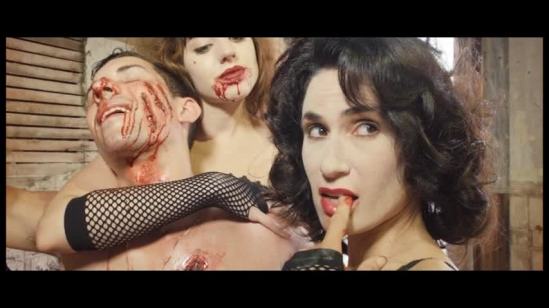
A Church youth group voluntary attends a Saint Christopher’s Catholic Middle School weekend cleanup before the school’s much needed reconstruction and restoration. As soon as they start with the sweeping, dusting, and polishing, three demon nuns, let to suffer behind an enclosed brick wall by a child molesting priest, unleashes their vengeful wrath, a gift from their new lord and savior, the devil, to whom they’ve sold their soul. Quickly, one-by-one the volunteers fall to the flesh hungry demonic nuns, using their sins against them, and extracting their souls for hell bound eternity. The select few to survive the ordeal of nuns will come face-to-face with Satan himself where praying for mercy will get them nowhere and is the same as burning in hell.
vlcsnap-2016-03-09-22h25m04s162
Director Richard Griffin once again pushes down the throttle to wrap the shooting of an entire movie in a matter of days on another lightweight budget. “Flesh for the Inferno” had a 9 day shoot with, and no surprise here, Griffin hiring some of his entourage of talented actors and actresses. The stage actors employed are always remarkable to watch; the underrated Michael Thurber, even in a toned down performance, is such a joy to watch with his adaptable skill set to jump into the shoes of any role in any film. The same can be said about the co-leads, Jamie Default and Jamie Lyn Bagley, who easily adjust into various roles from one Griffin film to the next. However, to my surprise, Griffin’s works with new faces, such as Ryan Nunes, Andrew Morais, and Kevin Michael Strauss, whom fit into his homage work of European possession horror. Then, there’s the talented Aaron Andrade who puts any other actor’s portrayal of Devil to shame.
vlcsnap-2016-03-09-22h24m00s38
Griffin and long time collaborator and cinematographer Jill Poisson purposefully softens the lens to give the photography a dreamlike or surreal state to mimic the iconic European director styles such as from Mario Bava or more in tunely with Lucio Fulci and though this respectable style was succesffully achieved and did contribute to the Bava or Fulci level of cinematic and atmospheric charm, the haziness was a bit overbearing, almost closing in on the actors within a modified frame of dominating clouds. The effect mostly shadows from what I noticed, right off the bat, the recognizable set from a previous Griffin film, “Future Justice,” sporting a new coat of paint and constructed with new, or new-ish, set pieces to create the Catholic school locale.
vlcsnap-2016-03-09-22h26m05s2
Screenwriter Michael Varrati churns out a script in less than a week to give Griffin much time as possible on a location rented much longer than needed. Varrati has written remarkable natural banter between opposition, connected, and flirtatious characters and does well with the dynamics for a quickly progressing story where shit hits the fan, crossing over into act two, in a matter of minutes. Its the dialogue, however, that slightly over saturates “Flesh for the Inferno” and it’s demonic, habit-wearing nuns. Fully engaged conversations between the nuns and the unlucky survivors cross over into theological debates rather than leading into a sacrilegious and unholy curse. Though at times, scenes like the one with Michael Thurber chasing his own tail in a Groundhog Day movie-type scenario was well placed in the story and well shot, even if little-to-no dialogue was present.
vlcsnap-2016-03-09-22h24m39s171
“Flesh for the Inferno” was suppose to be Griffin and his crew’s all out gory effects movie the homage attuned director has ever filmed. Yet, I can’t help but feel as if the opportunity was bobbled to recreate a “Demonia’s” bloodshed. The John Dusek effects were simply effective though, catering to all the film’s intention and needs to pull off a nasty nunnery narrative. The Timothy Fife soundtrack isn’t necessarily Fulci inspired as well that perhaps resemble more of a Goblin and Ennio Morricone blend and that’s highly more notable.
vlcsnap-2016-03-09-22h25m17s38
Scorpio Film Releasing and MVDVisual distribution together created and distributed another fantastic film that’s graced with retro-sleek cover art, like always, and I’m always impressed by director Richard Griffin’s capability to turn low budget horror into a formidable admiration of the old days of all kind of horror. Griffin and his entourage are on a whole separate level than their counterpart in their Hollywood doppleganger Eli Roth. The MVDVisual DVD looks sleek with a 16:9 widescreen presentation for the 79 minute feature. Bonus material is limited, but informative, that includes a crew commentary, cast commentary, and the film’s trailer.