Not a Plague of Rats Could Stop EVIL’s Obsession. “Nosferatu” reviewed! (Universal Films / Extended Cut Blu-ray)

Experience “Nosferatu” in 4K UHD or Blu-ray. Purchase Here!

Wisborg, Germany, 1838 – Thomas Hutter is a promising real estate apprentice appointed travel six weeks to the Carpathian Alps to settle on Wisborg real estate for the reclusive and mysterious Count Orlok.  Thomas Hutter is also a newlywed, married to the lovely Ellen Hutter whom together Thomas plans to solidify their proper social status with the wealth of this trip away from his wife despite her pleas for him to stay.  Upon meeting Count Orlok in his dark castle, Thomas is overcome by his host’s undying evil presence that confines him to the grounds while Orlok psychically holds spellbound Ellen’s mind to a fretful state.  When Thomas escapes, he makes it back home at the same time Orlok arrives by ship that brings a plague of rats to the city of Wiseborg as well as a nasty blood-loss disease affecting population.  As Thomas warns of Orlok’s intentions, discredited Prof. Albin Eberhart von Franz knowledge of the occult sees through the rat-plague and into the dark heart that has cast its shadow over the city and into Ellen Hutter’s soul.   

The acclaimed folkloric horror director of “The Witch” and “The Lighthouse” sinks his teeth into one of the most renowned classical villains of our time, a vampire known to most as Dracula and revised, at times, up to the Robert Eggers take on the timeless “Nosferatu” tale.  Eggers’s 2024 adaptation of Bram Stoker’s novel and the 1922 F.W. Murnau silent picture, “Nosferatu:  A Symphony of Horror,” written by Henrik Galeen, is also penned by the director, revamped to tell both classic narratives in a way that is his own and that’s reflective of his slow burn gothic dread style.  “Nosferatu” is a Focus Features presentation from the productions of Birch Hill Road Entertainment and Studio 8 as well as produced by Eggers alongside the industry esteemed Chris Columbus (“Home Alone,” “Harry Potter”) and daughter Eleanor Columbus under their Maiden Voyage Pictures co-founded company.

Stepping into the tall, slender, blood slurping role of the titular character, under a full-body prosthetic suit of what is essentially a rotting corpse with a wicked mustache, is Bill Skarsgård, the actor who is quickly rising to the top of heavy makeup and effects characters while making the star-studded Skarsgård name synonymous with horror in his breakout film playing the maniacal demon-clown Pennywise in the film remake adaptation of Stephen King’s “It.”  Skarsgård’s baby face is completely enveloped in the ancient Transylvania nobleman Count Orlok with a high-bridge nose, protruding and high cheekbones, a vertically elongated face, and a sparse hair straggling through presumably a latex mock of decaying skin.  Skarsgård also modulates his vocal chords to reach deep, resonating levels that gives Count Orlok an additional tier of terror.  Undoubtedly, Count Orlok is an omnipotent, powerfully entrenched presence brought to existence by Skarsgård and accentuated and elevated even further by Lily-Rose Depp in Orlok’s obsessive muse of Ellen Hutter.  Through choreographed body manipulation and control, the daughter of Johnny Depp has since put the gum-chewing, wise-cracking, convenient story clerk “Yoga Hosers” role behind to redefine herself as an austere period and physical role actress willing to go the extra mile for the story.  Nicholas Hoult (“Warm Bodies,” “Mad Max:  Fury Road”) updates his Dracula film resume with another after having just come off the heels of playing the titular character in “Renfield” to Nicholas Cage’s grotesquely campy version of the Prince of Darkness, but there’s nothing intentionally campy about this Stoker story nor his role as Thomas Hutter with first-hand experience of Count Orlok’s monstrous dysphoric plague in what would be, too, another physical, yet less so, role for Hoult as a concerned husband fighting for his wife.  Speaking of roles, or films, that come around again for certain actors, Willem Dafoe passes the torch of Count Orlok from his Max Schreck performance in “Shadow of a Vampire” and takes on the elder Professor von Franz, a once esteemed learned man of science and knowledge now a discredited scientific explorer of the occult brought in to see to Ellen Hutter’s feverish nightmares and hallucinations.  Dafoe’s just as spasmodic and expressive as ever to be a part of those knowledgeable opposition of the vampyr realm, giving prominence to the character Dafoe has bordering as a mad genius of sorts with eccentric behavior that never allows to be compassionate or otherwise emotionally driven, like a true scientist.  Principal cast rounds out with Aaron Taylor-Johnson (“Kickass”), Ralph Ineson (“The Witch”), Emma Corrin (“Deadpool & Wolverine”), and Simon McBurney (“The Conjuring 2”).

As much as Eggers wanted to make “Nosferatu” a scary film while staying to the themes of obsession and Stoker and Munrau’s core elements, the film only manages to scare up a couple of true moments of hold-your-breath terror with panning shots and swelling scores that composition a seat jumping jolt.  Like most of Egger’s previous work, a continuous course of dread, which the filmmaker produces well in droves, meanderingly streams through the narrative that slowly builds with each closing in step Count Orlok takes toward obtaining Ellen Hutter’s willing submission to him.  Between the 1922 and 2024, both films play the love-triangle card of a married couple’s happiness being compromised by a tall and dark outsider entrancing, enthralling the wife, diverting her loyalty by any means possible.  In this case, those means are to blackmail her by holding the city hostage to plague of rats and draining her of the loved ones surrounding her.  However, the genesis of Orlok’s obsession is built upon brittle sticks with a prologue that hamstrings a powerful, psychic ability unwittingly used by Ellen Hutter to awaken the ancient evil.  The whole origin of events feels threadlike and happenstance, perhaps to instill more mysterioso of the antediluvian universe on a smaller scale obsession story.   Aesthetically, “Nosferatu” follows the Robert Eggers’ cinematography trend of blacks, grays, and a reduction to dull of primary colors for a gloomy period piece of cold weathered melancholy and bleakness under the continuous collaboration camerawork eye of Jarin Blaschke, marking their fourth feature together that implements inventive, complicated shots to sell practicality as fantasy in an early 19th century European context.  Blaschke’s aesthetic style would not have worked without the makeup and prosthetics for Count Orlok as a decrepit evil nobleman juxtaposed against the period costuming and elevated higher by the massive set designs of creating the Wisborg city as well as all of the other sets built to scale on acres of movie lot land. 

Robert Eggers and “Nosferatu” is the match made in dark heaven to give that classical rebirth the kick in the Dracula cape it desperately needed for Universal.  The at-home, Blu-ray release brings the darkness into living room television sets and other media players with an AVC encoded, 1080p high-definition, BD50.  Eggers is also so fine and particular on detail, such as with all the production value listed above and the retro design company opening credits, “Nosferatu” is also presented in a European widescreen 1.66:1 aspect ratio used in antiquated times of the 60s to early 90s in Europe, to which this story is fictionally set.  The Universal Films release houses both the theatrical version and extended cut at their respective runtimes of 132 minutes and 136 minutes, which is pretty incredible being both versions compressed onto one disc and, in the same breadth, had me concerned for artefacts in what’s surely a beautifully dark and tenebrous veneered Egger feature.  However, low and behold, no signs of posterization or banding to speak of with a saturated void to keep the shadows menacing rather than murky or milky.  The overall grading is quite dark with a deep bluish hue that enriches the time piece as well as the gothic tones.  The unnatural density of color saturation leaves natural skin tones to sake of reality, but the details do emerge here and there when shadow play, mostly around the presence of Count Orlok, is abridged for quotidian life without the encroaching dread of supernatural omnipotence.  Both formats are encoded with lossy audio mixes, a quite of a bit of them actually, with an English Dolby Atmos, Spanish Dolby Digital Plus 7.1, a French Dolby Digital Plus 7.1, and, lastly, an English Dolby Virtual Speaker (DVS) 2.0.  The Dolby Atmos is tuned for a 7.1 configuration, emitting immersive and resonating sound to which “Nosferatu” laps up in luxury.  The most notable aspect of the entire design goes, without question, to Skarsgård voice modulation for Count Orlock, a deep, guttural, European-accented assertion of all-encompassing faculty highlighted in every scene when, even more so when Orlock is not physically in frame.  I like to think Robert Eggers is the Wes Anderson of horror when it comes to dialogue and entourage of ensemble casts and with dialogue range and depth that’s dynamic to flow with the ever-presence of physical change or to swell or diminish a moment.  Dialogue is also stable, clear, and without dodgy interference, the spatial environment diffuses and disperses nicely through side, back, and even upper channels in Atmos and, the illusion provided, in DVS, and LFE finds a proper level without overwhelming cataclysmic plagues, fever dreams, or Orlok’s dreadful lust.  Opted subtitles are available in English SDH, Spanish, and French.  Bonus content includes a feature length parallel commentary with writer-director Robert Eggers, a lengthy behind-the-scenes featurette with interviews from cast and crew, and deleted scenes that can be seen in the extended cut.  The Blu-ray, plus digital code, release comes with white-black and grayscale in between cardboard O-slip with the same Lily-Depp Rose’s face being caressed by Orlok’s sharp-nailed and decrepit hand image also as the cover art on the Amaray case.  Inside, you’ll find the digital code stage right while the disc is pressed like most of all of Universal’s home video Blu’s with a near translucent quality to them.  Theatrical cut is rated R for bloody/violent content, graphic nudity and some sexual content and the extended cut comes not rated.  Though not listed anywhere on the cover or disc, the Blu-ray is encoded with region A playback only.

Last Rites: Robert Eggers shoots his shot working his dream story under a major Hollywood studio providing him with a major Hollywood sized budget. “Nosferatu” is every bit of Eggers, carved out and etched to the gothic and folkloric perfection that has quickly skyrocketed his brief career and the eclectic cast stuns in their own right with otherworldly and creepy performances that revives ole’ Count Orlok back to from the celluloid dead.
Experience “Nosferatu” in 4K UHD or Blu-ray. Purchase Here!

An Invisible, EVILociraptor is No Walk in Jurassic Park! “The Invisible Raptor” reviewed! (Well Go USA Entertainment / Blu-ray)

“Insivible Raptor” Tearing Onto Bluray! Buy it Here!

 once promising paleontologist is reduced to being a dinosaur theme park sideshow act after being swindled and sued for a discovery of a lifetime aboard.  When a deadly and intelligent lab created raptor escapes from its maximum-security confines, the paleontologist, an attractive ex-girlfriend returning into his life, and an eager townie security guard with no friends must put a stop to the first living, breathing carnivorous dinosaur in 65 million years, but tracking down an invisible creature with razor sharp talons and teeth is no easy task, and they must follow the carnage and bloodshed of its wake in order to stop it.  With little resources, relying mostly on the paleontologist’s expertise and the chummy security guard’s willingness to take life-or-death risks for his new friends, the trio rope in a local, rough-around-the-edges chicken farmer to persuade the foul ancestor into a madcap trap before the whole town becomes raptor food. 

Audiences shouldn’t care about another “Jurassic Park” sequel.  Instead, any cretaceous period anticipation should all be channeled and focused toward Mikey Hermosa’s “The Invisible Raptor.”  The 2023 comedy-horror is not land of the lost as it lands right in our homes on a new physical media release.  Written between first feature film writers Mike Capes and Johnny Wickham, the “Dutch Hollow” director Hermosa is not one bit phased by the prospect that his main villain is every bit nasty and furious as antagonists come but is entirely out of sight!   With the challenge accepted, Hermosa aims to pull of the next big comedy-horror dinosaur film since “Tammy and the T-Rex” while ribbing in fun it’s bigger, more successful, campy-somber, franchised brethren mercilessly.  Hermosa coproduces the Showbiz Baby and Valecroft production with writers Capes and Wickham as well as William Ramsey and Nic Neary with Well Go USA owning the theatrical and at-home presentation rights. 

Capes writes for himself as the hard-up paleontologist Dr. Grant Walker, a play on Sam Neill’s Dr. Allen Grant, who has succumb to being of caricature of his profession and while the Dr. Walker is downcast despite his credentials, educations, and reputation, opposite him is the town goof Deniel “Denny” Denielson (David Shackelford, “Beneath”), a friendless, family-less, theme park security guard who’s repute amongst his peer is lower than fossilized dinosaur crap, but his attitude remains cheerful and positive.  The two characters complement each other with budding growth in their arcs of Dr. Walker not pushing people away like he did with ex-girlfriend Amber (Caitlin McHugh) and Denny, with every ounce of his hillbilly being, trying to a fault to make a friend.  There’s a slew of eccentric side characters but one not more as colorful as chicken farmer Henrietta McClusky.  Played by the early 70-year-old Sandy Martin, the “Scalpel” role debuting actress who had a profound supporting character career having had a role in “Napolean Dynamite” and “Three Billboards Outside Ebbing, Missouri” in recent years continues her dry humor, dark comedy run with the Henrietta role a crude, rude, and with ton of attitude poultry farmer with a no nonsense way about her and while Henrietta is a deeply sexual creature in her own right, the amorous tension lies in between Walker and Amber that have instantly become two magnets in rekindling their lost flame.  The ease of which the two characters are written to be instantly smitten is greatly construction to be an almost an unattainable relationship by introducing a child with no relationship to either one of them, a decade long gap without a ton of hurt feelings for the other’s sudden decision of career over love, and, the obvious, a large, man-eating, invisible predator repelling the two magnets apart.  Sprinkled with familiar faces, “The Invisible Raptor” rounds out with notable cult film actors, such as Richard Riehle (“Office Space,” “Hatchet”), Larry Hankin (“Armed and Dangerous,” “Home Alone”), and Sean Astin (“Encino Man,” “Lord of the Rings”) as well as a cameo appearance from Vanessa Chester who played Dr. Ian Malcolm’s daughter in “The Lost World” in another potshot at the “Jurassic Park” series.

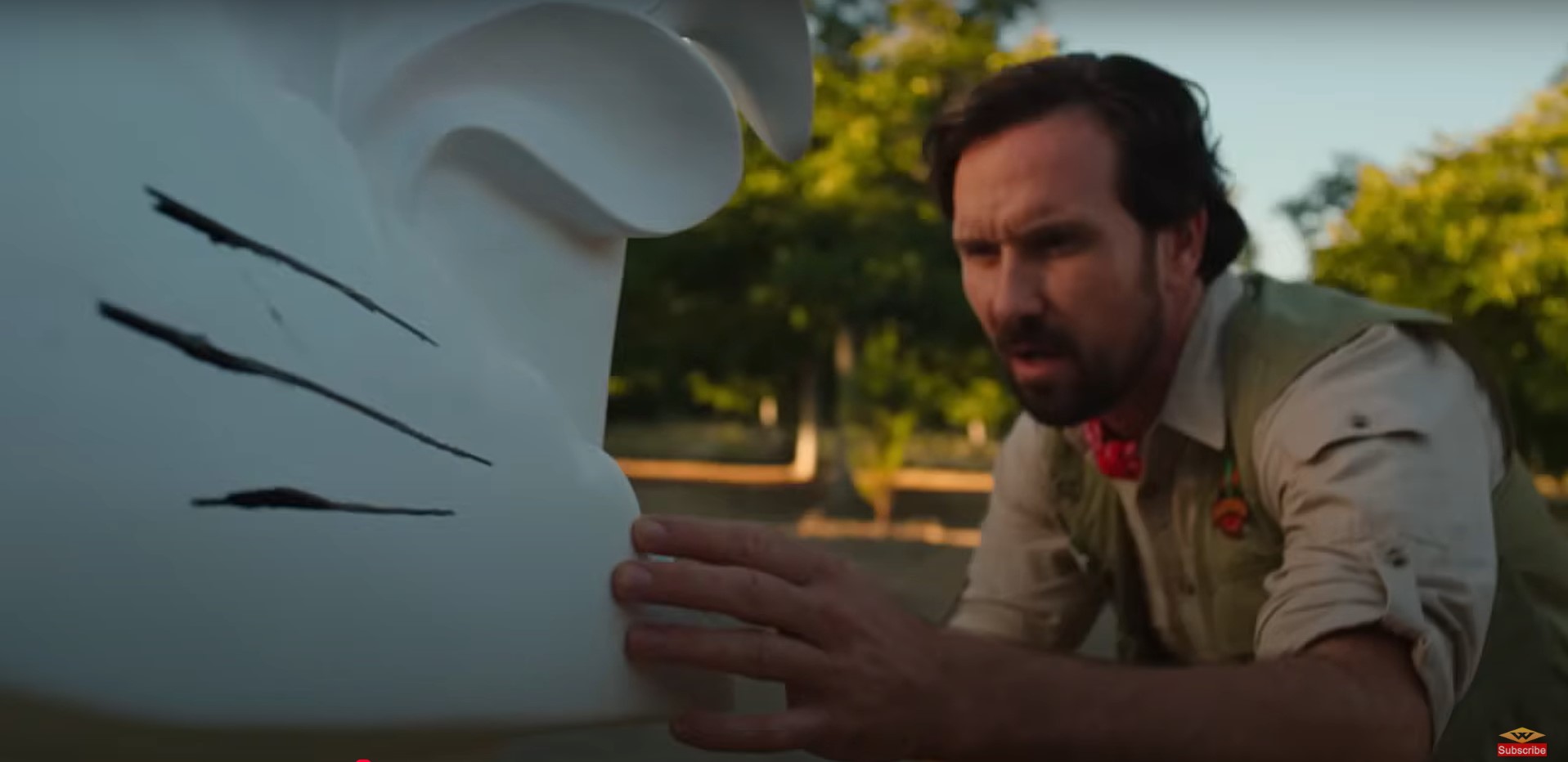
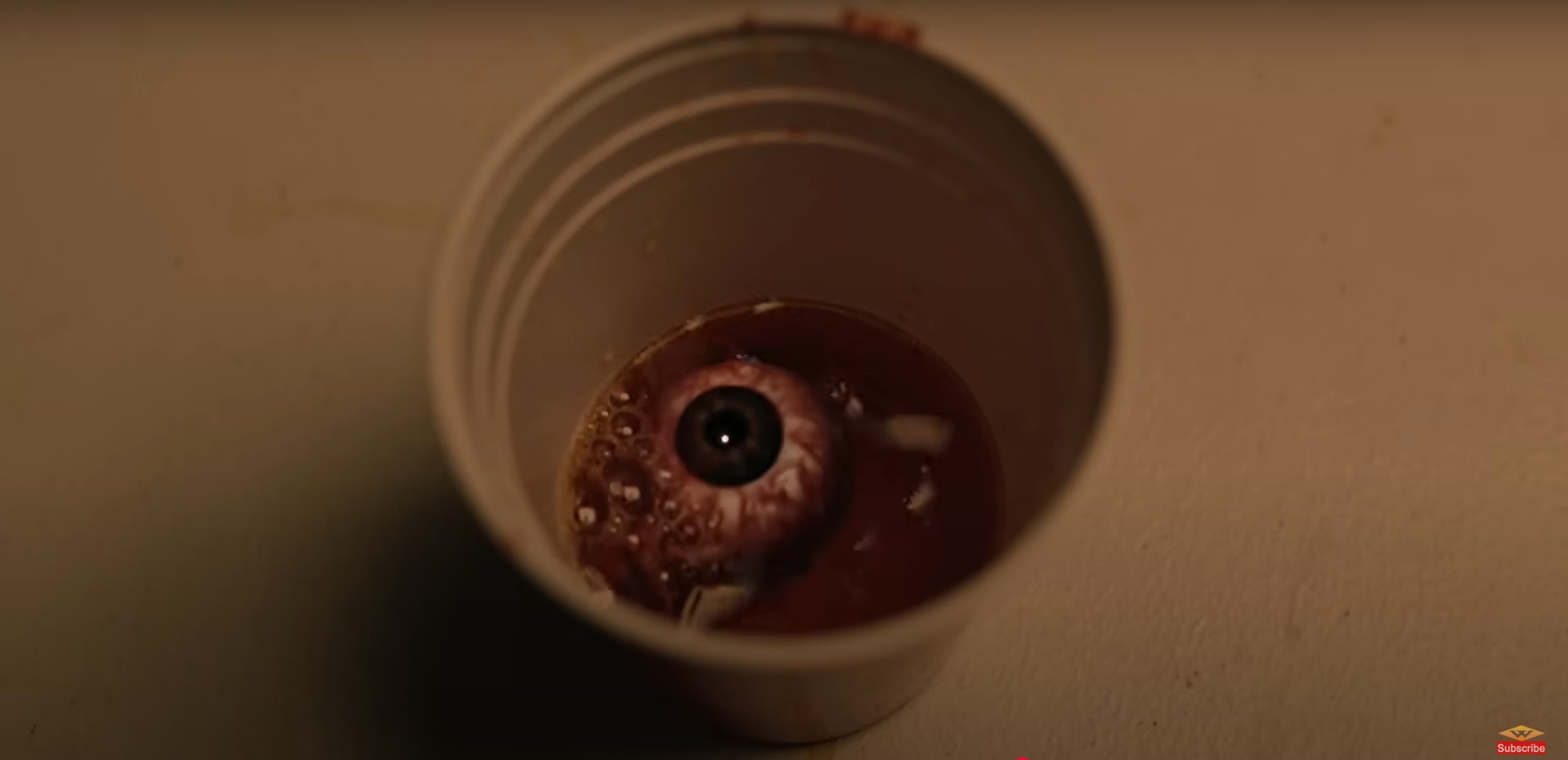
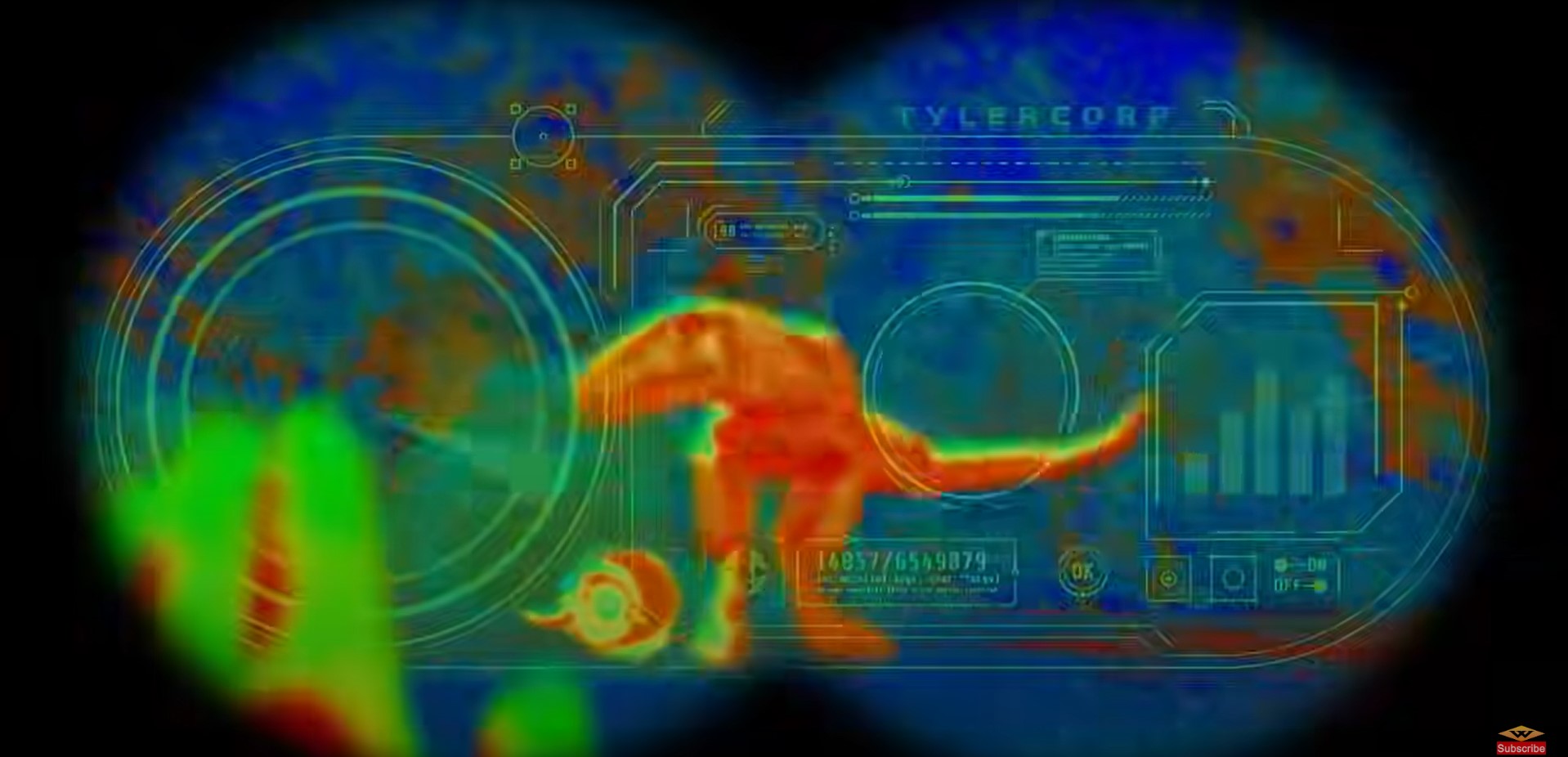
Between the hilariously staged “Jurassic Park” callback moments and an unnerving number of gags around the butt region (raptor feces, fossilized raptor buttholes, butt jokes in general), “The Invisible Raptor” has a lot of humor that’s either smart or misses the mark, but not by much in the cogently confined venture packed full of heart, heroism, and havoc on a prehistoric, science-fiction level.  “The Invisible Raptor” may be a modern-day gory comedy-horror but that gory-horror element combined with a bit of underground covert weaponization of dinosaur has a real throwback sense to the early 90’s to early 2000’s dino-horror, such as the “Carnosaur” films, “Tammy and the T-Rex,” and, of course, “Jurassic Park.”  Dino-horror is a niche subgenre that’s rare explored unless it’s totally satirical (“The Velocipastor,” “The Jurassic Dead”) or rooted more in a lost world aspect, sporadically released throughout the decades with “Raptor Island” or the more perilous journey of “Land of the Lost,” original series and it’s more comedic feature remake.  Hermosa quickly moves out from the testing bunker lab that has been the Raptor’s home and where the scientist treat it like an adored, harmless child, a theme of attachment to harmful things we shouldn’t be attached to and gets right into the mayhem by letting it loose in only a way one could perceive a raptor would – in indiscriminating bloodshed.   Hermosa also doesn’t flinch with an invisible titular foe, one the actors have to mentally conjure up to play against in a combative or cat-and-mouse scene, with neatly composited special and visual effects of floating objects, quickly consumed severed heads, and silhouette work through blood spray, heat vision, and a shower curtain by the talented Steve Johnson (“Lord of Illusions,” “Species II”) and Dorian Cleavenger, both of who bring years of experience and both of whom have worked together for the effects of Robert Englund’s “Fear Clinic.” 

Audiences won’t see this one coming!  “The Invisible Raptor” debuts onto an AVC encoded, high-def 1080p, Blu-ray courtesy of Well Go USA Entertainment.  The single-layer BD initiates some cause for concern on the image presentation prior to viewing but the picture produced is solid and stable with no banding in the darker voids, especially in those areas since there is no Raptor to be seen mostly during the night exteriors, poorly lit underground laboratory, or in the lowly key-lit interiors, there’s more shaded and hallow space exposed in the 1.78:1 widescreen aspect ratio.  Textured details are generally adequate with a softer, smoother touch from capacity compression, coupled with a hazy warm yellow-green lighting scheme.  The more standard, non-stylistic shots have better definition to where the details on Dr. Walker’s paleontologist outfit stand out amongst the eye glazing brown-and-tan colors and in the gooey grooves of the Velociraptor fecal matter complete with yellow kernels of corn.  Visual effects are handled with not too revealed explicitly to limit noticeable computer imagery and keep all that is practical the focus.  Audio options come in two English formats – a DTS-HD 5.1 and Stereo 2.0.  The range on this mix is explosive as it is subtle right down the clicks and grunts of the assumed noises one would be led to believe a prehistorical, carnivorous raptor would make.  Dialogue renders clearly and definitively prominent amongst ensuring bedlam cacophony whenever there’s a dino-crises in a more than one people grouping; the audio compilation has been carefully layered to denote exactly what’s intended to be discerned at that moment. English and French subtitles are available. There are no encoded special features on fluid menu of this feature only release but there is a quick bonus scene at the end credits. The physical copy has only a little bit more in the way of extra content with a cardboard, tactile-titled O-slipcover sporting the current state of arranged character pyramid composite. The snap lock Blu-ray Amaray is standard with the same cover art and no tangible extras inside. Rated R for bloody violence and gore, crude sexual material, drug use, and brief graphic nudity, Well Go USA’s release is region A encoded for playback and has a runtime of nearly 2 hours at 114 minutes.

Last Rites: Though the raptor may be invisible, this release should be seen by all! “The Invisible Raptor” is a hilarious “Jurassic Park” parody with plenty of bite, plenty of fun, and plenty of non-visible computer-generated dinosaurs, especially for those who are feeling the dinosaur fatigue.

“Insivible Raptor” Tearing Onto Bluray! Buy it Here!

A 13-Year-Old Girl is EVILLER than Skinheads! “Becky” reviewed! (Ronin Flix / Blu-ray)

“Becky” is Clearly a Special Girl!  Purchase the Blu-ray by Clicking the Below Cover!

Cancer has taken Becky’s mother away from her.  Over the past year, the 13-year-old girl finds comfort in being angry, especially at her father who choose to move forward with his life that stirs a flurry of pent up uncomfortable, rage-filled emotions inside the teen.  As Becky stays in her constant stew of angst, her father surprises her with a trip to their cabin getaway he initially planned to sell but had a change of heart.  There is one small caveat, he plans to propose to his girlfriend who joins them on the trip, cornering Becky into one-sided fight and meltdown with those who love her and care for her and sending her to retreat into her woodland fort.  At the same time, a group of escaped convicts take her family hostage in search for a mysterious key left behind by the escapee’s neo-Nazi leader, Dominick.  Dominick has planned for years every possible scenario to secure the key that will undoubtedly serve every race with what he thinks they deserve, but Dominick didn’t plan for one scenario:  Becky. 

Amongst the movie nerds, there’s a particular phenomenon that occurs when a film is first mentioned across the internet and an immediate acclaim and attraction follows in its wake toward the film’s actors or actresses flipping the script on their stereotyped industry roles and playing totally unorthodox personalities that may shock. “Becky” was one of those films.  The 2020 released home-invasion, revenge thriller has been labeled by critics and fans alike as a horror, but the Jonathan Milott and Cary Murnion codirected production is more than just blood and guts.  The Ontario, Canada production is based off an original and debuting script from Nick Morris with “The Devil to Pay” and “Rattle the Cage” screenwriting husband and wife team, Lane and Ruckus Skye who have specialized credentials in the thrillingly brutal, hardnose character genre.  With a punk energy and engrossing family themes, “Becky” is a heart-stopping, heart-stomping, mischief making, ball of fury.  Jordan Beckerman of Yale Entertainment (“Cut/Print”) and Boulderlight Pictures’ J.D. Lifshitz and Raphael Margules (“Barbarian”) serve as the U.S. production companies in association with Bondit Media Capital, SSS Entertainment and Buffalo 8 Productions and is presented by Quiver Distribution and Redbox Entertainment. 

Aforementioned, this strange manifestation of hype for an upcoming feature leads the world, or at the very least film aficionados, in extreme anticipation. The conspicuously, incongruous piece glimpsed briefly in the trailer, one-sheet, posters, and stills claws for our attention as our brains can’t quite compute or process Kevin James in an Aryan acolyte. With a shaved head, long beard, and covered in swastikas, SS doppel sigrune, and other various Nazi-symbolic tattoos, Kevin James transforms his loveable and comedic “Paul Blart: Mall Cop” and “I Pronounce You Chuck & Larry” self into a ruthless and irredeemable skinhead. James absolutely nails the look of escaped convict and neo-Nazi Dominick with growing out his facial hair and shaving his head that takes his usually unassuming presence to a whole new level of calculated evil, but the script spoon feeds Dominick too much leeway to tolerate insubordination amongst his four-man crew, to allow hostages to talk back, spit in his face, and antagonize against his goals, and lacks the know-how of how to appropriately bait Becky with her own family, if Dominick is truly a despicable person as we’re lead to believe in earlier scenes of an approved prison leadership shanking and the implied murdering of children sitting in the backseat of a family roadster he aims to hijack. Yet, Dominick allows to be taken advantage of despite his cruelty stating to the contrary. In a stark contrast to evil embodied, there’s teenage girl Lulu Wilson.  The New York City child actress has been quickly making a name for herself in the horror genre, as a scream queen prodigy of sorts, with having supporting roles in “Deliver Us from Evil,” Ouija:  Origins,” “Annabel:  Creations” and Netflix’s “The Haunting of Hill House” before landing the titular lead in “Becky.”  Instead of scared pretense, Lulu Wilson gives a visceral, violent performance.  It’s teenage angst on steroids.  “Becky” is the only child versus adult cat-and-mouse game where the audience will get more out of the younger, smaller rival full of enraged paroxysms.  Joel McHale is another comedic actor wiggling his way into more dramatic roles that expand not only his resume but his range to showcase the other side of the once syndicated television comedy host.  From his stint into horror alongside Lulu Wilson in “Deliver Us From Evil” and in dark comedy, such as “Happily” that released the same year as “Becky,” McHale is finding a different voice other than laughter that has come natural to the actor and does show a lot of promise in more compelling roles as in “Becky’s” widowed father looking to move forward with his life but treads on pins and needles with his angry daughter.  Those relationship complications between Becky and her father never wander but rather do wonders for the connection on coming to terms with little go of the past.  The robust range of characters continue with an eclectic and noteworthy remaining cast that includes Amanda Brugel (“The Handmaid’s Tale”, “The Infinity Pool”), former Canadian-turned-actor Robert Malliet (“Pacific Rim,” “300”), Ryan McDonald (“He’s Out There”), James McDougal (“Heinous Acts”), and Isaiah Rockcliffe (“Random Acts of Violence”).

Kids committing hyper-violence in films is not entirely uncommon but they’re also not run-of-the-mill either.  Yet, films like “Becky” produce an unsettling affect that churns in the back of our psyche when witnessing a young teen girl intently stabbing a grown man with a jagged ruler and a handful of colored pencils in the neck.  Fans and critics label “Becky” as an adult, violent version of “Home Alone,” but the comparison I would draw would be closer to “Die Hard” for the barely young adults.  “Becky” plays out like a graphic novel or a young adult novel, stylish and impulsive in its edgy execution and character.  Unlike “Home Alone,” hardly anything sweet and endearing radiates from Milot and Murnion’s ferocious family retaliator and though Becky may set a trap or two (really just one trap) to inflict pain and punishment on her pursuers, the youngster is more inclined to John McClane wing it as the plot plays out, going toe-to-toe, face-to-face with adults two and three times as big as her without a moment of hesitation. There are some unique and graphic death scenes that ooze Becky’s personal satisfaction, and the Derek Liscoumb (“Possessor”) special effects blood reel is perforating, shredding, and cutting to pile on perfection as the kills go deeper into mutilate pool. Tremendous raw emotion superhumanly strengthens Becky’s adrenaline rush as the tragedies aggregate into one big horrific destruction of familyhood, contradicting the first act’s despisal of her father with a regret-filled, redemptional theme that without family there’s nothing else to lose. Its powerful for Becky to lose people she, in the moment, abhors yet are close to her because of her own unworked out pain and suffering that in all innocence pit her against the world.

“Becky” is the quintessential diamond in the rough as an unsurprising hit with fans. This small, independent Canadian film can hold its own in story, style, and sanguinary. With a sequel in the works, entitled “The Wrath of Becky,” our friends at Ronin Flix have released a collector’s edition Blu-ray to enlighten those new to Becky’s inherent mean streak. Released on an AVC encoded BD50, the feature is presented in 1080p high-definition on a widescreen 2.39:1 aspect ratio. Nothing to particularly note negatively on the digitally recorded image quality to the tune of compression storage as there doesn’t appear to be an issue with a clean-cut picture that delineates the hell out of the image, capturing every contour, fiber, and skintag inconvertible. Colors are potent with a natural grade along with plenty of textures to salivate over with a palpable tongue, such as Becky’s wool hat or Kevin James’s thick beard. The compressed image unloads at a gloriously hefty 36-38Mbps. The CE comes with two lossless English audio options – a Dolby Digital 5.1 Master Audio and a Dolby Digital 2.0 Stereo. Unless your audio outputting on the television speakers, the surround sound is the optimal and preferred choice for “Becky’s” unmanage mischief making through the rustling brush. The small aspects of her plotting and executing her revenge are what give the ambient padding meaning and offer a plentiful and grotesque semiliquid, semi-flesh sound effects. Dialogue comes through clean, clear, and robust. Optional English subtitles are available in SDH. Over 60 minutes of bonus features are on this release with interview commentary by directors Jonathan Milott and Cary Murnion, an interview with Joel McHale, and an interview with Lulu Wilson that all pretty much do a similar roundtable of remarks of their time and experiences working with each other. Milott and Murnion provide more backgound, backstory, and insight to their directing process compared to solo directors. Behind-the-scenes gallery, fan art, audio commentary with Lulu Wilson and screenwriters Ruckus and Lane Skye, and individual pre-feature introductions by the directors. Physical features include a cardboard slipcover of composite art by Tim Johnson, which is also on the latch-featuring clear snapper case cover art, a reversible cover art featuring a solo Lulu Wilson, and an anime-esque, illustrated disc art by Andrea Michel. The Blu-ray is rated R for strong bloody violence, graphic images, and language with a runtime of 94 and is region A locked. “Becky” is brutal with blood and guts galore and is more fun than can be describe with Lulu Wilson delivering an atomically hot-headed performance and Kevin James sporting uncharacteristic, fascist tats.

“Becky” is Clearly a Special Girl!  Purchase the Blu-ray by Clicking the Below Cover!

Best Friends Trying Their Best to Best EVIL! “The Boy Behind the Door” reviewed! (Acorn Media International / Blu-ray)

Best friends Bobby and Kevin are kidnapped by a stranger and taken to a remote house in the middle of nowhere. After Kevin is removed from the stranger’s trunk and is dragged into the house kicking, screaming, and pleading to be let go, Bobby breaks free of his restraints, but hearing his best friend Kevin’s screams leaves Bobby with no choice but to help him. Working his way through the house and upstairs unnoticed, obstacles stand between him and rescuing Kevin, including the boys’ kidnapper, a paying customer, and Kevin being shackled to the wall, locked inside behind an attic door, but that doesn’t avert Bobby’s intentions from thinking outside the box to save his best friend from a fate far worse than death. However, only a matter time before the kidnapper or the paying customer knows there’s someone else lying low the house and unearthing troubling secrets.

Child sex abuse is, without a double, a disturbing and touching subject to exhibit in cinema.  How to maneuver around the theme with child actors can be a delicate balance of commitment and understanding when considering the cast involved, especially if most would argue that a child’s brain is too immature or not developed appropriately to comprehend the impact of sexual abuse and to expose them indirectly could also be traumatic to their being.  The opposite of that argument has been proved over the decades with child actors having major roles in general with horror films.  Monsters of all shapes and sizes, guts and blood, and violent themes surround them and films such as “The People Under the Stairs” and “IT” have some of the most frightening and disturbing practical effect imagery that would cause sleepless night terrors for months and, yet kids star in them and are key to their success because, as we all know, children are not immune to real world dangers and threats.  So, why should be exempt from the creative imaginary ones? David Charbonier and Justin Powell finesses that line with a massaged contented breakout feature in “The Boy Behind the Door” written-and-directed by the lifelong friends and produced by Ryan Scaringe of Kinogo Pictures. Howard Barish of Kandoo Films, and Rick Rosenthal, Bert Kern, Ryan Lewis of Whitewater Films

***Beware… this section may contain spoilers*** Lonnie Chavis (“This Is Us”) and Ezra Dewey (“The Djinn”) play Bobby and Kevin who find themselves in the worst-case scenario of two unaccompanied pre-teens violently whisked away to an isolated farmhouse near one or two oil well pumps. I commend Chavis and Dewey’s hard fought, emotionally deep performances in battling against the creepiest of odds and feigning injury without being too over-the-top or inauthentic. Either if by being well coached or, more than likely, just good child actors, the level of anxiety maintains a solid 10 throughout with them. Their only scenes together where I thought the fusing of their friendship didn’t quite work was before the abduction where their dialogue and interactions as two young boys drifting across fields and profoundly thinking about their future deemed itself well too mature and far beyond being advanced for boys their age that the moment was a complete misfire for the story. Inevitably, the two friends run into a couple of creeps and exploitative racketeers in Micah Hauptman (“Phobias”) as the paying customer abandoning paid up time to chase down Bobby and Kristen Bauer van Straten (“True Blood”) in a twisted plot point of a white, late 40s to early 50s-year-old woman, who in the film could be someone’s mother, as the ruthless kidnapper of young boys for old man pleasure. Hauptman is more-or-less there in slimy spirit but doesn’t ooze enough egregious behavior to note as that trait falls immensely well upon the shoulders of van Straten with a mean streak that never lets up despite the rather paralleling of a hard R “Home Alone” antics between adults and children.

“The Boy Behind the Door” is a butt-clenching thriller because of the sheer fact children straddle the danger line on either side of spectrum. You have Kevin locked securely away in the summitted play and video room, shackled and waiting in screams, tears, and fears for his sure fate, and then there’s Bobby escaping his restraints and staying in the shadows, out of sight, trying to save his friend before he becomes either chained and exploited like Kevin or executed because of his strong will. Charbonier and Powell offer little-to-no fluff in pretending “The Boy Behind the Door” is anything but a fight for survival, a fight for friendship, and a fight against the utmost evil. The film isn’t full of strong one-liners or momentous moments that keep the story grounded and pure in its vilest state with tiptoeing around the one-woman operated child sex abuse ring without going into the full gross details. Charbonier and Powell’s story has many strengths, but it also has a few weaknesses waned upon the characters’ decision making. For instance, when Bobby has to break into the house, he throws a rock through the mud room door window without knowing where the kidnapper is and if they are in earshot of the window breaking. Later in the film, Bobby is trapped in the upstairs bathroom and when a squad car pulls up, instead of breaking the window he can clearly reach, he tries to yell through it and fiddle with opening the latch. Why does he simply not break the window and then yell for help? That particular scene drove me nuts and there a few other minor instances of the same caliber throughout in a story that well made enough to be compelling, to be horrific, and to be gripping in and around every house interior scene.

Tense, harrowing, and an ugly truth, “The Boy Behind the Door” is defensible horror at its best and a righteous strength of friendship. Acorn Media International distributes “The Boy Behind the Door” onto a region 2 Blu-ray in the UK! The PAL encoded release is presented in a widescreen 2.38:1 aspect ratio and, speaking digitally, the picture renders flawlessly the inkling of low-lit hope inside a world of dark fatalism and cynicism under the cinematography eye of Julián Estrada. The English language DTS-HD Master Audio 5.1 is crystal clear that occupies each channel with the right number of decibels to exact the range of sneaking through a creaky wooden floored house. Dialogue is clean and clear, especially at whisper breath. The Shudder original film comes with a pair of special features including a blooper reel of mostly Lonnie Chavis sneezing and goofing off which is nice to see kids being kids on set and a music video to the film which is more like a trailer with Anton Sanko’s dark synth-gripping score being an apogee of suspense. There’s never sympathy for these types of vile exploitation villains on and off screen and in “The Boy Behind the Door,” that fight back mantra resonates loud and clear in an unambiguous do-or-die between guileless innocence and pure evil.