Scarf Michael and the Fiddler’s Power that Draws Upon EVIL! “The Outcasts” reviewed! (Deaf Crocodile / Blu-ray)

“The Outcasts” on Blu-ray Now Available Here!

Ireland 1810 – a small farming village sustains a livelihood off their crops, marital successors, and superstitious belief.  Widower Hugh O’Donnell and his three teenage-adult daughters find themselves in the midst of all three mechanisms with his eldest daughter forced to live with him into widowed spinsterhood, a middle daughter’s secretive betrothal to a neighboring farmer boy despite Hugh’s disdain for the family, and Maura, the youngest daughter, who acts strange and fearful making her an easy target for ridicule.  When the village crop faces blight, bad luck ensues many of the surrounding farmers, and a sudden, expected snow fall threatens harvests and income, Maura is accused of conspiring with witchcraft of a wraith fiddler known as Scarf Michael whose music invokes visions and creates mischief.  Nearly crucified by the fearful villagers, most of whom derided for her aberrating strangeness, Maura is saved by Scarf Michael to be taught his outlier ways that could lead the young woman to never return home again.

Through themes of folkloric belief, societal class structures, family, marriages, mental illness and how it’s ostracized in an early 1800s setting, “The Outcasts” is a cold, hard, and solemn look at daily affairs of a 19th century, poor Irish seaside village, fenced in with the unusual conducts of Maura whose mind is more curious and vastly hungry for knowledge than her peers’ and that creates an escapism component to try and be equal, or perhaps get even with, those that look down upon her.   English writer-director Robert Wynne-Simmons tackles his debut feature-length film with great understanding of tradition and human fear, elemental human nature bred from the uneducated and localized myth seen in his original devilish script from 1971’s “The Blood on Satan’s Claw” by director Piers Haggard.  “The Blood on Satan’s Claw” was certainly far better suited for success with Haggard’s additional scenes of brackish deviltry aesthetics, plenty of full-frontal nudity, and visible vibrant and rich blood.  “The Outcast” is a return to the slow born of an eventual decline and degradation of not just Maura but her family and her village.   “The Outcast” is part of an Irish production conglomerate of companies, including Arts Council of Ireland, The Irish Film Board, and the Toymyax Company with Tony Dollard producing.

Mary Ryan is the centerpiece of the fantastical and fraught tale because of her teenage character’s childlike innocence that’s deemed unusual, weird, and, eventually, in bed with a spiteful spirit, labelling her character, Maura, as a cursing occultist.  Ryan, who would go on to have minor roles in “Rawhead Rex” and “The Courier,” brings a balance of beauty and blamelessness to Maura’s undesired disposition, one that allows her no friends and is even on the edge of displeasure from her older sister Breda (Brenda Scallon) and father Hugh (Don Foley) whom both found love and lost them over a rough course of untimely death.  There’s still obvious love between them, but Maura likely reminds them of mother, especially from Hugh, and sees a same early grave fate for the youngest and adrift daughter.  Middle Daughter Janey resides on the opposite side of the spectrum with unconditional love and support for Maura only to be intertwined with her own serendipitous affairs with local farm boy Eanon (Máirtín Jaimsie), finding themselves rushed into proper marriage when Janey comes home expecting.  And while Maura made faultless inconsequential ripples through the family and the village, she was initially not on the forefront of everybody’s concern as Janey and Eanon became a jovial celebration that sought the joining of two well-known families and farms until Scarf Michael reappeared to play his fiddle.  Mick Lally fiddles as the musical wraith casting his violin strokes against those essentially bullying Maura with trickery that led to subsequent fears and accusations of agricultural assassination and magical maligned mischief that turn the rural villagers away from Janey and Eanon’s blessed marriage to an acute decline of rationality that put Maura in the crosshairs of suspected supernatural conjuring.  Scarf Michael’s intentions are not to whisk Maura away into what she sees and believes is as blissful freedom from those nasty looks and mocking that surround her as well as Michael’s tenderness to which she falls in love for the first time, like a child growing into adulthood.  “The Outcasts” round out with Tom Jordan, Cyril Cusack, Gillian Hackett, Brendan Ellis, Hilary Reynolds, Donal O’Kelly, James Shanahan, and Paul Bennett.

Not ever story about the loss of innocence from growing up is portrayed in a good light.  Maura wants to hurry grow up and be free of her childish qualities without realizing the consequences.  Falling in love with Scarf Michael proves to be perhaps folly of Maura who gives into the dream, or fantasy, of a man who quickly enters her life and charms her with the mystical fiddle.  By the end, indications of Scarf Michael nothing more than a rake leaves a sour and sad aftertaste that shutters Maura from the rest of her family as she willing joins him on the other side, practically begging him to free her from an unforgiving reality.  Perhaps Maura was also led to believe in no other choice, condemned to a watery grave, the same fate that befell Scarf Michael, by her fearful village peers and elders.  Robert Wynne-Simmons is often playing devil’s advocate by building up Scarf Michael as a savior and a romantic, but Maura drinks the Celtic Kool-Aid because, frankly, she knows no better and received no beneficial direction from those who surround her, leaving the alluring fiddler to warn her of the choices she desires.  Wynne-Simmons and Seamus Corcoran’s soft-and-dreamy fairytale indulges a bit of surrealism through soft-lighting, soft focus, and crude yet effective editing tricks to create a specter’s intermittent visibility amongst other slight of sight practical effects. 

If ever a time to be totally physical media inclusive toward all the obscure outliers, now is the time with “The Outcasts” arriving onto a newly restored 2K transfer for the first ever Blu-ray in the U.S. courtesy of Deaf Crocodile.  Presented in an European widescreen 1.66:1 aspect ratio, the AVC encoded, 1080p high definition, BD50, plus the restoration efforts conducted by the Irish Film Institute – Film Archive, retains that airy softness of a daydream inlaid to suggest a surrealism surrogation but the story is rooted in reality, the reality of early 1800s Ireland to be exact, and so this impoverish, austere, and salt of the Earth land and it’s people are often absorbed by superstition belief that’s awfully real for them but to the audiences, it’s bordering the illogical.  Details are generally soft but the upgrade increases the contours and create a nice layer of depth between foreground and background, bathed in the muted and ascetic green, brown, and tan color scheme of a traditional period piece wardrobe and materials, leaving behind any ounce of hue pop to not spoil the intended grading that lives and dies by somewhere between the RGB and the average grayscale, but there are times of an eerie dressed lighting of added backlit blues and bright whites to secure a fantasy, or spooky, flare.  The fidelity reproduction on the Irish-English DTS-HD mono track diffuses distinct aspects through the single channel without any vague overtaking.  The brogue English did, at least for me, require the optional English subtitles to be turned on for my untrained ear to decipher certain antiquated period terminology and the strong Irish accents that would drown out an entire sentence; this is not an issue concerning the quality of the audio track as it’s nicely achieved without any damage to note or crackling, hissing, or other obstructions to interfere.  The dialogue is also fairly robust and prominent.  Steve Conney’s lyrical and guitar score enchants with traditional Irish folk and is ascertains the mix of commonplace and otherworldly mood Wynne-Simmons seeks to create.  Bonus content includes a new video interview with writer-director Robert Wynne-Simmons, a new video interview with composer Steve Conney, producer and film professor Rod Stoneman, former head of The Irish Film Board, and physical media expert Ryan Verrill provide a video essay, and concludes with five Robert Wynne-Simmons’ short films:  “L’Eredita di Diavolo,” “The Greatest All-Star Advertial of All Time,” “Bomb Disposal,” “The Scrolls,” and “The Judgement of Albion – Prophesies of William Blake”  These shorts include appearances/cameos by Charlton Heston, Sammy Davis Jr. and Peter O’Toole to name a few.  The clear Blu-ray Amaray has an appearance that’s about a stark as the film’s aesthetic with a gray coverart composition of celebration fiddlers in their straw masks overtop an isolated Maura.  An insert advert with a QR code offers to access transcribed bonus content.  The disc is pressed with the same front cover image and the reverse side of the primary cover has a still from the film.  The unrated release has a runtime of 105 minutes and is hard-locked with region A encoding.

Last Rites: An obscure gem of Irish cinema, a folklore and social explication of “The Outcasts” outlives antiquation with a new Blu-ray release from obscure aficionados Deaf Crocodile!
“The Outcasts” on Blu-ray Now Available Here!

The Blind Leading the EVIL. “Oddity” reviewed! (Acorn Media International / Blu-ray)

“Oddity’s” Blu-ray from Acorn Media International is Here!

Dani Timmins spends many nights renovating her and her husband’s new country home.  While her psychiatrist husband Ted works long nights most nights at the mental hospital, Dani spends her time in solitude and isolation to fixup their future home.  When a strange man knocks on her door and warns someone is inside her house, Dani must make the difficult decision to either trust the stranger into her home or dismiss his warnings as subterfuge to get inside.  The next day Dani is dead, brutally murdered.  A year later, Ted and his new girlfriend reside in the country home and Darcy, Dani’s twin sister with retrocognition abilities, arrives at the country home with supernatural suspicion toward the couple, bringing with her a trunk containing a family heirloom of a life-size wooden mannikin.  Threatening to expose him, Darcy appetite for blind justice is stronger than Ted’s need to convince her otherwise when the plot against her sister thickens beyond the plane of the corporeal world.  

“Oddity” is the 2024 release supernatural haunt and golem thriller from “Caveat” writer-director Damian Mc Carthy.  The sophomore feature from the Ireland born filmmaker is a mishmash of culture inspired heavily on the Jewish folklore of the inanimate, human formed material being commanded to animate a task, such as being bewitched for wicked transgressions and this commingles with twin superstitious beliefs of extrasensory connection, and, I’m going to stop your train of thought right there, just because this is an Irish production with an Irish actress playing twins doesn’t make this a movie about the derogatory Irish twins concept.  Filmed in the County Cork, Ireland, “Oddity” is produced by “Come to Daddy” producers Evan Horan, Katie Holly, Laura Tunstall, and Mette-Marie Kongsvad with Lisa Kelly as co-producer and Keeper Pictures and Shudder serving as co-productions presenting as a Shudder Exclusive film.

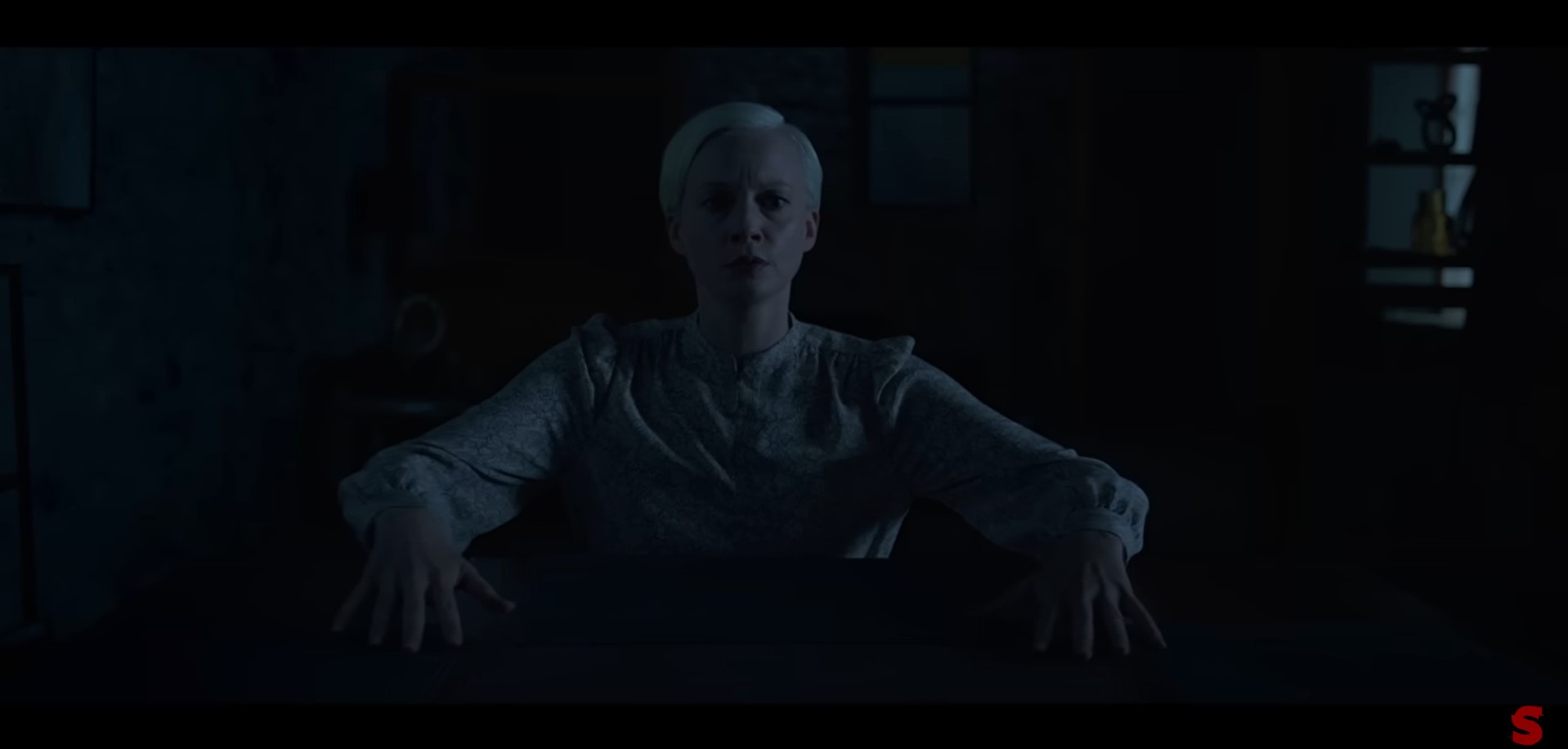
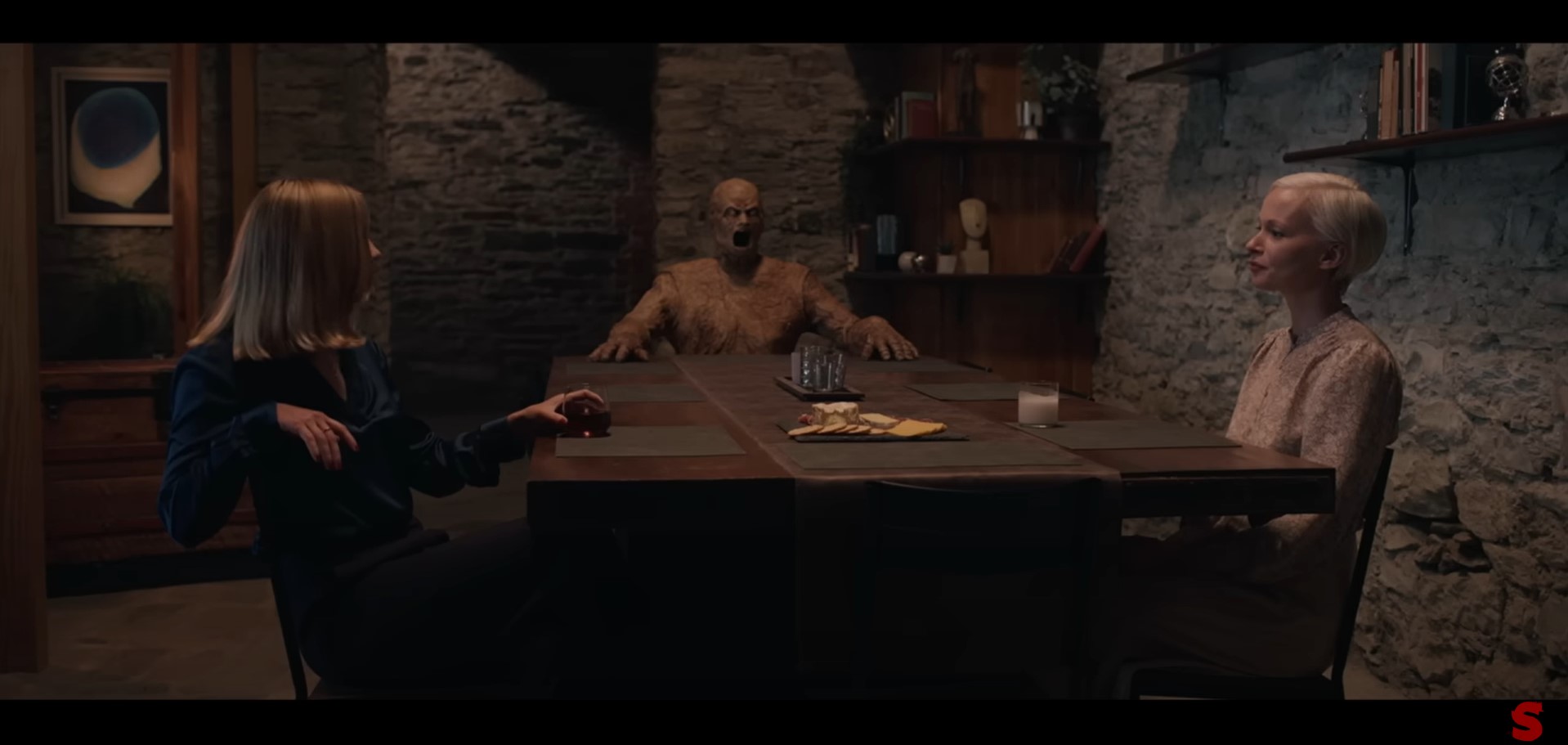
Carolyn Bracken (“You Are Not My Mother”) dons the double role of twin sisters Dani Timmins, murdered housewife to doctor Ted Timmins, and Darcy Odello, a blind psychic who owns an oddity emporium called Odello Oddity, as partly in the title.  When we think of twins in films, we think identical down to the very last mannerism and hair fiber, but for Dani and Darcy, they’re similarities are in blood and face structure alone.  The differences are stark with Dani sporting dark, long hair whereas Darcy’s is nearly white and cut pixie short., Dani’s health is more intact whereas Darcy’s afflicted with blind caused by a brain tumor, and the aforementioned results in Darcy’s gift whereas Dani lacks in that department.  Lastly, Darcy exudes more confidence for a blind woman who’s able to read the room without her known unnatural ability, possessing a separate superhuman knowledge left without the power of sight.  While Bracken only plays Dani for a short period of time a lot can be said between the two women who are portrayed perfectly contrasted; yet a connection between forms an invisible bond through Darcy’s practice of learned witchcraft that involves the wooden manikin.  Opposite Bracken is Gwilym Lee as Ted Timmins, a man unable to escape the haunting of his deceased wife and start again with new girlfriend Yana (Caroline Menton).  Lee’s an absolute pragmatic when it comes to being psychiatrist Ted Timmins in a good display of when a rational doctor plays a rational plan on how to do something irrational and while Timmins and Bracken share not a ton of screentime together within either of Bracken’s dual roles, the thick tension formed between their characters is palpable wrought.  Yet, the real award-winning performance should be handed to Ivan de Wergifosse, the unsung face and movements of the wooden man.  Menacingly still like a large Pinocchio doll ready to come to life at any second, Wergifosse’s golem movements erratically alter the tone of drama-thriller to creature-thriller, coupled with an intense sound design that will resonate in nightmares.  “Oddity’s” principal cast fills out with Steve Wall (“Dune:  Part Two”) as an unscrupulous orderly and Tadgh Murphy (“Boy Eats Girl”), who really does have an artificial eye, as the red flagging mental patient.

A confluence of componential folklores doesn’t stale “Oddity’s” unique brand of Mc Carthy storytelling.  Shrouded deep in shadows, an underlining sense of intense dread, and colorful in diverse characters, the film truly represents the meaning of the title despite its adopted resources and, to be honest, that’s how most stories survive nowadays when the familiar is rebranded with fresh frights dwindling every second.  Sometimes, being too novel can have the reverse consequences of being too odd for most general fans.  “Oddity” provides balance with a slow burn buildup by chopping out exactly what happens to Dani, creating a cliffhanger right at the beginning to get the investigative wheels turning.  Where I do believe Mc Carthy suffers to retain a truth uncovered is in the story’s predictability.  We already know who the bad guy and we’re just waiting to see how he did it.  That takes a good chunk of suspenseful whodunit away from the narrative when it’s practically spelled out for you.  The mysteriousness around witchcraft and the supernatural twin sibling bond, coupled and accentuated with the manmade blunt force apathy, carries the weight, and can overshadow what’s missing and purposefully omitted to keep a sense of the unknown palpable. 

Acorn Media International presents “Oddity” on an AVC encoded, 1080p high resolution, BD50. Mc Carthy and director of photography Colm Hogan’s first collaboration together in a horror feature that results in the graveness of blanketing shadows and an aged, speckled, and muted color scheme solemnity. Graded in undertones of green, blues, and yellows, “Oddity” contrasts nicely and frighteningly against an object, like the brown wood of the mannequin, is in juxtaposition of the norm.  Detailing is superb around said golem with tree notices and grooves despite looking like a man in a suit in certain angles.  There’s also finesse detailing around skin textures, costuming, such as Darcy’s intricate green and white outfit, and other concepts implemented into the story’s narrative, such as Tadhg Murphy’s false eye that’s been accentuated with a bright iris or the leathery strap around another patient’s ravenous mouth.  The British and Brogue English DTS-HD Master Audio 5.1 courses through the individually marked rear, side, and front channels for full surround effect of the mannequin’s wailings and joint creeks, relying more on the discordant higher pitches than minor chord LFE to scare wits.  Oppositely, an earnest and tense stillness is achieved when all sound ceases to exist without the faint hint of interference and or other noticeable popping, humming, or generated soft noise.  English subtitles are available under the static menu selection.  Special features include a behind-the-scenes with cast and crew, a storyboard to screen vignette of one’s scene’s storyboard conceptual illustration compared to the final scene’s cut, and the the making of the wooden mannequin told through an image gallery.  The standard release comes in a thicker than normal North American Amaray Blu-ray case with Darcy and the wooded mannequin in spiritual positioning cloaked partly in darkness, similar to the shadow work in the film.  Inside does not contain any inserts or other physical accompaniments but there is a more detailed facial depiction of the mannequin’s face on the disc pressing.  Hardcoded for region B PAL playback, Acorn Media’s Blu-ray clocks in at 98 minutes and is UK certified 15 with no certification qualifications but the story has violence, strong language, and intense situations.

Last Rites: “Oddity” may not feel like nothing new but it’s nothing new done well in its reenvisioning of folklore and the standard horror tropes to give this Damian Mc Carthy’s filmmaking career an open door and a blank check to scare us with something far more novel and next level in the Irishman’s films yet to come.

“Oddity’s” Blu-ray from Acorn Media International is Here!

Break a Promise with EVIL And Pay the Little-Big Price! “Unwelcome” reviewed! (Well Go USA Entertainment / Blu-ray)

Not the Leprechauns This Time.  It’d Be Goblins that “Unwelcome” You!  

Trying desperately to become pregnant for some time, Jamie and Maya celebrate the news of learning they’re expecting but their jovial rejoice is cut short when three thugs break into their city apartment home, nearly bringing an end to their lives and the baby.  When Jamie’s great aunt Maeve wills him a rural cottage in Ireland, the married couple jump at the chance to start afresh away from the urban chaos and the trauma in hopes for a peaceful life with their child.  The friendly village residents take in Jamie and Maya unconditionally but one stipulation is highly encouraged to be met if living at great aunt Maeve’s cottage:  they must leave out a blood offering for the little people, the Redcaps, of the forest butted up against their home.   Just happy to be out of the city, Jamie and Maya shrug off what they believe to be folkloric wives tales of old Ireland and on such short notice, they hire Mr. Whelan and his children, who come with an unfavorable village reputation, to do much-needed repairs around the house.  When dealings with the Whelan clan go violently sideways, Maya invokes superstitious belief to draw the Repcaps out of hiding and implore their murderous mischievousness for dire neighborly assistance. 

Welcome to the “Unwelcome!”  Pint-sized evil continues to be mondo popular around the world, especially in the Full Moon empire that’s built a kingdom off the backs of supernatural ankle biters.  However, “Unwelcome” is not a Charles Band production that’s rushed straight through to a fast-tracked, direct-to-video release of shoddy, schlocky proportions.  Instead, this release comes from overseas, the UK specifically, with some quality production footing that lands the 2023 released film into a limited theatrical run before hitting the home entertainment market.  Behind the film is Jon Wright, director of dark humored revenge against high school bullies in the “Tormented,” who directs and co-writes “Unwelcome’s” grim fairytale-like narrative of personal growth, inner fight, and underfoot goblins gone wild with Mark Stay, reuniting with Wright for the first time since their script collaboration on the 2014 automaton invasion epic, “Robot Overlords.”  Under the once working title of “The Little People,” “Unwelcome” is a production of the Yorkshire based Tempo Productions Limited, with cofounders by Jo Bamford and Piers Tempest as executive producer and producer, and the private equity investment group, Ingenious Media, with producer Peter Touche along with Warner Bros. and Well Go USA Entertainment distributing. 

“Unwelcome” has such unusual casting in a good way.  The entire Whelan clan consists of actors plucked from successful, multi-seasonal television shows that have essentially shaped their careers from their well-known, fan-adored roles, but the unintended adverse effect in such triumph stamina is being recognized only for that performance.  In my mind, Colm Meaney will forever be embedded in my hippocampus as Engineer Chief Miles O’Brien from “Star Trek:  Deep Space Nine.”  “Con Air,” “Under Siege,” and even as a British Airways pilot doomed for landing in “Die Hard 2,” Chief O’Brien, I mean Colm Meaney, is still in space tinkering with transporter buffers.  Here in “Unwelcome,” Meany is Daddy, aka Mr. Whelan, a rough around the edge contractor who beats his kids, let them get away with whatever they please, and has a real notoriety around town.  When I say kids, I mean grown adults stuck in Daddy’s hooligan wake and are played by more outstanding and familiar faces from Ireland, such as Hodor from “Game of Thrones,” Kristian Naim, Netflix’s “Derry Girls’s” Jamie-Lee O’Donnell, and the “1917” actor and upcoming principals of “Last Voyage of the Demeter,” Chris Walley, make up the trio of terribly laid construction workers who have really no business being around a hammer, a ladder, or anybody’s valuables.  That brings me to “Unwelcome’s” lead actors as the scarred couple who hires out Whelan’s band of delinquent spawns to do the handiwork repairs.  I realize Wright and Stay wrote Douglas Booth (“Pride, Prejudice, & Zombies”) to be an overly optimistic and fairly useless good guy with Jamie, but the insecurities are just ostentatiously oozing out of the husband without a clue.  Jamie’s arc also doesn’t quite flesh out by the end of the film as he’s blocked by the baby mama instincts of Maya, played by “Resident Evil:  Welcome to Raccoon City’s” Hannah John-Kamen, with an unspoken I’ll-do-it-my-damn-self attitude that sends the narrative into a knife-brandishing gob of Redcaps eager to do her bidding for an unfavorable exchange.  Maya sacrifices all for a good man with good intentions who can’t do diddlysquat to save her and, in the end, that doesn’t seem balanced for this ferocious fairytale. 

If there is one aspect, above all us, to note about “Unwelcome’s” shin kicking goblins as a takeaway is that the rambunctious and ravenous Redcaps are not computer generated, are not puppets, and are not even animatronics.  Actors and stuntmen fill those small shows with a little help of disproportionate movie magic, heeding to the ways of a lost art in miniaturizing actors, such as in “Willow” or “Honey, I Shrunk the Kids,” and touching up with some CGI on the tangible face molds for a layered composition that’s super fun to see come to life on screen.  Unfortunately, the Redcaps make a late appearance into a yarn unspooled with mostly the pent up pile of frustrations of Jamie and Maya as an unlucky couple without a chance of peace in the world.  Trouble finds them wherever they go in what’s essentially a trade for city thugs for unfriendly country versions of the same type of ill-mannered.  “Unwelcome” plays very much into it’s title that no place feels welcoming for a couple on the verge of the already daunting premise of parenthood life and everything appears now alien as the world is being upended by concessions for your child in what has turned terrifying in what was supposed to be a warm, welcoming of a new adventure.  That’s the sensation setup for the pair who trust dip into trusting superstitions and magical beings to be their guardians.  Folklore then takes over; its has, in fact, been welcomed to save the day no matter how maligned the backstories.  Wright and cinematographer Hamish Doyne-Ditmas do, in fact, construct an ocular stage crafted out of an ethereal red and yellow fire lit sky with an overall color theory toned to contrast as a mystical storybook set in what is usually flush with greenery around an Irish village, reminiscent of late 70s-early 80’s European horror sets built to detailed scale, built with vibrant backlighting, and yet built to feel distant, apprehensively off, and strange like another world, a Redcap ecosphere.  “Unwelcome’s” ending also pulls from that unabashed time to be creatively mad in an innately mad universe with an unexpected Redcap reason that doesn’t clarify so much their hunger for blood offers, which the diet includes raw store-bought meat and the frothy flesh of felonious individuals, but better explains their twisted promises and intentions for their knife-jabbing services rendered.

With Goblins, there’s always a price to pay but for the Blu-ray release of “Unwelcome,” the price is worth the admission.  The single-layered, AVC encoded, high-definition 1080p Well Go USA Entertainment release presents the film in a widescreen 1.78:1 aspect ratio.  Slightly squeeze onto a BD25, there’s some minor irregular compression patches that degrade solid darker colors and the image loses a bit of sharpness in the background – you can see an example when the Redcaps pop up out of the keep tower appearing more like moving globules than well-defined humanoids.  Goblin facial features and skin and clothes textures have tactile appeal during closeups with the same being said with the cast in their natural color tones.  Computer-generated facial movements have seamless pertinence to the surrounding action and the motion of the Goblin actors themselves with layering of frames looking clean to create their smallness around principal characters.  The English DTS-HD 5.1 Master Audio mix maintains a stout dialogue track but deploys no depth into recordings resulting in all the dialogue tracks to be at the forefront, even when characters are in the background in the scene.  The weird spatiality with the dialogue doesn’t translate over to ambient noise as those tracks are well designed into the scheme with levels of depth that add richness to the storybook atmospherics.  English SDH are optionally available.  Bonus features include a behind-the-scenes cast and crew interviews discussing their time forming the idea and working on the project, a making the Redcaps segment with special effects supervisor Shaune Harrison (“Nightbreed,” “Attack of the Adult Babies”) discussing the step-be-step process of bringing these little devils to life, including showcasing their head and body molds, and the theatrical trailer. The physical property comes in a standard Blu-ray snapper with latch with one-sided cover art of a knife-out Goblin starring up at the new mistress of the house.  Inside, a single-leaf advert of Well Go USA films and the disc pressed art with a blue-graded Goblin looking menacing makeup the inner contents. “Unwelcome” runs at 101 minutes, is rated R for strong violence and gore, pervasive language, some drug use, and sexual material. From an ironic perspective, “Unwelcome” uses the mythological mischievous of Goblins as a gas pedal accelerator to mature a pair of genteel gulls faced with a parlous reality and to be factotum in life in general told inside in the linings of a dark and gory fairytale universe.

Not the Leprechauns This Time.  It’d Be Goblins that “Unwelcome” You!  

You Must Put EVIL to Fire! “You Are Not My Mother” reviewed! (Magnet Releasing / Digital Screener)

Quiet and meek Charlotte lives with her granny and mother in Northern Dublin, Ireland. When Charlotte’s mother spirals into one of her depression fits after dropping off Charlotte at school, her mother disappears without a trace only to return a day later, wandering into their home in the middle of the night. Happy to see her mother acting jovial, the teen aims to reconnect the mother-daughter bridge that has long been under disrepair due to severe mental depression, but she then notices a string of fits, fits not concerning depression but of violent, erratic behavior too frightening for Charlotte to believe that this person who came back home in the middle of the night is the same person, her same mother. When her Granny suspects that mom has been replaced with a changeling, Charlotte and her new best friend Suzanne seek to uncover her mother’s true self on Halloween night when the barrier between our world and the spiritual world is at its thinnest.

There are many customs and cultures surrounding Halloween for various countries. Sometimes, the day that most of us horror fans look forward to every 31st day of October every year isn’t always about dressing up in costume, obtaining bags upon bags full of candy, doing mischievous pranks, or even sitting down to marathon the Michael Myers’ “Halloween” franchise. For UK, specifically in Northern Ireland, bonfires light up the land on Halloween,” or what is called Samhaim, for an array of reasons, one more traditionally being to keep evil spirits from crossing over from their dimension and into ours when the “All Hallow’s Eve” barrier between the two realms near kiss in proximity. Today’s Irelanders set ablaze bonfires more for an extravagant, beer-drinking party than to defensively thwart the uninvited spirits from gliding into our world and this becomes the Halloween backdrop for Kate Dolan’s written-and-directed, debut feature length folklore horror film, “You Are Not My Mother,” as a battle against the supernatural hidden in plain sight as one of us, a doppelganger. Dublin-based Fantastic Films (“Vivarium”) and the sweeping Screen Ireland compose as the film’s production companies with “Vivarium” and “Sea Fever’s” Deirdre Levins as producer.

The touch and go fragile battlegrounds of where children tiptoe on already severely fractured eggshells around their parents debilitating and volatile depression can be tough to capture on screen.  The voyeuristic hesitancy of sunken melancholy keeps the child around the fringes and ever guessing their parent’s rotating state of mind and “The Green Sea’s” Hazel Douple, as the teenage daughter Charlotte, nicknamed Char, and Carolyn Bracken (“The Dublin Murders”), as the unstable mother, connect strongly with that unnatural relationship imbalance.  Douple is perfectly reserved with Char’s mother’s erraticism, witnessing, and conveying a different response with just her eyes, every emotional stage washes over her mother from listlessness to jovial dancing to complete abusive rage, a range Bracken unnervingly does so frighteningly well.  Eventually, Char would need to realize the truth that her mother’s manic behavior is not solely due to a mental health issue but a malevolent fairy issue and need to break the chains of restraint to save the only parent she has left.  There’s no mention of a father figure throughout the narrative and could only speculate that the father either past or hightailed the relationship due an infinite amount of reasons with one being more prominent against mom’s harmful instability.  Amongst the multi-generational, female-driven, character story is the top matriarch in Granny, played by “Citadel’s” Ingrid Craigie, who is positioned awkwardly as a bypassed presence and not really substantial weight bearing down on the contentious tension in the house they all share together.  Granny’s off-putting and mysterious ever since the opening scene with a layer of understanding and occultism hardly tapped into or even with a slight of exposition as she builds talismans and goes off to visit a friend to discuss Char’s mother.  Paul Reid (“The Ritual”), Jordanne Jones, Katie White, Jade Jordan, and Florence Adebambo co-star.

“You Are Not My Mother” continues to be a tsunami of new wave UK horror washing onto the shores of theatrical, digital, and home video platforms and any film that starts with burning a baby just might be okay in my book.  No, I’m not a psychopath, I just like to be overcome by dreadful content; yet, though the Kate Dolan cinematic accession as a feature film writer-director doesn’t start with perfection with the story burdening more wrinkles than the direction  I’ve already touched upon the mishandling of Granny and her connection to a supernatural belief goes without say that her role as mediator falls severely short of development key to Char’s total comprehension of her mother not really being her mother due to XYZ reason.  The backstory also tries to reinstate itself into the present story but can’t shape up from its gelatinous yarn, giving little for Char and the audiences to work off of and take all that is happening with good faith on face value. There are continuous instances of this weak bridge connection between characters and events as we also see between Char and a school bully Suzanne who instantly become best friends after a single shared connection that’s not poignantly stabbing, but for the narrative, it’s enough for Suzanne, who wants chewed gum and stuck it on Char’s school notes or help set a photograph of her mother on fire, to open up a soft spot instantaneously without a hurtle to overcome.  Where “You Are Not My Mother” succeeds is in the character and story driven parameters without relying heavily on gratuitous special effects with enough practical to scare the wits out of you and firmly no CGI to supplement the creation of Carolyn Bracken’s facial dysmorphia, like a disturbing happy face emoji, as a replaced mother.

“You Are Not My Mother” is a Halloween movie, an Irish folklore Halloween movie, prickled with Samhain traditions at the very core of Kate Dolan’s story.  The film is slated for a March 25th release in theaters and on demand from Magnet Releasing. The 93-minute folklore horror is equally matched by its rifting, soul-stirring composition from the Belfast-based and worldly-sound of Die Hexen who also double-dips as sound designer, blending sometimes delicate but often jarring synthesized ensemble of sound. Narayan Van Maele’s cinematography has an overcast austere, almost icy, in the rendering of what is usually a lush in greenery and rich in historical, old-world place, but the Maele’s wide and long shots are engrossing accompanied by a tighter edge that often feels cramped when inside the house, good for close quartered domestic contention in the family drama parameter. There were no bonus scenes during or after the credits for this film. If not for Carolyn Bracken and Hazel Douple’s fiery and lucid performances to keep glued to, “You Are Not My Mother” would simply fall apart at the seams, squandering much of the Irish folklore that already hangs by a thread.

When EVIL Runs The Show, That’s When the Reality Sets In. “Funhouse” reviewed! (Magnet Releasing / Digital Screener)

Eight C-grade social media celebrities sign a contract for a new reality show, Furcas’s House of Fun.  The reality show streams worldwide on all electronic devices in an exhibition of different and standoffish personalities locked together in apartment-size living quarters.  Contestants will have to face challenges and weekly viewer voting to be the last one standing for a chance to win a 5 million dollars cash prize  Instead of sexy making out sessions, drunken brawls, and contestant melodrama to boost viewer ratings, Furcas’s House of Fun is in actuality a syndicated snuff reality show where a contestant is voted out is a contestant receiving a brutal death in front of the entire world.  Survivors watch behind paned glass as one-by-one their castmates are dispatched in the most gruesome way possible, directed by a screen animated panda bear helmed by a sadist eager for the show to go on.

Ready to have a little fun?  The “Funhouse” is open for what is a variety show of horrors in this 2019 shot, 2021 released reality show of encroaching aggravation and gore from writer-director Jason William Lee.  “The Evil In Us” filmmaker plays his hand at personifying internalized resentful rage for hack, do-nothing, inconsequential to society celebrities by feeding them gladly and enthusiastically to the bloodthirsty wolves.  “Funhouse” isn’t your typical social media or tech horror film as Lee dishes out a thought-provoking disgust covered in a powdery sugar and popcorn veneer that’s surely to please the broad range of horror fans.  The co-ventured Canadian-Swedish story of shallow fame nihilism is shot in the Providence of British Columbia and in Stockholm, home base of Ti Bonny Productions under executive producer Henrik Santesson, in collaboration with Lee and producer Michael Gyorl’s Sandcastle Pictures.

With the surname Skarsgård, acting is in certainly in the blood.  Valter Skarsgård, the youngest son of “Nymphomaniac” and “Deep Blue Sea’s” Stellan Skarsgård’s first marriage and the brother of terrifyingly frighteningly Pennywise actor, Bill Skarsgård (“It”), branches out following his ancestral destiny by headlining as the lovable and misjudged Swede, Kasper Nordin, who leeched fame by being the ex-husband to a renowned singer.  Nearly the spittin’ image of his older brother Bill, Valter brings his name and family looks to the table while showcasing his own talent amongst a motley crew of nationalities.  That’s one of “Funhouse’s” main messages about social media stardom as a plague that has spread to every corner of the world symbolically infecting each contestant from a different country:  Dayleigh Nelson (“Island of the Dolls”) of Britain, Khamisa Wilsher of America, Gigi Saul Guerrero (“Puppet Killer”) of Mexico, Amanda Howells of the Philippines, Mathias Retamal (“The Source of Shadows”) of Chile/Canada,  Karolina Benefield of Poland, and Christopher Gerard of Ireland.  The roles of wannabe celebrities is an ostentatious representation of click bait influencers who will sell essentially their soul and show their skin to be noticed and this turns the clear antagonist villain, a merciless gamester and contract abider with business dealings more vile than from the Devil himself, to be a subtle antihero of sorts as the cast rounds out with Jerome Velinsky’s wickedly sophisticated performance as Nero Alexander that is urbane nihilism at its best. 

Outrageous, fun, and gory – “Funhouse” has all the hallmarks of a 90’s horror on cruise control.  With a bedazzling rudimentary shell of a panda bear avatar animation and blend of practical and digital blood over the simplicity of a small location and indie production, Lee is able to fly through the narrative at whiplash speed and still drop animosity-awarding and empathetic traits to believe in the cast of characters.  In the middle of the chaos of axe splitting heads and being dunked into a barrel of highly corrosive acid, a topical theme of the detrimental social media and influencer stardom to society really positions “Funhouse” on the frontline for inflammatory and anti-social media messages, harping on the noncontributing and unbeneficial role of these money-generating, like-focusing, click baiters in culture and society other than selling to their audiences sex, gossip, and violence.  Speaking of violence, I was pleasantly surprised by the right amount of gore that didn’t shoot for extravagant levels despite some smoothing around the digitally added sinew and guts, keeping a modest amount of realism to the dystopian gameshow construct.  Initially, there are dubious first act moments that quickly shuttle hapless soon-to-be-casualties into the same location, much like in “Saw II” when characters all wake up in the room together and we have no idea who they are, where they come from, and what their backstory is, but as the film progresses we learn more about them and the roles they play in the maniacal puppeteer’s design.  The twist, almost meta-like, ending leaves “Funhouse” on a low note that doesn’t fulfill any void for its existence, but a good chunk of the story is really meaty with a revolving door of plights and a small, yet efficient, compassion outpouring spicket.

Not your traditional participatory surprise-laden and mirror maze attraction, “Funhouse” will still bring old-style thrills with some new blood spills in it’s grand opening release in theaters and on demand on May 28th courtesy of Magnet Releasing. Shawn Seifert (“Dead of Night”) lays out a smorgasbord of cinematography techniques that includes rich, un-matted color filters, isolating characters in darker, dim rooms in making them seem centerstage for their own grand demise, and cultivates stationary, handheld, tracking, and some drone shots for an extremely vibrant and glossy approach and feel for reality television version 2.0. Lee edits the digital reel himself and, honestly, the pacing wanders quickly to the overly rushed section like a quick-spit-it-out story wanting to be finished before it even begins and is compounded with another intrusive quality in the hyperactive back-and-forth of shots that aims to resemble the irksome flight in and out of reality shows that speed up and slow down like a nervous teenager behind the wheel of their parents and continuously presses down on the brake pedal. Stay tuned after credits for a gag bit scene that ties into the main story but promises nothing more. No more being voted off the island or nixed by expert judges, “Funhouse” cleans house with deadly eliminations and a message of the unyielding power granted to many so easily through a rapidly reshaping medium that has become too influential on a braindead scale.