The James Brothers’ EVIL May Not Compare in “Killers” reviewed! (Synapse Films / Unrated Director’s Cut Blu-ray)

“Killers” Unrated, Director’s Cut on Blu-ray from Synapse!

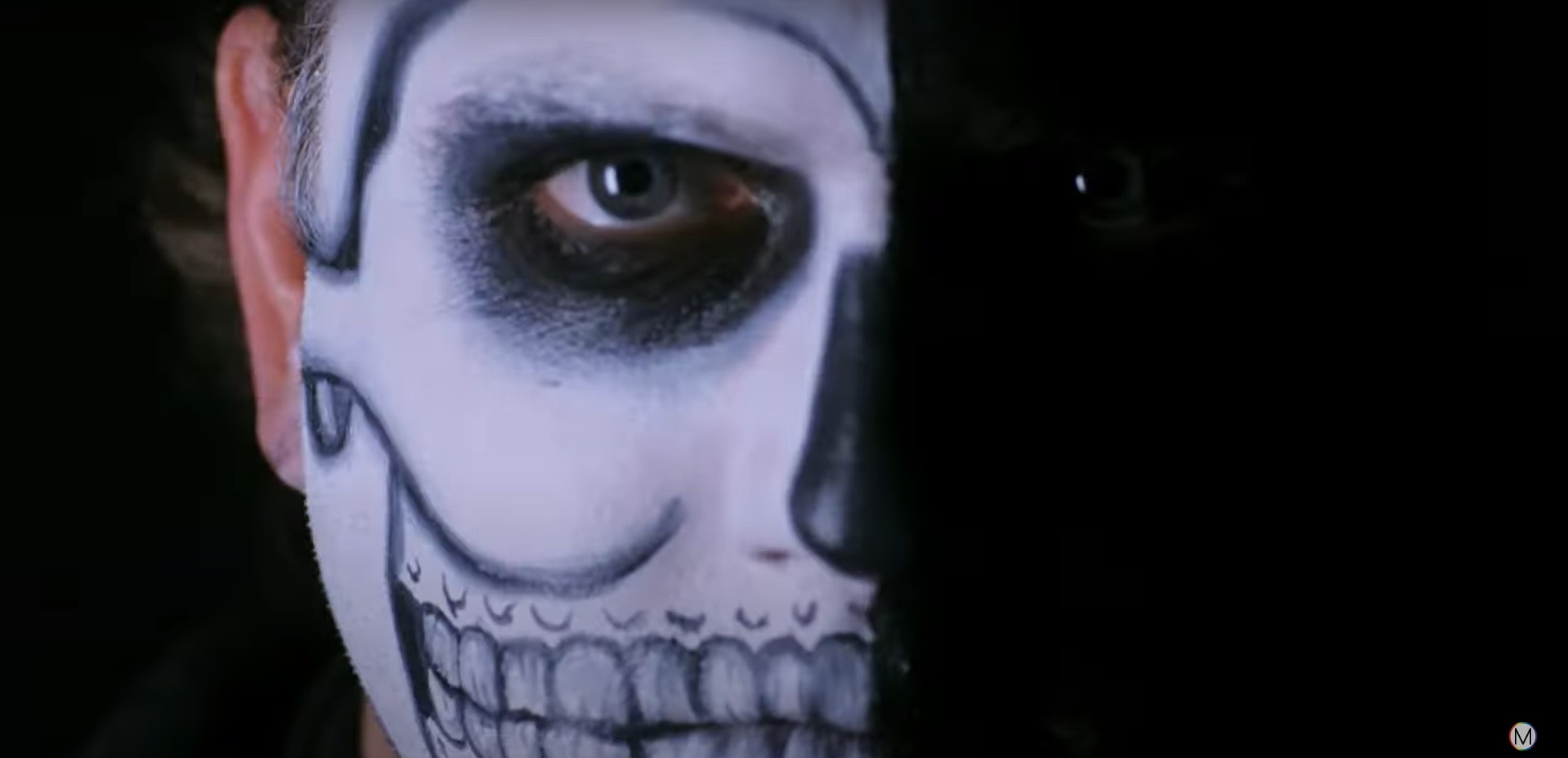
Odessa and Kyle James paint half their faces with skull imagery, don their Santa hats, and load their pump action shotguns and on Christmas Eve, walk into their parents’ bedroom and unload multiple shells into them where they lay without mercy.  A trial sentences them to death row for their crimes despite their calm efforts to dismiss the State and prosecutor’s case against them.  Years later, the brothers escape from the maximum-security prison and are the loose in the town of Beatty where the Ryan family happily watch television and play board games on a stormy night.  With U.S. Marshalls hot on their tail, Odessa and Kyle invade the Ryan home where their strangely more than warmly welcomed by the mother and two daughters.  It quickly becomes clear their usurpation of the Ryan household is more of a sheep in a wolf’s clothing and the meager, goody-two shoes Mr. Ryan will reestablish dominance and show the James Boys the real man of the house.  

1996 marks the year of Mike Mendez’s debut feather-length film, titled simply “Killers.”  “The Covenant” and “Satanic Hispanic” segment director writes and direct a philosophical and brutal home invasion thriller cowritten by one of the film’s principal actors, the late Dave Larsen (“Vampire Centerfolds”), full of unusual twists that can second guess everything you know about storytelling.  “Killers” cements under his greenhorn feet novel elements of twisted character studies while finding homes for bad boy cool characters, stylized shootouts, and a smoky noir and dark dwelling cinematography to commingle with his anarchic structure and tale.  The U.S. produced film is independent funded by star-producer Dave Larsen under the LLC of The Lost Boys, a reference from the film’s story that labels the escaped convicted brothers as such, with Joseph E. Jones-Marion as coproducer.  Most of the funds were secured by Dave Larsen’s father, S.E. Larsen, after remortgaging the family home.  Eventually, the home was foreclosed upon after Dave’s premature death.
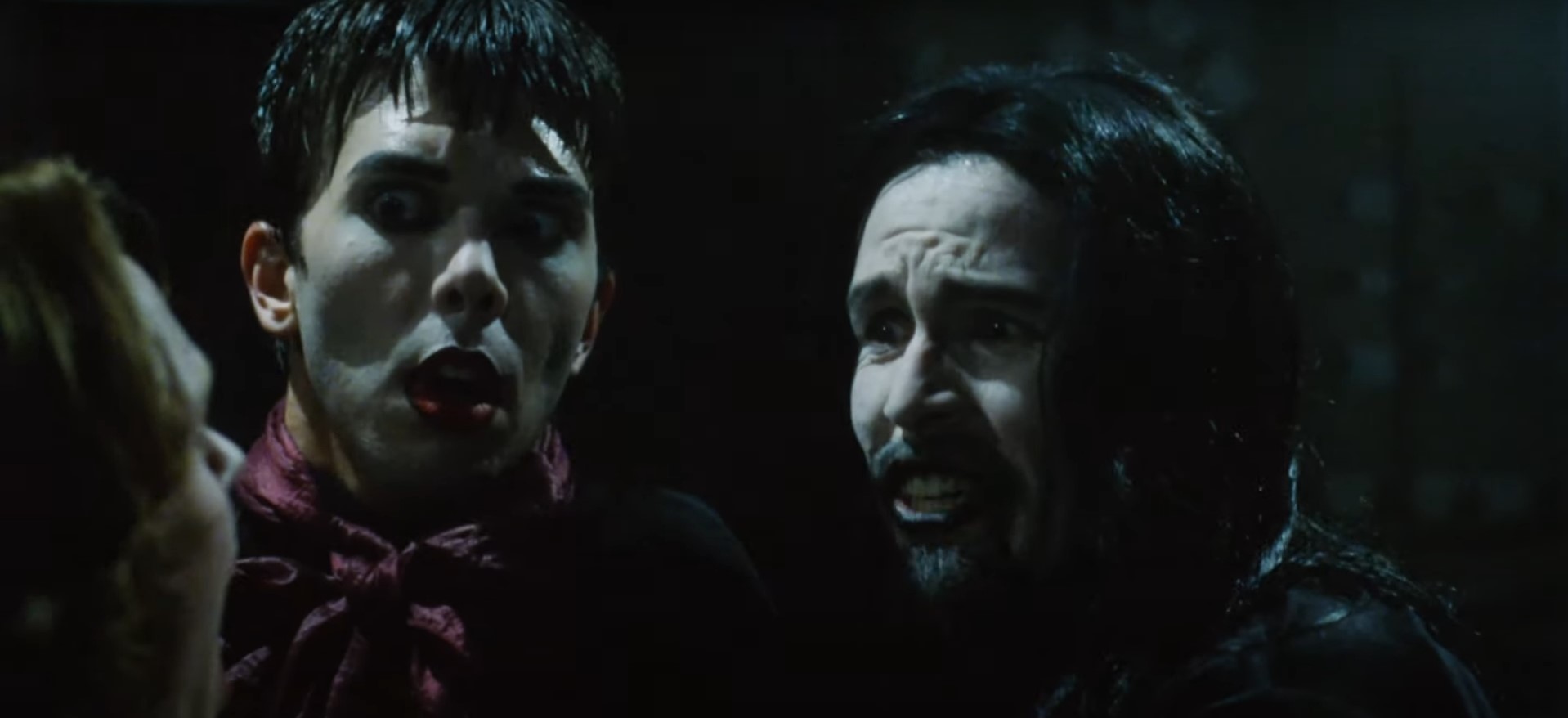
Dave Larsen and David Gunn entrench themselves into the sordid souls of sociopathic brothers Odessa and Kyle James, inspired almost to the exact murder by real-life killers the Menendez Brothers who committed parricide in nearly the exact shotgun-loaded manner in Beverly Hills 1989.  Portraying mindful. ruthless killers with intellectual monologues and a panache that’s very Mickey Rourke pastiche, the solemn faces and confidence carrying Larsen and Gunn go greatly above and beyond the call for the titular types.  Thinking the summit has been reached and there could be nothing more grave than two brothers snuffing their own mom and dad without hesitation, who kill Beatty locals with intent, who steal daughters (Nanette Biachi, “The Killer Eye,” and Renee Cohen) and a wife (Damian Hoffer) for their own carnal pleasures, and who bully and insult a respected husband, father, and man (Burke Morgan, “Bloodsucking Babes from Burbank”) of the Beatty community, the tables suddenly and jarringly turn and viewers will be knocked unbalanced when the police storm the door, lead by U.S. Marshal Lorna McCoy, played by the quick and sarcastic lip of Wendy Latta, and discover just then who that two killers are actually more in this seemingly quiet and small suburban house, rivaling the James boys, if not surpassing their malevolence even if just a little.  The “Killers’” cast doesn’t stop there as Ellis Moore (“Femme Fontaine:  Killer Babe for the C.I.A.”), Ivan Vertigo, Chad Sommers, and Carol Baker becomes a part of the fray.

“Killers” defined is simply a conceptual paradox.  If two unstoppable forces collide, the logical result would be an unfathomable outcome as nothing can stop an unstoppable force.  Instead, what may occur is a massive particle explosion, a rift in dimension time and space, or a vast nightmare so bizarre nothing can compare to it.  “Killer” embodies every quality of the latter in its maniacal melting pot of phantasmagoric potpourri, especially through the Mendez lens of engulfing shadows and mostly Duke blue and poker hot red gel tints.  Following the progression is a guessing game unto itself with welcoming and shocking pivots that parade forth a Hell on Earth turn of events.  You think the story’s going one way then it acutely shifts, and this happens more than once to the point where none of the previous groundwork or what’s instore for the future can be taken for granted in this fluid, subversive, kill-or-be-killed home invasion and cannibal bipartite.  For a first-time independent production, weapon props are extensive, gory moments are effective, makeup has grotesque appeal, and the dialogue indulges in shades of conversation complexity that equally match the complexity of the characters’ MacGuffin backgrounds.  Mike Mendez’s impressive start to his career has provocative monologue and stylish notes of Quentin Tarantino and William Freidkin bathed in primary color gels and a tale zigzagging with zeal.

Available for the first time in high-definition, the director’s vision, restored by the Multicom Entertainment Group, is in the hands of Synapse Films, delivering “Killers” to the cult physical media table with an AVC encoded, 1080p high-definition, BD50 Blu-ray. Presented in the 1.78:1 aspect ratio, “Killers” has a stylistic choice of being tenebrous, whether in shadow, in night, or just to over exuded a sense of gloom and doom in tone and in what’s visually shown. Delineated blue and red gel lighting beam through and glow the necessary bits for effulgence effect to contrast the darkness. Another popping source of lighting and colors are the individualized, punchy Christmas colors because, for all who don’t know, “Killers” is actually a Christmas movie. Because of the cheerless grading, details are not inherently sharp but Synapse and Multicom’s restoration enlightens quite a bit than previous versions, putting rightfully on display the details where once shrouded by lower resolution or otherwise mishandled. Skin tones appear natural as well as the grain with a scintilla of white speckle. The lossless English DTS-HD Master Audio 2.0 stereo has an organic dual-channel dynamic, catering a central focus on the monologuing, that translate to the dialogue exchanges also, with great enthusiasm and clarity. Not the best in edited sound design that has layer slippage but pulls enough ahead and into the fold to not be an unsynchronous, incongruous mess. “Killers” could have greatly benefited from a surround mix with the varietal exchanges that emits a full-bodied arrangement of resonations, mostly in the interiors and playing to those specific in locations. English subtitles are available. Special features include a feature-paralleling audio commentary with director Mike Mendez and horror journalist Michael Gingold going over backstory, tidbits, and the goals of making “Killers,” an alternate, pared-down ending that’s loses a lot of the original film’s feasting flavor, and the original promotional trailer. The black Amaray case comes with new illustrative cover art without a reversible option. Inside contains a 6-page essay My Brother Death: Mike Mendez’s Killers by cult film enthusiast Heather Drain, a Synapse 2025 product catalogue, and a disc pressed with Odessa’s half-skull covered face. The region free release has a 96-minute runtime and is unrated.

Last Rites: Synapse Films have brought “Killers” from out of the shadows of obscurity. A schismatic, soulless killer of a film, “Killers” has the heart of madmen and madness meshed together in one seriously sideways story.

“Killers” Unrated, Director’s Cut on Blu-ray from Synapse!

Daddy’s EVIL Little Secret. “The Beast Within” reviewed! (Well Go USA Entertainment / Blu-ray)

“The Beast Within” is Calling! Own Your Copy Here!

Infirmed 10-year-old girl Willow witnesses one night a month her mother whisking away her rather distant father into the dense woods deep within the English countryside.  When brought home the next day, her father must be helped carried in, appearing haggard and weak from his strange and mysteriously kept overnight departure far from home.  The secret festers between the parents, as well with her grandfather, to a point where tensions rise to the surface and the family is slowly falling and drifting apart.  One night, Willow decides to sneak onto one of those one-a-month egresses and discovers her father, left chained inside a dilapidated structure in the middle of the wooded nowhere, transforms into a horrible beast.  From that point on, the family secret was no more, and she must come to terms with her parents’ deception and their struggling family cohesion before the next full moon rises above their isolated home compound.

Lycanthrope films are on the rise with the anticipation of two new theatrical releases that have seen positive reactions just by their trailers alone with “The Invisible Man’s” Leigh Whannell staying in the Dark Universe with “Wolf Man,” slated for the silver screen January of 2025, and “Scream of the Banshee’s” Steven C. Miller going wild and hair near this Christmas season with his chaotic and carnage-ladened “Werewolves.”  Kicking it off in the werewolf category however is English director Alexander J. Farrell making his debut fictional feature with “The Beast Within.”  The 2024 released conceited thriller plays on a child’s perception of events, especially when she sees her parents joyless faces, co-written by Farrell and more seasoned screenwriter Grear Ellison (“A Woman At Night”) and both have worked previously on Farrell’s last two projects, a documentary entitled “Making a Killing” that sheds like an antiquated law that results in capping financial need after preventable medical negligence and another cowritten session, a RomCom in “How to Date Billy Walsh” that was also released in 2024.  The UK production comes from a conglomerate of companies in Paradox House, Future Artist Entertainment, and private equity group Filmology Finance and is produced by the father-son duo Gary and Ryan Hamilton of Archlight Films who oversaw global sales of the film, Martin Owen, Tammy Batshon, Spencer Friend, Evan Ross, Sebastian Street, and Paolo Pilladi.

Looking for his next big hit to branch out from the shadow of “Game of Thrones’” bastard hero, Jon Snow, is Kit Harrington taking the headlining role as an intermittent explosive disorder father struggling to keep his family whole because of his own family curse.  Often resembling the HBO role that made him a household name when donning that iconic large fur coat that became an innate symbol of the Stark family, Harrington’s Noah character fails to become uniquely recognized as he’s quite the mystery with little background to his compound abode and his occupation of what seems to be a lumberjack of sorts, always cutting down trees in the nearby forest.  What’s even more mysterious is the family lineage of temporarily transmogrifying into an aggressive, animalistic beast when the full moon is high.  His reason for being cursed stems mostly from anecdotal knowledge of his own grandfather’s tragic history with being plagued by the same condition.  This places Noah’s family onto spider-cracking eggshells as his wife Imogen (Ashleigh Cummings, “NOS4A2”) finds herself loyal to a fault by caring for Noah’s condition but taking the brunt of his abusive behavior all the while daughter Willow (“Caoilinn Springall, “Stopmotion”) initially doesn’t know what’s truly happening but has this underlining fear of her father, noted by wedging her rocking horse underneath her room’s door handle every night.  Willow’s grandfather and Imogen’s dad Waylon (James Cosmo, “Highlander”) serves as a buffer between Noah and his family, maybe even perhaps the voice of reason.  Performances are mostly strong with Harrington forcing Noah’s hand a little to be brutish, a quality that doesn’t quite stick as intended.  There’s also some finale unresolve essentials with Waylon that doesn’t determine his fate as we’re left with only a threadbare implied outcome, an unfortunate state for one of the handful of principal characters.  The supporting actors rounds out with Ian Giles and Martina McClements (“When the Lights Went Out”) who never share scenes with the key intimate cast.

Aforementioned, “The Beast Within” is from the perspective of a child, in this case a child with great imaginative qualities as seen with her hobby of matchitecture of her home and nearby buildings, but the story is also definitively an allegory for an abusive husband and father that uses the lycanthrope mythology as a bestial symbol for one man’s vile nature.  Noah’s deceptive behavior lures in what the family wants, a loving husband and adoring father providing, protecting, and caring for them, but Farrell strings along a hidden truth with spot visual clues of Noah’s true self.  Those clues are terribly evident to the family devolution but there’s also a stasis of hope when Noah’s charm and smile glimmer through the cracks of his monstrous shell that’s mostly kept at bay from the audience.  The allegory keeps well until the end and then the allegory loses its legs and not mounting to much when everything laid before our eyes in the story is suddenly washed away by Farrell’s inability to stick with his metaphorical story and go explicit in the last few scenes when the child’s perspective veil is dropped, as if the new feature director couldn’t trust audiences to come to their own conclusions.  Yet, timeless set locations in the expansive English countryside, the compound set design, performances, and the limited but practical effects of the wolf man add to the independent film’s slow burn horror-dramaturgy that seizes the opportunity to label man a beast under his worst genetical conditions. 

A terrible, dark, ancestral secret can never be contained and now the terrible animal is loose onto Blu-ray home video from Well Go USA Entertainment.  The AVC encoded, 1080p high-definition, BD25 stacks up against the rest of the label’s catalogue as par for the course with a slightly softer image mostly under natural daylight and key night lighting and foundationally based with a mixture of yellow and red hues.  Though soft, details are not lost.  There’s an abundance of sharper medium to closeup shots, especially in darker scenes, where granular textures surface and the layers separate more distinctly.  Where the softness prevails is in the exterior wide shots of the 1.78:1 aspect ratio that can’t seem to not only create a greater sense of space but also can’t fathom the finer diversities of road, land, forest, and structure in what is likely a dovetail diffusion of color around the edges.  Ultimately, your brain figures it out but to the eyes the landscape is a bit one noted.  There is a pinch of splodgy murkiness in the shadows that doesn’t affect the presentation immensely.  The English DTS-HD Master Audio 5.1 diffuses the layers with solid balance.  There’s plenty of isolated audio capillaries to carry over the ambiance denotations of an ever-present fear, such as the howling wind, the violent banging of a fortified gate, or even the animalistic sounds deep in the distance, creating the depth needed to present danger from afar.  This is also coupled with tighter tension of closer vibrations, the hacking of the trees, the creaking of a floors, etc., for heightened lossless reproduction.  Dialogue renders clearly and cleanly throughout.  English and French subtitles are available for preference.  In the special features department, this Well Go USA release only comes with the film’s trailer plus pre-feature previews of other label releases.  The Blu-ray disc is pressed with a clawed imagery inside a standard Blu-ray Amaray with snap-lock and has only an advert card in the insert for this film, sharing space with “Twilight of the Warriors:  Walled In” and “You Gotta Believe.”  Rated R for Strong Violent Content and Language, “The Beast Within” has a runtime of 97 minutes and is listed as region A playback only but I was able to play the disc in Region B. 

Last Rites: “The Beast Within” is a by-the-book and subdued English allegory for fearsome behavior and Farrell’s debut is finely drawn but up to a point when audiences are quickly subjected to an unnecessary and redundant end-all, tell-all of daddy’s true being.

“The Beast Within” is Calling! Own Your Copy Here!

Demonic Nuns Want Virgins to Resurrect EVIL! “The Convent” reviewed! (Synapse Films / 4K UHD and Standard Blu-ray)

4K and Blu-ray “The Convent” Demonically Entering Your Soul! Buy It Here!

A woman strides into a convent carrier a can of gasoline and a shotgun during the sacrament of Eucharist between priest and nuns.  After setting the humble nave ablaze, she unloads shotgun shells into all the screaming bodies.  40 years later, a group of Greek life college students look to make their Greek letter mark on the same derelict convent now swarming with urban legends and ghost stories.  When a virginal student is kidnapped by wannabe Satan worshippers, they accidentally open the gate for dormant demons to arise through the corporeal vessels of the dead.  The possessed dead slaughter all in their way to seek another virgin, one that will embody their unholy master until this plane of existence.  The only chance for survival is to track that now woman from four decades ago to finish what she started after 30 years in an insane asylum, to blow away the demonic beasts of Hell!

At the turn of the century in the year of Lord of 2000, a year some Christians believed marked the 2,000th anniversary of the incarnation of Jesus Christ, saw another reincarnation of Hell passing through Catholic sacred ground from the creative culinary of profanity director Mike Mendez.  The one of a handful of creative talents behind the “Satanic Hispanics” anthology film and the native Los Angeleno helmed “The Convent,” his third directorial in horror behind breakout pyscho-hit “Killers” and the male-chauvinist be damned horror-comedy “Bimbo Movie Bash,” from the Chaton Anderson’s debut script full of sacrilegious imagery, glow-in-the-dark veined demons, and the dark comedic charm of early 2000s.  Shot entirely in Los Angeles, the demon-comedy is produced by Anderson and Jed Nolan (“Jurassic Women”) on a microbudget from executive producers Ryan and Roland Carroll of Alpine Pictures (“Dark Honeymoon”), Elliot Metz, and Rene Torres, who served as associate producer on the cult favorite, “Night of the Demons.” 

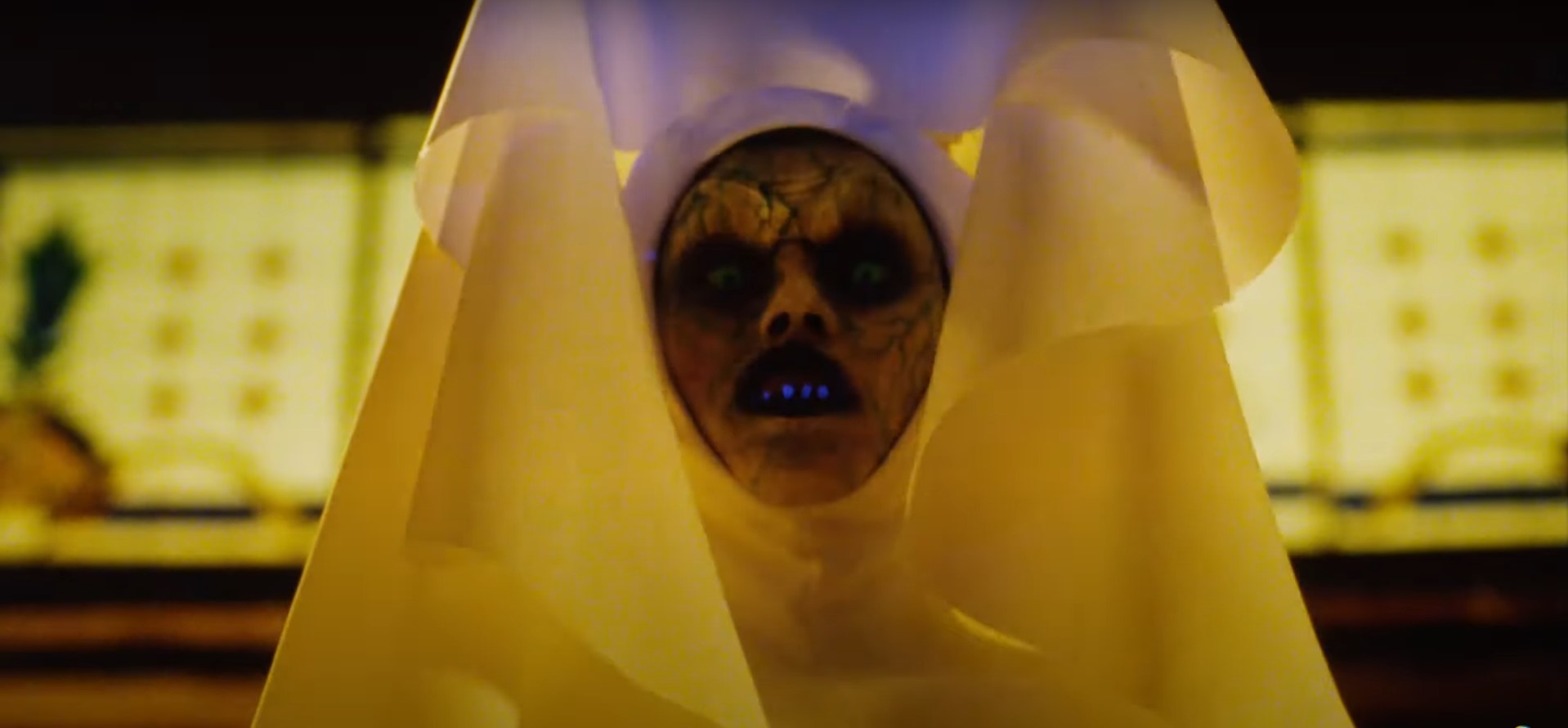
The collegiate characters are not only surrounded by twitching, carnage-dishing demons under the nuns’ habits but they’re also surrounded by headlining genre greats Adrienne Barbeau (“The Fog,” “Swamp Thing”) and, briefly, Bill Moseley (“The Devil’s Rejects,” “Texas Chainsaw Massacre II”) and gangster rapper, the late Coolio.  Barbeau doesn’t lose a step being the beautiful badass we all know and love from her reign as an 80s-90s scream queen, shotgun barreling down demons left and right as her character’s 40-years-senior self from the Nun-torching and blasting opener, the accused certifiable crazy lady called to action in Christine.  She’s called to once again stop a demonic Catholic kerfuffle she immobilized from spreading four decades back by a new set of naïve, older teenagers looking to get high, get lucky, and get the kicks.  Joanna Canton, who had three seasons in her on “That 70’s Show,” battles back-to-back with Adrienne Barbeau as Clorissa, the lead principal of the trespassing teens.  Canton is joined by story boyfriend Chad (Dax Miller, “Blood Surf”), story friends Biff (Jim Golden), Kaitlin (Renée Graham, “Shriek If You Know What I Did Last Friday the Thirteenth”) and Frijole (Richard Trapp, “Re-Cut”), story little brother and abuse-taking pledger Brant (Liam Kyle Sullivan, “Rideshare”), and story gothic bestie of another life time in Mo (Megahn Perry, “The Perfect Host”) whose been ostracized by mostly Clorissa’s friends and even a little by Clorissa trying to escape a gothic lifestyle for more fit in “normal.”  A dark and spooky night in a rundown convent transforms into a night of terror when Satan Worshippers Sapphira (writer Chaton Anderson, “Wither”), Davina (Allison Dunbar, “Browse”), and Dickie-Boy (“Kelly Mantle, “The Evil Within”) are led by so-called Satanist expert and a poorly 17th century speech replicator Saul (David Gunn, “Killers”).  “The Convent” does have dynamic trope characters, ranging from jock, to druggie, to cheerleader, to goth, and to the nerd, following formulaic footsteps to face forces of ferocious, fanged demons and doing it oh not so well and oh so gloriously bloody.  Casting rounds out with Oakley Stevenson, Larrs Jackson, and Elle Alexander.

Mendez’s “The Convent” has a real identity crisis issue walking in the familiar territory that closely resembles Kevin Tenney’s “Night of the Demons.”  Hell, I would go as far as stating Mendez’s Y2K-personified horror is a near step-by-step remake of Tenney’s 1988 demon possession carnage in an abandoned structure film.  However, minutia differences, a fall of Catholicism theme, and the addition of a motorcycling, demon-destroying Adriene Barbeau keep similarity nuances at bay and the acquainted plot lively and entertaining with a glow-party, nightclub maquillage on the demons to give them a fascia of techno-effervescence veins.  Mendez also adjusts the demons’ movements to a rapid twitch with increased frames per second and having the actors jerk their movements in a wild array.  Seems a little bizarre at first but the effect grows on you, and you can’t imagine “The Convent” demon without the spasmatic shots, as their glowing eyes set on seek-and-destroy roam from dilapidated hallway to dilapidated hallway, succumbing to the evil spirit’s will after the life force leaves the body.  Themes of an evil Catholic perspective will challenge those with a Christian value upbringing, especially with nuns and priests being gunned down and torched, and more character specific concepts of personal growth in deciding what’s right versus what’s popular run a paced course of dispersed too late to fix what’s already broken. 

As part of the Mike Mendez 4K UHD double bill release from Synapse that includes his individual inaugural film “Killers,” which we will review soon too, “The Convent” comes in a 2-disc, dual format set, making it’s uncensored, U.S. debut remastered in Dolby Vision 4K from the original 35mm internegative elements.  HEVC encoded, 2160p ultra-high definition, BD66 and the AVC encoded, 1080p, BD50 rockets the previously out of print film right past a standard Blu-ray release and into the land of 4K with 2k hitching a ride.  Both formats presented in a widescreen 1.78:1 aspect ratio, the definition and color saturation advancement are a huge leap from previous DVD releases with more delineate means inside a broadly shadowed interior.  Light and shadow have now divided fully and agreeably to shapes are now more obscured or in illumination.  With that being said, details are not knocked out of this part and that’s especially surprising since director Mike Mendez supervised the 4K remastering.  Facial features do appear smoothed out, more so on the standard Blu-ray release.  UHD has a slightly better rooting out skin details and customer texturing which Adrienne Barbeau leather jacket and tight denim jeans, with all the folds, zippers, buckles, and such, seeing the most promise.  The superimposed glow f/x has rich lamination with the emanating pulses creating reflection being done well on character faces and throughout an enclosed room.  The UHD and standard Blu-ray come with an English DTS-HD master audio 5.1 surround sound from the original 16-track master audio.  Uncompressed fidelity is a complete win here for “The Convent” that seizes side and back channels with monstrous grunts and growls, and not to forget to mention the often-neglected spooky house ambience of creaks, cracks, and killer hits to the body.  A broad range helps diffuse distinct layers to the individual channels.  Dialogue renders clean and clear with no pitchiness of hissing or crackling to note.  English subtitles are available on both formats. While the UHD only has eyes for the feature, the Blu-ray has the movie plus Hell-Raising bonus content, including two audio commentaries with a cast and crew commentary with director Mike Mendez, Megahn Perry, and Liam Kyle Sullivan and a Lords of Hell commentary featuring David Gunn and Kelly Mantle in full character of Saul and Dickie-Boy, a behind-the-scenes featurette, a location featurette, a single deleted scene, gore/kill scene outtakes, the original EPK (Electronic Press Kit), a pair of promotional trailers, and a still gallery. The new primary cover art and the reverse cover art inside the black Amaray case is illustrated by Ralf Krause and Samhain1992. A 6-page essay from Corey Danna has cropped color pictures along with release acknowledgements on the backside. The not rated film has a 80-minute runtime and is region free.

Last Rites: Never intended to take itself seriously, “The Convent” has wicked style, makeup, and effects under an early 2000’s feng shui and is balls-to-the-wall nonstop with demonically dark humor laughs and the barbaric blasphemy of a savagely railed faith!

4K and Blu-ray “The Convent” Demonically Entering Your Soul! Buy It Here!

Sleep Studies Tap into an EVIL Dimension! “Shadowzone” reviewed! (Full Moon Features / Remastered Blu-ray)

“Shadowzone” Available Now on Blu-ray!

The accidental death of a test subject during a highly immersive REM sleep project deep underground of abandoned nuclear fallout shelter resulted in the dispatch of a NASA investigator, Capt. Hickcock, to determine if the accident was a fluke or project negligence by the scientist staff.  The skeleton crew are eager to assist Capt. Hickcock with whatever he needs to wrap up his investigation and get back to the extreme deep sleep research aimed for NASA deep space pilots, but Hickcock is not so easily persuaded the research adds up, questioning the data that possibly lead to a volunteer’s brain to fatally hemorrhage.  A male and female volunteers rest in deep stasis sleep and while testing the lengths of the project’s capacity on the male subject, to sate Hickcock’s review, they inadvertently open a door to a parallel dimension through the unconscious mind and something has come through.  The facilities radioactive sensory system locks down the entire complex, trapping the captain, scientists, and staff with an unknown, and deadly, creature that will stop at nothing to return home. 

One of the few Full Moon productions to go outside their bread and butter of runt creatures and murderers, “Shadowzone” branches out with parallel dimensions and antagonistic alien creatures with molecular modifying capabilities in one hell of a star-studded, claustrophobic creature feature from the turn of the decade in 1990.  J.S. Cardone (“The Forsaken,” “8MM 2”) writes-and-directs cloistered camp of unseen terror that uses scientific research on REM, rapid eye movement, sleep research as the foundational base for breaking through the barrier of our existent and tap into another’s without cause or concern, until whatever comes out bites them.  Shot in and around the Griffith Park of Los Angeles, “Shadowzone” is produced by the master of dolls and everything small, Charles Band, as well as longtime collaborating producer Debra Dion and Cardone’s wife, Carol Kottenbrook, under the Full Moon Entertainment production company.

For a Full Moon production in the 90’s, “Shadowzone” had some unexpected star power between James Hong, the prolific Hong Kong-American actor who was a household name in the cult realm having been villainous black magician Lo Pan in John Carpenter’s “Big Trouble in Little China” as well as having roles in “Blade Runner,” “Revenge of the Nerds II,” and “Tango & Cash,” and Louise Fletcher, an equally prolific actress and a best actress Academy Award winner for her detestable Nurse Ratchet role in “One Flew Over the Cuckoo’s Nest, a wicked performance that suited Fletcher very well in her career with natural way to express a sarcastic tone.  Hong and Fletcher are not necessarily portraying bad guys in “Shadowzone” but they’re no heroes either as scientists eager to explore the unknown by ripping a hole in the plane of existence and both veterans of the trade give their best in this low run but highly thrilling Full Moon creature feature.  Hong and Fletcher are joined by an eclectically charged cast that while don’t have the recognizable charisma of established names, they each contribute a valued service in the parts portrayed, especially with David Beecroft (“Creepshow 2”) in the protagonist lead of the outsider Captain Hickock, investigating in toward the unknown.  Beecroft plays a suitable military-esque high ranking officer with a semi-relaxed demeanor that goes against the grain of the stereotypical stern and regimented leader you usually see in low-budget horror and sci-fi.  “Shadowzone” fills out the cast with bodies for the interdimensional meatgrinder with performances from Shawn Weatherly (“Amityville 1992:  It’s About Time”), Lu Leonard (“Circuitry Man”), Frederick Flynn (“The Forsaken”), Robbie Rives, Maureen Flaherty (“Bikini Traffic School”) and the always underscored, underrated, and understated horror supporting actor, Miguel A. Núñez Jr. (“Friday the 13th Part V,” “Return of the Living Dead”).

Where does “Shadowzone” fit into the grand Full Moon scheme?  Before the company solidified itself in the mid-1990s with miniature maniacs invading the majority of projects and their respective fast-tracked sequels, Charles Band took chances on other tales of titillating terror from all sides of the complex cinematic prism.  Sci-fi oddities, like “Trancers” and “Robot Jox,” of the legacy company Empire, took footing on beyond dystopian while more classical horror centric productions, like “The Pit and the Pendulum” and “Re-Animator,” provided a wider berth of subgenres under the phantasmagoria.  “Shadowzone” takes a little bit from both the horror and the science fiction tropes, coupling the scientific research of new age technology that rips a hole in the fabric of space and time to introduce an unimaginable, supernatural creature that virtually goes unseen as it morphs into the subconscious fears of the people it hunts down one-by-one.  What audiences will enjoy is the medley of figures this particularly nasty being can warp into when going for the kill.  What audiences will not enjoy is the sorely underutilized creature potential that’s left more to the imagination than to screentime.  All but one kill is off camera and in two of those instances, the creature isn’t even in frame as a burst of blood splatter becomes the demising indicator.  This shortchanging affects “Shadowzone’s” longevity for repeat viewings with no outstanding or satisfying purge of fated characters in an otherwise underground and dark corridor deathtrap of otherworldly proportions.

Full Moon Features continues to toot their own catalogue with remastered, high-definition releases of their older features with “Shadowzone” being one of the latest and greatest to be remastered onto a new Blu-ray.  The AVC encoded, 1080p, single-layer BD25 offers a soft, metallic palette to a harsh subterranean laboratory where shadows run thick, and lighting is keyed on exact spaces and people for effect. I quite enjoy the softness of stark industrial that does not even relieve primary color as this remastered version sees no color correction, but rather color reduction retainment of a sunless, cavernous crypt.  Healthy grain against the details brings more attention to the textures, especially when we do get the see the true form of the being in a bone-chilling scene of its final war cry moment, a scene that will often haunt me because solely of its A/V compositional construction.  The matted visual effects don’t hold true to original first look during its brilliancy dissimilarity when compared to the rest of the film’s cold tone.  The English language LPCM 5.1 and 2.0 disperses through the multiple channels to convey echo location of the front and back while the 2.0 does the job to channel audio layers through with a balance for differential treatment, especially separating Richard Band’s less than jaunty score that’s replaced with more common composition of intensifier notes.  Nothing overtakes the dialogue layer that runs clear and prominent without any hissing or crackling.  English subtitles are optional available.  Other than the original theatrical trailer, the only other special feature is Full Moon feature trailers.  If it’s not a Jess Franco sexploitation special, these remastered releases of originally Full Moon produced titles receive a touched-up version of the VHS cover art and, fortunately, “Shadowzone” already had an eye-catching art, gorgeously illustrated to the point of what to expect.  Like usual, there are no inserts or other tangible bonus materials included.  The disc is pressed with almost a lenticular look of the toothy creature in a scientist coat.  The 63rd title to be released from Empire has a new Blu-ray that comes rated R, has region free playback, and a runtime of 88 minutes.

Last Rites: “Shadowzone” definitely has the feeling of a little film that could, and for a better part it it did with fantastic casting, an isolating atmospheric tomb, and a transmogrifying creature of our personal stress inducers. The Remastered Blu-ray caps off the success with high definition not from this world.

“Shadowzone” Blu-ray is Here to Stay and Is Coming For You!

A Boy’s Imagination Can Conjure Up EVIL Death and Sex. “Viva La Muerte” reviewed! (Radiance Films / Limited Edition Blu-ray)

“Viva la Muerte” Limited Edition Won’t Be Around Long. Grab Your Copy Here!

At the peak low of the Spanish Civil War, naïve adolescent boy Fando doesn’t understand what is happening between the Catholic-blessed fascist takeover of his country nor exactly why his father was arrested and what has since happened to him.  He stumbles upon letters written by his mother suggesting that she had something to do with his sudden arrest because of his parents’ rival principles paralleling their nation’s bloody conflict of dividing beliefs.  Fando asks his remaining family questions, especially pelting his mother with detailed inquiries, about his father, death, and the fascist opposition, and while he’s lives under the draconian rule of a fascism reality and his family who abides it closely, the inquisitive boy intersperses his new, complex reality with his own way of comprehending, filling in the blanks with his vivid imagination of childish macabre, oedipal maturing, and an uninhibited interpretation of the evolving revolution surrounding him.   

“Viva la Muerte,” aka “Long Live Death,” is the 1971 surrealistic war horror from then debut filmmaker Fernando Arrabal.  Arrabal, who went on to modest yet esteemed career with such arthouse films such as “I Will Walk Like a Crazy Horse,” “Car Cemetery” and another Spanish Civil War set drama “L’arbre de Guernia,” also wrote the film that cemented his contributions to the surrealistic performance art movement known as the Panic Movement.  Though Arrabal was born in Spain and tells the story of the Spanish Civil War, the filmmaker had lived in France where the movement’s genesis began solely as street shock performances alongside fellow filmmaker Alejandro Jodorowsky (“El Topo”) and writer/actor Roland Topor, the latter had penned the novel of inspiration for what would be Roman Polanski’s “The Tenant.”  Eventually, the Panic Movement slid into cinemas and the French production/language “Viva la Muerte” was designed to not only exhibit chaotic, childlike account of the Spanish Civil War but also shock audiences with bizarre imagery.  Isabelle Films and S.A.T.P.E.C. fund the film under the producing credits of Hassene Daldoul and Jean Velter.

What better way to express an arthouse film than with arthouse performances from a blend of European actors and actresses from the French and Spanish territories.  “Viva la Muerte” couriers a perception through the eyes of a preteen child, a young boy of approx. 10 years of age, in Fando played with infatuation innocence and a model of child-to-adult growth in Mahdi Chaouch.  Fando’s virtue through the Spanish Civil War becomes shaped by not only the sudden loss of his father but also the quick onset of maturity being left and lifted as the man of the house.  Fando slips into a mix of fantasy and disdain for his mother, played by Spanish actress Núria Espert, surrounded and shaped by a political conflict climate as he interprets every statement she makes regarding his father’s irresolute fate between imprisonment and execution and every desirably suggested aspect of her action that drives him to internally create visuals of sex and death.  In the effect of one’s different self is the subtle infusion of the aunt whom Fando lives with for a while, a role by French actress Anouk Ferjac (“Hallucinations sadiques”) and mirrors the mother in appearances and in the same taboo risking amorous ways that creates thick, nearly line-crossing, sexual tension between adult woman and male child, especially topped by its incestuous nature.  Unknowns Jazia Klibi, Jean-Louis Chassigneux, Suzanne Comte, and Ivan Henriques as Fando’s dissident father round out the cast with a sense of authenticity for real world conflict. 

Arrabal’s “Viva la Muerte” becomes a beaconing example of merging stern reality with liberal imagination.  Though starkly apposition in film styles and surreal contrasts against the backdrop of a new world and bleak order of a fascism regime, reality and fantasy do blend to a degree as Arrabal sought to have one and the other bleed into one another to evoke questions of motives and symbolize with child caricaturizing the authoritarian oppression.  The overtly sexual fantasies of a naked mother and aunt in the presence of the boy can be egregiously sensed outside the dreamlike context with paused moments of starring and awkward touching.  Same can be said about Fando’s father’s demise as the boy goes through an array of grotesquely creative possibilities regarding father’s fate with most often being death and while Fando is spoon-fed lesser punitive measures by his mother, the chances of the father being alive after being arrested are likely zero based off earlier graveside executions of military firing squads for those with strong ideology opposition.  Fando’s mother plays a hefty role in his deadly, warped thoughts and just not sexually either as her role in his colorfully constructed explanations pin her as the chief executioner after reading her letters to the church about his dissident behavior.  Catholicism, or rather the Church, plays a huge role in shaping young Fando’s personal arc.  Religious imagery of his mother as the virgin Mary, a priest blessing fascist swords before battle, and also the same priest having his manhood violently removed and fed to him represents a way to explain how Catholicism has essentially failed stand against the violence to which, later exhibited in the story, molds Fando as a trouble instigator or rebel in his Catholic nun run school for the Church’s complicity in his father’s death.  Fando’s rejection of the Church confirms his character’s growth from the story’s beginning of his extreme self-penancing and opposition to such aberrant thoughts; thoughts that are not just sexual in nature but also incline themselves to be dirty, literally, with skin-covering mud and scat in playful mirth to signify enjoyment equates to being sinful and filthy.  Arrabal really does give you lots to unravel and the panic really starts to set in, hence his Panic Movement.

Limited to 3000 copies, “Viva la Muerte” arrives to the U.S. on its first Blu-ray release here in the States from Radiance Films.  The beautiful, new 4K restoration scan, with the collaboration of director Fernando Arrabal, pulled from the best elements of the original 35mm negative, 35mm French sound negative, and 35mm interpositive negative fathoms a rich spectrum of a diffused color palette on the AVC encoded, dual layer, BD50, presented in a high-definition 1080p and in the original European aspect ratio of 1.66:1.  Reality scenes are grounded by natural lighting, brighter contrast of the mountainous desert landscape, and a thorough macro-examination of the details and textures that pop the imagery between the grandfather’s bloodletting scene on the shaved portion of his fibrous head to the wet-slick and soapy naked Fando as he stands to get scrubbed down in the bath.  Blacks are solid without signs of a weaker compression encoding.  The surreal imagery switches gears, harshly, from 35mm film to an interlaced videotape, changing and reducing the quality down significantly but with the tape image is heavily colored in mostly primary colors to denote an artful way of imaginary explanations in Fando’s head.  No other issues arise from the video portion, retaining Radiance Films’ attention to detail and respect intact for their culturally valuable and extensive catalogue.  The French language uncompressed LPCM 2.0 mono track fairs well from a virtually damage free preservation.  A slight background hiss or hum can be found as the only audio blemish to note.  ADR dialogue is clean and clear throughout and with usually any post dialogue recordings there’s a bit of enclosed reverberations that don’t synch well with the scene that should sound airier.  Optional English subtitles synch fine and are error free with seemingly proper translational grammar.  Special features include an audio discussion between Projection Booth podcast’s Mike White, esoteric and horror film writer and former Video Watchdog contributor Heather Drain, and filmmaker-writer Jess Byard whom provide commentary overtop of the feature but not in synch with watching feature, a feature-length documentary on Arrabal by French novelist Xavier Pasturel Barron that contains interviews with friends, family, and fans of the director, an exclusive interview with cinema historian David Archibald, a new cut trailer from Radiance, and an image gallery.  Radiance continues to impress with the encoded special features and, not to be outshined, the physical features are also a bright light that reflects the essence of the Panic Movement with a clear, a millimeter thicker Amaray presenting the yellow and red background with provocative character imagery at the center that speaks the sex and death motif.  The reverse side has the same color scheme mixed up with an illustration of one of the characters displayed infamously in the film.  The insert contains a 35-page color booklet, bounded end-to-end with the strange and uneasy drawings of Fernando Arrabal, with a 1976 Arrabal interview by film critic and historians Peter Brunette and Gerald Peary and an exclusive essay from Sabina Stent.  Transfer notes as well as a complete cast and crew acknowledgement bookends the booklet’s main courses.  The disc is pressed in a solid, canary yellow with black lettering for the title.  Radiance’s 66th title comes region free release has a runtime of 88 minutes and is not rated. 

Last Rites: War is hell. For Fernando Arrabal, war is ambiguous and surreal. Radiance spotlights every ambivalent corner of Arrabal’s “Viva la Muerte” to light up its anti-nondescript digestion of one boy’s survival of his own maturity during a post-war fascist scrub, a task none too simple to undertake much like Arrabal’s storytelling.

“Viva la Muerte” Limited Edition Won’t Be Around Long. Grab Your Copy Here!