Three Men, a Boat, and One Giant, EVIL “Crocodile” reviewed! (Synapse Films / Blu-ray)

“Crocodile” on Blu-ray and Lurking Behind the Wates of Thailand’s Film Industry!

Along the serene Thailand shores, a doctor and his young colleague take their family and fiancé to a beach resort for some much-needed time away after a massive casualty natural catastrophe on a nearby island swallows the entire village with seismic volcano bedlam.  Little do they know that a component of the disaster has swam to their very watery spot on the beach resort and gnashed without remorse on the doctor’s family and fiancé.  Not knowing what kind of creature could do such carnage, they soon discover through first hand witness accounts and the evidence gathered that a large crocodile, mutated by man’s own disregard for mother nature, is the culprit.  The men, along with a fisherman who believes in a destiny of a beastly showdown, swear to track down the killer croc and kill it.  The crocodile’s bloodlust on mankind is seeming unstoppable as it wreaks havoc swimming down river, destroying entire villages in its destructive and hungry path.

Thailand’s reptilian “Jaws” equivalent, “Crocodile” wriggles with wayward ferocity in this giant creature feature horror that rivals Bruce the shark.  “Computer Superman” director Sompote Sands oversees the enormous amphibious aggressor versus frantic and frightened man film that merged or morphed from Won-se Lee’s “Crocodile Fangs” into a blending of the two productions of the same film of one seamless man versus animal hunt above and below the surface of the water.  Sompote Sands produces the venture along with a postdated credit toward exploitation producer Dick Randall (“Pieces,” “Escape from Women’s Prison”) from “Crocodile Fangs.”  Coproduced by Robert Chan and Pridi Oonchitti, “Crocodile,” or rather “Crocodile Fangs,” was a multi-national undertaking with Thailand and Korean actors and crew and a Japanese special effects company bringing the giant, carnivorous maneater to cinematic actualization.  The Chaiyo Productions spliced feature was distributed into the U.S. under Cobra Media. 

Doctors Tony Akom and John Stromm have it all; Akom (Nard Poowanai, “Ghost Hotel”) has a beautiful wife and child and leads a charmed life despite his vocation challenges of being a doctor always on call. and Stromm (Min Oo) is recently and happily engaged to Angela (Ni Tien, “Black Magic” 1 & 2).  Their vacation doses audiences with a picturesque double date plus one child but does a rough patch setup of Dr. Akom’s family neglecting workaholism that isn’t crafted to be a strain on the relationship he has with his family but rather bring upon him tremendous guilt and inset the good doctor into a studious montage of crocodile research after his family becomes crocodile chow.  Sympathy toward the doctors is incurred but the level of sympathy falls low as the ladies’ death scene falters in the editing room, or perhaps was only partially shot, as only one of them is visually attacked while the others are grieved over in postmortem.  Character will is strong enough to carry the anticipated revenge but the giant crocodile is truly the main star stud, a vicious, village-obliterating mammoth of armor and teeth goes full Godzilla on the riverside communities and dining buffet style on anyone, land or sea, who makes a splash in his kill radius.  Unlike in “Jaws,” “Crocodile” is back-and-forth without the mysteriousness of the shark’s lurking underneath the glassy surface, snatching swimmers and boaters to a watery, gory grave, and this really solidifies the crocodile as an intended principal figure as a well-known, full-visible, antagonistic killing machine spurred by man’s own atomic-making hand; an idea that’s only theorized in exposition and not practically fleshed out.  “Crocodile’s” cast fills out with Kirk Warren, Angela Wells, Hua-Na Fu, Bob Harrison, and Nancy Wong.

“Crocodile” very much embodies the “Godzilla” and “Jaws” with deference without being a total negligent rip of either more widely successful hit.  The crocodile, in the form of its oversized whipping tail and rather big and detailed puppet head, raze miniaturized villages, much the same way Godzilla tramples over Tokyo in the 50s through the 80s, and the storyline for “Crocodile” parallels portions of Steven Spielberg’s 25-foot man-eating Great White tale of three men boarding a boat to hunt down a formidable creature, complete with yellow barrels and a sinking ship to an exploding finale.  Antiquated by today’s standards, for late 70’s, the special effects are a marvel to behold.  Kazuo Sagawa, of the special effects company, Tsuburaya Productions, lead the department with size-mattering scale and detailed depictions of villages and boats being quickly and violent undone by either a crocodile puppeteer or a mini-croc circling the boat and even, at times, being wire-flown through the air, bombarding the model ship with WWF elbows (do crocodiles have elbows?).  Action sustains an intensity that’s wrathful and keeps the heart palpitating with excitement.  The same thing can’t be said about the story through the choppy editing style, often times revisiting cut scenes being spliced into progressive context, but the setting, exterior weather, and clothing haven’t changed.

Synapse Films obtains the original Cobra Media distributed U.S. release and meticulously restores “Crocodile” in a 2K scan from the original 35mm camera negative, premiere the film for the first time on Blu-ray worldwide.  With an aspect ratio of 2.35:1, the AVC encoded, 1080p high-definition, BD50 is a deathroll of beauty and when Synapse says meticulously restored, the poof is in the details and coloring.  Not a ton of age wear or damage, a nearly pristine print for some intricate touchups to invigorate the content.  One brief series of scenes appeared as if the film cell was folded with a blended vertical line down the right side, much like a scratch would appear on the film but this looked different; however, the line did not substantially affect viewing.  Between the rapid severity of the crocodile thrashing and the reduced frames of select slow-motion sequences, there is nothing to fault about Synapse’s compression with objects keeping intact and away from ghosting or aliasing.  Blacks are generally faded but don’t show signs of posterization or banding.  The English print audio spec is a DTS-HD MA 2.0 mono dub.  Fidelity of the original audio is retained, uncompressed for lossless sound in all areas of the ADR, Foley ambience, and the cue soundtrack of the impending or attacking crocodile, with a hint of John Williams theme in the opening credit track.  English subtitles are available, but the dub is perfectly clear and prominent.  Special features include an audio commentary with writer and film historian Lee Gambin, a video interview with Won-se Lee, director of “Crocodile Fangs,” deleted and alternate scenes from different country versions of the film, and the original theatrical trailer.  The standard release comes in a green Blu-ray Amaray without the “nude” slipcover but has the same original, clothed illustrated artwork.  Inside, the disc is pressed with a toothy faceless creature versus and a scantily cladded bikini woman.  Opposite side is the usually accompanying Synapse catalogue for this year, 2024.  The R-rated feature has a runtime of 92 minutes and is region free! 

Last Rites:  A Thailand terrorizing monster movie with unrelenting savagery and terrific special effects for circa late 70s.  if you can withstand the story’s choppy waters, “Crocodile” is a fun and fierce swim through predatory, blood-suspended waters. 

“Crocodile” on Blu-ray and Lurking Behind the Wates of Thailand’s Film Industry!

Yeoh, Rothrock Beat the EVIL to a Pulp! “Yes, Madam!” reviewed! (88 Films / Blu-ray)

“Yes, Madam!” on Blu-ray from 88 Films!

Hong Kong’s Inspector Ng and Scotland Yard’s Inspector Carrie Morris reluctantly join forces to solve the murder of an undercover British national on the verge of exposing a fraudulent real estate contract helmed by crooked businessman Mr. Tin.  When a small piece of key case evidence, a microfilm, winds up in the bumbling hands of three low-level thieves after coincidently robbing the undercover British agent’s hotel room, they find themselves at a crossroads; do they give up the kill-for microfilm to the police in the name of self-preservation or ransom it against Mr. Tin’s syndicate for a big payday?  The elusive Mr. Tin becomes enemy number one in Ng and Morris’s crosshairs despite his circumventing the law.  Not deterred by the failed arrest, the tough as nails inspectors track down the microfilm thieves to make their case and take down by force one of Hong Kong’s most powerful criminal organizations.  

An accelerating knockaround action-comedy from Corey Yuen (“Ninja in the Dragon’s Den,” “The Transporter”), “Yes, Madam!” is a fight-heavy, female-driven super cop emprise with martial arts daggers drawn and slicked in a vigorously lubed burlesque dark comedy.  The 1985 Hong Kong production, penned by Barry Wong (“Hard Boiled”) and James Clouse, as his sole credit, teams an unlikely and highly skilled, international partnership between a twosome of type A personalities who not only initially combat each other and then the unscrupulous bad guys and their mischievous plans but also against the historically prejudiced gender role reversals outside the borders of the story.  Action-packed choreography mixed with slapstick comedy, “Yes, Madam!” is entertainingly fun to watch and hard-hitting, produced by stuntman Sammo Hung (“Long Arm of the Law”) and film’s costar John Sham (“Royal Warriors”) and along with Sammo Hung, executive producer Sir Dickson Poon develops “Yes, Madam!” under their cofounded martial arts and action feature producing D&B Films.

If you’re ever looking for a celebrity roots film, a launching pad feature of success, “Yes, Madam!” has that inner circle, star-studded power and deliverance that not only showcases the beginnings of two presently well-known action and martial art film women but also joins the East with the West in a singular chop-socky fracas.  Oscar winner Michelle Yeoh (“Crouching Tiger, Hidden Dragon,” “Everything Everywhere All at Once”), credited as Michelle Khan, and black belt martial arts competitor and World Champion Cynthia Rothrock (“China O’Brien,” “Tiger Claws”) explode to the thousandth degree on screen as apex inspectors forced to work together to take down crime boss Mr. Tin (James Tien, “Fist of Fury”).  They’re fast, they’re ferocious, they’re incredibly talented in what could be considered their debut principal performances, especially Rothrock in her first feature film in which she doesn’t speak an ounce of either of the native Hong Kong’s Cantonese or Mandarin dialects.  Yeoh and Rothrock are top dog heroines in a yard full of marginal, blundering thieves caught in the middle of a grander operation.  Under incognito with pain reliever aliases are actor-producer John Sham (“Winners & Sinners”) as Strepsil, Hoi Mang (“Zu:  Warriors from the Magic Mountain”) as Aspirin, and Hark Tsui (“Working Class”) as Panadol and though they act like, and sort of resemble, the Three Stooges, the three thieves and counterfeiters embody a mutual brotherhood with background history and a all-for-one, one-for-all attitude as their minor caper turns into a full collapse of their con game.  Characters and performances are all over the board between the various groupings in the melee but does weirdly gel together in an artificial way toward a poignant culmination collision of what’s just and unjust that destroys, and unites, friendships and bonds.  “Yes, Madam” rounds out the cast with Melvin Wong, Wai Shum, Eddie Maher, Michael Harry, and Dick Wei (“Five Deadly Venoms”) and Fat Chung (“To Hell with the Devil”) as Mr. Tin’s nonpareil sub-bosses. 

Barreling along from the very beginning of an armored car hijacking turned into a bloody shootout to the grand finale that pageants the marvelous, born-for-this skill of Michelle Yeoh and Cynthia Rothrock as they plow down foes with acrobatic fists and kicks galore, “Yes, Madam” doesn’t dwindle as a debut disappointment but rather is a tour de force of destruction, drollery, and delictum prevention.  Outlandish at times, of course, with a story slightly straying off course here and there but that feverishly, cyclonic filmmaking condenses to being nothing new or novel for the reputably fast-paced, churn-them-out style of Hong Kong cinema and palpable fighting is taken to a whole new level of ouch and woah.  Multiple takes from various angles equates to the stunts being depressed continuously onto the repeat button, solidifying prolific editor Peter Cheung (“Ready to Rumble,” “Mr. Vampire”) as one of the best in the business, globally, to manage the multiple strands of film and make a coherent and entertaining yarn out of the celluloid chaos.  The crux of the kerfuffle isn’t delineated well enough to justify and muster this kind of police force and exaggerated villainy but the theme majority inside the broadly cartoonish veneer is mostly about respecting the girl boss and grasping friendship that has been taken for granted, dipped in a furiously candy-coated rouse of visually exciting stimulation. 

88 Films adds “Yes, Madam!” into their U.S. distribution cache with a new, well-curated Blu-ray release.  The AVC encoded, 1080p high-definition, BD50 presented 2K scanned and restored feature has the original aspect ratio of 1.85:1 in the Hong Kong cut. Beautifully diffused and vibrant color, there’s no hue deficiency under this well-lit production, restored to nicely detail skin tones and textures in every aspect of the lighting. No issues with compression during the rapid-fired sequence cells, such as aliasing or ghosting, and black levels are solid albeit there’s not a ton, if any, negative space to experience as even the night shots are illuminated in a “moon” diffusion. Delineation reflects a deepened background contrasted against foreground objects, creating ideal space between objects in what is mostly a close quartered, hand-to-hand combat with only a handful of medium, medium-long shots to make the scenes more realistic than choreographed on a wider frame. Two audio options encoded are the original Cantonese DTS-HD 2.0 mono and an English DTS-HD 5.1, both use ADR dialogue which incurs only minor negative separation and synch between actor and script. Cantonese track fairs slightly better with the native tongue but much like the story’s brisk pace, vocals are also quick as a whip and often times outpace the lips. What’s interesting about “Yes, Madam!’ is the score which is credited to Romeo Díaz (“A Chinese Ghost Story”) but samples much of John Carpenter’s “Halloween” in tense moments. “Halloween” comes through so prominently that it shadows and hurts Díaz’s own work, if any of it exists. Ambience tracks work with the grain with some of the fighting emphasized for chop-socky effect. English subtitles synch fine and have scribed errorfree. Product special features an audio commentary by Frank Djeng on the Hong Kong cut, a new interview with star Cynthia Rothrock, Rothrock and Djeng also provide select scene commentary, a new interview with Mang Hoi who played Aspirin, archive interview with Michelle Yeoh, an archive Battling Babes featurette, and with the Hong Kong trailer rounding things out. New action-packed compositional artwork from graphic designer Sean Langmore graces the primary cover art with original artwork on the reverse side. The disc art is pressed to promenade the two female actresses and there is nothing across the way in the insert clips. The region A playback release has a runtime of 93 minutes and is listed as not rated.

Last Rites: There’s nothing more to say other than “Yes, Madam!” A top-notch, assertive action film starring two worldclass women in the fighting subgenre who stir in the cool and the kickass with silky, smooth ease.

“Yes, Madam!” on Blu-ray from 88 Films!

Awesome Boy and Bludgeon Man Fight EVIL at “Slaughter Beach” reviewed! (SRS Cinema / DVD)

July 4th Is Here! Time to hit “Slaughter Beach” on DVD!

Ralph and Barry are best buds.  They’re best buds freeloading off Barry’s father’s shore house during the height of Slaughter Beach’s Summer season.  When Barry’s father becomes annoyed by his adult son and friend’s loafing, his ultimatum to them is to get a job or get out, but the touristy destination of Slaughter Beach has nearly become all but a ghost town as businesses and tourism shut down or come to a slow crawl after a string of mysterious disappearances along the beaches and boardwalk.  Barry’s idea to become vigilante crime fighters, under the hero names of Awesome Boy and Bludgeon Man of the duo’s moniker The FenderBenders and hoping to resurrect the once booming vacationing hotspot back to its full former glory, reels in a boatload of trouble when a salty, horseshoe crab fisherman behind the disappearances casts his deadly fishhook line toward the wannabe crime fighters to make chum out of them and anyone else who crosses his path. 

“Slaughter Beach” is the buddy horror-comedy and slasher set on the American Eastern shorelines of not the actual Slaughter Beach of Sussex County Delaware but actually shot 25 miles north in the more populated Rehoboth beach.  The 2022 released, Daniel C. Davis written-and-director feature is “The Scarecrow’s Curse” and “X Knight Escape from Warp Hell” actor’s third film in a decade span.  The Delaware-born, Wilmington University graduate continues his grow his independent filmmaking career in his home state and the surrounding metropolitan, tri-state area.  His latest directorial lands him on the Eastern beaches of Delaware with filming done mostly at night during the tourism offseason, allowing more wiggle room for shooting, less hassle from onlookers, and a better chance at snagging shooting locations that would be, perhaps, heavily trafficked during peak months.  “Slaughter Beach” runs under Davis and Brett Taylor’s production company, Clockout Films, and is produced by the two filmmakers alongside Jim Cannatelli (“Yester-Years”).

“Slaughter Beach” is amazingly well dialogued in the comedy context for a low-budget, independent feature and without the principal leads, the hapless and hero-lite buddies, of Jon McKoy, who I still recall his similar performance in “Easter Sunday,” and Ethan Han, in his debut feature film role, “Slaughter Beach” would have flop hard like a fish out of water, gasping for a watery breath.  Between McKoy and Han, Ralph and Barry’s antics are contrived out of dunce energy with good intentions that slow churns infectious wit to character likeability.  Their crude innocence faces impossible trials when against a foe that tests their trying not-very-hard heroic vigilantism on the shore’s boardwalk.  Jim Cannatelli, yes, producer Jim Cannatelli, dons the Sou’Wester hat and chest waders for the crazed Fish Man Sam’s crusade on hooking Lilith, the mythical and monstrous horseshoe crab, with his special human bait from wielding a weaponized line and lure and fishhook to gut and chum his victims.  In an appearance very similar to The Fisherman in “I Know What You Did Last Summer,” Cannatelli’s twist hits the old seadog stereotype complete with nautical vernacular and is a fine comic book antagonist to the campy, counterpart sideshow that is Ralph and Barry.  However, the standoff between good versus evil is held to the very end with Fish Man Sam angling boardwalk and beach patrons to their deaths, that’s closer to shooting fish in a barrel with support bit parts performances from mostly Davis casting regulars, such as Amy Lynn Patton, Michelle Qenzel, Keith Crosby, Shawn Shillingford, Heather Street, Kiyneeanay Dykes, and Ethan Han’s actual father, Oscar Aguilar, playing Barry’s dad.

There’s no shortage of zaniness, slapstick, or waggishness in Davis’s “Slaughter Beach.”  Same goes with the horror façade that’s well framed around the comedic core.  “Slaughter Beach’s” terror won’t be a trepidant of tension or knock off your tacklebox with fright, but Davis shows obvious signs of paying attention to the what-works in horror motifs with the crafting of looming angles, danger-building and coherent editing and score, and a villain that might be a caricaturable and an exaggeration vocally but appears damn right creepy in the background as the obscured and shadowing lurking fisherman.  A gory practical effects décor by Trauma Queen FX special makeup and effects artist, Isabelle Isel, elevates the feature’s victim pool to an anticipation level amongst the audience to see what Fish Man Sam has in store next for his ice chest full of horrors.  While visually alarming and usually frightening in nature, the villainous veneer and gore-soaked effects are not excluded from the comedy tone with the fishing themed gallows humor that’s about as ridiculously funny as it sounds.  What isn’t as fleshed out as hoped was Fish Man Sam’s obsessive and radical pursuit of bagging the giant horseshoe crab he’s bestowed as Lilith.  Its an important motivation factor that drives the deranged angler left to swim upstream and doesn’t elaborate and relay Ralph and Barry’s foe sympathetically as a man on a mission.

The Clockout Films production has been picked up by the longstanding zero-budget genre label, SRS Cinema, for the at home DVD release.  “Slaughter Beach” is MPEG-2 encoded onto a single-layer DVD5 with a 720p resolution and is ungraded.  With nearly zip on the hue saturation and stick with a lower resolution, “Slaughter Beach” is able to compress adequately, suppressing any major artefact issues to lesser posterization, and keeping a soft, yet relatively clean image that doesn’t focus on stylistic highlights but rather draws all the attention onto the buddy heroes and the gore.  Lighting is retained by the array of brightly lit Boardwalk bulbs, some specialized muted-colored uplighting for a slightly retro feel, and natural lighting, reducing much of the beachy backdrop to a black void that centers the characters without much depth to delineate within the widescreen 1.85:1 aspect ratio.  The English LPCM 2.0 stereo track musters enough strength from the blemish-free boom recording.  No crackling, hissing, or any other kind of distortions on the dialogue or LFE layers, suggesting that care was put into the audio, and it rightfully shows a coherent and competent mix with alternative-punk-ska tracks from The Jasons, Station, and Skatune Network.  Dialogue clear, clean, and prominent.  There are no optional subtitles available.  Special features include a feature length commentary with a roundtable, ride along discussions with director Daniel C. Davis, stars Ethan Han and Jon McKoy, producer and principal Jim Cannatelli, and director of photography Brett Taylor.  Also included is a raw footage gag reel and SRS trailers, one of which is for “Slaughter Beach.”  The extremely detailed and aesthetically illustrated cover art gives the physical DVD a lucrative eyeful but the release do not credit the artist, nor do I see a signature hidden inside the tonal shades. The region free SRS DVD has a runtime of 80 minutes and is not rated.

Last Rites: “Slaughter Beach” is more than a head in the sand thriller; the Daniel C. Davis horror-comedy paces to deliver timely laughs as well as casting flesh-ripping, barbed lures that easily hooks us for more giggles and gore.

July 4th Is Here! Time to hit “Slaughter Beach” on DVD!

A Gang’s EVIL Ransom Elicits the Wrath of “Zero Woman: Red Handcuffs” reviewed! (Neon Eagle Video / Blu-ray)

“Zero Woman: Red Handcuffs” is Number One on Our Must Have Lists!

When undercover officer Rei lets her overwhelming emotions kill a suspect on an assignment, her displeased colleagues lock her into a cell, unable to decide her fate with fear of public outcry of police brutality that would blemish the department and force leadership regsinations.  When a prime minister candidate’s daughter is kidnapped by a ruthless gang of rapists and murderers and brought to a cathouse for sale, the brothel madam believes the young woman is better exploited by issuing a large ransom for her safe return.  Unwilling to face public scandal, the politician and a rigid yet loyal investigator of the clandestine Zero Division rig up a covert plan to eliminate every person involved with the kidnapping by offering a murderous deal to Rei in exchange for her freedom.  Rei’s able to infiltrate the gang’s inner circle only to see the plan devolve into chaos and blood between the gang and corrupt authorities.   

Japan doesn’t make films like “Zero Woman:  Red Handcuffs” anymore!  The violent Toei company pinkusploitation production, released in 1974, played a major role in unifying the sexual appetites of Japan’s pink pornos with the rough-and-tumble violence of exploitation action films.  The rising of Nikkatsu Roman Pornos forced the hand of the Toei Company to expand their portfolio, creating such as combinational conquest over salivating grindhouse cinema patrons that the radical subgenre deserved a new sublet coinage labeled pinky violence.  Toei company man Yukio Noda, a staple yakuza filmmaker for the company, helms the visuals translated from a script penned by “Female Prisoner #701:  Scorpion” writers Fumio Kônami and Hirô Matsuda.  Loosely based off the manga written by Tooru Shinohara (who also penned the manga of “Female Prison Scorpion series”), “Zero Woman: Red Handcuffs” stitches its own blood soaked and sexually provocative clothing that would later continue “Zero Woman’s” adventures throughout the years with more films.

Cladded in a chic long red coat, black boats strapped up just below the knee, and wielding an extra-long connector chain pair of red handcuffs, Rei is the anti-heroine of our manga fantasies.  Miki Sugimoto works deep into that fantasy vision as Rei, Division Zero’s lady cop who will do anything and everything, clothed or undressed, to get the job done, even with extreme prejudice.  A frequent delinquent girl portrayer for Toei Company’s gritty bad girl gang pink pictures (try saying that five times fast), Sugimoto’s filmography include the “Girl Boss” series, “Terrifying Girls’ High School:  Women’s Violent Classroom, and “Criminal Woman:  Killing Melody,” and so Sugimoto already had established this foundational layer for Rei as a fortitude of badassery and now tacking on another layer of a moral high ground, justified only by seeing her word through to the end.  Rei is up against a gang of five – four street thugs led by the recent prison released Nagumo (Eiji Go,” The Executioner”) and one lesbian brothel madam (Yôko Mihara, “Sex & Fury”) – as she agrees to a back-against-the-wall deal and slyly subverts the gang by helping Nagumo during a faux ransom sting operation.  Along with Sugimoto’s stoicism, the Toei porn actress retains her promiscuous allure, one where she doesn’t have to do anything to be seductive but just be herself, working not only toward the favor of her character, who continuously is taken advantage of sexually without shame, but also keeping the integrity of the Toei élan for Japanese sleaze.  “Harakiri’s” Tetsurô “Tiger” Tanba resides to the general’s overlooking hill as the prime minister candidate who sends his battlefield colonel in Hideo Murota (“Rape and Death of a Housewife”) to be the Zero Woman’s handler.  Their scheme quickly devolves as their plan evolve when the operation goes slower than expected and the gang’s leader Nagumo begins feel the pressure of paranoia and starts to unhinge, especially around his ruffian acolytes played by Seiji Endô, Rokkô Toura, Iwao Dan, Kôji Fujiyama, and Ichirô Araki as Saburo the mysteriously quiet, aviator-waring knifeman who in himself is an interesting character.  Cast fills in with the Japanese speaking Westerner Ralph Jesser in a wild opening sequence that results in a gunshot to the groin!  

Like most pinky films, “Zero Woman:  Red Handcuff’s” incorporates an X-rated sexual violence but unlike most pinky films, the pinky violence subgenre omits the softer side of sensuality, creating more of a nihilistic viewpoint toward sex of taking what you want, when you want it, and aggressively at that.  Yukio Noda picture contains hostile lesbianism, gang rape, and pressurized perversions that take control thematically in pinky violence.  The corrosive context that has a guilty pleasure pull in most patriarchal dominated cultures and fleapit cinemagoers goes hand-in-hand with the over-the-top violence conjoined at the hip of cause-and-effect.  Usually, the narrative goes an ugly rape equals hard-fought revenge; in Noda’s film, the cause is the kidnapping, and subsequent deflowering of a power politician’s little girl leas to the Zero Woman effect of silencing with corporal punishment that circumvents the law.  Stylish like a spaghetti western and brutally violent, “Zero Woman:  Red Handcuffs” is a meanspirited, out-for-blood, femme fatale engendered on the verge of the pinkusploitation genesis.

Neon Eagle Video, a collaborative boutique label effort between Cauldron Films and Mondo Macabro’s Jared Auner, releases “Zero Woman: Red Handcuffs” onto a new Blu-ray, restored in 4K from the 35mm print. The transfer is AVC encoded, 1080p high-definition, onto a BD50 and shown in the widescreen aspect ratio of 2.35:1. A relatively clean 50-year-old print hardly displays any age wear, if any at all. Scarcely marred by blue vertical emulsion scratches in only a single scene, the print retains and is stored with care to diffuse the range of color and to effectuate as much detail as possible in textures and skin while without taking away from Noda’s underbelly surrealism. The lower contrast infuses a pulpy layer to create softer shadows, but contouring manages to stick an outline thanks to key Rembrandt lighting precision, akin to Hammer Horror with a splash of Kensington gore. The uncompressed Japanese DTS-HD MA 2.0 mono peaks with the best possible optical audio. While not much in the way of depth creation, there’s plenty of range in the Foley, even if it’s artificially abstract and illogical compared to shotgun microphone captured audio. The ADR synch is one of the best inlaid post-recordings with visuals that renders hardly any feedback or unnatural noises on the audio layer. English subtitles are burned into the only available Japanese language picture on the release. Special features include a feature length audio commentary by author and producer for Vinegar Syndrome Samm Deighan, Sex + Violence = Pink Violence TokyoScope author Patrick Macias analyzes “Zero Woman: Red Handcuffs,” and an image gallery. Graphic designer Justin Coffee produces a new, rich-in-red, and taletelling composite illustration of what kind of film to expect on the front cover art of the clear Amaray Blu-ray. The reverse cover houses another illustration, one pulled from the feature’s original poster line. The BD is pressed with more Coffee fiery and red-laced artwork. This particular copy reviewed is not the limited edition set with accompanying slipcover and neither copy contains insert material. The region A playback release comes unrated and has a runtime of 88 minutes.

Last Rites: “Zero Woman: Red Handcuffs” is a fine introductory film into the world of Pinky Violence, a starting line for those perverse-thirsty for the unification of sex and violence in Japanese cinema. Neon Eagle Video delivers excellences with their restored print, second to none in its picture and audio quality that will provide a sterling experience.

“Zero Woman: Red Handcuffs” is Number One on Our Must Have Lists!

The Bishop and Castle seek to Checkmate EVIL! “Sabotage” reviewed! (MVD Visual: Rewind Collection / Blu-ray)

“Sabotage” on MVD Visual’s Rewind Collection Blu-ray!

Former Navy Seal Michael Bishop was nearly killed on a gone awry Bosnia mission at the hands of former special forces soldier turned mercenary Jason Sherwood.  Three years and one court martial later, Bishop’s recently hired as a bodyguard for a wealthy businessman and his wife until a successful assassination on the businessman leaves Bishop as the prime suspect in the eyes of Special FBI Agent Louise Castle and his former Bosnia commander Nicholas Tollander now a spook with the CIA.  As Bishop strives to prove his innocence with the help of single mother Castle, looking to impress and rise in the agency to support her daughter, he’s determined to uncover an elaborate conspiracy that involves the FBI, CIA, and the man that put seven holes into him in Bosnia, Jason Sherwood, who enjoys the playful art of mercenary work.  The deep-rooted plot that exploited Bishop as a scapegoat to eliminate gunrunners plays out like a game of chess and each move is deadlier than the next. 

“Sabotage” is the 1996 independent, Canadian cloak-and-dagger thriller from “The Gate” and “I, Madman” director Tibor Takács and cowritten between Rick Filon (“The Redemption: Kickboxer 5”) and Michael Stokes (“Jungleground”).  “Sabotage’s” inspiration pulls from the simple, strategic game of chess where all the pieces, moves, and players are witnessed in plain sight in what is a tactical tornado of interagency spydom and the innocent are only the pawns in the middle, sacrificed to be a part of the puzzle to strike the monarchy behind the shadows on behalf of the across adversaries.  The Andy Emilio (“Shadow Builder”) produced and Ash R. Shan (“Lion Heart”) and Paul Wynn (“Tiger Claws III”) executively produced feature, shot in Toronto Canada (which also doubles for Bosnia in certain brushy areas), is a production of Applecreek Productions and presented by Imperial Entertainment. 

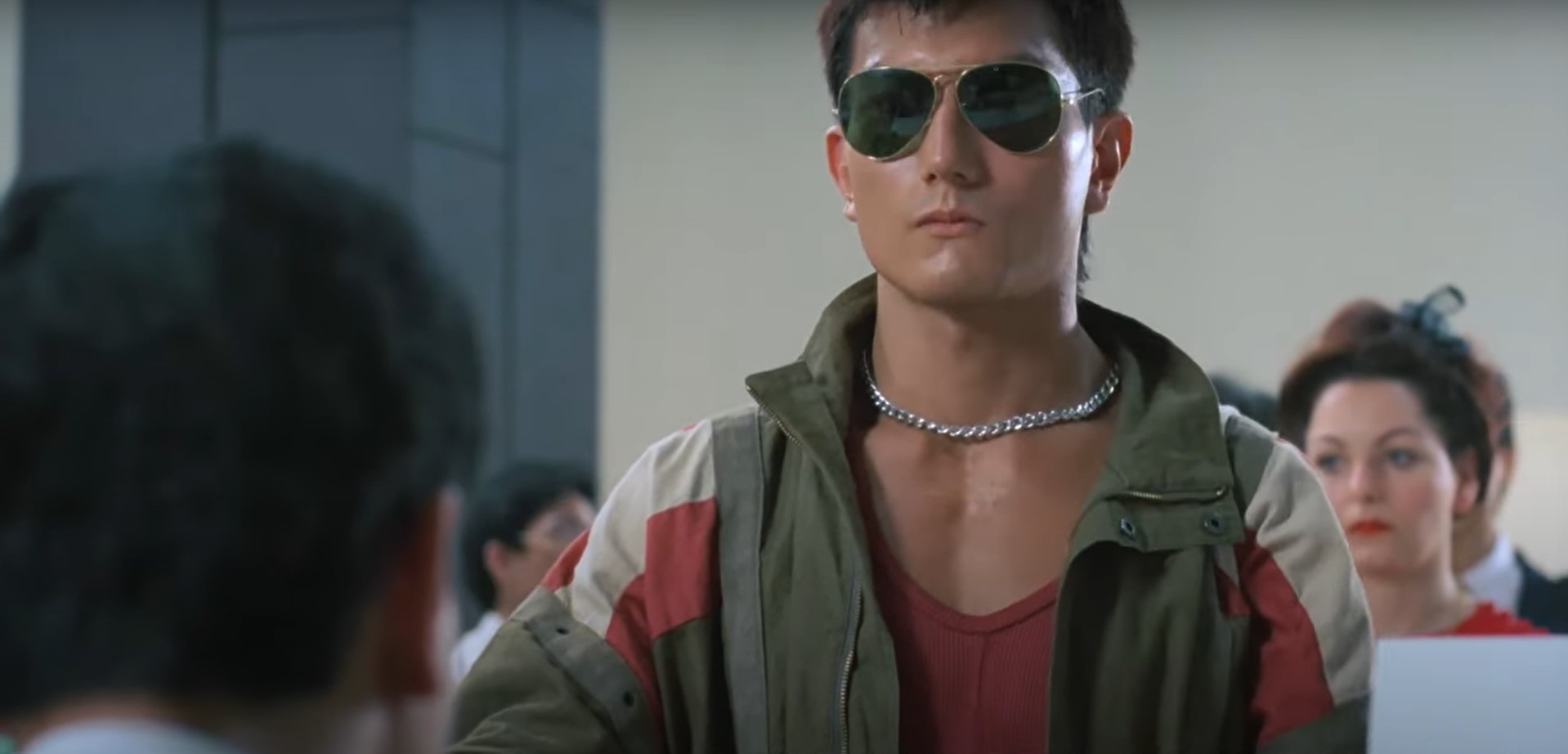
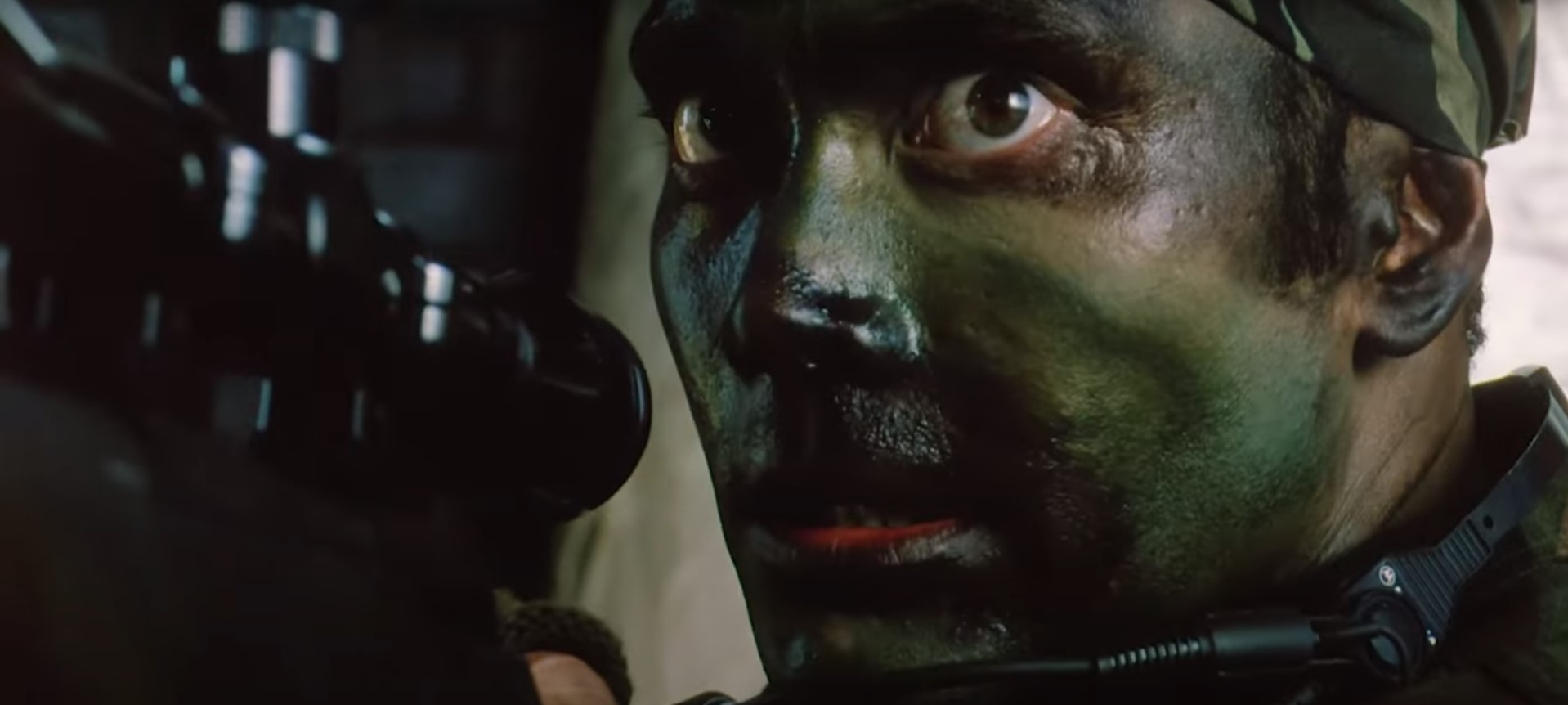
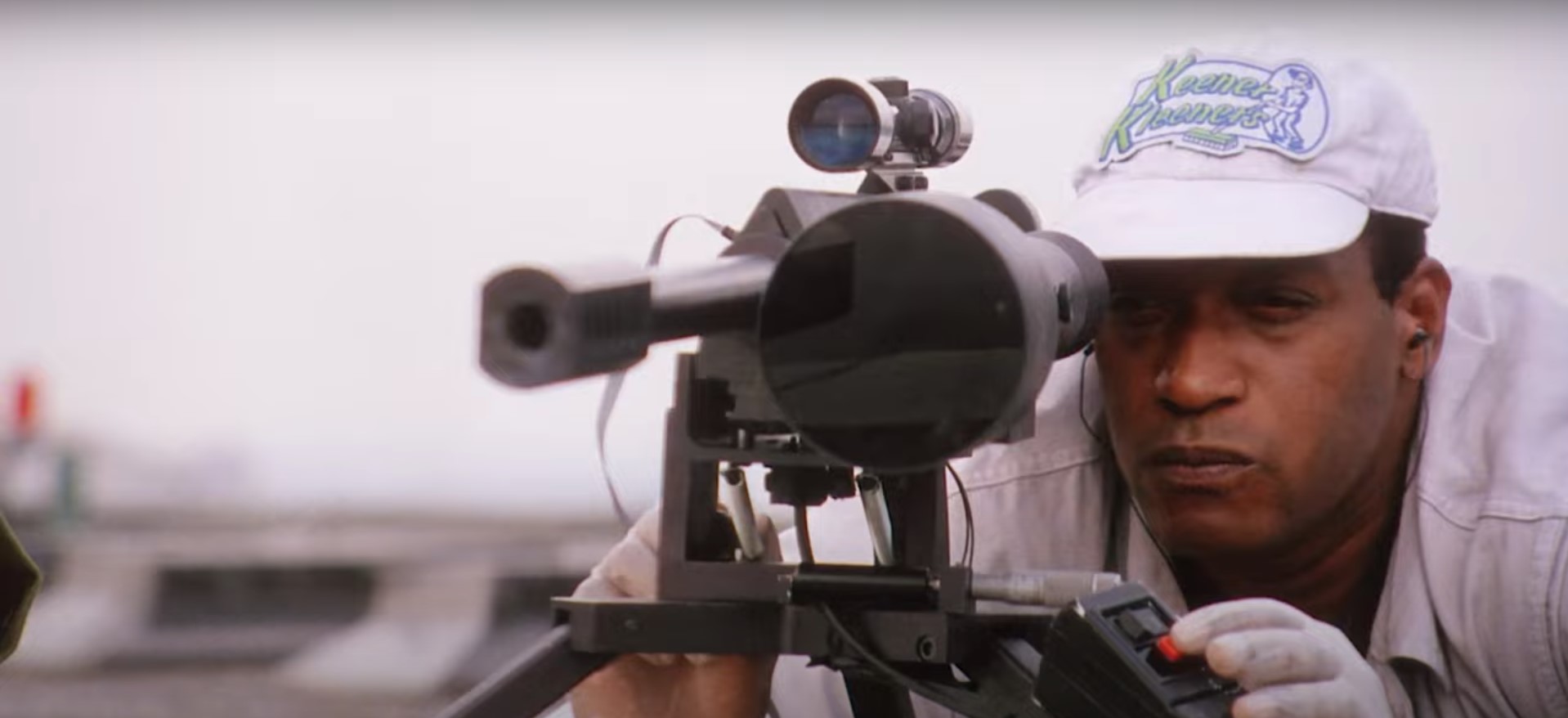
Working off another script from Rick Filon, the previous being “The Redemption : Kickboxer 5,” and hot off his humanoid cheetah role in John Frankenheimer’s “The Island of Dr. Moreau” remake, opposite Marlon Brando and Val Kilmer, the mixed martial artist Mark Dacascos plays the setup and scorned Michael Bishop, disgraced by his own military organizations, and reduced to being a bodyguard for an unscrupulous businessman.  Despite being soft spoken, Dacascos has great charisma on screen that mixes greatly with his eclectic array of martial art fighting styles, such as Muay Thai and Kung Fu.  Dacascos is a shoe in for leading man material, which also includes his swarthy good looks, and does fill the shoes of being a blacklisted former Navy Seal now on the hunt for who burned him in a botched Bosnia mission years earlier.  However, Bishop’s early motivation speaks more toward his character than his need for revenge as Bishop is not aware that it was his former attempted murderer James Sherwood, played by the towering and formidable Tony Todd (“Candyman”), who whacked his client.  Bishop becomes obsessed with the case which speaks to his loyalty and his completist mentality to see something through.  Overshadowing the leading man is Sherwood as Tony Todd instincts with this character is to be a merciless and cutting with his smooth handiwork and jibe remarks, all the while doing the horrible things with a sociopathic smile on his face.  Opposite Dacascos, in a semi-love interest role, is the pre-“Matrix” Carrie Anne Moss as Special Agent Castle who has more complexity of character than Dacascos and Todd combined.  Castle is a struggling single-mother trying to make headway in her governmental career but hits a snag when her morality is checked as she must either stay the course and go along with corruption to obtain security for her daughter or do the righteous thing and unsnarl dishonestly at the highest level with extreme prejudice for her sake of her daughter’s life.  Between the three principal leads, Castle’s arc is the steepest and more stirring with internal conflict, a testament to Moss’s performance.  Graham Greene (“Antlers”), James Purcell (“Bloodwork”), John Neville (“Urban Legend”), Heidi von Palleske (“Dead Ringers”), and Richard Coulter make up the rest of the cast.

“Sabotage” is a down-the-rabbit hole spooktacular 90s thriller, and I don’t mean spooky as in scary.  What I’m referring to is the characters’ covert agencies, such as the spooks of the Counter-Intelligent Agencies, and far-reaching operations that meddle and deconstruct a what should be a tidy organizational design with pot-stirring double-crossing, even triple-crossing, narrative paths that can be a strain to keep straight.  The film’s prelude and core story span 3 years apart and connect while there’s a simultaneous backdrop narrative that’s also connects but only exclusively in exposition.  Audiences will have to hamster wheel their mental gears to connect the dots and keep up with the pacing in this ever-evolving plotline that keeps the action caffeinated with a winding, hard-target center.  Takács also stylizes “Sabotage” with bullet-tracking special effects, high impact shelling, and an indulgence of explosive blood squibs that elevates the independent picture to an upper-class of B movie and gives the feature an edge of fun and entertainment that dichotomizes it from the more slapdash action films of the mid-90s where sex-appeal played more of a role than any other kind of actual action. 

Number 60 on the spine of MVD Visual’s Rewind Collection Blu-ray, Tibor Takács’s “Sabotage” breathes new life into the crisscrossing, projectile-pursuing, scacchic espionage extraordinaire. The AVC encoded BD50 provides a 1080p high-def resolution presented in an anamorphic widescreen 1.78:1 aspect ratio. A well-suffused and maintained print results in an excellent detailing of pixels and a punchy-noir grading. Details on the 2K scan print are historically omitted here, like with many in the Rewind Collection catalogue, but “Sabotage” doesn’t feign to be a product of enhanced visual replication with an organically pleasing form with minimal grain and only one noted frame containing age or damage wear. The uncompressed English language LPCM 2.0 stereo has abundance of vitality, discerning the layers through the dual channel funnel. Range of melee fire power has individualized zenith occurrences rendered at the right synchronization and depth makes the distinction of foreground and background dialogue, ambience, and the sort. Speaking of dialogue (pun intended), the uncompressed encoding keeps faithful fidelity, an ample and adequate of clearly expressed conversations without ever sounding muddled or lost in the skirmish. Optional English subtitles are included. Special features are little light for a Rewind Collection bannered release but what’s available packs a wallop with two new interviews with stars Tony Todd and Mark Dacascos on Zoom, or whichever face time platform is being used, going through their recollection and thoughts of “Sabotage” from nearly three decades ago. A Mark Dacascos trailer reel rounds out the special feature content. The rigid slipcover contains the reprint of the original “Sabotage” poster in a mockup of a VHS case; however, this particular Rewind Collection cover composition has less flair to sell the VHS facsimile. Inside cover art of the clear Blu-ray Amaray case contains the same poster sheet but is reversible with a less-is-more one sheet. In the insert section is a folded mini-poster of the primary cover art and, opposite, the BD50 is pressed with a plastic-patterned, VHS-tape motif. The region free Blu-ray comes unrated and has a 99-minute runtime.

Last Rites: Overall, a gratifying A/V and physical presentation of a mid-90’s, mid-level action-thriller encompassing a showcase of Mark Dacascos’s leading man chops as well as a different side to Tony Todd that isn’t encapsulated in the supernatural during the height of his career.

“Sabotage” on MVD Visual’s Rewind Collection Blu-ray!