The folkloric Bigfoot goes bananas on one man’s family, killing his wife and young daughter before leaving him crippled. Years later, the same beast rips the guts out of two tattooed women filming a girl-on-girl romp in the middle of the woods after mistakingly gunning down Littlefoot with their accompanying high powered rifles. Meanwhile, gun store owner, Shannon, receives news that’s she’s inherited land from her estranged, molesting grandfather that could be worth a small fortune. Before opting to sell the land, Shannon, her brother Billy, and her two uncles, Bob and Chester, aim to have a good old fashion hunt, but are viciously attacked by the monster. Barely surviving the ordeal, they managed to capture the creature with a tranquilizer gun and phone in an eccentric cryptozoologist, Dr. Corman, who presents a radical proposition: To prove his missing link genome theory, he wants to conclude that Bigfoot can, in fact, inseminate a human female to produce an offspring. Though crazed and inhumane, the wild idea could bring in loads of capital from all sorts of scientific angles, but the greedy captors soon learn that’ll it’ll take more than a pretty face to get the legendary and mysterious Bigfoot into the proper mood for lovemaking!

With the exception of a few films, the lesser known Sasquatchsploitation genre has been more schlocky exploitation than of Bigfoot doing some serious rampaging. Critics from around all outlets, small and big, have mercilessly dumped upon the hairy big fella, calling the flicks stinky as much as reeking Bigfoot in it’s natural habitat. Unfortunately, “Bigfoot: Blood Trap” sustains the same fodder and, perhaps, evens lowers the bar even further. Despite claims of the satirical motivations and plenty passion for the project, the John Orrichio directed film released in 2017 is a bit of giant mess. The New Jersey based Orrichio (“Paranormal Captivity”) collaborates with Edward X. Young, who was thrusted into scandalous controversy with this film as he was then an active candidate for a member on the New Township Board of Education. Safe to say, a storyline involving young women being kidnapped for rape and insemination didn’t go over well with parents, but Young and Orrichio sallied-forth to bring us a plot about an abomination from the abominable.

As aforementioned, Edward X. Young steps into the role of a creepy cryptologist named Dr. Corman whose obsessed with impregnating an abducted, innocent young women. With extensive credits in no-budget horror, including “Mold!” and themed holiday slasher “Easter Sunday,” Young is highly enthusiastic about his part, being one of the main fixtures of the overhauled production, evening tackling the special effects rich with blood soaked intestines. Another lasting cast member is “The Soulless” actor John McCormack as uncle Chester. Rustic as as he is rusty, McCormack bulldozers through his lines, never letting emotions and inflections carry his performance to fruition. Playing Chester’s nephew, Billy, is “Bloody Christmas’s” Dennis Carter Jr. With turbo energy and a high, if not zany, voice, Carter blossoms more of the satire from hiding, especially when contrasted against his sister, a gun-toting, possessive, money grubber named Shannon played by Chrissy Laboy (“Long Island Serial Killer”). Young, McCormack, Laboy, and Carter are the staple four that have the most scenes, but since the production spanned over the course of years, main characters came and went like yesterday’s bagel, introducing other characters into the fold from a supporting cast that included K.J. Hopkins (“Witches Blood”), Richard Szulborski (“Paranormal Captivity”), Gregory Stokes, and John D. Harris Jr.

As much as one can open their mind to all types of movies, across a vast spectrum of genres, sitting through “Bigfoot: Blood Trap” tested patience, will, and interests. The over-the-top gore, with strewn organs being, sometimes awfully blatantly, ripped from the bellies of Bigfoot victims did not turn heads away in disgust. The problem is more insidious with sloppy, shoddy technical gaffes with a brain seizing storyboard and choppy editing topping the lineup. Performances eek by without much scathing and one could even look past the joker in the “Trading Spaces” monkey suit passing as a vicious Bigfoot, but the lack post-production effort, especially with such a lengthy shoot, kinda says, “Hey! Let’s wrap this up! “Pronto!” and carry on with our lives without batting an eyelash in attempting at beautifying a hunk of ho-hum creature feature, but there is one positive thing about “Bigfoot: Blood Trap,” Orrichio manages to pull off 95 minutes in a sex with Bigfoot bonanza and I’m sure nobody else can claim that title.

“Bigfoot: Blood Trap” is released onto DVD home video courteous of Wild Eye Releasing on their Raw & Extreme label. The DVD is presented in a widescreen, 1.78:1 aspect ratio, that often looks stretched over a canvas with plenty of digital noise and low lighting woes. Colors look okay and same can be said for skin tones. There’s hardly any tinting so all, if not most, scenes are in natural lighting. Some lens cleaning wouldn’t hurt either on the drone for ariel shots. The English language stereo 2.0 lossy mix has hard stops when regarding quality. Swelling vocal tracks lack fidelity gusto and wander into the crackling territories often associated with poor mic placement or an unfinished track mix. Dialogue also comes and go from the forefront to the background. Bonus features include a production interviews, which are basically actors introducing themselves and being advocates for their characters. Also included is a segment entitled “Andy Girffith,” where little foot and Bigfoot reenact that rememberable son and father walk with a fishing rod with whistling that recognizable and catchy thematic tune. “Killing the Girls” is a true behind-the-scenes look into two of Bigfoot’s potential unwilling mates meeting their ends at the monstrous hands of the hairy beast; it’s a glimpse of Edward X. Young, wearing his special effects technician hat, gooey up the gore on the girls as the act out their best scream queen impersonations. Rounding out the extras is a music video and trailers. From the Wild Eye Raw & Extreme’s snarling, bloodied-teeth, Bigfoot faced DVD cover, high hopes created a false foundation leading into a John Orrichio’s Sasquatch breeding farm film! Yet, no matter how enthusiastic the cast, “Bigfoot: Blood Trap” unsavory independent charisma snared time that we’ll never get back into our precious lives ever again.
Tag Archives: MVDVisual
Taking the Vindictive Fight Against EVIL! “Girl Number Three” reviewed!

Art major Max lives a disciplined life, especially in the love department which is constantly challenged by her roommate to play the field, but Max aims for true love and will consummate her feelings toward longtime boyfriend, Brian, whose patience will be rewarded with a sexy maid costume at a Halloween party that will eventually lead back to the bedroom. Before the party, Max is kidnapped by masked men at gunpoint and taken to an abandoned textile factory. Surrounded by All Hallows Eve zealots and eight other hooded and bound women, Max becomes the ritualized girl number three, a number bestowed upon her as a chosen sacrifice amongst the brotherhood for sex and, most likely, death. When part of the crumbling building collapses, Max seizes the opportunity to flee, but as escape from the building seems impossible and other women screams echo through the vacant hallways, girl number three has been pushed too far and picks up an old fire axe, concluding that she must kill them all.

The second Shami Media Group distributed production to come across our chop block in a matter of weeks. First, the Nathan Thomas Milliner directed “A Wish for the Dead” written by Herschel Zahnd was the fitting entry film to ease into and extract our thoughts, takes, and opinions. Overall, Milliner’s film sold a solid product. Now, here’s Herschel Zahnd directing “Girl Number Three” that’s written by Nathan Thomas Milliner and Zahnd guides us down a completely different pathway from Milliner’s wish granting of undead havic and into a conceivably relevant sadistic exploitation and vengeance thriller. Released a decade ago in 2009 and based off of a Milliner’s short graphic novella, which seems to be a reoccurring and fruitful source of material for their production company Renegade Arts Productions, Zahnd’s ice breaker into the feature film market with “Girl Number Three” precedes the Milliner’s “A Wish for the Dead,” kickstarting the duo’s long wrong together into independent filmmaking.

With the two filmmakers so intwined, of course there are others, in the cast, that have had starred or have had bit parts in both films. Leading lady, Julie Streble, is one of them. Streble’s tackles the titular character who shoulders more than just being a conventional final girl; in fact, far from it as she’s a girl who makes things final…forever. Streble has an absolute vision as a scorned and beguiled woman to well-round Max’s initial love is true nature and her ideology slowly unravels as Max’s day trek becomes nothing more than an objectifying daily journey as the film progresses. From being bumped into twice by men, without an apologetic gesture, and being googly-eyed and hit on with unwelcome advances, Zahnd forces Max’s everyday struggle with the opposite sex down the audience’s already #MeToo’d cultured throats – remember, this film was made 10 years ago before many of the current movements. Other characters are not thoroughly developed to be systematically a part of the story to unfold in such importance, but play significant parts in her physical and mental reshaping of being a killer elite and the actors and actresses in those role include Kent Carney, Shawn Dolphin, Jess White, Jason Crowe (“Don’t Fuck in the Woods 2”) and “A Wish for the Dead” troupe – Dennis Grinar, Lori Cooke, Melissa Hoff-Decker, Chuck Lee Miller, and Adam Pepper.

“Girl Number Three” has a story that drives down a one lane road, a road certainly headed for Max to give her abductors hell, but a proverbial fork in the road puts a monkey wrench into gears already in motion. There won’t be any spoilers to be had here, but the outcome of “Girl Number Three” discerns differently in a social context that maintains another variant of disturbing exploits. A welcoming trickster’s commodity might change perceptions or might insight and evoke counter attitudes of how Max unravels her newfound vindictiveness. I praise Zahnd and Milliner for their foresight of a cultural that’s abrasively pandemic and how the structure of their film decimates one demeanor to seamlessly flow into another without a speck of hesitation. However, the latter borders being undercooked, and perhaps favors an unchancy raw red center, in not dumping more into the backstory or even circumnavigate with a savage shocker of an ending. The end scene was good enough to call the film quits, but not without leaving much to be desired.

MVDVisual and Shami Media Group ups the kill counter with the Renegade Arts Production, “Girl Number Three,” releasing the 80 minute unto DVD home video. The singer layer DVD is presented in a widescreen, 16:9 aspect ratio. Filmed in black and white, the devoid of hues reinforces the subject tone while also appearing to shade obvious low-budget obtrusions. With a story that mainly takes place inside a ramshackle building, black and white was an obvious choice as colors receptacles would be sorely underused and everything would just appear vapid and monotonous, like looking at the same four walls in a prison cell or a high school classroom. However, there’s always a downside to shooting black and white, such as contrasts levels on an unstable picture and the evident presence of digital noise. Exteriorly, the blown up moon and glowing yellow building windows composite was superficial at best, but clever in a pinch. The English language 2.0 stereo mix had the worse of the two major technical aspects with a low-bit rate that caused some hissing flare ups, the lossy metal soundtrack lacks robust fidelity, and there’s was also a complete disregard for depth. For example, when Max is exiting a store on her cell phone, her vocals remain on the same audio level from the background to the foreground. The mix is what it is, but there are solid points for a decent range and an agreeable dialogue track. There are no bonus features available other than a static menu, with two options to proceed into the feature. Don’t know why. The DVD art from SMG is a gorgeous illustration of the titular character that’s sexy, raw, and retro. “Girl Number Three” has grindhouse bones and director Herschel Zahnd fractures conventional storytelling with a notable plot twist, but Max and her cobwebbed axe doesn’t just rack up a body count as the intertwinement of the person and the instrument of destruction only eviscerates temporary contentment waned much more cognition.
One Wish Sparks a Lifetime of Evil. “A Wish for the Dead” reviewed!

Ever since his wife’s life has staggered on the near brink of death, John’s mental state has been thrust into constant turmoil. Unable to get straight answers from doctors and stuck inside the vapid white walls of a hospital, John remains by his unconscious wife’s hospital bed. When a mysterious man with a severely disfigured face wrapped in bandages offers him a locket that will grant him a single wish, John’s desperation to try anything to save her soul stretches beyond logic and reality, overpowering his rational principles. Despite coming with an ambiguous warning on how to detail his wish, John heedlessly requests that death cease to exist. The locket grants endless life not only for John’s wife, but for everyone as the dead rise from their eternal slumber in perpetual anguish that sends them into a frenzy of violence without a means to an end.

“A Wish for the Dead” is the first venture into a Renegade Art production and a Shami Media Group, or SMG, release for Its Bloggin’ Evil and, to be frank, the viewing re-establishes a couple of important things: 1) “A Wish for the Dead” has tremendous bite for an under the radar flick and 2) never rule out modestly financed films based on their technical appearances. The 2014 micro-budget indie horror from the short film director of “The Confession of Fred Kruger,” Nathan Thomas Milliner, along with the editing, photography, and co-writing assistance from “Girl Number Three” writer Herschel Zahnd, takes the cautionary tale themed with a careful what you wish for approach when despondency has one backed against the wall that leads to direly lethal negligence. Milliner’s film that’s based off a comic book of the same title might not be “Wishmaster,” starring Andrew Divoff, but can certainly be grouped into that similar genre realm where the ugliness of mysticism mischief can be personally devastating instead of gratifying. The film can also be lassoed into the over saturated zombie category because, well, you know, the whole arise of the undead thing.

“A Wish for the Dead” has a fairly large cast, but doesn’t have definitive leads. Instead, Milliner and Zahnd scribe a tale with miniature, personal scenarios for characters with John being a considerable catalyst or, an interpretation, of a centralized character. John’s played by Chris Petty, who had a bit part in the Zac Efron Ted Bundy biopic “Extremely Wicked, Shockingly Evil and Vile,” and despite the character being fairly one dimension, Petty sells the performance of a grieving, greedy husband. John encounters the mysterious, disfigured stranger in a trench coat, head wrapped like a mummy, and nodding John over like a he’s going to sell him a knockoff Rolex from the inside lining of his coat, in Robert Hatfield that tempts him with the wish granting locket. Hatfield version of a biblical villain has charismatic and devilish value, but nothing new to note the rendition from previous performances of shallow humor and sly mischief upon an cutting grin. Branch off stories that indulge into supporting characters un-charmed, demised lives fill in the gaps and provide fuel for the undead fire and these supporting characters include Lori Cooke (“Girl Number Three”), Kristine Renee Farley (Hi-8 – Horror Independent 8), Adam Pepper (“The Zombie Movie”), Julie Strebl (“Volumes of Blood: Horror Stories”) and Ashley Anderson.

The beginning of this film starts off oddly as soon as the title credits roll for the feature film and coming to the realization that the viewer is actually not submersed into the actual story yet. First slither portion of the film is a short thriller, noted at the conclusion as being directed also by Milliner, that becomes clearly distinct from the rest of the plot line. The abnormal sequence snaps the story’s fluidity as a seamed segue that then constructs the multiple-tiered building blocks for the heart of the feature. Once the short has past, much to our chagrin that we believed to be the actual film, “A Wish for the Dead” goes into a precision mode with coordinating individually wrapped death backstories and while Milliner attempts to get us to care about these characters, all is washed away and lost when death revokes all their previous, present, and future terminations. The backstories become null and void when not circled back to for the exception of John and his wife that find’s a sweet ironic malevolency making “A Wish for the Dead” satisfying in the end.

MVDVisual and Shami Media Group courteously releases Nathan Thomas Milliner’s “A Wish for the Dead” onto a not rated DVD home video. Presented in a stretched 16:9 aspect ration, the lossy video quality and the lack of color, mostly in a squashy greenish-yellow, chap into sore spots along the 80 minute runtime to the almost the point of SOV quality. Darks are plagued with digital noise that remove the sharp quality from the image, leaving the story to fend for itself and make up for the lack of presentation. The English 2.0 stereo sound mix pops during the higher pitches of dialogue and of some action points, but the dialogue is in the forefront and nicely balanced amongst depth and range considering. There are no bonus features on this release, but as an interesting note, Milliner illustrated much of Scream! Factory’s home video artwork (releases such as “Halloween II and III”) and for HorrorHound Magazine. The artist and filmmaker’s graphically detailed and perfectly suited talents grace the SMG cover as well. A wish granted for the major win with “A Wish for the Dead” as a macabre success story for independent filmmaking for aspiring artists despite the post-production engineering for a cleaner release, but death isn’t pretty, is it?
EVIL Wants to Feed Off Your Pain & Suffering in “Hotel Inferno” Reviewed!

Gulf War decorated soldier Frank Zimosa uses his particular set of skills as a professional contracted hitman. Frank’s current assign takes him oversees to a luxurious hotel to eliminate a couple of marks, a man and a woman, who are itemized as atrocious serial killers who’ve murdered over 150 people and Frank’s employer seeks to provide the same gruesome retribution in a certain kind of way – remove the brain the skull and the guts from the body. The relatively simple task for Frank turns into a fight for his life and his very soul as he finds himself trapped inside the hotel, owned by a secret organization swarming with putrefying acolytes of an ancient, fire breathing demon known as The Plague Spreader. Frank was ordered to kill to satisfy her pain and suffering hunger pangs, but his tenacious refusal awakens the demon who now hunts him, craving his pain, his suffering, his eternal soul for her own sated gratification and disrupts the organization’s creed to keep her dormant for the sake of humanity.

More, more, more! My internal fireworks outpouring and wanting more from a fire and brimstone gore forged finale from the action-packed first person view feature length horror film, “Hotel Inferno,” could not quell the embodied explosiveness wanting more from writer-director Giulio De Santi! Hailing from Italy, “Hotel Inferno” pulls little-to-no punches when dishing out uber-violence and non-stop carnage that invigorates the sensory and corporeal experience in the first installment of what’s called the Epic Splatter Saga that will total over six films. Two have already been produced with the third in production! De Santi, who is no stranger to the fervid gore film, teams his visual effects knowledge with long time, special effects collaborator, David Borg Lopez (“The Mildew from Plant Xonader”), and makes something shockingly beautiful that’s only been wrongfully teased in predecessors.

What’s also unique about “Hotel Inferno,” other than its first person perspective, is nearly the entire dialogue is layered with a voice over track. Unique as well as cleverly cool, we’ll touch on why later, faces with distinctive dialogue pinpoint main characters, but their faces are either shrouded by some sort of horror-esque mask, turned away toward another direction, or fed through a communication conduit, such as a portable television-radio device. Same goes with lead character Frank Zimosa whose vision never goes eye line with a mirror, never gaining a glimpse see his frantic mug, though Zimosa sounds like a chisel chin, hard-nose, angry-looking ass kicker, especially when voiced vehemently by Rayner Bourton. Playing the arch nemesis that’s quickly established and continuously prominent through duration is not the all-powerful Plague Spreader, but, in fact, the faceless Jorge Mistrandia. Donning the voice is English born actor Micahel Howe (“Solo”) who has one of the more sinister intonations amongst the few; an attribute that can be cool, calm, and inviting and can suddenly transform into a treacherous, malevolent, and vile performance that amplifies the intensity tenfold. Bourton and Howe are essentially the sole two main characters inside a melee of supernatural goons and goblins, amongst them in the cast is the introduction of Jessica Carroll who went on to do more voice work in video games and actors from De Santi’s inner film circle with Christian Riva and Wilmar Zimosa, who without a doubt was the moniker inspiration for Frank.

What sets “Hotel Inferno” apart from other splatter films? The first person shooter style, or FPS, video game structure is it! In literally the first of it’s cinematic kind, “Hotel Inferno” looks, sounds, and feels like a FPS from start to finish, a blended progeny from the ultra-violent horror survival games like DOOM or BLOOD; honestly, everything about De Santi’s film feels like a BLOOD rendition minus the shirtless, axe-wielding zombies and the robe hooded, tommy gun shooting cultists, though the rotting henchmen due speak in a high pitch dialect. Think about it. In BLOOD, a game built on a foundation of iconic horror, the anti-hero, Caleb, is a gunslinger against a unholy cult he once was a part of and then becomes his opposition. Same goes with “Hotel Inferno’s” own anti-hero Frank Zimosa, a hitman hired by an organization who then deceives him for nefarious reasons and then Frank has to blast his way out to save his soul. The story goes right for the throat, throwing Frank almost immediately into peril, and from room to room, layout to layout, the anti-hero has to slice through henchmen and ghastly demons in a very HOUSE OF THE DEAD kind of face-off, weaponizing everything against foes with armaments in the anterior of a cultish backdrop. Super. Fucking. Cool.

MVDVisual distributes Giulio De Santi’s “Hotel Inferno” onto DVD from the Wild Eye Releasing’s Raw and Extreme label. Presented in a widescreen, 16:9 aspect ratio, the Necrostorm produced “Hotel Inferno” engages the viewer into battle, but also invokes slight vertigo and turbid at times, especially the cave-like dungeon that’s almost absolute pitch-black. Again, atmospheric video games are much of the same regard for instant jump-scares and De Santi pulls that off here by not illuminating much of the scenes. The English language Dolby Digital 2.0 stereo audio track is in an opposing stratum to how the film plays out; doesn’t quite sync with the action as the audio track is an obvious track laid on top to emphasis how much “Hotel Inferno” is like a FPS storyline. There’s an array of depth and range from each tier Frank has to painfully endure and willfully live through. English and Italian subtitles are available. Bonus material includes a secret bonus film entitled “Hallucinations,” a rough cut SOV, direct-to-video supernatural gore feature from twin brothers John Polonia (“Feeders”) and Mark Polonia (“Sharkenstein”) and Todd Michael Smith (“Splatter Farm”). Giulio De Santi’s “Hotel Inferno” is only part one of the highly anticipated Epic Splatter Saga, with part 2 and 3 very high on my to-do list The blood splatter is in a doom of mayhem, will quench gore hounds from any walks of life, and reap the collective FPS gamer from their stationary consoles and blow their mind with the most seriously berserk action-horror of this decade. Crudux cruo!
Triangular Space EVIL is the Sign of the Beast! “The Dark Side of the Moon” reviewed!

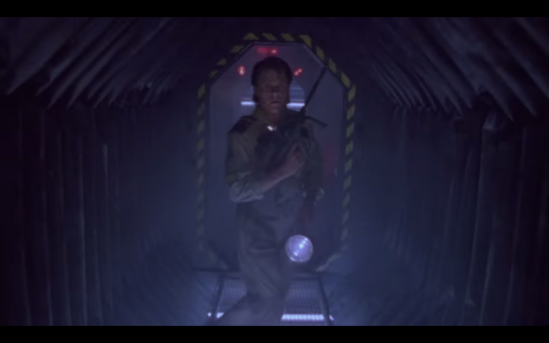
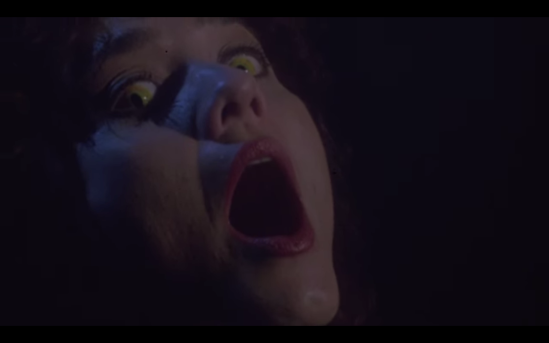
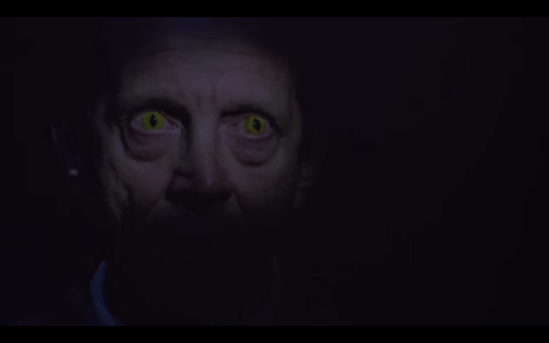
In the year 2022, orbital satellites carry nuclear missiles and maintain flight patterns around the moon. When a satellite repair ship, known as a “refab” ship called Spaecore 1, attempts to intercept a satellite for maintenance, the system wide computer goes into an unexplained power failure that jeopardizes communications, life support, and navigation. Drifting helpless toward sector Centrus B-40, the dark side of the moon, all hope will be lost within 24 hours unless operations can be restored, but a mysterious spacecraft, NASA’s Discovery shuttle, heads toward them and docks onto their outer hull without so much of a hail from the shuttle. Captain Flynn and Lt. Giles investigate a seemingly abandoned ship until coming across a dead body of a presumed missing NASA astronaut, eviscerated with an opening left in a perfect triangle as the cause of death, and that opens the door to more questions than answer as a sinister presence boards their ship, pursuing damnation for their souls.

Just think, in two more years, weapons of mass destruction satellites will loom just above fluffy white clouds, ready to mushroom clouds out of targets with a 10-ton yield; at least that’s what director D.J. Webster and the screenwriters, identical twins Carey W. Hayes and Chad Hayes, modeled the future when conjuring up this delectable Sci-Fi horror film approx. 20 years ago. With special effects models and techniques that withstand against powerhouse space films, such as from the immaculate effects of Alien franchise, “The Dark Side of the Moon” becomes more than just a 1973 Pink Floyd album title Fabricated out of warped creativity of old and new concepts with a Biblical horror base that only the 1990’s could loosely spin into an hour and 27 minute feature, for many of the filmmakers involved, “The Dark Side of the Moon” credits as their first taste of a feature length, large scale production, especially with the mainly music video director D.J. Webster, who loves his closeups, and director of photography Russ T. Alsobrook, as they auto clicks into a team that seemingly have experience of seasoned veterans or, perhaps, spent some secretive, unlogged time in space. Who knows, but the outcome ruminates about the dark side of religion and how each of us deal with it internally.

When mullets and giant framed glasses are afoot, the late 80’s, early 90’s filming era is beyond evident with interestingly gritty characters lined up for an evil figure eager to knock them down and, of course, the story’s lead character is the mullet sporting pilot named Lt. Giles Stewart who is unwittingly thrust into the fast track of a hero’s lane. Giles’s atheism framework has a pleasant sardonicism about it when face-to-face with the immortal conqueror of his ship and crew. Will Bledsoe paints Giles as such as faithless space pilot, bound to duty, and willing to do anything to just not save himself, but others. One of the only recognizable faces, at least for myself, in the cast is John Diehl. The “Stargate” and “The Shield” television actor is best at being a wild card in turmoil situations and as shipmate Phillip Jennings, the same can be expected without being utterly conventional or warrant any kind of typecast label. Another actor to note is Alan Blumenfeld as the ship’s panicky Dr. Dreyfuss Steiner. Blumenfeld, who had a role in the best Jason Voorhees film, in my humble opinion, “Friday the 13th Part VI: Jason Lives, is once again stalked by a larger-than-life villain while maintaining a profusely sweaty persona that’s symbolically intended to be true, unadulterated fear. As a whole, the cast is amazing regardless of some first time filmmakers at the helm, rounding out with “Re-Animator’s” Robert Sampson as the ship’s Capt. Flynn, Joe Turkel from the first “Blade Runner,” “Blood Frenzy’s,” and overall erotic thriller goddess, Wendy MacDonald, stunt man (“Kill Bill Vol. 1 & 2, “Army of Darkness”) Ken Lesco, and another “Friday the 13th” actor, Camilla More, or Tina from “The Final Chapter,” as the stationary sexy, ship’s onboard computer-robot named Lesli – think on the same lines as Mother from “Alien,” but in the flesh.

What makes “The Dark Side of the Moon” very interesting is the film being an unofficial precursor to other science fiction horror films like “Event Horizon” that was released roughly seven years later. Space as this gateway to Hell concept is sorely under-appreciated and underutilized. Space is already vastly frightening to begin with and by adding a devilish abyss aspect to it makes the idea an absorbingly scary thought. What’s also fascinating is the Hayes brother. “The Dark Side of the Moon” is the brothers’ roots film; the proverbial patient zero that spread successful movie writing careers for the twins, spawning turn of the century horror with the remake of “House of Wax” that saw the on-screen death of Paris Hilton, had “Underworld” star Kate Beckinsale track down a killer in Antarctica in “Whiteout,” and they penned “The Conjuring” that constructed its very own universe.

“The Dark Side of the Moon” comes in at #2 on the Unearthed Films’ Classics label distributed MVDVisual. The newly restored 4K transfer of the Wild Street Pictures production is presented in a widescreen, 1.85:1 aspect ratio, region A Blu-ray release. Surprisingly sharp despite consistent low-lit scenes and not as washed like previous VHS versions, this restoration fine tunes the nitty-gritty specifics needed for proper presentation that doesn’t falter from heavy digital noise or blotch artifacts and shows no signs of enhancing The English language LPCM 2.0 audio track is strapping for a dual channel format. Dialogue pronounced clearly, ambient spaceship clinks and clunks create atmospheric range and depth, and the relentless brooding score by “Society’s” Mark Ryder and Phil Davies delivers shuddering spinal-tingles without being monotonously dull. Bonus features include a commentary with executive producer Paul and Unearthed Films’ Stephen Biro, interviews with Alan Blumenfeld, FX artist R. Christopher Biggs, and stuntman Chuck Borden, plus vintage audio track, trailers, photo gallery, and a insert booklet that dives into about the production and the cast. All packed into a nice little slipcover package. “The Dark Side of the Moon” pioneers into the future of space horror as a good ole dread-inducing fear-monger of the great expanse, deserving this Unearthed Films’ release, hands down.