
In the year 2027, enhanced humanistic cyborgs virtually run the planet with the renowned L.A.P.D. being no exception. Alex Rain, one of L.A.’s finest brute cops, is partially cyborg himself, but the essence of his soul remains human intact while his synthetic flesh cloaks the icy machine beneath. After tracking down suspected cyborg terrorists and almost losing his life in the struggle to stop them, Alex questions his dwindling humanity, leading him down a path of unfulfilling revenge and botched smuggling before his former employer, the L.A.P.D. commissioner named Farnsworth, tracks him down and uses deadly coercion to force Alex as a pawn in dangerous covert mission. The burnt out cop is thrusted back into the fray of his former life when Farnsworth orders him to retrieve data from the treacherous female cyborg, Jared, who was once Alex’s partner and lover, before she hands over the sensitive information to a group of cyborg terrorists who call themselves The Red Army Hammerheads. With a micro bomb implanted near his heart as insurance, Alex has no choice but to accept the assignment before detonation in 3 days and with his time running out, finding Jared isn’t the problem as Alex comes to realize that deception has convoluted the stakes and nothing is who or what they seem.
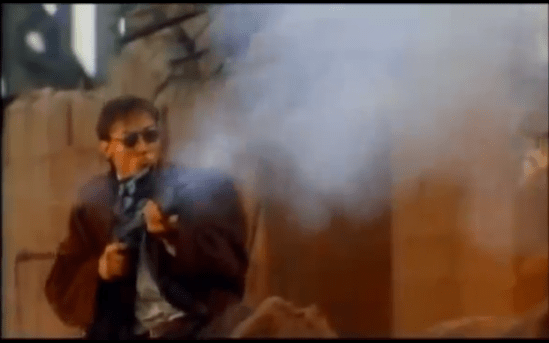
Albert Pyun’s 1992 cyberpunk action-thriller “Nemesis” is an explosive-heavy, science fiction existentialism film never before seen, or even aware of, by this reviewer, but the ground-worked narrative has remained a constant piece of foundation in being the byproduct of inspiration extracted from other cyberpunk films of its kind, such as “Robocop,” “Blade Runner,” and “The Terminator.” “Nemesis” has a presence much to the tune of another film, “Cyborg,” starring John-Claude Van Damme and that inclination would inevitably make a world of sense when the awe-striking epiphany lands that Pyun also directed that film, also utilizing some of the same actors for his early 90’s cybernetic dystopian feature. In reviewing Pyun’s credits, the assumption can be made that the filmmaker has a sturdy hard-on for the intertwining of mankind and machine as not only did the director write and direct “Cyborg” and helmed “Nemesis,” but went on to be a part of, whether director, writer, or producer, of four more “Nemesis” sequels with a fifth being produced and shot, but scrapped in post-production due to Pyun’s flailing mental health. Rebecca Charles fed the scribal beast as “Nemesis’” screenwriter, along with penning “Nemesis 2: Nebula” and “Nemesis 3: Time Lapse.”

Alex Rain is a cold cut character, sliced thick like a cool cucumber on top of a hard to wedge salad. Rain’s iciness symbolizes his downtrodden humanity status and with each part of his body shattered from destruction, he becomes one step closer to being an automaton with eye brows. B-movie action star Olivier Guner essentially make a big career breakthrough with “Nemesis” as his sophomore feature. Guner’s military background suitably solidifies his physique as a workaholic cyborg cop while also presenting a rough cut speech impediment that’s very straight forward and without emotion. Some would say that Gruner’s approach fits his half-human, half-toaster oven character and I would say that would be correct. The 80’s and 90’s saw a crowded entry list of action stars, including Jean-Claude Van Damme, Chuck Norris, Steven Seagal, Sylvester Stallone, Arnold Schwarzenegger, and many others in various degrees of success – and Olivier Gruner became one of those faces that had since then been lost over the years; Gruner’s performance in “Nemesis” lacked pizazz which could have been the contributing factor to his success, but the monotonic, unflattering one-liners and blank face stare didn’t spark any fires on top of his average muscular frame. His performance, to keep with the fire motif, didn’t provide the oxygen, a combustible, or a flammable source to quickly set ablaze a trail for semi-popularity amongst his peers and that’s where “Nemesis” falters in entertainment value. Comparatively, “Trancers” franchise actor, Tim Thomerson, is full of range and vigor as an concealing Commissioner Farnsworth. Thomerson, in his early 40’s at the time of filming, displayed an impressive physicality to his role, keeping up nicely with his onscreen rival. Farnsworth, from the get-go, reeks of desperation when pressuring Alex to do his bidding and Thomerson really nails the part and can switch on the proverbial dime as an egocentric field operative when chasing Alex through the jungles on the Hawaii set. The night and day performance is a stark contrast between the two actors. What’s mostly disappointing about “Nemesis’” cast that favorable characters come and go; some the characters a pinned with terrific actors such as Shang Tsung himself, “Mortal Kombat’s” Cary-Hiroyuki Tagawa, as the leader of The Red Army Hammerheads and the late, great Brion James (“Red Heat”) chirping a lousy German accent of the Commissioner’s right hand man. The cast has many other recognizable names that, again, come and go, including a strung out looking Merle Kennedy (“Night of the Demons 2”) as Max Impact, Marjorie Monaghan as the algorithmic beauty Jared, Vincent Klyn (“Cyborg”) as a disposable bodyguard, an extremely fit and nude Deborah Shelton (“Body Double”), voice actor Nicholas Guest (“Dollman”), brief cameo by Jackie Earle Haley (“Watchmen”), a fresh faced version of “The Predator’s” Thomas Jane, and Thomas Jane’s bare ass.

The financial backing was obviously designated for a particular department in the “Nemesis” workshop and that department was special effects. Explosions, rotoscoping, stop-motion, sculpture, implosions, practical effects and makeup are just the tip of the iceberg. Frayed wires and eye ball cannons are the elegant touch that makes “Nemesis” a cult favorite and bring substance to a clunky storyline and divisively dynamic acting. However, not all the specials are pinpoint precision and grounded by reality. The one scene that stands above the rest when Farnsworth is hot in pursuit of Alex and Max and he’s shelling off rounds of a shotgun, standing relatively still, blasting away without moving the barrel around to compensate for his prey’s length of distance gained or even when they decided to make quick pivots in direction. Somehow, the rounds hit very close to Alex and Max and that’s not all, they even explode like a single stick of TNT. ACME must have had a hand in the special effects department because the scene sure was loony. Yet, the implosion of a monolithic silo was uber-impressive, well-executed, and really ritzy for the silver screen.

Imperial Entertainment’s “Nemesis” infiltrates onto another home video release, a region free, dual DVD and Hi-Def 1080p Blu-ray format release, from MVDVisual under their MVD Rewind Collection series. Sheathed by a slick, retro-grade slipcover with familiar art, reminiscent of the now decade old Sterling DVD release, the special collector’s edition provides two aspect ratios, an anamorphic widescreen 2.35:1 and a widescreen 1.78:1. This MVDVisual Release has stellar detail in the texture and in framing that are exhibited in various tint shades, such as yellow and blue, and eventually cough up toward a more natural look into the second act when Alex reaches the rough neighborhood of Shang Loo, Java. Even though the visual compositions and mold work doesn’t pop with color and are a bit fuzzy, “Nemesis” is a product of it’s time, the early 1990’s and you can’t fault Pyun’s film for that. The English 5.1 surround sound is beautiful. So beautiful and potent, in fact, that you can actually understand Olivier Gruner’s mumbling, putting dialogue for all characters right into the front row while offering a stimulating range and depth of ambience sound, an unlimited variety of explosions, and plenty of miscellany cyborg hubbub. Other language are available, including French, German, as well as English in 2.0 stereo and there are English and German SDH subtitles available The Blu-ray bonus features include new interviews with producer Eric Karson and director Albert Pyun, “Nemesis 2.0” the director’s cut with Albert Pyun audio commentary, and original theatrical trailer. The DVD is the director’s cut and also includes the Japanese cut with Japanese subtitles burnt-in. Bonus features for the DVD include introductions by the director Albert Pyun and star Olivier Gruner, an afterword by Albert Pyun, a behind-the-scenes featurette, an interview with star Olivier Gruner, the making of segment involving the hefty special effects, stunt work, and visual effects, a featurette entitled “Killcount,” a behind-the-scenes photo gallery, TV spots, Key Art Photo gallery, and, top it all off, a mini-poster inside the casing. Inside a killer definitive, two-format and disc set from MVDvisual, “Nemesis” hones in on the existentialism notion of what being human actually means to each and every one of us through the bombardment of gun fights and jumbo explosions on top of a conglomerate cyborg coup that peaks with hard bodies and even harder viewer contemplation.
Tag Archives: MVDVisual


Evil Loves a Good Plot Twist! “Open Wound” review!
In the moments before attending a pool party, apparent strangers-to-acquaintances, a distinguished, if not quirky man and a promiscuous, self-involved German woman, withdraw to a secluded building in order for the brazen woman to shave the bikini line exposed excess hairs before strapping on a suit. Their intricately deep discussions about desires, sex, and kinky foreplay fair nothing more but course, blunt banter between two familiarities, but when the woman pretends she must be tied up and punished for playfully biting the man’s ear until bleeding, the next few moments after fall into a state of obscurity of a he said, she said rape accusation. As confounding declarations are made and fingers are being pointed to decimate lives, a sack of deceptions and an abundance of threats accrue through a blackmail scheme and an abduction based vendetta. Nothing can be certain and no one can be trusted between the two, but one thing is definite, a third man watching from afar has nefarious plans of his own.
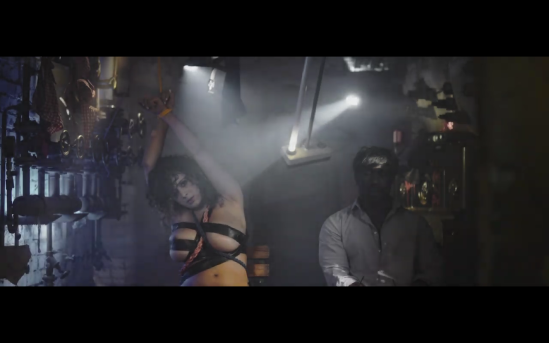
Like sitting front row at a bastardized version of an off-broadway show, “Open Wound” is an immaculate stage performance of battered psychologies and visceral deceptions from writer-director Jürgen Weber. The thriller, also known as “Time Is Up” or “Open Wound: The Über-Movie,” measures extreme lengths of human bitterness while constantly shapeshifting into plot twist after plot twist aggregated with clusters of popup violence. The Chinese born Weng Menghan, under her moniker Tau Tau, is the financial backer of “Open Wound. The globetrotting author makes her breakthrough imprint into the feature film business that modestly begins with an opening scene about anal sex among other verbal sexual references before man versus woman fisticuffs and a pivoting third act that rapidly alters character compositions into, essentially, a free for all. So metaphorically speaking, a Chinese producer walks into a bar, sits onto a stool next to a German director, and orders one of the more absorbingly chic cocktail thrillers in English. “Open Wound” is a melting pot of cultural influences and a display damaged egos that’s simply brilliant.
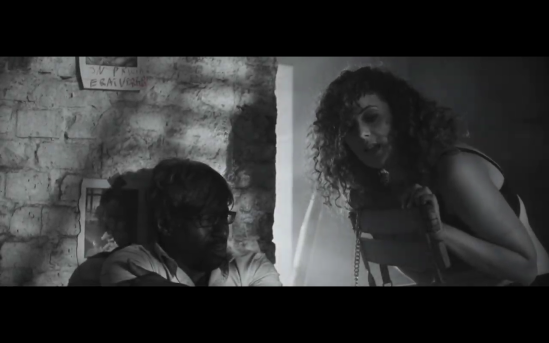
“Open Wound” has a short character list comprised of three characters. The first is woman who is introduced first, or rather her lips do when she declares her love anal sex and the parallel criteria for types of cars in one man’s garage, as she’s using a straight razor to trim the dark haired pubes from her bikini line. She oozes eroticism like a bodily fluid that gravitationally seeps from between the legs, spilling innermost desires, whims, and historical sex-capades with in a philosophical prose. #Nippelstatthetze advocate, German podcast expert, and stunning model, Leila Lowfire engrosses herself into the role of fierce, proud, confident, and strong woman. With an established vigorous sexual prowess, Lowfire culminates the femme fatales and breakneck show-stoppers female roles, notably similar in Quentin Tarantino movies, with high-brow tastes and a debasing reprove. Lowfire’s accent is low and thick and can be considered her weakness here as getting your brain to interpret the fluidity of the words, structures, and compositions is undeniable challenging at times, but acts upon fervor while in her lingerie or even topless throughout the film. The contrast against man is stark. His introduction paints him as unequipped, socially inept, and hopeless desperate. Man longs for Woman, but knows he doesn’t have a chance with her until she offers up a random game of role-play that inevitably leads to disarray. Jerry Kwarteng’s man performance is systematically peerless and a complete joy. Even if the character lacks depth, Kwarteng’s range is devilishly good with the only comparison coming to mind would be James McAvoy and his multiple personality disorder in “Glass.” Once Man and Woman comes to terms after a back and forth bout with dominance, the Suicide King’s grand appearance bestows upon the plot an even bigger, clunkier monkey wrench. The Suicide King’s an ex-con, looking for revenge in a small vat of acid, and his mark and him have a long, complicated history which parts personally shock the other. Erik Hanson’s raspy voice, feeble appearing physique, and lofty age has a second row seat to his character’s unwillingness to die, in a slick performance that’s part nihilist and part psychotic to which Hansen pulls off.

Weber’s choice toward “Open Wound’s” narrative layout conflicts with how the DVD release is specifically marketed. “Open Wound” rides the dark comedy pine that is peppered with black tongue-and-cheek dialogue and violence and as will be noted later in the review, the advertising depicts something far more extreme and graphic. On the shock value scale of one to ten, “Open Wound” hovers around a solid five and maybe a seven or eight for the casual popcorn viewer and, personally, I don’t believe “Open Wound” was intended to be a source of utter distress and visual barbarity. There’s brisk lighthearted comedy that softens the blunt force. For example, in the room with the Man and Woman, a record player will every so often, to comically assist in explaining the actions, play the cheesy tune of lounge background music with a singer narrating the character’s every move and also be the voice of between chapter contention or bewilderment. The singing is privy to only the audience just as the twelve chapter titles that offer a mixed bag of sequences that interchange between English, German, and Chinese title introductions, a toilet paper title card in reverse action, and an artistic rendering of chapters titles and just like his title card introductions, Weber also utilizes an assortment of styles to tell his story, whether be a 5 minute sepia, nitrate film burn effect, or day dream sequence, that peers the sudden twists and eruptive chaos between the characters. While the effects work to sensationalize the context, they tend to be equally be nauseating and annoying as a disruptive structure that seemingly doesn’t make sense to the naked eye.
MVDVisual and Wild Eye Releasing distributes Jürgen Weber’s “Open Wound” onto DVD home video as the the 11th spine feature under the Wild Eye Raw & Extreme sub-label. The DVD is presented in a widescreen format and the image quality holds up well, withstanding Weber’s bombardment of stylistic techniques of distortion, over exposure, sepia, and contrast. There’s a little softness around the skin, more noticeably during facial close ups, with a slightly lower bit rate in the compression but still very agreeable detail. The stereo two channel audio channel does the job, but has flaws with Weber’s score have an equal playing field with the dialogue tracks. The audience already has to manage Leila Lowfire’s thick German accent and their ears will also need to try and filter out the soundtrack that’s invasive upon the colloquy. Not much range to warrant mentioning, but the depth was well tweaked amongst Weber’s visual compliments. There are unfortunately no bonus material with the feature, but the DVD reversible insert is graced with a semi-naked and bound Leila Lowfire. “Open Wound” is dangerous, sexy, thrilling, and complicated to say the least, but stamped as a Raw & Extreme film it should not; however, see this film! Director Jürgen Weber’s visionary molotov cocktail of a story is an underground must for arthouse lovers and noir enthusiasts.


Evil Shall Not Steal! “Purgatory Road” review!

The Kirby brothers, Vincent and Michael, witness the attempted suicide of his father who placed a snub-nosed barrel shotgun underneath his chin and pulls the trigger. As adult, the brothers process the trauma in their own ways with Michael unable to jumpstart his life that has been exploited by his brother who has joined the priesthood. Now as exonerated Catholic priest, Father Vincent continues his crusade in absolving confessional patrons of their sins, but with a twist. Hell bent on exacting death through absolving upon those who steal in any capacity, Father Vincent travels the rural areas of Mississippi in a beat up congregational and confessional mobile camper to soapbox his wrath sermons and to rid the world of those who surface his childhood trauma. When another psychotic killer ascertains Father Vincent’s radical cause and wants to join devious purposes, the aversely complicate Michael can no longer abide by his brother’s carnage of guilt path and isn’t keen on spending his life with another heartless killer, urging himself to exit the threesome and starting a life of his own with Ruby, a diner waitress who has taken a shine to him, but Father Vincent and his newfound accomplice won’t let him go that easily.
Just what the Catholic Church needs… one more film depicting a priest using God to benefit his own greed! Mark Savage co-writes and directs the damnation of thieves film, “Purgatory Road,” with a post-viewing requiring a penance of one Our Father and ten Hail Mary’s! Co-written with “Stressed to Kill’” Tom Parnell, “Purgatory Road” is a horrific hallmark of adverse Americanisms such as religious fanaticisms, self-indulgence, mental instability, corruption, and narcissism. All these qualities can potentially lead to one common bond that Savage makes centerpiece and that would be murder. Savage’s extreme vision isn’t all that far from today’s reality where cases of the mentally and the spiritually unstable and religious acolytes plan, stage, and carry out killing sprees almost weekly, corrupt politicians and the uppermost devout pocket secrets and bribes, and egotistical maniacs pick and choose basic civilities to divide groups against each other. I don’t see “Purgatory Road” as shocking and taboo, but rather as 98 minute revelation, not in a Almighty sense, but as a break in the opaque lens that is today.
Father Vincent firmly believe in his actions, without doubt and without shame, and uses any tool, or person, to fatally smite thieves, but has no absolute joy in the way he responds to pilferage acts. The guilt over his father’s attempted suicide drives him, sucking the vibrancy, the energy, and the happiness from him, and the fact that his father still lives, as a basement dwelling, cannibalistic creature, makes the matter even more dire to Vincent. The fraught priest ended up being an ideal performance for Gary Cairns (“Malignant”) who noted in the behind-the-scenes interview that his personal issues at the time brought out the all-around worst in Father Vincent and despite the character written as a fire-breathing, wrath of God man of the cloth, Cairns is able to weather his role as a seemingly idyllic Catholic priest with something to hide from credits-to-credits. Michael Kirby might be complicit, but isn’t wholeheartedly on-board with his brother’s blood shedding that drives another relevant nail into a Cain and Abel type tale. Michael’s longing to part from his brother is difficult for him, whether he also feels guilt for his father’s misfortune or an attempt to try and steer Vincent from complete and utter chaos, and even with a chance to escape the madness, Michael unintentionally flounders the attempt that ultimately becomes his climax to kill. Luke Albright (“Devil’s Pass”) engrosses himself as the black sheep amongst wolves in sheep clothing. Though his character is scribed as conflicted, Michael has downplayed emotional trauma that extremely binds him to his brother and makes him just as equally disturbed when disposing of his brother’s victims. Savage and Parnell’s narrative angle might not focus on the emotional level of Michael, but Albright flourishes the angst that internally rips him apart within the confines of every contentious scene that involves Cairns’ character. The brothers are driven further apart when Mary Francis, a sadistic and cannibalistic serial killer, discovers their undertaking, forces herself to join them in the cause, and catches the eye of Father Vincent, who displays some physical touch withdrawals and loneliness with the vulnerability of his corpses. Mary Francis is easy on the eyes, casual in her affairs, and empowering with a high sex drive that would make any man weak at the knees in a normal world, but Mary Francis is far from normal and Trista Robinson (“Jurassic City”) offers her short build, cutesy voice, and piercing eyes that favorably compliment Mary Francis’s dark features and equally dark soul. The character is an unsuspecting brut heart whose well-written as she describes to a radio talk show host her boy or girl fascinations as a drab hunting sport where spilling their blood and robbing them is the last great and excitable moment of the relationship, signified and sealed with a single kiss. The rest of the cast rounds out with Sylvia Grace Crim (“Happy Death Day 2U”), Geoff Falk (“The Livingston Gardener”), Chace Beck (“Meltdown”), and Douglas Cunningham.
Shot on location in Mississippi, “Purgatory Road” offers a really cool story that’s not produced on a studio lot and is kept out of the rural areas of California and any other locations that bear no resemblance to the deeply Southern pious roots of the 20th state of the U.S. Savage was able to obtain raw locations that best fit the delusional and fanatic tendencies of Father Vincent and with the gruesomely beautiful special effects and makeup by “American Guinea Pig: Bloodshock’s” Marcus Koch and Cat Bernier, the murderous role of not only Father Vincent but also Mary Francis are furnished to frightful fruition of two fiends you just don’t mess with in the devout South. Koch and Bernier texturize severed body parts and provide a wide diameter for blood splatter as an intensifying tool, but don’t overly exaggerate the gory garnishes that might re-direct attention from the story.
Unearthed Films and MVDVisual’s Blu-ray of Delirium’s “Purgatory Road” has Unchristian values worth indulging that includes a widescreen 1.85:! aspect ratio. The digital shot film uses a Canon EOS C300 Mark ll in a full HD setting and the image quality has phenomenal sharpness with natural skin coloring and excellent details that come to focus on the outside faded, dirty paneling of the rustic RV and in the fleshy, blood wet limbs of the Koch and Bernier gory special. Cinematographer Andrew Giannetta has a working eye for the horror element of “Purgatory Road’s” red-light district familiar frame work with appropriate fog and tint to augment the gothic murkiness and dread. The Dolby Digital 2.0 audio track is favorably well-balanced with no kickback or unintelligible miscues. “Purgatory Road” might have an RV kill room, but the RV isn’t involved in high speed chases or fiery explosions, so the dual channel works well for this type of low-key thriller. There are bonus features aplenty with a commentary with writer-director Mark Savage, a gallery slideshow entitled “The Grisly Art of Marcus Koch and Cat Bernier,” writer Tom Parnell speaking about his experience as a screenwriter behind his main profession as a lawyer, a lengthy featurette of the three lead actors speaking about their involvement, how they came to the project, and what the film and/or story means to them personally, and a Purgatory Road Q&A featuring Mark Savage. Impenitent swindlers beware! “Purgatory Road” is all fire and brimstone braced with a strong cast of compelling talent and a horrifically transfixing tale of blood is stronger than holy water.


Take A Magical, Evil Ride on the “Caroushell” review!

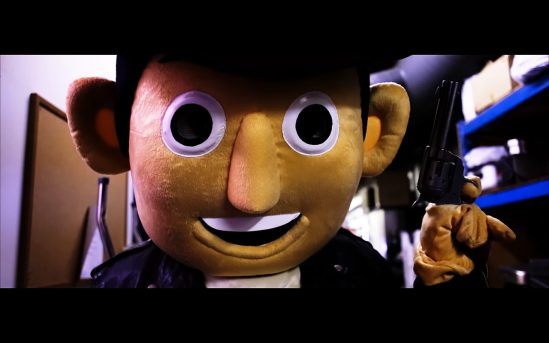
Extremely frustrated with the lack of respect from snot nose kids and the monotonous, round-the-loopy-loop that is his life existence, Duke, the carousel unicorn, has finally had enough the moment after a fat kid mounts him for a ride, smacks him like a giddy-up horse, and wiping his snot onto Duke’s glossy wooden eyeballs. The latter being the final straw that broke the unicorn’s back. Duke breaks free from the amusement park ride in search for a better quality of life when he happens to discover that killing makes him feel good, real good. With a newfound purpose, Duke vows to hunt down and end that fat brat, slaughtering anyone and everyone in his path of carnival-esque carnage that leads the unicorn not to water, but to a house party where the kid stuffs his chubby face full of cake and other goodies while his older sister and her friends order pizza and hit hard the alcohol as they discuss a love and hate for a popular kids show, My Tiny Unicorn. When Duke shows up at the front door, his statue-like presence is a big party hit amongst unicorn show fanatics who are unsuspecting of his murderous desires. The only person capable of stopping the mayhem is the amusement park mascot, a jovial warden cowboy named Cowboy Cool with his trusty, evil unicorn stopping six-shooter.

Step right up! Step right up! Behold and be amazed by the stupendous and the downright bonkers horror-comedy, “CarousHELL,” about a killer carousel unicorn from big top maestro, writer-director Steve Rudzinski. The “Everyone Must Die!” filmmaker helms a satirical slasher co-written by Aleen Isley in her first credited treatment. “CarousHELL,” a whimsical play on carousel and hell if you somehow couldn’t figure that out, inexplicably sprints with the inanimate killer concept that visually livens an old “Family Guy” wisecrack about the latest Stephen King novel being about a killer lamp! Instead of a bright bulb shining blood red and using the electrical cord as a noose, Rudzinski and Isley explore the macabre qualities of an inorganic unicorn by extending its cache of weapons beyond the obvious long, pointy horn to also being able to wield a machete without opposable thumbs, sharp shoot with a bow-and-arrow with hooves, and even have the capability to kill with ninja stars despite the sloping shoulder conformation. Impressive…
Rudzinski also co-stars as Joe, a diehard pizza delivery guy and passionate dog lover who is desperately trying to earn money for his ill-stricken four legged friend. Rudzinski, sustaining both roles as a director and a performer, solicitously molding Joe as an oblivious nice guy just looking to do his job and even though he’s a bit of an impatient spaz, Joe’s not the biggest spaz swimming in the character pool. Rudzinski could be considered the lead male in the one of many boisterous roles of “CarousHELL” who certainly manages to get the girl without having to lift an finger. That girl being the self-indulgent Laurie, big sister to the unicorn pissing off brother. With her face glued to her social media phone and being a spoiled brat herself, Laurie has little-to-no attachments to anything: she’s not tied down to one boy, weighs social media clicks heavily in life, and finds disrespect the choice of attitude even toward her pole–strapping stripper of a MILF mother. Pittsburgh, PA born Sé Marie (“Cryptids”) does bitchy well, finding a nice niche to nest in with this harebrained, but light-hearted slasher with bite. Joe and Laurie have excessive personalities, but nothing can top Preston who sets the field bar. The house party co-host starts off as a complete douchebag complete with popped collar and an unquenchable thirst for bare chests and the introduction of Chris Proud really makes a first impression in a truly unbearable, over-the-top role, but believe it or not, Preston is one of the few characters of the film to have what could be construed as an arch storyline. Preston, by the end, transforms into a likable character with penchant expertise for the My Tiny Unicorn universe (a spoof toward Hasboro’s “My Little Pony”) and is the only character to perceive the first hand danger from the infiltrating and evil unicorn from hell. Duke is hands down the best scribed character of the entire film. Voiced by veteran voice actor, Steve Rimpici, Duke can literally stand inanimate and still be a vital part of the story. The versatile Rimpici is like the movie trailer voiceover guy with an uncanny Duke Nukem-type voice who has movie credits including the Dustin Mills’ directed features, “The Puppet Monster Massacre” and “Easter Casket,” as well as stints in video games such as “Red Dead Redemption” and “Mafia III.” The cast rounds out with Sarah Brunner, P.J. Gaynard, Judy H.R. Kirby, Josh Miller (“Amityville” No Escape”), Teague Shaw, Haley Madison (“Haunted House on Sorority Row”), Cindy Fernandez-Nixon, Shawn Shelpman (“Red Christmas”), Corella Waring and Michael Mawhinney.
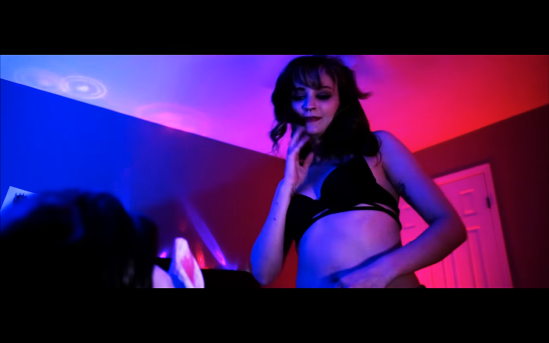
With a film like “CarousHELL,” killer special effects need to be a must as marketing an inanimate villain will be hard sell. Yeah, “CarousHELL” has catchy dialogue, witty enough banter, and gratuitous and non-gratuitous nudity. There’s even multi-positional sex with the unicorn. Thanks for that searing image Steve Rudzinski and Haley Madison! However, a slasher requires good kill moments and the special effects work by Cody Ruch meets the demand with a brutal that include a beautiful gored unicorn horn kill to the neck, a double impale followed by a goopy string entrails, and an Ronald Lacy melting scene with charring laser eyes! Even with a high body count and delectable moments of insanity at it’s peak, “CarousHELL” will undeniably find a general audience outside the scope of genre fans who will understand the context behind fashioning a unicorn slasher, those who are just easily entertained, and maybe a slither of fans of westerns.

MVDVisual and Wild Eye Releasing delivers the hell raising attraction, “CarousHELL,” onto DVD home video presented region free, unrated, and in widescreen format. The digitally shot video has a pleasing standard of quality. A few moments of brief aliasing but nothing to specifically note that matters. The dual-channel audio was the most disconcerting issue that’s affecting the release. More so with the exaggeration of performances with the screaming and the screeching, the feedback distortion is pesky and jarring. Dialogue is prevalent and forefront, but lacks range and depth and so the verbal tracks tend to blend together. The bonus features are a welcoming site with a commentary track, cast interviews that explain how the film came to fruition and that better explains what the “CarousHELL” they were thinking when creating this fun flick, a few deleted scenes that explain the disappearance of minor characters, bloopers, and Wild Eye Releasing trailers. Just like “JAWS” did with ocean, “CarousHELL” will cause hesitation when deliberating if riding a unicorn will endanger your mortality. “CarousHELL” is fun, campy, and a whole bunch of nonsense that has our full 100% support in the horror community.


Half-Woman, Half-Machine, All Evil! “SheBorg” review!

Brought before an intergalactic sentencing, a chaos-driven cyborg faces extreme persecution for committing heinous acts across of destruction and death amongst the galaxy, but desperately escapes on a small shuttle pod aimed directly for the planet Earth. The cyborg craves massive amounts of energy to contact others of it’s species for world domination and also needs to feed off of animal flesh to sustain. The local anarchist Dylan and her friend Eddie team up with a alien enthusiast and a provincial cop to thwart human annihilation as the cyborg assimilates the townsfolk into it’s own flesh hungry minions, doing the bidding of constructing a solar system reaching power source to create a space antenna. The world’s hope relies on a pair of anarchy subversives to stop a monstrous sheborg who believes chaos will provide for planetary obliteration.

Its Bloggin’ Evil has been around the bush a few times with director Daniel Armstrong, a name known very well here by previously reviewing two of the filmmakers films under his Strongman Pictures label, the 2015 wrestling-sploitation “Fight Like A Girl” and the slasher on blades “MurderDrome” from 2013, and there has been much appreciation for the ballistic, ass-kickin’ carnage and indie horror mayhem Armstrong is so strongly passionate about in his films. The 2016 “SheBorg” is no different as the film revels in many of the same feral totalities. The Australian writer-director favors the 80s-90s science fiction and horror cultural elements for not only his earlier works but also for “SheBorg,” cherry-picked specifically for the mechanical madness. From “Star Trek,” to “Ghostbusters,” and to “Back to the Future,” “SheBorg” affectionately homages these films through the dialogue in an explicitly melee narrative that oozes with crazy, feasts on the flesh, and gorges on heartily on dismembering and assimilating all in a path to geek fandom.

Dylan lives to subvert the establishment, even if that means derailing her politically obsessed, sorry for excuse father, Mayor Jack Whiteman, and the self-indulged agitator is played by Whitney Duff alongside “MurderDrome’s” Daisy Masterman as Dylan’s best Kung Fu knowing mate Eddie. Duff and Masterman are a solid budding duo who can expel eccentricity and calmness as a single, combative unit against an seemingly unstoppable mechanism of man killing, the Sheborg. The mechanical alien is mechanically performed by another “MurderDrome” casted and “Fight Like A Girl” actress Emma-Louise Wilson. Wilon’s robotic coldness sounds actually very Russian in performance, as if the Eastern Europeans were gearing up for war with killer, flesh eating cyborgs, but Wilson’s contrast to the uncouth Duff and Masterman tagteam is comedic bliss that symbolisms freedom over tyrannical subjection. Sean McIntyre, Mark Entwistle, Louise Monnington, Jasy Holt, and Tommy Hellfire fill in the rest of the “SheBorg” cast.

Labeled as a Neo-Pulp sci-fi, horror film, “SheBorg” encapsulates the essence of a schlocky B-horror, charmed with two-bit practical and visual effects. Yellow alien blood sprays and cascades like neon Kool-Aid, the assimilated have oversized and gaudy optical lens over one eye, and there’s also some eye popping, heart ripping, and dog eating gore to appease every facet of a modern sci-fi horror. Once titled “SheBorg Prison Massacre” and then retitled to “Sheborg Puppy Farm Massacre,” Armstrong drops the ancillaries and simply presents his Daisy Duke-cladded killing machine film as “Sheborg” that continues a trend, whether intentional and ill-conceived from selective viewings on my part, of having a heroine in the lead role, such as “Fight Like a Girl” and “MurderDrome” with the latter involving an all-woman roller derby gang. Armstrong’s seemingly trademarking his films with rebellious women, whom are at odds with the world around them, and are coming out on top hauling away being more of a kick-ass warrior than before the a nemesis made the scene.

“SheBorg” is now available on Blu-ray courtesy of WildEye Releasing and MVDVisual. The 1080p resolution in a widescreen 1.85:1 presentation release has an underwhelming image quality. Details flutter sporadically in the woodsy locale in and around the puppy farm and night scenes have coagulated blotches of the unsharp nature. A few sequences turn out brilliantly poetic like when SheBorg frightfully exits through a mist-cloaked, open aired windshield of one of her three junkers turned into a makeshift solar system communicator. The 5.1 Stereo works for the budget, but while the punk rock score by KidCrusher befitted the anarchist lead, syncing with the rest of the film was far from being symbiotic. Dialogue was clear enough and ambience was fine, even if it was slightly over-exaggerated. Bonus features include a medium-length Behind the Scenes documentary that has engrained interviews with director Daniel Armstrong and selective cast; the BTS-feature is more tell all of Armstrong’s visionary mechanics and where he pulls inspiration from. There are also music videos and trailers. Resistance is futile as “SheBorg” is a must-see cybernetics battle royal in the realm of Ozploitation.
 It's Bloggin Evil!