Who is This EVIL Named “Dariuss” reviewed! (SRS Cinema / DVD – Extreme and Unrated)

Find Out Who “Dariuss” Is With this SRS Release!

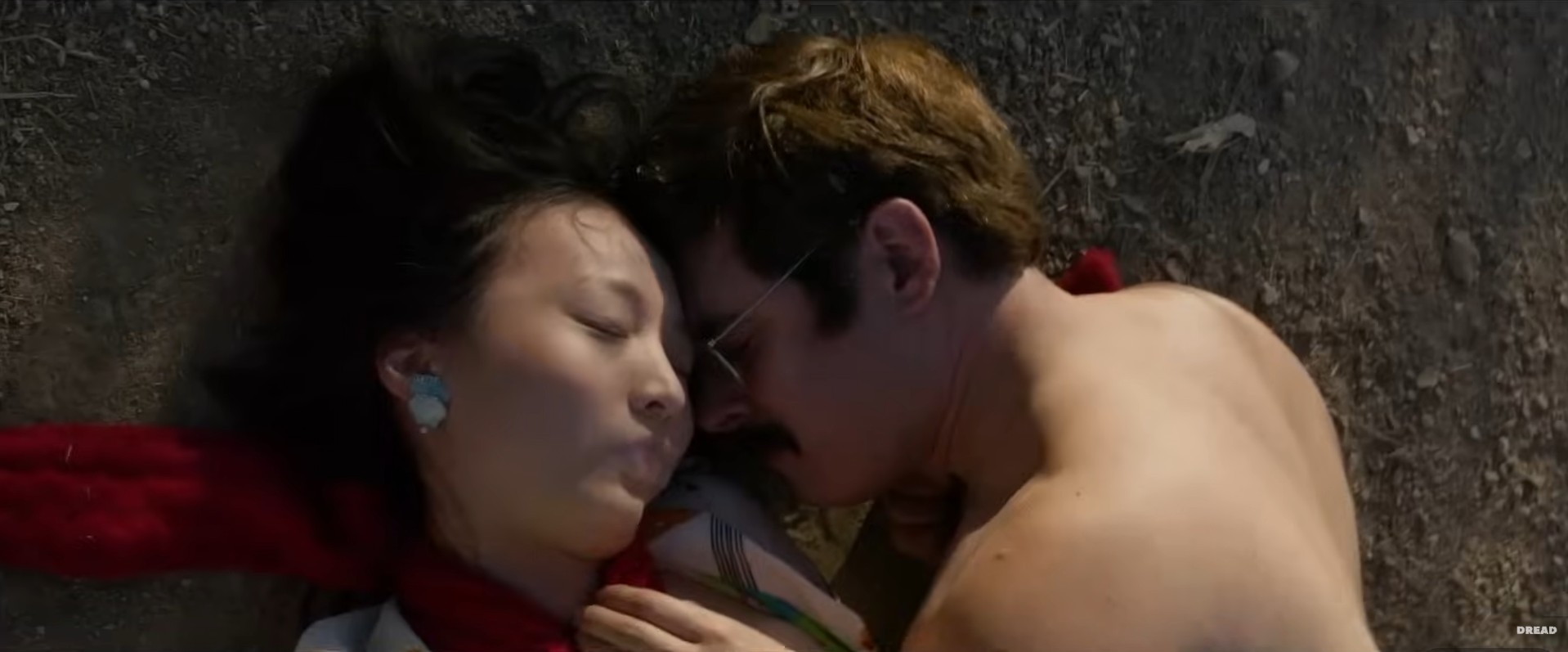
An experimental vision quest of loss, grief, and death takes refuge in a small English town, inside an old and quaint English house.  A mother grieves for the loss of her child, sobbing uncontrollably and mindlessly wanders with distant stares as the heart pains for her child.  The grandmother, doing what she can, comforts her daughter’s newfangled distraught nature while the husband, grieving in his own isolated way, stays out late at night to drink himself into a stupor.  When madness lurks about their home and intrudes upon their privacy, a vile and heinous loss of life bathes a depraved lunatic in their fluids.  Neither mother, father, nor grandmother is safe from terrific travesty in corporeal form.  A sickness has arrived to cure the inconsolable, eradicating them slowly of the pain in the most painful of ways imaginable, and doing it all with a bloodstained maniacal grin stretching from ear-to-ear.

A hellish loop of defeating pessimism, “Dariuss” fringes the black void areas around reality and escapism that evoke the uncomfortable nature of people and the unpredictable tides that turn for the worst when already at rock bottom.  “Dariuss’s” brackish, brainsick narrative is the brainchild of Guerrilla Metropolitana, an Italian artist crafting his underground and dark cinemaverse of misanthropic mayhem and esoteric eroticism.  The writer-director Metropolitana lives and creates out of London, UK and “Dariuss” is his 2023, debut feature-length film behind an oeuvre of distressing shorts of human imperfection and immortality encroached by a constant line of madness.  Metropolitana not only self-funds and produces his film, where he achieves total control to push back against not only major studio norms but also conventional independent stratagem, but provides the avant-garde cinematography, unorthodox editing, an experimental score and sound design, and even costars the trench coat covered naked body of the antagonistic killer. 

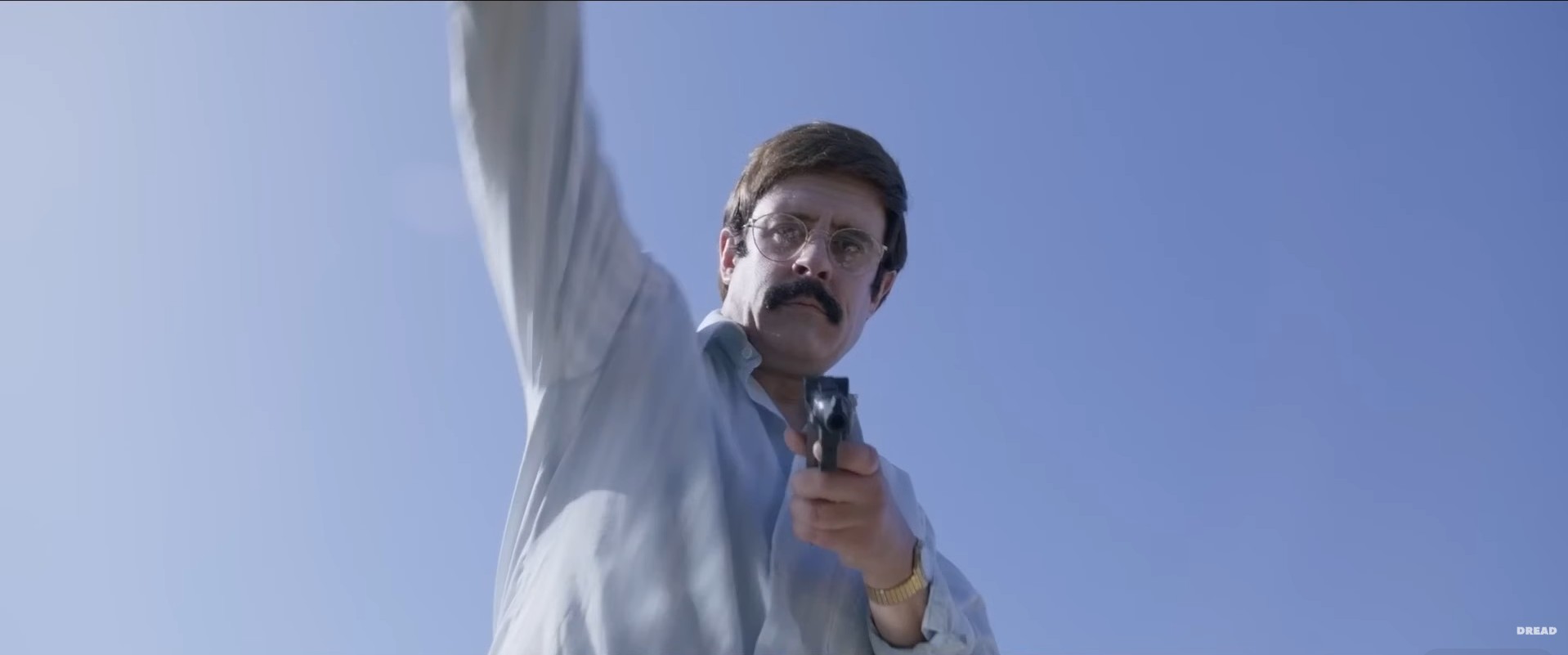
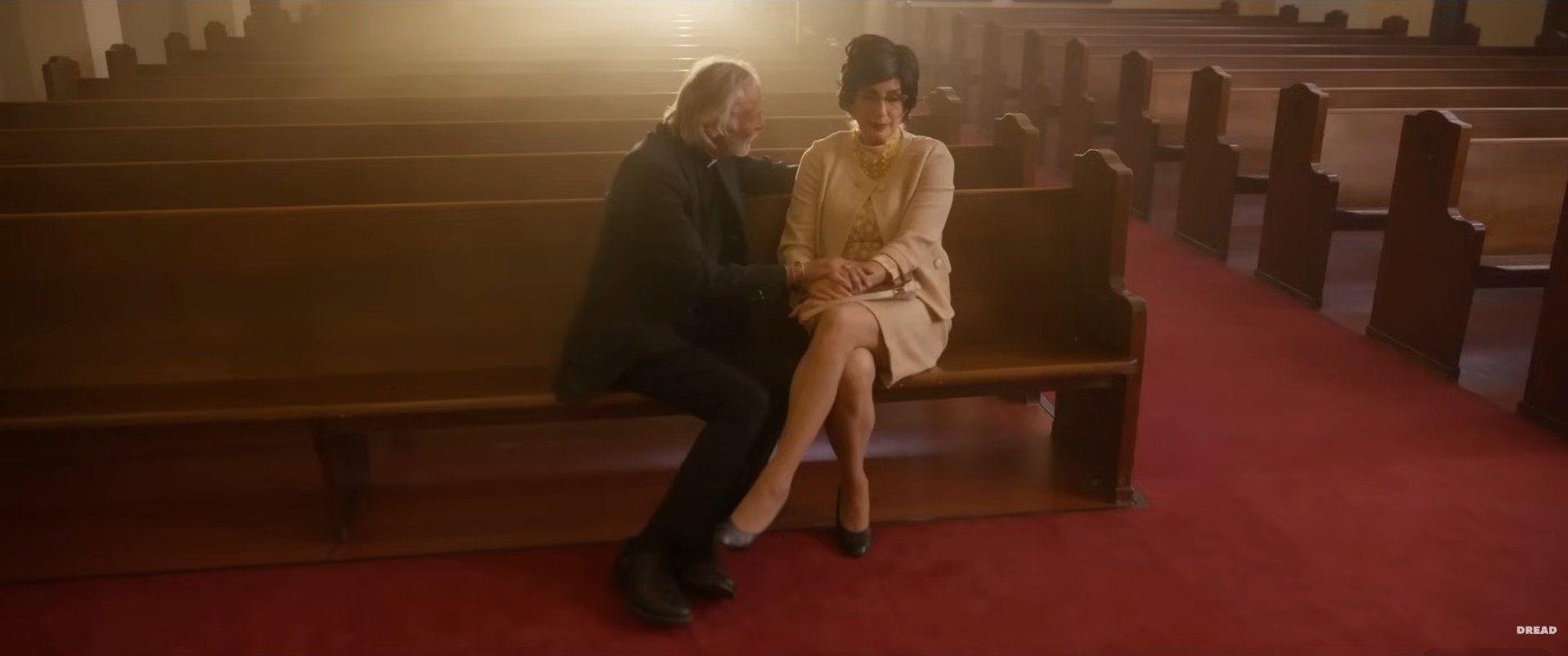
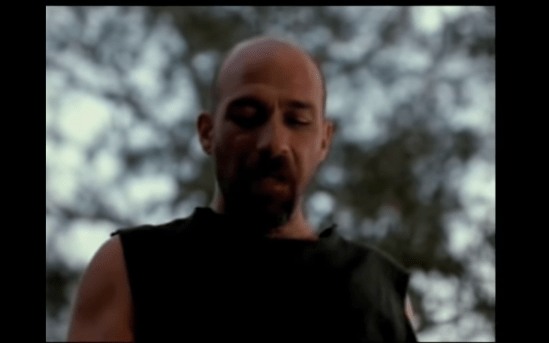
One element to not forget to mention before going through the cast is that “Dariuss” is completely without dialogue.  Metropolitana’s sound design manipulates and repeats many sound clips, such as the plops of water droplets or the high-pitch lip trilling, to fashion an uncomfortable audio sensation sporadically strung throughout that parallel’s the coupled low tumbling score and baby laughter, the later more so when referring to child loss or the abhorrent reincarnation of the child.  Ila Argento holds the majority screen time, especially since the pregnant woman credited as Sarah Isabèl is also Argento as well in some sort of meta crafting or illusion, and she plays the grieving, depressed wife wailing, screaming, and just distantly starring in vast quantities and in a daze of mirrored or painted inversions about the English home.  “Dariuss” is more than just extreme performance art as it embodies interval wretchedness associated with trauma, or in this case more specifically, loss through a reverse world looking glass.  As the wife is tended to by the grandmother, played with apneic conditions and posturing concern is Marie Antoinette de Robespierre, Archibald Kane’s the husband role is scantily around for a father who just lost a child and when the father is in frame, he’s idling in his car drinking, or rather gulping, from a bottle.  Both the grandmother and father roles are a part of Metropolitana’s message of a shattered family structure of insincerity and disconnect. Feeding on that dysfunction is the childlike maniac, played by Metropolitana himself, with rapacious amusement off the back of the household’s suffering.  Almost as if the maniac is a reincarnation of the lost child, perceived by play like antics in a nearly naked and hairless state and audible by the babylike, post-introduced laughter, returning home to exact horrific horseplay on his family involving rape and murder and cannibalism alongside the frolicking and breast milk chugging.  

Let’s preface with an important fact that “Dariuss” will not be everybody’s cup of tea; in fact, Metropolitana’s film is more like bitter black coffee with a pungent, sour smell as a narrative series of images, like a splayed, taped together string of polaroids, giving godawful glimpses of grief and gore.  Sounds and images repeat that beg for madness to emerge out of the nouvelle vague filming style, experimenting with various inverted images, mirrored and angled shots, different types of aged filters and strange lighting, various camera speeds, and oddly framed shots will subject audiences to pricklier sensory sensations than the depicted violence and gore, which is graphically ghastly and extreme with necrophilia and cannibalism.  Story structure also veers into non-linear territory but the gist of the acts is present, if not loose and equivocal for open interpretation and choice cinema characteristics that stray from normal convention, to mold a beginning, middle, and end in only a way Metropolitana can construct by contrasting melancholic grief with stagnating indifference, with a maniacal pleasure of a sandbox of sinew, and, in way, comical by way of the insanity with disturbing imagery mixed with playful mischievousness. 

Just who is Dariuss?  That’s the obstruse person perhaps at the centermost of this ghastly, grisly story that’s now on DVD from SRS Cinema as a part of their Extreme and Uncut label.  The DVD comes MPEG2 encoded, 480p standard definition, 5-gigabyte DVDR that showcases a wide-range of filters, inversions, lighting designs, grading, and you name it, “Dariuss” likely did it of cinematography techniques that stay in the rough patches of eccentricity rather than being comfortable in the fairways.  Picture quality fluctuates and varies depending on the aesthetic chaos methods being deployed, leaving behind not the sharpest looking picture with noticeable pixelation on anything above a 32″ television but not enough of an eyesore to be an imperceptibly deterrent.  Depth has fair spatial qualities but range and saturation is pretty limited to an anemic neutral palette to only when the monochrome or higher contrasts are not in play. The LPCM 2.0 stereo contains no organic matter, meaning that none of the sound is captured within the scenes, as Metropolitana modulates, manipulates, and modifies singular notes and tones for creepy and ear-splicing effect. This also pertains to the soundtrack being completely devoid of dialogue to give the auteur complete authority of how his film she be heard and every bit of that sound design is front loaded and high-powered but to an intended unrefined audio art. English captioning for the deaf and hard of hearing is available. Special features encoded are a behind-the-scenes still gallery and SRS trailers while the standard Amaray comes with an SRS illustration of the film’s original one-sheet, transposed to the disc pressing. There are no inserts included nor slipcover. SRS Cinema’s release is region free and has a runtime of 62, ideal, or even a tad bit too long, for this type of experimentation.

Last Rites: Not to be confused as a nail-biting, popcorn thriller, “Dariuss” will only speak to a select few able to bend the mind to impressionistic, dark eroticism and savagery, both qualities of which Guerrilla Metropolitana has and depicts in droves.

Find Out Who “Dariuss” Is With this SRS Release!

Necrophiliac EVIL Until the Eyes Open Awake. “The Corpse of Anna Fritz” reviewed! (Invincible / DVD)

Get “The Corpse of Anna Fritz” While Available! Purchase here!

Renowned actress Anna Fritz steals the hearts of millions as fan adorn her beauty and her acting performances that invite her to galas and red-carpet events.  Young and promising, Anna’s career is at its peak until her untimely death upon discovering her lifeless body in the bathroom of a private party.  This is where we begin Anna Fritz’s story, at her death as her body is wheeled and stored into a hospital morgue, naked on a metal gurney and under a white sheet.  In the hands of a late-night shift orderly, Pau, Anna’s beauty and body becomes the ultimate temptation as he sends his party rowdy friends Ivan and Javi pictures.  As soon as Ivan and Javi show up, curious and eager to see the once famous Anna Fritz in all her glory, Pau leads them down to the basement morgue where Ivan and Pau decided to have a once in a lifetime experience of molesting and penetrating her corpse at the disagreement and discouragement of Javi, but in the middle of the necrophiliac act, Anna wakes up in a temporary paralyzed state of shock.  Now that she has seen their faces, the three men have to come together to decide on her fate or theirs. 

By the very title alone, you know “The Corpse of Anna Fritz” is going into the dark territory of sick perversion with unnatural molestation of a human corpse.  The 2015 Spanish film, natively titled “El cadáver de Anna Fritz,” is the debut feature written and directed by Hèctor Hernández Vicens (“Day of the Dead:  Bloodline”) and cowritten with Isaac P. Creus.  An unofficial re-envision or just reminiscent of Marcel Sarmiento and Gadi Harel’s “Deadgirl” where young hormonally aggressive young men find themselves immorally pants down with a presumed dead body of a beautiful young woman without the supernatural element, and sprinkled with similar imagery and energy to that of the following year’s “The Autopsy of Jane Doe,” even with the DVD cover art and film title, “The Corpse of Anna Fritz” is more grounded in reality in comparison but still retains the theme of what aberrant people will do when they believe no one is watching, no one is getting hurt, and believe they’re doing nothing wrong when in fact everything they’ve done is completely deviant and a price has to be paid.  Produced by Bernat Vilaplana, Marc Gomez del Moral, Xavier Granada, and Marta and Albert Carbó, the film is a co-production of Silendum Films, Plató de Cinema, and the Instituto de la Cinematografia y de las Artes Audiovisuales. 

Like most of these autopsy or morgue pictures, they come standard with intimate casting of less than a handful of actors to create a sense of dreadful isolation and loneliness far from public view and safety.  Vicens’s basement of dead body debauchery follows suit with a quad-principal of three men – Cristian Valencia (“Atrocious”), Albert Carbó (“Beach House”), Bernat Saumell (“Eloïse’s Lover”) – and the one lone woman Alba Ribas (“Diary of a Nymphomaniac,” “Faraday”) mainly secluded to the morgue and its cramped backroom.  Valencia, Saumell, and Ribas have worked previously together a couple of years prior on the rom-com “Barcelona Summer Night” and that possible familiarity may have contributed to a feeling of ease when shooting the disturbingly portrayed necrophilism scenes where Ribas’s amazingly still life proneness is physically being rocked back and forth until her head eventually slides off the back of the gurney in a truly sub-rose moment of a cold-fact reality in one point in time, I’m sure.  The three men run the gamut of being trio of separate personalities to which the respective actors deliver the tension into with Ivan (Valencia) as the coked up party boy game for anything except being caught, the orderly Pau (Carbó) has a deep, dark yet timid obsession with molesting the dead of the fairer sex, and Javy (Saumell) exacting some measure of level-headedness and reason despite going along in the first place.  Opinions and concern perspective clash between them with Anna Fritz’s undead consciousness comes around yet the whole back-and-forth does become too long in what is a crap-or-get-off-the-pot stymie of progression in the second act.

Other confounding instance continuous slip banana peels under the feet of “The Corpse of Anna Fritz’s” extreme depravity and violence.  Aside from waltzing right into the hospital morgue without being spotted by personnel or security cameras (there’s CCTV in Spain, right?), Anna Fritz being dead for hours and then suddenly wake up could be considered a medical miracle. With no signs of brain damage other than a temporary nerve paralysis that alleviates segments of her body at a time, Anna appears to be completely recovered and showing no signs of being dead for hours.  She’s even noted as being cold to the touch before the turning point.  If you can stomach the indecent touching of a dead body and then the subsequent risen of said dead body, in what could be considered a parallel to the resurrection of Christ as Anna is this beloved figure killed by self-destruction by her own fame, the Spanish thriller picks up with the ever-growing cascade of bad decisions and no-turning-back moments and with that, those obfuscated moments can be pushed aside with the shocking, disturbing, if not sickening basement-dwelling behavior that’s sought taboo television. For a near stationary storyline, “The Corpse of Anna Fritz” paces particularly well within limited oscillation, especially with the first act and half without Anna Fritz being, lack of a better word, alive.

The 2015 released Spanish film finally sees its day back in the U.S. market with a re-release DVD from Invincible Entertainment. The MPEG-2 encoded, 480p, on a DVD-9 that decodes the data decently at an average of 7Mbps and presenting it in a widescreen 1.78:1 aspect ratio. Yet, therein lies still some evident compression issues such as banding in the darker image regions. Skin tones and details, however, are favorable and delineated nicely. The Spanish uncompressed PCM stereo 2.0 has and shows no trouble of making itself heard with a lively dialogue track overtop an ambient secondary that’s a little on the softer side for an echoey basement, if you ask me. English subtitles are forced with no optional menu. In fact, there is no menu at all as the film starts up from the very moment you hit play on your physical media device. Translation appears accurate and errorfree with my knowledge of the language and the Spanish dialect. Aforementioned, there is no DVD menu, resulting in no special features to peruse. I quite like the simplistic, yet provocative cover image on Invincible Entertainment’s release; it may not be as graphically explicit as the Dutch Blu-ray but does still immediately direct one’s brain to the depravity to come with an eye-opening twist. Inside holds a nearly identical image on the disc press with only a slight facial change. There is also no inserts, booklets, or slipcovers with this release. Invincible’s release comes not rated, has a playback of region 1, and has welcomingly brisk runtime of 76 minutes.

Last Rites: “The Corpse of Anna Fritz” doesn’t sprinkle a coating of sugar over what it set out to do – to gorge viewers with real world ghoulish, post-mortem coprolagnia and necrophilia – and like those very few titles in existence across cinema land, a universal theme of those who mess with the dead get theirs in the end.

Get “The Corpse of Anna Fritz” While Available! Purchase here!

Taxi Driver by Day, EVIL Serial Killer by Night! “Dr. Lamb” reviewed! (Unearthed Films / Blu-ray)

“Dr. Lamb” is ready to operate.  See him in action on Blu-ray from Unearthed Films and MVD Visual!

Quiet as a boy verbally and physically abused by his stepmother yet laid to experience the adult perversities at the permission of his unconcerned father, Lam Gor-Yu, now as a man, is still quiet and still has unusual interests as an afterhours taxi driver.  Triggered by rainy nights when a torrent of verbal abuse by his female passengers send the usually reserved taxi driver into a homicidal fury, extending his lonely nights into straggling women, returning their bodies to his family homes, and video tapes his exploits within his fascination for amateur medical procedures.  When the police raid his family home after developed disturbing pictures were discovered at the local print shop, Lam’s entire family is hauled into questioning and it’s to Inspector Lee and his team to unearth exactly what transpired to the lifeless bodies seized by a notoriously sociopathic serial killer.

When you think of serial killers globally, Hong Kong isn’t the first place that comes to mind.  In fact, Hong Kong isn’t even a blip on the radar as the Pearl River Delta residence only has two known serial killers attributed to the city.  One of those killers is Lam Kor-wan – aka The Jars Murderer – aka the Rainy Night Butcher – who terrorized the then British territorialized Hong Kong in the early 80s, killing and post-mortem mutilating four young women.  La Kor-wan became the notorious inspirational material for the Danny Lee and Billy Tang (“Run and Kill”) co-directed Dr. Lamb that was released in 1992 and penned by Kam-Fai Law (“The Close Encounters of Vampire).  “The Killer’s” star Lee, who was more Chinese action star than filmmaker, developed the film, reluctantly at first, during the time when Hong Kong’s Category III classification rating was extending from solely high-end erotica and sleaze into extreme horror and thrillers.  Lee served as executive producer with Parkman Wong, who also worked alongside Danny Lee on “The Killer,” under Grand River Films Ltd.

To be portraying one of two Hong Kong’s serial killers feels like an unsurmountable responsibility burdening the actor’s shoulders in order to parallel the motivational intricacies and the mental mindset as accurate as possible knowing that the character can’t just blend into a vast serial killer fold where you can find multiple variations of John Wayne Gacy or Jeffrey Dahmer being grossly rendered for U.S. pop culture exploitation.  Yet, in steps in front of the camera Simon Yam, one of Hong Kong’s prolific action stars in the late 80s to early 90’s now stepping into the shoes of a real-life maniacal persona and relatively close to where all of Lam Kor-wan’s dirty-little-deeds took place.  Simon Yam could very well be the killer himself, that’s how brilliantly Yam’s performance is in what’s certainly a confident display of range in contrast within his acting opus.  Replacing a gun with a scalpel, Lee and Yam dig deep into the character’s psyche with an interpretation of why Lam Kor-wan did what he did and, frankly, Yam just went stoically wild to reach Lam’s staggering levels of crazy as he descends deeper into the retelling of his encounters with each victim. While “Dr Lamb” is a grim tale, there’s a comical side to it with the police force, supervised by Inspector Lee, played by Danny Lee himself in a duality position of cast and crew. More of the comic relief stems from Inspector Lee’s second-in-command, an experienced, yet overweight, cop who lets others handle his workload. Literally named Fat Bing, comedian and “Human Lanterns” actor Kent Cheng continues his whimsical routine in unvarnished subject matter revolving around separate bits and pieces of people’s tissue and organs for twisted pleasures. Collateral damage of Lam’s horrifying late-night exploratory surgery antics on women involve his family as they also become suspects. Lam’s father (Siu-Ming Lau, “A Chinese Ghost Story”) keeps his blinders on while the evidence piles only to be turned when his son’s transgressions include a minor family member does his own flesh and blood then cross a line of no return.

There are always two sides to every story. No, I’m not saying there are two repelling sides to The Rainy Night Butcher’s homicidal havoc. “Dr. Lamb,” as a film, has a dichotomy about it that’s half biographically true and grim while the other half is crime drama peppered with clownery. The combination is odd and equally as frustrating as the black tone of the historical background and the graphic nature of some authentical depicted acts of inhuman urges find their way weaved into the fabric of cavalier cop buffoonery who, on one hand, seem really good and really intense at their job while, on the other hand, lack the gumption for sobering behavior. Even when investigating Lam’s videotape (to which there is no way in Hell Lam videotaped that himself as the camera moves as he’s engrossed with necrophilia and removing body parts), the cops overact the disgust with what looks like chunky tuna being forced out of their mouth along the lines of appearing like vomit. The underplayed theme is anything but funny in its psychological context of misanthropy and misogyny. All of Lam’s scenes of cruelty are told in flashback through his perspective, molded by his undertone hate for women. “Dr. Lamb” is a misogynistic tale bred out of childhood abuse by a woman close to his family and unabashed and unattended by his lenient father’s lack of concern. Three out of the four women Lam taxis-to-taxidermy often verbally and physically assault him and plague his personal space with their awful behavior, setting a dial backwards in his battered brain that reminds him of the time his stepmother slapped him or forced him into a closet for hours. Is “Dr. Lamb” a Freudian lemma that Lam sees his ruthless stepmother in these women and turns on them to humiliate their corporeal existence? That’s a deep dive, but not as deep as “Dr. Lamb” cuts as a visceral experience based off of one of Hong Kong’s notorious serial killers.

Distributing in at number 8 on the spine of the Unearthed Films’ Unearthed Classics banner is “Dr. Lamb” on a new Blu-ray home video. The region A locked, AVC encoded, BD50 is slicked up with a 1080p high-definition upgrade presented in a widescreen 1.78:1 aspect ratio. As one of cinematographer Kin-Fai Mau’s first few pictures, the cool blue and misty has an interesting allure like a hazy bad dream subdued by an infusion of looking through blue glass with a prism of white light filtering through. Perhaps not as detailed as desired, the release does stand above the rest with low-level continuous speck blemishes that are only noticeable if you’re searching for them. Two audio options are available: a Cantonese LPCM 2.0 Mono and a Mandarin LPCM 2.0 Mono. Both tracks do come with well-sync and accurate English subtitles with the only downside is in their quick sojourning. There are a few instances where the subtitles pop up for literally a second as a result of quick nature of the dialect to get to the next set of text. While toggling between the two languages, my audio receptors really took to the Cantonese for a more natural flow and visually for unison between speech and speaking. The Mandarin is certainly more powerful but also too over-the-top as in watching I relate to watching old Japanese with English dub. The special features include an audio commentary by Ultra Violent’s Art Ettinger and Cinema Arcana’s Bruce Holecheck, a background interview about “Dr Lamb’s” genesis with the story producer Gilbert Po Lamb to the Slaughter, an interview with film critic James Mudge on the Golden Era of Cat III Three Times the Fear, a talking point conversation about “Dr Lamb” from film academic Sean Tierney, an Atomic TV interview with star Simon Yam, and trailers. The physical release itself comes with a 6-page, color booklet essay from cinema academic and author Calem Waddell (producer of “The Collingswood Story” and many horror-film related documentaries). A cardboard slipcover with one of the more provocative poster arts. Unearthed Films’ Blu-ray comes unrated with a runtime of 90 minutes. When perusing what to watch one night, be sure to hail down this cab of fact-based macabre driven by “Dr Lamb’s” psychological psychopathy and his pathologic urge for unnecessary medical procedures.

“Dr. Lamb” is ready to operate.  See him in action on Blu-ray from Unearthed Films and MVD Visual!

Nothing Will Stop EVIL From Being EVIL! “Chaos” reviewed! (Dark Force Entertainment & Code Red / Blu-ray)


Visiting home on break from UCLA, Angelica visits her close friend, Emily, at her parents’ secluded country home. With nothing else better to do in the small rural town just outside Los Angeles, the two teenage girls set off early to attend a local rave deep within the woods at the reluctance of Emily’s overprotective parents and to kickstart what could be a drink and dance fueled night, they aim to push the limits and find a drug pusher to score ecstasy as the first priority to make a dull party fun. They run into Swan who promises the best ecstasy as he leads them to his cabin away from the rave. What Angelica and Emily find is themselves caught in the middle of a ploy by a sadistic gang lead by the ruthless Chaos, whose wanted in 4 states for his barbaric and merciless methods and looking for something fun to play with and torture. The cat-and-mouse game with the girls makes an interesting turn when the gang arrives at Emily’s parents’ house when their van breaks down and the parents suspect them in Emily’s sudden disappearance, veering the night into unreserved chaos.

“Chaos” is the intended true love song remake to Wes Craven’s 1972 sadistically vile “The Last House on the Left” that’s co-produced by Marc Sheffler, who play Junior Stillo in Craven’s film, and, at one time, Krug himself, David Hess, was attached to the project. “Chaos’s” conception is the brain child of Steven Jay Bernheim and David DeFalco, with the DeFalco wielding the hammer of writer and director, and the pair have collaborated a few years earlier on another DeFalco directorial, a comedy horror entitled “The Backlot Murders.” In the eyes of the filmmakers, the amply charged exploitative “Chaos” shares more in common with the original “The Last House on the Left,” despite having no official connection other than the ties with Marc Sheffler, and that the more commercialized remake of the same original title, released four years after “Chaos” in 2009 by Universal Pictures Home Entertainment (UPHE), lost that raw camerawork and visceral storytelling that depicted the abhorrent human malevolency that’s capable from within us all. “Chaos” is essentially a self-funded project from Steven Jay Bernheim’s Bernheim Productions.

Though Sage Stallone, the late son of the iconic action movie star, Sylvester Stallone, receives front cover bill due to, in perhaps, his name alone, but the film is called “Chaos” which centers the story around the “Heat” and “Laid to Rest” actor, Kevin Gage. In some kind of cosmic circumstances in regards to recent events, before the Kelly Preston settled into married life with John Travolta, she was once wedded to Gage, marking “Chaos” as a timely film from 2005 and a just so happened upon my lap occurrence for this review. Yet, Gage, a seemingly giant of a man with a resemblance build toward WWE/WWF’s legendary Bill Goldberg, utilizes his intimidation appearance, transferring all the good and gentleness that’s described of him from fellow costars into a pure embodiment of evil whose misogynistic, bigoted, a killer, and just a downright bad guy giving way a testament to the character’s adverse moniker. Gage brings to the table a formidable tone, viperous wit, and a clean cut brutality in the most sordid and unforgettable ways that makes him stick out as portraying one of the most inhumane villains in the last 15 years of the cinematic universe. Chaos’s infamy is by ingenious design from the Marc Sheffler and David DeFalco collaborations who, along with the actors’ faux backstories, meticulously craft each of the gang’s personalities. Sage Stallone’s Swan seems like a similar parallel version of Sage in reality as a chain-smoking, reserved individual sans the perverse context. “The Love Witch’s” Stephen Wozniak is a complimenting character that offerings a different personality with Frankie and Frankie’s feels like a two-bit slime ball with long, greasy hair, an unkempt beard, and a scrawny figure but can produced an evil that’s step or two back from Chaos; Frankie is a character you’ll love and you’ll love to hate, making Wozniak’s performance singular and one of the best in the film. Then, there’s Daisy, the only female of the group though more butch than delicate, and Kelly K.C. Quann (“Baberellas”) adds a dose of Southern inhospitality to Daisy’s brutish beauty. “Chaos” rounds out with a bunch of victims; hell, everyone’s a victim, but the cast includes Deborah Lacey, Scott Richards, Maya Barovich, Chantal Degroat, Ken Medlock, and Jeb Barrows.

“Chaos” absolutely equates toward the unflinching callous themes from “The Last House on the Left” of violence amongst various degrees of people, youthful ingenuousness, and systematic racism with the latter being extremely relevant and on point, years earlier, of the current social climate in America. Yet, with any remake, “Chaos” yearns to stand on its own by instituting an unmeasurable sense of graphic violence that will churn stomachs, advert eyes, and belly-up the throes of disgust. For a good portion of “Chaos,” the exploitation narrative is fairly run-of-the-mill, damn near walks the same line as Craven’s story, with a sadistic gang kidnapping two young women for their own amusement only to then wander unknowingly into the arms of retributive parents, but two scenes sticky out and go beyond the course of customary exploitation fodder and into necrophilia, mutilation of body parts, and a perverse way to kill another human being with such tactless intentions that the act makes the other gang members splay questions, doubt, and fear amongst their faces. The film opens up with a written warning, not so much on the intense scenes themselves, but resembling more of a public service announcement for parents that what you’re about to see does and will happen to the youth of land, but these shocking scenes are just that, for shock value, and that a small percentage of people partake in such grisly matters. “Chaos” is violence upon violence, leaving no room for conscious absolving resolutions in the unofficial capacity of a remake that pungently separates itself with extreme violence and that’s saying something considering Craven’s visceral first course.

As the bestow flagship release of Dark Force Entertainment, “Chaos” arrives onto a deluxe special edition Blu-ray in association with Code Red and distributed by MVDVisual. Transferred through to a 1080p, high definition scan, from the original 35mm negative, complete with extensive color correction, and presented in a widescreen, 1.78:1 aspect ratio. “Chaos” doesn’t look very chaotic anymore in regards to the image quality; instead, the before stardom cinematography by Brandon Trost (“Lords of Salem” and “Halloween” remake) creates the voyeuristic position of the audience is now visually distinct with stable color markers that are more in tune with the premise’s raw approach. The English language dual channel stereo mix renders softer than desired, especially in the first act as Angelica and Emily converse through the woods. The teenagers dialogue are nearly mumbling on their rave trek with depth issues perplexing their relation to camera. Range seems to be well faceted: rustling leaves through the woods, the clank-clunks of a rustic van, the ground skirmishes. All seem to exude exact decimals of their intended value. Even the firing of firearms has a pleasantry about it. The special features include brand new interviews with co-producer Marc Sheffler, who goes in-depth pre-production and production while also touching upon his other interests before concluding with director David DeFalco and a man in a banana suit making an appearance and offering up dick jokes, and actor Stephen Wozniak with a fountain of information about his time on production, his fellow cast, and about the filmmakers as he is being interviewed in front of a locomotive museum. I love the absurd, obscurity of it all. The bonus material rounds out with commentary from the director and producer as well as the original theatrical trailer. The lewd and radical “Chaos” has engrossing roots of violence that burgeon into realm of rarity or, if not, into sadomishsim extended by the filmmaker’s deepest darkest desire, but what’s transpires on screen is difficult to look away from which begs the question, is it morbid curiosity or is there something far more sinister within us all?

Own “Chaos” on on the new “Blu-ray” release!

Necrophilia EVIL Will Love You Beyond Death! “Nekromantik” and “Nekromantik 2” reviewed!


Husband and wife, Rob and Betty, enjoy the company of other people in their bedroom. Those other people are corpses. With Rob’s profession being a street cleaner after grisly accidents, he’s able to bring home bits and pieces of deceased individuals: eyeballs, hearts, hand, etc. When Rob is left in charge to dispose of half decomposed corpse fished out of a lake, the necrophiliac husband brings home a third party to his necrophiliac wife for play time, but when tensions between them rise with the loss of Rob’s position, Betty doesn’t want to waste her life with a deadbeat husband when she can have a dead man give her all the pleasures she desires. Feeling lost without the company of the corpse, Rob struggles to find his place in life and resorts to murdering animals and prostitutes to get his rocks off, leading to an extraordinary life alternating conclusion.

Necrophilia. Necrophilism. Necrolagnia. Necrocoitus. Necrochlesis. Thanatophilia. The act goes by many terms and divides into many segments, but the end result concludes to the same sexual attraction and acts, involving intercourse, with a lifeless corpse and writer-director, Jörg Buttgereit, aimed to exploit the exploits of grave robbers and murderers to stand against the strict censorship that was presently structured around German cinema in 1987. As Buttgereit’s first full length directorial filmed in West Germany and co-written by Franz Rodenkirchen, their censorship battling film, “Nekromantik,” is tinged heavily in necrophilia that, while obviously gross and illegal in the conventions of society, intertwines with the unwavering romantic gesture; a sensual disposition of tenderness and love for the other whether or not their eyeball is hanging out of a decaying socket or their covered in a think layer of body purging mucus. “Nekromantik’s” tragedy isn’t so much in the appalling acts, but in the defining human directions of grief and destruction that ultimately still make us human even if our acts are inhumanity.

In “Nekromantik 2,” a female nurse named Monika digs up a freshly buried male corpse to be her sexual play thing, but as she questions her feelings for necrophilia, Monika tries to suppress those deviant desires by befriending-to-date a young man, Mark, whole also keeping limited parts of the body while cutting up and disposing the remaining pieces. Seemingly going well with her boyfriend, Monika’s relationship resembles a stint of normalcy, but her desires bubble to the surface as she fantasizes about the corpse and goes to great lengths to keep Mark lifeless as possible during their lovemaking. Mark’s suspicions about her girlfriend does deter him from beauty or his desires for her, but how long can Monika go without her beloved bloated and discolored carcass? What lengths will show go to secure her happiness while taking advantage of Mark warm body?

As an extension of Buttgereit’s “Nekromantik,” “Nekromantik 2,” also known subtitled as “The Return of the Loving Dead,” is a direct sequel in limited fashion with only the corpse being the connecting factor. However, the 1991, East Germany filmed “Nekromantik 2” aggregates and compounds the unsavory lust for the dead that depicts a stronger sense of violence at an explosive carnality in the final act. Along with Franz Rodenkirchen as co-writing, Buttgereit returns to co-write and direct the sequel of considerable unlawful content, according to German authorities that arrested and trialed Buttgereit for poisonous material that could affect the youth of Germany. However, Buttgereit comes unscathed by the tribunal in a justified win against censorship. “Nekromantik” and the sequel aren’t necessarily set in a platonically set society, but held within the confines of an invented world chockfull of ignorance and drenched in biodegradable bliss.

Daktari Lorenz stars as the hopeless romantic for putrid partners. Lorenz is a good look for the Joe’s Street Cleaning Agency employed Rob as Lorenz is a scrappy man with thinning wild hair set on top of a receding hair line and has a feral soul behind his wide eyes, fitting for a fellow who did a short stint in porn in later years, but starring as Rob, however inglorious he might portray the role, wasn’t Lorenz only contribution to Buttgereit’s “Nekromantic” as he became the special effects guru behind the corpse’s fruition – the corpse that would be Rob’s character’s rotten rival. Rob’s tragedy situation is a plight of villainy against villainy, leaving the role unsympathetic to audiences but still leaving a residue impression of sordid anxiety. Rob’s only rival to necrophilia is within Monika, played by Monika M., from “Nekromantic 2” who goes through a different kind of internal struggle. Whereas Rob struggles with loss of two companions, one living and one dead, Monika struggles oppositely with one living and one dead and the choice she must make between the two. Monika doesn’t long for a cold, slimy, dead body and she choices to dispose the one that was held firm in her embracing grasp; yet she has an inkling for normalcy, a urge to undercut her deviancy, and acts upon the reformation despite the addictive callings for necrophilism. There’s not much in terms of a supporting cast in his low-budget shock horror, but the few co-stars include Beatrice Manowski, Harald Lundt, and Mark Reeder.

Overall, the “Nekromantik” films can still produce shock systemically despite being antiqued from the ye ole days of Video Nasties from the 80’s. Director Jörg Buttgereit might be thought perverse or mental to pinch body parts or dead bodies for tales of romance, but no matter his intentions to bring to the cinematic table, Buttgereit could be considered a far-fetched genius delivering the very definition of necrophilia to the screen and hoisting up a narrative around a taboo and illegal stricken act in the name of anti-censorship. Both films are nearly dialogue-less and, perhaps, wouldn’t have been highly accepted in the cult world if the score wasn’t as poignant or powerful as it was. Composed by Hermann Kopp, John Boy Walton, and, again another hat, Dakari Lorenz, as well as Monika M. in the sequel, they compose a classical and new age soundtrack that’s neither obtrusive to the ears nor not necessarily out of bounds of being parallel with the explicit material, marking the tracks as much as a character and being the quintessential dialogue much needed for a virtual silent, and extremely graphic, social commentary piece.

Cult Epics has really outdone themselves with a fantastic re-release of their previous issues of the “Nekromantik” films, releasing a limited edition, only 500 copies, Blu-ray release of both films, sheathed not only in their individual slipcase with original artwork, but also housed fully in a larger, double-sided slipcase bundle with artwork by Martin Trafford whose been a long time collaborator with director Jörg Buttgereit. The two films are presented in their original aspect ratio, 1:33:1, with two cuts available of “Nekromantik”: a director approved, super 8mm restored transfer, blown up to 35mm, that’s of a relatively washed image, but is vastly superior and clean look with hardly any blemishes upon the reconstructed coloring, which looks great considering. The second cut, a 35mm “Grindhouse version,” is a HD untouched version that keeps in the burns and blemishes and emits a warmer image in comparison. The 16mm, director approved transfer of “Nekromantik 2” is also neat, clean, and infraction free with a more natural color scheme overlaying and not as stylized as Buttgereit’s first film. The German language Dolby Digital 5.1 surround sound with re-transcribed English subtitles puts the vigorous soundtrack on a pedestal in the midst of previous releases that saw lossy audio compositions. With hardly any dialogue and next to none excitable action in both films, the burden lies truly on the back of the score that’s riveting and powerful and the right call to improve amongst the options for tinkering. There are also German language 2.0 stereo mixes available. A wealth of new and old bonus material includes the new transfers mentioned above, plus introductions by director Jörg Buttgereit, Q and A with the director at the American Cinematheque, audio commentary on both films by Buttergereit and co-author Franz Rodenkirchen with Monika M. and Mark Reeder included in “Nerkomantik 2,” the making-of for both films, “Nekromantik” featurette, still galleries of both features, two isolated versions the films’ soundtracks plus a live version of “Nekromantik 2,” “Nekromantik 2” post cards, and a couple of Buttgereit short films entitled “Hot Love” and “A Moment of Silence at the Grave of Ed Gein,” plus music videos and live concerts from the director, Monika M., more. Cult Epics’ wrote the definition on the definitive release for “Nekromantik” and “Nekromantik 2” and if you thought the content couldn’t get any gooier, grosser, dissident, and vile, Cult Epics said hold my beer and went to grave and back with a phenomenal package bundle that’ll be a necrophiliac’s delight as well as a gory gem in the collection of any horror film enthusiast.

Visit Cult Epics for your copy!


Plus, the holidays are right around the corner and at http://www.cultepics.com you can gift yourself or gift to others their very own Messed Up Puzzles’ 1000 piece jigsaw set inspired by both “Nekromantik” and “Nekromantik 2!”  These NSFW puzzles are a limited run, with 50 out of the 300 signed by director, Jörg Buttgereit!  (Selected randomly through distribution).