

A cursed countess has returned home to the Madeira Island. Countess Irina Karlstein has an insatiable thirst, deadly to any man or woman she’s comes in content with on the scarcely populated island. By day and night, the beautiful mute countess, wandering the terrain more than half naked, enjoys the islet’s amenities, including sucking the blood, or the sperm, out from her erotically hypnotized prey and zapping their life essence right at the point of climax. Discredited Dr. Roberts and a mystical blind Dr. Orloff aim to track down the creature practicing vampirism, despite the local authorities unwillingness to aid them and wishing to debunk the outlandish theory. Amid the rising death toll, the countess unexpectedly falls in love with an aspiring writer on holiday and she fears her curse, her hunger, her need to be filled will consequently overtake the love she has bestowed upon the writer.

Classic European schlock from the greatly candid and voyeuristic director Jesús Franco, “Female Vampire” goes by many interesting titles, just like Franco himself who also has a cache of various, widely used monikers. “Erotikill.” “Loves of Irina.” “Lustful Vampires in Sperm Frenzy.” These are just the tip of the enigmatic iceberg that is of the English titles associated with Franco’s film with “The Bare-Breasted Countess” and “Female Vampire” the better suited for the version reviewed by Its Bloggin’ Evil. Oh, did I forget to mention there are multiple cuts and versions of this film? The 1975 sleazy vampire flick has numerous renderings from an XXX version with sexy-time vampire scenes to a 35-minute reduced cut where many of the sexually graphic material has been removed and more of the horror either remains or second, more conservative, takes are introduced. Whether “Female Vampire” is a good film or not ultimately determines to be an unnecessary factor as Franco’s film can be rather an interesting case study in how one story or, in this case, one reel can be reworked and reconstructed to emit a completely different sensational perceptive.

Barcelona born actress Lina Romay exposes herself as the Bare-Breasted Countess Irina Karlstein. Her striking dark features and piercing eyes make her resemble your typical lady bloodsucker and with vampires being naturally attributed with strong sexuality and influential powers, Romay doesn’t need the omitted dialogue as she instills beauty, sex, and power into the body and the expression of her character. The untrained actress leads by being an extrovert, uninhibited by conventional proprieties, and Romay wins at being Countess Irina Karlstein just by naturally being herself. Her longtime collaborator and future husband, Jess Franco, had developed, whether intentionally or not, this role for his free-spirited companion and, as well, stars himself as the inquiring Dr. Roberts. As the countess’ love, cult genre favorite Jack Taylor brings his tall, dark attributes to be a soft spot for the unquenchable cursed and an Amazonian built Anna Walican gets hanky-panky as a islander journalist with Lina Romay in a sensual scene of unchained lust. Alice Arno (“Justine de Sade”), Monica Swinn (“Hitler’s Last Train”), Luis Barboo (“Conan the Barbarian”), and Jean-Pierre Bouyxou round out the cast surrounded by Romay’s eroticism.

On the outside, Jess Franco directs like the utmost perversity, deep-seeded with gratuitous nudity and filled with revamped versions of the same scene. On the inside, “Female Vampire” is tragic love letter with Countess Irina Karlstein’s wretched curse stretching beyond her power. Her curse is more than just yearning from blood (or semen), but also an ache of the inability to be sexually gratified. Even when her victims are dead, she continues the carnal ritual of graphic grinding, tantalizing touching, and manic masturbating. Aside from being mostly nude throughout the entire feature, and if not, semi nude through a see-through blouse, Lina Romay’s perfectly shaped apple bottom is constantly upended, flaunting her pheromones in more way than one, with each conquest more exposed than the other.

Screenbound Pictures has released “Female Vampire,” aka “The Bare-Breasted Countess,” as one of the first United Kingdom DVD titles from the new Euro cult label, Maison Rouge, who specialize in Euro trash and sleaze. I was offered a DVD-R screener and can’t comment on the quality or the bonus features, but with release, with excellent cover art, contains two versions of the film: the highly erotic version with as much body part exposure as one can handle and the “Erotikill” which has alternate scenes and less sleaze. The main feature dons no blood, except the countess in a blood tub, and allows Countess Karlstein to roam in sunlight, non-typical traits of the conventional vampire and as the “Erotikill” version still lets the countess be exposed to ultraviolet rays, there’s more blood that’s more than enough to barely gentrify the horror genre. “Female Vampire” is an usual bird of love and lust, a perfect example of Jess France’s body of work, in an awful take on an iconic horror villain legend.
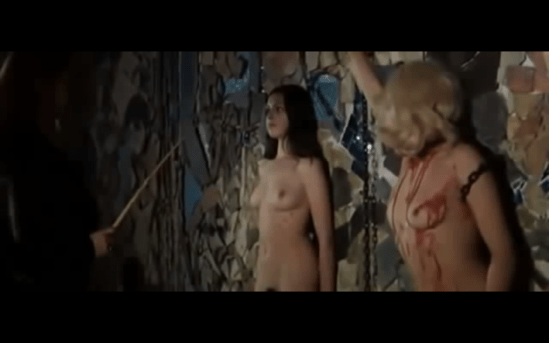
Tag Archives: sex
Enter Into Your Darkest, Evilest Fantasies. “We Are The Flesh” review!

Struggling to survive the conditions of the outside world, a brother and sister locate shelter inside a desolated complex and stumble upon it’s strange inhabitant, a solitary middle-aged man named Mariano with a penchant for welcoming his insanity. The alcohol distilling and isolating embracing Mariano has a twisted offer for harboring the young siblings as he also puts the two to work, constructing Mariano’s trash-ridden home into a cavernous structure from taped scraps of lumber and cardboard. Mariano desperately needs them to explore unorthodox depravities upon themselves to become one with their unhinged host that forms, in more than one way, one flesh-ravenous happy family.

“We Are the Flesh,” aka “Tenemos la carne” in the original title, is an experimental art house feature from controversial Mexican director Emiliano Rocha Minter. The 2016 film harbors more than just three hermit individuals dipping their toes into a forbidden pool of acts, but also provides numerous metaphors and symbolisms that might be hard to swallow and difficult to sit through during the 79 minute runtime. “Sin Nombre” actor Noé Hernández stars as Mariano and there isn’t enough praise in the art house world from his performance that consumes his mortal being, transforming him into a well oiled psychotic machine with a blazing stare, a certifiable grin, and a defined muscular physique. Hernández steals scenes left and right from his young and novice co-stars María Evoli and Diego Gamaliel, whom are equally as brave as the more experienced Hernández in their respective roles. “We Are the Flesh” emits racy undertones by just hearing the title alone and, absolutely, lives up to the title’s very core by displaying non-simulated sex acts. Think about it. Minter’s film only has three main characters for most of the narrative and two of them are siblings. Yup, Minter went the incest route for the sake of art.

In the opening scene, heavy breathing creeps upon a black screen until the image pops open to a Mariano’s face, laboring over something. Next cut is Mariano hunched over with a high stack of baled cardboard, walking in the color tone of a dark cool blue with a slight haze engulfing him. This opening scene is one instance where Mariano is portrayed the Messiah prophet Jesus. Other religious symbolistic events that connect Mariano, who would be condemned for his actions in the Christian scope, to Jesus that occur throughout, such as being dying and being reborn, the cave aspect, the motifs of faith from the mysterious eye dropper liquid, and being the sacrificial body as if transpiring to be some sort of demented wafer during a crazed cannibal communion orgy. Of course, opening anybody’s eyes or mind to this notion can be immensely difficult and profanely sacrilegious to even spell it out in text because seeing the streaming drug use, the attempted murder, the cannibalism, and the sibling incest rule the majority of the narrative makes a case that affiliates more with an unholy antichrist rather than Christ, but I believe director Emiliano Rocha Minter, being a Mexican national and growing up in a Catholic, like the majority of Hispanics, culture aimed to blur the lines between the heavens above and the fires below and embodying them as a singular whole.

Intrinsically irrational and insatiably grotesque, “We Are the Flesh” has momentum in a colorfully abrasive form, quickly evolving from act to act with characters reemerging anew every second onscreen. What might seem as a visionless quest for the sole purpose of producing shock value can be re-construed as a message more aesthetically beautiful in man’s most detested nature. Yollótl Alvarado’s cinematic vision is absolutely dripping with gripping, mature atmospherics that are well doused in vividness while, at the same time, being despairing in a post-apocalyptic haze. The experience charges at you, pulls you into this cavernous womb, and scratches at your tender barrier lining, trying to sneakily slip into your soul. The sensation is as much unreal as the film’s avant-garde structure.

Produced by production companies Piano, Detalle Films, Sedna Films, Estudios Splendor Omnia, and Simplemente, “We Are the Flesh” is a poetic approach experimental wonder, gratifyingly brought to home entertainment fruition from Arrow Films in the United Kingdom and Arrow Films, in conjunction with MVD Visual, in the United States on Blu-ray and DVD. Between Lex Ortega’s brutal social commentary gore-flick “Atroz” and Emiliano Rocha Minter’s art house metaphor “We Are the Flesh,” Mexican filmmaking stands high and bold, unafraid to tell unapologetic stories in conservative societies; a mere taste of what’s to come, I’m positive. While recommending this type of film isn’t the easiest for status quo movie lovers, “We Are the Flesh” hopefully will expand minds, open eyes, and encourage skin-on-skin contact for the cinematic adventurers.

“We Are the Flesh” available in USA! and in the United Kingdom!

Revenge is an Evil Dish Best Served Cold! “Gelosia – Vendetta D’amore” review!

After Thomas’ voluptuous wife’s immaculate beauty falls victim to a horrifying and scarring fiery car accident, the sex-addicted womanizer, fueled by a constant stream of strong alcohol, dumps his maimed wife and obsessively hops from one unchaste woman to next, but in the darkest shadows lurks a hidden danger toward his newfound, unrestricted fast and loose lifestyle. A sinister plot of revenge against him begins to quickly unravel and Thomas’ stretch of unscrupulous carnal behavior is about to be ‘cut’ short because, as the ancient saying goes, “hell has no fury like a woman scored.”

Alberto Barone’s vengeful sex-thriller “Gelosia: Vendetta D’Amore” is a short film laced with irrepressible desires and consequences, doused in pure hatred and nihilism, and packaged as a vibrant grindhouse homage garnished with a tightly-knotted black bow. Milton Welsh stars as Thomas, a man on a bulldozing sexcapade, and with Welsh’s raspy, baritone voice and slick back, greasy hair makes him, on screen, the perfect, middle-aged creep, hooking up with the shameless, uninhibited women. The German born Welsh has indistinguishable looks and talents with the impeccable “Doom” and Rob Zombie “31” actor Richard Brake that brings a lot of despicable enjoyment to not only the performance, but also with the monologue by Welsh throughout the short film. Welsh’s previous credits include the 2011 remake of “Conan the Barbarian,” “Aeon Flux,” and, one of my personal favorite Norman Reedus films, “Antibodies.”

Welsh’s performing cohorts makeup solely of very well-endowed, very offensive-embracing women that include a porn star, a dominatrix, and a couple of veteran genre actresses starting with the Southern France born Manoush (actress in Marian Dora’s “Cannibal,” “Philosophy of a Knife,” and, most recently, “The Curse of Doctor Wolffenstein”) as Heidi, Thomas’ discarded wife. This dominating role didn’t feel quite right, slightly forced, from the possibility of this role not being in Manoush’s native tongue, constraining the gushes of violent emotions that should be exploding from within the character outward. Manoush directly interacts alongside “German Angst’s” Kristina Kostiv, as a very seductive Eastern European escort girl in a manner that blurs the motivations of the characters, but we’ll discuss that later in this review. Rest of the cast fills every man’s, sometime woman’s, prominent fantasy with sacrilegious Nunspolitation and naughty nerd girl scenario roles, respectively donned by Tara Rubin and German porn star Lana Vegas. Both Rubin and Vegas steal from “Gelosia’s” root message with their provocative performances that leave almost nothing to the imagination. Tattoo model Alexa van Unique gets kinky in a brief scene of dominance that’s short and sweet and gets the message across.

“Gelosia” is Italian for Jealousy, but Alberto Barone’s written and directed film doesn’t hit hard with one of humanities irrational and vile attributes. More in line with the subtitle of “Vendetta d’Amore,” aka Revenge of Love, Barone tells two-stories: One of the monologuing, sex addict that objectifies women more than he wishes to understand them and a vengeful wife with a dastardly plot of deadly retribution against him. I just don’t see jealousy as the major player this short film is titled after and that, at least for me, dilutes much of the radical content supporting the story including the naked women, the gruesome violence, and the admirable cinematography.

“Gelosia: Vendetta d’Amore” is sexy with shock value. Produced by Ingravisione, the exploitation thriller seeks to debut in late 2017! Overall, Barone’s ultra-exploitation leaves an indifferent residue with me as I’m still hung up on a few difficult to ignore hiccups, but I love the short’s perverse freedom as a whole that’s vivid and modern while staying classic in style. “Gelosia: Vendetta d’Amore” is starting to hit festivals as I type this, bringing all the castrations and sex to an arthouse theater near you!

[youtubehttps://youtu.be/9PR-KtfhaA4]
Opening Your Eyes Takes a Necessary Evil! “Deadly Virtues: Love.Honour.Obey” review!
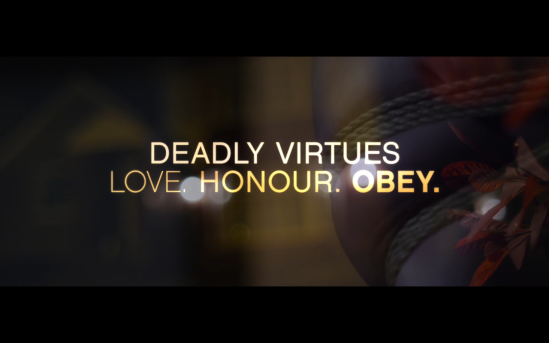
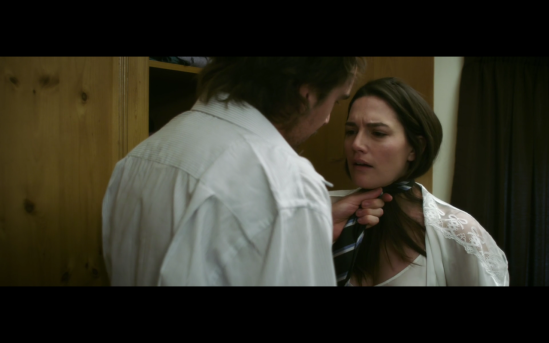
Friday night, A stranger breaks into the home of Tom and Alison. After tying up and torturing Tom, leaving him in the bathtub, he reveals a weekend long scheme that involves convincing Alison to genuinely want him by Monday morning. The stranger’s psychological game slowly breaks down Alison’s perception of her relationship with her husband through consequential threats toward a battered Tom, survival obedience, relationship morals, and untapped desires while Alison desperately attempts to squeeze away her captor’s maniacal grasp any way possible. With Alison’s husband undergoing continuous abuse throughout the weekend, the stranger persistently exhibits various versions of being the perfect husband to appease Alison’s preference in a partner, a striking contrast that begins the spiraling doubts about Tom and the life to which she’s submitting to with him.
The director who gave audiences a reason to believe in their zany childhood imaginary friend in “Drop Dead Fred” and who drove viewers through the depths of Satan’s domain on the epic retrieval of love journey that was “Highway to Hell” has resurfaced. Director Ate de Jong’s 2014 film has found a home for his British exploitation thriller eloquently entitled “Deadly Virtues: Love.Honour.Obey.” at the Philadelphian based home entertainment distributor Artsploitation Films. An intense eye-opening experience that makes couples’ therapy a cut rate rekindling process, the “Deadly Virtues” story comes from the talented, yet relatively unknown, drafter Mark Rogers whose characters contribute a fierce and engaging potency.
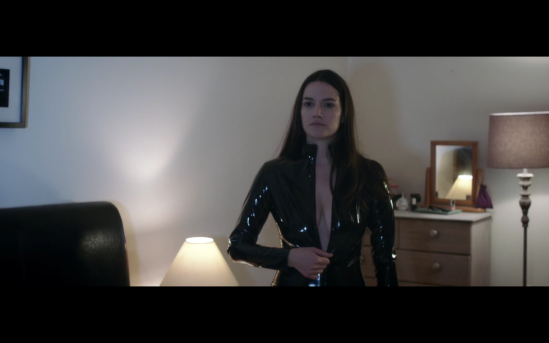
Characters can be written from head to toe with gargantuan electricity, but it takes the actors and actress portraying the characters to actually flip their switches on, vividly toggling their characters to shine. Edward Akrout’s puts forth a dangerously sophisticated Stranger excellently defining the term acting. Every unique touch of the binding rope used on Tom and Alison, every calculated sinister action taken against Tom, and every apt expression emits just enough information to state the Stranger’s purpose without spoiling the character’s mysterious motivations. Akrout is joined by American actress Megan Maczko with a selfless performance that pits her character Alison in a cat-and-game mouse against the Akrout’s Stranger. There are bits of unwanted sexual activity and nudity and role playing BDSM that might mistakenly place Jong’s film in the incorrect genre; instead, Akrout, Maczko, and, even Matt Barber as Tom, acutely pivots the subject matter, even with the provocative nude and bound woman graced film poster.
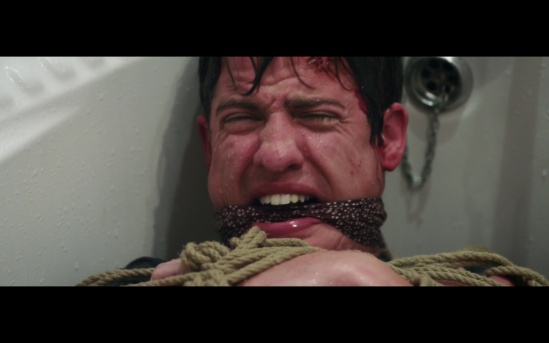
Not all is copacetic with “Deadly Virtues.” Some of the pacing slows down a bit where the motivation feels arguably aimless as Alison quickly becomes content and comfortable with a man who just softly raided their home and violently turned their lives upside down. Also, as a matter of character, Tom needed fine sprucing from being painfully forceful with how the character critically needed to know, to ultimately compute, trivial information at the most inappropriate moments. The story itself might have forced Tom’s inadequacies and insecurity issues to completely tell the story within the total 97 minute runtime, but in the end, the finale loses that little something something to put the final nail into an already furbished piece of work by director Ate de Jong.
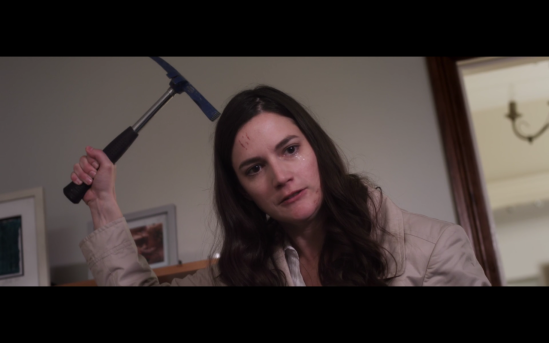
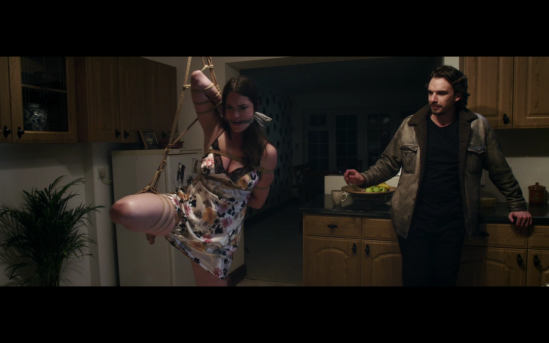
Artsploitation Films’ latest release, “Deadly Virtues: Love.Honour.Obey,” surfaces deep rooted marital issues in an extreme, hostile manner, bringing to the forefront the versus struggle of adapting or fighting back, and also touches upon the beauty of the overlooked. The film’s poster, which I already remarked upon having some minor nudity, accentuates a woman’s other pleasant bodily features including the small of her back, her long neck, and her protruding deltas which Akourt’s portrayal of the Stranger similarly remarks briefly upon when more pigheaded men not noticing, or appreciating, other, less obvious, parts of women. I’m sure for most viewers, gazing at Megan Maczko strung up and suspended in an inviting position can stimulate a lot of interest. “Deadly Virtues” is currently only exclusively available in United States via VOD formats, such as Amazon, Vimeo, and GooglePlay, courtesy of Artsploitation Films.

Watch “Deadly Virtues” on Amazon Video! Click Here to view!

Want to be the Evil Doctor’s Guinea Pig? “American Guinea Pig: Bloodshock” review!

One man becomes the unfortunate subject of ghastly experimentations performed by a sadistic and blood thirsty doctor. Wheeled by abiding orderlies back and forth from his sterile white and padded cell to the mad doctor’s dark and dingy operating room office, the man’s will to live quickly begins to fade, yearning for death before suffering anymore in an alternative Hell. That is, until the handwritten notes start appearing on his padded room floor. The notes seep through between the pads from another tortured soul, a female, in the adjacent room. Withstanding new atrocities done to her before the man receives them, she pleads with the man to not leave her and to make a pact to outlive the inhumanities together.

Welcome to the new American Guinea Pig series! “Bloodshock” is the 2015 follow up film, on the coattails of 2014’s “American Guinea Pig: Bouquet of Guts and Gore,” from writer-producer and Unearthed Films president Stephen Biro and directed by special effects guru Marcus Koch. Koch, whose effects credentials include the Barbara Crampton starring thriller “We Are Still Here” and Koch’s prior directorial work “Rot” and “100 Tears,” strays away from the straight forward concept with an ultra gore art house expressionistic horror film that aims to break your mind as well as your body. Open for interpretation, “Bloodshock” fits perfectly into the ever provocative Unearthed Films’ wide open cache of underground cinema and will alleviate Koch to the next level of filmmaking. My interpretation of what this poor man and woman are experiencing is simply a penancing purgatory that’s intended to cleanse their souls in the warmth of their own wretched blood; the two victims understand their pain, as if not feeling the invasive effects of being dissected while still yielding breath, and are willing to subdue themselves to a maniacal physician until they’re able to briefly thwart his tireless work to share pain and open wounds in blood-soaked passion of hopeless ecstasy.
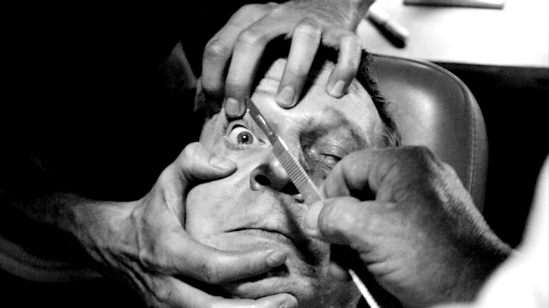
Dan Ellis puts in a powerful performance as the mistreated male patient with Lillian McKinnay, as the female patient, co-starring in an equally bold performance, especially being McKinnay’s first major role. Andy Winton’s diabolical medical maltreatment compares to the similar magnitude of “The Human Centipede’s” Dieter Laser by conducting exploratory, invasive, and unnecessary surgeries for sport while being candor about his blood lusting necessity. Amongst the three main actors, Biro’s script contains little dialogue, banking laboriously on physical renditions since both tortured patients’ tongues have been severed and jarred. Every movement is precisely executed and surged with attention, tuned to tell the story without much verbiage. Ultra gore isn’t everybody’s cup of cinematic tea and with an extremely thin film of dialogue as an outer coating, Ultra gore becomes that much difficult to be entertained by, but, recently, I’ve been lucky enough to come across another gore and shock film, coincidentally enough another Unearthed Films’ release entitled “Flowers” by director Phil Stevens, that had proved to me, as well as Koch has just done, that unspoken gore can be ingeniously crafted and thought provoking.

“Bloodshock’s” gore holds nothing back and leaves nothing to the imagination. The meticulous bone-sawing, head-splitting effects from a talented special effects team, consisting of Marcus Koch’s Oddtopsy FX crew, paint a sordid picture with a blood brush. Koch’s decision to go with Donald Donnerson’s cinematography under the two-tone of black and white doesn’t stiffen the poignant sight of blood, inner layers of flesh, or the splintering bone fragments. The Japanese would be pleased with their American counterparts realistically depicting gore and death captured amongst an underlying meaning. Unearthed Films has already taken the steps to continue the series with their next installment, “American Guinea Pig: The Song of Solomon,” which will pertain to a graphic exorcism and, currently, there are preview images and video scenes available.

The 3-Disc Collector’s Set from Unearthed Films and MVD Visual has priceless collector’s value. Not only does the set have a Blu-ray transfer of the 1.85:1 widescreen presentation, but also contains a DVD presentation and a third disc containing a CD of the Kristian Day industrial-jarring soundtrack. The black and white image quality is sharp and solid for a majority of 91 minute runtime. Some scenes go soft, losing shape to blotchy interference, but the qualities only supplement to “Bloodshock’s” charming grit. Only during the course of the patients unifying do colorful hues gradually seep in, almost unnoticeably, during an ostentatious sex scene involving blood and intestine that’s effectively edited to slowly build the passionate boiling point. Despite two of the main characters have their tongues removed, the Dolby Digital 2.0 audio has the dialogue so sorely crushed under the weight of the Kristian Day soundtrack that at some scenes I can’t even understand what the good mad doctor is saying. Also, on the DVD, I noticed that all audio tracks delay a second behind the action and dialogue. The bonus features are immense with interviews with director Marcus Koch, writer-producer, Stephen Biro, actor Dan Ellis, actress Lillian Mckinney, and two commentary tracks with Marucs Koch and Stephen Biro on one and actor Andy Winton, Gene Palubicki, and Alberto Giovannelli on the other. There’s also a behind the scenes featurette, production videos, and a booklet with a review from Ultra Violent Magazine! Unearthed Films certainly has a definitive release in their collection with “American Guinea Pig: Bloodshock” that’s packed with bonus material and full of venomous content abiding by the guidelines set forth by the Japanese. I don’t foresee the underground cinema juggernaut or the explicitly snuff-like Guinea Pig series ever slowing the flow of blood. “Bloodshock” fulfills the qualifications of the series by having the guts to show the guts and being just as demented and sick for fans who can stomach and endure grisly content.

Isn’t the cover just gore-geous. Get it at Amazon!

 It's Bloggin Evil!