Conman Bites Off More EVIL Than He Can Chew. “Impulse” reviewed! (Grindhouse Releasing / Blu-ray)

Pre-Order “Impulse” Here at Amazon!

As a boy, Matt Stone had an altercation that resulted in the transfixing death of a man at his hands.  As an adult years later after a sanitarium stint, Stone seduces wealthy women as a sophisticated and well-off playboy, using the cultured guise as way to con women out of thousands of dollars, and then murders them when has milked them for all their worth or when their patience for his extravagant and philandering behavior has run it’s course.  When he meets widow Ann Moy, Stone begins his plan of deceit, eyeing not only the single mother for her riches but also Ann’s even more affluent and eccentric best friend Julia.   Stone’s scheme begins to unravel when a strong-arming ex-partner unexpected show up to force into his ploy, his mental instability flares into paranoia and near psychosis, and then there’s rambunctious Tina, Ann’s young daughter who even though doesn’t want Stone to replace her deceased father also witnesses firsthand Stone’s violent transgressions. 

Personally, when William Shatner comes into the conversation about anything, “Star Trek” inevitable pops into the mind first thing.  “Star Trek” and “Captain Kirk” have become not only a household name for Trekkies but also for the non-science fiction laymen who rather get lost in, dare I say, rom-coms.  Shudder.  Diehard horror fans know Shatner is more than just the charismatic space explorer seducing alien women, karate chopping the Gorn, and become inundated with the furry Tribble.  The now 92-year-old Canadian born Shatner has sporadically yet constantly been the star of thrillers for much of his career, such as 1966’s “Incubus,” 1975’s “The Devil’s Rain,” and even the more recent 2019’s “Devil’s Revenge” with fluctuating, polarizing success.  Yet, one of Shatner’s engrossingly more disturbing performances comes from director William Grefé’s (“Mako:  The Jaws of Death”) 1974 schizo-thriller “Impulse.”  Penned by “Blood Mania” and “The Killing Kind’s” Tony Crechales, “Impulse” was filmed in Tampa, Florida under Conquerer Films with Socrates Ballis in his first producing role.

What most don’t realize about William Shatner, from their limited scope of him inside just “Star Trek,” is the man has range and can accomplish more complexity than just being confident space captain.  “Impulse” really drives Shatner to split hairs and be a polygonal persona, one that goes into deep anxiety at the sight of blood or extreme violence, one that can polished and suave in charm and romance, and one that can be ruthless and cunning.  All these traits fit into Shatner’s performance bubble of Matt Stone, chiseling each angle of the traumatized encoded individual into a wolf in sheep’s clothing in constant conflict with himself and those around him.  With the exception of Tina, those around Stone are targets as he swoons Anne Moy (Jennifer Bishop, “Horror of the Blood Monster”) and Julia Marstow (Ruth Roman, “The Baby”) of their money.  Anne and Julie feed into Stone’s false promises and hidden agendas and, as characters, Bishop and Marstow play their diverse friendship with traditional flare that can be easily duped by a stranger from off the street and barely know.  Tina is the only wildcard.  With the look like Heather O’Rourke and a prickly preteen attitude, Kim Nicholas falls in tune with the boy who cried wolf but, in this instance, as the girl who cried wolf as she becomes the aware adolescent privy to a fault to Stone’s dangerous side.  Agitated by the loss of her father and her mother’s effortless slip into a physical relationship, not to forget to mention her impish naughtiness, turns Tina into an incredible source, labeled spiteful, and angry at the world despite her true knowledge of her own world burning down around her with Matt Stone at the wheel.  “Impulse” rounds out the cast with James Dobson (“The Search for the Evil One”), Marcia Knight (“Stanley”), Shatner’s then wife Marcy Lafferty (“Kingdom of the Spiders”), and James Bond’s Odd-Job himself, the former heavy weight wrestler Harold Sakata as the ex-partner Karate Pete crashing Stone’s scam.
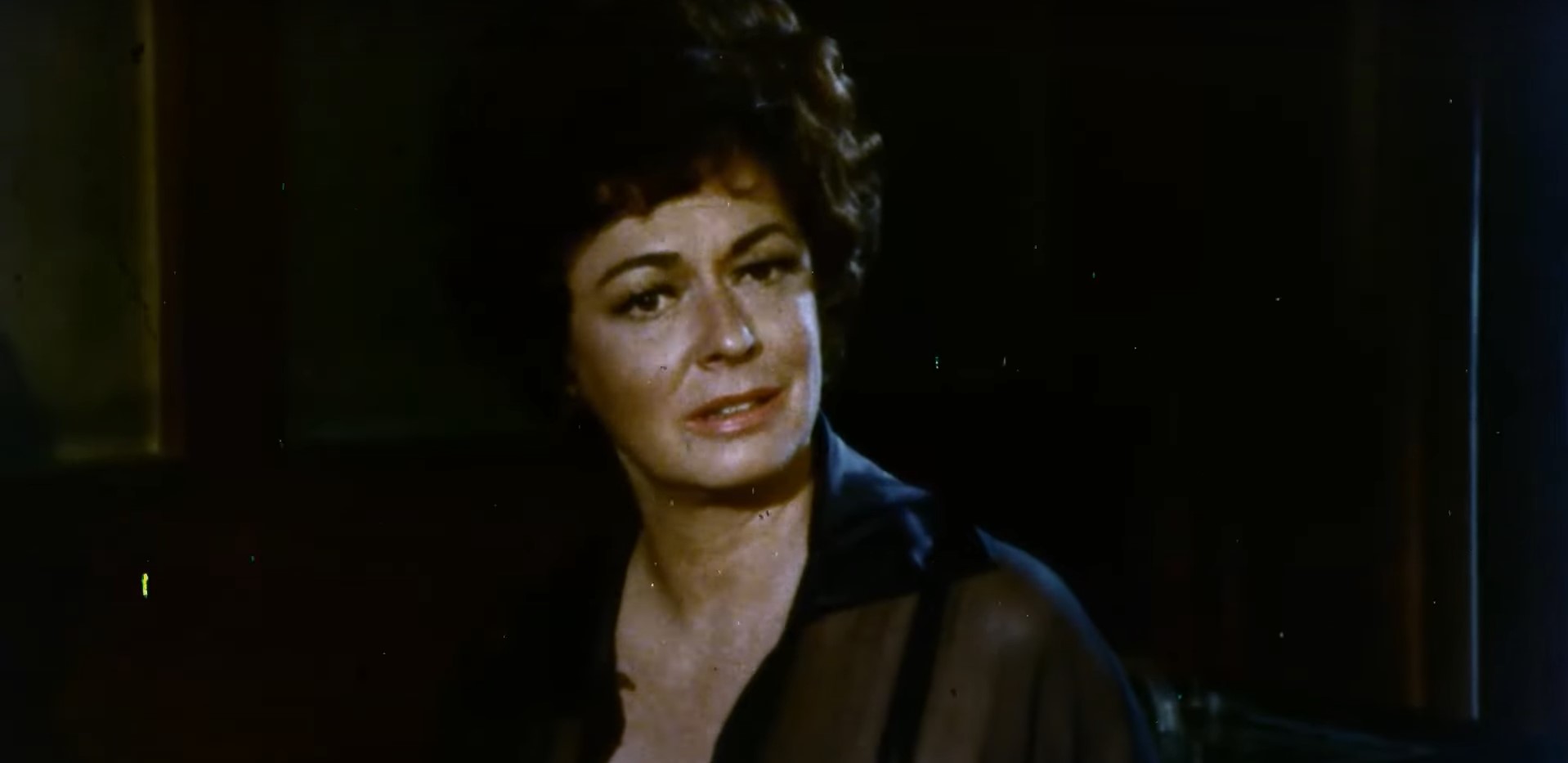
William Grefé steers childhood trauma to be the root cause that shapes Matt Stone into a cold and calculating killer.  While not driven to be a rabid dog seeking to kill on sight, the sweet and innocent child only protecting his mother from the potentially rapist hand of a drunken brute had not only been scarred by the incident but also incited his mother to institutionally commit him as if assigning him blameful wrongdoing, extenuating his reality into a woman hating deviant.  And the worst part of it is, and the part that Grefé is able to define and make Stone be sympathetic to audiences, is Stone knows he shouldn’t have been deinstitutionalized, as he more than once referred to his situation as a puppy left out in the middle of the street.  Then, does “Impulse” become more of a tragedy for our principal villain as an unfortunate byproduct of a catastrophic situation, an ill fit mother, and a system that have all let him spiral down to this point in the story?  The only individual to see through his ruse, in fact, is another child, Tina, with a child’s sixth sense in their melting pot of developing emotions.  The social niceties and grown-up cognitive reasoning shield Anne Moy, Julia Marstow, and others, and even to an extent the unscrupulous brute Karate Pete, from Stone’s devious nature and his will to survive at any cost, no matter who he has to kill whether be a lover, former partner, or a little girl. 
The new Grindhouse Releasing, the first through the distribution firm MVD, is a 2-disc Blu-ray release restored from a rare archived, 35mm film elements.  The original negative was unfortunately destroyed and the restored, 4K scanned print comes with a prologue disclaimer that some elements may not be up to quality standards.  However, the print, on the March 12th Blu-ray release now available for pre-order, looks stellar, stored on an AVC encoded, 1080p High-Definition, BD50, and presented in a widescreen 1.85:1 aspect ratio, with only a few noticeable scratches, faint to the eye, in a few brief frames within the natural grain.  Grading can appear monochromatic gray in some exterior scenes but the overall grading pops and are distinct in natural-looking shading. We can also look at Grefé’s direction and Edmund Gibson’s cinematography as just as striking as the picture quality with brazen, worth-while shots that include an interior car shot aimed toward the windshield heading toward a watery grave. The English language original mono track, for a single channel output, clears the bar with room to spare with intelligible, comprehensive dialogue, capturing every word and sentence distinct and syllabized to great detail without too much interference, technically and from layering. Slight popping and background electronic interference never engulfs or take the reins over the layers. Decent spacing and a good range, supported by the Lewis Perles lingering unhinged musical composition, adds value to Shatner and the casts’ performances. Grindhouse Releasing Blu-ray also comes with the original mono French soundtrack. English subtitles are optionally available. Loaded with special features with a William Grefé audio commentary, Shatner Between the Treks a Ballyhoo produced documentary regarding Shatner’s various projects before, after, and in-between, Kingdom of the Shatner is a William Shatner live interview in Santa Monica in Oct. ’22 after a Shatner triple feature, Shatner promo shorts, William Grefé shorts “Thumbs,” “Iceman,” “The Cask of Amontillado,” and “Underwood,” a making-of “Impulse,” the 40th anniversary screening at the Tampa Theater with William Grefé post-film discussion, the raw footage of Shatner saving Harold Sakata from accidental lynching with two commentaries from Grefé and Shatner, still gallery, two theatrical trailers, and other trailers from Grindhouse Releasing titles. Also included are bonus Grefé features, including “The Devil’s Sisters that has its own special features with an introduction, Grefé audio commentary, radio spot, still gallery, and a revisiting of the film from the director, plus “The Godmothers” with only an intro by Grefé. Grindhouse Releasing’s “Impulse” is truly a lovefest of the two Bills, Grefé and Shatner, and the label really goes the extra mile with a deluxe edition and restored release with a character and title embossed, fully colorized, and rigid cardboard sleeve with a clear, dual disc push lock Amaray Blu-ray case sporting the originally illustrated, composition cover art that’s also reversible with the same sleave cover design that’s utter madness on printed cardboard. Inside, the discs are locked in on the right, one on top of the other with the top disc snuggly in behind the feature disc in a vertical layout, and both disc arts are rendered with pulpy aesthetics and primary colored, yet darkened feature stills for full fear effect. Opposite in the insert section, a 4×6 illustrated liner portrait of Matt Stone painted by artist Dave Lebow, and a 6-page linear note booklet with color pictures, grindhouse posters, and an essay by Jacques Boyreau. The 87-minute Blu-ray comes region free and is not rated.

Last Rites: The tale of two Bills, Shatner and Grefé, is a match made in heaven, or, better yet, a match made in demented evil with “Impulse” and Grindhouse Releasing stuns with a fully loaded, supersized, and Shatner-stuffed 2-Disc release that puts the film rightfully up on a grandstand pedestal.

Pre-Order “Impulse” Here at Amazon!

100-Year Return Brings a Plague of Flesh-Eating EVIL to a Small Town! “Messiah of Evil” reviewed! (Radiance Films / Blu-ray)

The “Messiah of Evil” has Come to Blu-ray Home Video!

Arletty travels up the California coast to a small beach town known as Point Dune.  The reason for her visit is to find her artisan father after a series of bizarre letters came to an abrupt stop.  She arrives at his mural-graffitied home to discover it empty and decides to stay a few days to ask around town about his whereabouts and to be present for his return home.  Her inquiries at art gallery shopkeepers lead to a motel where Thom, a wealthy collector of urban legends and spooky stories, and his two travelling female companions, Laura and Toni, have also sought out Artletty’s father for his bizarre experiences.  As the days pass, Point Dune slowly becomes a literal ghost town that forces Thom and his companions to stay with Arletty and, together, they experience the horrible truth of what’s really happening to the  residents of the west coast community who eagerly await the arrival of the dark stranger. 

Once married filmmakers Willard Huyck and Gloria Katz are the creative minds behind the stories of “Howard the Duck” and “Indiana Jones and the Temple of Doom.”  They also wrote “American Graffiti” in what was to become their link toward working on Steven Spielberg’s Indiana Jones sequel since both “American Graffiti” and “The Temple of Doon” were both produced by the father of “Star Wars,” George Lucas.  Yet, in the midst of “American Graffiti,” the couple also penned and Huyck came into the entrance of directing with the 1974 horror-thriller “Messiah of Evil” that pulled from various themes of mindless consumerism and the rising fears of dangerous and deadly cults in the U.S.  Also known by a variety of titles around the world, including “Dead People,” “Night of the Danmed,” “Messiah of the Evil Dead,” “Revenge of the Screaming Dead,” and “Blood Busters” to name a few, the Californian coast shot film is a production of the International Cine Film Corp and V/M Productions with Gatz producing and Alan Riche (“Deep Blue Sea”) serving as executive producer. 

“Messiah of Evil” slinks into the soul leaving behind dread’s unwashed pull against what we know as conventional horror.  In order to accomplish such a fear-induced feat, a cast must envelope themselves fully in world of weird and irregularities that nestle an uneasiness stemmed not solely from their performances but from how they react to the eccentric environment, to the crumbling small town society, and to ghastly behaviors of normal-looking people.  Like most daughters, Arletty has concerns for her father and seeks to understand the truth behind his unhinged letters.  Marianna Hill (“Schizoid,” “The Baby”) plays the quietly curious at a cat daughter dabbing residents with barely an effort in interrogational questioning of her father’s whereabouts.  Hill floats Arletty through stages of a slow descent into madness that simmers slowly to a boiling point understanding of what’s taking shape around her.  The same happens to Thom, played by Richard Greer (“The Curious Female”), who initially is a fraction of the nonconformity surrounding Point Dune with his obsession toward collecting strange stories and his polyamorous collection of women.  Of character, Greer is resoundingly in control without being dominating with Thom who has wealth and magnetisms but isn’t someone to be beholden to forever as we see with Laura (Anita Ford, “The Big Bird Cage”) who deserts him for his open-door intimacy policy in his pursuit of Arletty and with the childish Toni (Joy Bang, “Night of the Cobra Woman”) in her infinitely naïve opinions surrounding the dull Point Dune.  One actor I wish we had more of but is utilized perfectly as Arletty’s father and a harbinger of what’s coming is Royal Dano (“Ghoulies II,” “Spaced Invaders”) in a non-humorous nor drunken idiot role that seemed to typecast him later in his career.  Dano’s short but sweetly terrifying stretch divulges a man torn between his previous life and a new terror that now occupies him as he interacts with Marianna Hill as concerned and contaminated father holding it all within toward his frightened, confused daughter.  “Messiah of Evil’s” cast rounds out with Elisha Cook Jr (“Rosemary’s Baby”), Bennie Robinson, and Charles Dierkop (“Grotesque”). 

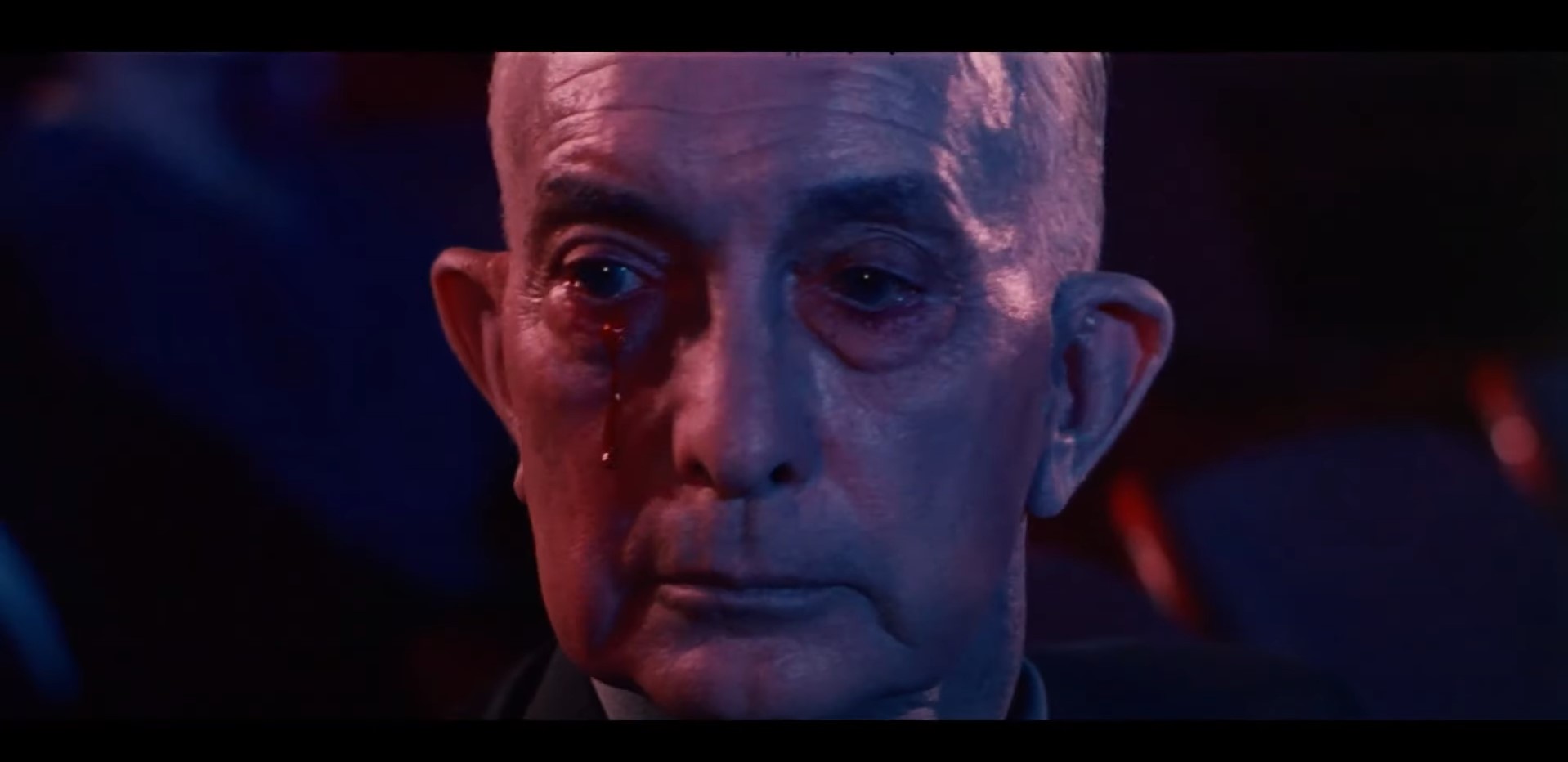
Huyck directs with colorful and verismo synergism that takes the positives of what should be life’s routine pleasures and turns them against us as fantastical and harrowin deadly elements of false securities.  The rolling crashes of Point Dune’s waves takes on a constant cacophony of sinister foreshadowing, a bright and welcoming supermarket becomes a vacant trap in every aisle, the entertaining movie theater darkens with blood on the screen, and an artist’s home, full realistic murals and colors, is an oppressive feast of lifeless eyes.  Point Dune becomes a dead town, literally, as the inhabitants succumb to dark forces from beyond their years, turning primeval in their contemporary three-piece suits and evening blouses.  Huyck and Gatz story pulls inspiration from U.S. history and folklore to mark the 100-year return of spreading evil amongst the land, an evil that resorts to cannibalism by either spellbinding archfiend, an internal infection, or the rise of the undead and not just any mindless, shuffling, flesh-eating zombie but a transmogrified plotter able to move fast and think as a single unit with the touched by evil masse with telltale signs of a single rivel of blood seeping from out of their eye and their insatiable need to consume other people. ”Messiah of Evil” is not overtly graphic like George A. Romero zombies or like the unbridled number of zombie films to follow inspired by Romero’s zombie game-changing wake for the last 60 plus years, separating the flesh-eaters from Romero’s gut-gnashing, pale faced, and slow-walking undead and Huyck and Gatz’s transmitted pestilent receiving horde running fast in their best church shoes with vastly different traits. Huyck and Gatz dip into more eldritch means with the return of a paganistic dark stranger in a pared down explanation without explicitly being definitive who or what the dark stranger (a demon?Antichrist?) is that is driving foreboding signs to a doomsday-disseminating end. ”Messiah of Evil” thrives as the mysterious and strange fulcrum of the beginning of the end told through the point of view of young woman left to tell the world of what’s to come only to be about as believed as much as a man wearing a polka-dotted tutu who has delusions of unicorns dancing the waltz with garden gnomes in his front yard. 

United Kingdom distributor Radiance Films releases a new restoration transfer of “Messiah of Evil” also on their U.S. line. The AVC encoded, 1080p high-definition, BD50 presents a 4K scan of the best-known surviving 35mm print from the Academy Film Archive in a widescreen 2.35:1 aspect ratio. As noted in the release’s inserted booklet, the restoration processes used was the Digital Vision’s Phoenix Finish and DaVinci Resolve was used for color correction, under the supervision of Sebastian del Castillo at the Heavenly Movie Corporation. Audio was also restored with the Izotope RXB. For a surviving print, the original elements look pretty darn good with barely any celluloid hiccup. No vinegar syndrome, not significant tearing, or exposure to name a few issues of possibility. There are a few minor blemishes and missing or damaged frames that seem to provide an unwanted cut but most of “Messiah of Evil’s” film problems stem mostly behind the camera with a rework of the story during the stop-and-go production and conflicts in marketing the film, hence the various title aliases of the film from around the globe. Other detail low points are when the film is bathed in blue and purple gels and tint for to set an apprehensive wander and wonder while retaining more natural grading in its majority throughout. The resorted audio is a lossless English LPCM mono mix. Really focusing on the electronic score of Phillan Bishop (“The Severed Arm”), the low-frequency score sets a perpetual and durable tone of dread out of place in a prosaic small town, much like the Arletty’s father’s work-of-art home that sticks out amongst the mediocrity. In design, dialogue remains robust yet delicate when the scene calls for it, such as Elisha Cook Jr. story of how he was born in what is essentially him, as a vagrant paid for his story, making the only noise in the room. Dialogue in these moments is greatly discernible with negligible electronic interference. Depth layers the permeating isolation of a town gone mad in unison with the range stretching from the distressing design of rolling, crashing, oppressive waves to the scuffles of zombies’ consuls and heels scuffing against asphalt, pavement, and shattering through panes of glass. Radiance provides English subtitles with their release. Bonus features include a new audio commentary by film historian and horror archetype authors Kim Newman and Stephen Thrower, an archived interview with director Willard Huyck, and a new, feature-length documentary showcasing “Messiah of Evil’s” background, themes, production, and influences by various horror scholars, including Kat Ellinger who also voiceovers a visual essay on American Gothic and Female Hysteria, which if I’m being honest, parallelly treads on similarities with Ellinger’s Motherhood & Madness: Mia Farrow and the Female Gothic on Imprint’s “The Haunting of Julia.” Radiance has in the short time poured their heart and soul into their releases and “Messiah of Evil” is no different with a sleek cladded and clear Amara Blu-ray case that’s subtle in showing less but feeling more on the cover art, opposite of the reverse side that houses a classical black and white compositional illustration of characters. Inside the 28th release for the label is a 23-page color booklet insert with the appraisal writings of Bill Ackerman, transfer notes, release credits, and acknowledgements. The disc is pressed red, much like the red moon in the film, with a stark black title. The Radiance release is unrated, region free, and has a runtime of 90 minutes. ”Messiah of Evil” uses cult fears, satanic panic, and the loss of ordinary life to penetrate the spirit by way of slowly eating at it. The crawling, creeping dread meanders, much like Artletty who is seemingly held in place at Point Dune, and we’re glued to the engrossing rate of the terror to come orchestrated by the captivations of a once married couple on a fast track toward success.

The “Messiah of Evil” has Come to Blu-ray Home Video!

Just Because Your EVIL Dad Says Its Okay, It’s Probably Not. “Netherworld” reviewed! (Blu-ray / Full Moon Features)

Enter the Netherworld on Blu-ray!

A wealthy owner of the Thorton plantation bequeaths to his willfully neglected son, Corey, his large Louisiana estate. He’s welcomed by the estate’s unusual lawyer, a house caretaker with an affinity for birds, and her beautiful daughter Diane who, despite her teenage muliebrity, immediately takes an interest and liking to the handsome young man. Corey is also met with his shirker father’s penned testament, to be resurrected from the dead by a sexually alluring brothel woman and necromancer named Delores who works at the local bordello and bar named Tonks. Fascinated by the idea, Corey hangs around the bar and becomes just as engrossed with Delores as his father as he seeks to abide by his father’s supernatural wishes but there’s a warbler cult connected to Delores and Corey’s father with an underhanded scheme that doesn’t favor the new, young estate owner trying to save and possibly get to know the father he never knew, the same one who abandoned him as a small child.

One of the more stranger Charles Band productions to every come out of Full Moon Entertainment, and that’s saying something for a media empire that made killing on hawking killer dolls amongst other oddity-saturated, carnivalesque sci-fi and horror for many decades, “Netherworld” is the early 90’s, Cajun-encrusted, occulter of the Full Moon legacy director of “Tourist Trap” and “Puppet Master,” David Schmoeller, who also cowrote the film alongside Charles Band. “Netherworld” harkens to a time before Band became visionally crazed by dolls, or miniaturized maniacs in general, with a plot that promises Cajun black magic beyond the traditional spells and curses of Louisiana Voodoo, a son desperate to reconnect with his long-lost father who abandoned him, and a flying stone hand with finger extremities that turn into vicious snake-like creatures when attacking the quarried head, but is “Netherworld” too extrusive of the regular and in vogue poured cement of solidified psycho-dolls? ‘Netherworld” is executively produced by Charles Band, produced by Ty Bradford (“Trancers II”) and is a part of the vast Full Moon Entertainment catalogue of productions.

Unsuspectingly walking into between the veil of the living and the dead is predominately television actor Michael Bendetti (“21 Jump Street”) embarking on his first ever horror feature as Corey Thorton, the city boy, or so we assume as he leisurely journeys down a windingly steamy Louisiana tributary in a button-down shirt and tie, who learns his deadbeat, rich father has left him a large amount of property. For having been left fatherless for all of his life, the pill that read as Corey’s deep-rooted longing to familiarize with a flake of a father is a hard one to swallow. The angle that Schmoeller should have attacked more resurrection motivation is the one that involves Corey searching for answers in his father’s disfavor, choosing to live without the flesh and blood legacy of a son, and why now, posthumously, does his father want to reconnect? Audiences will find the answer overly obvious, but Corey Thorton’s thickness proves more difficult to penetrate, especially when he’s beguiled by an enchantress who can summon a flying, snake-fingered hand that emerges an affixing binding wire out from its stony skin and can turn whorehouse johns into caged birdies, literally, if they misbehave or become indelicately frisky. The house keeper’s horseback riding daughter Diane is marred by Holly Floria (“Bikini Island”) with an excessive Southern Belle accent when her character’s status doesn’t stem from sophistication and affluency but rather from the blue collared starry eyes of Anjanette Comer’s (“The Baby”) motherly and hospitality position. When the climax arrives in grand temps and we’re face-to-face with Corey’s ghostly pops, living in the titular Netherworld, the story takes a sudden branch drop that executes any voyage into the void between worlds and there’s quite a bit of neglect for Robert Sampson (“Re-Animator”) as Corey’s father who barely has any scenes to live up to being the film’s primo antagonist pulling the strings of the marionette of his flesh and blood. “Netherworld” fills out the cast with Robert Burr (“Ghost Story”), Alex Datcher (“Passenger 57”), Holly Butler (“Vendetta”), George Kelly (“Jugular Wine: A Vampire Odyssey”) and Denise Gentile (“Ordinary Madness”) as the super-sexy, premium prostitute Delores with parapsychological powers that connect her to the land of the dead.

Off the tip of a gator’s nose, “Netherworld” offers a taste of Full Moon’s 90’s production, promising radically outlandish F/X with a monstrous airborne hand, saucy sexual content, and gore. Corey’s inner thoughts exposition and waterway introduction tends to be more private eye monologuing in the explanation setup of his unplanned inheritance and it also feels like the brittle beginnings of a trashy romance novel: young man travels down the river to his inherited late father’s estate, torn between a pubertal young daughter of the long-standing estate housekeeper and the haram brothel seductress with an eldritch, supernatural inveiglement. Corey’s past lacks backstory, leaving an even playing field across the board of all characters and participating audiences in what to expect from the wild card that is Corey. Immediately drawn to the wanton Tonks not for carnal desires but rather the one woman who her father says can restore his past expiration, Corey’s not a wild card of ambiguity as his role lacks the pull of tough decisions, often between character versus character conflict, with basically a mind already made up to visit the bar-and-bordello despite the ominous warning signs between George Kelly’s sloppy bayou cajuner wanting to dance with Corey at Tonks, Diane’s strong opposition for Tonks in general, and amongst others dubious gratifying points. “Netherworld” very much lives in a world of opposition, like Superman’s bizarro world that defies logic. Logic such as the transition of people into birds, or being inducted into a clan of avian cultists, or ciphering who’s a good guy and who’s a bad guy, or, and this is the most important or, the suddenly cleaved ending that not only doesn’t allow a satisfying ending but also doesn’t explain much, in dialogue or in action, what came into existence once Corey was stuck in the Netherworld other than the obvious trade his father wanted to force.

Full Moon Features brings Hell to Blu-ray with an uncut and remastered from the original camera negative transfer of “Netherworld” in the continuous effort by the empire to upgrade all their classics for a new wave of format availability. Scanned into 2K from the 35mm negative, the AVC encoded, 1080p, high-definition Blu-ray looks pretty darn good. Well kempt over the years, the negative appears to have sustained little age or wear that progresses the hi-def upgrade with relative ease. Color grading is warm and stoked with detail that encrusts every object – the lushy bayou forest, the stony power of a flying hand, Michael Bendetti’s layered curly-perm mullet – all of it is greatly textured and delineated for depth, presented in the 1:78:1, widescreen aspect ratio. Compression doesn’t appear to be an issue despite a lower storage BD25 but that might be due to the utter lack of bonus accompaniments. The release offers two audio options: an English Dolby Digital 5.1 surround sound and an English Dolby Digital 2.0 mix. Both options are equally suitable as the there’s not much more environmental oomph through the extra channels despite the full-bodied cacophonous cicada singing, which unfortunately doesn’t open up depth in the back channels despite the prevalence of the singing in the story’s background sonance. However, dialogue doesn’t feel cheated with a dominating layer and decent range to go with it. Along with essentially what is a bare bones disc, there are also no subtitles available with this release. What is available to view outside the feature is other Full Moon trailers and the original VideoZone segment that covers this particular 1992 gem. Physical features don’t stray too far from VHS, to DVD, to Blu-ray with the same flinty hand rocketing outward in a 3D-like position on the front cover. There are no inserts included with this release. “Netherworld” Blu-ray comes region free, with a runtime of 82 minutes, and, for the first time ever, uncut! An opposition to the usual spun of Louisiana voodoo-hoodoo, there’s another dark magic brewing in the bayou in “Netherworld,” but the promising story can’t coherently piece together down river in an uneven quagmire of quandaries.

Enter the Netherworld on Blu-ray!

Evil Thoughts. The Baby (1973) and The Prowler (1981)

Tonight I thought I would discuss two very different kind of horror films.  Trying to dissect and compare horror films to each other can be enlightening to others; to help them explore new territories in horror.  Also, this idea gives me to chat to be a blabber mouth about obscure, retro movies that most of the younger generations don’t know about.  Hell, I’m almost 30 and I probably still need more horror movie schooling.

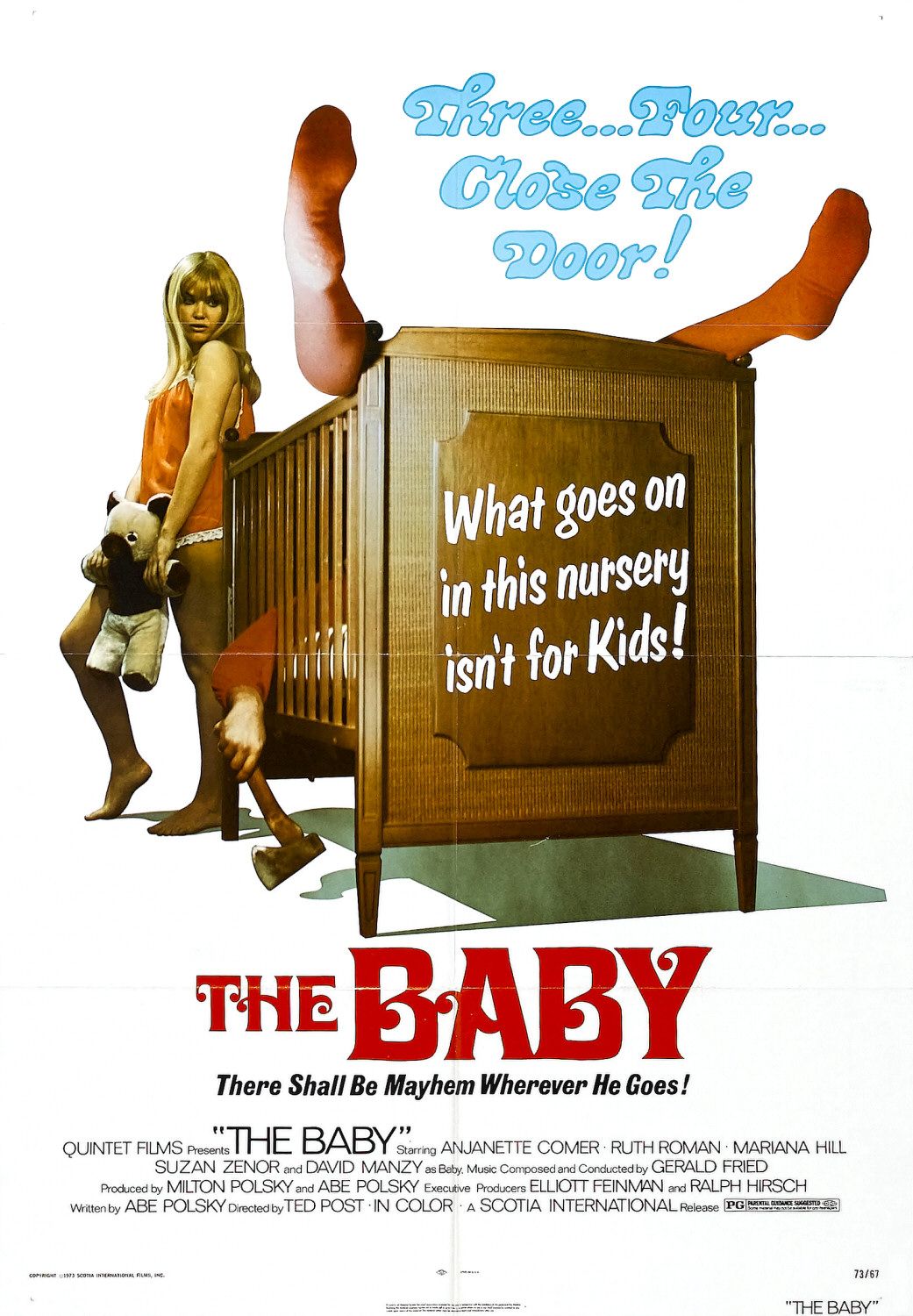
babyFirst I want to talk about Ted Post’s 1973 exploitation film The Baby.  A social worker seeks out and becomes hired by the Wadsworth family to oversee the mentally ill child of the family who goes by the name of just Baby.  Besides the retardation, Baby is an average boy who plays with toys, sucks on a bottle and cries when his diaper is wet with the exception that Baby is a 20-year-old man.  The social worker plans for Baby seem genuine  – to try to progress Baby’s ability to walk and talk like everybody else.  However, the Wadworth family holds a dark secret that if anybody gets to close to that person ends up disappearing, but little does the Wadworth family know, that the social worker has alternate means for Baby than what she cares to divulge.

The Baby is a unique exploitation for me.  I’ve never seen anything like it before.  The fact that the mentally ill, a man, and the mind of a child are being exploited beyond rational means.  When you (in this case when I) think of the exploitation genre, I imagine women being used for their body or just a person being exploited for violence.  In The Baby, the man and the mentally ill is being abused for his body and the man and the mentally ill is being exploited for violence.  During the duration, there is no grasp on who might be the hero and who might be the villain.  The roles are a virtually reversed between the Wadworths family and the social worker and even at the end of the movie, you still don’t know how to process the information and end up second guessing the hero and the villain.  The Baby will imprint in your mind and sear into your brain making The Baby a well executed film just by script alone.  Director Ted Post and The Baby David Mooney do a remarkable job even if the 70s film does come off outdated and corny.  Gerald Fried’s score is also pretty amazing and that is worth listening to as well.


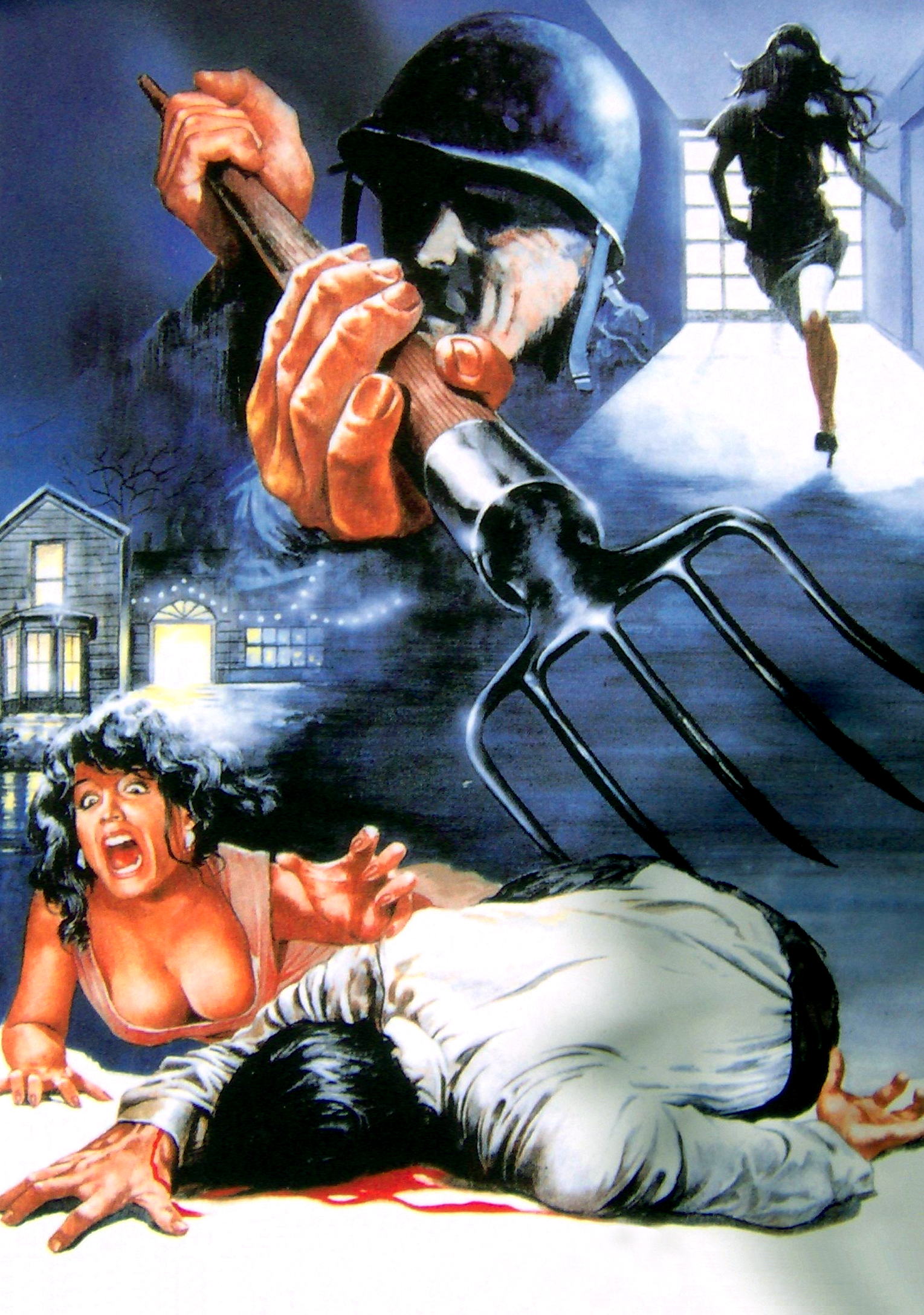
Second comes The Prowler.  A maniacal killer runs rampant on Avalon Bay, NJ dressed in WW II fatigues carrying aprowler pitchfork, bayonet and a handheld shotgun.  The killer reminisces about Rosemary, the love of his lift who gives him a Dear John letter for his time in military service.  His longing forces him to kill.


Tom Savini has mentioned that his work on 1981 The Prowler was his best work ever.  I don’t know if I could agree with Mr. Savini or not on that as his effects for The Burning are superb, but anything Savini touches is gold so The Prowler is a shining example of his gruesome work.  The problem or problems rather with The Prowler is the entire storyline as it was far too choppy and incoherent.  I pieced the story all together sans the movie and I get that the audience sometimes has to make their own interpretation, but come on!  I feel as if The Prowler character just didn’t have enough back story like Jason Voorhees who had a tragedy as a child seeing his mother beheading and seeks revenge on the free-spirited, sex crazed teenage campers and consolers.

Two very different movies.  Two different styles.  All with in the realm of thrills and chills.  Exploitation and slasher genres have gained knowledge from these two prime examples, yet we still build and build upon each genre.  We don’t see them too much in theaters anymore which is a shame since both genres really put you in the center of the worlds most delicate issues of the world.  People kill people.  People exploit people.  These issues will never go away but they will never been renowned as popular because the subjects frighten us way too much.