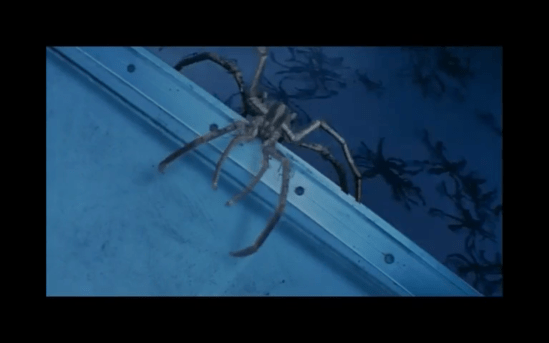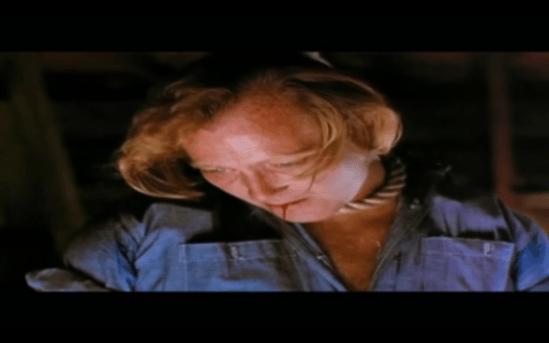
Desert Rats Doing EVIL To Anyone Crossing Their Path! “Motorpsycho!” reviewed! (Severin Films / Blu-ray)

“Motorpsycho!” on a new 4K scan Blu-ray from Severin Films!

Three motorcycle hooligans on their way to Las Vegas through the Mojave Desert ride up on a smalltown Veterinarian named Cory Maddox and his voluptuous wife Gail.  A minor brush with the gang does little harm to the Maddoxes and the couple move on with their life certain the gang has moved on to the next town, but little does Cory know while on a professional checkup of a local mare, the gang invades his home and violently rapes his wife.  Hellbent for vengeance, Cory tracks their transgressive escapades through the arid landscape and comes across Ruby, a beautiful woman left for dead after her husband is gunned down and she herself being grazed by a bullet fired by the same delinquents.  The two track them down into an inescapable, unidirectional corner of the desert but with both sides facing car trouble, injury, and seeping slowly into mental instability, only one side will come out alive. 

By and large, “Motorpsycho!” is the Russ Meyer helmed B-picture that side straddles less explicit content.  The 1965 exploitational action feature, that sported less-than-speedy Honda Trials, flirted with bare-chested women, and immersed itself in light and dark innuendo, is nestled amongst two other Meyer films, “Mudhoney” and “Faster, Pussycat! Kill! Kill!,” released the same year and are showcase of unscrupulous violence and sexual content and innately sets the stage for Meyer’s bosomy and barren set movies that bestowed the former World War II photographer turned sexploitation director accolade success later in his career with the “Vixen!” branded films.  “Motorpsycho!” is co-written by Meyer and fellow “Mudhoney” writer William E. Sprague from an original idea from the screenwriters along with James Griffith (“Russ Meyer’s Lorna”) and Hal Hopper.  The Meyers, being Russ and wife Eve, produce the story in cahoots with Ross Massbaum (“Beach House”) and is produced and distributed theatrically by Eve Meyer’s Eve Productions.

The way Meyer sequences the “Motorpsycho!” story is an ebb and flow of events that culminate into a showdown and audiences, perhaps, won’t know exactly who the leads are until well into the chaos, such as with the female principal lead Ruby, a Cajun woman down on her luck travelling in a forced by necessity marriage to an older man in order ot start a new life in California, played by Haji, a Canadian dancer with a unique face and beautiful curves who caught Meyer’s eye for “Faster, Pussycat!  Kill!  Kill!”   For a new actress, Haji is impeccable and easy on the eyes while working off another first-time actor, principal lead Alex Rocco (“The Godfather”), playing vengeful veterinarian Cory Maddox.  Haji and Maddox have unquestionable sexual chemistry and tension despite their slight platonic relationship of seeking revenge as Meyer provides a great deal of sexual innuendo and reference instead, beating around the bush for the ultimate tease.  Don’t worry, “Motorpsycho!” doesn’t hang around the coquettish scene for entire duration as there’s plenty of one-on-one racy and salivating spiciness to sate sexploitation fans between the playful bedtime arousals of Rocco and on-screen wife Lane Carroll (“The Crazies”) and the playfully aggressive rape of Carroll and a fisherman’s wife a bikini-cladded large bosom.  “Motorpsycho!” has a man to woman ratio that strays from the normal Russ Meyer credits with the female cast rounding out with Sharon Lee in her usual typecasted role of a blonde bombshell and, more specifically in this story, a mare-owning flirt for Cory Maddox’s services.  While not a large breasted woman craving sex in every episodic scenario, this Meyer run has an interesting arc for the three ruffians who initially start with copasetic unity in their troublemaking fun through the Mojave only to end themselves in disbandment of backstabbing and derangement in unswerving performances from Timothy Scott (“Lolly-Madonna XXX”) as the handheld radio melomaniac, Joseph Cellini (“Beyond the Valley of the Dolls”) as a hip cat love-taker, Steve Oliver (“Werewolves on Wheels”) as their military vet leader with a stoic expression but unpredictably violent.  “Motorpsycho!” rounds out the cast with Coleman Francis (“Beyond the Valley of the Dolls”), Steve Masters, Fred Owens (“Supervixens!”), George Costello and Russ Meyer as the unsympathetic, cynical Sheriff.

Not as sordidly sleazy or insatiably randy as many of the Russ Meyer films we all know and love for their perky antics, voluptuous vixens, and zany comedy with a isolated desert town backdrop, “Motorpsycho!” is virtually nudity free in comparison to his thereafter work and shot entirely in black and white that, too, tones down the situationally shaded situations of diverging sexual overdrives that conclude around a centered focus, usually around something sexually themed.  That’s not to say just because production year is in the cinema puritanical early 60s and is in black and white does that mean the film goes without a fair amount of brief nudity as Meyer slips into a couple of nipple slipping instances and countless sideboob that would be deemed too salacious for media content harking back 60-years ago.  Innuendo has always been fair game in all sorts of production sizes and studios but couple what Meyer has done with the sexualized material with the gang violence and what you have is one of the earliest known grindhouse pictures prior to its monikered labeling in the 1970s.  Production value and authenticity floats around the low-budget spectrum with a film titled “Motorpsycho!” that spends what little funds there is to supply Honda Trials that are more the speed and look of Mopeds than motorcycles, but Meyer competently adds and edits fast paced car chases, the discharging of a single pump action rifle, and a curtain calling explosion with body prop fragmenting special effects to level up the value where it counts. 

The Museum of Modern Art and Severin Films restore and scan Russ Meyer’s “Motorpsycho!” onto a new 4K transfer from the original camera negative and encode the transfer onto a new Blu-ray release as part of the Russ Meyer’s Bosomania collection.  The region free AVC encoded, 1080p high-definition, BD25 is a perfect, snug fit for a well-endowed black-and-white feature restored to a virtually free of dust, dirt, and damage.  Meyer’s an eclectic electric editor and every transition is smooth and robust without fading reduction of quality in the rapid, rambunctious edits of his assembling panache.  Though in black-and-white, details don’t suffer from monochromic flattening and every inch of desert is captured with precision, every bodily curve is shapely contoured, and even when a resembled nights dims the lights, there’s plenty of definition of outline to let the mind do the rest of the work with textures and delineation within the presented 1.85:1 widescreen aspect ratio.  The English LPCM 1.0 track is about as expected, flat, but pumps through the single channel with great vitality and strength to be an effective, agreeable sound mix that, again, sees little-to-no distortion or interference.  Dialogue renders over clean and clearly without hissing or crackling in its ADR form with obvious but little asynchronous measure between visual and audio.  Closed captioning English subtitles are available.  Severin Films compiled special features, in association with the Russ Meyer Trust, include an audio commentary with queer film historian Elizabeth Purchell and “Malevolent” editor and filmmaker Zach Clark, archived interviews with stars Haji and Alex Rocco Desert Rats on Hondas, and the film’s trailer.  Primary red boxes in a mustard yellow background cover art with Steve Oliver and Sharon Lee providing the film’s genre caliber with fast bikes and big breasts plastically encased inside a black Blu-ray Amaray with the inside disc pressed with the same image, following suit to the previous first three Bosomania installments of “Vixen,” “Supervixens,” and “Beneath the Valley of Ultra-Vixens.”   The region free release has a runtime of 74-minutes.

Last Rites: “Motorpsycho!” is Russ Meyer convincing us he’s more than just a T&A sex hound with a 100% pure exploitation revved up with revenge, violence, and sordid sexual behavior.
“Motorpsycho!” on a new 4K scan Blu-ray from Severin Films!

Another Cabin of EVIL in the Woods. “Exposure” reviewed! (Scream Team Releasing / Blu-ray)


Get exposed ot “Exposure” on Blu-ray at Amazon.com!

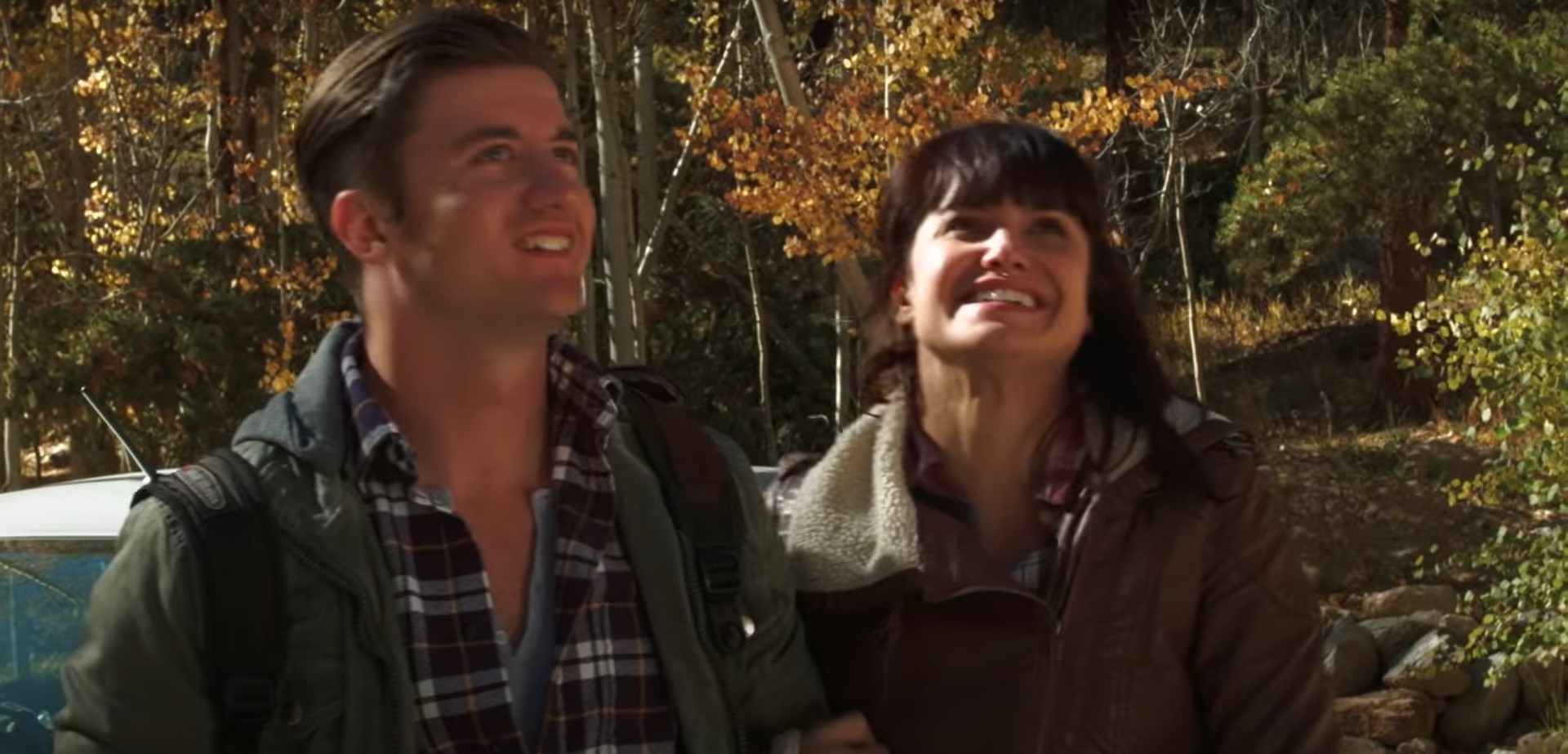
A rough patch in an abusive relationship opens up an opportunity for Myra and Owen to reconnect on a retreat at Owen’s family mountain cabin.  With wilderness for miles around, not a soul can disturb their serene getaway in retrieval what is lost in their relationship.  What they find is a biotic evil that has cursed Owen’s family once before and has returned to build a divide between the struggling lovers as a single, break-the-skin nip can transform anyone into a beastly monster.  Myra and Owen’s love for one another is put to the test when the monster blood insidiously begins to take over, leaving nearly nothing recognizable left behind the eyes. 

A complete monster movie bred out of the indie spirit with a callback to prosthetic practical effects that evokes a mental and emotion psychological theme around the durability of a relationship after being compromised by internal abuse and, possible, heredity mental health.  That’s the deep dive, suppositional story surrounding Austin Snell’s 2018 sophomoric feature film “Exposure” with a script penned by Snell and first-time screenwriter Jake Jackson.  “Exposure” is filmed in the wooded mountains of scenic Leadville, Colorado just outside the city limits of the quaint, stuck-in-time downtown where annual skijoring is a popular attraction right in the heart of town on mainstream.   Snell and Jackson produce the film alongside Clayton Ashley, who has worked as a gaffer on Snell’s debut feature “Erasure,” under their Kansas based LLC production company, Sunrunner Films.  

You can bet your lift ticket that the cast of “Exposure” is not strapping on skies and gripping to a rope for their dear life as a horse pulls the skier through the streets of downtown to go over manmade slopes and obstacles.  I wouldn’t think Snell would want to risk his four-person cast to such revelry actions that could result in injury.  Instead, a quiet, cabin-in-the-woods shoot leaves the actors to focus on the story at hand where a ingrained woodland evil infects and destroys an already bridle relationship between young couple Myra (Carmen Anello, “Zombie Beauty Pageant” and “I Am Lisa”) and James (Owen Lawless, “Hell Town”).  Anello and Lawless make a cute couple with some baggage hanging over their heads that is mostly implied rather than fully divulged and they sell well what their characters are struggling with, which is mainly trust.  Afraid of Owen’s temper, Myra is reluctant about moving forward in their relationship whereas Owen’s trust lies with Myra separating herself from an affair with a doting fling with a penchant for sending her sweet nothing texts she tries desperately to ignore.  I honestly don’t feel the immense love and hate tension in the room between Anello and Lawless who are more like best friends with an occassional spat than lovers going through a severe rough patch.  The more show of passion between them clings to the insincerity but that’s the high note for the connection between them.  Lynn Lowery (“I Drink Your Blood,” “The Crazies”) has a small role in flashbacks as Owen’s grandmother and Bruce Smith as the grandfather.

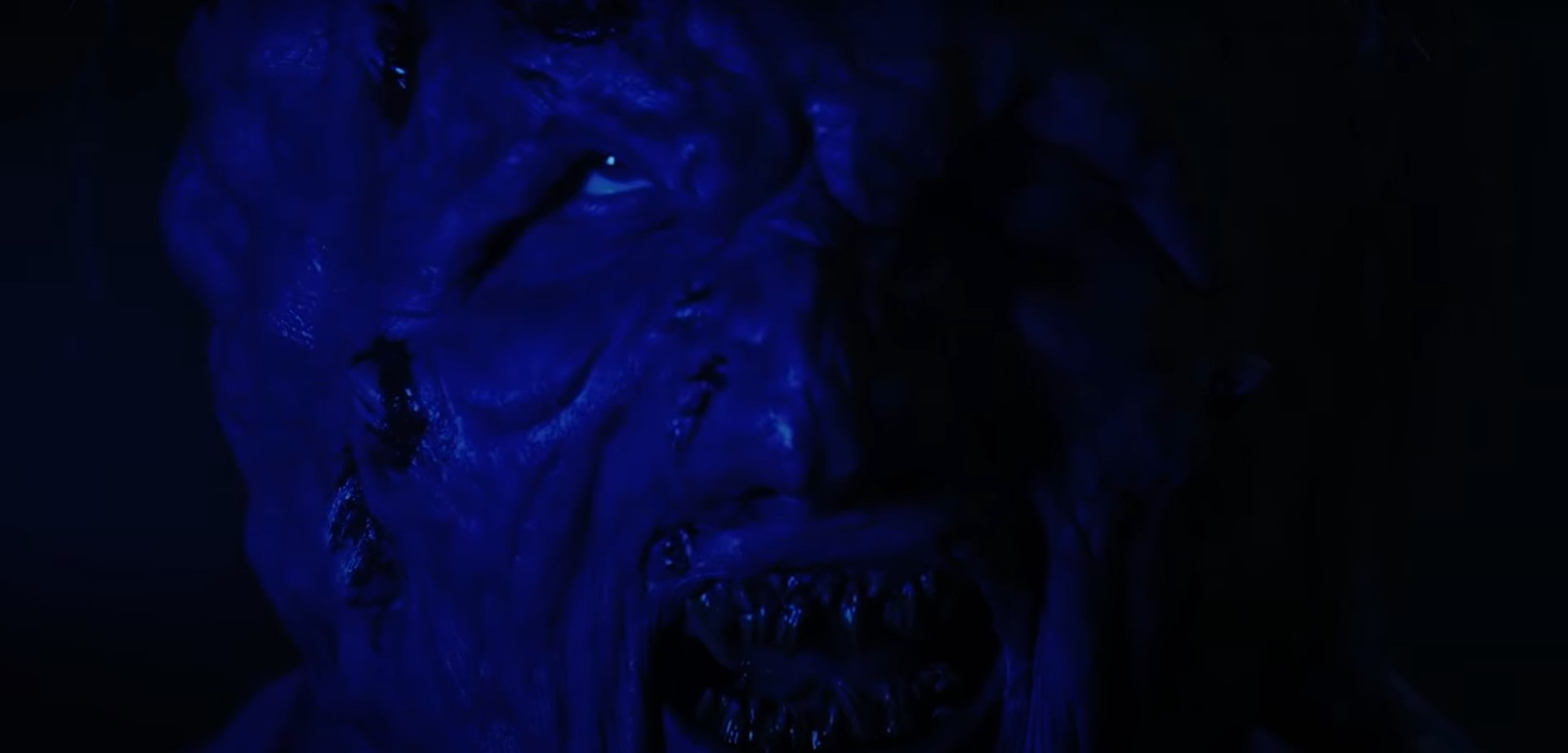
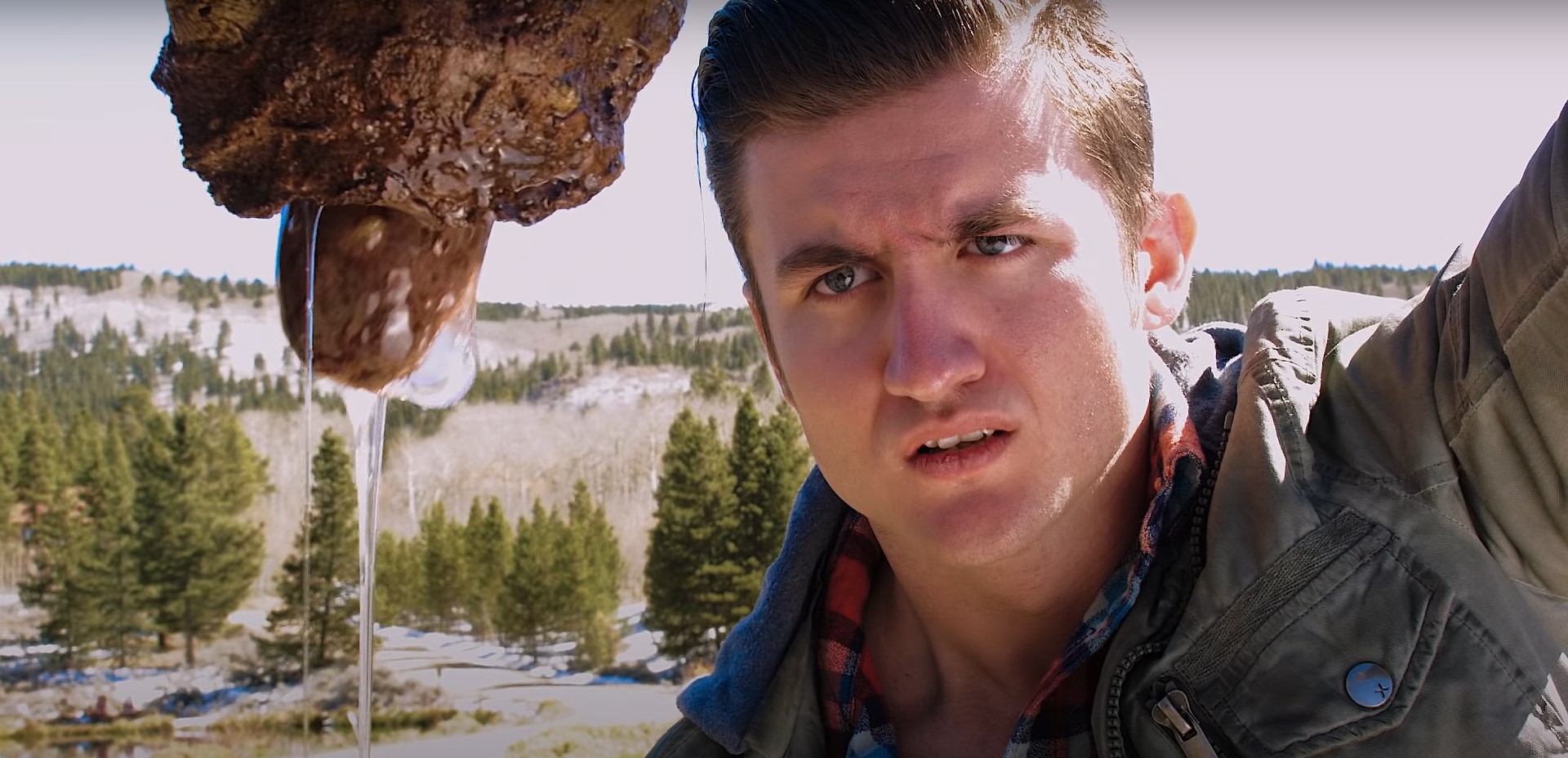
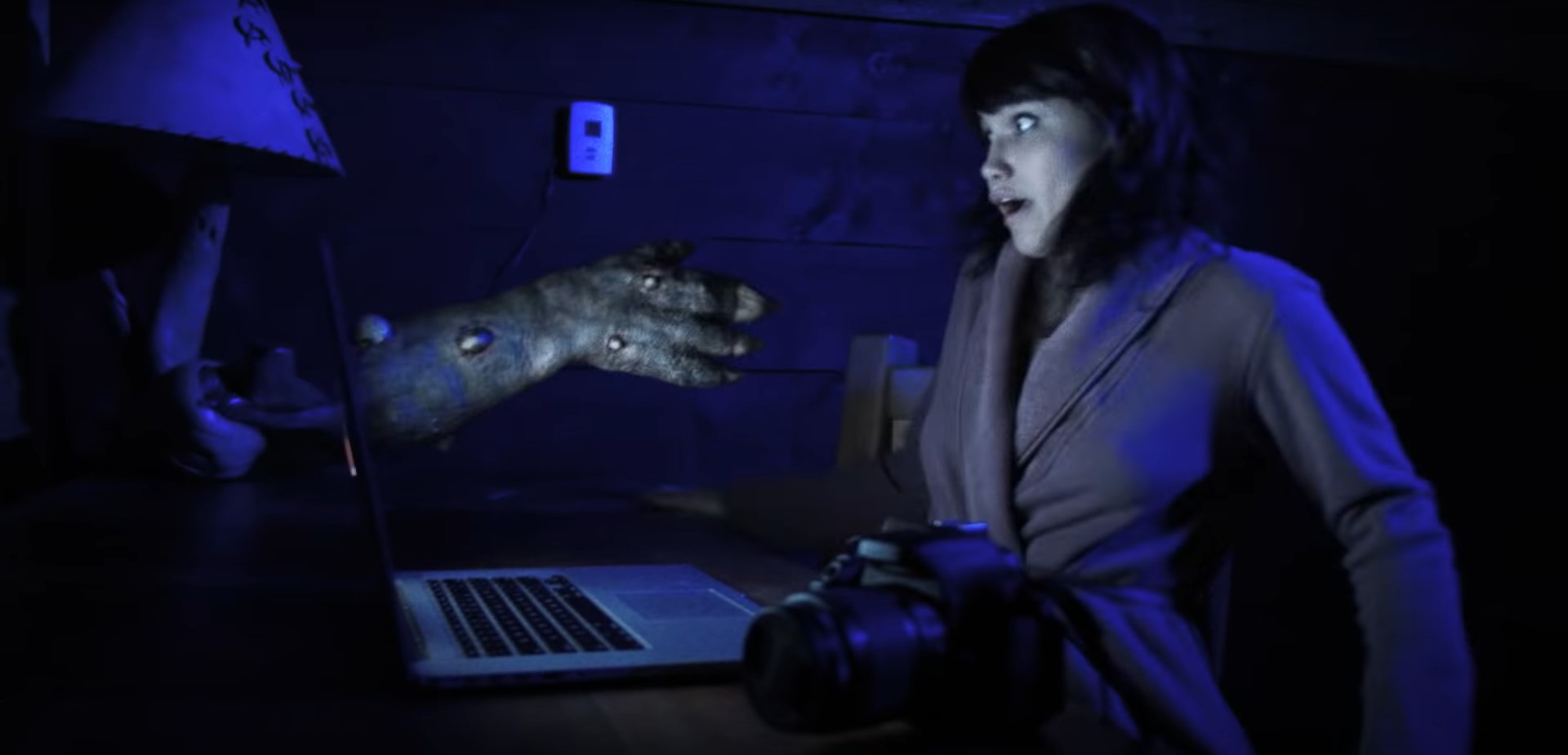
If you have already viewed Austin Snell’s “Exposure” then you likely know that the title is entangled in a double meaning. Perhaps even a triple meaning. Mountainous woods surrounded by frigid air with little-to-no help in sight leads to the vulnerability against the natural elements. In this case, the evil is the element, an unnatural one, that has laid claim to the area and sought the generational organic matter of Owen and Myra for its vile purposes – to spread its wickedness through the veins and mutate its victim into a hideous, baleful beast with a mind to match. The third meaning is more metaphorical as the term exposure can also be defined as the revelation of a typically bad thing that wasn’t clear before. In the film, Owen and Myra are going through a tough period in their romance with one of the inimical causes is Owen’s explosive and hurtful anger. Slithers of his masked morose behavior bubble to the surface in a motif view of just why they need to sort out the turbulent present in order for their possible future to resemble their merry past. The flashback story about Owen’s grandparents shed some light that what Owen may be going through is inborn, hereditary, and unchangeable; Owen’s reason and love mutates toward a gradual descent into monstrous behavior and that’s what the evil symbolically represents. Snell just happens to spin genuine relationship woes into an emblematic story with campy practical creature feature prosthetics and makeup. What most will dislike about “Exposure” is Snell’s true indie, natural approach to the special features that relies heavy on the cheesy, rubbery prosthetics and tangible tube and rod special effects without a lick of visual imagery for a smoothed over appearance. I applaud Snell for his raw, if not antiquated, choice that nods the throwbacks in the absence of contemporary conveniences.

For the first time on home video, “Exposure” makes a Blu-ray debut courtesy of Scream Team Releasing and distributed by MVD Visual. The not rated, NTSC region free, AVC encoded Blu-ray is presented in a widescreen 16X9 (1.78:1) aspect ratio. The 1080p, high-definition resolution looks pretty good and detailed, despite the heavy blue tint and gels, with negligible compression issues, especially with the heavy use of fog machine and a number of night scenes that don’t display noticeable banding or fuzzy/blotchy pixelation. The English language PCM 2.0 stereo audio provides a lossy amplitude that’s definitively detrimental to “Exposure’s” teetering success with audiences and the tracks don’t punch like that should for an atmospheric creature feature. The dialogue also sounds a bit boxy and artificial at times but, nonetheless, the dialogue track is still clear and discernible. Special features include cast and crew audio commentaries, a quick glimpse featurette into the behind-the-scenes of the special features, production stills, theatrical trailer, and retro VHS trailer. The physical Blu-snap case comes with reversible cover art, which, if you ask me, the secondary cover is the best with the illustrated, shadowy monster looming over a brightly lit heroine carrying a flashlight and a small axe. “Exposure’s” tribute veneer to the 80’s creature feature is spectacular without a doubt but lacks the energy to fully come to terms with its theme that’s become caught in the throes of a throwback rather than in the throes of relationship reconciling.

Get exposed ot “Exposure” on Blu-ray at Amazon.com!

This is One Evil Pussy! “Hell’s Kitty” review!


A Hollywood screenwriter named Nicholas owns a very special household feline. Angel, his Cat, has a unique relationship with her owner Nicholas. Yet, their unbreakable bond has put a severe damper on Nicholas’s intimacy with women as Angel slaughters any and all who becomes close with her beloved human. When Nicholas finally catches wind of the reason behind his love life woes and learns that Angel is actually possessed by an obsessive and dangerous demon, he and his friends Adam, whose also his downstairs neighbor in the apartment complex, seek to exorcise Angel back to being a nice kitty, but all who’ve challenged Angel thus far have been unlucky enough to be scratched to death. A medium, two priests, and even a cat therapist haven’t seem to help Nicholas through the bombardment of weird dreams and death that surround him in his lonely and tiny one bedroom apartment.

Cat lovers beware! “Hell’s Kitty” is purring up your leg to claw you in this new horror-comedy by writer-director Nicholas Tana. If you had thought cats were already contemptible enough to begin with then sit down in your air freshening kitty litter and get a can of Friskies out because you’re about to take a 666 ride with this demon kitty. “Hell’s Kitty” is original a web series created by Tana that began all the way back from 2011 to 2015 and, since then, has been immensely popular through the inter-webs with the extra special casts of genre vets ranging from “The Hills Have Eyes'” Michael Berryman to “The Fog’s” Andrienne Barbeau. From the web series, the episodes were pieced together, forming one hairball adventure of Nicholas and his demon cat, Angel.

Aforementioned, Nicholas Tana headlines as himself because, essentially, “Hell’s Kitty” is based off true events of his turmoiled love life. Series regulars also become essential players in the film, such as Nicholas’s downstairs loafing neighbor and best friend Adam (Adam Rucho), Lisa Graves (Lisa Younger of “Cold Creepy Feelings”), and Dr. Laurie Strodes (Nina Kate of “Snake Club: Revenge of the Snake Women”). Then, there’s a slew of special guests that, at times, pay homage to the works that made them household names in horror or relating genres. Special guests that include “Children of the Corn’s” John Franklin and Courtney Gains semi-reprising their roles as Isaiah and Mordicia. Lynn Lowry (“The Crazies”), Doug Jones (“The Shape of Water”), Bill Oberst Jr. (“Coyote”), Kelli Maroney (“Night of the Comet”), Dale Midkiff (“Pet Sematary”), Lee Meriweather (Catwoman from “Batman” television series), Victoria De Mare (“Killjoy” franchise), and porn star goddess, and legend, Nina Hartley (“Pleasure Maze”)! That’s one heavy-hitting lineup! As a cherry on top, even a Killer Klown, you know, the ones from Outer Space, made an appearance!

If a viewer didn’t know of or research into “Hell’s Kitty” web series past, the thought of low-budget junk just might scroll across a judgmental mindset. Let’s be honest for a second; “Hell’s Kitty” is grade-A camp with schlocky special effects and the editing quality of a ramshackle shackled ram. Along with the unique cast being intertwined into the story, other aspects of the Frankenstein-glued together film, such as the sharp pivoting subplots, stir up Nicholas ever so chaotic life into a new and interesting fold. From his fruitless sex life with various attractive women to the friend who always makes himself welcome in Nicholas’s apartment, Nicholas only has one consistent thing in his life and that is his relationship with the cat from hell and that journey is explored from episode-to-episode that climaxes with an ultra-drag musical rendition of something out of the “Birdcage.” Another quality to watch for, and enjoy, are the homages to fan favorites like “Children of the Corn” and “Killer Klowns From Outer Space” as mentioned before, “The Exorcist,” and “Psycho.”

MVDVisual and Wild Eye Releasing presents the Smart Media LLC,. production of “Hell Kitty,” as a whole, on DVD home video that’s visually subpar when considering the quality. The low bitrate crudely displays blotchy image quality, leaving details to the waist side. The 5.1 surround sound is the best attribute to the DVD with clear dialogue and a modest soundtrack. There are no extras included aside for the film’s trailer. While technically incompetent, “Hell’s Kitty” meows murderously onto DVD in a cultivation of cult actors and hellacious comedy by writer-director Nicholas Tana that does sometimes feel rehashed or borrowed from previous films, but the quirky evil pet element gnaws on an inner layer to be enjoyed and enthralled in a day-and-a-life of one man’s skewed, if not deranged, version of events of a lackluster romantic lifestyle blamed toward one jealous feline.

Add “Hell’s Kitty” to your collection!

A Lonely Mind Plays Evil Tricks. “Visitors” review!


Yachtman Georgia Perry aims to be a part of the best of the best by joining a handful of women who’ve sailed around the world. The rules are simple: don’t step on land, don’t let anyone step on your boat, and don’t turn on your outboard motor. As Perry heads out into the open ocean, the 25-year-old carries with her a burden of lifetime baggage stemming from her mother’s acute depression and gruesome suicide, her father’s accident and deteriorating health, and the bond between her and her boyfriend Luke coming unraveled. Combine all that weight with complete isolation, loneliness, and no wind to push her sails, Georgia quickly spirals downward into a turbulent state with her only traveling companion being her cat with whom she has conversations on her becalmed sloop. All her fears come to fruition, blurring the line between reality and disturbing fantasy that threatens her voyage and, maybe, even her life.

Bayside Pictures presents “Visitors,” the last helmed feature by the late Richard Franklin of “Psycho II” and “F/X2” fame. “Razorback” writer Everett De Roche penned the 2003 psychological thriller and is able to conjure out some wicked mind buckling material of a woman subjected to cabin fever in the form of a volatile, non-linear story. Franklin adds his two-cent charm with impressive visual sets and effects from the early turn of the century, implementing CGI where appropriate, being practical when deemed, and, by golly, the effects resulted didn’t come out too shabby. The ocean has always been beautiful, yet terrifying mystery that has yet to be fully explored, and Franklin’s able to capture the ominous anomaly that associates with the deep blue sea under an overwhelming guise of mental health and severe isolated confinement.

Before she wandered into “Silent Hill,” but after becoming forsaken in “Pitch Black,” Radha Mitchell showed strength in solitary by playing the headstrong, nautically ambitious sailor, Georgia Perry. Mitchell, who was slightly older than her 25-year-old character, fabricates a troubled young woman willing to risk it all, even her life, even if it meant to leave to escape all her woes and that she holds dear at home. The “Rogue” and “The Crazies” remake actress from Melbourne has a sensationalized and systematic dynamic with her on-screen mother, played by the late Susannah York, in what’s considered to be a disturbing role of manipulative motherhood that forced Georgia to be extremely close and clingy to her endearing father, an underrated role bestowed upon Ray Barrett. A young and upcoming Dominic Purcell (“Blade: Trinity” and “Primeval”) costars as Georgia’s lover and business manager who may or may not have other underlying intentions with Georgia’s sponsors. Appearing never together and putting Mitchell at the epicenter of their lives, the foursome played their roles beautifully by stretching the limits of reality without being overly absurd to the point of being unbecoming of a thriller.

By no means is “Visitors” a woman versus nature premise. Yes, Georgia faces any elements that would plague any sailor who ventured into the ocean alone, but nature was only accessorial. “Visitors,” for the sake of being funny, is more of a film about a young girl embarking on a journey of self discovery. Georgia must get away from negativity that has been eating at her zealous spirit ever since the terrible childhood accident that had crippled her father and destroyed her parents’ marriage. Her embattled mother’s constant belittling, berating, and blaming is the brunt of that that has been burdening. At sea, Georgia battles her onshore demons, which also includes her father’s failing health and her failing relationship with Luke, and coinciding is her ever present looming and underlying fears that lurk out into manifestation, or a visitation if you will, during severe cabin fever. The trip around the world won’t kill her, but her inner demons just might which begs the question if “Visitors” is more of a mental health film and the answer is a firm yes without salty doubt.

Umbrella Entertainment releases “Visitors” onto a region 4 home entertainment DVD. The DVD is beyond an upgrade from it’s region 1 counterpart in the image and audio departments. The anamorphic widescreen, 2.35:1 aspect ratio, renders a cleaner image with slightly more natural color tone as well as offering more film flesh on either side from the 35mm negative. The English Dolby 5.1 audio track offers a range of diversity. The dialogue is clear and fine, the ambient track syncs with ample depth, and the brooding and perilous soundtrack from composer Nerida Tyson-Chew (“Anacondas: The Hunt for the Blood Orchid”) provides a delectable varied score to Georgia’s though process. The extras are thin, not much different from the Stateside release, including a photo gallery, cast and crew bios, and the Palace Film’s theatrical trailer. Considered widely as an Australian ozploitation film, “Visitors” is deep-seeded, mental trench warfare on the high seas set on a course of psychological doom. A fine film for being Richard Franklin’s last hurrah.

Get Video Nasty Evil With “I Drink Your Blood” review!


A pledge group of amateur, hippie Satanists on a LSD-induced drug trip have their nationwide havoc reeking voyage come to a screeching halt when their dilapidated van breaks down at an equally dilapidated small quarry town with an isolated population of 40 residents. Squatting in a vacant hotel, Horace, the clique’s leader, dangerously lets his followers indulge in their whims while under the powerful hallucinogen. Their brutal run in with a local girl causes a stir of attempted reprisal amongst the girl’s family, especially with her grandfather who aims to remove the hippies from the area, but when the elderly man is beaten up and given the a taste of LSD, a whole new can of meat pies is opened up! Looking for retaliation for his grandfather’s battering, the grandson withdraws blood from a rabid dog he killed earlier in the day and spikes the town bakery’s meat pies that were to be specifically purchased by Horace’s gang. The combination of rabies and LSD turns the deranged Satanist into foaming at the mouth and infectious killing machines set loose amid the town’s 40 person population.

Let it be known that Satan was an acidhead. That shocking phrase serves as a prelude of the horrible acts to come in David Durston’s “I Drink Your Blood.” The 1970 Jerry Gross produced exploitation and infected horror video nasty, notoriously labeled an X rating solely for the graphic violence, is a quintessential staple of Americana horror. Shot in upstate New York and based off true, and disturbing, events, Durston’s written and directed feature is a horrific tale harnessing every unspeakable evil in the unholy book: rape, drugs, murder, abortion, promiscuity, cannibalism and even touches a little upon racism. Durston flaunts a scattered-brain and raw edit that fluently rides along with the script’s crazed atrocities.

“I Drink Your Blood” never cashes in on one headlining actor to fulfill a star lead; instead, calculated characters fill the void where needed, an endearing homage attested by the structures invested by George Romero who used a similar blueprint for his pioneering, black and white horror classic “Night of the Living Dead.” Bhaskar, aka Bhaskar Roy Chowdhury, tops the credit list. The India born actor stars as the sadistic Satanist leader Horace, one of the handful of ethnic roles whose character background mingles more on the Native American side. Every so often, Bhaskar’s native accent filters through, but the actor’s devilishly brilliant performance reassures a radically raw and physical undertaking that forgiveness for such a small concern is automatically defensible. Other prominent roles were awarded to John Damon (“Blue Sextet”), George Patterson (“God Told Me To”), Rhonda Fultz, Arlene Farber (“The French Connection”), Iris Brooks, Richard Bowler, and a young Riley Mills has the rabies-revenger Peter Banner. However, another cast member, in a minor, less dialogue role, has overshadowed many of her costars in light of her legacy since then. Lynn Lowry, known for her role in George A. Romero’s “The Crazies” and more recently in Debbie Rochon’s directed exploitation film “Model Hunger” that was reviewed here at Its Bloggin’ Evil, plays a mute hippie turned rabid killer in a memorable video nasty-warranted scene involving a, then, antique electric knife, like the ones you plug into the wall.

In the glory of “I Drink Your Blood’s” sickest and most stunning special effects that include the poignantly severed limbs and heads of likable characters, a synthesizing score also gnaws at your gut-riddled nerves. During intense moments, harmless butterflies fluttering against your stomach’s inner layer, tickling your core’s coy innocence, violently alter through a bone-chilling metamorphosis, evolving into gut-busting vampire bats with razor sharp talons and flesh ripping fangs. Your whole whitewashed body will clench during Clay Pitt’s one of a kind visceral score, pitched in an ear piercing vortex during high anxiety segments such as when a diseased oppressed Horace and a shaken dam worker are toe-to-toe in a deadly standoff in the hotel’s attic. The jarring soundtrack pulses up until the end which stands as my only gripe for Durston’s film. The climatic ending has it’s formidable bubble popped when the tense scene immediate concludes while obvious questions still remain, such as what happened to Carrie, Lynn Lowry’s character, that goes unexplained?

Australian EX Films presents a monster of a high definition bundle release for David E. Durston’s “I Drink Your Blood” that includes two Blu-ray discs bundled with a VHS clamshell of the film. Inside a reversible artwork case, the first disc is an all region BD50 that stuns in a vivid 1080p in an 1.66:1 aspect ratio. Image quality maxes out with vibrant blues, yellows, and, especially, blood red, your three main colors in technicolor. The second disc gets even better with two bonus films, Del Tenney’s 1964 usual associated doubled bill feature “I Eat Your Skin” and David Durston’s 1969 erotic “Blue Sextet.” Over the course of the two Blu-ray discs, there are a slew of extras including a commentary by David Durrston and the late Bhaskar Roy Chowdhury, four never before seen scenes, video interviews with Lynn Lowry, Tyde Kierney, and Jack Damon, along with stills, poster, and home video art. You’ll also get rare footage of Bhaskar performing “The Evil King Cobra Dance”, the original trailer with two radio segments, and much, much more. Dolby Digital two-channel track vibrates constantly with forefront dialogue, hardly any disruptive damage, and well balanced levels amongst all tracks. The limited edition bundle includes a PAL formatted cassette of the original double billed films, as aforementioned, inside a reversible artwork housed clamshell. And that’s not all! Lastly, this bundle includes a Horror Hypo Needle and LSD Blotter Art tabs, featuring the artwork from “I Drink Your Blood.” Check out the image below to get an inside look. Even though “I Drink Your Blood” beats around the bush with social depravities such as gangbangs, drugs, and a quick stint of Satanic activity, this overall mega fan package from EX Films is a must own for the true video nasty collector or aggregate aficionados of unhinged horror.

BUY YOUR EX FILMS VHS BUNDLE TODAY! HURRY BEFORE THIS LIMITED EDITION SET IS ALL GONE!