Pinksploitation EVIL is Transgressional Passion! “Love and Crime” reviewed! (88 Films / Limited Edition Blu-ray)

Limited Edition and Numbered Blu-ray / DVD Set Available at Amazon!

The dead body of a young woman arrives at pathology for post-mortem autopsy.  A victim of a heinous crime, the bare corpse already informs the head pathologist of sexual activity before, or after, death because of the fresh semen that’s inside her.  As he toils over her to open the chest, separate the ribs, and get a good look inside to see how and why she perished, the pathologist remains in disbelief that the semen inside her, inside his lifeless wife before him on the cold medical table and under the bright lights, is not his own.  Digging deeper into how someone could kill his beloved wife, the researcher in him hits the books, selecting and scouring through records of similar cases of murderers and rapists from over the years.  Each one under different circumstances concludes in a sentence that reflects the person they have become.  Inside the mind of a killer is a long hard look at ourselves in how far we go for treasure, love, and to quench our insanity. 

“Love and Crime,” or officially known under the Japanese title as “Meiji Taishô Shôwa: Ryôki onna hanzai-shi” aka “Showa Era:  History of Bizarre Female Crimes,” is the Japanese anthology from 1969 that pictorializes true crime narratives of mostly women transgressors, as the title suggests.  Yet, the Teruo Ishii helmed anthology is not entirely female perpetrator centric as the anthology jumps ship briefly to explore crimes against female victims for a crossover, comparative distinction.  Ishii, who played his hand in producing late 1960s sexploitation and violence by directing films in Toei Company’s pinku series that showcased the two subcategories, such as “Orgies of Edo,” “Shogun’s Joy of Torture,” “Inferno of Torture, and among many other titles with similar salaciousness, was thrust into “Love and Crime’s” consolidating short film escapade with a wraparound monologuing narrative that was just as intriguing as the sordid stories themselves.  Shigenu Okada produces “Love and Crime” as well as many of the films aforementioned.

Yoshida Teruo kicks off the wraparound with a mater-of-fact narration running through the head of Murase, the anatomist examining his dead wife’s corpse (Ritsuko Nakamura), in what would be the grisliest part of the anthology, especially when that chest snaps during separation.  Having worked with Ishii previously with “Abashiri Bangaichi,” a crime thriller about a reminiscing criminal aimed to reform himself, Teruo only worked a short stint with the Toei Company but his time spent on such films like “Crime and Love” discerns a piece of the dramatic devotion that would be otherwise missing in these purely exploitative films.  As Marase puts nose to book, he unearths and internally narrates the start of his true crime story journey research, beginning with the cut-throating scheme of the Toyokaku Inn case.  Chiyo (Aoi Mitsuko, “Melancholy Flesh Business:  Sensuous Zone”) and Kosuke (Kenjire Ishiyama, “Kwaiden”) own and run the humble Toyokaku Inn but when Chiyo seeks to changes businesses and cut ties with her philandering husband Kusuke, a treacherous and murderous plot against her is formed between Kusuke, spearheaded by assistant manager Kinue Munekata (Rika Fujie, “Outlaw:  Heartless”), and executed by maintenance man Shibuya (Takashi Fujiki, “Shin Godzlilla”).  From there, the film transitions to other female intertwined crime tales of Sada Abe, a woman who would kill her lover because of love and insistence during alternative sex, the case of Kunihiko Kodaire, a serial rapist and murderer spilling tricks of his trade to authorities, and the last known female murderer executed by katana beheading, Takahashi Oden, for poisoning her husband.  Each performance plays into the intricate patterns described by their true life counterparts with either a chilling contentment in taking a life or hurdling the obstacles inward to do the unpleasantries of what is asked of them  Circumstantial opportunities and conniving plots bury bodies six-feet under in a multifacted range of expression, greed, lust, and all the other deadly sins that plague mortals right to the very end.  “Crime and Love” fill out the pinksploitation anthology with Yukie Kagawa (“Female Prisoner Scorpion:  Jailhouse 41”), Eiji Wakasug (“Inferno of Torture”), Tomoo Koike, Tatsumi Hijikata (“Orgies of Edo”), Yumi Teruko (“Horrors of Malformed Men”), and a special appearance by the actual, reclusive, convicted murderer Abe Sada herself, shot from a distance while being interviewed by Yoshida Teruo.

As anthologies go, especially one rare as true-life crime and love, or in this case sexploitation,” “Love and Crime” has an unsystematic design when it comes to the stories and how they relate to the wraparound narrative.  For starters, not all the bizarre crimes are female centric.  The story of Kodaire revolves about a male serial rapist and murderer divulging his collected anecdotes to investigating confessors and are depicted in monochromatic flashback, the same as his present yarn telling scenes.  Though the case involves multiple women victims, Kodaire greatly stands out amongst the compilation of crimes for the very fact he is a man in an anthology literally entitled History of “Bizarre Female Crimes.”  Was the case of Kordaire a gap filler? Perhaps the uniquity of Japanese serial killers is so low and rare in their culture and history that this particular short story had enough estrogenic blood spilled it avoided the short list cut.  Each story’s relationship toward the wraparound is also thin as neither story suggests a same or remotely similar pattern to death of Maruse’s wife in what is more of a random-generator selection of stories read and worked through for better understanding of the killer female psyche rather than what makes the male killer tick to hit-and-run his wife.

“Love and Crime” is 88 Films’ answer to opening the door of the wonderfully violent and sexually charged world of pinksploitation.  A limited edition and numbered dual-format, AVC encoded, 1080p, 50-gigabye Blu-ray and standard definition, MPEG encoded, dual-layered DVD, set presents the 1969 film in the original aspect ratio of 2.35:1.  With various stylistic color grading outfits, such as grayscale image for the Kadaire case story or the last case of Takahashi Oden that’s starkly cold rooted in blue and green.  There’s not a lot of mention of what kind of work went into restoration but the print has kept in excellent condition with age or damage wear kept to a minimum with nominal vertical scratching and dust speckling.  Colors appear to be handled with true reproduction of the dyed processing, rich and bold leaves no room of ambiguity of image or object representation.  Skin tones appear natural that do flirt a lighter shade of orange at times, textures are coarse and greatly apparent, even in the black-and-white story, and there’s tremendous environment or background distinction that creates an organic depth between character and their setting rather than them being crushed into an all-in-one image.  The encoded audio is the original Japanese language LPCM mono 2.0 that captures the soothing project whir during post ADR.  Dialogue retains prominence with a clean enough clarity albeit some negligible hissing sporadic throughout.  Ambience is not as enlivened within what’s mostly an isolated dialogue mix but is there to complement to composition when necessary, such as the blustery snowfall during the execution that sets a tumultuous tone of desperation and severity.  The improved English subtitles are timely synched and error-free.  Special features include an audio commentary by the 88 Film’s Japanarchy release fire starter and Midnight Eye’s co-editor Jasper Sharp and Fangoria staff writer Amber T., a brand-new film introduction and conversation by film critic and journalist Mark Schilling, a still gallery, and trailer. The Obi-striped 88 Films packaging has a very familiar feel to what Radiance Films, another boutique UK label, is doing with their Blu-ray releases nowadays and “Love and Crime” could be confused for a Radiance resemblance, but clear UK Amary has a gorgeous, commissioned, newly designed artwork from Ilan Sheady that brings all the sordid shades of this anthology to life. The cover art is also reviersible with the original Japanese one-sheet. Inside, the Blu-ray and DVD overlap in a dual-disc lock system on the right while the left stashes 15-page black-and-white-and-colored pictured adorned essay by Nathan Stuart prologued with cast, crew, and release acknowledgments and bounded by the same Sheady artwork without the Obi strip obstruction. 88 Films release comes both in region A and B playback, is not rated, and has a runtime of 92-minutes.

Last Rites: “Love and Crime” will be a love-it or hate-it anthology of early pink violence and sexual discordance because of its broad stroke theme but the 88 Films’ limited edition, Japanarchy debut is an exciting and eager look toward the future of the label’s dive into Japan’s exploitational cinema.

Limited Edition and Numbered Blu-ray / DVD Set Available at Amazon!

Feminism’s EVIL Plan Thwarted by CIA Hunk in “The Million Eyes of Sumuru” reviewed! (Blue Underground / Extended Edition 4K UHD and Blu-ray)

Sumuru’s Eyes Are Everywhere, Even Here on Amazon! Purchase the 4K and Standard Blu-ray Set Here!

Tall, handsome, and witty CIA agent Nick West is about to go on a much-needed vacation.  As soon as he steps outside of headquarters, he’s approached by British agent Colonel Baisbrook to cash in a favor the CIA owes the British government.  Unable to refuse, West agrees to investigate the assassination plot against one President Boong of an unnamed East Asian country.  The assassins are nothing short of extraordinary as a bunch of femme fatale infiltrators have put themselves in positions of power all over the globe as wives and girlfriends of nation leaders and President Boong is the only one that has refused to take the bait.  West and his good friend Tommy Carter find themselves quipping and philandering amongst the most dangerous female-centric organization on the planet, led by the ruthless and beautiful Sumuru.  To protect President Boong, West must become friendly with Sumuru who uses his likeness in a new elimination plot that puts him front, center, and in between saving the world or watch the men become subservient by an ambitious woman seeking world domination.

Double agents.  Foreign places.  Secret lairs.  Suave operatives.  Sexy women.  These descriptors are the very spirit of a James Bond movie.  At the height of the Sean Connery 007 era, plenty of knockoffs were produced to capitalize on the action and sex appeal of martini-drinking covert agent that rules the 1960s.  One of those copies was helmed by Lindsay Shonteff in 1967, titled “The Million Eyes of Sumuru.”  The “Devil Doll” and “Voodoo Blood Bath” director had already an espionage thriller under his directorial belt with “The 2nd Best Secret Agent in the Whole Wide World,” I bet you can guess who the first was during that time.  Kevin Kavanagh pens the script from the original story by legendary B-movie producer Harry Alan Towers (“The Face of Fu Manchu,” “Psycho-Circus”) that would become an incongruously and acerbically witty-tale of pseudo-feminism with hot pursuits, sensual promiscuity, and a dart gun that can turn a person to stone.  Towers also produces “The Million Eyes of Sumuru” under his LLC and filmed in Hong Kong at the Shaw Brothers Studios. 

As Sean Connery heats up the screen with his double 0 escapades through all over the global to thwart the men of evil and with an astounding amount of carbon copy espionage reels rearing to chase the all mighty buck, “The Million Eyes Sumuru” desperately needed a cast to keep afloat in a flooded spy film market.  For the most part, Towers and Shonteff’s cast pull off exactly what the story needed, a caricature of crowning chuckles subdued only by its slivers of spy game ventures.  That’s not to say there’s an abundance of gun play and fight sequences with terrific tussling as “House of 1,000 Doll’s” George Nadar uses his tall stature and ear-to-ear smile to be a lover, not a fighter in the wise-crackin’ American CIA agent Nick West.  West destroys the all-women Sumuru arsenal with just his manliness in a satirical jab at Ian Fleming’s titular protagonist and, for all intent and purposes, it works in the story to see Sumuru’s plans become ruined by not a gun nor a fist but because women in her organization, even Sumuru (Shirley Eaten, “Goldfinger”) herself, throw themselves onto him at critical moments and Nadar’s timing and screen charm laps every second of it.  Frankie Avalon (“Horror House”) and Wilfred Hyde-White (“The Third Man”) play Nick West’s allies as friend Tommy Carter and cavalier British agent Colonel Baisbrook who both play in two totally different capacities.  Tommy Carter equals West witticisms but falls behind as the friend who must journey solo to find West in the middle of Asia while Baisbrook effortlessly shows up in the nick of time to be either a savior or West’s handler with another mission in his pocket for West to reluctantly tackle.  A pair of principals that are held at bay is the beautiful Maria Rohm (“99 Women”) and the eccentric Klaus Kinski (“Nosferatu the Vampyre”) whose swift takes leave more to be desired as Rohm becomes weak-kneed on her Sumuru femme fatale application and Kinski plays drug-addicted, politically incorrect, and perverse president of this untitled Asian country. 

“The Million Eyes of Sumuru” contests to be a smartly funny, exotically set, and action-invested covert operative film of the late 60s, swimming against the current of some of the hard to beats and who have more of a legacy in the subgenre.  While “The Million Eyes of Sumuru might be more Swinging 60’s with cavalierism rather than sophistication and intent, the production value could rival the best Bond film of it’s time but it’s the stunts that drive this one down below the bar as Shonteff looks toward George Nadar’s quick wit and budding personality to be the masculine sex symbol that drives the rabid female race to their supposed manhating knees.  Its quite comical to see a firm line of feminism course through the plot’s veins, a plot where deadly women penetrate and subvert men world leaders only to become a slave to West’s dunce charm and attractive appearance.  West really isn’t the smartest of secret agents as he’s not trying to evade capture with rapid haste or fool anybody of his intentions; instead, he’s just mildly clever with broad shoulders and, apparently, that’s what women droll over instead of carrying out their loyalty pact of a global coup d’etat.   

Swinging onto the 4k Ultra HD Blu-ray bandwagon is the Blue Underground’s 2-Disc combo set UHD and Standard Blu-ray release of “The Million Eyes of Sumuro.”  The HEVC encoded, 2164p resolution, BD66 has picture quality absolution with a stunning brand-new 4K restoration transfer from the original 35mm camera negative thought originally lost.  The rich and colorful picture hits all the important markers with balanced film density that diffuses the hues nicely into every aspect of depth and focus, from the background to the foreground.  This goes for texture too.  No matter where an object lies in the frame, there’s an accurate representation in the reproduction inside the immense range of color schemes, landscapes, and textures.  Delineation is quite pleasing; the close ups of George Nader’s face exhibit ever facial feature with precision without appearing overly bright or smoothed.  The AVC encoded, 1080p resolution, BD50 Blu-ray captures much of the same finer points too on a slimmer pixel count but still denotes Blue Underground’s improved restoration, complete with inky blacks and no compressional misses to sully the quality.  The extended cut adds approx. 10 minutes of additional footage, which in these cases can often be less-than-pristine upon discovery of the elements but the additional scenes are seamlessly blended into previous releases’ runtime, suggesting the print was greatly protected from all harmful exterior factors.  A single channel English DTS-HD mono is the only mix available. Though standard and not as dynamic as more modern audio designs, the uncompressed track provides superb fidelity clearness, cleanliness, and with an even-keeled throughout.  The snappy dialogue shows prominence amongst a wide-berth range of surrounding elements.  There’s a blend of ADR and live recording, much to the chagrin of the Asian actors who have their English post-dubbed with a more accented stereotype.  English SDH are optionally available.  Capacity limitations on the UHD keep disc one to just two audio commentaries:  Film academics David Del Valle and Dan Marino on the first commentary with usual commentary notables Nathaniel Thompson and Troy Howarth on the second.  These commentaries are encoded on the Standard Blu-ray version of the film, accompanied by a new feature-length documentary England’s Unknown Exploitation Film Eccentric:  The Schlock-Cinema Legacy of Lindsay Shonteff that has historian interviewees, such as Kim Newman, discuss the brilliance of Shonteff’s work amongst the espionage thrillers of the time, an exclusive RiffTrax Edition of the film, riffed by Mike Nelson, Bill Corbett, and Kevin Murphy, the theatrical trailer, and the poster and still gallery.  It’s always a pleasure and a thrill to have tactile elements on the Blue Underground O-slips, such as this release with the embossed title overtop and below the memorable packed compositional, illustrated artwork.  The slightly thicker black Amaray casing houses the same artwork with a reverse side of the original Blue Underground DVD artwork.  Each interior side contain each format disc, pressed individual with the same cover arts, with the Blu-ray on the left and the UHD on the right.  Encoded for all region playback, “The Million Eyes of Sumuru” now clocks in at 89 minutes and is not rated.

Last Rites: “The Million Eyes of Sumuru” has a million positives – a farce of the espionage subgenre, cheekily acted, exotic locations, and an extended, clean-cut version from Blue Underground – to name a few that quickly surmises the Lindsay Shonteff film to be the golden gun of his repertoire.

Sumuru’s Eyes Are Everywhere, Even Here on Amazon! Purchase the 4K and Standard Blu-ray Set Here!

Weak Meekness Leads to One’s Own EVIL Destruction. “Catacombs” reviewed! (Imprint / Blu-ray)

Own Your Copy of Imprint’s “Catacombs” on Blu-ray!

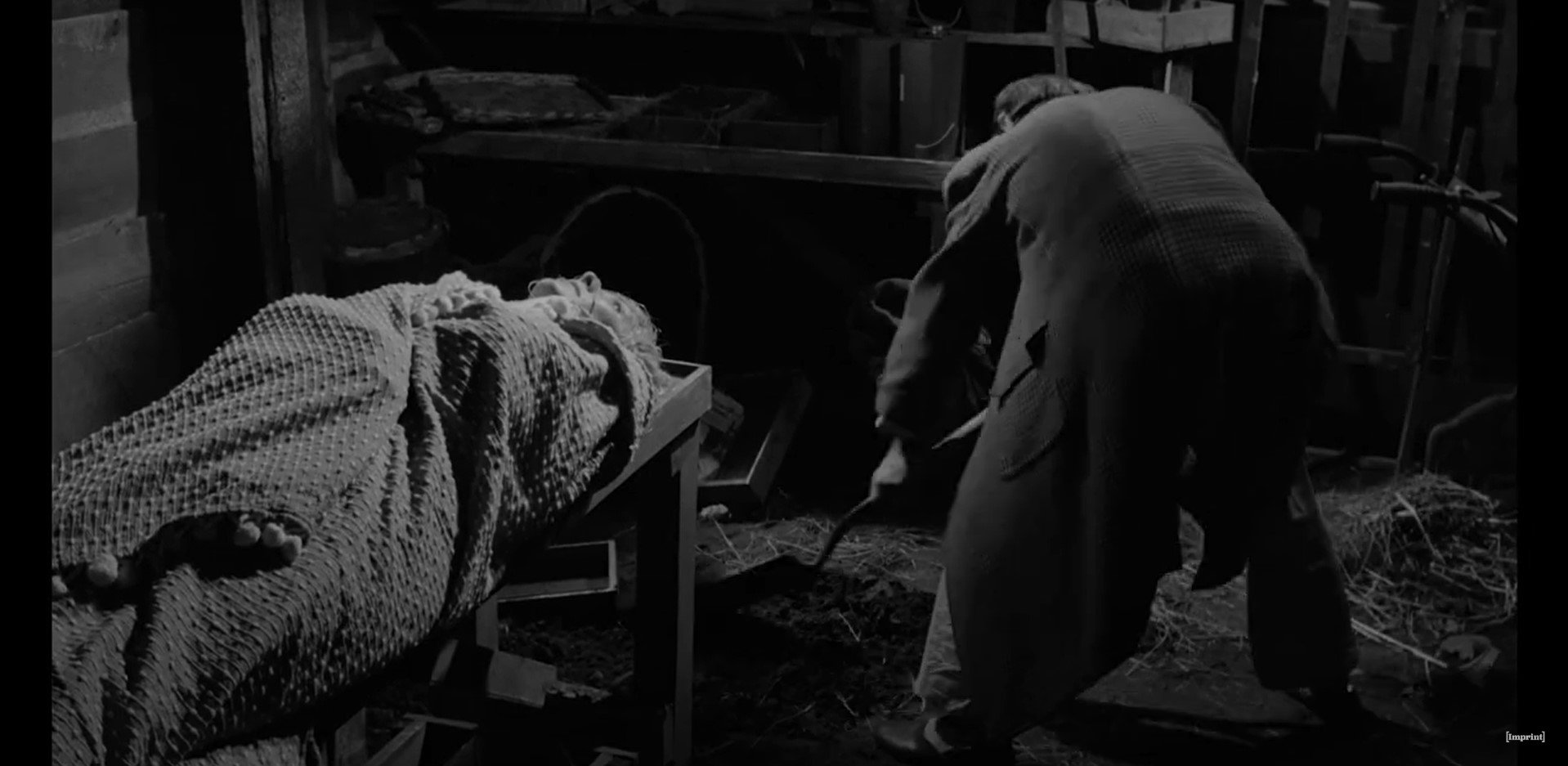
Ellen Garth, a strong willed and wealthy but physically afflicted businesswoman devotes her all her love to an enervated doormat of a husband, Raymond.  When Ellen’s beautiful young niece, Alice, returns to London from Paris after a year abroad, Raymond is smitten by her flirtations for older men and strikes up an affair behind his very perceptive and sly wife’s back who catches them in each other’s embrace.  Tired of being a slave to his wife’s controlling behavior and wanting to be free to court Alice, Raymond kills Ellen and buries her in the potting shed behind their honeymoon house in a plot conceived with Ellen’s right-hand secretary and former con, Dick Corbett.  Believing he’s free of her and having been willed her fortune to share with Alice, Raymond suddenly suspects, after a series of strange events, that he’s being haunted by Ellen’s ghost, or even worse, the undead Ellen herself. 

Black and while horror from half a century or more ago always leaves a lasting impression that terror and suspense can be created by virtually story and acting alone instead of a heavily reliance of special effects and visceral coloring, such as with gore or grotesqueness of the unfathomable creature.  The British film “Catacombs,” or otherwise known as “The Woman Who Wouldn’t Die” in America, is one of those fear manufacturing films generated by pure acting talent and the managing cleverness behind the camera.  The 1965 film is directed by “The Oblong Box” and “Scream and Scream Again” director Gordon Hessler with American screenwriter Daniel Mainwaring (“Invasion of the Body Snatchers”) penning the script based off an American novelist Jay Bennett’s novel of the same UK title.  Shepperton Studios served as house of operations for the Parsons-McCallum production under Neil McCallum and Jack Parsons and distributed by the BLF, British Lion Films.

There’s no such thing as wasted parts or throwaway performances in Hessler’s murderous-revenge haunt with precision-acute actors and actresses chin deep in their characters’ cruelty, callousness, conformity, and control.  Twists and tension-riddle rods help elevate this nearly 60-year-old film to refrain from aging poorly.  Gary Merrill, former husband of silverscreen actress Bette Davis and star of “All About Eve,” plays the meek husband Raymond wed into money but at the cost of his manhood.  Merrill plays convincingly into Raymond’s submissive, passive nature under the more dominant but fair and kind mogul lady Ellen Garth, a hip-afflicted women that doesn’t feel the ailment impede her wealth or attitude in life by way of British actress Georgina Cookson.  In the mix is Ellen and Raymond’s parentless niece Alice who has returned from her studies in Paris seemingly transfigured from a chubby child to a beautiful lady.  Jane Merrow, who co-headlines “Catacombs” with Merrill, finds her stride as the elder-entangling Alice secretly at-odds with her aunt by seducing Raymond behind her back.  Rounding out the principal foursome is Neil McCallum (“Dr. Terror’s House of Horrors’) as Ellen Garth’s sneaky secretary Dick Corbett who has a façade of a hard worker, but Corbett can’t keep up with boss’s demanding energy and is itching to subvert her.  When the story’s peak turning point hits, the expectation of character change recedes back to status quo as if Ellen’s death changed nothing other than open the door of opportunity for Raymond and Alice to connect without concern.  Yet, that inkling of shame, guilt, and fear, mixed under a plot of deception and murder, has the reverse effect of a now burdenless happiness, producing a very little capricious life-change, especially in Raymond who is still as amiable as ever.  “Catacombs’” fills out the intimate cast with Rachel Thomas and Frederick Piper.

The actual use of catacombs, or subterranean burial grounds, has little do in the film other than in its infinitesimal moment of being a key piece of evidence toward something amiss, a tell for foreboding or already doomed health, and serves as one playful, paralleling reason to Ellen’s resurrection, though not reflected in plain sight as playful or parallel by Hessler.  What’s intended the most is building the mysterious dread around Ellen Garth’s return in a semi-gloss gothic polish aimed to crack Raymond and Alice’s psyche in half.  Hessler breeds tension after tension to engulf the characters in an unrelaxing state of disgrace and distrust and what makes the matters worse for Raymond and unscrupulous company is while Ellen Garth may have held all the cards being an authoritative woman of status and wealth, she showed loyalty, humility, and adored her family, friends, and lover despite their flaws and circumstances.  That unjustifiable murder stings audiences the most, a straight shot to the sympathetic heart that creates a need to see those responsible punished by Ellen’s earth-soiled, grave-escaping, dead-cold hands with edge of your seat anticipation.  Is Ellen Supernaturally haunting her killers or is the guilt driving them mad? 

The only way to find out in glorious high-definition is to pick up a copy of Imprint Film’s definitive Blu-ray version of “Catacombs” on an AVC encoded, 1080p, BD50 presented in a 1.66:1 European aspect ratio. The black and white picture receives a 4K scan from the original nitrate negative for its worldwide Blu-ray debt and though not much to mention in regard to colorization and black levels, the monochrome remains sharp at all times in a pristine negative that sees no damage. Usually, black and white can issue fuzziness, heavy grain, and ghosting during spliced cell overlap but this print, or rather this scanned print, looks amazingly fresh, holding patterns and transitioning seamless to the highest of restorative care. The English language is a mix between American and British English encoded with an uncompressed LPCM 2.0 mono, rendering a dialogue centric audio with composter Carlo Martelli brass band that’s minor keys taut tension to swell during the height of suspense. Dialogue is clean and clear with very minimal crackling; there’s no wispy or hissing detected. Although the mono feed vectors flatly, the range surrounding “Catacombs” is vast and timed to tackle distinction between the audio idiosyncrasies. Optional English subtitles are available. Special features include an exclusive feature-length audio commentary with authors Jonathan Rigby (“English Gothic: Classic Horror Cinema 1897-2015”) and Kevin Lyons, a new interview with co-star Jane Merrow on her experiences in “Catacombs” Merrow & Merrill, new interview with continuity supervisor Renee Glynne and sound designer Colin Miller The Glynne-Miller Story, a new interview with composer Carlo Martelli Martelli & Martell, and with a still gallery ending the bonus material. Housed in a Hammer blood red cardboard slipcase designed with a rendition of the original poster, the Imprint release is it’s 317th title. The clear Blu-ray Amaray case is even more colorful with a giallo-colored title and back cover, overtop a frightened scene with stars Merrow and Merrill. The reverse side of the cover has more of the psychotronic photo of Ellen Garth (Georgina Cookson) staring blankly into a pocket mirror to submit herself under a trance. The BD is pressed with the same red coloring and half-woman, half-death figure as the slipcase with no inserts included. One thing I will say on the negative side of the package is that the Amaray case is a bit difficult to extract from the slipcase; you kind of have to shimmy and shake it out enough to pull the case out. The 90-minute feature is unrated and did play on our region free player without having to setup flip to the desired region for playback.

Last Rites: Gorgeously macabre yet classic packaging, Imprint’s Blu-ray release of “Catacombs” is must-own Machiavellian umbra of greed and foul play, a timeless tale yarned to yield a megaton of shadow-lurking, supernatural suspense.

Own Your Copy of Imprint’s “Catacombs” on Blu-ray!

Being Bored at Home Turns into an EVIL Enterprise! “Moonlighting Wives” reviewed! (Dark Force / Blu-ray)

They’re Housewives.  They’re bored.  They’re…”Moonlighting Wives.”  Now Available at Amazon.com!

Unsatisfied with her distressed husband’s meager wage as a third shift switchboard operator, Joan Rand strikes up a new Stenography business to bring in a little extra cash for the household.  When her new boss makes salacious advances toward her, she explores the opportunity of making more money than just on a stenographer’s wage.  Roping in her only contracted typist, Joan begins to bring in beautiful, bored housewives seeking to earn dough no matter how sexually scandalous and instead of perfecting their short hand skills or their ability to read back letters aloud without error, the determined entrepreneur revamps her stenographic business as a front for perfecting prostitution.  Infiltrating her way into every bar, hotel, and country club, even partnering with the country club’s golf pro, Joan’s call girl ring rides a profitable high and expands into new men-oriented territories but how long can the lucrative venture last when two vice cops are inching to bring down the elusive ring and one of her girls become scorned by the affectional eyes of love. 

Sexploitation has come a long way since 1966 when director Joe Sarno helmed the scene-efficient and bored housewife subversion “Moonlighting Wives.”  Before embarking full-fledged into the adult industry, Sarno blazed the trail for the economically friendly dicey skin flicks of the 1960s through the 1970s, retrospectively finding a cult base amongst observers and academics of subversive cinema and underground exploitation. “Bad Girls for Boys” producer Robert M. Moscow serves as associate producer on the Morgan Picture Corporation production, founded by George J. Morgan, producer of “The Thrill Killers” and “The Lemon Grove Kids Meet the Monster.”

Credited as Diane Vivienne, Tammy Latour (“The Naked Fog”) plays the business savvy Mrs. Joan Rand turning her dictation craft as a storefront for a more provocative and promiscuous profession to keep men happy and her pockets plush.   Latour’s a cool and calculating in her performance that makes Mrs. Rand a pragmatic kingpin of her quick-to-success prostitution ring but in doing so with her performance, that is much like everyone else’s in the film denoting a sign of the time period in which the story is constructed, Latour comes off extremely monotone like her large 60’s hairdo houses a little green man at the control of her cerebral center, calling out commands flatly, coldly, and without a slink of emotion behind her absent inflections or thousand yard stares.  Instead, much of the emotion, if any, is produced by her ashamed-driven to alcohol abusing husband and emotionally exploited bored housewife (Gretchen Rudolph, “The Dicktator”) brought to shambles after cheating on her husband and losing her paramour at the same time due to Rand’s scheming into the operational fold to rake in more rakes and cash.  We’re treated to Mr. Rand’s bottoming out as he’s no longer the bread winner and he’s suspicions overwhelm him to drink himself into a stupor.  The emotional pull that the Rand swindled housewife goes through is callously cut deep when her country club lover, Al Jordan (John Aristedes, “My Body Hungers”), becomes in cahoots with Mrs. Rand, taking her own as not only a business partner but a side-by-side lover, and coaxes his former mistress’s desire for him into doing naughty things with other men to keep him out of a deceived lie of debt.  A rollercoaster of fear, doubt, acceptance, and emotional evolution goes to full arc spectrum with the one cog in the machine that ends up breaking down the whole organization into a crumbling heap.  Aforesaid, the other performances don’t stray too far from Tammy Latour’s matter of fact and is more just a sign of the times in which “Moonlighting Wives” is produced, especially on a microbudget as early sexploitation couldn’t break into mainstream or even with welcoming arms in a more accepting niche public as a more right-wing, puritanical society was starting to be on the brink of uninhibited free love model.  “Moonlighting Wives” has a sexploitation friendly cast with June Roberts (“The Pink Pussy:  Where Sin Lives”), Marla Ellis (“Sin in the Suburbs”), Joe Santos (“Flesh and Lace”), and George Winship (“Teenage Gang Debs”).

How does a racy U.S. cinematic story beat the odds of staying out from the sleazy cinemas, like the sheltered exterior and tacky carpeted 42nd Street of the 1980s, and from being blackballed from the blue balled public looking for a little titillating release?  Innuendo in film became a thing of the past once the film boards ruled film nudity was no longer to be considered obscene a few years before 1960 and this opened up an opportunity for filmmakers to tap into the salacious half of the American population, experimenting with primal carnalities depictions that burrowed into the deepest of desires.  Since financing was scarce as the newly appointed sexploitation genre was too much of a risk for return, movies like “Moonlighting Wives” were made for next to nothing and director Joe Sarno quickly became quickly an expert in churning out licentious cinema commodities on a dime at the turn of the decade.  Having completed moderately successful films of this nature with “Warm Nights and Hot Pleasures” and “Pandora and the Magic Box,” Sarno built a rapport with actors and actresses who would return film-after-film.  John Aristedes, Joe Santos, June Roberts, and Tammy Latour, to name drop a few, regularly frequented Sarno’s casting call – and, hopefully, not his casting couch. Much like the rest of the lot, “Moonlighting Wives” serves as a lesson learned, a steep cost if you will, when morals mingle with perversity and blur the lines of right and wrong.  However, these types of films didn’t come tense action either, or rather much of any type of action because of it’s hand-to-mouth (or in related terms – any orifice to mouth) leanness in funds.  Sarno masters the exposition scene with what I like to label as high school sexual education discourse in where talking heads explain in detail every single action and do it in a tone that’s somewhere between mundane and deadpan.  Objectively, “Moonlighting Wives” is a cold-hard look at cause-and-effect with the loosening of standards jeopardizing what’s most dear to you after the deed is done. 

As a 2k restoration from the uncensored 35mm original negative, “Moonlighting Waves” has been paradoxically upgraded by adding back in original content that initially hit by censors with the lost nude scenes, a summation of 5 minutes’ worth of film, has be reclaimed for the Dark Force Entertainment Blu-ray release.  Yet, Dark Force’s release also competes with a Sarno double feature in “The Naked Fog” from Film Movement that was coincides with a similar market date.  Unfortunately, we’ve yet to land our hands on the Film Movement version to compare.  The Dark Force Blu-ray is AVC encoded with high definition 1080p resolution and presented in the letterboxed 1.33:1 aspect ratio. Back cover lists the ratio at 1.33:1 but also list an anamorphic widescreen and while I concur with the anamorphic lens, the presentation is firmly in a square box of 1.33:1.  Prefaced with a black title card warning regarding the additional image quality, more than just the additional footage has weathered under the test time to sometimes appearing more yellowish and with vertical scratch lines and speckled dust. For the most part, the overall image presentation makes the grade with an unimposing, yet steady color grading and most of the frames free from visual blights. If there were any digital enhancements done during the restoration, DNR appears to be the present culprit as facial features often appear too smooth for 35mm stock that should be developed with a fine layer of grain. The English 1.0 audio mix furnishes the appropriate single channel output for an exposition heavy feature. Distinct sound relativity is shot and the Stan Free score is lounge music 101 with rhythmic snare and hi-hat raps but the dialogue fairs rather strongly with forefront, clean, and clear conversing. Film historian Michael Bowen bookends a pair of included special features with an audio commentary track and an on-webcam interview discussing Sarno’s life coursing the newfound sexploitation genre pre his adult industry tenure. Also included is a deleted nude scene that involves no familiar actors from the trunk narrative in a seemingly out of place couple swap of the topless kind. I’m a little taken aback by the loss of some of the special features that were a part of the Alternative Cinema DVD release that are not present here on the Blu-ray, such as the Joe Sarno interview before his death. What’s neat about the physical features of the Dark Force release, aside from the clear Blu-ray snapper, is the retrograded, stark yellow and black, low-key cover art that builds up the hype with exclamational points about how obscene “Moonlighting Wives” is and not recommended it for the modestly shy and most prude moviegoers. The bold marketing attempt really perks up interesting in checking out the title that ultimately finishes with antiquated impressions, but the idea is neat, and the word heavy front cover is very representational of the exposition drenched dialogue in the narrative. Disc art is pressed with a wanted ad for young attractive women, which is also a nice touch. the region free release comes not rated and has a runtime of 86 minutes. Without a doubt scandalous in any decade, “Moonlighting Wives” encapsulates the seedlings of sexploitation with Joe Sarno at the helm of cultivating ripe, round melons out of barely any dirt and succeeding with a lust-heavy pursuit under a profession that now, ironically enough, only exists mainly in law-abiding courtrooms.

They’re Housewives.  They’re bored.  They’re…”Moonlighting Wives.”  Now Available at Amazon.com!

EVIL Follows the Virtuous. “Justine” reviewed! (Blue Underground / 4K UHD & Blu-ray)

Own Your Piece of Virtue with this 2-Disc “Justine” set from Blue Undergrounda and MVD Visual!  

Unable to continue their religious education, left with a meager currency to afford room, board and food, and holding no station or options for social pursuit, Justine and her sister Juliette are put out to the streets of 18th century France.  While Juliette recruits herself into a Madame’s established brothel for money, shelter, and sleight of hand opportunities, leading a life sinful in flesh, murder, and exploit that reaps luxurious benefits into high society, a more chaste Justine finds her path to be far less desirable.  Her virtue becomes the object of obsession, lust, and is taken advantage of for other’s personal gain.  No longer protected by her parents or the convent’s shelter, Justine is exposed to the wickedness of the world in every form and fashion with only slithers of bliss here and there as a reward of her decency only to be immediately snatched from her grasp before she can even enjoy a second.  Accused of stealing and murder, tortured and branded, imprisoned and convicted, labeled an escaped enemy of France, and with her virtue corrupted by a cult of pleasure seekers, Justine questions a life led in chastity and overall goodness that has brought her nothing but pain and strife. 

On the heels of my own personal overseas trip to France, a trip for pleasure if you must know, I found it timely and fitting that the Jess Franco directed film, the Marquis de Sade’s “Justine,” would be the next celluloid critique of enticing pulpy obscura.  A part of a pair of Marquis de Sade-themed productions from producer Harry Alan Towers, the other being “Eugenie,” the Eurotrash sexploitation is based off Marquis de Sade’s 1791 novel Justine, or The Misfortunes of Virtue and is adapted for screen by Towers from an original treatment penned by Arpad DeRiso (“Death Steps in the Dark”) and Erich Kronte. “Justine” is one of Franco’s most ambitious visual epics with ornate time period customers, elaborate and grand locations, and an anthology of sorts of the titular character’s misadventures through France that disenchant her chastity. Corona Filmproduktion and the Aica Cinematografica S.R.L. served as the co-productions of this Italian-Spanish 1969 film.

Perhaps the most recognizable and most notable adaptation of Marquis de Sade’s novel, “Justine” is also popularized by its identifiable cast with big names in not only Europe but also in America. The opening scenes with Klaus Kinski, in a wraparound narrative as the Marquis de Sade himself imprisoned and suffering visions of bloodied and bound naked women, immediately draws you into the “Nosferatu the Vampyre” and “Schizoid” actor’s character plight and muted damnation into writing about virtue, a misfortunate respectability. The other famous face in the film, one that spans from Europe to the U.S., is Romina Power as the titular “Justine.” Power, daughter of actor-songwriter Tyrone Power, was, in her own right, a well-known Eurovision singer after the release of the Franco film, but it was her father’s musical talents who landed the sweet-faced Romina into the denigrated young woman role. While Kinski acts on pure facial expression alone, using his iconic, distinct facial features, Power offered a more rigid approach like a child locked by confusion and while unintentional and usually not what any filmmaker wants in a devoid of relaying vicarious expressive emotions, Power naive innocence proves key to Justine’s, well dare I say it, naive innocence. Power’s beauty alone could have stood ground in making the attack from angles perversity film work like a charm. One of the more surprising casted members is Jack Palance. Yes, Curly from “City Slickers” or Jake Stone from “Cops and Robbersons” outlines the formidable pleasure-seeking cult leader Brother Antonin with such gusto flamboyance, the must-see and most-enjoyable performance seemingly feels alien to the usual stoic and stern typecasted actor who could rival Clint Eastwood with a fierce thousand-yard stare. Having co-starred in the Franco-de Sade film “Eugenie” a few years later, Maria Rohm, aka Harry Alan Towers wife, plays the role of Juliette and while the story is ultimately a dichotomy of virtue and sin, there’s an imbalance between the two characters for screen time. The Marquis de Sade’s novel was named “Justine” after all. For her alotted screen time, Rohm provides a suitable sinful scarlet woman climbing the aristocratic ladder by cheating, stealing, and killing her way to the top. The cast fills out with Harold Leiptnitz (“The Brides of Fu Manchu”), Horst Frank (“The Cat o’ Nine Tails”), Gustavo Re (“Horror Story”), Sylva Koscina (“Uncle was a Vampire”), Akim Tamiroff, Rosalba Neri (“The French Sex Murders”), and “99 Women’s” Mercedes McCambridge in an unforgettable role as a nasty gang-leading woman whose high-velocity cruelty rockets are so homed in on Justine it’s explosively devastating to watch.

Having seen the elegance of interior architectures inside Paris’s Opera house, walked the cobblestone streets surrounding the monumental Eiffel Tower, and taking in the laissez-faire of the French way of life, I can honestly say Jess Franco captures France impeccably well for an self-exiled Spaniard known more for his sleaziness and horror than his efforts in cinematic expressionism.   Arching with one big showcase revolving around the idea that virtue will get you nowhere and will be nothing but trouble, ultimately putting to question the validity of the decency concept, the narrative is broken up into a mini-scenarios, mostly of Justine being completely subjugated to the wicked whims of others and a handful of Juliette erecting a better life off the backs of others she’s duped or snuffed.  Franco mastered false hope and misconceptions with each of Justine’s encounters as they lure her in with promises of salvation to then only kick her when she’s down and reap full advantage of her inexperience and gullibility that the world is full of good people.  Sordid and cruel, “Justine” is a contradiction of actionable cynicism in the foreground of depicted magnificence in location, costume, and cinematography choices that hews into the coarse callousness; one particular scene comes to mind involves Jack Palance’s Antonin arranged with hand positioning that abbreviates the name Jesus Christ and as Antonin is holding this hand arrangement, he seemingly glides or floats down the stone corridors toward Justine, demonstrating religious imagery as a form of abusive power or corrupted guidance to serve one’s own deviant devices.  Though labeled in some circles a sexploitation film and certainly full of skin from Romina Power, Maria Rohm, and Rosalba Neri amongst others peekabooing their assets through cut potato sacks during the sex slave orientation scene, much of the sex is heavily implied with a limited gratuitous outcome.  Before going fully into an Eurotrash market by the late 70s and all the way through to the 90s, Franco made every effort to be a considerable filmmaker for a broad audience in numerous countries and his dislike for censorship shines through to his work, despite the likelihood of costing him acclaimed fame as a director. 

“Justine” arrives on 4K UHD in a Blu-ray combo set from Blue Underground.  The two disc set is AVC encoded Blu-ray 50gig and a triple layered Blu-ray 100gig with 1080p (standard BR) and 2160p (UHD) high-definition resolution, and presented in the original European widescreen aspect ratio of 1.66:1.  The brand new 4K restoration from the uncensored original camera negative of the 35mm film with Dolby Vision HDR is a foremost upgrade to the highest power, an ultra-balanced grading that reels in a wide variety of colors from interior to exterior that helps bring the ornamentation of 18th century France to a vivacious life on screen.  The saturation is enriched and finitely retuned to deliver the best and naturalistic grading as humanly possible, or as current technology allows.  The Blu-ray offers a just as reasonable presentation but does lack that high attention to detail because of the lower pixel count.  Bitrate decades are a comfortable average in the high 30s to low 40s.  The UHD and standard Blu-ray offer a clean and free from compression artifacts with immeasurable format capacity to render an unimpeachable picture. Both formats come with an English DTS-HD mono, dubbed in English by voice actors and not the original cast. No hissing, popping, and only a slight interference hum. Dialogue is dub boxy but clean, clear, and right forefront without question of what’s being discoursed and is well-folded into the ambient and Bruno Nicolai epic vein-coursing score that triumphs a military march over a classical base. English SDH are optional. In regard to special features, both formats include a new audio commentary with film historians Nathaniel Thompson and Troy Howarth and the French trailer, but the Blu-ray contains archive interviews with director Jess Franco and writer-producer Harry Alan Towers, an interview with author Stephen Thrower of Murderous Passions: The Delirious Cinema of Jesus Franco, a new interview with actress Rosalba Neri, in Italian with English subtitles, On Set With Jess, a newly expanded poster and still gallery, and a Jess Franco dreaded censored cut of the Americanized shorter version of the film under the “Deadly Sanctuary” title in HD and clocking in at 96 minutes, a nearly 30 minutes shorter. The physical features mirror the “Eugenie” 4k/Blu-ray release with a black Blu-ray snapper case with similar thickness. A shackled Justinne graces the front cover, as with the previous DVD Blue Underground release, and has the same cardboard slipcover with an oval shaped like mirror cutout to not block the half-naked Romina Power. Back covers are both the snapper case and cardboard cover have the same layout design but different still images on each. Inside, there is a disc on each side of the case held in by a push lock. The UHD is a sizzling infrared and sultrier posed version of the snapper cover while the Blu-ray, in the same red hue, is a composition of characters clustered together in a circular design. The film comes not rated, region free, and has the presentation feature with a runtime of 124 minutes. The Marquis de Sade divulges a sardonic, topsy-turvy belief that the more you stay virtuous, the more trouble follows as it’s the way of the world and the more you swindle, the more headway you make in life. Jess Franco brings the Marquis’s vision to cinematic life with a grand and sordid tale, dissevering the two ways toward their individual soul crushing path, and discovering morality within the immoral.

Own Your Piece of Virtue with this 2-Disc “Justine” set from Blue Undergrounda and MVD Visual!