It Takes Evil to Write Evil. “Shirley” reviewed! (Neon / Digital Screener)


Backdropped inside the mid-1960’s of Bennington, Vermont, famed horror fiction writer, Shirley Jackson, and her husband, Stanley Hyman, a folk literary professor at the Bennington College, welcome a young newlywed couple, Fred & Rose, in their home, but the stay isn’t for social purposes as Fred stands to be the assistant professor aiming to achieve greater success under professor Hyman and Rose becomes the happy wife whose reluctantly willing to help with household chores as the surly Shirley flounders in a writer’s rut, sour around polite company, lethargic for most of the day, and at war with her cheating husband, but Shirley finds inspiration when taking a fascination to Rose, merging her with a news story of a missing local girl that leaves Shirley entranced, catatonic, and inhibited from writing her novel. Once disdained by Rose’s very presence, Shirley exploits Rose’s eager ambitions and trustworthy attributes by befriending her as an endless flood of literary muse offerings that breathe life into Shirley’s next masterpiece.

“Shirley” is a biopic allegory of half-truths and a tale of a grim waltz between common civility and the yearning, paralyzing pursuit of opus mastering from the “Madeline’s Madeline” director, Josephine Decker. From the creator of the “I Love Dick” television series, writer, Sarah Gubbins, who adapted the screenplay from the author of “Shirley: A Novel,” Susan Scarf Merrell, provides a textural interpretation of renowned horror and mystery fiction writer Shirley Jackson during the bitter final years of her and Stanley Hyman’s unusual, yet threadbare functional, relationship. “Shirley,” in itself, is like one of Jackson’s terrifically terrifying horror stories woven together with anecdotal fragments of Shirley’s flailing existence with the new energy of a fictional young couple to drain the life from for her own benefit and is cinematically arranged the story like a perverse thriller of intellectual capitalism. The Los Angeles Media Fund (“Dark Crimes,” “The Bye Bye Man”) and the biographical drama producing powerhouse, Killer Films (“Notorious Bettie Page,” “Infamous”) serve as the production companies behind “Shirley.”

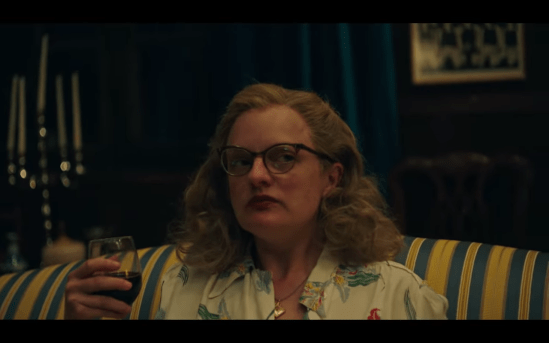
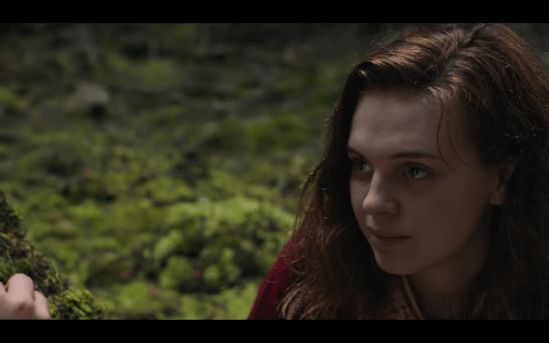
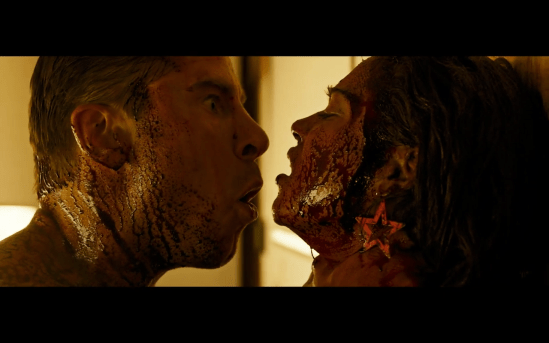
Hot off her success in the gender-dystopian television series, “The Handmaid’s Tale,” and in Leigh Whannell’s vision of a Universal monster classic, “The Invisible Man,” Elisabeth Moss embodies the titular role of Shirley Jackson with a fluid performance of a corkscrew soul. Moss aims to make Shirley as a detestable gorgon with nihilistic and agoraphobic intellect and a narcissistic view of her work she considers to be the holy grail. Moss is methodic and calculating in her character’s icy social skill set and floats half-seen above the water’s surface like an alligator hunting, ready to snap when a warm blooded meal doesn’t expect a thing. Shirley Jackson is only as interesting as her philandering other half, Stanley Hyman, who has a whole separate cache of quirks and callous intentions, though parading in a much more vibrant, lively, and gregarious manner. “The Shape of Water’s” Michael Sthulbarg has pitch perfect execution of Hyman’s managing tugboat who pulls and escorts this cruise liner-sized ego to port with an unorthodox show of a manipulation and affable disingenuous blend working tirelessly that ship to anchor after a long voyage on rough, stagnant seas. Fred and Rose enter like a parallelogram, a four-side rectangular where two sides pair together equally in length, of innocents wondering into a den of a pair of hungry lions. Then, the parallelogram flips and skews to form an twisted mirror of itself that has turned the sweet and loving Fred and Rose into a pair of awaken fragments of Shirley and Stanley. We don’t get to experience much of Logan Lerman as the assistant professor who shadows in Hyman’s overshadowing dominance, but we’re rather engrossed by Odessa Young’s onscreen reciprocity with Elizabeth Moss. Rose falls short of being the epitome of youthful innocence with a fast and loose shotgun marriage to Fred because of her pregnancy and her rendezvousing sexual appetite with Fred, but Rose’s delicate curiosity and naïve gives way for Shirley, Stanley, and even Fred to tread all over her. Young fully grasps Rose’s disadvantage in the viper’s pit that sizes her up for a great fall.

“Shirley” doesn’t bask in the spotlight of the biopic-ee’s celebrated work, like “The Lottery” or “The Haunting of Hill House,” even if it name drops the former; instead, Josephine Decker’s film is cut from the Susan Scarf Merrell cloth that disconnects and desensitizes intellect from moral conduct. Distinct lines are drawn between the couples Shirley and Stanley, whose dynamic teeters on alcohol, smokes, and a banter based on a fraction of love less, and Fred and Rose, who are teased with the taste of the good life, bow and scrape for the attention of their hosts. As the scrupulous infatuations begin to blur the lines and Fred and Rose become infected by Shirley and Stanley’s inceptive wicked cynicism, a metamorphosis occurs as the naïve newlyweds are now the bitterly tireless unable to cop with their shortcoming whereas Shirley and Stanley remain unaffected, if not, better off than from when they started, leeching the purity from the impressionable youngsters like a pair of scholarly vampires. Decker’s airy, dreamlike touch evokes another level of the already Freudian bombarded “Shirley” that’s laden with heavily schemed psychoanalytic foreplay and undercurrent human reaction to a string of unconventional occurrences.

Become the fly trapped in a web of deceits with “Shirley” heading to Hulu, VOD, virtual cinemas, and select drive-in movie theaters come June 5th, 2020 distributed from Neon. The rated R, 107 minutes quasi-biopic is presented a widescreen 1.78:1 aspect ratio. Unfortunately, a digital screener doesn’t allow me to critique the A/V quality. However, composer Tamar-kali’s subdued score lingers on the right side of brooding without feeling overly dreadful and with feeling more horrifically intrusive, complimenting Shirley’s aggressive mind rape of Rose’s psyche. There were no bonus features included with the digital screener nor was there any bonus scenes during or after the credits. Unlike the sullen, reality bending state as the titular persona, “Shirley” is an entertainingly cathartic glimpse into the worst side of erudition plagued upon those lesser informed that builds lustrous works of horror on the backs of perfidy.

Purchase the poster with Elizabeth Moss!

When EVIL Gets Inside Your Head…


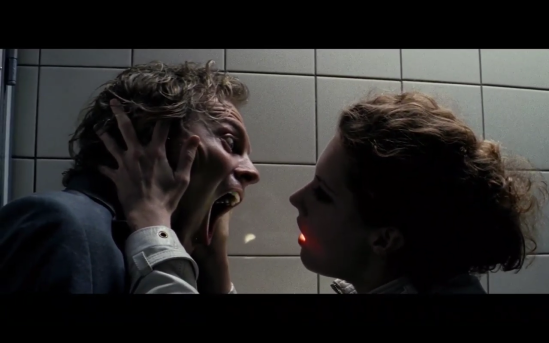
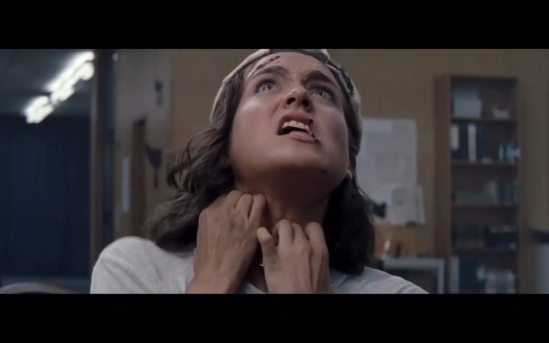
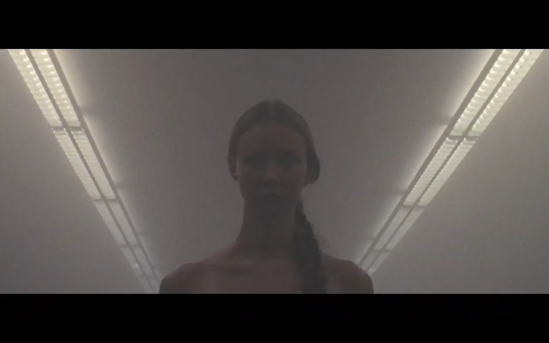
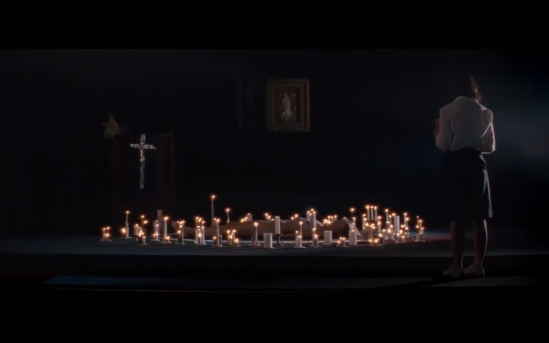
An immigrant cabby named Luz stumbles dazed into a German police station, repeating a profane distortion of a religious prayer to a couple of baffled detectives. Meanwhile, in a nearby bar, a forwardly chatty woman is diving seductively into a spiel about her Catholic schoolgirl friend who just recently jumped out of her moving taxicab to a psychoanalysis specialist on the edge of his seat. Drunk enough to take advantage of, the Doctor falls for the woman’s alluring trap, beguiling him to do her bidding as an unwilling host. As the now possessed doctor arrives to evaluate Nora for the police, he instigates a hypnosis recreation of the details events leading up to Luz’s ravings and disillusions. What happens next goes beyond human comprehension and rational as the doctor desires more from the stupefied Luz than what meets the eye.

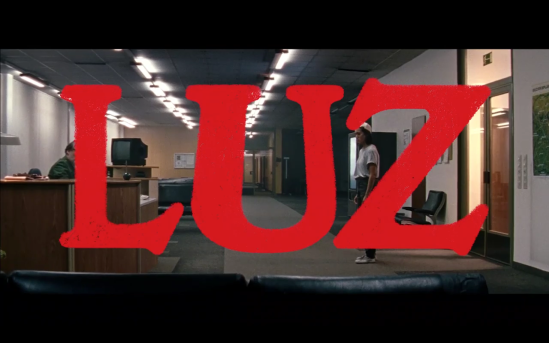
Undoubtedly a strong skiff of demonic peculiarity weathering forth against an unforgiving maelstrom of spiffy-glamourous and yacht-sized counterparts is Tilman Singer’s memorizing tale of demigod deception in “Luz.” As the German born filmmaker’s first written-and-directed full length feature film, a film school project shot entirely on 16mm color negative, Singer dazzles with a throwback grindhouse glow set ablaze with a neon flare that adds to the perilous seduction and violation of the mind and primal infatuation. “Luz’s” was filmed in Cologne, Germany, where Singer studied film at the Academy of Media Arts Cologne, during the production year of 2018 and saw success at various Germany festivals, including it’s debut at the Berlin Film Festival and the Fantasia Film Festival. The Academy of Media Arts Cologne also serves as the production company, as it was, after all, a school project, and listed as Kunsthochschule für Medien Köln (KHM).

“Luz” wouldn’t be what as staggering as it is if it wasn’t for the invested cast who brings Singer’s vision to the spectrum. Luana Velis’s seamless grasp of the editing has remarkable wealth when playing a disoriented cab driver coming in off the street and Velis as Luz, in the ebb and flow of reality when Dr. Rosinni (Jan Bluthardt) entrances her with a blend of hypnosis and psychoanalysis techniques, sustains character through various transitions present inside a large police board room, reality, and the subconscious recollection of places and events inside her mind that Singer constructions for visualization, not reality. Singer melds together places, people, and events, throwing audiences for loops and casting misleading signals and just where the hell our characters are gathered. Bluthardt is equally captivating post transformation, coming off like a calculated maniac, resolved in his wild role. Perhaps, my favorite of the cast list goes to Julia Riedler as Nora Vanderkurt, Luz’s icy former bedfellow from Catholic School who slithers into Dr. Rosinni’s ear like a bewitching asp while seeming like a normal bar patron, but Riedler’s spin on Vanderkurt breaks the construct beyond that of the sleazy barfly and into something more conniving, wicked, and alcohol infused while still steamy with sexual emissions. All three performances are keystones to “Luz” success while fellow cast mates Johannes Benecke, Lilli Lorenz, and Nadja Stubiger, offer some spot on support.

“Luz” summits fear with intrinsic performance art of hazy, but colorful, atmospherics and off-kilter shapes and lines, making the most routine settings feel unsettling. It’s a strong cinematography showcase by Paul Faltz who was able to frame and fright a scene from a sterile and fatigued, wood paneled office environment; essentially put, Faltz turned coal into a diamond while Singer brought a keg of European horror to the party. Unconventional, of course, with a profound arthouse quality about it, “Luz” is very much inspired by the European masters of horror, but pulls quite a bit from the vibrancy of American filmmaking too, pulling inspiration more noticeably from John Carpenter’s overwhelming sense of apocalyptic doom from such a scale down narrative and the terror looms like a chandelier hanging by a single thread just waiting from the startling crash of glass and metal. There are themes related Catholicism, homoeroticism, guilt, and obsession through the venomous innate nature of demon, as if unknowingly leaving an open invitation for evil by way of spiritual clairvoyance and Catholic defiance. Full of abstract visuals and melodious dialogue, “Luz” still burns the scary story lantern with a flickering of imminent existential combustion.

While the theatrical release has been officially canceled, “Luz” will still live on through the digital world, being released by Sharp Teeth Films, who released the POV slasher horror “You Are Not Alone,” on June 1st in the United Kingdom. With this being now a digital release, critiquing the audio and video quality will be limited to the artistic direction. Video-wise, Singer sought the use of a 16mm film stock with the speckle and grain texture of that beloved, yet enveloping imperfection and shooting in an anamorphic widescreen aspect ratio of 2.35:1, using an Arri Alexa and RED cameras that supported an anamorphic lenses. The result is phenomenal to digest with some serious depth when considering how small the sets are, turning mere pockets of space into the likes of grand ball rooms. The German, Spanish, and very little English dialogue tracks are clear and prominently abutted against a well adjusted ambience mix; in all, the audio package has good depth and range. There were no bonus features included with the digital screener. “Luz” is weird, mystifying, and can wriggle into your favor with a chilling essence taking a leisurely stroll along your back, propping up the hairs one strand at a time. Highly recommended.

Nothing Says EVIL Like a Woman Scorned! “Revenge” reviewed! (Second Sight / BR Screener)


Richard, a wealthy businessman, and Jen, his young, candy arm mistress, helicopter in onto Richard’s desert retreat house. While his wife and children are at home, Richard plans to spend his time away relishing a pleasurable weekend that involves relaxing by the outdoor firepit, swimming in the infinity pool, being sultry with Jen, and do a bit of hunting along the mountains, canyons, and riverbeds. When Richard’s associates, Stan and Dimitri, arrive a day early, a party filled night rapidly ensues, but events turn sour when Jen is brutally attacked the next day and Richard plans to snuff out the scandal before it unravels to ruin him. Unwilling to cooperate with a coverup, Jen is nearly murdered by her three attackers only to arise like the rebirth of the Phoenix, igniting a vengeful fire inside her as she uses everything she has at her disposal to finish what they started.

In a day and age when the slightest bit of a woman’s attention can explode into a vile reaction of testosterone warped misguidance and it’s the woman who is shamed as the accosted criminal being barked at aggressively by the unequivocal fearful and condemning voices of the male species, it’s movies like Coralie Fargeat’s action-packed “Revenge” that symbolizes woman’s resiliencies against men’s efforts in a show of violent force that’s “First Blood” without John Rambo, but rather with a scorned princess for retributive capital justice. “Revenge” is the French filmmaker’s first full-length penned and directed feature film that’s one gritty and bloody grindhouse vindictive sonovabitch, a pure punch to the throat, and a direct message to misogyny everywhere. Filmed in the Morocco desert during Winter, the small cast is swallowed by the vastly arid landscape of transfixing cruelty, a synonymous parallel to the feat the heroine Jen is drawn to task. It’s also a feat that Fargeat managed to salvage to finally release a rape-revenge thriller backed by a conglomerate of production firms and financiers to stand with a film from a first time director whose treatment offers up maltreatment of women, such as the rape, along with the savagery, the concept of revenge, and ridiculous amounts of blood. M.E.S. Productions, Monkey Pack Films, Charades, Logical Pictures, Nextas Factory and Umedia are just to name a few of the production companies to be supporting capital.

With a role embodying the symbolic brutalization of physical and mental rape, a role of complete loneliness in a fatal skirmish against their attackers, and in a role forsaken in the face of death only to be reborn from the ashes of their former self, Matilda Lutz’s fully charged capacity to tackle such a demanding performance is beyond praiseworthy, scrapping the timid traits from Jen’s ravaged glossy persona and replacing with a rigid exterior ready and willing to combat to the death. The Italian born Lutz has to go through a metamorphosis and refashion Jen to be able to differentiate from her more bubbly first half self as the easy kill or the disposable male plaything. In a twisted turn of events, Jen’s mortal adversaries have every advantage to douse out Jen’s existence: gear, guns, vehicles, clothes, water, fuel, numbers, etc. Yet, despite all the advantages, the desert, much like Jen, is unforgiving as it is bare. Richard (Kevin Janssens), Stan (Vincent Colombe), and Guillaume Bouchede (Dimitri) exude the utmost confidence their grip around Jen’s throat. Janssens’ fortifies as the rigorous cutthroat, a misogynistic philanderer, determined to save his own skin no matter the cost while Colombe’s Stan is a retracting coward with regretful impulses. Colombe’s brings the comedy to a grimly tale and positions Stan to be the teetering villain tarnished by his guilt of nearly killing Jen, but never apologizes to being the catalytic rapist that initiates the whole debacle. Bouchede supplements with his divestment to charm as the overweight, do-nothing witness to save Jen from Stan’s seizing urges. As Dimitri, Bouchede stalls his typical niceties to be the silent violator who can open up the flood gates of aggression when transgression warrants it.

“Revenge” has an ultra-violent and super-synth finish chapping with multiple motifs of a rebirth theme and supplies a hefty bloodletting of incorporeal measures. Knocking it out of the park in her first feature film, Fargeat’s cauterizes the unnerving serious tone with alleviated black comedy of the bloodiest kind. The roundabout endgame chase comes to mind, involving a frazzled Jen and a wounded, but indomitable Richard in a merry-go-round of a shotgun standoff is some of the best editing work of fast and ferocious content I’ve seen in some time while still able to vitalize a transparent sense of what’s occurring. However, not all the slick editing is flawless. Some minor inconsistencies in the editing are noticeable and while these moments of lapse are not detrimental or pivotal to the story, they reflect Fargeat’s challenges of making a hyper-stylized action-thriller in her freshman full-length feature. In a sense, everything Fargeat’s deploys positions “Revenge” into a surreal tonality, glamorized for those thirsty for blood gushing in a canyon-vast desert bristled with rape and payback where a mere four players in this ebb and flow game of killer combat chess can effortlessly locate each other, but one can always find their prey by following their blood trail, another motif that continues to pop up that speaks metaphors of their life blood is the very object gives them away in the end.

Giving the limited edition treatment that it deserves, Second Sight Films’s Blu-ray release of “Revenge” is a mouthwatering narcotic of raging cathexis and while the Blu-ray BD-R can’t be technically critiqued, the LE release offers HD 1080p transfer of the original, 2.39:1 aspect ratio and sports an English language DTS-HD Master Audio 5.1 mix. While Fargeat might be inspired by Lynchian themes, the cinematography work by Robrecht Heyvaert also resembles “Pitch Black” director David Twohy’s films with making something small larger than life and a particular chase scene involving all four characters at the edge of a canyon stroke a familiar chord with Twohy’s “A Perfect Getaway.” There were Second Sight Films’ exclusive bonus features included on the disc, featuring new interviews with director Carolie Fargeat and star Matilda Lutz (entitled “Out for Blood”) an interview with Dimitri actor Guillaume Bouchede (entitled “The Coward”), a interview with Robrecht Heyvaert (entitled “Fairy Tale Violence”), a new interview with composer Robin Coudert and the synth sounds of “Revenge,” and a new audio commentary by Kat Ellinger, author and editor of Diabolique. The release is sheathed inside a rigid slipcase featuring new artwork by Adam Stothard as well as a poster and a new soft cover book with new writings by Mary Beth McAndrews and Elena Lazic Overall, “Revenge” received a monster packaged release ready for the taking on May 11th. “Revenge” destroys toxic masculinity and breathes a vindictive hope from the fiery embers of rebirth and destruction.

EVIL is a Slice of Deep Dish Hell in “Creepy Tales of Pizza and Gore” reviewed! (Bayview Entertainment / Screener)


Pizza, that delicious concoction of bread, marinara, cheese, and your topping of choice kneaded and pieced together in a gooey circular of staple culinary awesomeness, has somehow found its way baked into an Italian-sans-meatball horror anthology that promises an equally saucy taste of crusted blood red gore. Five varied, harried tales of horror molded into a gruesome and terrifying VHS-style that will send chills down your spine as you swallow your first piping hot bite of pizza will either have you hungry for more or hurling out your pepperonis. These tales of macabre include the cursed audio tracks of a deadly screaming ghost, the grisly torture and murder in the name of Satan, the tragic and supernatural deaths of two ill-fated lovers, a wooded creature stalking stranded motorists, and a VHS tape that seeks revenge on its former, ungrateful owner.

Let’s take our time traveling machine back to 2014 where Italian filmmaker, Lorenzo Fassina, releases his second feature directorial film behind the horror-comedy, “Anamnesi Mutante,” transmitting by way of a five tale anthology humorously entitled “Creepy Tales of Pizza and Gore;” the titles of the shorts are “Screaming Ghost,” “Devil of the Night,” “Alone in the House,” “Wood,” and “Killer Tape.” Co-directed with producer Marco Giangiarelli, The Milan born Fassina’s background also includes being a director of a collection of short films and music videos for bands that include Italian metal bands Cripple Bastards and Viscera///, similar music scores the anthology. The eclectic tales that greatly homage horror of the 80’s that include rich in color film titles and poignant atmosphere audio mixes, each have a runtime average of approx. 10 minutes long, and offer a mixed macabre of subgenre goodness from technological horror to inanimate object horror besieged with an interlacing host, a faceless, demon-like presenter with much to say, much like the Crypt Keeper. My apologies in advance as the screener that was provided didn’t have subtitles so the host’s soliloquy goes mostly misunderstood, but by the way of editing and how the syntax is structured, one would assume the ghoulish emcee sets up the pizza eaters with the next short video nasty. “Creepy Tales of Pizza and Gore” is produced by Fassina’s indie company, DirtyTape.

Most of us in the States more than likely won’t find any familiar faces inside the confines of these five tales and, know what? That’s okay! Aside from our hell bound host, there’s not a lick of dialogue spoken, but the capability to connect with the characters and the capacity to understand the story without words is as transparent as crystal clear waters of the Venice canals. An assemble of facial and eye expressions and a well edited together script and structure by Fassina for each short provides a sustainable and a sufficient menacing mixed bag of mouthwatering horror. The largely novice cast has either worked on previous projects with Fassina before or are an unknown delight to us viewers and cast list includes Sara Antonicelli, Beatrice Cartoni, Jonathan Farlotta, Jacopo Grandi, Francesco Marra, Tommaso Meledina, Alessandro Melito, Riccardo Tiberi, and Bunny Roberts with a cherry on top topless scene for good measure.

I’m not a terribly big fan of anthologies. Yes, I enjoy “Creepshow 2,” like every other horror fanatic smuck, and I do revel in the grave zest of the low-budget spectrum, especially with compilations from directors of the “HI-8”, aka “Horror Independent 8,” that featured the bloodbath films of some 80s/90’s SOV prodigies in Ron Bonk, Donald Farmer, Tim Ritter, and Marcus Koch, but most anthologies find their unsuccessful way right toward the trash bin, condensed to third-rate releases with little-to-no marketing and hardly any surplus material in the special feature department. “Creepy Tales of Pizza and Gore” may be a foreign anthology barely making an insignificant speck in the cinema market, but certainly shouldn’t be overlooked as the derived golden age of an immensely beloved straight-to-VHS horror courses through the veins of Fassina’s reverencing anthology. The stories garnish b-reel content, but not necessarily effortless or incompetent in substance and range from serious, to tongue-in-cheek, and out right absurdity, with the latter stories being the weaker links. In all, it’s a fun and entertainment horror show from our Italian friends.

“Creepy Tales of Pizza and Gore is delivered fresh and blood warm onto DVD home video courtesy of the New Jersey based distributor, Bayview Entertainment. As aforementioned, Bayview Entertainment publicity provided a streaming screening link so the audio and video aspects will not be critique for this review, but the DVD specs include a single disc, Anamorphic widescreen presentation, with an unrated rating on an Italian language anthology that, supposedly, has English subtitles – my screener did not have subtitles. Bayview Entertainment’s DVD casing resembles entirely like a VHS-cassette with faux movie rental stickers stuck on the outer plastic. The packaging is a nice and warranted touch to a VHS-homaging anthology. There were no special features included with the screener or released in the press release. Chow down on night with “Creepy Tales of Pizza and Gore;” a validating horror anthology worthy of time and effort and reaffirming the faith in anthologies once again with wild, imaginative macabre ambitions without the stiffening efforts of pushy financiers calling behind-the-wheel shots.

“Creepy Tales of Pizza and Gore” won’t disappoint! Buy here on Amazon.com

EVIL Choo-Choo Choses You! “Infernum” reviewed! (Indican Pictures / Screener)


When Camille’s parents awake to an unknown and encompassing rumbling and what sounds like agonized wailing, they decide to go investigate not too far from their camping tent where their daughter, Camille, still sleeps. When Camille awakes, the rumbling is now deafening and her parents have disappeared into the night, leaving the young child frightened beyond belief. 25 years later and still haunted by the phenomena, art post-graduate Camille conducts recorded interviews with witnesses of the event along with James, a film studies student working on a documentary project. When the rumbling returns in the Nevada desert, Camille and James take a train to record research just outside the affected area and not become too close to the dangers that’s traumatized Camille, but when the train stalls in a tunnel halfway to the destination, Camille and James awake alone with no passengers or conductors in sight and a rumbling noise that isn’t the train’s engine. Camille finds herself once again in the midst of wailing and now something outside the train is trying to get in.

Stick “Infernum” into the sub-horror category of the great and fear-inducing unknown perhaps based loosely off the unexplained low-frequency hums, such as a Taos hum, stretching from the U.S. to the U.K., writer-director Dutch Marich sensationalizes the phenomena by adding the trimmings of tortured souls howling in torment as a rift opens up between Camille’s world and, supposed, Hell. Filmed primarily inside an antique rail train from the Northern Nevada Railway Museum and inside the railway tunnel west of Ely, Nevada, the “Hunting” and “Miserable Sinners” filmmaker, Marich, slow churns a low-budget friendly and simple plot into a materializing worst case scenario with the anxiety-riddle markings of being trapped, surrounded, and alone inside a dark and confined space with a cacophony of screams, as if in a dark-padded psychiatric cell. Mariach’s Luminol Entertainment and Vekinis Studios, headed by former Luminol Entertainment employee, Peter Panagiotis Vekinis, collaborate on the project.

Playing the traumatized Camille is “American Mummy” and “Dude Bro Party Massacre III” b-movie actress, Suziey Block, who has to not only struggle with coping against the hauntingly strange event plaguing her past, but also deal with an overprotective, yet also apathetic boyfriend in a role filled by who could very well be a young Christopher Meloni lookalike, “Happy Camp’s” Michael Barbuto. Block’s become something of a scream queen over the last few years and “Infernum” continues to make the Michigan born actress keep screaming her lungs out; however, its Camille and Hunter’s hot-and-cold relationship that topples the main theme here as Camille, through Block’s insensate performance, feels disinterested in unearthing what happened to her parents while being too engaged in Hunter’s desensitize, if not rightly justified, position toward her glazed over stress, but Block is engrossed by the fear just enough to sell it. Rounding out Infernum’s cast is Clinton Roper Elledge, Sarah Schoofs (“The Theatre of Terror”), and Rita Habermann.

“Infernum” can feel like a simmering slow burn of paranormal byproduct and resonates closely with Milla Jovovich’s extraterrestrial faux found footage thriller, “The 4th Kind.” The lingering scenes with tedious exchanges render a remote sense of terror that’s teamed with more tension from Hunter and Camille’s argumentative discourse. Yet, when things seem to be dwindling as Camille and her filmography friend, James, board the vintage train to the ghost town of Kimberly (and when I say ghost town, I mean an abandoned mining area), that’s when things go from a steadfast numb to a terrifying turn of the inexplicable circumstance kind. Camille finds herself in a familiar situation like 25 years ago, but the environments different with desolate train, an ominous presence over the loudspeaker, and though most passengers have disappeared, there are some who are found, blue as ice in the face, and lifeless. The tension is thick with the engine rumbling of an infernal-sounding machine that reeks havoc with cries and screams to amplify night jitters. The open ending leaves room for a wide berth of possibilities and interpretation, making “Infernum” metaphysically loiter in between the rifts of our minds.

“Infernum” is a spooky train ride to hell and back, pulling into the DVD home video and digital platform station from the independent film distributors, Indican Pictures. Unfortunately, the video and audio quality will not be covered because of the DVD-R screener, but I can say that the LFE audiophiles are immensely characteristic and behooves viewers to play on a surround sound system or quality headphones will also do the trick. The film’s innate hues are on the bleaker, gloomier side, backdropped by the frigid air of a wintery Nevada dessert. Other than Indican Pictures’ trailers for other films, including “The Lurker” among other films, there were no other special features beyond a static menu. I highly recommend “Infernum’s” spooky vibe and unlimited possibilities all aboard it’s simple, yet effective paranormal premise.

Watch “Infernum” on Prime Video!!!