There’s Growth in the Darkest of EVIL Pacts. “Vulcanizadora” reviewed! (Oscilloscope Laboratories / Blu-ray)

Catch “Vulcanizadora” on Blu-ray from Oscilloscope Laboratories!

Friends Derek and Marty trek through the Michigan forest to get away from their life’s problems, stopping occasionally to dig up previously stowed away porn magazines, camp around a fire and in tents out in the open air, enjoy swimming in the fresh waters of nearby lake, and videotape themselves setting off small fireworks.  As Derek enjoys life’s little moments out in the wild with his best friend, Marty’s intentions are more focused on their unspoken pact, the whole reason for their journey through isolated wilderness.  The closer they walked toward to their journey’s terminus, Marty’s determination to finish what they started becomes more rabid whereas Derek has second thoughts with fear projecting out of his nervous habits.  When one of them doesn’t return home, tremendous guilt submerses the other into self-liability as he tries to make right and to make amends for what happened between the two friends alone in the wilderness.

Vulcanizadora.  A Spanish dictionary word for tire shop or also the heat-treating process of crude rubber to improve durability.  It’s also the title of Michigan native Joel Potrykus’s written-and-directed, 2024 dark comedy drama that relates, in a way, to both English definitions of the word.  Potrykus began his directing career in comedy back in 2012 with “Ape,” a black comedy about a struggling comedian-turned-pyromaniac, and from there the residing Grand Rapids filmmaker has hovered in the bleak and comedic mingle continuing with the ill-fitted paranoia of “Buzzard,” fortune obsessed mysteries of “The Alchemist Cookbook,” and “Relaxer” that takes audiences, or at least those who lived through the experience, back to the Y2K apocalypse scare for one man’s quest to conquer the Pac-Man videogame.  “Vulcanizadora” is a produced by Hannah Dweck and Theodore Schaefer of Dweck Productions, Matt Grady of Factory 25, and Ashley and Joel Potrykus under Sob Noise Productions. 

Joel Potrykus co-stars in his own feature story alongside Potrykus film regular Joshua Burge in their first collaboration since 2018’s “Relaxer,” marking their fourth project together.  Potrykus plays the incessantly hyperactive Derek, a babbling, balding, and large goatee rocking fun seeker eager to show Marty a good time on their walk through the woods despite the grim preconceived end game.  Marty’s a direct opposite of Derek with solemn character and intensive tinkerer putting up with Derek’s nervous ways but also impatiently awaiting their determined fate.  Potrykus constructs a fascinating and fantastic preluding invisible wall with the intention of blocking both Derek and Marty’s past and chiseling out piece-by-piece under casually cryptic conversation, we can begin to learn what motivates their pact with hints of property destructive transgressions and life disaffirming unhappiness.  There’s never clearcut cause upfront or even into the second act and that naturally leaves the last act to unravel the unfortunate circumstances around what makes Joel and Marty tick, and their friendship acutely grows stronger with compassion and genuine regard despite the other’s permanent absence.  The story primarily and innately focuses on the buddy duo, that appears under the guise of the arbitrary mundane with one-sided indulgence in Derek’s childlike Incessancy and quiet Marty’s tongue-biting abiding of his friend’s then unknown stall tactics, but the narrative opens up and expands upon “Vulcanizadora’s” world as one of them reinstates themselves back into their personal misery, a smalltown society of unscrupulous lawyers, browbeating and demented fathers, challenging ex-wives, and intimidating authoritative figures casted with Bill Vincent, Sherryl Despress, Scott Ayotte, Dennis Grants, G. Foster II, Jaz Edwards, Melissa Blanchard, and introducing Solo Potrykus. 

A slow burn of melancholy, “Vulcanizadora” is masked depression at its worst with voiceless victims that work out an ill-fated end on their own.  “Vulcanizadora” is also about friendship despite the seemingly lopsided larking and crestfallen relationship between Derek and Marty, who often feel more like diamagnetism than having a connection while on their passage through the woods.  Potrykus’s story, and subsequent exhibition of the tale, depicts an all but true tragedy of feeling the impact of loss, especially in the context of underappreciated and compassionate feelings for someone else.  While the other friend is around, complacency is the devil’s active ingredient in dividing our human connection as the thought is both being alive together or dead together would be constant, and even more so when that connection is with a person who might be the best person in the world to them but just can’t see underneath the film of one’s own miscontent.  When not around, being separated makes the heart grow founder and the reality of loss sets in.  Potrykus highlights those forlorn facets in the third act surrounded by nothing of life’s hardships and unusual bombardments, which to be fair was brought upon by past transgressions of invincibility, which involve a process similar to vulcanizing, hence the title, and the knowledge that it’ll all over soon.  Yet, there’s also a sort of vulcanizing of the friendship elasticity and durability even in post-“breakup” of the friendship to create an everlasting peace with all the bad that’s happened.

Oscilloscope Laboratories, an indie label curating the filmic curiosities, releases “Vulcanizadora” to Blu-ray home video with an AVC encoded, 1080p Hi-Def resolution, BD25, presented curiously in an European widescreen 1.66:1aspect ratio, a standard proportion display you usually would primarily see in 1960s-1980s Europe with a slightly boxed and bordered matte.  A satisfiable picture for a character-driven slow burn aimed to build and destruct to build again a relationship between two friends during a time of individualized darkness is not a picture of perfection where certain areas inside the forest are out of focus and indistinct, such as the blending of orange and brown leaves on the ground in very long shots while capturing the principals traversing through.  Likely more of an issue with the cinematography than in compression because Potrykus uses 16mm to evoke a richer texture, “Vulcanizadora” is not a high-powered, action-packed thriller or sensational visual drama to be affected by it’s off-and-on focus.  Details are generally better around close-to-medium shot textures, skin tones appear organically accurate, and there’s decent depth of field inside a naturally limited color range.  There are some good close ups that do deviate, such as in a gorier graphic shot that impales more intrusive grain into the cell, in what is perhaps a limitation of 16mm zoomed in.  There are often indiscernible blips in the film stock because of its newer production but the grain, when not extended, is organic with an enriching natural aesthetic.  The English DTS-HD 5.1 surround sound is more than enough to cover all audio aspects from a precisely clear and clean dialogue to a Sasa Slogar’s sound design of comping operatic harmonies of soprano Maria Callas with the rough heavy metal soundscape of the Brazillian band Sepultura.  Dialogue retains in the forefront even in long shots when characters are at far points in the scene denoting an omission of depth in what is mostly a medium-to-close shot narrative.  English subtitles are optionally available.  Joel Potrykus, Joshua Burge, and cinematographer Adam J. Minnick provide an audio commentary track parallel to the feature with a making-of “Vulcanizadora,” deleted scenes, the theatrical trailer, and Potrykus’s short film, “Pets” to fill out the special features.  Oscilloscope Laboratories release comes in a clear Viva case with an unsettling yet telling death and video image in its cyborg-esque edge cover art and a reverse cover honed-in on a still image of the two protagonists.  Disc comes company typical pressed with the company logo large and in charge at the center and film title hovering over top.  The not rated release has a runtime of 85 minutes and is suitable for all region playback.

Last Rites: Few will relish in Potrykus’s “Vulcanizadora’s” slow-and-steady tragedy of deep depression and the crawling out of the fiasco unfolded, self-dug hole to find some sliver of peace and comfort in doing one right thing for a friend.

Catch “Vulcanizadora” on Blu-ray from Oscilloscope Laboratories!

Rash Decisions Permeate EVIL’s Presence. “When Evil Lurks” reviewed! (Second Sight Films / 4K UHD Blu-ray)

“When Evil Lurks” 4K UHD Blu-ray for Purchase!

Two brothers in a small, remote community discover a neighboring man infested and rotting with a demon inside the body.  Fearing evil will spread once the birthed demon is free from the bloated and pus-oozing human host, they move the body miles out of town with the help of an impatient and bellicose farmer, but when they lose the body, a dark violent force spreads across their rural outlook, beginning with the horrendous death of the farmer and his pregnant wife.  Escaping to the city, the two brothers hightail out of town, picking up family along the way, only to unintentionally spread evil from contamination by the rotting body.  Local folklore has a set of established rules, seven rules in fact, when face-to-face with a demon and they enlist a reclusive woman, a proper cleaner of the rotten, to help them against the clinging evil determined to never let their family go unscathed. 

The 2023 released, heavy demonic and folkloric horror from Argentina, entitled “When Evil Lurks,” tells the whole story of a family’s past regrets, the road-splitting life choices they make, and the consequences that follow using graphic, unabashed violence and a campiness that’s corrosive to the soul.  Demián Rugna writes-and-directs “When Evil Lurks,” aka “Cuando acecha la maldad,” after his breakout hit “Terrified” from 2017.  The Buenos Aires filmmaker continues to push a singular amalgamate of wide-range tradition and horror to the extent the world has never seen, and he continues to shoot on location from his own country, mostly in or around his home municipality.  Fernando Díaz of Machaco Films alongside Roxana Ramos under her founded production company Aramos Cine with the support of the national cinema institute, the Instituto Nacional de Cine y Artes Audiovisuales or the INCAA, and the streaming horror service and productions, Shudder.

“When Evil Lurks” primarily follows Pedro and Jimi, two brothers living on the outs of their own lives stagnantly inside their rural family home.  Ezequiel Rodríguez (“Legions”) sports a grizzly beard as the lead, older brother Pedro who frantically and desperately needs to get his family away from the spreading evil while returning to collaborate with Rugna “Terrified” actor Demián Salomón tracks as a more youthful footloose, Jimi, not tied down by a family or even a girlfriend but rather is dialogued as free lover amongst women.  Every character they encounter exposes them to the evils that lie ahead, or generally around the vicinity, as the this rotten, as they label the formless rotten presence that is solely an inhabitant of people and animals alike, can jump to another host if the rules are not followed, with the most common rule being broken is using gun powder to kill the possessed rotten.  Up for to be demonic fodder is Pedro’s estranged family who have alienated him because of his ambiguities’ surrounding possible unforgivable crimes and family abandonment.  The latter speaks more specifically to his severely autistic son Jair (“Emilio Vodanovich, “Fever Dream”) Pedro once hated himself for spawning, per his ex-wife and restraining order enacting Sabrina (Virginia Garófalo, “La Vagancia”), but his Pedro’s pre-narrative occurred change of heart sends him frantically into the fire to save his children Jair and younger brother Santino (Marcelo Michinaux, “Fever Dream”).  Also demonically targeted is Jimi’s once city affair now turned socially isolated former cowwoman-turned-rotten cleaner Mirta (“Silvina Sabater, “The Wrath of God”).  Mirta pivotally provides audiences insight by solidifying what other characters only know by hearsay or try to understand intuitively about the rottens, or the possessed, and how it spreads and what rules to follow.  Without Mirta, a lot of the supernatural circumstances involving children, the insidiousness, and the mindset of evil.  Other cast members interlocked with the gruesome violence and gut-wrenched storytelling is Luis Ziembrowski (“The Rotten Link”), Paul Rubinstesztein (“Portraits of the Apocalypse”), Isabel Quinteros (“High Heels”), Lucrecia Nirón Talazac, Ricardo Velázquez, Desirée Salgueiro (“Luciferina”), Federico Liss (“Portraits of the Apocalypse”), and Berta Muñiz (“Plaga Zombie”) as the voice of the bloated rotten Uriel.

“When Evil Lurks” accompanies with it a strong theme of children replacing their parents or adults in a metaphorical, supernatural demon enriched context.  Children are drawn to the demon as the demon is drawn to children, a verbatim more-or-less statement said by Mirta about the rotten, or demon, that shows children as it’s bewitched devoted servants and protectors, like little underage Renfields, who try and trick adults off the rotten’s hidden location or carry out for more sinister acts.  One of those acts is literally devouring adults which becomes a regular theme throughout seen with Jair and Eduardo, and even in anecdote told by Mirta about a previous witness to a rotten’s case of regurgitation.  In a way, the demon is a child itself being birthed into the world under a swelling and oozing Uriel’s sinew and viscera and indulges in childish acts of fibbing, mischievous tricks, and playful portents that happen right under our noses and can be shocking to the system as we want to believe what our children, our flesh and blood, have to say but there’s always that inkling of untruthfulness in our minds. Rugna couples the manipulation with bold, visceral violence, even some on children, and a grotesque folklore inflamed by poor and naïve choices by those who don’t understand or are unwilling to fully comprehend the extent of consequences that follow because of their hastiness to act, solve, and be rid of a threat.  “When Evil Lurks” clearly points out our innate flawed existence and makes abundantly clear our mortality with our progeny to dominate the world. 

Second Sight Films emerges “When Evil Lurks” onto a 4K UHD Blu-ray.  The BD66 is HVEC encoded with an ultra high-definition, 2160p resolution and presented in the original widescreen aspect ratio 2.39:1.  Second Sight Films produce the high dynamic range with Dolby Vision, approved by director Demián Rugna.  The result is immense image immersion that inarguably has the wherewithal for a fluently stable color timing, a range of depth, and phenomenal detail.  Every aspect of what is on screen is crisp to the bone and Rugna’s violence, under Mariano Suárez’s eclectic cinematographer eye that builds toward suspense, benefits from the grisly faced display.   Audio fidelity through a Spanish DTS-HD 5.1 Master Audio holds and delivers exact reproduction.  Plenty of back and side channel clinks and clunks to establish a presence created coincidingly with the image.  Dialogue is unobstructed, confidently paced, and above the layers whenever appropriate with Pablo Fuu’s score sneaking int folkloric tones and a despairing timbre and tempo there in the mix but subconsciously eats away the soul of the viewer.  Optional English subtitles are available and accurate but in moments of great hasty dialogue, the rhythm of display can be quick.  Special features include a new audio commentary by cinematic academic Gabriel Eljaick-Rodriguez, four new interviews with director Demián Rugna It Was Always There, actor Ezequiel Rodríguez Tragedy is Inevitable, actor Demián Salomón We Made a Movie, and actress Virginia Garófalo Stripped to the Bone, and a video essay by UK film podcaster Mike Muncer Terror and the Unknown in When Evil Lurks.  There are no during or after credit scenes.  The 4K UHD Blu-ray release comes in a black UHD Amaray with a new monochromatic art rendition of young Vicky holding the leach of the French Mastiff, same as the pre-release promo still for the film.  There are no internal supplements with the region free release that has a runtime of 100 minutes and is UK certified 15 for Strong Horror, Bloody Violence, Gore, and Language.

Last Rites: There’s no stopping death. Our children will replace us no matter how hard we try. A seemingly evil accursed death will come for us all and the choices that are made will be the design to our destruction. Director Demián Rugna sees the path and knows “When Evil Lurks” it has us completely encircled with no escape, no hope, and no compassion. How soon we choose to parish depends on how rash and unwise our decisions are in the grand scheme of life.

“When Evil Lurks” 4K UHD Blu-ray for Purchase!

This Toyish EVIL is Definitely Not a Toy! “The Monkey” reviewed! (Neon / Blu-ray)

Own “The Monkey” on Blu-ray from Neon!

When twin brothers Hal and Bill, who personably couldn’t be more different, come across their deadbeat father’s windup toy grinding monkey amongst his left behind things, every time they wind up the monkey’s rat-tat-tat tune, at the last stroke someone close them dies a gruesome, horrible, seemingly accidental death.  As the deaths hit closer to home, such as the violent aneurism that takes their loving mother, the boys decide to toss the sinister toy into a deep well to stop it’s dooming of another soul.  The boys diverging personalities drive them apart and for many years they don’t speak until Bill calls Hal about the accidental death of their aunt.  A new string of death begins as the toy resurfaces to play its portentous tuneful rattling once again.  Hal, who’s now trying to connect with a son he’s kept at arm’s length in fear of the monkey’s return, must reunite with Bill to stop the carnage before it’s too late for them all.

Stephen King is so hot right now.  Hell, Stephen King has been hot for decades as one of the still living novelists to have numerous film and television series adaptations.  This year alone proves how influential and craved King’s work is amongst filmmakers and fans with “The Long Walk” and “The Running Man” feature films being released in the months to come.  There’s even the upcoming film rendition of “The Stand,” a novel that’s been adapted twice already set to receive a third account.   Since 1976 with his first adapted novel “Carrie,” King has been the king of having his work reimagined for visual scares and entertainment.  Earlier this year’s “The Monkey” is another example of the prolific author’s short story of the same title from his “Skeleton Crew” collection, coming to life on the big screen being helmed by one of the hottest new directors in modern horror, Osgood Perkins (“Longlegs”).  The horror-comedy is written and directed by Perkins in British Columbia, Canada and produced by “Saw’s” James Wan as well as Chris Ferguson, Dave Caplan, Brian Kavanaugh-Jones, and Marlaina Mah.  “The Monkey” is a company collaboration between Atomic Monster, The Safran Company, Oddfellows, Stars Collective, and C2 Motion Picture Corp. with Neon presenting theatrical distribution.

English actor Theo James is also no stranger to films adapted from literary works as The Divergent Series film star steps into “The Monkey’s” killing sphere by playing not one but two roles as the Hal and Bill Shelburn, twins with a tragic history that runs integrated with the windup, grinder monkey.  James caters to both personalities with mild-mannered energy that does transition exactly from the children counterparts (Christian Convery, “Cocaine Bear”) in the first half of the 30-year time span. Older Hal is joined by his son, lightheartedly named Petey, played by “Wonka’s” Colin O’Brien with the same deadpan deliveries as Theo James that greatly adds to their combined relationship and antagonism.  There’s plenty of self-deprecating and bullying upon Hal who, amongst the monkey’s supernatural selection-for-death drumming, is fashioned to be a loser but the narrator of the story in his slow burn rise to overcome the blood splattering challenges ahead, turning one-half of the twin duo into a lead principal and the feeble hero of the tale mostly setup by the character’s voiceover of the past and his action of the present.  In a rare showing amongst conventional character work, there is no love interest to note to either Hal or Bill other than possibly the Shelburn mother Lois in a doing in the best with what I got single mothering act by Tatiana Maslany (“Diary of the Dead” ).  Lois’s rough around the edges attitude is more shaved down by her airline pilot husband who left her and the boys and comes across as a guiding light for her twins on the rough, diverging path.  Once she’s removed from the picture, whatever threadbare connection between the twin boys had was severed that day, creating underlining turmoil and bloodshed decades later.  The cast fills in with Rohan Campbell (“Halloween Ends”) a teen obsessed with the monkey since his first encounter, Osgood Perkins as the blunt uncle, Sarah Levy as the unfortunate aunt, and a couple of powerhouse names with cameo appearances in Elijah Wood (“The Toxic Avenger”)  as Petey’s soon-to-be stepfather and Adam Scott (“Krampus”) as the Shelburn deadbeat dad.

Through the mysterious monkey business of randomized, accidental deaths is this dark theme of everybody dies and everybody dies at different times in various ways.  Through Theo James’s Hal narration and a few character jawing harps upon a zero set expiration date for people and really nails the head on the lack of preconceived set of parameters and time span of how long a person should be alive before they die, setting a concentrated focus on the way a person dies, as mentioned in Lois’s post funeral service monologue while holding her two boys that some die screaming in blood curdling agony and some parish peacefully without a blip of hoopla.  The grinding monkey toy (never call it a toy!) represents the sardonically absurd aspects and happenstances of death with its selective process and imminency; in essence, the grinder monkey is a materialized grim reaper.  Stephen King wrote “The Monkey” 45-years ago in 1980 but the film shares similarities to the modern-day horror of the “Final Destination” franchise that provides ominous premonitions precipitating subsequent deaths of those who weren’t supposed to survive a major mass causality event.  Yet, what the two entities possess is their love for the absurd, Mouse Trap ways those in the crosshairs come to end with “The Monkey” rivaling the exploding of gore, gruesomeness, and ferocity that’s made the “Final Destination” franchise rocket with cult fandom. 

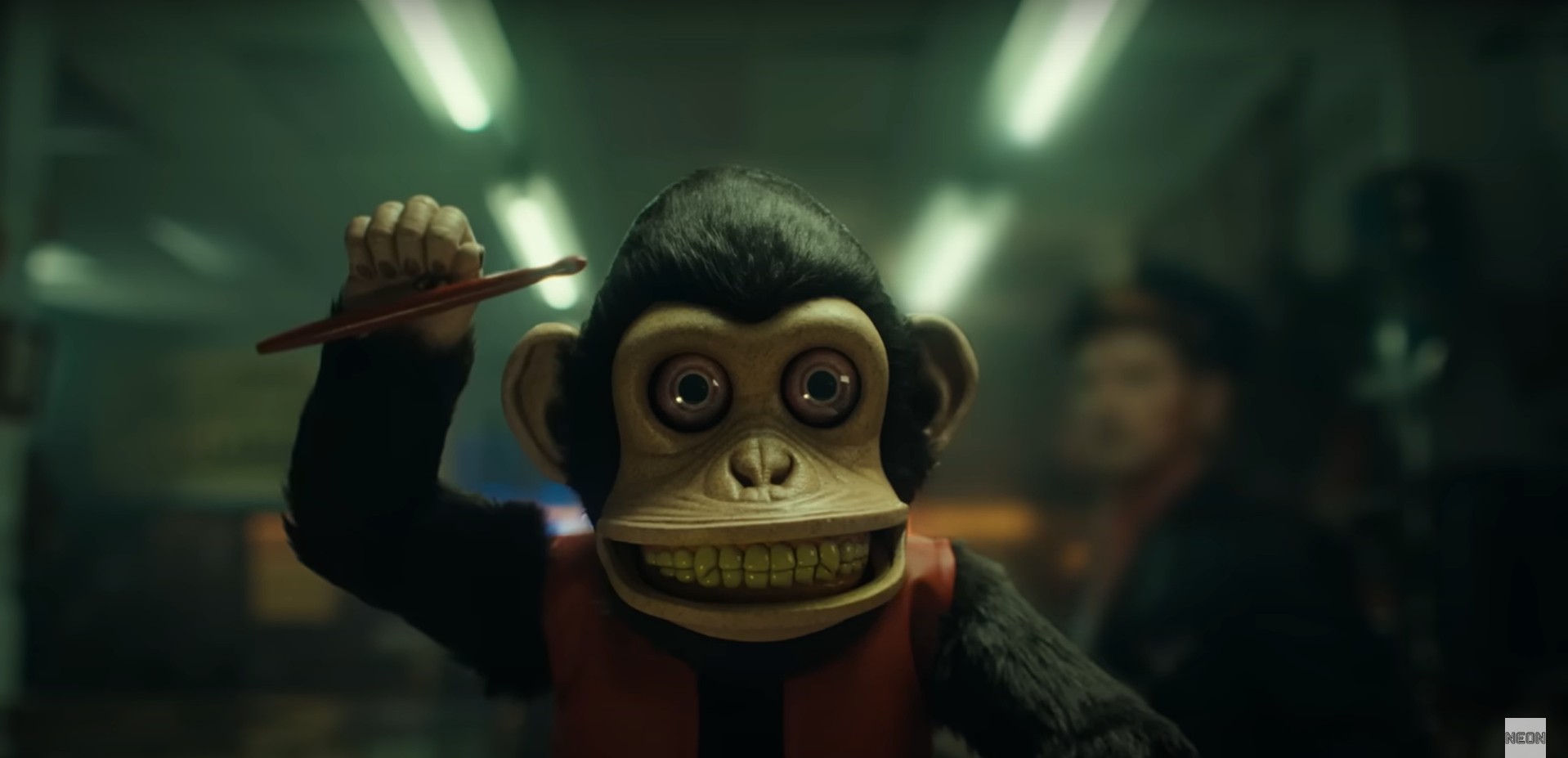
Beyond bananas, “The Monkey” shines as an adept and agreeable anarchial Stephen King adaptation.  Neon brings the blood with a standard Blu-ray with an AVC encoded, 1080p high definition, BD25, presented in a widescreen 2:00:1 aspect ratio.  Technically, “The Monkey’s” a sound example of competent compression on a lower capacity format with no evident artefacts of any size.  “Witch Hunt’s” Nico Aguilar’s semi-dark gloss adds a sheen to the elements inside a middle-of-the-road contrast.  Coloring is diffused distinctively into the well-lit scene, providing separation and delineation amongst objects, while the lower lit, more obscure moments, are sprawled by a mellower shadow that is inky or just a void but a stylistic choice to create atmosphere rather than be a menacing presence or a gape of mystery.  The English DTS-HD 5.1 Master Audio equates much of the same caliber with a clean, clear, and robust dialogue layer with a step down for the ambience, accentuated by range and depth where necessary, and a soundtrack that’s not engrossingly ear-catching but is still full-bodied and present from Edo Van Breeman (“Afflicted”).  Also listed is a Descriptive Audio 2.0 Stereo and there are English and Spanish subtitles optionally available.  Encoded bonus features are a condensed cut of behind-the-scenes featurettes, including Becoming Hal and Billi with Theo James conversing about getting into the mindsets of two completely personalities of twin brothers, Funeral Gallery provides insight on the funeral programs for the multiple services of accident deaths, Outrageously Gory and Thoroughly Gratuitous takes a dive into the cartoon-like graphic violence full of blood – lots of blood and body parts, and The Cast of The Monkey rounds out with in-depth look at the cast playing the cast of eclectic characters.  An assortment of trailers is also in the mix with an included announcement teaser, teaser, and the full theatrical trailer.  Neon’s Blu-ray is standard fare with a conventional Blu-ray case from Viva Elite housed inside a delicate slipcover with a hard detailed look at the grinder toy monkey (again, don’t call it a toy!) in full smile and ready to rap his drum, the same image of stark red and black contrast that’s also on the front cover of the Blu-ray cover art.  The insert section does not contain any physical supplements nor are there any other physical supplements included.  Locked in a region A playback, Neon’s release has a runtime of 98 minutes and is rated R for strong bloody violent content, gore, language throughout, and some sexual references. 

Last Rites: Banging away as a harbinger of death, ‘The Monkey” drums up an honest day’s work as a solid Stephen King adaptation twisted by Oz Perkins’s black comedy and high-level gore only the filmmaker could devise.

Own “The Monkey” on Blu-ray from Neon!

Is Your Disturbing Library This EVIL? “Reality Killer” review! (Treasured Films / Blu-ray)

“Reality Killers” Entering the U.S. Torture Porn Market! Buy it Here!

Serial killer known as “The Sculptor” narrates his obsession and love with documenting the stalking, capturing, torturing, raping, and killing of his victims.  As he watches and video tapes his next target, Mary, from afar, a woman he’s chatted with online extensively about recording home snuff movies, The Sculptor opens up his personal library of snuff movies, labeled and numbered dark web bought tape cassettes exhibiting the videoed brutal deaths of strangers by strangers for their pure sordid joy of taking another life.  An adventurous couple lure a promiscuous young girl on the promise of a threesome, a group of three masked teens take pleasure in the torture of a young woman, a couple enticement a child to their backyard pool, father and son roam the streets for call girl action and a little home invasion, and an underground, all-female rock band’s music video takes male fans to new extremes.

A title and a film unabashed and fully accepting the phrase torture porn, as if it’s a pithy elucidative to be proud of, “Reality Killers” is a shot-on-video, found footage anthology and snuff horror from 2005 helmed by “Witch Story” director and “Body Count” writer Alessandro Capone.  The Italian production contains shorts and a wraparound story that connects them together in an ugly tale of sadism, written by four aspiring, young filmmakers in Pablo Dammicco (“A Deadly Compromise”), Francesco Maria Dominedò (“Dedalus”), Volfango de Biasi (“Help!  My In-Laws Are Vampires”), and a writer simply known as Zedd with Alessandro Capone also contributing with his own screenplay while project managing filmic newcomers as they shoot mostly in Los Angeles using American actors.  Alternatively known under the title of “Project K,” the 2005 film of nihilistic sadism is produced by Eagles Pictures’ Ciro Dammicco and Pablo Dammicco and executively produced by Luca Dammicco and Fabrizio Manzollino.

“Reality Killers” is one of those rare breed films that shares a connection with pictures 70+ years it’s senior with having no after credits.  With no before or after cast credits, acknowledging the cast and their ignoble roles is a challenge to say the least.  If fact, it’s impossible.  The wraparound segment with The Sculptor has some clarifying character elucidation online connected to one of the more well-known Italian extreme violence and horror filmmakers in modern times with Domiziano Cristopharo, director of the surrealistic yet broad-stroked with intense visceral “Confessions of a Necrophile Girl” and “House of Flesh Mannequins,” in a role credited as The Monk.  However, there seems to be some melding overlap between The Monk and the large, oiled-up, and masked concentrated sadist on screen in the wraparound story, played by Valter D’Errico, in a disturbing show of vain and perverse expression.  Alongside D’Errico, in a handful of scenes of being stalked around a metropolitan city and in a naked position of vulnerability on D’Errico’s slab of slaughter, is Cristina Puccinelli (“Phantasmagoria”) playing as the aspiring snuffer enthusiast and killer as well as the online conversationalist Mary who turns prey to her own betrayal going against and essentially humiliating a masterclass maniac like the oily and masked maniac.  After that and within the shorts, none of the other actors are repeated or credited for their work that waver between being exaggeratedly overacted and staged to the point of disingenuous means and the thought of the inflicted violence that spur a subtle creepiness.

The trouble with “Reality Killers” is the inherent topsy-turvy post-production that revamped the anthological storyline with a linear outer story with an anthological storyline connected with a threadbare connected wraparound.  Initially story structured with a sheriff unearthing a library of snuff films and going through selected VHS examples of the killer’s cache with a journalist to explicate the rare breed of butcher.  The videos were also lengthier, more narratively in depth of character and plotline, and have digestible connective tissue with the main shell story that’s redesigned for a body round and glistening, conventionally narcissistic, masked chatterbox, “The Sculptor,” who’s just a physical and commanding orb of a presence in a dark and grimy setting, spouting a deluge of devilish details about his devotion to snuff filmmaking and his own contribution to the perversion.  The told tales vary in degree of both explicit violence as well as story structure as some become more glimpses than a perusal of a three act analog anecdotes to which, in all fairness, found footage, especially pulled from VHS, are only short-lived windows into the lives of others, literally short-lived.  The vignettes are mostly hyper concentrated on the gore, leaving little room for a yard to build, lengthen, and become deeper to invest audiences when the decisive moment comes to take a life with sociopathic heartlessness.  However, “Reality Killers” pales in comparison to the likes of others, such as Fred Vogel’s “August Underground” features that really hammer down on violence and gore with sickening special effects and concentrated shock.  Capone’s entry into the niche subgenre feels reversed at times, never really going for gold in the gutting of precious human life, but the film still evokes a visceral response to the extreme content. 

“Reality Killers” arrives into the U.S. market hailing from the UK label Treasured Films, squeezing itself into the ever tightening commerce of boutique distributors.  Treasured Films’ debut special edition Blu-ray is MPEG-2 AVC encoded, 1080p high-definition resolution, BD50 is presented in a 1.33:1 aspect ratio and either scanned through a VHS record or implements a VHS or commercial handheld camera filer to achieve that passé effect that’s slowly making an aesthetic comeback.  There’s not a ton of other stylistic options used in the vignettes to instill a realism effect and result while the wraparound ups the contrast and grades darkly into its grim substance, leaving attenuated tones of yellows, greens, and reds to be coloring that seep through the oily voids.  The featured presentation carries more of the filtered aspects but in the special features’ Original Production Scenes, the alternate telling of “Reality Killers” embarks on a cleaner, conventional approach in the different outer story with the vignettes either slightly less boxed in by a matte or are outright more defined.  The audio track is an English DTS-HD stereo.  Though an Italian production, the vignette actors are primarily American and the wraparound story is voiced over.  Dialogue coincides with an onboard camera mic that picks up every little detail but also captures varying degrees of volume.  Discerning clarity is, must I say, pretty excellent for the differing sub-productions without an overbearing lopsidedness that usually stems with some who don’t have the technical knowhow to engineer audio precision; each episode achieves what’s strived for without interference, or even with the physical release, compression issues.  English subtitles are available.  Special features include a new interview with director-producer Alessandro Capone From Witch Lore to Snuff Gore in Italian only with English subtitles, a new interview with coproducer Gabriele Pacitto A Killing Reality in Italian only with English subtitles, a new English language essay by Giacomo Calzoni Cutting Deep :  Mapping the Origin of Torture Porn which takes a look at films like “Saw” and “Hostel” that generated the coining of descriptor torture porn and how it influenced horror pop culture, a teaser trailer, storyboards, and an image gallery.  The Original Production Scenes I’ve mentioned previously tells a completely different story and, in my opinion, is more interesting with longer story sequences, more nudity and gore, and the first vignette is scored with music from Nine Inch Nails, specifically “Dead Souls” from The Crow soundtrack, which adds another element to the coarse-riddled subject matter.  Treasured Films standard special edition set comes in a rigid slip box with a hazed face of the masked Sculptor.  The clear Amaray case houses new Ilan Sheady illustrative, compilation cover art in all its explicit detail with the same art pressed onto the disc.  Inserted is a 31-page color booklet with film stills, Blu-ray acknowledgments, and a David Flint essay “The Forbidden Films of the 21st Century” that discusses the films banned in Britian, which includes “Reality Killers’ rejected by the BBFC.  The all-region release has a runtime of 75-minuts and is, obviously, not rated.

Last Rites: Torture porn snuff films are, for a lack of a better world, repetitive in their controversial narrative and “Reality Killers” is no exception but it’s the style choices that and effects that entertain us or makes the sweat run down our brow. Alessandro Capone’s entry to torture porn has a visceral bite but isn’t the repulsive best-of-the-worst. Yet, Treasured Films’ entry into U.S. market is remarkably unforgettable.

“Reality Killers” Entering the U.S. Torture Porn Market! Buy it Here!

Fulci Turns Back Time to Bring EVIL Back from the Dead! “The House of Clocks” reviewed! (Cauldron Films / Blu-ray)

“The House of Clocks” Delivers Time as an Illusion. Blu-ray now available!

An isolated Italian villa becomes the looting target for three thieves looking for an easy score.  Villa residents, an elderly couple, are tricked into letting them into their estate adorned with elegant clocks of all shapes and sizes but as the plane unfolds it goes awry when the imposing grounds man arrives and both homeowners are killed.  Yet, the villa owners were no saints and no ordinary couple as soon as the husband’s heart stops, the clocks begin to move counterclockwise and that’s when the peaceful villa turns into a strange nightmare where time goes in reverse and those short and long dead come back to life with wounds miraculously healed as if it never happened.  As time continues to reverse, the thieves find themselves trapped inside the house and on estate grounds being hunted down by the merciless grounds man, but the skeletons in the elderly couple’s closet will soon resurrect and be thirsty for vengeance.

“The House of Clocks” is the Lucio Fulci made-for-TV movie that never saw the light of television programing.  Deemed too gory and violent for public broadcast, Fulci’s 1989 Italian film, to which he created the concept for and the screenplay treated by the duo team of Gianfranco Clerici  of “Cannibal Holocaust” and Daniele Stroppa of “Delirium,” was shelved for many years until it’s eventual home video release because, as you can tell just from the high-powered Italian horror names attached to the project, the finished film would certainly frighten those general audiences with easy turn-of-the-knob and bunny ear-antenna access.  Also known natively as “La casa nel Tempo,” was a part of a four-film horror special surrounding a theme of the houses of doom and was a production of Dania Film and Reteitalia production companies with “You’ll Die at Midnight” and “Delirium” producers Massimo Manasse and Marco Grillo Spina serving as executive producers.

The film initially opens with Maria, the nosy for her own good housemaid, discovering two rotting corpses ostentatiously displayed in the villa’s chapel.  Why Maria (Carla Cassola, “Demonia” and “The Sect”) decides to snoop around is not explained but the act does start a chain events, leading up to elder Villa owners in Sara Corsini and her clock obsessed husband Vittorio, played by the role age appropriate Bettine Milne (“The King’s Whore”) and Paolo Paoloni (“Cannibal Holocaust”) in a lot more makeup and prosthetics to make him appear as an older man.  As mysterious senior citizens go, Milne and Paoloni are the malevolently cryptic under a façade of geniality, possessing and maintaining the corpses of their niece and nephew they’ve murdered in order to keep their wealth.  The backstory between the two pairs has vague clarity but there’s enough to keep the pistons pumping toward the crux of why the uncanny time about-face.  While, again, no sense of explanation on why time reverses, we’re under the assumption Paolo is essentially Father Time, a personification of the time concept represented as an old, bearded man with an hour glass and a scythe to represent a span from life to death.  When thieves Paul (Peter Hintz, “Zone Troopers”), Tony (Keith Van Hoven, “Black Demons”), and Sandra (Karina Huff, “Voices from Beyond”) put an end to the Corsinis, that is when time stops and reverses itself, affecting the once dead to return back to life, and creating a nightmare scenario for now three trapped thieves under the chase of not only the Corsinis but those also killed by the Corsinis as their deteriorating bodies rejuvenate into active flesh and bone as well as flesh and blood.  “The Beyond” and “Zombie’s” Al Cliver rounds out the principal cast and the overall cast with his menacingly evil, Corsini’s jack-of-all-trades grounds man with a scarred over eye and a double barrel shotgun to hunt down the thieves.

“The House of Clock’s” is quite an interesting concept without a durably designed reason for all the madnesses.  At its core, three thieves home invade an older couple for their valuable objects and accidently kill them in the process when the standoff goes bad.  With that oversimplified version of events, a hellish cog in the pocket watch gearbox links the old man’s ticker with the tons of tickers that adorn his villa home, causing a chain reaction of turn back the clock proportions to which audiences never receive a proper understanding and while this may bother a sample size few, most will find the story too weird, gory, and trepidatious tense to care in what becomes a fair-game free-for-all against all characters who don’t have an ounce of virtue.  The lot of thieves, schemers, and murders are all trapped inside time’s ill-reverse affect without a sign of slowing down and while it might seem advantageous at first for some, as time continues to revert, the worse the situation becomes as old adversaries emerge from their graves and tombs.  Fulci’s visualized gore also emerges through with the fantastic effects by Guiseppe Ferranti, including a high right through the crotch impalement.  Ferranti would also be behind the effects for two other the house of doom television movies.

“The House of Clocks” may not have been safe for television but for a new Cauldron Films Blu-ray, the Lucio Fulci film fits right in and comes in the nick of time!  Restored from a 2K scan of the 35mm film negative, the AVC encoded, 1080p high-definition, BD50 offers a visually invigorated, audibly astounding, and special features saturated release that presents Fulci’s lesser known and once previously shelved work!  Presented in a European widescreen 1.66:1, color saturation is beyond reproach with a beautifully natural grading that pops textures and objects right off the screen, adding density and tangibility to each.  Disc capacity affords the codec compression with no artefact issues in the reproducing of the encoded image that nearly replicates an ideal exhibition and appearance of a made-for-TV movie, especially in the macabre moment where extra slimy ooziness of the decaying corpses or the perforation of the servant’s crotch area is as clear as clear can get without misinterpretation.  Skin tones aren’t flared and are naturally set within a healthy, though smoother, grain layer.  The release comes with two audio mixes – a PCM English 2.0 mono and a PCM Italian 2.0 mono.  Both tracks are produced from ADR and have been scrubbed with no issues of hissing or crackling.  There’s a brilliant touch of echoing within the estate to create reverberations and a range, open quality to the exterior dialogue.  Vince Tempera’s synth piano is a ticking measure of modified vocals and integrated milieu elements with a organ tone like quality that’s ghoulishly soft.  English subtitles are optional on both mixes.  Special features include a handful of new interviews from behind-the-camera with cinematographer Nino Celeste Lighting the House of Time, composer Vince Tempera Time and Music, first assistant director Michele De Angelis Working with a Master, FX artist Elio Terribili Time with Fulci, as well as unmentioned archival interviews with actors Paolo Paoloni, Al Cliver, and Carla Cassola.  There’s a parallel audio commentary with film historians and critics Eugenio Ercolani, Nathaniel Thompson, and Troy Howarth who regularly step in to commentate on Italian horror.  Graphic artist Matthew Therrien designs an illustrative composition artwork, pulling inspiration from the film’s most iconic and chaotic moments, while Eric Lee designs the titular logo sitting pretty dead center.  The reverse side of the cover art displays a rotting hand still from the movie.  The 19th title has a clear Amaray that houses a cropped version of the front cover image pressed onto the disc, which is region free, uncut, and has an 83-minute runtime.

Last Rites: Most people wish they could turn back time. For Lucio Fulci and his penchant for beyond death, going counterclockwise in “The House of Clocks” is more frightening and deadly as time can’t be owned and controlled. Simply put, there’s just no stopping the sands of time, forwards or backwards, for the past will catch up to you and the future is mercilessly uncertain.

“The House of Clocks” Delivers Time as an Illusion. Blu-ray now available!