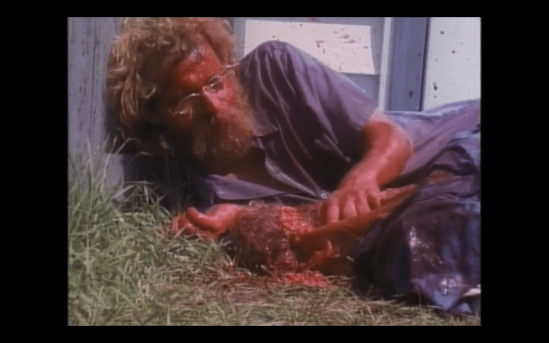
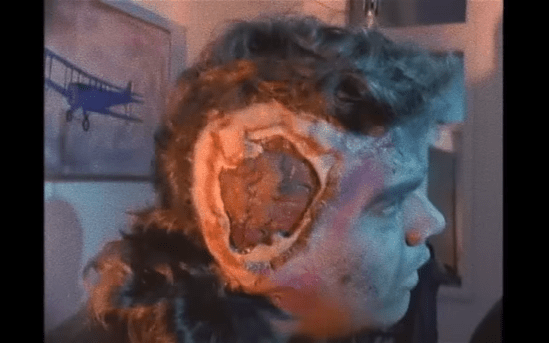
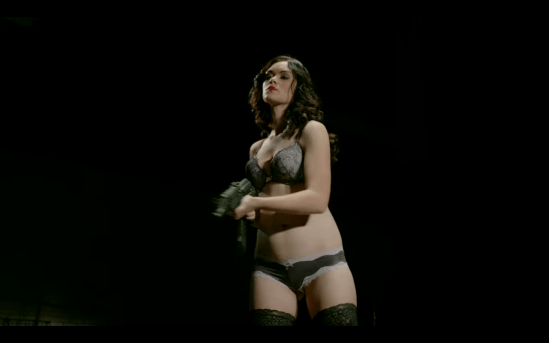
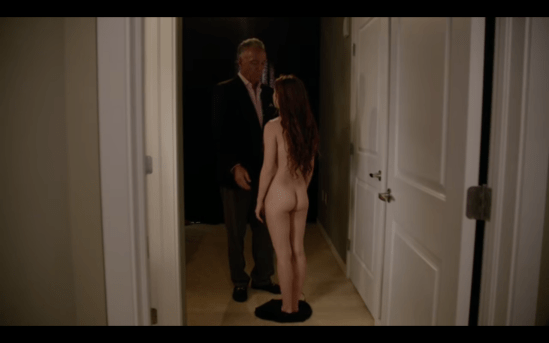
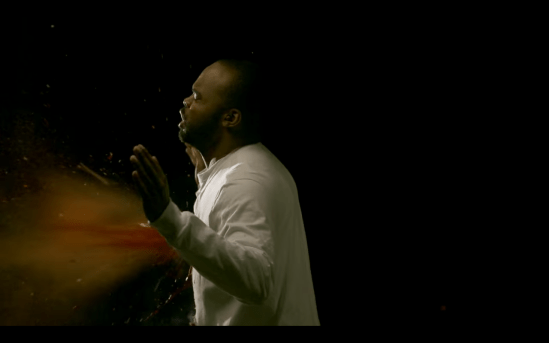
Ever since his wife’s life has staggered on the near brink of death, John’s mental state has been thrust into constant turmoil. Unable to get straight answers from doctors and stuck inside the vapid white walls of a hospital, John remains by his unconscious wife’s hospital bed. When a mysterious man with a severely disfigured face wrapped in bandages offers him a locket that will grant him a single wish, John’s desperation to try anything to save her soul stretches beyond logic and reality, overpowering his rational principles. Despite coming with an ambiguous warning on how to detail his wish, John heedlessly requests that death cease to exist. The locket grants endless life not only for John’s wife, but for everyone as the dead rise from their eternal slumber in perpetual anguish that sends them into a frenzy of violence without a means to an end.

“A Wish for the Dead” is the first venture into a Renegade Art production and a Shami Media Group, or SMG, release for Its Bloggin’ Evil and, to be frank, the viewing re-establishes a couple of important things: 1) “A Wish for the Dead” has tremendous bite for an under the radar flick and 2) never rule out modestly financed films based on their technical appearances. The 2014 micro-budget indie horror from the short film director of “The Confession of Fred Kruger,” Nathan Thomas Milliner, along with the editing, photography, and co-writing assistance from “Girl Number Three” writer Herschel Zahnd, takes the cautionary tale themed with a careful what you wish for approach when despondency has one backed against the wall that leads to direly lethal negligence. Milliner’s film that’s based off a comic book of the same title might not be “Wishmaster,” starring Andrew Divoff, but can certainly be grouped into that similar genre realm where the ugliness of mysticism mischief can be personally devastating instead of gratifying. The film can also be lassoed into the over saturated zombie category because, well, you know, the whole arise of the undead thing.

“A Wish for the Dead” has a fairly large cast, but doesn’t have definitive leads. Instead, Milliner and Zahnd scribe a tale with miniature, personal scenarios for characters with John being a considerable catalyst or, an interpretation, of a centralized character. John’s played by Chris Petty, who had a bit part in the Zac Efron Ted Bundy biopic “Extremely Wicked, Shockingly Evil and Vile,” and despite the character being fairly one dimension, Petty sells the performance of a grieving, greedy husband. John encounters the mysterious, disfigured stranger in a trench coat, head wrapped like a mummy, and nodding John over like a he’s going to sell him a knockoff Rolex from the inside lining of his coat, in Robert Hatfield that tempts him with the wish granting locket. Hatfield version of a biblical villain has charismatic and devilish value, but nothing new to note the rendition from previous performances of shallow humor and sly mischief upon an cutting grin. Branch off stories that indulge into supporting characters un-charmed, demised lives fill in the gaps and provide fuel for the undead fire and these supporting characters include Lori Cooke (“Girl Number Three”), Kristine Renee Farley (Hi-8 – Horror Independent 8), Adam Pepper (“The Zombie Movie”), Julie Strebl (“Volumes of Blood: Horror Stories”) and Ashley Anderson.

The beginning of this film starts off oddly as soon as the title credits roll for the feature film and coming to the realization that the viewer is actually not submersed into the actual story yet. First slither portion of the film is a short thriller, noted at the conclusion as being directed also by Milliner, that becomes clearly distinct from the rest of the plot line. The abnormal sequence snaps the story’s fluidity as a seamed segue that then constructs the multiple-tiered building blocks for the heart of the feature. Once the short has past, much to our chagrin that we believed to be the actual film, “A Wish for the Dead” goes into a precision mode with coordinating individually wrapped death backstories and while Milliner attempts to get us to care about these characters, all is washed away and lost when death revokes all their previous, present, and future terminations. The backstories become null and void when not circled back to for the exception of John and his wife that find’s a sweet ironic malevolency making “A Wish for the Dead” satisfying in the end.

MVDVisual and Shami Media Group courteously releases Nathan Thomas Milliner’s “A Wish for the Dead” onto a not rated DVD home video. Presented in a stretched 16:9 aspect ration, the lossy video quality and the lack of color, mostly in a squashy greenish-yellow, chap into sore spots along the 80 minute runtime to the almost the point of SOV quality. Darks are plagued with digital noise that remove the sharp quality from the image, leaving the story to fend for itself and make up for the lack of presentation. The English 2.0 stereo sound mix pops during the higher pitches of dialogue and of some action points, but the dialogue is in the forefront and nicely balanced amongst depth and range considering. There are no bonus features on this release, but as an interesting note, Milliner illustrated much of Scream! Factory’s home video artwork (releases such as “Halloween II and III”) and for HorrorHound Magazine. The artist and filmmaker’s graphically detailed and perfectly suited talents grace the SMG cover as well. A wish granted for the major win with “A Wish for the Dead” as a macabre success story for independent filmmaking for aspiring artists despite the post-production engineering for a cleaner release, but death isn’t pretty, is it?
Category Archives: Death
EVIL Wants to Feed Off Your Pain & Suffering in “Hotel Inferno” Reviewed!

Gulf War decorated soldier Frank Zimosa uses his particular set of skills as a professional contracted hitman. Frank’s current assign takes him oversees to a luxurious hotel to eliminate a couple of marks, a man and a woman, who are itemized as atrocious serial killers who’ve murdered over 150 people and Frank’s employer seeks to provide the same gruesome retribution in a certain kind of way – remove the brain the skull and the guts from the body. The relatively simple task for Frank turns into a fight for his life and his very soul as he finds himself trapped inside the hotel, owned by a secret organization swarming with putrefying acolytes of an ancient, fire breathing demon known as The Plague Spreader. Frank was ordered to kill to satisfy her pain and suffering hunger pangs, but his tenacious refusal awakens the demon who now hunts him, craving his pain, his suffering, his eternal soul for her own sated gratification and disrupts the organization’s creed to keep her dormant for the sake of humanity.

More, more, more! My internal fireworks outpouring and wanting more from a fire and brimstone gore forged finale from the action-packed first person view feature length horror film, “Hotel Inferno,” could not quell the embodied explosiveness wanting more from writer-director Giulio De Santi! Hailing from Italy, “Hotel Inferno” pulls little-to-no punches when dishing out uber-violence and non-stop carnage that invigorates the sensory and corporeal experience in the first installment of what’s called the Epic Splatter Saga that will total over six films. Two have already been produced with the third in production! De Santi, who is no stranger to the fervid gore film, teams his visual effects knowledge with long time, special effects collaborator, David Borg Lopez (“The Mildew from Plant Xonader”), and makes something shockingly beautiful that’s only been wrongfully teased in predecessors.

What’s also unique about “Hotel Inferno,” other than its first person perspective, is nearly the entire dialogue is layered with a voice over track. Unique as well as cleverly cool, we’ll touch on why later, faces with distinctive dialogue pinpoint main characters, but their faces are either shrouded by some sort of horror-esque mask, turned away toward another direction, or fed through a communication conduit, such as a portable television-radio device. Same goes with lead character Frank Zimosa whose vision never goes eye line with a mirror, never gaining a glimpse see his frantic mug, though Zimosa sounds like a chisel chin, hard-nose, angry-looking ass kicker, especially when voiced vehemently by Rayner Bourton. Playing the arch nemesis that’s quickly established and continuously prominent through duration is not the all-powerful Plague Spreader, but, in fact, the faceless Jorge Mistrandia. Donning the voice is English born actor Micahel Howe (“Solo”) who has one of the more sinister intonations amongst the few; an attribute that can be cool, calm, and inviting and can suddenly transform into a treacherous, malevolent, and vile performance that amplifies the intensity tenfold. Bourton and Howe are essentially the sole two main characters inside a melee of supernatural goons and goblins, amongst them in the cast is the introduction of Jessica Carroll who went on to do more voice work in video games and actors from De Santi’s inner film circle with Christian Riva and Wilmar Zimosa, who without a doubt was the moniker inspiration for Frank.

What sets “Hotel Inferno” apart from other splatter films? The first person shooter style, or FPS, video game structure is it! In literally the first of it’s cinematic kind, “Hotel Inferno” looks, sounds, and feels like a FPS from start to finish, a blended progeny from the ultra-violent horror survival games like DOOM or BLOOD; honestly, everything about De Santi’s film feels like a BLOOD rendition minus the shirtless, axe-wielding zombies and the robe hooded, tommy gun shooting cultists, though the rotting henchmen due speak in a high pitch dialect. Think about it. In BLOOD, a game built on a foundation of iconic horror, the anti-hero, Caleb, is a gunslinger against a unholy cult he once was a part of and then becomes his opposition. Same goes with “Hotel Inferno’s” own anti-hero Frank Zimosa, a hitman hired by an organization who then deceives him for nefarious reasons and then Frank has to blast his way out to save his soul. The story goes right for the throat, throwing Frank almost immediately into peril, and from room to room, layout to layout, the anti-hero has to slice through henchmen and ghastly demons in a very HOUSE OF THE DEAD kind of face-off, weaponizing everything against foes with armaments in the anterior of a cultish backdrop. Super. Fucking. Cool.

MVDVisual distributes Giulio De Santi’s “Hotel Inferno” onto DVD from the Wild Eye Releasing’s Raw and Extreme label. Presented in a widescreen, 16:9 aspect ratio, the Necrostorm produced “Hotel Inferno” engages the viewer into battle, but also invokes slight vertigo and turbid at times, especially the cave-like dungeon that’s almost absolute pitch-black. Again, atmospheric video games are much of the same regard for instant jump-scares and De Santi pulls that off here by not illuminating much of the scenes. The English language Dolby Digital 2.0 stereo audio track is in an opposing stratum to how the film plays out; doesn’t quite sync with the action as the audio track is an obvious track laid on top to emphasis how much “Hotel Inferno” is like a FPS storyline. There’s an array of depth and range from each tier Frank has to painfully endure and willfully live through. English and Italian subtitles are available. Bonus material includes a secret bonus film entitled “Hallucinations,” a rough cut SOV, direct-to-video supernatural gore feature from twin brothers John Polonia (“Feeders”) and Mark Polonia (“Sharkenstein”) and Todd Michael Smith (“Splatter Farm”). Giulio De Santi’s “Hotel Inferno” is only part one of the highly anticipated Epic Splatter Saga, with part 2 and 3 very high on my to-do list The blood splatter is in a doom of mayhem, will quench gore hounds from any walks of life, and reap the collective FPS gamer from their stationary consoles and blow their mind with the most seriously berserk action-horror of this decade. Crudux cruo!
The EVIL of True Norwegian Black Metal Roots Out the Posers! “Lords of Chaos” Review!

Euronymous, an Oslo teenager hellbent on launching true Norwegian Black Metal, shapes his band Mayhem with edgy publicity stunts that invokes the calling of Satan and being an anarchist against the moral norm to make his brand renowned around the underground music world in the late 1980s. As his fame flourishes with creating ungodly music, owning and running a music store, and helming his own record label, Euronymous continues his crusade agasint the establishment, but the lines blur when his messages of hellfire become unforeseen reality. Suicide, arson, violence, and coldblooded murder push Euronymous to the limits of his own soapbox inactions, leaving him open for the possibility of being overthrown by his own acolyte metalheads.

To prepare myself for Jonas Åkerlund’s biographical thriller, “Lords of Chaos,” I immersed myself into Jason Lei Howden’s 2015 black metal horror film “Deathgasm” as precursor preparation into the intense and unforgiving metal macabre genre. Whereas “Deathgasm” is a balls to the weed whacker splatter film of the pissed off demonia kind, “Lords of Chaos” is a polar horror feature with factual roots. Åkerlund’s, who directed Mads Mikkelson in Netflix’s “Polar” and has an extensive history in directing music videos for various artists, draws inspiration for the 2018 film from his own experience in a Swedish Black Metal band, Bathroy, from the late 80’s. The Grammy award winning music video director creates beauty out of the horrific true life event, unidealized nearly entirely without much speculation that faithfully puts to picture a misanthropic tragedy in a bone-chilling manner.

From “Signs” to “Scream 4,” Rory Culkin has remained on the actors-to-watch radar and is most certainly, our favorite Culkin to watch on the screen. In “Lords of Chaos,” Rory plays and narrates the story as Øystein “Euronymous” Aarseth, the guitarist and creator of Norwegian Black Metal band, Mayhem. As if written stars, Euronymous surrendered to Rory Culkin’s performance and Rory Culkin became Euronymous. The eerie synonymous blurred identities that catapults Culkin to be admired amongst his peers and his worked beloved. Opposite Culkin is Emory Cohen as Kristian ‘Varg’ Vikernes, former Mayhem bandmate and convicted murdered of Euronymous. Cohen is bitterly intense with a historical figure whose committed arson and homicide and the New York City born actor uncomplicated approach to a complicated character had a natural phenomena about that would spook your soul from your body. Culkin and Cohen fed off each other’s energy to an explosive dynamic too good to be stagecraft. Another highlight from “Lords of Chaos,” though rather story line brief, is Val Kilmer’s son, Jack Kilmer, as Per Yngve Ohlin aka Dead. Kilmer tackles a depressed introvert and, in one opinion, nails the mental deficiency metalhead who was ordained to take his own life with great savagary showmanship. The film also costars Sky Ferreira (“Green Inferno”), Valter Skarsgård, Anthony De La Torre (“Johnny Gruesome”), Jonathan Barnwell, Sam Coleman (“Leatherface”), and Lucian Charles Collier.

If not paying attention, “Lords of Chaos” will slip under the radar since most audiences are conditioned to subsidize shiny cinema productions that make you feel all warm and cozy inside and spark wander and induce marvel and amazement. Åkerlund’s film will not send those sorts of puppy dog tingles down your spine. Many biopic films about ill-fated tragedy don’t do well with the general population; “Auto Focus” comes to mind with Greg Kinnear and Willem Dafoe. Critics eat up the inherent black dramas like Cookie Crunch and “Lords of Chaos” exudes madness and misery through deep seeded vigor for fame and principle. Åkerlund deserves nothing but our admirable applause for delivering an unadulterated visualization of literal mayhem from soup to nuts.

Umbrella Entertainment releases onto DVD home video “Lords of Chaos,” a co-production from Gunpowder & Sky, 20th Century Fox, Vice Films, and Insurgent Media. Presented in a widescreen, 1.85:1 aspect ratio, Umbrella Entertainment’s picture quality is exemplary in it’s natural, yet supernatural-like surrealistic manner in a clean digital presentation. Pär M. Ekberg’s depiction is hard-edge elegant and haunting with recreations of and the intertwinement of actual photos of Euronymous, Varg, and Dead. If you’ve seen “Polar,” you know Åkerlund and Ekberg brush stroke a fine line between reality and graphic novel much the same as “Lords of Chaos'” allegory. The English language Dolby Digital 5.1 surround sound mix has high level attributes with clean and perceptible dialogue, a vast range of ambient noise, and a killer black metal soundtrack worth banging your head to. No bonus features accompany this title. “Lords of Chaos” is a heavy story that needed to be told and feels very much like a part of Åkerlund, an extension of himself through his past brought forward to illuminate the blackness in us all derived from the power of metal with a psycho-psychology that’s industrial-built.
Insecurity is a Path to the EVILside! “Killing Spree” review!

Airplane mechanic Tom Russo is a newly married man; it’s his second marriage, in fact. Tom’s first go around in marital union didn’t go over so well as found himself on the other end of being a victim of adultery. Paranoid and skeptical, Tom requires his young and hot new wife, Leeza, to become a house wife as he works long, exhausting hours to support his family in a one income household. As the work hours pile, money becomes tight, and tensions build in the back of Tom’s mind, paranoia steamrolls Tom’s reality when he starts suspecting a lonely Leeza of screwing every delivery, repair, and lawn car man that knocks at their door. Without confronting Leeza with his delusions, Tom’s extreme jealously pushes him to kill and bury the men that he envisions involved in the affairs, but his victims don’t stay dead, they don’t stay buried, and seek the eternal suffering for their killer.

A few, long years have gone by since our last encounter with the practical effects-heavy, indie horror director Tim Ritter. From his disturbing tale of destructive descent in “Truth and Dare?: A Critical Madness to his “Switchblade Insane” segment from the SOV masters of horror in the ghastly-variant anthology “Hi-8 (Horror Independent 8)” that also helms short films from Donald Farmer (“Cannibal Hookers”), Todd Sheets (“Dreaming Purple Neon”), and Brad Sykes (“Camp Blood”), the filmmaker has a legacy of blood-shedding entertainment. Today, exploration into Ritter’s “Killing Spree” unearths his passion for horror that develops out of influences from other horror icons before leaving his bloody footprint in the indie scene. “Killing Spree,” written and directed by Ritter, displays the filmmaker’s deep affection for Fangoria magazine having it displayed, repeatedly used as coffee table literature prop. There’s also admiration for “Night of the Living Dead” in the bonkers film about one man’s mind snapping like a twig under the formidable stress. The main character’s name is Tom Russo and Russo is the last name of NOTLD co-writer John Russo and let’s not also forget about the undead rising from Tom’s backyard is fairly synonymous with zombie classic.

While Tim Ritter flicks may not be graced with star-studded actors and actress, even from the B-movie lot, and more than likely don’t spawn hidden talent, there’s still something to be wholeheartedly said about the cast of his films that can only be described as an eclectic bunch of marvelous misfits that bring underground brilliance to the screen. Asbestos Felt is one of those said characters. No, I don’t mean the toxic asbestos felt roofers use as a underlaying backing when nailing in shingles. “Killing Spree” is one of three films Felt and Tim Ritter have worked on together and the scrawny-build with a strung out Grizzly Adam’s head on his shoulders has a wide-eyed spectacle about him when playing Tom Russo spiraling down the crazy train drain. Tom’s obsession with keeping Leeza from the perverted grips on those naughty repairmen would drive any wife away, but not Leeza, played by Courtney Lercara. The “Slaughterhouse” actress is an aesthetic flower growing in the middle of all the mayhem and she protrudes an innocence well received by her character. Other cast members include Bruce Paquette with the white boy dance moves, indie horror vet John D. Wynkoop (“Brainjacked”), Kieran Turner, Alan Brown, Rachel Rutz, Cloe Pavel, and Raymond Carbone as a dirty old pilot with a wise guy brogue.

Remember when I said these types of horror films don’t typically expose acting artistry? Well, behind the camera, one or two crew members start their illustrious careers in the indie trenches. Such can be said for special effects master Joel Harlow who makes his introductory launch with “Killing Spree” and then find work on a couple sequels for “Toxic Avenger,” “Basket Case 2,” and all the way up to the Neil Marshall “Hellboy” and “Godzilla: King of the Monsters.” Yeah, I think Harlow made out OK. Harlow’s effects on “Killing Spree” will “blow your mind,” as stated on the back of the Blu-ray cover. Well, when Leeza’s head turns into giant lips then goes oral on Raymond Carbone’s head until his crown ejaculates, then, yes, these effects will blow your mind…literally! The medley macabre showcase Harlow’s craft from A to Z that includes a torched corpse, a disembowelment, severed undead head, and a nosy neighbor without a nose or without half a face for that matter.

Sub Rosa Studios re-releases “Killing Spree” onto the dual format, DVD/Blu-ray combo set with MVDVisuals providing distribution of the limited 666 copies. Essentially, this is the same release that was made available a couple years back presented in a standard television format of 1.33:1. The Betacamp SP 16mm video has held back the test of time since 1987, but with any video film on a budget, the rather cheap recording method does come with inadequacies, even if being remastered. For the entire runtime and not just in the tinted moments of carnage, the skin tones are akin to Donald Trump’s uncanny neon orange flesh and perhaps could have gone under an extensive color correction. Aside a few very minor tracking issues and faded coloring, the video transfer passes substantially well despite the continuous flare of orange. The English stereo 2.0 mix isn’t hearty or robust. Whenever Tom goes into maniacal mode, his crazy quips are quite soft even when he elevates his voice, and that goes the same with depth and range which are non-existent over the course of a flat audio tracks. Though soft at times, dialogue strongly comes through in the forefront with some fuzzy nuances. Bonus features are killer on this release with the Blu-ray sporting the majority with a never before seen extended director’s cut, a new commentary track from director Tim Ritter, a 90 minute documentary entitled “Blinded by the Blood,” a radio show commentary by H.G. Lewis and Tim Ritter, music tracks, photo slide show, three alternative scenes, blooper reel, and a Joel D. Wynkoop segment. The DVD also includes the director’s cut version of the film, the new commentary by Tim Ritter, and commentary for the original cut by Tim Ritter. “Killing Spree” is as grisly as the SRS cinema Blu-ray/DVD cover implies and then some with all the characteristics of a deranged and unhinged man exerting himself beyond the limits of sanity and mortality to unambiguously protect what is his; a dramatize example rendered as a metaphor for those who will do anything to protect what’s theirs.
Bikini-Cladded Revenge on a Small Time EVIL Crime Syndicate! “Rondo” review!

Disturbed and dishonorably discharged Paul finds solace at the bottom of a glass bottle. As Paul falls deeper into dire depression with drugs, the drink, and cigarettes, Jill, his sister, lays down some ground rules while he crashes on her couch. At her advice and insistence, Jill schedules a psychological appointment for him and the doctor recommends sex as a release and not just any old sex, but the behind-the-doors, underground, Freak-a-leak kind of kinky encounters. Paul joins two other men in a high rise condominium, receiving instructions on how to treat and mistreat an affluent man’s wife, but Paul becomes the witness to an organized murder party and flees for his life, barely escaping the clutches of his captors, and returning home to his sister Jill to tell her everything. The only problem is, the killers know his address and now their business becomes a family affair loaded with straight razor slashing, crowbar bashing, and automatic weapon firing mayhem.

“Rondo” is an icy revenge thriller with bullets and blood galore from writer-director Drew Barnhardt. The “Murder Loves Killers Too” director reinvigorates a pulp noir approach into the independent film market that invokes woman power through all sorts of masculinity muck. Breanna Otts and Gena Shaw flourish as the anti-leading lady by wielding large assault rifles and being the kingpin of killers amongst a bunch of kneeling and broken men. “Rondo” is also about family, believe it or not. Whether bound in endless love or broken beyond repair,the theme of taking care of your own blood comes to the forefront, but before you go showing your kids, “Rondo” takes family to hell and back and then back to hell again for a rough ride of riveting vileness and hard-on revenge.

“Rondo” doesn’t necessarily have a lead character. In act one, the voice over utters over the pitiful existence that is Paul (“Galaxy of Horror’s Luke Sorge) who, at the persistence of his sister, tries to step outside the path of destruction by stepping into a sex den at the advice of a radical, and very pregnant, psychologist. The voice over is curiously used since pertaining to the fact that the narration, provided by Steve Van Beckum, becomes nearly Paul’s inner monologue by the end of his tenure. Act two transitions into a father and daughter reunion and then revenge plotters. No voice overs accompany the two, but Jill (“Westworld” and “SWAT” actress Breanna Otts) and her father Sam (“Rage of the Mummy’s Michael Vasicek) have an exposition fest involving what ifs and to dos. Sam felt to be a wasted character; an escaped VA patient returning to his children for revenge that doesn’t quite grow from there. On the other hand, Jill extends into act three as the sole protagonist and her thirst for vengeance is clunky and clanky, stirring up a halfcocked plan in the belly of the beast that happens to work in her favor and in our favor too as Otts ends up in lacy underwear in an episode of boobs and bullets. “Rondo” rounds out with Ketrick ‘Jazz’ Copeland, Reggie De Morton, Gena Shaw, Kevin Sean Ryan, Grant Benjamin Leibowitz and introducing Iva Nora in her first role and first nude scene.

Conceptually, Barnhardt’s tale of ravage savagery rouses out from the cobwebbed conventional anecdotal pathways and while “Rondo” might be a tale that’s rarely been told, apprising the plot into maturity bid Barnhardt with a far more difficulty, leaving to squash the answers to far more questions at the roll of the end credits. One of the more puzzling questions is why does the voice over only narrate for Paul? Kicking off with a voice over that explains Paul’s downtrodden life, then transitioning quietly into Paul’s inner thoughts, and then disconnected completely that literally leaves a punctuation question mark hover just over our scalps. There’s also the question of how deep this criminal organization roots in society? How did Cassie, wife of the barbaric boss Lurdell, get to assimilate herself into positions of power to influence poor souls to become meat for the grinder.

Artsploitation Films distributes an American bloodbath with “Rondo” onto DVD home video. The not rated release is presented in a widescreen, 1.77:1 aspect ratio, and despite some banding, the picture quality spruces a fine package with natural lighting and little-to-no filter use. The Dolby Digital 5.1 Surround Sound pitches perfectly without some much of a hiccup. Range and depth are fine, though the film isn’t necessarily a heavy hitter with action, and the channels are level amongst the LFE gun blasts in the cap your ass finale. Bonus features include a director’s commentary, deleted scenes, selected music commentaries with composer Ryan Franks, and an exhibition of the gritty pulp cover art and lobby cards set to a musical score. “Rondo” is a cult indie classic through the venomous teeth of white-collar Americanisms and a torrent of human immoral inclination that relentlessly shows no mercy scene after scene.