Experimental doctor, Anton Lupesky, invents a controversial drug that can free a human soul from its vessel and travel through into the lifeless eyes of a corpse, possessing the body to reanimation. The only side effect is grotesque hallucinations that are so horrible, few survive the experience. After a stint of missing persons and a string of mysterious deaths at the Whitebriar Institution, Lupesky is fired from his position, banned from the medical board, and brought up on criminal charges. His acquittal sparks him to embark on a journey overseas to continue his radical medical experiments, away from regulations and tremendous oversight. The doctor returns six months later for far superior medical innovations in America and begins practicing again in his own basement with the unscrupulous help from a couple of lackey acolytes that leaves Lupesky’s supply of “patients” not in short demand. One reporter keeps investigative tabs of the good doctor as she suspects a connection between him and her father’s death at Whitebriar and when her and her friends starts to snoop around, Lupesky has no choice but to use any means necessary to thwart her investigation, even if that means secretly administrating the drug to her in hopes that her soul can fly with his – if she survives.

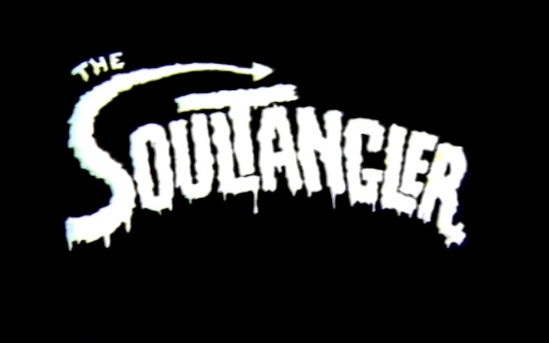
Thirty years ago, “The Soutangler” hit the cinema market. A low-budget gruesome mad scientist flick with a penchant for some fantastically grisly practical special effects. The 1987 shocker was directed by Pat Bishow, penned by John Bishow and Lance Laurie, and shot on location on Long Island, New York. The Do-It-Yourself and Lovecraftian macabre does a bit of soul-searching to find resurrection from the video graveyard. Luckily, Bleeding Skull! Video and the AGFA come to the rescue with a chock-full of extras release that digs up the Bishow’s lost creation, dusts it off, cleans it up, pats it on the butt, and sends it back out into the world onto DVD home video. “The Soultangler’s” niche envisioning goes against the grain of traditional filmmaking, bordering experimental, but definitely a must-see for those interested in existentialism horror: the removal of free will to be replaced by another’s.

Pierre Devaux stars in his only credited as the mad Dr. Anton Lupesky that resembles along the lines of a Dr. Herbert West from that little known trilogy of the H.P. Lovecraft inspired “The Re-Animator.” With a wiry frame, stringy shoulder length hair, and government-like issued classes, the very animated Pierre Devaux casts the ideal character whose maniacal and perverse in his medical malpractices. The only one willing to stop the Lupesky’s experiments is investigating journalist Kim Castle of The Daily Chronicle. Castle, played by Jane Kinser, is about as ferocious as her beautiful as an aggressive reporter, unwilling to stop to unearth the truth of her father’s tragic death. Kinser’s not much of an onscreen force to reckon with as she’s quite timid, but she manages to hold her own up against Devaux wild eyed lunacy. Rounding out the cast is Bob Cederberg as a Carl the drugged addict henchman, Louise Millman as a loyal minion to Lupesky, and Tom Ciorciari as Castle’s concerned friend who battles the zombified corpses embodied by Dr. Lupesky.

While a strong appreciation exists from the outstanding attention to detail with the decayed bodies and the explicit violence in the finale that nightmarishly flourish in a heap of ghastliness, the rest of the film is as disjointed as the dismembered bodies in Lupesky’s basement of horrors. Despite being submersed in various talking head scenes that divulge significant backstories between Dr. Lupesky and Kim Castle, the story struggles to keep the straight line focus, swerving erratically between subplots and the main premise. Castle’s horrific dreams of aggressive zombies loosely makes a connection other than prepping Castle’s subconscious when ingesting Lupesky’s soul freeing drug. The story of Dr. Simpson also flounders to the waist side with her and Dr. Lupesky’s love affair, the only women he would even consider getting close to and not slaughter for his own amusement.

“The Soultangler” arrives onto full-bodied, graphically illustrated DVD from the B-movie collaborators Bleeding Skull! Video and the American Genre Film Archive (AGFA) and distributed by MVDVisual from the original 1″ master tapes. Shot on 16mm, but edited on video, “The Soultangler” has a SOV experience in it’s original aspect ratio of a full frame 1.33:1. Quality varies from the source material, including some tracking and edge flare issues, but overall a solid transfer with a sizable color palette that includes tints, natural skin tones, and visceral dream sequences that show little-to-no sign of diminishing. Stereo mono track does the job despite poor mic placements to get the full girth of dialogue. HypnoLoveWheel’s indie synth/rock soundtrack has more popularity on the B-level than in the mainstream music, but serves “The Soultangler” with broad depth to solidify a wedge between “The Soultangler’s” whimsical charm and the Gothicism that is Stuart Gordon’s “Re-Animator.” Bonus features include, for the first on any release, the Unseen 62 minute alternate director’s cut, a commentary track with director Pat Bishow, behind the scenes footage, trailers for “The Soultangler” and “Dead of Night Town,” music video for “wow” by HypnoLoveWheel, and liner notes by Bleeding Skull’s Zack Carlson. Conceptually, “The Soultangler’s” premise oozes originality and creativity involving soul transformations through the portal eyes of a dead body and that’s simply brilliant and what today’s horror genre certainly craves. Constructionally, Pat Bishow couldn’t push the momentum to pickup the pace to overripe an engaging story, but the climax, out of left field, unsheathes a bloodbath of ultra-stellar, DIY proportions!
Category Archives: Death
Evil Gets a 4K Digital Transfer! “Ichi the Killer” review!

Three hundred million yen and Yakuza boss Anjo have disappeared without a trace. Anjo’s most deadly and most sadomasochistic enforcer, Kakihara, and the rest of the Yakuza gang embark on a torture-riddle search and rescue to find their missing boss. After unrightfully torturing and mutilating a rival Yakuza leader, Kakihara learns through a trail of mayhem of a fierce killer known as Ichi and after being exposed to Ichi’s grisly handiwork first hand, a usually stagnant and emotionally detached Kakihara becomes stimulated and eager to go one-on-one with a formidable foe like Ichi, who could possibly bestow upon him gratifying pain to feel something other than emptiness. Ichi’s eviscerating destruction isn’t totally in his control as the sexually-repressed and candidly disturbed overall nice guy is being coerce through psycho-manipulation by Jijii, an old man seeking retribution against the Anjo gang. With blades projecting from his shoes and his skill at martial arts, the timid Ichi becomes the ultimate killing machine when brainwashing takes him over the edge into a hysterical fit of rage that leaves guts and blood to paint the floor and walls.

Perhaps director Takashi Miike’s finest work, the 2001 Japanese blood bath “Ichi the Killer” is a must own for any film aficionado teetering on the razor wire between crime dramas and gory action flicks that might be on the viewing docket for then night, but certainly a must-see for all film lovers at some point in time. Miike’s stone cold, chaotic style of filmmaking embraces the story’s unwavering havoc that blisters with ruthless brutality between two very different, black and white characters with one thing in common – being good a killing. Based off the manga penned by Hideo Yamamoto and from the adapted screenplay by Sakichi Sato, Miike crafts the most disturbing elements of mankind and brings them to the forefront in a simple story of revenge. On one side, there’s Kakihara, a scarred-face Yakuza enforcer with a very rich violent history to the extent that he’s become numb to his own existence in the world and then there’s Ichi, a reclusive cry-baby stemmed from being mentally fed graphic bulling stories of battery and rape in a memory built upon languishing lies. Vastly different, well-written characters opposite the spectrum and both are good at dealing death, but one aims to dish it out and the other yearns to stop his carnage, and that compelling core element is immensely fluffed by extreme violence in a way that only Miike can deliver it.

But for a film like “Ichi the Killer,” Takashi Miike had a little (hint of sarcasm) help from his gifted cast in making this project a cult success. Before this actor was Hogun in the Marvel Universe’s “Thor” franchise, Tadanobu Asano shaped up the psychotic enforcer Kakihara and the usually dark featured Asano reconfigures his appearance to put life into the character who sports blonde, wavy hair, a frothy complexion, and small hoop piercings at the corners of his lips to keep the slits from opening to expose the entire gaping jaw which is used as a defensive weapon. Opposite Asano is the Tokyo born Nao Ohmori who perfectly subjects himself to being a wimpy human shell with an explosive inner anger. The two men have only a small amount of screen time together and that requires them to build their character’s standout personalities. Complimenting their performances is an amazing support cast, including Shin’ya Tsukamoto (“Marebito”), Miss Singapore 1994 Paulyn Sun, Hiroyuki Tanaka, and Suzuki Matsuo.

“Ichi the Killer” is simply magnificent where it vulgarly touches upon various themes, mostly human flawed that also destines opposing counterparts together. Aside from the graphically realistic violence, Miike’s film hits upon other attributable tangents, among them some are just being plain gross, but these aspects are undeniably important to the story. Themes ranging from sexual suppression and female inferiority to sadomasochism and severe obsession top the charts in a heap of motifs throughout. Accessorial blood and other bodily fluids are extravagantly portrayed, spraying across the room with jettison entrails or dripping from potted plants to a cloudy puddle below during in a voyeuristic rape scene, to get the clear sense of an adult manga inspired chockablock exploitation and crime drama.

Well Go USA presents “Ichi the Killer” on Blu-ray in a newly restored 4K digital transfer of the director’s cut; a task undertaken by Emperor Motion Pictures in 2017. Presented in a widescreen 16:9 (1.85:1) aspect ratio, the film starts off with a blurb about the history of this particular digital restoration and transfer that asserts director Takashi Miike’s approval for release. Well Go USA’s rendering resembles much of the previous Tokyo Shock Blu-ray with subtle differences such as a slightly more aqua tint to the picture coloring and also much like it’s other Region A Blu-ray counterpart, a bit of noise is present in the restoration, but still the better detail of the two. The Japanese stereo 5.1 DTE-HD Master Audio surround sound has an bombastic soundtrack, but dialogue remains on the softer side where relying on the English subtitles is crucial. No issues with timing or accuracy in the subtitles. Surprisingly, the only extras included on the Well Go USA release is an audio commentary with director Takashi Miike and manga artist Hideo Yamamoto, still gallery, and the trailer that undercuts this releases’ purchasing value and might as well hunt down for the out of print Media Blasters Blu-ray, if extras are a must. Even still, “Ichi the Killer” has been resurrected in North America again and the release technically sustains growth amongst the mass of releases around the world. The lack of special features is disconcerting, especially being a restored director’s cut, but “Ichi the Killer” can stand on it’s own as a gracefully sanguinary masterpiece. Look for the Blu-ray to hit retail and online shelves March 20th!
]
Evil Doesn’t Care for pH Levels! “Hot Tub Party Massacre” Review!

In the midst of a deranged serial killer’s escape from prison, Four Delta Omega sisters enter a school raffle to represent their sorority and end up winning an all expenses paid hotel suite complete with a luxurious hot tub. As student bodies fall in the maniac’s wake, the sisters flight toward fun times before taking notice how many of their friends and fellow students become unfortunate slashed-up victims and just when things are getting wet and carnal, the killer checks in, crashing good times, and making mince meat out of the lucky winners and their boyfriends.

Budget horror filmmaker Chris Greenaway gets his hands into the sisterhood horror genre with his 2016 written and directed tongue-and-cheek horror-comedy “Hot Tub Party Massacre.” Campy. gratuitous. Schlocky. Greenaway has covered all the bases of a satirical slasher sporting a killer wielding a small garden cultivator – “cultivator” is a good title or moniker for another campy slasher as long as you put the proverbial “the” in front of it. Instead, we get the Canadian cult no-so-classic “Hot Tub Party Massacre” because nothing says killer party than an actual killer at your party and here the party is wet and wild with an escaped maniac on the loose, ready to randomly slice and dice the unscrupulous and individualistic sisters of Delta Omega sorority.

While there’s not a sole headliner to Greenaway’s film, like a Jamie Lee Curtis to Laurie Strobe or a Neve Campbell to Scream, the sorority girls attending the bubbly hot tub affair function as a collective headlining mass of alternative women. In alphabetical order, Amanda Nickels, Erin Hyndman, Jynx Vandersteen (“Father’s Day”), and Sarah Foster each represent Delta Omega’s finest in their respective personas as popular, bookworm, party (or slut?), and goth. The quintessential tropes to any routine slasher star as surprisingly benevolent with their upbeat attitudes and gracious acceptance of all kinds of people. When Hyndman’s nerdy Bethany states she probably shouldn’t attend trip, party girl Brandi, aka Vandersteen, counteracts with you’re one of us, a Delta Omega, and only the best become Delta Omegas. Their stalker, the elusive serial killer, is played by Mark Kiazyk trying to do his best Michael Myers impersonation from the chest down, as he’s frequently screened. Kiazyk’s has the look, a face of pure hatred, and I wish that was more prevalent as it’s a face for television. Rounding out the cast are Delta Omega boyfriends Danny Warren and Ken Wright, “Rust’s” Corey Taylor as a school spirited University newscaster, “you’re all doomed” guy Nicholas MacDonald, and the indie scream queen Brinke Stevens making her bit cameo.

“Hot Tub Party Massacre” is essentially one big homage to the enshrined horror flicks and pays it’s respects to, as aforementioned, Halloween with the killer. Also gives a head nod to Friday the 13th Part II in which a couple are jointly impaled in a very similar frame-by-frame sequence. Even one of the official poster concepts is a direct take from “Slumber Party Massacre” and perhaps the Delta Omega is a sign of respect to another Brinke Stevens’ classic, “Die Delta Die!” Greenaway’s “Hot Tub Party Massacre,” by title alone, is not a serious horror film looking to ripoff the foundational slashers, but relishes in a lighthearted satire that begins in a realm of Zuckeresque that loses the visual gag steam at the tail end. The montage of gratuitous nudity of Amanda Nickela, Jynx Vandersteen, and Sarah Foster notch up the “Hot Tub’s” antics in fleshing out the skin craving viewers who can’t get enough of blood and boobs. Awarding this feature as a good film, as a pivotal staple in horror, is an extreme over exaggeration and a poor case of judgement, but consider only chocking “Hot Tub Party Massacre” up to being Chris Greenaway’s ode to the archetype slasher genre.

Ron Bonk and his Sub Rosa Studios, along with MVDVisual, proudly present “Hot Tub Party Massacre” onto DVD that absolutely belongs right in SRS’s arsenal of cheap and outrageous horror. The Full Screen 1.33:1 presentation is what it is, an unmatted sign of low resolution and blotchy, patchy image quality. The 2.0 audio track is a seesaw of fidelity where some aspects of the dialogue are barely audible and then the high pitched shrieks, and their are many shrieks, could pierce ear drums through popping static noise. There wasn’t an expectation of par level video-audio quality, but the due diligence is to publicize, not necessarily criticize, that of the DVD technical contents. The DVD cover is straight out of a photo shoot with a round, thong-cladded booty and long legs very shapely in front of an in ground hot tub. FYI – the hot tub in the movie is above ground and in a hotel. Bonus features include commentary tracks, behind-the-scenes footage (that contains more nudity, by the way), and trailers. Chris Greenaway’s “Hot Tub Party Massacre” has a premise of a short-lived concept that has been run through the kitty-grinder more than once over, but unquestionably is a honoring low-rent tributing spoof of cult classic works that obviously inspired the Canadian horror filmmaker.
DVD/Blu-ray Announcement: “Children of the Corn: Runaway!”
You can’t keep these damn kids out of the corn fields! If you didn’t know this, “Children of the Corn: Runaway” is the 9th installment in this undying Stephen King spawned franchise and was helmed by “Feast’s” John Gulager!
Here’s the press release from Lionsgate:
PROGRAM DESCRIPTION
From director John Gulager (Piranha 3DD, Feast) comes a horrifying new chapter in the Children of the Corn series when Children of the Corn: Runaway arrives on Blu-ray™ (plus Digital), DVD, Digital, and On Demand March 13 from Lionsgate. Based on the original story “Children of the Corn” by Stephen King, the tenth installment of the legendary horror series follows a young woman who can’t escape her nightmarish past. Written by Joel Soisson (Children of the Corn: Genesis, Dracula 2000), the Children of the Corn: Runaway Blu-ray and DVD will be available for the suggested retail price of $21.99 and $19.98, respectively.OFFICIAL SYNOPSIS
Children of the Corn: Runaway tells the story of young, pregnant Ruth, who escapes a murderous child cult in a small Midwestern town. She spends the next decade living anonymously in an attempt to spare her son the horrors that she experienced as a child. Ruth and her son end up in a small Oklahoma town, but something is following her. Now, she must confront this evil or lose her child.BLU-RAY/DVD/DIGITAL HD SPECIAL FEATURES
· Deleted SceneCAST
Marci Miller (“About Abigail,” “Viper,” The Ringer of Rimachi)
Lynn Andrews (“Borderlines 2” the Video Game, “Ghost of Goodnight Lane”
Mary Kathryn Bryant (“Hellraiser: Judgment”)
Jake Ryan Scott (“Bunnyman Vengeance,” “Warning Label”)
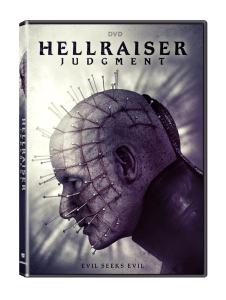
DVD/Blu-ray Release Announcement: “Hellraiser: Judgement”
PROGRAM DESCRIPTION
Experience a terrifying new chapter in the legendary Hellraiser series when Hellraiser: Judgment arrives on Blu-ray™ (plus Digital), DVD, Digital, and On Demand February 13 from Lionsgate. The tenth film in the classic horror series tells the story of three detectives as they struggle to solve a horrifying murder, but instead find themselves thrust into the depths of Pinhead’s hellacious landscape. Including horror icon Heather Langenkamp (A Nightmare on Elm Street, Wes Craven’s New Nightmare), and written and directed by Gary J. Tunnicliffe (Hansel & Gretel), the Hellraiser: Judgment Blu-ray and DVD will be available for the suggested retail price of $21.99 and $19.98, respectively.
OFFICIAL SYNOPSIS
The dreaded Pinhead returns in the next terrifying chapter of the classic Hellraiser series. Three detectives trying to stop a diabolical serial killer are sucked into a maze of otherworldly horror, where hellish denizens including the Auditor, the Assessor, and the Jury await to pass judgment.
BLU-RAY/DVD/DIGITAL HD SPECIAL FEATURES
· Deleted & Extended Scenes
· Gag Reel
CAST
Randy Wayne – “Escape Room” and “Death Pool”
Heather Langenkamp – “Star Trek: Into Darkness” and TV’s “Truth or Dare”
Paul T. Taylor – TV’s “Sheltered” and “Alternative Math”
Rheagan Wallace – TV’s “Malcolm in the Middle”