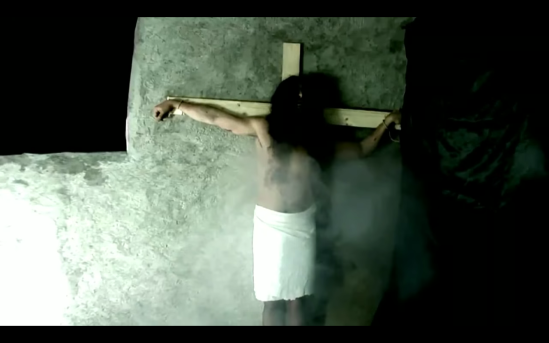
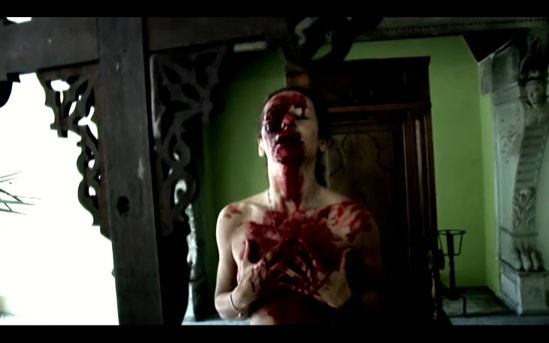
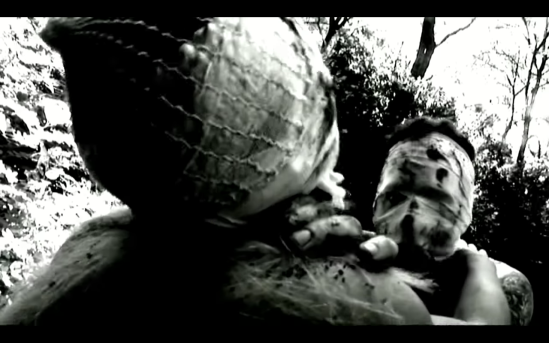
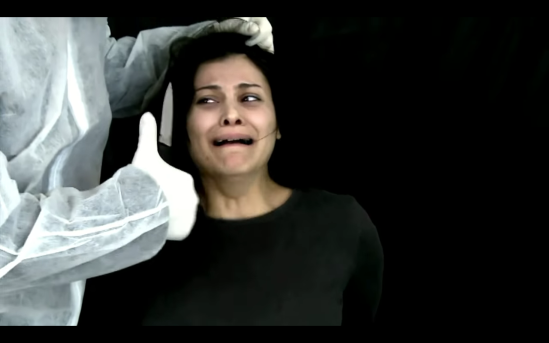
Welcome to the Suffering Bible, a collection of violating and gory interpreted religious allegories digging into stark contrasts of sin and piety and illuminating the darker side of these allegories with a lacerating gruesome perspective. These short stories include the internal strife of a psychopaths strong urge for forbidden lesbian companionship with the contentious, bigoted teachings of finding forever friends inside God’s eyes, a visceral performing depiction of the Incredulity of St. Thomas, an extreme mortification of the flesh, the prideful consequences with a Devil’s pact, and the murderous portrayals of lost souls needing redemption into God’s good graces.

Right in time for the Easter holiday, where Jesus Christ has risen back from the dead for our salvation, comes Davide Pesca’s written and directed “Suffering Bible” of sinfully derived tales of reverent and irreverent perfervid images. The Italian made and produced anthology that’s a contexture of stories is forged together with a wraparound story of the Adam and Eve in the Garden of Eden apologue. “Suffering Bible” begins with a title card excerpt, Tear thy neighbor as thyself, from an unknown storyteller named saamang Ruinees with a skewed version of the second commandment, Love thy neighbor as thyself, subtly denouncing the evils in popular religious culture and then slithering them, not so subtly, into the shorts of those suffering at behest of the bible. Pesca’s shock efforts have come across ItsBlogginEvil.com’s radar once before with another short framed macabre tale, “Hemophobia,” from Artsploitation’s home distributed release of “A Taste of Phobia” anthology and “Hemophobia” is and feels more commercialized with less than salutary toward mutilation and variety body meat, but the filmmaker does fly on a parallel body horror plane and has had his shorts featured alongside with fellow Italian auteur and shock director, Domiziano Cristophario (“House of Flesh Manniquins,” “Red Krokodil”) with a more rudimentary, analogue-video-feel approach. “Suffering Bible” is self-produced by his independent production and distribution company – Demented Gore Productions.

Being an Italian made cast functioning on the performances grounds of a heel budget writing up about “Suffering Bible’s” actors and actresses past credits, influences, methods and so on is proving to be a challenging task. Most of the cast is comprised of alternative, half-naked women, such as Nicola Fugazza and Mary Rubes who are the sole credited on IMDB.com. Rubes, an erotic model, becomes “Suffering Bible’s” inadvertent poster girl that graces the Sub Rosa Studio’s DVD cover and static menu as her seductively deceptive solo performance of body and genital self-mutilation is the most unsettling story revolving around mortification of the flesh. Rubes has previously worked with Pesca on a 2017 short film entitled “Fame de Vampira,” which also co-stars Beata Walewska. Both Rubes and Walewska sizzle in the Italian action scene with “Rage Killers” by director Roger A. Fratter, who co-directed “Fame de Vampira.” As you can see, a casting inner circle is starting to form, but that’s the extent of the network with Simon Rocca, Simon Macleod, Catlin Strange, Pate Douce, Paolo Salvadeo, Emilio Stangalini, Paolo Borsa, Emanuela La Neve, Chiara Digonzelli, and Marilena Marmo.

On the surface, “Suffering Bible” has a unwieldly, pigeonhole affect that places the impervious shutters around one’s peepers and thinking cap for the pleasures of gore and nudity that run continuously rampant, but Davide Pesca has a connect-the-dot vision that aims to unveil the worst of religious culture, using graphic imagery in a reverse psychological and divinity experience that’s wildly novel inside a less commercialized parameters and the more I stew on this film, the more I like it. Without this review not seeming to be a theoretical paper on Davide Pesca and the “Suffering Bible,” examples of the filmmaker using gore as the pain and suffering vessel for those struggling to be closer to God can be modeled from the first short, “My Only God” aka “Friends Forever,” in which a woman stitches herself to her now dead friend to be closer to her, as if their friendship, which was severed insinuated by the dead woman, will continue in the afterlife. Same can be said about the last, if not more potently gristly, short, “The Redemption of Last Souls,” where a druggie, a terminal ill person, and a homeless man who has lost family connectivity have nothing left to lose, have lost faith, and seek redemption through being chair strapped subjects of a snuff film. While “My Only God” and “The Redemption of Lost Souls” caters to the barbaric rite of celestial passage, Davide Pesca’s specialty falls more within the lines of body horror as the filmmaker has saturated himself in the infatuation of the Body Modification culture, reflected in his “St. Thomas” and “In The Name of The Father” that include Doubting Thomas reaching protractedly into a crucified Jesus’s side slit and include the extreme mortification of the sinful flesh – eyes, breasts, and clitoris – by a devout devotee.

“Suffering Bible” is a throwback moxie livid on sin and body destruction and it’s a title coming to you on DVD home vide like a disastrous, break faith, miracle from SRS Home Video and MVDVisual. Though listed as a retro release by SRS, “Suffering Bible” released in 2018, shooting over the course of a few years prior more than likely, with a combination sepia-color approach and the result outputted a strained and digitally cursed image of a widescreen, 1.78:1 presentation that suffers from severe compression artifacts in conjunction with digital interference. The errs are absolved by the very label of a throwback “erotic art house horror” gracing the retro, faux-VHS DVD back cover. The single channel stereo has limited flexibility with some ostentatious, if not laughable, Foley work. Aside from a little dialogue in two of the shorts, “Suffering Bible” takes a vow of silence and speaks volumes in actions alone; this creative choice, along with some probable glitch art, saves much of the technical woes already plaguing Pesca’s stain on profane. The robust grunge-brood style of OKY’s prolong guitar distortions, delicate strum and percussion echoing, and reverse melodies bedazzles in a cathartic relief that no dense, run of the mill metal band is attached to the soundtrack. Special features include a short interview with Davide Pesca, which turned out to be more of a behind-the-scenes look at handful of shorts for the film, a lengthy ultra violent and gory showreel for Pesca’s “Tales from the Deep Hell,” and SRS trailers. More grimly poetic than sleazy gore-porn, the book of the “Suffering Bible” can open eyes to the unsettling infernal of holy virtue with transfixing horrid death rooms.
Category Archives: gore
EVIL Waited 30 Years. Now It’s Unleashed! “Zombie Rampage II” reviewed! (Wild Eye Releasing / DVD)

A zombie ravaged world divides survivors into gangs. In this case, two warring rivals, a group of decent folk versus cannibalistic savages, spar over little territory left untouched by the undead. Seeking tactical advantage, the contentious factions either scheme a plan for appropriating the land while the other recruits and trains an inexpert survivalist to better their odds against one another. Leave it to humanity to still be the most dangerous animal on Earth during a zombie apocalypse when an armed showdown opens the doors for death and the undead to wreak havoc on the best and worst parts of being human.

Full disclosure. I have never seen or even sought out Todd Sheets’ renown direct-to-video, zombie epic, “Zombie Rampage,” from 1989. So, when the opportunity came around to check out the sequel, “Zombie Rampage II,” presented on a Wild Eye Releasing DVD, I jumped at the chance to witness the anticipated follow-up despite the sequel not being steered by Sheets himself. The “Bonehill Road” director’s involvement extends to the credit of producer and co-writer of the aborted 1990 sequel, which had unearthed VHS footage repurposed for the 2019 release, while Alexander Brotherton makes his directorial and script debut the new material and Mike Hellman and Charles Gooseman, who were a heavily involved duo of the original discovered footage, are credited as co-directors. In the last few years, Brotherton’s been a staple of Sheets’ films in some skeleton cast and crew capacity from the satirically bonkers “Clownado” to the narcotically world toppling chaos of “Dreaming Purple Neon” and with full confidence in Brotherton, therein lies sanctions for the filmmaker to pay homage to the 1989 original with its own shot-on-video rendition that maintains that gritty VHS integrity, continuing to be a financial churned out by Todd Sheets’ production company, Extreme Entertainment, which has been goring out content since 1988 and that makes “Zombie Rampage” and “Zombie Rampage II” larger than life, honorary bookends to Sheets’ continued indie success.

Cast is comprised of Sheets’ entourage of actors and actresses, starting off with Antwoine Steele whose reprising the afro-sporting, smooth talking, lady loving, ass-kicking Durville Sweet from “Zombie Bloodbath 3: Zombie Armageddon.” Steele steals the show with his indifferently foul mouth Sam Jackson approach that somehow manages to spin into a favorable personality trait. Another show stealer is Dilynn Fawn Harvey serving a plate of scantily-cladded roughness with the sexually suggestive Hot Stuff. Harvey jumps at the opportunity to show off her chest again while being the sultry lass who never has to be the dame in distress. Both Steele and Harvey are bigger than life on screen and that trend continues with other key players in Jack Mccord as the cross-dressed Mr. Hyde, leader of the cannibal gang, Eve Smith as an androgynous warrior for the good side, Jay Perkaple as the inept survivor recruit, and Skyler Roberts as a psychotic cannibal with a severed finger partner in crime. The supporting cast is made up of Daniell Bell, Carol Word, and Jenny McCarty.

“Zombie Rampage II” is a rough, SOV mix of black-to-satirical humor and a healthy amount of zombie carnage that isn’t a direct sequel. Don’t expect the carnage to be overwhelming complete and gory as the low budget bullet flatlines the realism of any kind of flesh-eating horde violence, but that lack of zombie realism is to be expected from the kitschy quality that seals in air tight the stank of the 30-year-old VHS predecessor. Yes, mistakes and miscues will be a natural condition of a penny-pinched film, such as a conspicuous train passing by in the background during a supposed zombie desolated world, fight sequences that will be hilariously and horrendously overstated, and the gore would be nothing more than quick explosive flashes of red matted paint and be about as Wharferin thin to the point of being limpid clear. Yet, what bothers me the most out of everything is the drifting flimsy and anorexic plot that initially emphases on finding Stewart and his assimilation into the gang of well-versed survivalist, but then grossly upends more for a battle of territory between gang one and gang two with a final showdown involving Durville swinging a colossally fluorescent, two-sided dildo as a num-chuk and the bashing of heads in with foam covered kids’ toy bat that you can purchase offline for $10. There’s a crude and abnormal sense of poetry in that scene involving an adult’s orifice stuffing sex toy with a children’s athletic plaything being combative instruments in the same scene, but for the sake of not going off on a tangent, “Zombie Rampage II” bares little plot growth that flaunts more tasteless humor than rampaging a zombie chorus and the destruction that leaves in it’s wake.

For fans sworn to be loyal acolytes of Todd Sheets, take a long, hard gander at “Zombie Rampage II” on DVD home video from Wild Eye Releasing on their Raw and Extreme banner. Those who’ve waited for a sequel will be pleasantly surprised in how the video presentation and quality are comprised of two similar but distinct formats with a letterbox 16:9 in the recently shot video that bookends the letterbox 4:3 footage from 1990. Both formats are heavily lossy in providing a detailed presentation and express vapid color that comes to not surprise inside a production value cost little-to-nothing at all. “Zombie Rampage II” definitely harks back to the demeanor of a shot on video film where quality is but an intangible illusion compared to the unfathomable gore that fills the quality caliber void, but to my shock, there is just not enough fake blood in the sequel to justify a purchase of a subpar quality pardon. The English language single channel stereo output caters to the same lossy conditions of a low bitrate amplitude with a stiffened dialogue track and poorly edited stock foley inserts. Again, all telltale attributes of an indie video recorded classic that’ll certainly get SOV and Todd Sheets’ fans rocks off. The only special feature amongst a model static menu available is the film’s trailer, but the visceral DVD cover, distributed by MVDVisual, has a milky eyed zombie grotesquely chowing down viscera that’s very poignant of a Raw and Extreme title and very welcoming, eye-catching package feature. There are bonus features before and after the feature with a fake trailer for “Durville Sweet and the Lost Temple of Ass Pirates” and bloopers during the rolling credits. “Zombie Rampage II” covers 30-years of ground, breaking the laws of time, and giving retrograde VHS and Todd Sheets aficionados what they want – blood, boobs, and butchery.
Danzig’s EVIL Stank All Over This One! “Verotika” reviewed! (Blu-ray, DVD, CD / Cleopatra Entertainment)

Three sordid, macabre tales straight from the controversial pages of Glenn Danzig’s Verotik comic line that slips into the surreal lurid dimension of obscure stories of a subconscious half-human, half-spider manifestation with a sexual appetite and a morbid desire to break the necks of women of the night, of a disfigured and mysteriously alluring stripper who seeks out beautiful women nightly to crudely remove their faces with a knife and overlay their once perfect skin on top of her face as she adds them to her collection of facial distinctions, and, lastly, of a bloodthirsty medieval countess known to her subjects for exquisite beauty and grace emanated by the blood baths of her virginal female subjects.

Legendary metal musician and songwriter Glenn Danzig has been a symbolic (Anti-)God that inspired other metal bands and fans over for more than 40 years, birthing perhaps the original, and still more popular, horror-goth punk bands to ever set the black lit stage, the Misfits in the late 1970’s. Outside his illustrious musical career, Danzig owns Verotik, a comic book publisher, that’s a portmanteau derived from “violent” and “erotic,” geared toward adult-themed material and inspired by his fascination with horror. In comes “Verotika,” a three short film anthological horror feature penned by Danzig and is his director debut while in collaboration with powerhouse musical recording label, Cleopatra Records, under their cinema label, Cleopatra Entertainment. Co-producing alongside Danzig is James Cullen Bressack, whose heavily been the created force behind the affectional indie found footage horror “2 Jennifer” and “From Jennifer” films, and Bressack associating collaborator, Jarrett Furst.

Keeping with the “Verotika’s” motif of scantily cladded women and the elements of horror, each story is driven by a female lead portrayed by actress who’ve established themselves with a scream queen presence, have enter the entertainment industry by way of X-rated programming, or are fresh faced with the presumptive hypothesis that the role secured was for their voluptuous assets. Ashley Wisdom is one of those endowed actresses that fit the latter category. The Instagram model and fling of Glenn Danzig becomes a shoe in for the lead of Dajette in the first segment, “The Albino Spider of Dajette.” Wisdom’s cringing faux French accent and rigid manner doesn’t wholly dilute from her bustier attributes that include prosthetic eyeballs for nipples – all part of Dajette’s character – and fairs better than Scotch Hopkins’s (“2 Jennifer”) absurd Albino Spider of grim free verse prospects inside a stiff, stingy mockery of a humoresque spider. Optimistically, the episodes only go up from her with the following tale ”Change of Face” that follows mystery girl, “12/12/12’s” Rachel Alig, hunting down and slashing off the faces of beautiful women for her collection. Alig is a palpable psychopath amongst a sea of overzealous, conventional orchestrated character types that sells a noir, or hints at a giallo, loom that sensualizes as well as sexualizes a salacious one-person schismatic view of beauty. However, the grand finale saves the best for last with Verotik’s more diabolical and foundational brutal transgressors, Drukija: The Countessa of Blood. Without so much of a setup or without expositional bookends that dive into backstory, conflict blossoming, or even resolution, Drukija’s a voyeuristic chronicle that exhibits the day in a life of a abhorrent ruler soaked in virgin blood with Australian actress Alice Tate fulfilling Drukija’s iron spike studded crown. Numerous scenes linger with Tate just bathing in blood or checking her sangre-moisturized skin in a three-way mirror to just extenuate the picking and choosing of daughtered victims, gleaming of deity-hood inside the eye’s of her maniacal maiden hand, and, in her spare time, amasses decapitated heads of the slaughtered young women as keepsakes. Yet, Kayden Kross dignifies that porn stars can get into the silver screen market, well, at least in Danzig’s irregular one. The director and starlet filmmaker hosts an outer edge story as the witchy-gowned and demonically unholy Morella who introduces each segment in between. Sean Kenan (“My Trip Back to the Dark Side”), Natalia Borowsky, Emma Gradin, with special cameo appearances by Caroline Williams (“Texas Chainsaw Massacre II”), Courtney Stodden, and a number of women from the porn circuit like Kross, such as Bobbi Dylan, Katrina Jade, Emma Hix, Aalyiha Hadid, and Veronica Ricci.

I’m all for the forging of industry realms when comic meet the big screen with adaptation and love Verotik’s edgy eroticism and hyper-violence mantra, but “Verotika’s” pulpy irregular narrative meter coursed a perplexing devolved sojourn through our visual cortex, leading us pleading for a bigger, better version of Danzig’s auteur dreamscapes. Verotik’s a fire and brimstone optical narrative from the illustrated pages that speak volumes of profligate and vivid avant-garde characters and unlimited violence that tremendously lose that tailor-made authenticity when translated to the screen. Danzig’s free-form script works with music symbiotically; for together, the strums and riffs glue together disassociating dialogue to a unison of harmonics, even if Danzig’s prefers harsher rock melodies. For the musician’s first dance with directing, Danzig deserves props creating a gory, pulpy, and colorful piece of his subsequent profession. Yet, there’s always room for improvement in his technique, such as Danzig’s fascination with the zoom feature on the camera. The edit cut is almost too rough for swallow with no segue equilibrium between shots that result in some obvious cue acting and I’m usually a fan of Vincent Guaustini’s work, but his Albino Spider suit, in which the other four arms out of the three sets were fastened together, rolled back years of good effects work.

True to form, Cleopatra Entertainment offers a staggering release for Glenn Danzig’s “Verotika” in a triple-format Blu-ray/DVD/CD release distributed by MVDVisual. For this review, the Blu-ray was covered and the transfer is released in a widescreen, 2.35:1 aspect ratio, shot on an Arri Alexa anamorphic lens camera. The enormity of color schemes offers a wide variety of tints, especially in “The Albino Spider of Dajette,” but revert to more a natural tone for “Change of Face” and “Drukija: Countess of Blood” with stable details inside and outside the black. Slightly hazy (or maybe just smokey?) at times, but the 1080 does too good of a job to see all the nonexistent pores on the ripped off faces in “Change of Face.” The English language Dolby Digital 5.1 surround sound audio mix that, again, has a lossy quality from Cleopatra Entertainment, a sub-label of a major music recording company. The surround faintly register ambient audiophiles inside the channels whereas Danzig’s rock solid and eclectic soundtrack offers more, just a notch more, LFE oomph quality to boost into all areas. The CD renders around the same lossy quality. Bonus features include a trailer, a slideshow, and, of course, the compact disc featuring a new track from Danzig and also features tracks by Ministry, Pink Velvet, Studio 69, and Switchblade Symphony. Like a bizarro “Red Shoes Diaries'” episode, “Verotika” bares no shortage of nudity that’s interlocked with well-nigh arbitrary violence spread-eagled in a gnarled cinema anthology of surreality that lied festering inside Glenn Danzig’s head.
The Dead Don’t Stay Dead in EVIL Burial Grounds! “Pet Sematary Two” reviewed! (Scream Factory / Blu-ray)

After the accidental and traumatizing death of his beautiful actress mother, happening right before his eyes, Jeff Matthews and his veterinarian father move from Los Angeles to his mother’s quaint hometown of Ludlow, Maine to start over. The father and son are met with small town hostility from an arrogant, abusive Sheriff and the high school bully, but the ease of settling into their new surroundings with a new veterinarian business going well and Jeff gaining friendship with the Sheriff’s stepson, Drew, provides some inkling of comfort after their loss. When the Sheriff’s hot-headed temper murders Drew’s dog, the disconsolate Drew, along with Jeff, buries his beloved best friend in a sacred Indian burial ground with a smidgen of hope of the dog’s return, as the town’s urban legends suggest, but the dog becomes the first to return in a series of deaths and catastrophic returns that stagger to a family reuniting climax Jeff and his father won’t ever forget.

With Stephen King removing his name and separating himself from the overall project, the sequel to the 1989 “Pet Sematary” raised a few eye brows from the general public, and I’m sure some anxious investors, of how just would a non-adapted sequel to one of Stephen King popular novels would pan out come release. “Pet Sematary Two,” released three years after first film, would follow the predeceasing story a few years later with an entirely new cast of characters while still evoking the presence of the first film to linger about with director Mary Lambert to return to the director’s chair and helm a script by a relatively unknown writer, Richard Outten. Yet, Lambert’s return didn’t necessary equate to the reimplementing a broody, ominous, darkness facade as the well versed music video and television director flipped the script on a film she might not have any control over albeit financial backers did. Instead, “Pet Sematary Two” garnishes a scoffing rock’n’roll polarity that’s a raiper-like obverse approach of merriment morbidity doused with flammable fun and demented delight.

Hot off the presses of his first major role as a young John Connor fighting man-killing machines from the future in “Terminator 2: Judgement Day,” Edward Furlong stars as the scathingly broody Jeff Matthews. While Jeff Matthews isn’t as punk, off the street, as the delinquent turned hero John Connor, Furlong is about to turn Jeff back into being a kid with real life problems such as bullying, father-son quarrels, and dealing with the death of a parent. That screeching cry, those sunken eyes, and that bad boy attitude from “T2: Judgement Day” convinced thousands of young teenage girls that Edward Furlong was a desired heartthrob and “Pet Sematary Two” continued to showcase those attributes even further. However, in my humble opinion, Clancy Brown is the real heartthrob of the sequel with his over-the-top performance in the abrasive Sheriff Gus. The New England twang instantly sells Gus’s malignancy and crimson temper without even lifting one ill-fitting moral finger. From another King adaptation in “Shawshank Redemption” to being a bug hunter Commander Zim in “Starship Troopers,” Brown’s distinguishable deep and resonating voice, square jaw, and tall with broad shoulders has made the veteran actor the picture of law enforcement and military type and while “Pet Sematary Two” played into that typecast, Brown, who didn’t want to venture into horror, saw the laughter in the darkness and came out on top with a stellar exaggerated and unforgettable Sheriff Gus as a full blown undead maniac. Furlong and Brown stands out immensely over the rest but the remainder of the roles are just a grand with performances from “Revenge of the Nerds'” Anthony Edwards, Jared Rushton, Darlene Fluegel (“Freeway”), Jason McGuire, and Sarah Trigger.

“Pet Sematary Two” might have been profane against all that is (un)holy from the Stephen King’s novel and Lambert’s first film, but truth be told, the sequel is a whole lot of fun, a shell of the name worth watching, and provides substantial brutality with gory leftovers including skinning stark white rabbits, shredding the face off a young punk with the back wheel of a motocross bike, and an electrocution that ends with a head eruption. The Steven Johnson effects had range and bite, but unfortunately, the full brunt of the “Videodrome” and “Night of the Demons” effects artist’s work was perhaps not entirely showcased with some hard cuts to obtain a R rating, even unfortunately keeping the age-old rating with the new collector’s edition from Scream Factory that’s also the feature’s Blu-ray debut. Lambert certainly wanted the sequel to bask in a different kind of darkness that’s more comedic than gloomy and the schism between the two gulfs compares like a night and day, but the core principles of what makes “Pet Sematary” “Pet Sematary” remains faithfully intact. In hindsight, the sequel should have been labeled something else other than “Pet Sematary.”

Back from the physical media graveyard comes Paramount Pictures’ “Pet Sematary Two” onto a full 1080p, High Definition, collector’s edition Blu-ray from Scream Factory, hitting retailers February 25th. The release sports a new 4K scan of the original 35mm camera negative and presented in the original aspect ratio, 1.85:1 widescreen. The fact the source material remains unblemished becomes a plus that renders the newly scanned transfer with complementary darker shades of Autumn foliage and outerwear, delineating the burial ground and town nicely, and offering a range over hues that amplifying the perilous circumstances ahead. Still leaving some natural grain, the scan chisels through the softer portions and really does offer some nice details toward facial finishes, even in the dog’s mangy and matted blood stained fur. A few select poor edit choices, such as slow motion techniques, counteract against the detail naturally by disrupting the frames per second and causing a bit of a smoother finish than desired. If the English language 5.1 DTS-HD Master Audio could be described as one thing, that would be a menagerie of ambient gratification. The crinkling of leaves and the subtle cries of wildlife really set the primal and augury atmosphere. Dialogue clearly comes through and Mark Governor’s score shutters as a gothic western, an oddity for sure, mixed with wolf howls and Native American percussions, that fits the in the film’s black argyle pattern. All new special features accompany the single disc release, sheathed in an Laz Marquez illustrated cardboard cover, including a new audio commentary by director Mary Lambert, new interviews with Edward Furlong, Clancy Brown, Jason McGuire, special effectors advisor Steven Johnson, and composer Mark Governor, and a standard edition theatrical trailer. While not a fully uncut, “Pet Sematary Two” for the first time on Blu-ray is paramount to the genre the feature serves, swerving far from the antecedent, and evolving into a promising guilty pleasure.
The EVILs of Drugs, Addiction, and Art in “Bliss” reviewed!

Dezzy Donahue, a struggling Los Angeles artist, lives life ferociously with hard drugs and heavy drinking despite the cautionary advice of her quasi-boyfriend, Clive. Her current masterpiece falls behind on schedule and she hits a formidable creative block that results in being fired by her managing agent and with cash quickly dwindling, Dezzy’s losing the battle for inspiration that turns to an increasing narcotic intake surging through her system where any and all substances are fair game to explore. When she snorts a line of Diablo, a blissful, out of body experience drug, she finds herself in a rapturous three way with friend Courtney and her on-off side piece Ronnie that leave her with a post-high, post-sex altering inner body inexperience of opening the flood gates on her creativity to draw again as well as pang her with an insatiable need for a fix when no longer riding the high. Soon, Dezzy discovers the Diablo might not have been the drug that lit the fire inside her when a strong craving for blood becomes an inescapable addiction and a means to finally finish her greatest triumph work of art.

An audio/visual besieging rabbit hole shiplapped with braided beleaguering addiction and vampiric pathology in the stimulating aggressive, Joe Begos written and directed visceral horror, “Bliss,” set in the sordid Los Angeles metal scene. The “Almost Human” and “The Mind’s Eye” filmmaker hypnotizes on a stroboscope wave with his latest take on the vampire mythos with a drug-fueled, warmongering hell on a canvas tale of sex, drugs, and diabolical fiend cravings. Produced by Channel 83 Film, as are all of Bego’s works, “Bliss” is the director’s next notch up on the crazy, unrestrained belt that’s already garnished and weaponized with razor wire and three-inch cone spikes and while the story itself isn’t fashioned for originality, the way Joe Bego’s exfoliates the overripe garbage of rehashed formulaic filmmaking from the excessively strained eyeballs, sheepish with mawkish and dull stories, will be a new design to treasure as cult status.

Where’s “Bliss’s” 2019 nomination for best actress in a lead role!? Dora Madison seizes the performance of Dezzy Donahue by storm inside a role of careless abandonment that coils into viperous mode and lashes out with a deadly strike of unconventional fangs. Madison embraces the exotic Joe Begos route covered in blood, paranoia, and a sleazy shade of florescent neon and runs a willingness to express his mesmerizing vision with body cam harnesses. “Bliss” quickly establishes a hard-hitting tenor and Madison, whose credits include “The Loft,” “Night of the Babysitter,” and in the next upcoming Begos release, “VFW,” exacts a fortified layer of extreme sovereign, a do-what-I-want policy with a zero complaint department attitude, while stowing away what little hope and compassion Dezzy has in the forgotten corners of her plainspoken mind until the moment is too late to turn back. The story solely follows Dezzy’s perception of events as she encounters and reencounters characters before and after needing a junkie’s fix, an exaggerated play on an abusers volatile relationships. The cast affixed to roles of Dezzy’s vexing fix are Tru Collins, Rhys Wakefield (“The Purge”), Jeremy Gardner (“The Mind’s Eye”), Graham Skipper (“Carnage Park”), Chris McKenna (“King of the Ants”), Rachel Avery, Abraham Benrubi (“Wristcutters: A Love Story”), and that lovable “Cheers” regular, George Wendt.

At this point in the review, an overabundance of praise for Joe Begos’ “Bliss” has been logged by this reviewer, who is obviously a fan of the film, but more can be unquestionably explored. From previous reviews and comments I’ve come across regarding “Bliss,” a minority have displayed a disdain for the indistinct theme of drug withdraws and vampirism that resembles Abel Ferrera’s 1995 film “The Addiction,” but instead of being set in shadowy alleys of New York’s urban jungle, Bego’s relocates to the wayward esse of L.A. life. Perhaps Begos was inspired by Ferrera’s undiluted struggle and violence that makes “Bliss” a clone to “The Addiction’s” chief thread, but the film’s are artistically polar opposites. “The Addiction’s” black and white photography and slow-burn air tunes more into the story of the Shakespearian tragedy variety, especially when Christopher Walken provides lengthy life stance and coping monologues to establish his eternal dominance over Lili Taylor. “Bliss” proclaims a stimulus trip from the very beginning with a favorable thrashing metal soundtrack and an psychedelic filmic presence that comes with an opening epileptic warning. Both films compliment the figurative comparison for a fix in their own poetic ways and would make a fantastic double feature release or double bill midnight movie.

If this writeup has a jonesing affect, “Bliss” is cut and lined ready for blipping on an Umbrella Entertainment DVD home video presented by Dark Sky Films. The Channel 83 Films production is presented in a widescreen, 2.35:1 aspect ratio, being shot with a ARRI/ZEISS Super Speed Lenses, as credited on IMDB, that would explain the sharp image and stark contrasts on the colors. The visual perception of the seemingly humming-on-your-eyeballs neon lighting barely lets you experience the film in natural lightening during night scenes and only in the daytime that resembles the little normalcy left of Dezzy’s life, fade away with natural light the more she succumbs to blood cravings. “Bliss” feels and acts out like a 90’s film, slightly grainy for grindhouse seduction by way of shooting of actual film stock (35mm!), and forgoes the bubbly shine of perfection, coinciding damningly with Dezzy’s inner circle of sleaze, grime, and gore. The English language Dolby Digital 5.1 surround sound has a lot of kick and energy with a prevailing metal and punk/post-punk soundtrack feature Doomriders, Deth Crux, and Electric Wizard just to name drop a few. Dialogue is clean with an appropriate depth in the midsts of hard partying and live bands. Range is a little harder to discern since the soundtrack really is overpowering and dialogue sops up the remaining amount of audio track space, but when opted, the ripping of flesh and breaking of bones doesn’t disappoint. No subtitles are offered. Like many of Umbrella Entertainment’s standard releases, the single sided, singer layer DVD has no static menu or special features to offer other than the 80 minute runtime feature. “Bliss” is one coked-out, blood hungry hell of a vampire tangent from the norm that rectifies the optic and audible sanctuary for shock brilliancy to flesh out the Machiavellian in all of us.
[https://www.youtube.com/watch?v=5KdXU-n7qSg]