

After bearing witness the brutal suicide of her father, Mary undergoes family counselling as a result of being the cause of her father’s death with repetitive public accusations of molestation. The ill-equipped counselor suggests medical evaluation from a professional who beseeches the assistance of The Catholic Church when the determination concludes that Mary is suffering from severe Satanic possession. Directives from high positions in the Church service in waves three priests to perform the delicate exorcism; all of whom have conducted an exorcism under difficult and soul-exhausting situations. The irresolute and embattled priests field the call, blindly walking into Mary’s slithery persuasive possession state of soul-tormenting and death. The priests will tirelessly seek to have the beleaguered Mary exorcised of the nasty demon from within and have her tattered body come back to Jesus…or perhaps be personally delivered to the Devil.
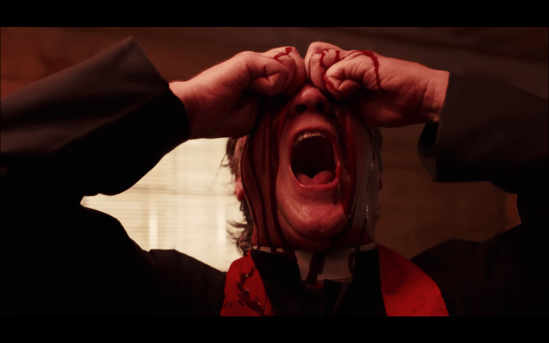
Finally! American Guinea Pig: “The Song of Solomon” has been on my highly anticipated review material list for a very, very long time. Written, produced, and helmed by the founder and president of Unearthed Films himself, Stephen Biro has been more than widely known for years to promote and glorify gore in the shock-provoking films underneath his banner; a practice that has made his company a stable in the realm of horror aficionados. “The Song of Solomon” keeps the blood flowing….splattering, squirting, spurting, spilling, in fact! Whereas many of the Unearthed Films productions and distributions have a granular or avant garde stories, Biro, despite the confined and limited locations, pens an engrossing narrative with evocative, haunting, and surreal characters surged into a powerful and ageless tale that sordidly spanks “The Exorcist” like an irrefutably forgotten and spoiled rotten step-child. “The Song of Solomon” is that good and soars to the top in being one of this reviewer’s favorite Unearthed Films’ titles.

Jessica Cameron should just be handed a ton of awards for her performance as the possessed Mary. Cameron’s creative creepiness is unsurpassable and just oozes out of the character, zapping an icy chill down each disk of the spine whenever she uses the playful sing-songy voice of a snake’s fork tongue. As a whole, Cameron singlehandedly comes off overwhelming haunting and delivers a personality made up of nightmare material; a phenomenal performance that rivals, if not outright tops, Linda Blair’s Regan. There are moments when you think the 2003 “Truth or Dare” director and actress had post-production enhanced vocals to make Mary persuasive, enticing, and demonic, but only a slight vocal overlay on top is the only thin icing on the already devilish cake. It’s not as if Cameron didn’t have any competition on screen, either. Scott Gabbey, David E. McMahon (“Followers”), Angelcorpse’s Gene Palubicki (“American Guinea Pig: Bloodshock”), and Jim Van Bebber (“The Manson Family”) compliment the versus’ righteous, if not also flawed, challenger with immense passion for their respective roles of grief-stricken priests, plucked carefully by top Church officials to handle the exorcism. Maureen Pelamati, Josh Townsend, and Scott Alan Warner (“3-Headed Shark Attack”) co-star.

Production value must reign above the conventional indie fare and special effects owns much of that real estate. The man behind the special effects on such films as “Mohawk” and “Lung II,” Marcus Koch, has teamed up with “Bereavement” and “Murder-Set-Pieces'” Jerami Cruise to assemble some of best, yet refreshingly basic, gore effects seen recently. Regurgitation of internal organs, the compound splintering of bones, and even a Columbian necktie are the prime examples of what to expect from the unlimited imagination of the Koch and Cruise collaboration. Locations are simple and tight, leaving not much room for exploration of options for practical effects, but each scene is well thought out, choreographed, and designed for gruesome upshot that keeps true to Unearthed Films brand of filmmaking. Toss all that into a sack along with fellow colleague Gene Palubicki’s malevolently cacophony soundtrack and the outcome is a well-rounded horror film with extreme unapologetic values worth the time of day and night.

“The Song of Solomon,” an Unearthed Films production, lands onto Blu-ray distributed courtesy of MVD Visual. The 86 minute runtime film is presented in a High Definition 1080p widescreen format, 1.90:1 aspect ratio, on a single layer BD-50 disc. If you want gore, you got it with this particularly warm hued transfer really puts the devil in the details with grisly effects that could be hard to stomach. The English LCPM Dolby Digital 2.0 audio track caters with nice fidelity. Dialogue is clearly present amongst the Palubicki score and the ghastly ambience augments the visual viscosity of the gore. Bonus features include an audio commentary with Stephen Biro and Jessica Camera, another commentary with Biro and effects gurus Marcus Koch and Jerami Cruise, interviews with Jessica Cameron, Stephen Biro, Marcus Koch, Gene Palubiki, David McMahon, and director of photography Chris Helleke, a behind the scenes look, outtakes, and a photo gallery. Comparing Stephen Biro’s “The Song of Solomon” to William Friedkin’s “The Exorcist” is like comparing apples to oranges as both films relish and thrive in their own atmospheres. However, “The Song of Solomon” stands firm as a powerful competitor that offers up a ravishingly foul and metaphysical entry into the genre realm of demonic possessions casted with raw talent.
Category Archives: gore
Herbert West Receives a New, Evil Release! “Re-Animator” review!
Third year medical student Dan Cain is on the verge of graduating from the New England Miskatonic University Medical School. That is until Dr. Herbert West walks into his life. Learning all he can from neurologist Dr. Hans Gruber in Zurich, Switzerland, West eagerly enrolls as a student at Miskatonic to viciously dismantle, what he believes, is a garbage postmortem brain functionality theory of the school’s grant piggybank Dr. Carl Hill while West also works on his own off the books after death experiments with his formulated reagent serum. West takes up Cain’s apartment for rent offer and involves Cain in a series of experiments that lead to reviving the old and the fresh dead. The only side effects of revitalizing dead tissue is the unquenchable rage and chaos that urges the recently revived to rip everything to shreds. Things also get complicated and people begin to die and then revive when West and Cain’s work becomes the obsessive target of Dr. Hill, whom discovers the truth and plans to steal West’s work, claiming the reagent serum as his own handiwork while also attempting to win the affection of Dr. Cain’s fiancee and Miskatonic’s Dean Halsey daughter, Megan Halsey, in the most undead way.

A vast amount of time has passed since the last time I’ve injected myself with the “Re-Animator” films and I can tell you this, my rejuvenation was sorely and regrettably way overdue. Stuart Gordon’s impeccable horror-comedy, “The Re-Animator,” is the extolled bastardized version of Mary Shelley’s Frankenstein without direct references and begins the ghastliness right from the initial opening prologue and never wanes through a fast-paced narrative of character thematic insanity and self-destructing arrogance with hapless do-gooders caught in the middle of undead mayhem. Producer Brian Yuzna financially backs Charles Band’s Empire International Pictures distributed 1985 film that’s based loosely off the H.P. Lovecraft 1922 novelette “Herbert West-Reanimator.” From a bygone novelette to an instant cult favorite amongst critics and fans, “Re-Animator” glows vibrantly like it’s reagent serum embodied with reality-buckling entertainment and grisly havoc displayed through the silver screen adapted form. Umbrella Entertainment has released a two-disc collector’s set, the first volume on their Beyond Genres label of cult favorites, and this release, with various versions, will include the allusive 106 minute integral cut!
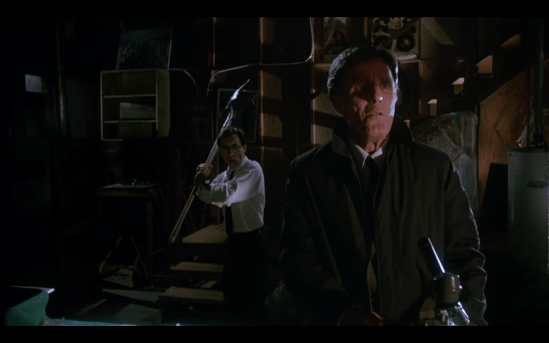
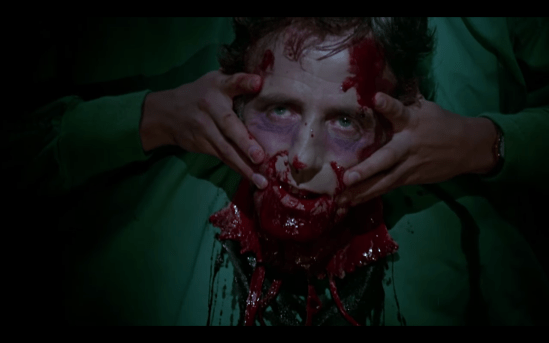
From his first moments on screen holding a syringe to over three decades of pop-culture films, comics, and social media presence, nobody other actor other than Jeffrey Combs could be envisioned to be the insatiable Dr. Herbert West. Combs is so compact with an explosive vitality that his character goes beyond being a likable derivative of a Machiavellian anti-hero. Narrowing, dagger-like eyes through thick glasses on-top of small stature and a cruel intent about him makes Combs an established horror icon unlike any other mad doctor we’ve ever seen before. Bruce Abbot costars as Dr. Dan Cain, a good natured physician with a penchant of not giving up on life, but that’s where he’s trouble ensnares him with Dr. West’s overcoming death obsession. Abbott’s physically towers over Combs, but his performance of Cain is softly acute to West’s hard nose antics. Abbott plays on the side of caution as his character has much to lose from career to fiancée, whose played by Barbara Crampton. “Re-Animator” essentially unveiled the Long Island born actresses and made her a household name who went on to have roles in other prominent horror films, including another Stuart Gordon feature “From Beyond,” “You’re Next,” and the upcoming “Death House.” David Gale rounds out the featured foursome as the detestable Dr. Carl Hill. Gale embraces the role, really delving into and capturing Dr. Hill’s maddening short temper and slimy persona; a perfect antagonist to the likes of Combs and Abbott. The remaining cast includes Robert Sampson (“City of the Living Dead”), Carolyn Purdy-Gordon, and Peter Kent.

The “Re-Animator” universe is right up there with the likes of Sam Raimi’s “The Evil Dead.” Hell, there is even a line of comics that pit the two franchises together in a versus underlining. Unfortunately, “Re-Animator” is frankly nothing without the franchise star Jeffrey Combs, much like “The Evil Dead” is nothing without Bruce Campbell even though we, as fans, very much enjoyed the Fede Alvarez 2013 remake despite the lack of chin. Gordon’s film needs zero remakes with any Zac Efron types to star in such as holy role as Dr. Herbert West. That’s the true and pure terrifying horror of today’s studio lucrative cash cow is to remake everything under the genre sun. Fortunately, “Re-Animator” and both the sequels have gone unscathed and unmolested by string of remakes, reboots, or re-imagings. Aside from a new release here and there, such as Umbrella’s upstanding release which is fantastic to see the levels of upgrades up until then, “Re-Animator” has safely and properly been restored and capsulated for generations to come.
Umbrella Entertainment proudly presents the first volume of the Beyond Genres’ label with Stuart Gordon’s “Re-Animator” on a two-disc, full HD 1080 Blu-ray set, presented in a widescreen 1.77:1 aspect ratio. A very fine and sharp image quality that maintains equality across the board with minuscule problematics with compression issues, jumping imagery on solid colored walls for example, but the issues are too small amongst the rich levelness of quality and when compared to other releases, Umbrella Entertainment’s release is a clear-cut winner. The English DTS-HD master audio puts that extra oomph into Richard Bands’ score that’s heavily influenced by Alfred Hitchcock’s “Psycho,” adding a pinch of chaotic gothic charm to the macabre story. Dialogue is balanced and upfront, but there isn’t much prominent ambient noise to put the dialogue off-kilter. Special features on the first disc include the 86 minute unrated version of “Re-Animator,” audio commentaries from director Stuart Gordon, producer Brian Yuzna, and stars Jeffrey Combs, Barbara Crampton, Bruce Abbott, and Robert Sampson; there’s also a “Re-Animator Resurrectus” documentary, 16 extended scenes, and a deleted scene. The second disc includes the 106 itegral cut along with interviews with Stuart Gordon, Brian Yuzna, writer Denis Paoli, composer Richard Band, and former Fangoria editor Tony Timpone. Plus, a music analyst by Richard Band, TV spots, and the theatrical trailer. All this and a bag of corpses is sheathed inside a remarkably beautiful encasement with a seriously wicked custom slipcover desgin by illustrator Simon Sherry. There’s also reversible Blu-ray casing cover art with previous designs incorporated. H.P. Lovecraft would be extremely flattered and proud on how Umbrella Entertainment not only enhanced the film adaptation of his classic tale of macabre, but also with how diabolically attired the release is distributed. A true horror classic done right!
Burt Gummer is Back to Destroy a Long Time Evil Foe! “Tremors: A Cold Day in Hell” Review!
A remote Canadian science team is under the threat of a Graboid situation, hunting drill parties through the ice and ripping them to shreds with their snake-like mouth tentacles. The team phones the only known Graboid hunter, the legendary outdoor sportsman Burt Gummer, who flies from Perfection, New Mexico to the North of the border with his son Travis Welker to terminator their subterranean predator problem. Graboids aren’t the only problem as nasty Ass-Blasters also roam the sky. Stranded on a remote research station and stuck with non-combative administrative researchers, Gummer’s shoulders bare much of the battlefield burden, but the long time Graboid ass-kicker comes face-to-face with an internal Graboid stemmed disease that sidelines his ability to finish the campaign. Travis must pick up the reigns and band together a ragtag team of scientists to not only save Canada from a being swallowed from below, but also to save his father’s life by obtaining antibodies from a live Graboid.

Michael Gross is back! Reprising his role of Burt Gummer, the gung-ho military nut with a penchant for hunting down and killing Graboids, Gross straps on the HK-91 assault rifle once more for Universal’s “Tremors: A Cold Day in Hell,” the sixth installment to the “Tremors” franchise that began 27-years-old in 1990! The PG-13 creature feature is helmed by direct-to-video sequel director Don Michael Paul (“Tremors: Bloodlines”), written by two-time “Tremors” sequel writer John Whelpley, and release appropriately enough on Universal’s 1440 Entertainment label. Whelpley relocates the franchise away from the blistering heat, the scorching sand, and the denim-camo-plaid sporting bedrock to cooler climate of the Canada’s 49th parallel north. Under the ice and the chilled soil are pre-pre-cana Graboids awakened by the ever looming effects of global warming. Al Gore was right; Global warming will kill us all…by rousing the underground beasts who’ve been dormant for thousands of years! The very one aspect the filmmakers wanted shiplap together for this next chapter is to perilously put the invincible Burt through a taste of own mortality, plaguing him with a symbiotic Graboid worm that puts him on the edge of death, and introducing a worthy replacement, or perhaps a legacy, in his son, Travis Welker.
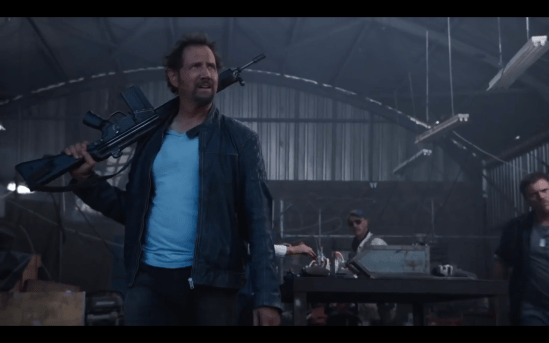
Welker is a returning character from “Tremors: Bloodlines” portrayed by comedian Jamie Kennedy. His role as Brad “B-rad” Gluckman from “Malibu’s Most Wanted” has been forcibly seared in many of our minds and his horror enthusiasm captured our black hearts as the lovable Randy Meeks in Scream, but being Travis Welker nearly upends those personas and transform him into a smooth talking, fast thinking, son of a gun whose perfect to match wits with his on-screen old man, Burt. “Tremors 6” is essentially the Burt and Travis show, leaving many other characters up as red shirts, but waver a handful as potential love interests and bone headed comedic reliefs. Starting with South African Tanya van Graan (“Starship Troopers 3: Marauder”) as the kinda kooky Jamie Kennedy love interest in Dr. Rita Sims. Sims is nearly all over the board being the lead scientist on the research expedition to a complete bad ass with a rifle to being a sultry fox who goes commando with no underpants in the arctic. Then there’s Jamie-Lee Money, just on the cusp of her career, plays Valerie McKee, the offspring of “Tremors'” Valentine McKee (Kevin Bacon) and Rhonda LeBeck (Finn Carter). Money looks the part, but the character is severely downplayed and lifeless that mistreats the legacy of Val who was spontaneous, inventive, and naively charming. Other characters come off goofy, oddball, and arbitrary or insignificantly used played by Greg Kriek (“Lake Placid: Legacy”), Stephanie Schildknecht (“Accident”), and Kiroshan Naidoo.

The entire Tremors franchise has been through a wringer of changes over the last 27-years that has really stretched the incredible substratum monster thinner and thinner. Reducing the physical formidability down to a visual effects monstrosity that still preserves a somewhat tongue-and-cheek campiness, “Tremors: A Cold Day in Hell” doesn’t quite have the “Tremors” flavor. Perhaps it’s the arctic setting. Perhaps it’s the inane special effects. Perhaps it both, but one thing is certain and that is Michael Gross being solidified as the unwavering face of the franchise, but even with that constant variable, this sixth installment attempts to lure back in the original fan base by referencing the original film in numerous instances, such as with Valentine’s daughter, Valerie, or even with Burt’s famous one-liner when he shot-to-death the basement crashing Graboid from the first film, but instead of saying “rec room,” he yells “airplane hangar” as the Graboid explodes in a gush of orange blood as it rams into an underground electrical barrier. It’s a bit of a farce. Yet, there’s still an immense amount of enjoy-ability, energy, and Graboid fun to be had.

Universal releases the PG-13 “Tremors: A Cold Day in Hell” on the home video, 1440 Entertainment label, with a combo Blu-ray + DVD + Digital disc. The 1080p High Definition Blu-ray was viewed for this review which is presented in a widescreen 178:1 aspect ratio and the image quality is deep with details. The terrains absolutely come alive to the screen and, at the same time, expose the visual effects work. No matter how much the visual effects team tries to create an Canadian arctic atmosphere, the sands of the South African landscape couldn’t be optically opaqued. Nonetheless, facial features, character attire, and even the explosions, cascading, and orange Graboid blood gooing is sharp with precision definition. As far as audio, the English DTS-HD Master Audio 5.1 surround sound caters to every audible fissure with an attractive ambiance track (ass)blasting with baritone and ripping semi-automatic fire cues. Dialogue comes over clean and the soundtrack has healthy bones, aside from it’s generic, low-budget assortment. Extras include a making of “Tremors: A Cold Day in Hell” that’s broken down into multiple, short chapters, the anatomy of a scene, and inside Walter Chang’s kitschy market. Since the breaking news that SyFy will not longer move forward with the anticipating Tremors television series with Kevin Bacon, “”Tremors: A Cold Day in Hell” signifies that the withering franchise will not stray from Burt Gummer’s one-man show anytime soon; still, the sixth installment provides a healthy amounts of witty banter and a swimming pool full of Graboid gore, two foundational motifs still vibrant in the Tremors universe.
Free Your Soul With the Evil Mad Doctor! “The Soultangler” review!

Experimental doctor, Anton Lupesky, invents a controversial drug that can free a human soul from its vessel and travel through into the lifeless eyes of a corpse, possessing the body to reanimation. The only side effect is grotesque hallucinations that are so horrible, few survive the experience. After a stint of missing persons and a string of mysterious deaths at the Whitebriar Institution, Lupesky is fired from his position, banned from the medical board, and brought up on criminal charges. His acquittal sparks him to embark on a journey overseas to continue his radical medical experiments, away from regulations and tremendous oversight. The doctor returns six months later for far superior medical innovations in America and begins practicing again in his own basement with the unscrupulous help from a couple of lackey acolytes that leaves Lupesky’s supply of “patients” not in short demand. One reporter keeps investigative tabs of the good doctor as she suspects a connection between him and her father’s death at Whitebriar and when her and her friends starts to snoop around, Lupesky has no choice but to use any means necessary to thwart her investigation, even if that means secretly administrating the drug to her in hopes that her soul can fly with his – if she survives.

Thirty years ago, “The Soutangler” hit the cinema market. A low-budget gruesome mad scientist flick with a penchant for some fantastically grisly practical special effects. The 1987 shocker was directed by Pat Bishow, penned by John Bishow and Lance Laurie, and shot on location on Long Island, New York. The Do-It-Yourself and Lovecraftian macabre does a bit of soul-searching to find resurrection from the video graveyard. Luckily, Bleeding Skull! Video and the AGFA come to the rescue with a chock-full of extras release that digs up the Bishow’s lost creation, dusts it off, cleans it up, pats it on the butt, and sends it back out into the world onto DVD home video. “The Soultangler’s” niche envisioning goes against the grain of traditional filmmaking, bordering experimental, but definitely a must-see for those interested in existentialism horror: the removal of free will to be replaced by another’s.

Pierre Devaux stars in his only credited as the mad Dr. Anton Lupesky that resembles along the lines of a Dr. Herbert West from that little known trilogy of the H.P. Lovecraft inspired “The Re-Animator.” With a wiry frame, stringy shoulder length hair, and government-like issued classes, the very animated Pierre Devaux casts the ideal character whose maniacal and perverse in his medical malpractices. The only one willing to stop the Lupesky’s experiments is investigating journalist Kim Castle of The Daily Chronicle. Castle, played by Jane Kinser, is about as ferocious as her beautiful as an aggressive reporter, unwilling to stop to unearth the truth of her father’s tragic death. Kinser’s not much of an onscreen force to reckon with as she’s quite timid, but she manages to hold her own up against Devaux wild eyed lunacy. Rounding out the cast is Bob Cederberg as a Carl the drugged addict henchman, Louise Millman as a loyal minion to Lupesky, and Tom Ciorciari as Castle’s concerned friend who battles the zombified corpses embodied by Dr. Lupesky.

While a strong appreciation exists from the outstanding attention to detail with the decayed bodies and the explicit violence in the finale that nightmarishly flourish in a heap of ghastliness, the rest of the film is as disjointed as the dismembered bodies in Lupesky’s basement of horrors. Despite being submersed in various talking head scenes that divulge significant backstories between Dr. Lupesky and Kim Castle, the story struggles to keep the straight line focus, swerving erratically between subplots and the main premise. Castle’s horrific dreams of aggressive zombies loosely makes a connection other than prepping Castle’s subconscious when ingesting Lupesky’s soul freeing drug. The story of Dr. Simpson also flounders to the waist side with her and Dr. Lupesky’s love affair, the only women he would even consider getting close to and not slaughter for his own amusement.

“The Soultangler” arrives onto full-bodied, graphically illustrated DVD from the B-movie collaborators Bleeding Skull! Video and the American Genre Film Archive (AGFA) and distributed by MVDVisual from the original 1″ master tapes. Shot on 16mm, but edited on video, “The Soultangler” has a SOV experience in it’s original aspect ratio of a full frame 1.33:1. Quality varies from the source material, including some tracking and edge flare issues, but overall a solid transfer with a sizable color palette that includes tints, natural skin tones, and visceral dream sequences that show little-to-no sign of diminishing. Stereo mono track does the job despite poor mic placements to get the full girth of dialogue. HypnoLoveWheel’s indie synth/rock soundtrack has more popularity on the B-level than in the mainstream music, but serves “The Soultangler” with broad depth to solidify a wedge between “The Soultangler’s” whimsical charm and the Gothicism that is Stuart Gordon’s “Re-Animator.” Bonus features include, for the first on any release, the Unseen 62 minute alternate director’s cut, a commentary track with director Pat Bishow, behind the scenes footage, trailers for “The Soultangler” and “Dead of Night Town,” music video for “wow” by HypnoLoveWheel, and liner notes by Bleeding Skull’s Zack Carlson. Conceptually, “The Soultangler’s” premise oozes originality and creativity involving soul transformations through the portal eyes of a dead body and that’s simply brilliant and what today’s horror genre certainly craves. Constructionally, Pat Bishow couldn’t push the momentum to pickup the pace to overripe an engaging story, but the climax, out of left field, unsheathes a bloodbath of ultra-stellar, DIY proportions!

At Amazon, The Soultangler, Right now!

Evil Gets a 4K Digital Transfer! “Ichi the Killer” review!

Three hundred million yen and Yakuza boss Anjo have disappeared without a trace. Anjo’s most deadly and most sadomasochistic enforcer, Kakihara, and the rest of the Yakuza gang embark on a torture-riddle search and rescue to find their missing boss. After unrightfully torturing and mutilating a rival Yakuza leader, Kakihara learns through a trail of mayhem of a fierce killer known as Ichi and after being exposed to Ichi’s grisly handiwork first hand, a usually stagnant and emotionally detached Kakihara becomes stimulated and eager to go one-on-one with a formidable foe like Ichi, who could possibly bestow upon him gratifying pain to feel something other than emptiness. Ichi’s eviscerating destruction isn’t totally in his control as the sexually-repressed and candidly disturbed overall nice guy is being coerce through psycho-manipulation by Jijii, an old man seeking retribution against the Anjo gang. With blades projecting from his shoes and his skill at martial arts, the timid Ichi becomes the ultimate killing machine when brainwashing takes him over the edge into a hysterical fit of rage that leaves guts and blood to paint the floor and walls.

Perhaps director Takashi Miike’s finest work, the 2001 Japanese blood bath “Ichi the Killer” is a must own for any film aficionado teetering on the razor wire between crime dramas and gory action flicks that might be on the viewing docket for then night, but certainly a must-see for all film lovers at some point in time. Miike’s stone cold, chaotic style of filmmaking embraces the story’s unwavering havoc that blisters with ruthless brutality between two very different, black and white characters with one thing in common – being good a killing. Based off the manga penned by Hideo Yamamoto and from the adapted screenplay by Sakichi Sato, Miike crafts the most disturbing elements of mankind and brings them to the forefront in a simple story of revenge. On one side, there’s Kakihara, a scarred-face Yakuza enforcer with a very rich violent history to the extent that he’s become numb to his own existence in the world and then there’s Ichi, a reclusive cry-baby stemmed from being mentally fed graphic bulling stories of battery and rape in a memory built upon languishing lies. Vastly different, well-written characters opposite the spectrum and both are good at dealing death, but one aims to dish it out and the other yearns to stop his carnage, and that compelling core element is immensely fluffed by extreme violence in a way that only Miike can deliver it.

But for a film like “Ichi the Killer,” Takashi Miike had a little (hint of sarcasm) help from his gifted cast in making this project a cult success. Before this actor was Hogun in the Marvel Universe’s “Thor” franchise, Tadanobu Asano shaped up the psychotic enforcer Kakihara and the usually dark featured Asano reconfigures his appearance to put life into the character who sports blonde, wavy hair, a frothy complexion, and small hoop piercings at the corners of his lips to keep the slits from opening to expose the entire gaping jaw which is used as a defensive weapon. Opposite Asano is the Tokyo born Nao Ohmori who perfectly subjects himself to being a wimpy human shell with an explosive inner anger. The two men have only a small amount of screen time together and that requires them to build their character’s standout personalities. Complimenting their performances is an amazing support cast, including Shin’ya Tsukamoto (“Marebito”), Miss Singapore 1994 Paulyn Sun, Hiroyuki Tanaka, and Suzuki Matsuo.

“Ichi the Killer” is simply magnificent where it vulgarly touches upon various themes, mostly human flawed that also destines opposing counterparts together. Aside from the graphically realistic violence, Miike’s film hits upon other attributable tangents, among them some are just being plain gross, but these aspects are undeniably important to the story. Themes ranging from sexual suppression and female inferiority to sadomasochism and severe obsession top the charts in a heap of motifs throughout. Accessorial blood and other bodily fluids are extravagantly portrayed, spraying across the room with jettison entrails or dripping from potted plants to a cloudy puddle below during in a voyeuristic rape scene, to get the clear sense of an adult manga inspired chockablock exploitation and crime drama.

Well Go USA presents “Ichi the Killer” on Blu-ray in a newly restored 4K digital transfer of the director’s cut; a task undertaken by Emperor Motion Pictures in 2017. Presented in a widescreen 16:9 (1.85:1) aspect ratio, the film starts off with a blurb about the history of this particular digital restoration and transfer that asserts director Takashi Miike’s approval for release. Well Go USA’s rendering resembles much of the previous Tokyo Shock Blu-ray with subtle differences such as a slightly more aqua tint to the picture coloring and also much like it’s other Region A Blu-ray counterpart, a bit of noise is present in the restoration, but still the better detail of the two. The Japanese stereo 5.1 DTE-HD Master Audio surround sound has an bombastic soundtrack, but dialogue remains on the softer side where relying on the English subtitles is crucial. No issues with timing or accuracy in the subtitles. Surprisingly, the only extras included on the Well Go USA release is an audio commentary with director Takashi Miike and manga artist Hideo Yamamoto, still gallery, and the trailer that undercuts this releases’ purchasing value and might as well hunt down for the out of print Media Blasters Blu-ray, if extras are a must. Even still, “Ichi the Killer” has been resurrected in North America again and the release technically sustains growth amongst the mass of releases around the world. The lack of special features is disconcerting, especially being a restored director’s cut, but “Ichi the Killer” can stand on it’s own as a gracefully sanguinary masterpiece. Look for the Blu-ray to hit retail and online shelves March 20th!

Get Ichi the Killer today on Blu-ray!


