Phil Stevens returns! The Philadelphian filmmaking is coming back for more surreal and gory abstract horror in his next upcoming project “Flowers 2,” a direct sequel, that “explores the final days of the serial killer known as ‘THE EXILE’ through a macabre birthday party held by his past murder victims. We are shown this monster’s violent past life through the eyes of his dead.”
However, Stevens needs your help because making movies you love and that you’re passion about is most certainly not free or cheap despite our best efforts. An Indiegogo page has been setup and the fans of “Flowers,” and I know there are many of you, should take the time to read thoroughly through the campaign page and think about donating to a original horror storytelling. The goal is $15,000 and Stevens is only 6% there from eleven backers. Please donate, no matter the denomination! Your contribution goes a long way and there’s swag for donations starting at $25, but you better hurry due to limited stock.
From being stuck in stand still Floridian hurricane traffic to waking up in a hospital without any recollection of how she got there, Amy Barrett finds herself in a seemingly evacuated sanitarium on the verge of being hit by a category 5 hurricane. When she finally makes contact with the limited hospital staff, Amy discovers that the staff are not in the position to help, but desire to perform unnecessary surgeries. Then, she finds herself in traffic again. Then, she wakes up in hospital…again. Amy, and other patients, find themselves trapped in a nightmare loop forged by the powers of the massive hurricane. Before the storm passes over, Amy must find a way to end the corkscrew of timelines that propel her limbo hell or else she will be trapped in the hospital forever.
To the O.R. stat! From writer-director Christopher Lawrence Chapman comes “Inoperable,” the horror equivalent to Bill Murray’s exceptional dark comedy “Groundhog Day.” As Chapman’s sophomore directorial, first in the realm of horror, the director takes “Inoperable” to rebrand the quantum paradoxical plight by introducing a medical butchers with hours upon hours, days upon days, years upon years of experience with exploratory surgery and ghastly invasion procedures. Behind the wormhole of terror script with Chapman is co-writer, the b-horror screenwriter, Jeff Miller whose extensive credits include “Axe Giant: The Wrath of Paul Bunyan” and “Jolly Roger: Massacre at Cutter’s Cove.” In this go-around, Miller explores the space-time-continuum, or does he, with Amy reliving the same moment, experienced slightly differently, in an endless loop of grisliness.
Starring in “Inoperable” is the “Halloween’s” franchise third favorite star, behind Jamie Lee Curtis and Donald Pleseance, being Danielle Harris (“Halloween 4,” “Halloween 5,” and Rob Zombie’s “Halloween” remakes). Harris keeps and maintains the tension, supplementing an increasing annoying and frustrating tone with each and every reset, and does superbly in extended takes running through the hospital’s dark corridors. Amy’s center storied character really puts Harris to work on her ability to flex in sequentially illogical scenes that go in various tangents and come to a dead halt in the end, flipping the script that forces the modern day scream queen to relive some of those killer “Halloween” moments. Harris is accompanied by Katie Keene and Jeff Denton, both whom worked with Chapman previously on the clownsploitation slasher “ClownTown.” Keene and Denton’s characters are also caught up in the same situation as a Denton plays a beefy good looking cop named Ryan who brings in a witness, Keene’s JenArdsen, a dolled up blonde who while in his custody, to the hospital following a multi-vehicle pile up; the very exact incident Amy in which Amy was involved. The two fall for each other more and more with each and every restart and that pain coldly passes over when to bare witness to each other’s demise over and over again is disturbingly twisted. Rounding out the cast is Chris Hahn “Axe Giant: The Wrath of Paul Bunyan”), Cher Hubsher (“The Amityville Terror”), Michelle Marin (“Bloody 27”), Philip Schene, and Crystal Cordero.
The trio of resetters formulate a wildly speculated theory that a nearby military compound, experimenting in spatial physics, was ravaged by the hurricane that oozed out their experiments that disrupted timelines, affecting this particular hospital, and the only way to escape the madness is by displacing the same energy that was put into it; so for example, since Ryan and JenArdsen arrived together, they would have to escape together. As long as Amy doesn’t die, every trapped soul is eligible for escape. Wait, what? Like aforementioned, Amy is the centerpiece to the puzzle and the whole entire situation actually revolves around Amy, intentional or not. Even though clues try to put a monkey wrench in that notion, the story always seems to revert back to Amy much like the loop she’s caught in. That in itself is the biggest hint of all that funnels to a underwhelming ending in null and voids the rest of the story.
ITN Distribution presents “Inoperable” onto DVD and VOD. The DVD is presented in a widescreen to “preserve the aspect ratio of its original exhibition” and, yes, this was done so. Nothing too particularly to note about the image quality being a modern release, but the color palette is balanced and vivid. The English language 5.1 Dolby Digital track has some good range and clear dialogue that effective communicate all theories and explanations on why this is happen to Amy, Ryan, and JenArdsen. Extras are slim that include a cast and crew commentary and the theatrical trailer. The Zorya Films and Millman Productions’ “Inoperable” is open heart surgery gory and is unique in a deadfall environment that’s sublimely refreshing for the over saturated genre, but culminates flaccidly with a conventional finale too predictable for comfort.
Four sorority sisters embark on a isolated cabin vacation for an all girls’ weekend in the quiet woods. Through all the booze and the trips to the lakeside beach, Sloane, Abby, Margot, and Lulu reap the benefits of solitude and sisterhood and just when everything seems to be going delightfully swell, even when Sloane’s perverse boyfriend and his friend show up unexpectedly, trouble brews beneath their feet, under the leaf-riddled surface, when Abby unwittingly unleashes three space originated, pint-sized ghastly ghouls. As the miniature and ferocious creatures rip through unlucky victims, nobody knows how to stop, let alone escape, their woodland carnage, especially when they’re being aided and abetted by human caretakers.
In the filmmaking fashion of Brett Piper (“Queen Crab”) or Mike Lyddon (“First Man on Mars”), Brett Kelly offers his low-rent talents in construction an 80s-esque creature feature on a pygmy scale in more ways than one. The Ontario born director has helmed a vast amount of independent b-horror prior to, including such great titled credits as “The Bonesetter,” “Attack of the Jurassic Shark,” and “Raiders of the Lost Shark.” Now, released for the very first time on any format, anywhere, is “Ghastlies,” a “Gremlines” or “Critters” creature feature that aims to rain down terror when all hell breaks loose with ankle biters running around and while the low budget production or creature value doesn’t par with the more popular Joe Dante or Stephen Herek films, the heartfelt attempt in this modern day feature accomplishes the intended effect of a 1980’s horror comedy, complete with synthesized score and era correlating attired.
“Ghastlies'” lineup consists of Brett Kelly regulars such as Jessica Huether and Kendra Summerfield from “Raiders of the Lost Shark.” Huether’s and Summerfield’s performance as the nerdy, yet overall good girl Abby and the snobby, superficially rich bitch Lulu, instilling the yin and yang personas of the group, and their joined by Julie Mainville and Kim Valentine as the unforgettably clueless Margot and the sisterhood leader in Sloane. Mainville more memorable out of the four sisters as she has spot on timing and delivery with the witless and likable Margot. John Migliore, known more for slabbing on the prosthetics and makeup to be a zombie, has a minor costarring role as a dimwitted bike cop Officer Vinnie and Migliore, whose donned zombie wear in films like “Land of the Dead” and “Ninjas vs Monsters,” filled multi-faceted shoes for the Kelly film by dappling into the spaceship special effects and providing the Ghastlies puppetry. Migliore’s Officer Vinnie is paired with another similar goofy character in Peter Whittaker as Officer Frank as well as Joel Elliott “Countrycide,” Eric Deniverville, Stephanie Moran, and Kyle Martellacci who also co-star in the zany trope-ladened homage. As his first feature credit, Chris Bavota’s script creates no real dynamic between the characters who all pertain to a self-serving purpose under a guise of slapped together dialogue that’s no more substantial than a boulder in outer space.
And there in lies the rub. “Ghastlies” inability to click together to fulfill the allusion of was what-once-was is the film’s weakness. The cartoonish hand puppets, the implausible effects, and the technical inconsistencies can all be overlooked as campy charm, passed aside to enjoy “Ghastlies” for what it’s worth, but what can’t subside is the wonky connection between the cast that doesn’t favor well that’s diluted at the end by the starkly questionable and abrupt editing, resulting in a presumed unfinished film that seeks to either be an open ended invitation for a potential sequel, defined by one of the characters standing up with a makeshift mini-gun and garbed in Rambo-like gear, or a hasty cut that provides a lukewarm, satisfactory, and budget friendly finale that actually invokes more confusion than viewership appeasement. Shortly following the live-action wrap up, a short animated comedy, illustrated by the multitalented John Migliore, in the same vain as the quirky Looney Tunes but with Ghastlies.
The lovely, cuddly, and ghoulish “Ghastlies” is released onto DVD and Blu-ray combo from Camp Motion Pictures. Image quality for the Blu-ray format is by far stunning for a low-budget feature presented in 1080p encoded MPEG-4 AVC BD 25. The coloring naturally displays and even the darks had great depth without distortion or inconsistencies. The English Dolby Digital 2.0 is another story as, unlike the image quality, the presentation is inconsistent with imbalanced levels that make a few scenes difficult to comprehend. Clarity isn’t necessarily an issue with no blights on the tracks, but the technical placements could have been smoother. The electric score score by Tomb Dragomir, the composers first score ever, manages to engross and re-illuminate the decade that inspires “Ghastlies.” Bonus material includes a special effects interview with john Migliore’s helping hand into Ghastlies’ FX, Tomb Dragomir discusses his experience scoring his first feature, “Ghastlies'” music video, the trailer and Camp Motion Pictures’ trailers, and an audio commentary with director Brett Kelly. “Ghastlies” is part “Gremlins,” part Lovecraftian, and all borderline shlock-y fun, but the loose character interactions and out of kilter editing embargo the full bodied experience.
Texas 1955 – the pride of the Sawyer family was not their tattered farm, but a bloodline taste for something else – callous murder and a penchant for human flesh. Verna Sawyer sought to instill that pride into her children, especially her youngest, Jed, but when Hal Hartman, hard nose local Sheriff, learns that his daughter becomes victim of the Sawyer’s suspect nefarious carnage, he executes the law to his advantage, deeming the Sawyer house unfit for children and removes Jed from his labeled degenerate mother Verna. Ten years later, a group of teenage patients escape a mental hospital, kidnap a young nurse, and reek bloody havoc in their voyage to Mexico in an attempt to elude the very same lawman who put them away, but this time, Hartman isn’t adhering to the law, straying off his moral compass to pursue a vengeance mission against unprincipled youth that’s personally driven by Jed and the Sawyer family. Once the embattled Hartman catches up with his prey, a series of gruesome events lead to the creation and the construction of one of the most notorious killers Texas will ever see.
I love a good origin story. There’s something to be said about understanding the commencement of character, to be in the shoes of a long running icon, and to be able to sympathize with their story no matter how atrocious. Directors Alexandre Bustillo and Julien Maury’s 2017 “Leatherface” does just that with the film’s own origin enlightenment on how the chainsaw wielding, human skin mask wearing psychopath came to fruition inside a home of unspeakable brutality and influenced externally by a unforgiving society. From a script penned by Seth M. Sherwood, “Leatherface,” serving as a direct prequel to Tobe Hooper’s “The Texas Chain Saw Massacre,” briefly touches upon the preteen years to setup the catalytic road trip from hell, birthing a monster in a time of adolescence and if part of a legacy spanning over forty decades inspired by Ed Gein, the real life human skin wearing and notorious serial killer, then you damn well know “Leatherface” has to be genetically predisposed to be ultra-violent drenched in blood splatter. The French filmmaking duo, who’ve helmed 2007’s “Inside” and had directed the “Xylophone” segment in “The ABCs of Death 2,” nail the dark and gritty tone that not only breathes a gassy and exhaust fumed life into a massive flesh-ripping chainsaw, but also inflicts heartlessness across the story board into a heartfelt homage to the characters and to the story fathered by Kim Henkel and the late Tobe Hooper, both of whom were attached as executive producers.
Over the years, many actors have held the mammoth power-drive cutting tool in their hand that’s ready to chip away at flesh such as Andrew Bryniarski (“The Texas Chainsaw Massacre” 2003 remake), Bill Johnson (“The Texas Chainsaw Massacre 2”) and, most famously, Gunnar Hansen, the original Leatherface. However, I’m not going to divulge who the pubescent Leatherface is in the story because the film plays out as a who out of the group of degenerate teens is the son of Verna Sawyer, even though you can easily obtain the information in a simple click and search on Google. Instead, Sam Strike, James Bloor, and Sam Coleman portray the three escapees who are accompanied by an equally insane sociopath in Jessica Madsen and an eagerly novice kidnapped nurse by Vanessa Grasse. Amongst a sea of English actors are a pair of vets to shepherd the young cast and be the embattled bookends to the dawn of an icon. Lili Taylor (“The Haunting”) and Stephen Dorff (“Blade”) face off as Leatherface’s mother, Verna Sawyer, who butts horns with a longstanding sheriff, Hal Hartman, with a steadfast vendetta against the Sawyer family. Christopher Adamson (“Razor Blade Smile”), Nathan Cooper (“Day of the Dead: Bloodline”), and Finn Jones (“Wrong Turn 5: Bloodlines”) co-star.
Usually with a pair of directors, two different styles spawn to an end result. With Bustillo and Maury, styles merge into a seamless effort of elegant wonders. Each shot emerges a purpose to the story whether it’s painting an image of the Sawyer’s death house to pulling a one-eighty with characters, the filmmakers ability to combine each element into a single story, that has such a close knit cult following, and still manage to cinematically pull off the atmosphere, the grit, and the gory carnage of a Texas Chain Saw Massacre film is impressive. Cinematographer Antoine Sainer, whose worked previously with the directing duo on the “The ABCs of Death 2’s” segment “X,” has the ever so poised eye that’s able to well-round and solidify Leatherface’s terror tenor, particular exampled in a foot chase scene through a moonlit forest, smoke bellowing out of a growling chainsaw, and a tattered young girl bawling, screaming, and fleeing for her life from a deranged masked killer whose huffing, snarling, and growling during the pursuit.
Lionsgate Home Entertainment presents the Millennium Films produced “Leatherface” onto Blu-ray + Ultra-violet combo disc, a MPEG-4 AVC encoded disc with a 1080p resolution and presented in a widescreen, 2.38:1, aspect ratio that displays the Bulgaria landscape in a yellowish-brown, Texas-like backdrop. Details are noticeably fine that exquisitely reveal the death and destruction of the Sawyers and those who unfortunately surround the family. The English DTS-HD Master Audio 5.1 track evenly distributes and consistently a range of engrossing fidelity, ambient, and dialogue layers. Bonus material includes a play feature with an alternate ending that’s less superior in contrast to the final product, deleted scenes, and a behind-the-scenes making of that includes brief interviews with directors Alexandre Bustillo and Julien Maury, actors Sam Strike, Stephen Dorff, Lili Taylor, and others, and goes behind the scenes in creating the tone and style of “The Texas Chain Saw Massacre” while implementing their own vision. “Leatherface” forces the unsavory and unpleasant down the throats of TCM fans, jamming an attempt to exposition a futile chance to a destined maniac of cannibalistic proportions and manages to mix up the Tobe Hooper’s weathered franchise with a barbaric bruiser of a tale.
Zaki owns a small kebab shop in England’s vern own party central in Bournemouth on the South Coast. Every night, Zaki withstands the late night drunken antics of the local party goers in the hope his son, Salah, would continue his graduate studies and to also, maybe, one day own his own fine dining restaurant, but when he becomes involved in a scuffle with a late night rowdy bunch, he’s killed in a fit of alcoholic whims. Salah takes over his father’s shop, neglecting his studies, and continuing the serve the intoxicated public in his father’s memory, but when he accidentally kills one stubborn customer, he mincings his body parts into kebab meat instead of calling the police and whenever a deplorable enter his shop, he serves them the newest menu item. One sloppy drunk customer after another, Salah wages a vigilante’s war on party world, especially toward a new dance club that masks over a drug trafficking ring.
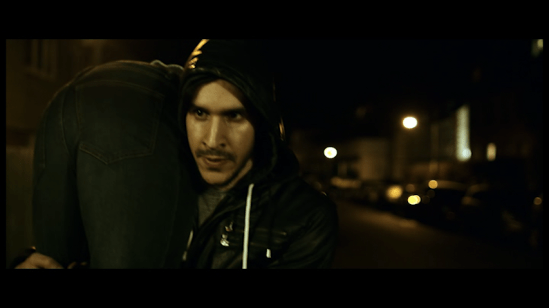
“K-Shop” is the 2016 horror from writer-director Dan Pringle in his first helmed feature that aims to explore the troublesome nature of the after party, intoxicated human plagued upon sensible people. Pringle strengthens the social commentary by implementing actual footage of drunken debauchery filmed right on England’s South Beach that range between spewing chunks onto the sidewalks to heated back and forth fisticuffs. Pringle’s script tackles that insatiable inner urge everyone has felt at least once in their life when dealing with unreasonable nightlife and that is to raise a fist against them to show how to act like a decent human being. “K-Shop,” which denotes being a double entendre for Kebab Shop and Kill Shop, takes the act one step further, introducing a cannibalistic element to the mix as Salah rids scrum from the earth by slicing and dicing them into his kebab mixture. Salah’s father, Zaki, is a Turkish refugee and him and his son are essentially immigrants that becomes another script undertone brought up the club owning, drug trafficking, all over bad guy Jason Brown.
Salah is brilliantly executed by Ziad Abaza who brings a cache of raw emotions to his character. “K-Shop’s” trailer hinted at a horror-comedy feature, but there’s nothing funny about Abaza’s Salah who seems that life is wholeheartedly against him as a downtrodden college student in a search for basic human decency and compassion. Salah is pitted against an egregious Jason Brown played by Liverpool native Scot Williams and Williams embodies and embraces being a person of high social status and fame, a person of who lavishes in luxury, and epitomizes being a slime ball. Brown’s a stark contrast against Salah who has to slave away and earn his living while Brown takes his life for granted. The supporting cast are also very interesting starting with Reece Noi as Malik who voyeuristically takes an interest in Salah’s vigilantism and who also, perhaps, shares common cultural aspects, but Malik is just a kid acting beyond his age at times and then drastically at his age at the most crucial moments during his dynamics with Salah. Another character is Salah’s potential love interest in Sarah portrayed by Kristin Atherton. Atherton provides a sweet, quiet, and intelligible demeanor to Sarah that projects onto Salah whereas other women in Salah’s life, mostly his patrons, are loud, obnoxious, and corrupt. Lastly, “Doomsday’s” Darren Morfitt instills a catalytic character in fallen from grace Chaplin Steve. There’s a bit of a confessionally staged event between Salah and Steve that offers a realization and a tale-end twist that just puts that unwanted pit into the bottom of stomachs.
Now “K-Shop” isn’t totally perfect, especially in the flow of the film. Pringle doesn’t clearly provide a timeline of progression. Between the holidays Christmas and News Years is perspectively prominent, but Salah’s calling, or mission, seems to extend weeks, if not months, and that isn’t clearly communicated. Plus, there’s slight difficulty understanding turn page moments that dilute the significance of events whether it’s through too much exposition or choppy editing. Where “K-Shop” is weak, Pringle makes up with gore and story. The gore is absolute from scorching an inebriated man’s face sizzling in a vat of hot oil to chopping up limbs with a butcher’s knife in order to make his delicious kebabs. Pringle’s conclusion is absolving, satisfying, and also, at the same time, fruitless because even though Salah makes a stand against immorality, a realization washes over him that nothing will ever change despite cutting the head from the snake.
Breaking Glass Pictures distributes “K-Shop” on to an unrated DVD home video. The DVD is presented in a widescreen 2:35:1 aspect ratio and the overall quality is stunning sporting a dark painted picture and still convey a healthy color palette even if lightly washed in a yellow hue. The’s no attempt to enhance the image as the natural color tone comes right out and off the screen and that dark gritty matter really speaks to Pringle’s capabilities to create shadows. The English Dolby Digital 5.1 audio track is surprisingly hanging around par level as, some of those key moments once spoken about, are lost in a muddled heap in the dialogue track, but there’s range and fidelity thats good on the output amongst a balanced five channel track. Bonus material includes a behind-the-scenes segment and deleted scenes plus Breaking Glass trailers. “K-Shop” is dark, gritty, and eye opening backed by a versatile lead in Ziad Abaza and helmed by newcomer filmmaker Dan Pringle, seeking to entertain and unearth our inner and deadly vigilante doppelgänger in the midst of social indecencies.