A Snapshot Celebration, Averting the EVILs of Typecasting, for the Iconic Actress “Sylvia Kristel: The 1970s Collection” reviewed! (Cult Epics / Blu-ray)

The “Sylvia Kristel:  1970s Collection” Available on Blu-ray and DVD at Amazon.com!  Currently on Sale!

Sylvia Kristel.  A name that is synonymous to eroticism.  Kristel paved the way in mainstreaming seductive romances of softcore exploits, helping to elevate the provocative genre out of the depths of sleaze and into a more exotic trashy novel for the big screen.   In her titular role in the “Emmanuelle” franchise coursed an arousing path of sexual freedom, uninhibition, and became the sumptuous and worldly window in private fantasies. Playing the role for nearly two decades didn’t stop Kristel from other high profile and lucrative projects with an array of filmmakers as well as her roles pre-“Emmanuelle” that molded the Netherlands actress into a sexual icon rather than object of male fantasies. Cult Epics acquires four films – “Playing with Fire,” “Pastorale 1943,” “Mysteries,” and “Julia” – that even though didn’t have Kristel set as a principal lead still showcased her range within the constraints of a minor, but certainly not insignificant, performance.

“Playing With Fire”

In a madcap Paris where sex trafficking is something of a sport, a wealthy French banker learns his daughter has been kidnap and threatened to be tricked out or burned alive if the kidnappers’ ransom isn’t paid.  Quickly learning that another woman has been mistaken for his daughter, a wave of relief bestows him to be cautious about future attempts on his daughter’s safety.  The banker hires a private detective to protect his loveliest of assets, offering to escort her to a local safehouse with the promise of sanctuary, but the P.I. is operating incognito being really one of the leaders of a surreal and lavish brothel who now has the banker’s beautiful daughter in his possession.  Or is it her who possesses him? 

Unlike any other exploitation-comedy you’ve likely ever seen, the 1975 released “Playing with Fire,” aka “Le jeu avec le feu,” is a wacky deep-dive of surrealistic sex trafficking from French writer-director Alain Robbe-Grillet whose obsession with prostitution rings and other filmic eroticism pursuits extends back within a decade later with “L’Immortelle,” aka “The Immortal One,” and “Successive Slidings of Pleasure.”  A French production of Arcadie Productions, Madeleine Films, and Cinecompany, “Playing with Fire” masters the avant-garde art of making light of a grim topic that results in a pull of emotions.  Robbe-Grillet draws out the shocking aspects of sex slavery while also encouraging a smirk or a chuckle at the whimsical characters and shooting techniques weaved throughout a burlesque narrative.  Robbe-Grillet also plays with the theme of dualities with a number of the principal characters having two or more versions of themselves:  Philippe Noriet plays not only the banker father Georges de Saxe but also a voiceless sleaze erotically interacting with the banker’s daughter in a very Freudian concept between father-daughter relations.  His daughter, Carolina (Anicée Alvina), disguises herself as the thin-mustached private detective to thwart future any attempt at an abduction and there’s also the identity mishap with the similar looking woman mistakenly kidnapped by the ringleader.  Leading us into Jean-Louis Trintignant as the ringleader Franz constantly in a revolving door switch-a-roo façade into the private detective.  The presence of duality doesn’t stop being a present throughout, continuing with the banker’s butler who is also a whorehouse patron without affirmation that they’re the one and same person.  Before their illegal banishment in the mid-20th century, Brothels were widely dispersed throughout Paris, but not until the Nazi occupation absorbed the houses of ill-repute that seared a bad taste of deviant humiliation and sordid disgust into the mouths’ of the French populace and Robbe-Grillet taps into that once time of unrest by splicing in a pair of isolating scenes of goose-stepping Nazi soldiers with one of the moments garmenting Anicée Alvina in uniform and marching in the ranks, suggesting a more sinister subplot afoot in the storyline.  Kristel plays one of the women snatched by Trintignant’s efficiently devious Franz with virtual a voiceless performance in what’s only a symbol of strength and beauty that sets perversion ablaze as she’s taken through the motions of essentially onboarding her into slavery whoredom. “Playing With Fire” can be at times difficult to keep up with the Alice in Wonderland-like surrealism and the character dualism but persists unwaveringly with a multi-faceted narration of deceit, eroticism, and comedy full of perversions and random outbursts akin to satirical skits that make this film unpredictable yet enjoyable to behold.

Pastorale 1943

During the Nazi occupation of the Netherlands, a quaint Dutch farming village lives day-to-day alongside soldiers and German sympathizers known as National Socialists (NSB) to the Nazis, traitors to their fellow Dutch countrymen.  When the Nazis learn of and round up all the dissidents and Jewish heritage people living in hiding on an adjacent, ferryboat island, a small band of unorganized resistant fighters determine the local pharmacist, a NSB member, to be the Nazi collaborator responsible for the treacherous leaking of information because his son impregnates an island village girl, teetering toward the fascist movement when mocked by her peers for her involvement with the pharmacist’s son.  Inexperienced in the execution of traitors, the bungling resistance fighters learn just how difficult planning a murder can be when their scheme falls apart in a small village where everybody knows everybody.

On this second of four Sylvia Kristel features is the Spieghel Filmproductiemaatschaappij of “Pastorale 1943” which makes more prominent the Nazi regime, is set with a backdrop of a Nazi occupied Netherland town and has a cameo role of young and dashing Rutger Hauer (“Blind Fury,” “The Hitcher”).  Netherland writer-director Wim Verstappen, whose had a few titles released previously from Cult Epics, such as “Obsessions” and “Blue Movie,” develops a script out of the World War II drama novel from author Simon Vestdijk with black comedic undertones and a tinge of corrosive sexuality and released the film in 1978.  Pastorale, or Pastoral, refers to the typically calm and idyllic country life which the complete opposite in 1943 Netherlands with all of Europe and East Asia engulfed in war; however, this story takes place in its own corner of the world with a mini, damn near microscopic, war waged between the Nazis occupation along with domestic NSB collaborators and the inhabitants resisting against the encroaching fascism that has plagued revenue crops and instilled an authoritarian culture, such as mandating the teaching of the German language to students in Dutch schools. Kristel’s involvement with Verstappen’s “Pastorale 1943” is about as much as her involvement in “Playing With Fire” with a minor role that’s still a keystone piece to the narrative. She plays Miep Algera, a local schoolteacher disparaged by her neighbors and colleagues for having romantic relations with a Nazi officer, but has she really fallen for the officer or is she secretly conducting counterintelligence for the resistance? “Pastorale 1943’s” two-part story plays heavily embroiling and embroidering characters in the first half to the point of instituting a cornerstone character but when the narrative pivots, to the darker side of implied Nazi exterminations and the fumbling through the execution of a rightfully innocent man, Verstappen homes in on Frederik de Groot as the artist Johan Schults whose Germanic surname causes him much strife amongst his Dutch brethren but to prove himself, Schults takes charge, along with an equally green execution squad of resistance politicians, to murder the NSB collaborator, a local pharmacist Poerstamper (Bernard Droog). The Academy Award submitted “Pastorale 1943” can be light and funny then turn quickly on a dime into wartime darkness and director Wim Verstappen’s vision pops with epic World War II fascism atrocities, confined to one part of the world and without the explicit voyeurism of genocide.

“Mysteries”

After the strange suicidal death of a man named Karlson, Johan Nagel arrives to the coastal town where the death occurred.  Immediately, Nagel stands out from the supercilious eccentric residents with his mustard yellow suit and fur coat, dispensing small cigars and money to everyone and every service as if they were infinite, and exhibits his own brand of strange behavior, especially with amorous feelings between two women and an unlikely friendship with a dwarf who has accepted his neighbors’ belittling jabs for humorous pleasure.  As his behavior declines, Nagel’s presence unravels the coiled, seemingly impenetrable, barriers around his friends, his enemies, and his romantic pursuits that reshape their properties for the better at the dangers of his own sanity and life.

Finally, we’re at a point in the Sylvia Kristel collection where the titular star is in a lead role with this demolition of concrete idiosyncratic personalities melodrama entitled “Mysteries” from Dutch filmmaker Paul de Lussanet, based off a novel “Mysterier” by Knut Hamsun, with Sigma Film Productions as the production company.  Kristel plays the steely Dany Kielland who becomes the infatuation of Nagel in an oppositional performance beautifully deranged and conducted by Rutger Hauer.  The hot-and-cold and on the brink of frustration relationship between Kielland and Nagel is as resolved as an unfinished breakfast left to waste and void of complete nutrition as both characters digest morsels of desire only to explode in a frenzy of loathsome disgust in an unsavory, brittle dynamic only Hauer and Kristel could produce on screen.  The other love interest involved, yet hardly feels as such until the last half hour, is an aged and more humble Martha Gude portrayed by “Last Night in Soho” British actress Rita Tushingham complete with a poor-looking frosty-colored wig.  Kielland and Gude represent the two-side of society – rich and poor respectively – stuck mastering a stanch stance of an indeterminate state that Nagel barrels into and knocks down the status quo, like a bowling ball to ten pins, for the better of the coastal town.  None of what Nagel does seemingly makes any sense and that’s very true to Hamsun’s novel in the unconventional, and probably unintentional, methods of Nagel’s erratic influence.  “Time Bandit’s” David Rappaport debuts in his first feature film as Grogard, an achondroplasia character bulled by most of the town’s residents due to his disorder.  Grogard anecdotally tells the story as “Mysteries” narrator, as if reading straight from Hamsun’s novel, the recollection of Nagel’s dichotomic behavior and, at the same time, Nagel also being a mentor, protector, and a friend that pained Grogard to watch his friend whither to death in fit of emotional exhaustion.  “Mysteries” borders arthouse cinema, adaptive faithfulness, and pristine melodramatic performance that sound good in theory but not always translate well to the screen, leaving more of a perplexing impression on the whole purpose of rendering Knut Hamsun’s novel into film in the first place.

“Julia”

Every year, Patrick departs his boarding school for a short holiday with his father and relatives at his grandmother’s idyllic lakeside house.  While riding the train en route to his grandmother’s, he encounters an older, yet beautiful, blonde woman inside the passenger carriage car and before he can firm up courage to act upon his sexual brimming hormones, the blonde is swept up by an older gentleman right from under his nose.  Come to find out, the blonde woman is actually his father’s girlfriend in a completely open relationship when it boils down to sex.  Anxious about his own insecure sexual appetite, Patrick finds himself surrounded by the perversions of his family and friends, leaving the young man hesitant and nearly impotent in bedding the woman he actually cares about, a longtime friend Julia who lives next door to his grandmother.

On the heels of “Emmanuelle,” Sylvia Kristel follows up with another licentious freedom film in Sigi Rothemund’s “Julia.” Also known as “Summer Girl” or “Die Nichte der O,” the German production from the Lisa-Film company is the earliest film on the 1970s collection with a release in 1974 and is the only other screenplay on the collection next to “Playing with Fire” that is not adapted from literature. Instead, “Julia” is a wild romp ride of young sexual exploration and the anxieties that accompany it from an outlandish and witty script by Wolfgang Bauer. “Julia” might not be based off a book, but the story is certainly an unapologetically open book about the insignificance of virginity, polyamorous affairs, lesbianism, voyeurism, and the sexual rite of passage into adulthood with the young and naive principal Patrick, or Pauli as credited, played by the late Ekkehardt Belle who passed away in January of this year. Opposite Belle, Sylvia Kristel obviously dons the titular role of Julia. Inexplicably voluptuously different from the other three films on the collection, Kristel radiates a sexual aurora perhaps infected by proxy of its release soon after “Emmanuelle” as Kristel obvious branches out to more sensible dramatic roles rather than the decor of a German sex comedy such as “Julia” that galvanized by its free-for-all eccentric caricatures including an operatic, overweight, and perverse uncle Uncle Alex (Peter Berling, “When Women Were Called Virgins”), a highly aggressive lesbian in Aunt Myriam (Gisela Hahn, “Devil Hunter”), the house maid Silvana who Myrian seduces with whipped cream and has piano-top sex (Christine Glasner), and his polyamorous father Ralph (Jean-Claude Bouillion, “The Sextorvert”) and girlfriend Yvonne (Teri Tordai, “She Lost Her…You Know What”). Comparatively flimsy next to “Emmanuelle” as a sexual journey and coming of age film but “Julia” is a hot-to-trot sex comedy with funny bits as well as sultry naught bits too.

Beautifully curated for the first time ever release in the United States of all four films is Cult Epics’ “Sylvia Kristel: 1970s Collection” on Blu-ray and DVD. The 4-disc, uncut Blu-ray, which was provided for coverage, is region free, limited to 2500 copies, and perfectly packaging to extol praise upon the robust early career of Sylvia Kristel. Presented in European widescreen 1:66:1 (with the exception of “Playing with Fire” which is displayed in an anamorphic 2:35:1), each film is newly scanned in 2K from the original 35mm elements as well as been restored. Transfers for the most part are exquisitely pristine, each harboring their own mise-en-scene mélange, but some are better than others with “Mysteries” sitting at the bottom rung of showing slightly a few more scratches and one-or-two single frame damages that flame up through the reel briefly. “Julia” also has minor scratches, but that’s really the extent of the issues with the image quality on this restored visual released with a rich color palette and textures redefined for a better palpability. Compression issues are virtually non-existent and there are no tinkering enhancements or cropping used to skirt transfer limitations. I am in awe of the audio output of the 1920kps bitrate, transmitting the highest audio quality possible for each release through either DTS-HD Master Audio 2.0 or a LCPM 2.0. Dialogue clarity comes through cleanly with French in “Playing with Fire,” Dutch and German in “Pastorale 1943,” and German in “Julia.” “Mysteries” sounds a bit muddle sometimes due to the consistently background popping interference, but the Dutch language still pulls through strongly and discernibly. Each film comes with optional English subtitles. Special features are aplenty with audio commentaries by Tim Lucas, Jeremy Richey, and Peter W. Verstraten, new and vintage interviews and promotional footage with cast and crew on ‘Playing with Fire,” “Pastorale 1943,” and “Mysteries,” a poster and still gallery on each release, and original theatrical trailers. Outside the disc contents, the collection’s rugged cardboard boxset housing unit consists of a 4-disc snapper case with vintage-still collage cover art, a 40-page illustrated booklet with color pictures and an essay on all four films written by Jeremy Richey, and a cover art poster by Gilles Vranckx. Total runtime is 429 minutes, enough to get your Syliva Kristel fill and then want more…much more. The “Sylvia Kristel: 1970s Collection” lauds the actress’s versatility of performances and ability to work with any director from any country and fans who love “Emmanuelle,” or of just Kristel, will undoubtedly fall in love with this Cult Epics comprehensive look at the Dutch icon’s outermost filmography.

The “Sylvia Kristel:  1970s Collection” Available on Blu-ray and DVD at Amazon.com!  Currently on Sale!

EVIL Infiltrates to Seduce All Your Women! “The Vampire Lovers” reviewed! (Scream Factory / Blu-ray)

“The Vampire Lovers” Now Available at Amazon.com!

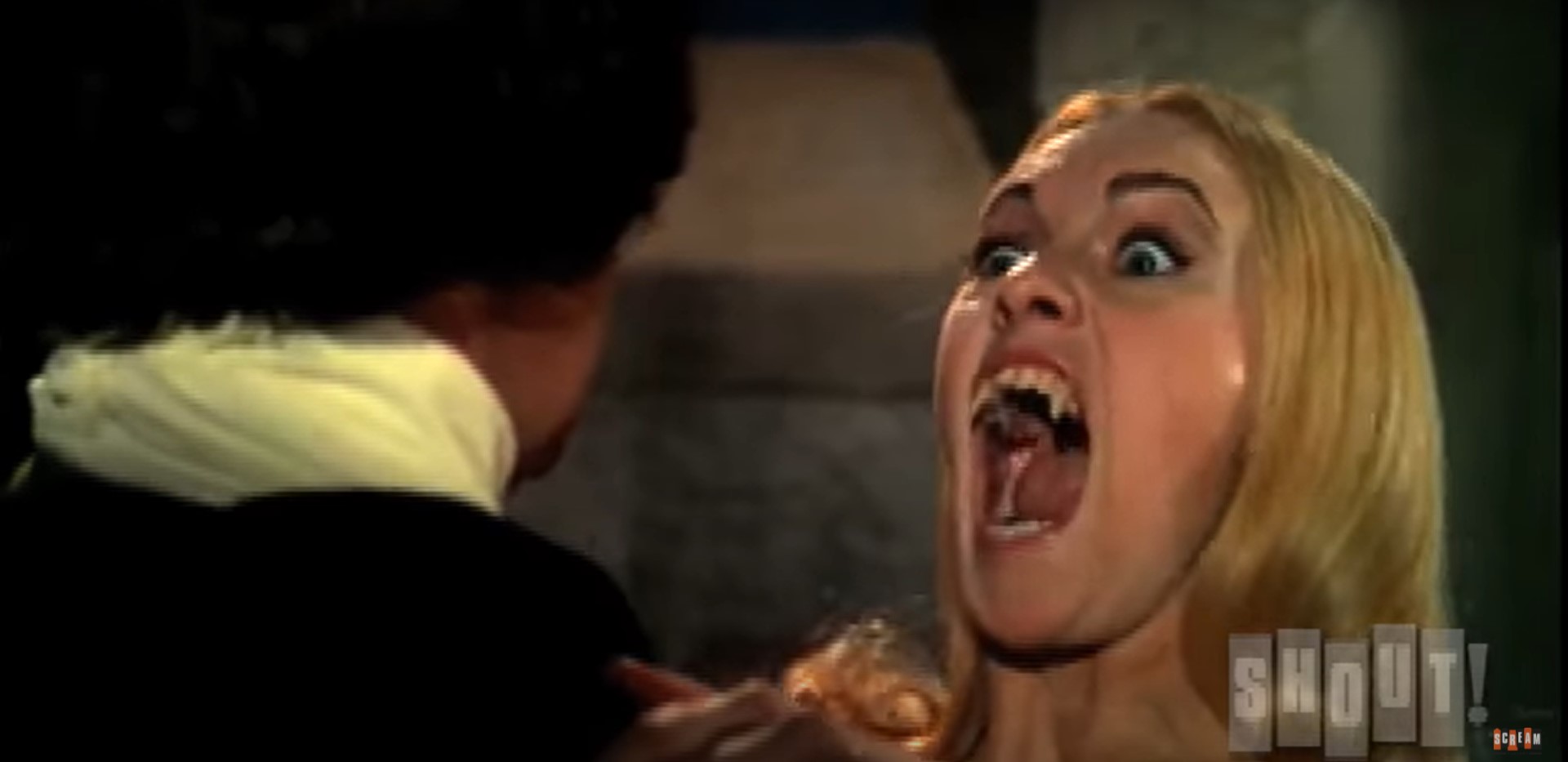
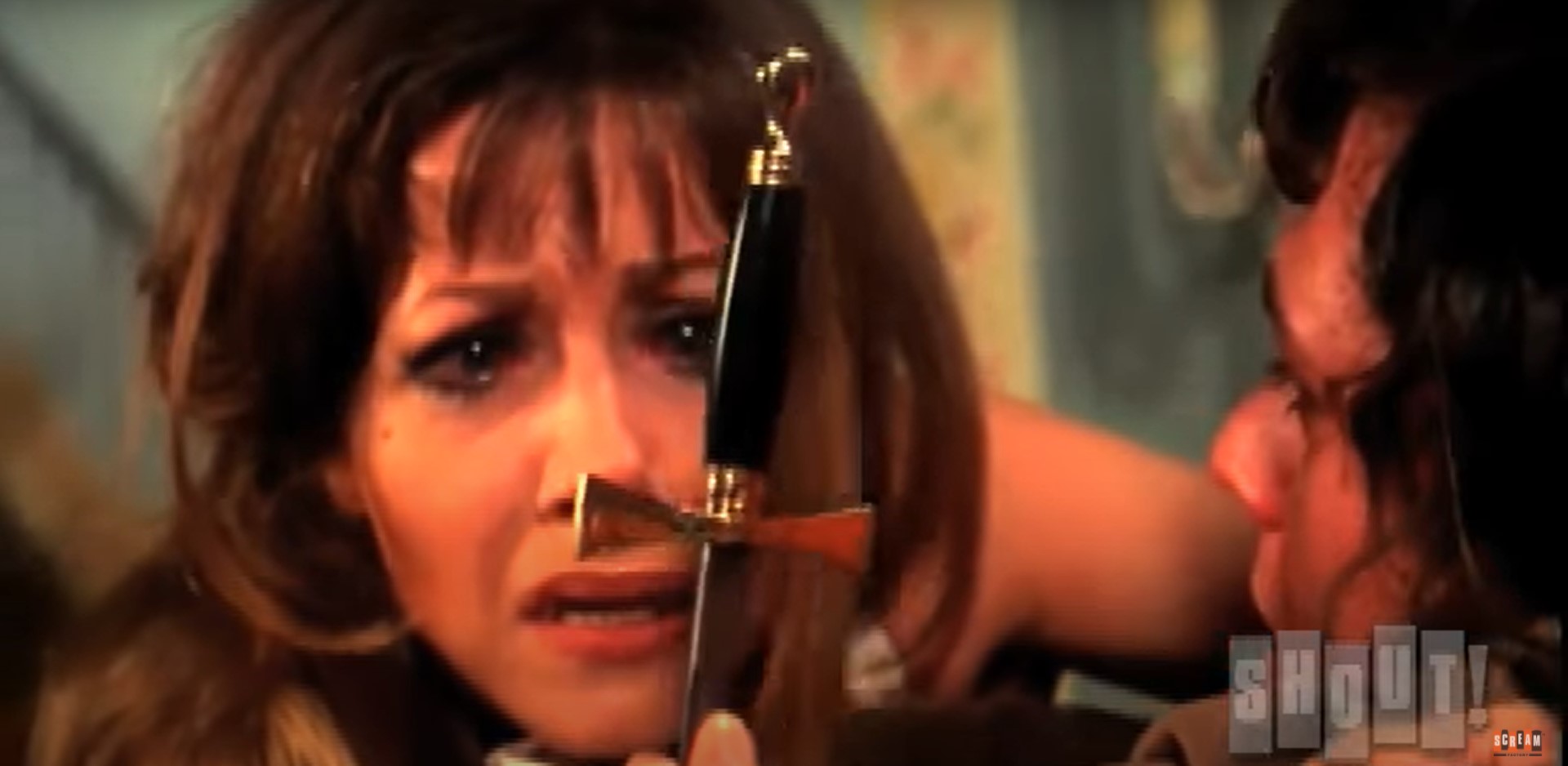
The Karnstein family’s notorious legends of evil spread vast throughout 18th century Germany. Once thought their wicked leeching of nearby villages exterminated after the Baron Joachim von Hartog dispatched all the villainous vampires after his sister fell victim to their seductive fangs. However, years later, the aristocratical General von Spielsdorf and his niece Laura find themselves in the unexpected company of a houseguest with Marcilla, the beautiful daughter of a new neighboring countess. Days later, Laura unexplainably dies from continuous nights that drain her of energy and flourish her mind full of nightmares of being strangled by a large wild animal. In the wake of her death, Marcilla also disappears. Sadden by the news of her friend’s death, Emma and her father take in the daughter of a travelling countess named Carmilla to provide Emma with cheery, distracting company in a time of distress, but the mysterious cycle of enervation and nightmares start back up all over again and it’s up to the survivals of Laura’s death to stop death before it’s too late.

Unlike any other Hammer horror film you’ve ever seen before prior to 1970, “The Vampire Lovers” blazed the trail for permissiveness of the era’s newly reformed certification system that moved the bar from 16 years order to 18 and kept in line with society’s leniencies toward the favoring sex and free love.  “The Vampire Lovers” opened up to not only a new line of exploitation and violence at the turn of the decade but also introduced the longtime fans to new faces, especially actresses, who would accumulate labels and prominence inside the genre that last until this day.  Based from the story of “Carmilla” from Irish writer Sheridan Le Fanu, relatively new at the time Hammer director Roy Ward Baker (“Scars of Dracula,” “Dr. Jekyll & Sister Hyde”) took the Harry fine and Michael Style adapted original story and ran the distance with the screenplay from Tudor Gates whose writing forte was not specifically well-known within horror genre nor was horror Gates’ personal interest, yet Gates tweaked the Le Fanu female vampire tale to accentuate more of lesbian themes in a very turmoiled time when lesbianism, or just being gay, was seen as a disease or an unstoppable influencing evil force amongst the young people.  Fine and Style serve as producers in this co-production between Hammer Films and American International Pictures.

“The Vampire Lovers” comes under an atypical rule of the protagonist role or roles.  Previous Hammer films oriented themselves with a male lead from Christopher Lee’s domineering monster Dracula to the fearlessly courageous vampire hunter played by Peter Cushing, but “The Vampire Lovers” has Hammer trade in the masculinity presence for femme fatale with the introduction of Ingrid Pitt (“Wicker Man”) in the role of the hungry Karnstein vampire, Carmilla as well as Marcilla and Mircalla as the sneaky creature of the night infiltrates estates. Pitt’s exotic look and uninhibited attitude discerns obvious sex appeal for the Polish actress who can also act with gripping emotion that develops compassion for her malevolent facade. Add another pretty face and innocently sensuous woman arm-to-arm to Pitt with then 20-year-old Madeline Smith (“Frankenstein and the Monster from Hell”) and you have a two-front protagonist made up of women. Tack on the dark features and piercing blue eyes of Kate O’Mara (“The Horror of Frankenstein”) and “The Vampire Lovers” evolves into the something unlike anything we’ve ever seen from Hammer horror trifecta as once the scene settles into the narrative’s girth, the dynamic turns into a love triangle of unspoken women intimacies and jealousy, under the guise of supernatural persuasion, rears its ugly head. The menfolk really do feel absent from the excitement despite being pivotal pieces to the story and despite being the iconic representation in face and name of Hammer films. Peter Cushing’s longstanding work with the company has branded him forever legendary in the eyes of horror fans young and new. As the benevolent General von Spielsdorf, “The Horror of Dracula” Cushing looks wonderfully regal, gentlemanly dashing, and epitomizes the very essence of a strong male figure who also takes a very noticeable backseat for much of the second and into the third act. Same can be said for that other vampire portrayer who’s not Christopher Lee, Ferdy Mayne (“The Fearless Vampire Killers”) as the village doctor with a scene plopped here and there to inch the story along as a motivational vessel and another player caught in the Karnstein fang-game. “The Vampire Lovers” sees through to move plot significant characters, played by notable actors, to and from the storyline with performances from George Cole (“Fright”), Jon Finch (“Frenzy”), Dawn Addams (“The Two Faces of Dr. Jekyll”), Pippa Steel (“Lust for a Vampire”), Harvey Hall (“Twins of Evil”), and Douglas Wilmer as the Baron Joachim von Hartog who give a great opening expositional prologue that sets the background and tone of the film.

Laced in the traditional gothic style we all know and love from Hammer Films, “The Vampire Lovers” has grandiose late 19th century interiors and costumes with the latter gracing the starlets with strikingly bright tropical colored dresses that are elegant beyond the more stiff, and sometimes more imperialistic, outfits representing the period.  In a way, the outfits contrast against the brooding gothic prominence that speak of subversive liberation much paralleling the very thematic elements of lesbianism, sexual motifs, and a nearly an all-encompassing female lead.  If sex was ever a subtle insinuation in previous Hammer film it was not so subtle in “The Vampire Lovers” that consistently and constantly thickened the sexual tension and produced blunt scenes of eroticism between two or more women.  Even with the powerful commingle of womanhood desires, as much as it was depicted to be devasting to their lifeblood, Tudor Gates’ narrative still pit them up against nearly impossible odds when the male characters, no longer duped by the formalities of chivalrous intentions, figure out what’s really happening under their noses, in their households none the less, and band together to put a to a heart-staking stop to the macabre madness aka metaphorical lesbian evil.  The story has the women’s lusts and desires, whether their choosing or not, be an outlier from normalcy, yet on the other hand, nudity flourishes within the new laxed certification guidelines that see in some way, shape, and form four actresses baring skin in what what would have been considered risqué X-certificated scenes prior to 1970.  “The Vampire Lovers” is by far a perfect film with a lack of character context, such as with the male vampire on horseback indulging his penchant for observing Camilla’s attacks from afar and doesn’t proceed to explain further or with more insight to who he is and what his position may be within the Karnstein family ranks, as well as the narrative format with early on into the story being bit choppy and disorienting when Carmilla assaults nightly the General’s fair niece as a furry beast in the confines of a lurid nightmare.

Deserving of a collector’s edition, Shout Factory subsidiary horror label, Scream Factory, presents a new Blu-ray release of “The Vampire Lovers” scanned in 4K of the original camera negative.  Scream Factory should be extolled for their color grading toward Hammer transfers as the release looks stunning with quality stability and richness that brings the era alive.  Transfer also appears free from any kind of major blemishes and barely of any smaller ones. The English language DTS-HD Master Audio mono has resolute fidelity in the best possible audio offering “The Vampire Lovers” will likely see now and in future releases with a clear dialogue track and a Harry Robertson score that relives the classic studio orchestra in compelling fashion. The release comes with a slew of special features including an exclusive new interview with film historian Kim Newman, who also shows up again in archived interviews in the “Feminine Fantastique: Resurrecting ‘The Vampire Lovers'” (Scream Factory lists it as Femme Fantastique on the back cover) featurette commentary snippets from John-Paul Checkett and David Skal and other historians and collectors of Hammer Films. Audio commentaries with director Roy Ward Baker, star Ingrid Pitt, and Screenwriter Tudor Gates, audio commentary with film historians Marcus Hearn and Jonathan Rigby, two interviews, one of them new, with co-star Madeline Smith that span about 10-15 years apart, Trailers from Hell: Mick Garris on “The Vampire Lovers,” a reading of Carmilla by Ingrid Pitt, a single deleted scene of Baron von Hartog radio spot, still gallery, and the theatrical trailer round out the bonus material. The 89-minute, Region A encoded, R-rated version runs solo as the only main feature and the transfer Scream Factory uses, or licenses, is the edited version of Ingrid Pitt’s bath scene that cuts away to a medium closeup of Madeline Smith holding a towel for Pitt who’s standing up in the tub and then cuts back to Pitt’s bare backside. However, in the “Feminine Fantastique” featurette, you can experience the unedited brief full-frontal of Ingrid Pitt standing up in the tub if that tickles your fancy. The collector’s edition sports reversible cover art with original poster art on the inside and a newly illustrated, and superbly beautiful in its simplicity, front art by Mart Maddox sheathed inside a cardboard slipcover of the same Maddox art. Turning a corner into vast opportunities for more violence, explicit nudity, and unrestrained vampire gore became a new dawn for Hammer Films without entirely prostituting themselves with wayward tactics to the point of unrecognition as “The Vampire Lovers” still emitted gothic characteristics and a partial token cast and now made even more alluring with a feature packed collector’s edition from Scream Factory!

“The Vampire Lovers” Now Available at Amazon.com!

A Stuntman and Rock-n-Roll Magicians Have EVIL Under Control! “Stuck Rock” reviewed! (Umbrella Entertainment / Blu-ray)

The MUST OWN version of “Stunt Rock” Now on Blu-ray at Amazon.com!

Grant Page is a world-famous veteran stunt man from Australia and his new big project, a high octane, thrilling action move feature packed with car chases, fire sequences, and death-defying falls set in Hollywood, California.   When he arrives, his cousin Curtis picks up from the airport and shows him around, ending up at the recording studio where Curtis’s band Sorcery is lays down tracks for their upcoming album.  Between Grant’s thrilling high flying, quick burning stuntman work and the band’s theatrical heavy rock and magic trick performances, a showcase of entertainment energizes the soul as well as entertains it.  Before long, a column journalist Lois Willis aims to get Grant’s story on occupational health and lifestyles.  They’re joined by Grant’s costar of the film, leading lady Monique van de Ven, and together they rock out and enjoy the daredevil antics like one big life party. 

Unique in format and content, “Stunt Rock” reflects upon the ostentatious career of director Brian Trenchard-Smith. Before immersing himself in straight-to-video sequels of “The Omega Code,” “Night of the Demons,” and “Leprechaun,” Trenchard-Smith had a talent for being unabashed and taking risks in making something different. Thus, an 86-minute one-part showcasing demo reel, one-part fictional story, and one-part heavy rock music video was born from a slew of Trenchard-Smith shot achieve footage highlighting the impressive physicality resume of the one and only Grant Page. In 1978, “Stunt Rock’s” short theatrical run assumed the picture too radical for the general public with a motley crew of characters and a get-to-know Grant Page storyline that interjected the heavy rock, or borderline glam rock, of Sorcery, a five-piece band accompanied by two magicians whose illusions and pyrotechnics were performed live on stage as the musicians rocked out. Only recently has “Stunt Rock” re-emerged onto home video due in part to the advocating acolytes of the now defunct by not forgotten band and has become a wonderous and enriching blast from the past of reliving decades old history, contrasting artistry cooperating under one umbrella, and a deluge of rock and master class stunts. Also known as “Crash” or “Sorcery,” Martin Fink produces the quasi-action docu-musical with Trenchard filming under his own banner, Trenchard Films.

Grant Page, a man you may never recognize in name or face but probably have seen his broad list of service work at least a dozen times or more. “Mad Dog Morgan.” Yup, Page did the stunts. “No Escape.” Yup, that too. “Mad Max.” That as well! Between performing the stunts and a stunt coordinator, Grant Page has achieved over 100 credits to his name, but not until receiving the lead role in “Stunt Rock” is where he actually got to be himself…literally. Trenchard-Smith’s goal was to put Grant Page on a platform having worked with the stuntman on previous films, such as “Deathcheaters” and “The Man from Hong Kong,” putting his career, and life, on the line numerous times. Page is charming and collected under his rugged facial hair and glasses atop a muscular physique as he’s paired to cohabitate with the latter half of two-word title. Grant Page is stunt whereas Sorcery is rock. Consisting of, at the time, members of the Americna rock group were front man Greg Magie, bass Ritchie King, guitarist Smokey Huff, drummer Perry Morris, and Keyboardist Doug Loch who always wore a glitzy or colorful stocking mask with had his vocals adjusted to a higher pitch. There were also two highly skillful stage performing magicians in Paul Haynes as the bearded King of all Wizards, Merlin, and Curtis James Hyde as Haynes on stage villainous counterpart, the Prince of Darkness aka Satan. In between the two rip-and-roaring personas is a reporter working on a column piece and Grant becomes her angled subject. Brian Trenchard-Smith’s wife of 40+ years is Margaret Gerard in the role of Lois Wills, a love interest who doesn’t quite understand Grant’s obsession with intentional self-destruction as a profession but quickly falls for the big hunk despite any real tangible flirtation. Across the aisle at the other end of female perspective is Monique van de Ven playing as herself. The Netherlands actress, who mastered the art being in a catch-22 love triangle between her longtime husband and her adventurous and new female lover in “A Woman Like Eve,” is positioned in “Stunt Rock” as certifier of the fake movie Grant is there to stunt for being the leading actress eager to do what Grant does, the stunt work, at the chagrin of her asset protecting agent.

“Stunt Rock” may not be our bread-and-butter material for review, containing a severe lack of ghastly horror, creature horror, sleazy exploitation, gore and shock, phantasmagoria schlock, etc.  Instead, what “Stunt Rock” is is a pure, 100%, grade A cult classic title that goes beyond the baseline criteria for critique, as if the film even needed our insignificant stamp of world cinema approval.  Absolutely not, as “Stunt Rock” speaks for itself, literally so in the very title, delivering essentially what the film is selling, documenting, exhibiting, and entertaining along with the caveat to be a career booster and an endearing tribute for director Trenchard-Smith’s much adored and highly respected Grant Page. The way Trenchard-Smith fashions his own shot stock footage of Page’s exhilarating and adrenaline junky spectacles into flashbacks, split screens, and just a reel of collected examples whenever Page goes into specific memories of stunts, a montage of similar acts, or even how he feels before or during the performance never bogs down into arrogant gray area on the part of feature’s star. Only the director behind the one-two punch “Day of the Panther” and “Strike of the Panther” could pull of “Stunt Rock’s” insanity on celluloid, rock on reel, and a cloud nine high on a combination of both.

“Stunt Rock” is more than just assemblage of electrifying stunts as it also brings down, as well as breaks down, stunt work as not this grandiloquent behavior but more about precision, planning, and self-care with some mild levels of egomania to do things bigger, better, and more dangerous. All of this great content is now on coming at you on a Blu-ray home video from Umbrella Entertainment as the 8th spine on their Ozploitation Classics label. Presented in a widescreen 2.35:1 in full high definition, 1080p, the region free Australian release is a fury of packed goodness, in all sense of the term. Rated PG, “Stunt Rock” is about as wholesome as a PG film came come that even comes with an opening disclaimer about not trying these stunts at home, so parents open your children’s eyes to “Stunt Rock!” As far as image quality is concerned, Umbrella’s release perfects the natural-looking colorization by adding a pop of robust color, unintrusive grain, and baring miniscule blemishes. Most of the film is shot in 35mm, but some of the older footage Trenchard-Smith shot on Grant Page is in 16mm and the varying levels of difference in the details can play tricks on the mind with the stark contrast. The English language DTS-HD Master Audio 2.0 is a solid track. Dubbing can tilt an audio imbalance in the depth around certain dialogued moments, but for the most part, no compression issues leave a clean and clear outcome with even an array of well-recording Sorcery tracks and capturing all the fine details in their pyrotechnic and smoke and mirror shows in front of a live high school audience. This Blu-ray is packed with special features beginning with an exclusive virtual interview with Brian Trenchard-Smith and his wife/leading lady Margaret Gerard at their home in Oregon going over every facet in the genesis and aftermath of “Stunt Rock,” plus 2008 interviews with Grant Page and the director from Not Quite Hollywood segment, 2008 audio commentary from Page and Trenchard-Smith, 2009 audio commentary from the director, producer Marty Fink, and actor Richard Blackburn, a 2009 introduction to the film, extended interviews with Sorcery guitarist Smokey Huff and Marty Fink, 2009 audio interview with the band’s drummer Perry Morris, Brian Trenchard-Smith’s Alamo Drafthouse Appearance, Cannes Promo Reel, a HD theatrical trailer, an exclusive new Trenchard-Smith approved trailer reel, and more audio commentary from the director in Trailers from Hell. And that’s not all! Beyond the colorfully retro-esque slipcover and snapper cast with reversible cover art with the film’s posters on the inside is a 14-page collectible comic book with the abridged illustrated version of the film. “Stunt Rock” is an amazing, one-of-a-kind film with now a one-of-a-kind Blu-ray release from Umbrella Entertainment sure to be a must-own for any fans of Brian Trenchard-Smith, Grant Page, or Sorcery!

The MUST OWN version of “Stunt Rock” Now on Blu-ray at Amazon.com!

Take a Dekko at this EVIL! “The Collingswood Story” reviewed! (Cauldron Films / Blu-ray)


Rebecca moves from her small town of Bedford, Virginia to Collingswood, New Jersey to attend college.  Her small town boyfriend, Johnny, buys her a webcam to keep in touch with long distant video chatting, or to more so keep tabs on the sanctity of their fraying relationship.  For her birthday, Johnny provides her an entertaining list of audiovisual phone numbers to call, one such number belonging to an enigmatic online psychic Vera Madeline who is compelled to reveal Collingswood’s gruesome, satanic ritualistic history with one of the town’s most horrific mass murders having occurred at the very house Rebecca currently resides.  As Rebecca and Johnny investigate deeper, the webcam keeps rolling as their curiosity leads them into a dark and deadly supernatural mystery that will engulf them both. 

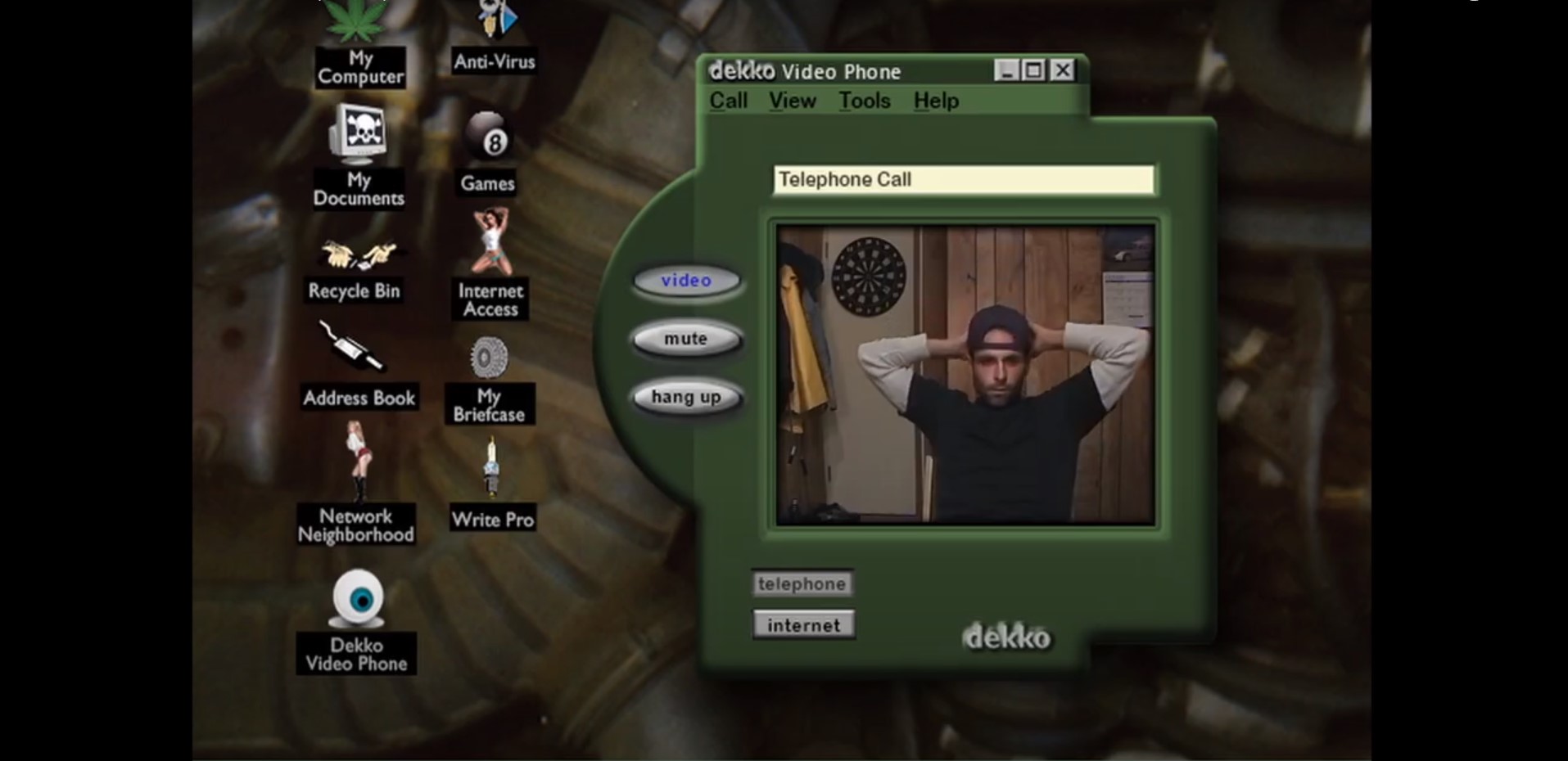
Talk about dated content!  “The Collingswood Story” is the 2002 trailblazer for the paranormal webcam subgenre that has ballooned over the last decade with the success of “Host,” “Followed,” and even the “Paranormal Activity” mega-franchise.  Writer-director Mike Costanza’s early 2000s film starkly contrasts how internet communication technology has changed over the last two decades with the ridiculous long corded phone jack plugins, time consuming uploading of camera footage before the invention of social media live platforms, and the lack of a pre-multiple participant teleconference with a limited single caller-to-caller video application. Once under the working title of “Mischief Night” as the story is set around Halloween night, “The Collingswood Story” is one of Constanza’s first feature films after branching out from the Paramount Pictures’ art department and right into the low-budget horror constraints, but the novel stylistic idea, based off real reports of a mass murder in a New Jersey town and saw little-to-no post-completion success traction back in the early 2000s, was a sell-produced production by Constanza’s Cinerebel Media along with associate producer Beverly Burton.

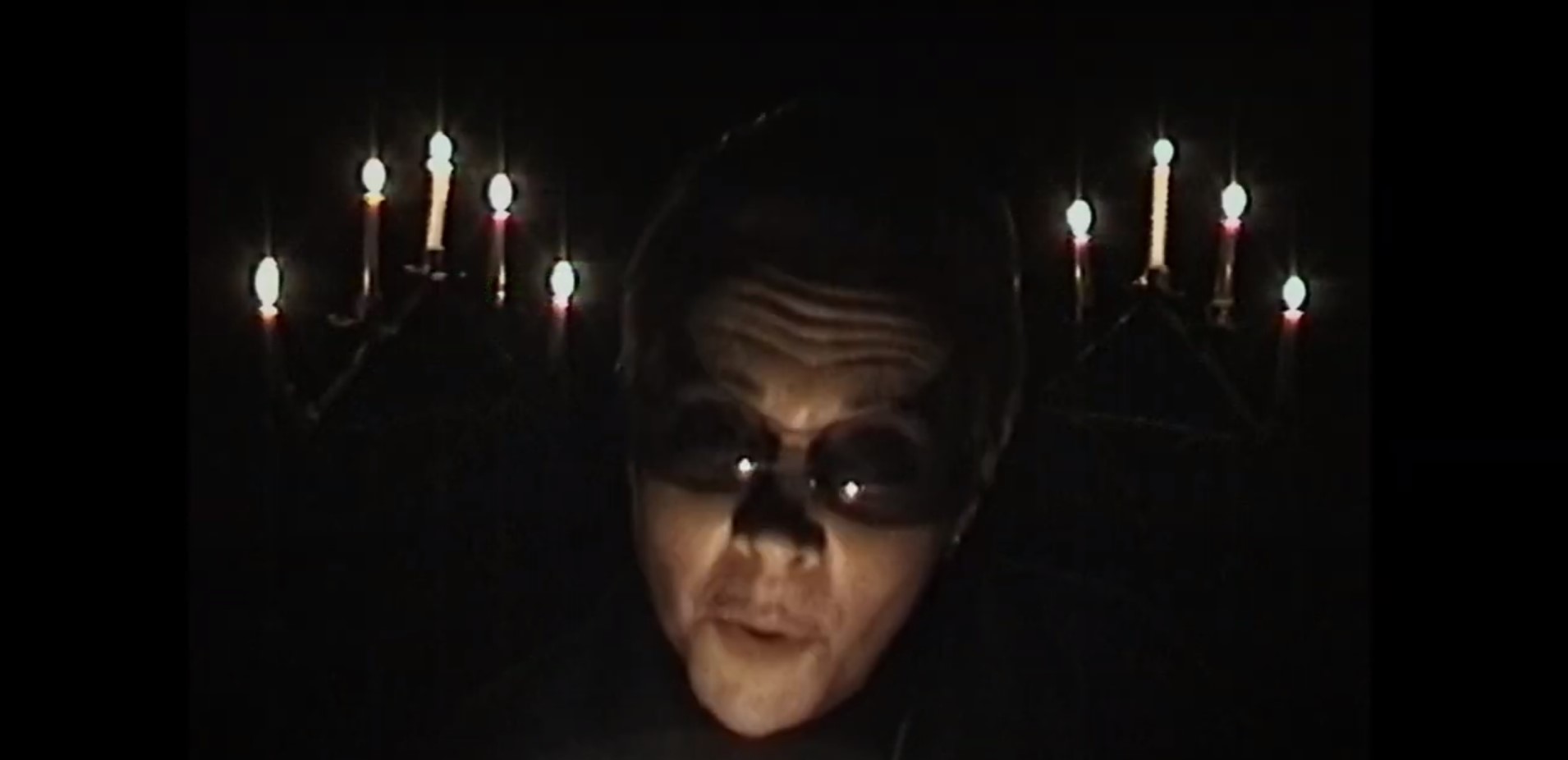
An interesting tidbit about “The Collingwood Story’s” shooting with the cast is that all the actors were shot individually since everything was done on essentially a webcam. Constaza would be in the room and read opposite the actor in performance. What’s spliced together makes good on delivering reasonable and believable menace, but without talent performances, there would not have been a revisiting home video release of this title. Stephanie Dees got her start in a major horror franchise by playing a minor role in “Halloween 4: The Return of Michael Myers” and 13 years later, Dees finds herself in the lead role of pioneering computer horror as birthday Rebecca. Opposite Rebecca is the lovesick paranoid puppy Johnny, played by Johnny Burton in his only credited role. Rebecca and Johnny go through the song and dance of his skirting around his relationship controlling paranoia as he bounces from Rebecca to his crass friend Bill (Grant Edmonds) while Rebecca is the picture of studious student, ignorant to the self-imposed friction in Johnny’s head. Burton’s a little stiff around the gills in his one-note and uninspired blue collar rendition of a longing, small town boyfriend whose personality matches his small bedroom as a background that never changes with the character unlike Rebecca who seems to grow into her environment with ever frame. In what’s probably her biggest identified role in a feature film, television actress Diane Behrens lurks in the shadows as the enigmatic psychic Vera Madeline wresting the story away from the slow burn of a dissolving relationship of young lovers and diverting into what we all came here for – a thrilling ghost story. Behrens plays the part with showmanship and a subtle inking that anything itching to come off her of mouth will be infomercial and portentous.

What Costanza has accomplished technically with “The Collingswood Story” is nothing short of amazing in his ability to seamlessly film and edit not only the scenes together coherently but also fabricate a meaningful connection between the two actors, shooting separately without a breath of another’s creativity to pull from, over still rather new and evolving technology to which some opposing critics would consider the technology to be disassociating the social standards.  “The Collingswood Story” is not a point and click monotony of talking head syndrome one might expect as Costanza, despite the gratuitous B-roll footage recorded by Rebecca as she drives around Collingwood searching specific locations, adds enough main footage filler of Johnny’s suspicions of a secret boyfriend, Johnny’s lowlife, yet witty, friend Billy giving him bad advice, and of psychic Vera Madeline’s mystifying mysticisms to keep viewers engaged while looking through the garbled eyeglass of lower compression bitrate quality of webcam footage shot on a Hi-8 camcorder that truly gives Costanza’s film that 90’s SOV feel at times.  There’s also the age-old theme of helplessness associated with webcam horror where those characters watching, just like us viewers, can only watch in an eye-widening terror unable to be a lifesaving branch of help when the supernatural stuff goes down.  Costanza also conveys the sense that the paranormal has zero limitations on a medium, in either a soothsayer or an internet conduit facet, to extend evil from the beyond, but the limitations on sensibility can extend only to a certain point in a culminating of Rebecca’s foreboding curiosity as her expedition into her lodging’s attic behooves her to take her laptop, along with its super long extension jack plugin cord, in order for her boyfriend, who lives a good 600 miles South, to accompany her into the darkness.  At this point, technology has yet to catch up with “The Collingswood Story” need and that’s where plausibility of the characters logic fumbles coinciding with an open for interpretation ending that wraps too quickly and asks more questions than provide answers.

For the first time, “The Collingswood Story” receives a proper North American release where technology has finally caught up to Mike Costanza’s vision! Cauldron Films presents the worldwide debut of a high definition, unrated, and region free Blu-ray release, remastered from the original source tapes by Costanza himself. Filmed on a Super Hi-8 camcorder, with Costanza undoubtedly the DP, “The Collingswood Story” remains presented in it’s original 1.33:1 aspect ratio and what also remains is the compression artefacts associated with transferring the source tapes. Certainly nothing devastating beyond a handful of B-roll scenes as much of the webcam shots look neat and tidy, but I’m surprised the reversal, aka webcam perspective of the person talking, scenes still shows a fair amount of blocky noise. The English language 2.0 stereo mix emits noticeable background static from, more than likely the culprit, the digital interference. The faint hum of dialogue track feedback hum is annoyingly choppy and it’s not just the play on the webcam mic of come-and-go vocals and background noise; however, the dialogue is clean and clear. The choice of soundtrack, a sundry of late 90’s-early 2000s placid rock, is audibly limp even for the dual channel output. The release comes with option English SDH subtitles and has a runtime of 82 minutes. Special features includes a behind the story with Mike Costanza looking back at the genesis of the idea as well as noting his inspiration for the idea, an interview with Stephanie Dees, an interview with Johnny Burton and Grant Edmonds, a director commentary, image gallery, and trailer. Despite it’s antiquated flaws, the crossbreeding of tech and terror in “The Collingswood Story” should have lifted the film into the cult status rafters of found footage films with the likes of “The Blair Witch Project,” but in lieu of the world’s massive oversight, Cauldron Film’s release is a big leap forward that looks back to the past.

Own the Limited Edition “The Collingswood Story” on Blu-ray Today!

The Crossover EVIL Has Been Fearing! “Straight Outta Nowhere: Scooby-Doo! Meets Courage the Cowardly Dog reviewed! (Warner Bros / DVD)


“Warner Bros. Home Entertainment provided me with a free copy of the DVD I reviewed in this Blog Post. The opinions I share are my own.”

A sub-frequency sound sends Scooby-Doo into a crazed and booty shaking fit.  So much so, Scooby runs away from the mystery solving gang and straight into the quaint, bizarre rural town of Nowhere, Kansas where he bumps into another canine, Courage, whose experiencing the same soundx and sensations.  When a plague of monstrous cicadas dig from out of the earth, Scooby and his friends, plus Courage and his lovable human Muriel and grouchy old farmer Eustace, must understand the copious amounts of the longstanding strange and unusual happenings in Nowhere to solve the mystery of the giant cicada attack that goes deeper into Nowhere’s roots…literally.  The two dogs have to peel off their scaredy cat shells and face fear head on while chowing down some of Nowhere’s delightful delicacies!

Finally!  The two most famous, fright-filled dogs make their cinematic crossover debut in “Straight Outta Nowhere:  Scooby-Doo!  Meets Courage the Cowardly Dog” that brings the terror tenfold to toon town!  Under the supervision of the serial animation director, Cecilia Aranovic, who helmed two previous Scooby-Doo installments, “Scooby-Doo! And the Curse of the 13th Ghost” and “Scooby-Doo:  Return to Zombie Island,” and tackled the action-packaged animation of “DC Super Hero Girls,” finds herself tackling a short-lived, Cartoon Network created cult fan favorite, “Courage the Cowardly Dog.”  Returning to the Scooby-Doo universe is the televised “Mystery Incorporated’s” writer and editor Michael Ryan penning a script with Courage the Cowardly Dog and creative mastermind of John Dilworth in mind to maximize all the grandstanding personalities faithfully.  Both lovable and yellow-bellied pooches are produced by Hanna-Barbera Productions, who do more crossovers of their cartoons characters than NBA’s Tim Hardaway, and are joined by Warner Bros. Animation and Cartoon Network studios. 

“Straight Outta Nowhere” reteams the “Mystery Incorporated” voice cast of Frank Welker as Fred Jones and Scooby-Doo, Grey Griffin as Daphne Blake, and “Scream’s” Matthew Lillard as Shaggy Rogers.  The revamped “Ducktales’” Kate Micucci replaces Mindy Cohn as the voice of Velma Dinkley with an apt Velma impression that easily transitions without discording the mystery solvers.  Courage voice actor Marty Grabstein reprises his quirky exclaiming hound whose full of heart and also returning Thea White stepping into the boots of Muriel, one-half of Courage’s owners.  Sadly, like original voice actor for Eustace, the late Lionel Wilson, who passed away shortly after the original show’s discontinuance, Thea White also passed away but the sting of her death was more poignant as White past July at the age of 81 and this crossover is presented in White’s memory.  Bugs Bunny and Daffy Duck funnyman Jeff Bergman voices the grouchy and sarcastic Eustace without missing a beat and with about as much cynicism as his predecessors even when unloading a boatload of scares with his giant and unsightly boogey-boogey mask!  A Eustace classic! To preface my character opinion, this movie is obvious about the Scooby and Courage spellbinding the little viewers about location gumption in themselves to face their fears when it matters, but Scooby and Courage’s friends and family provide pivotal, building black support that should render each mystery solver and podunk rural-ite as a mini-lead within the story. That’s not the case inside this crossover that lacks specifics with certain characters, such as the straightforward Fred, Daphne, and Velma who instantly fall way behind without much dialogue or screen time in favor of the more caricatured Muriel, Eustace, and Shaggy. Eustace even gets his own rap music video. Some minor characters from Courage’s past return to scheme and terrorize with the voice work rounded out by Jeff Bennett (“Friday the 13th Part VII: The New Blood”), Chuck Montgomery, and Paul Schoeffler.

Who would have thought it? Scooby-Doo has been a staple of Saturday morning cartoons, television specials, spinoff movies, holiday events, and has been reimagined animatedly and in live-action since 1969. And Courage the Cowardly Dog? Well, Courage ran on Cartoon Network from 1999 to 2002 with little specials here and there in between, but virtually radio silent when compared to his over 50 year-old co-star. Yet, did you know, the 2021 film isn’t the first time these two hounds crossed paths? That’s right, Scooby and Courage (along with Shaggy, Mureil, and Eustace) were first seen in a brief Cartoon Network promo together that you current see on Youtube – search “Scooby and Courage Cartoon Olio.” To be honest, I had assumed Scooby-Doo, who has spanned over multiple generations, is practically known worldwide in every household, and has been an invaluable money-making machine for Warner Bros., would tip the crossover screen time into the animated Great Dane’s favor, but in a pleasant surprise, a good chunk and crucial portions of the story revolves around Courage and his immediacy characters who are brought to the forefront with Scooby and the gang clearly taking a backseat to the smaller, lesser known pup.  Even the animation sides more with Courage, preserving within a smoother veneer the intrinsically warped details familiar to the show, as seen with Eustace’s Courage-scaring mask or Courage’s fluid scared reactions, and we can be honest with ourselves that although Scooby works in Courage’s surrealistic macabre world, the Dane and his gang have been rendered countless times in many different animation styles throughout the last five decades.  Enigmatically familiar to one of the mysteries Scooby and his gang dive right into, the tale fashions a composite of two different protagonist dynamics to expose who or whom are behind the giant cicada attack and the hypnosis causing ruckus; however, like the original episodes of the early 2000s, Muriel and Eustace are present just for the ride as Muriel stumps a self-frustrated Velma with elementary riddles and Eustace mouths off like an old kook without as much as a care in the world around them or what’s happened in their own backyard of Nowhere. 

Witty, zany, and all of the above with a nostalgia high, “Straight Outta Nowhere:  Scooby-Doo!  Meets Courage the Cowardly Dog” will delight fans of both series with the hope for more team-ups in the future.  Warner Bros. Animation will release the film on DVD come Tuesday, September 14th with a G rating approved for all audiences and with a runtime of 78 minutes. The disc’s animation picture quality is about as animated and as lively in it’s vibrancy as the characters with no real cause for format concern as aside from a cleaner, more robust color palette, the colors translate nearly indistinguishably from it’s 1080, HD counterpart as the colors do saturate nicely, leaving little room for a potential washed or dull veneer. The English (and dog gibberish) language Dolby digital 5.1 surround sound mix boosts an energetic and immersive output with nonstop creature effects, explosions, laser zaps, etc. All the creepy ambience and score that make “Courage the Cowardly Dog” spookily alluring is right here on this DVD, filling out the channels with dichotic range and space with the depth. Screams take centerstage as the keystones to ever scary flick to maximize the intended feeling of fear and, in this case, laughter. One of the more disappointing aspects of the release is the special features and while three episodes, seemingly randomized picks – Scooby-Doo! Where Are You!’s – “Decoy for a Dognapper” and The Scooby-Doo/Dynomutt Hour’s – “The Gruesome Game of the Gator Ghoul” and “Chiller Diller Movie Thriller,” is a blast from the past and a bit of nostalgia watching reruns as a kid, I really wished there were interviews with the voice cast, especially Marty Grabstein, Thea White, and Courage creator John Dilworth to laud the show and let the fans their appreciate for the little guy…meaning Courage. “Straight Outta Nowhere:  Scooby-Doo!  Meets Courage the Cowardly Dog” wins on many levels: Courage the Cowardly Dog is back, Matthew Lillard is Shaggy once again, and the most petrified pooches in all of animation land bring two generations of people together for the whole family to enjoy their staple idiosyncratic gags and colorful personalities.

A Must Own “Scooby-Doo Meets Courage the Cowardly Dog” on DVD!