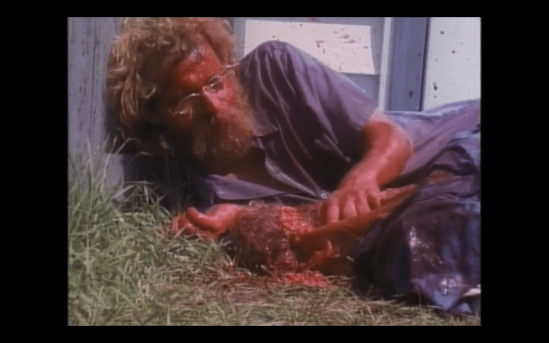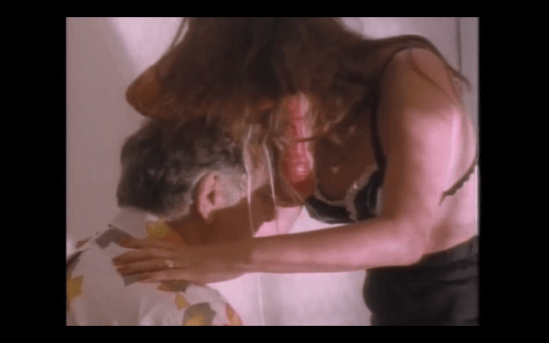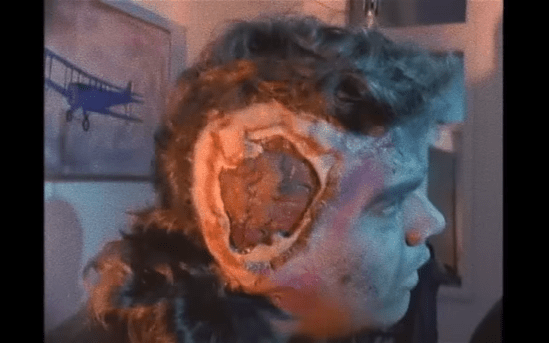
A graduate dream research group experiment on paranormal and sensory deprivation sleep patterns involving controlling their own dreams, even if their terrifying, and examining their own deaths but when they pivot to investigate supernatural activity inside an isolated compound mansion in the midst of an arid desert, the four students and their eccentric teacher conjure malevolencies that include satanic rituals and alien encounters. With their professor spearheading an underlying motive to use them for his diabolical plans, the hesitant and scared group must decide to either force their participation or try and escape their instructors madness, but when the lines of reality blur, friend becomes foe and foe becomes friend with casualties in the middle on all sides as grisly depictions of death and suffering question whether their nightmares are spilling into reality.
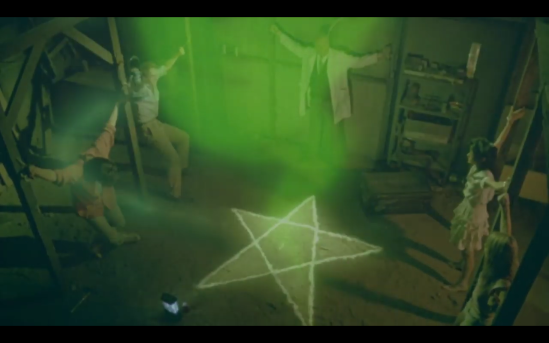
Subconscious surrealism on an ultimate terror coaster from writer-director Bruce R. Cook with an unspeakable horror in every corner, from flesh eating extraterrestrials to disillusioned Mad Doctors, in the nightmare-inducing “Nightwish!” The 1989 made and 1990 released “Nightwish” is produced by Paul White and Keith Walley, both of whom collaboratively funded through their Wild Street Pictures production company the early 1990s horror which included another Unearthed Classics release, spine #2, “The Dark Side of the Moon” and, also, put a little cash into the Jeffrey Combs cult favorite, the Brian Yuzna sequel of “Re-Animator,” “Bride of Re-Animator.” However, the real star of the filming crew is none other than Sean McLin. Before going full fledge into being a camera operator, especially around the early days of Power Rangers’ television series, McLin had a short stint as director of photography and his cinematography beyond divine that engrossed to draw audiences into odd angles, mind-boggling depth play, and just colors after colors of spectre ghoulishness. McLin provided a pure motley of mental macabre of the Gregory Nicotero (“Day of the Dead”), Robert Kurtzman (“Lord of Illusions”), and Howard Berger (“In The Mouth of Madness”) powerhouse effects team.
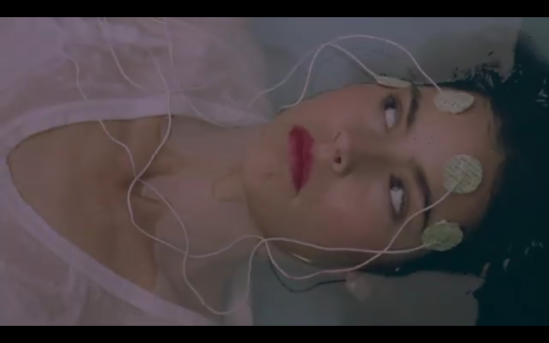
The central characters essentially encompass four graduate students – Bill (Artur Cybulski), Jack (“April Fools’s Day’s” Clayton Rohner), Donna (“Friday the 13th Part VII: The New Blood’s” Elizabeth Kaitan), and Kim (Alisha Das) – along with their stern professor played by the solemn faced Jack Starrett (“Grizzly II: The Concert”). Relatively low on the totem poll names when considering a main cast; hell, I only know Clayton Rohner from his role in the mid-80’s teen transgender appropriation film, “Just One of the Guys” as well as being Admiral Jameson on one episode of Star Trek: TNG. Yet, the combination of crew talent along with the chiseled define facial features of a one Brian Thompson (“Cobra”), the meshed cast suffer no visible calamities or outright fumbles of performance as they each carrier about equal weight into a floating, weightless, construct of boiling human antagonizing fear. The cast rounds out with colorful supporting performances of a muscle head henchmen by Robert Tessier (“The Sword and the Sorcerer”) and the nitwit gate keeper, also animal feeder, Wendall played by Tom Dugan. Yet, Thompson tops the more colorful performances as Dean whose Kim’s ruggedly, manly boyfriend that’s more confident jock without the loss of brain cells. Thompson’s at the height of career, sporing a tank top for most of the film that puts his muscular form on display, but he isn’t the only actor to bare skin as Elizabeth Kaitan and, especially, Alisha Das bare a bit of flesh for the sake of providing a sexual desire to story.
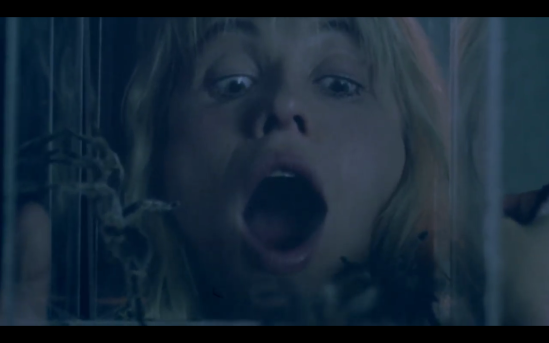
“Nightwish” understandably has a hard chronicle to follow because any film, regardless of genre, incorporating dreams or delving into the state of madness is definitively ambiguous at best, hard to follow, and puts minds into high gear to either understand the just what the hell is going on or to make sense of the chain of events to deduct a reasonable explanation. Sure, over thinking “Nightwish” as a complex construct can be dead wrong. There could be simplicity strewn about and, maybe, we’re too dense or too complicated ourself be aware of the obvious, but Cook certainly knew how to piece together a disjointed storyline that distinctly defines part A of the plot, but parts B and C are so well blend together that the clarity of part A starts to disintegrate and more questions than answers starting whizzing through our think box. “Nightwish” epitomizes the resemblance of nightmare residue and is best left open for personal interpretation.
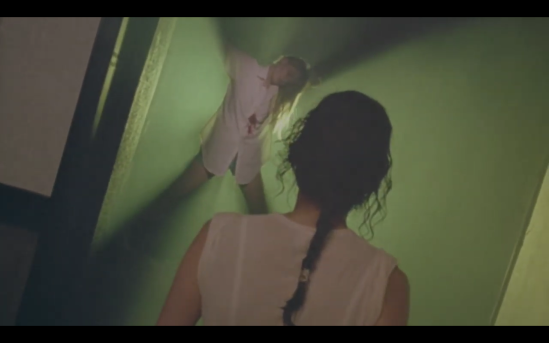
Spine #3 from Unearthed Films Classics label comes “Nightwish” onto Blu-ray distributed by MVD Visual. The Blu-ray is presented 1080p in a widescreen 1.85:1 aspect ratio through a newly restored 4k transfer, but the transfer, perhaps from the best negative possible, has some minuscule wear with faint scratches and dirt impressions; however, the definition and the color palette ultimately overrun the set hard grain with the minor damage also being an after thought. The uncompressed English 2.0 PCM has a better grade in comparison to the video with clear dialogue and a robust soundtrack throughout to which the ambience is nearly overshadows by but does present itself despite the lack of inertia to progress. Special features include a commentary track with Wild Street Pictures producer Paul White and the president and founder of Unearthed Films Stephen Biro. Also available is a photo gallery, trailers, and an extensive cast and crew bio booklet filled also with production notes and a slew of high resolution stills that’s great to flip through. As another judiciously placed classic for Unearthed Films, “Nightwish” is a dream come true for viewers that combines the effects talents of Nicotero, Kurtzman, and Berger with the terrifying ferocity of facing death through in the dark subconsciousness.
Category Archives: psychological horror
The EVIL of True Norwegian Black Metal Roots Out the Posers! “Lords of Chaos” Review!

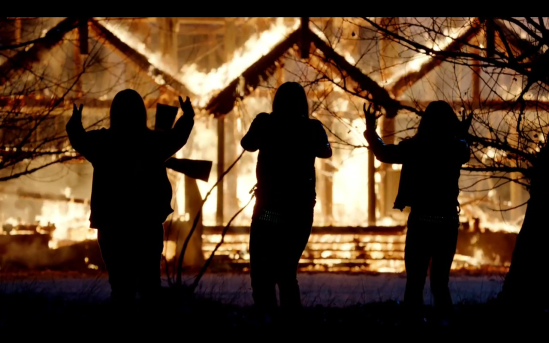
Euronymous, an Oslo teenager hellbent on launching true Norwegian Black Metal, shapes his band Mayhem with edgy publicity stunts that invokes the calling of Satan and being an anarchist against the moral norm to make his brand renowned around the underground music world in the late 1980s. As his fame flourishes with creating ungodly music, owning and running a music store, and helming his own record label, Euronymous continues his crusade agasint the establishment, but the lines blur when his messages of hellfire become unforeseen reality. Suicide, arson, violence, and coldblooded murder push Euronymous to the limits of his own soapbox inactions, leaving him open for the possibility of being overthrown by his own acolyte metalheads.

To prepare myself for Jonas Åkerlund’s biographical thriller, “Lords of Chaos,” I immersed myself into Jason Lei Howden’s 2015 black metal horror film “Deathgasm” as precursor preparation into the intense and unforgiving metal macabre genre. Whereas “Deathgasm” is a balls to the weed whacker splatter film of the pissed off demonia kind, “Lords of Chaos” is a polar horror feature with factual roots. Åkerlund’s, who directed Mads Mikkelson in Netflix’s “Polar” and has an extensive history in directing music videos for various artists, draws inspiration for the 2018 film from his own experience in a Swedish Black Metal band, Bathroy, from the late 80’s. The Grammy award winning music video director creates beauty out of the horrific true life event, unidealized nearly entirely without much speculation that faithfully puts to picture a misanthropic tragedy in a bone-chilling manner.

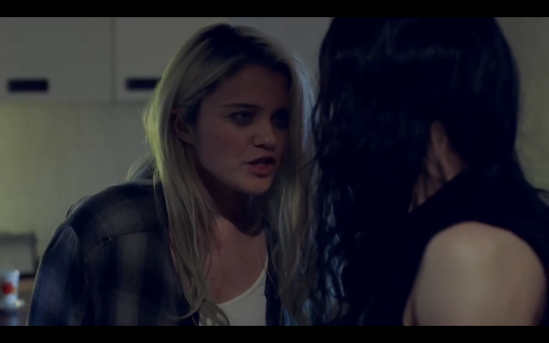
From “Signs” to “Scream 4,” Rory Culkin has remained on the actors-to-watch radar and is most certainly, our favorite Culkin to watch on the screen. In “Lords of Chaos,” Rory plays and narrates the story as Øystein “Euronymous” Aarseth, the guitarist and creator of Norwegian Black Metal band, Mayhem. As if written stars, Euronymous surrendered to Rory Culkin’s performance and Rory Culkin became Euronymous. The eerie synonymous blurred identities that catapults Culkin to be admired amongst his peers and his worked beloved. Opposite Culkin is Emory Cohen as Kristian ‘Varg’ Vikernes, former Mayhem bandmate and convicted murdered of Euronymous. Cohen is bitterly intense with a historical figure whose committed arson and homicide and the New York City born actor uncomplicated approach to a complicated character had a natural phenomena about that would spook your soul from your body. Culkin and Cohen fed off each other’s energy to an explosive dynamic too good to be stagecraft. Another highlight from “Lords of Chaos,” though rather story line brief, is Val Kilmer’s son, Jack Kilmer, as Per Yngve Ohlin aka Dead. Kilmer tackles a depressed introvert and, in one opinion, nails the mental deficiency metalhead who was ordained to take his own life with great savagary showmanship. The film also costars Sky Ferreira (“Green Inferno”), Valter Skarsgård, Anthony De La Torre (“Johnny Gruesome”), Jonathan Barnwell, Sam Coleman (“Leatherface”), and Lucian Charles Collier.

If not paying attention, “Lords of Chaos” will slip under the radar since most audiences are conditioned to subsidize shiny cinema productions that make you feel all warm and cozy inside and spark wander and induce marvel and amazement. Åkerlund’s film will not send those sorts of puppy dog tingles down your spine. Many biopic films about ill-fated tragedy don’t do well with the general population; “Auto Focus” comes to mind with Greg Kinnear and Willem Dafoe. Critics eat up the inherent black dramas like Cookie Crunch and “Lords of Chaos” exudes madness and misery through deep seeded vigor for fame and principle. Åkerlund deserves nothing but our admirable applause for delivering an unadulterated visualization of literal mayhem from soup to nuts.

Umbrella Entertainment releases onto DVD home video “Lords of Chaos,” a co-production from Gunpowder & Sky, 20th Century Fox, Vice Films, and Insurgent Media. Presented in a widescreen, 1.85:1 aspect ratio, Umbrella Entertainment’s picture quality is exemplary in it’s natural, yet supernatural-like surrealistic manner in a clean digital presentation. Pär M. Ekberg’s depiction is hard-edge elegant and haunting with recreations of and the intertwinement of actual photos of Euronymous, Varg, and Dead. If you’ve seen “Polar,” you know Åkerlund and Ekberg brush stroke a fine line between reality and graphic novel much the same as “Lords of Chaos'” allegory. The English language Dolby Digital 5.1 surround sound mix has high level attributes with clean and perceptible dialogue, a vast range of ambient noise, and a killer black metal soundtrack worth banging your head to. No bonus features accompany this title. “Lords of Chaos” is a heavy story that needed to be told and feels very much like a part of Åkerlund, an extension of himself through his past brought forward to illuminate the blackness in us all derived from the power of metal with a psycho-psychology that’s industrial-built.
Insecurity is a Path to the EVILside! “Killing Spree” review!

Airplane mechanic Tom Russo is a newly married man; it’s his second marriage, in fact. Tom’s first go around in marital union didn’t go over so well as found himself on the other end of being a victim of adultery. Paranoid and skeptical, Tom requires his young and hot new wife, Leeza, to become a house wife as he works long, exhausting hours to support his family in a one income household. As the work hours pile, money becomes tight, and tensions build in the back of Tom’s mind, paranoia steamrolls Tom’s reality when he starts suspecting a lonely Leeza of screwing every delivery, repair, and lawn car man that knocks at their door. Without confronting Leeza with his delusions, Tom’s extreme jealously pushes him to kill and bury the men that he envisions involved in the affairs, but his victims don’t stay dead, they don’t stay buried, and seek the eternal suffering for their killer.

A few, long years have gone by since our last encounter with the practical effects-heavy, indie horror director Tim Ritter. From his disturbing tale of destructive descent in “Truth and Dare?: A Critical Madness to his “Switchblade Insane” segment from the SOV masters of horror in the ghastly-variant anthology “Hi-8 (Horror Independent 8)” that also helms short films from Donald Farmer (“Cannibal Hookers”), Todd Sheets (“Dreaming Purple Neon”), and Brad Sykes (“Camp Blood”), the filmmaker has a legacy of blood-shedding entertainment. Today, exploration into Ritter’s “Killing Spree” unearths his passion for horror that develops out of influences from other horror icons before leaving his bloody footprint in the indie scene. “Killing Spree,” written and directed by Ritter, displays the filmmaker’s deep affection for Fangoria magazine having it displayed, repeatedly used as coffee table literature prop. There’s also admiration for “Night of the Living Dead” in the bonkers film about one man’s mind snapping like a twig under the formidable stress. The main character’s name is Tom Russo and Russo is the last name of NOTLD co-writer John Russo and let’s not also forget about the undead rising from Tom’s backyard is fairly synonymous with zombie classic.

While Tim Ritter flicks may not be graced with star-studded actors and actress, even from the B-movie lot, and more than likely don’t spawn hidden talent, there’s still something to be wholeheartedly said about the cast of his films that can only be described as an eclectic bunch of marvelous misfits that bring underground brilliance to the screen. Asbestos Felt is one of those said characters. No, I don’t mean the toxic asbestos felt roofers use as a underlaying backing when nailing in shingles. “Killing Spree” is one of three films Felt and Tim Ritter have worked on together and the scrawny-build with a strung out Grizzly Adam’s head on his shoulders has a wide-eyed spectacle about him when playing Tom Russo spiraling down the crazy train drain. Tom’s obsession with keeping Leeza from the perverted grips on those naughty repairmen would drive any wife away, but not Leeza, played by Courtney Lercara. The “Slaughterhouse” actress is an aesthetic flower growing in the middle of all the mayhem and she protrudes an innocence well received by her character. Other cast members include Bruce Paquette with the white boy dance moves, indie horror vet John D. Wynkoop (“Brainjacked”), Kieran Turner, Alan Brown, Rachel Rutz, Cloe Pavel, and Raymond Carbone as a dirty old pilot with a wise guy brogue.

Remember when I said these types of horror films don’t typically expose acting artistry? Well, behind the camera, one or two crew members start their illustrious careers in the indie trenches. Such can be said for special effects master Joel Harlow who makes his introductory launch with “Killing Spree” and then find work on a couple sequels for “Toxic Avenger,” “Basket Case 2,” and all the way up to the Neil Marshall “Hellboy” and “Godzilla: King of the Monsters.” Yeah, I think Harlow made out OK. Harlow’s effects on “Killing Spree” will “blow your mind,” as stated on the back of the Blu-ray cover. Well, when Leeza’s head turns into giant lips then goes oral on Raymond Carbone’s head until his crown ejaculates, then, yes, these effects will blow your mind…literally! The medley macabre showcase Harlow’s craft from A to Z that includes a torched corpse, a disembowelment, severed undead head, and a nosy neighbor without a nose or without half a face for that matter.

Sub Rosa Studios re-releases “Killing Spree” onto the dual format, DVD/Blu-ray combo set with MVDVisuals providing distribution of the limited 666 copies. Essentially, this is the same release that was made available a couple years back presented in a standard television format of 1.33:1. The Betacamp SP 16mm video has held back the test of time since 1987, but with any video film on a budget, the rather cheap recording method does come with inadequacies, even if being remastered. For the entire runtime and not just in the tinted moments of carnage, the skin tones are akin to Donald Trump’s uncanny neon orange flesh and perhaps could have gone under an extensive color correction. Aside a few very minor tracking issues and faded coloring, the video transfer passes substantially well despite the continuous flare of orange. The English stereo 2.0 mix isn’t hearty or robust. Whenever Tom goes into maniacal mode, his crazy quips are quite soft even when he elevates his voice, and that goes the same with depth and range which are non-existent over the course of a flat audio tracks. Though soft at times, dialogue strongly comes through in the forefront with some fuzzy nuances. Bonus features are killer on this release with the Blu-ray sporting the majority with a never before seen extended director’s cut, a new commentary track from director Tim Ritter, a 90 minute documentary entitled “Blinded by the Blood,” a radio show commentary by H.G. Lewis and Tim Ritter, music tracks, photo slide show, three alternative scenes, blooper reel, and a Joel D. Wynkoop segment. The DVD also includes the director’s cut version of the film, the new commentary by Tim Ritter, and commentary for the original cut by Tim Ritter. “Killing Spree” is as grisly as the SRS cinema Blu-ray/DVD cover implies and then some with all the characteristics of a deranged and unhinged man exerting himself beyond the limits of sanity and mortality to unambiguously protect what is his; a dramatize example rendered as a metaphor for those who will do anything to protect what’s theirs.
Its Just Not Any Evil Film. Its “A Serbian Film” review!

Milos, an aging porn star, struggles to provide for his wife and son. Though still working here and there with mediocre gigs, Milos longs for the glory days as the stud every starlet desires for a scene with, but for Milos, his family comes first and foremost. When an admiring former colleague offers him a meet and greet with a provocative director presenting a contract that would set his family stable for life, Milos assures himself doing the right thing along with the permission from his wife. He meets with Vukmir who captivates with progress pornography art, a new age of adult material, that will be novel and exciting that’s enshrouded with obscurities about who exactly the seasoned star is performing with and what exactly he is supposed to do in this project. What unravels before him is Vukmir’s mad vision that not only breaks every law and moral fiber know to mankind’s sexual nature, it completely obliterates the rules toward sexual deviances in an underground criminal industry that banks on the wealthy’s sordid tastes.

A long time has this reviewer been patiently waiting for the opportunity to screen Srdan Spasojevic’s written and directed multi-country banned film, “A Serbian Film.” Also known as “Srpski Film” in Serbia, the 2010 exploitation that features substantially graphic material with themes of necrophilia, pedophilia, and snuff rarely finds a suitable medium for an uncut presentation as Spasojevic’s feature consistently, and perhaps rightfully so, goes under the governing censorship board’s scalpel to selectively trim the excessive violence, the crude depiction of children, and all the other shocking material that’s rammed unwillingly into your backside. Fortunately, or unfortunately depending on how one perceives artful censorship, the most accessible copy of “A Serbian Film” has limited cuts that total approximately one minute worth of footage left on the cutting room floor to just eek one out from the ratings’ club. Though listed on the DVD back cover as unrated, this cut will be the one reviewed below from U.S. distributors Invincible Pictures and MVDVisual.

How does an actor run with a performance that incorporates vile and degrading perversive qualities and circumstances upon a character? I don’t know and I don’t know how, but somehow Srdjan Todorovic killed the performance as Milos. Todorovic’s veteran filmography credits establish him as a natural switch between characterizations and choking up on the reigns of each facet to achieve maximum reaction. Milos is a physically challenging role with many difficult scenes and Todorovic found inspiration out of thin air; I’m sure the Yugoslavian born actor needed a months’ worth of showers to remove the disgust from off his flesh when the film wrapped. Another complex character is Marko, Milos’ dangerously envious cop brother who chomps at the bit for Milos’ sexual longevity, stellar porn career, and his gorgeous wife. Slobodan Bestic could have passed for a Serbian Hugh Jackman from “Swordfish,” complete with little dangly earring. Bestic’s performance is unnerving, haunting, and downright salacious that waves in and out of a potentially dangerous man with a hankering for carnal informalities. Speaking of which, Vikmur epitomizes the very definition of being a lunatic. The lavish filmmaker has grandeur style with repugnant tastes in content. Sergej Trifunovic puts on the shiny shoes and fancy suits to become the venomous underground kingpin with a torrent of tasteless videos and the “Next” actor really plays the bad guy well, really does a showmanship disenfranchising Milos and those that love him their ability to enjoy free will. The remaining cast include Jelena Gavrilovic, Katarina Zutic, Luka Mijatovic, Miodrag Krcmarik, and Andela Nenadovic.

A unforeseen aspect of “A Serbian Film” that rings surprising is the engrained story of an extremely fallible hero. Srdan Spasojevic proved shocking, exploitation horror doesn’t have to be completely allegorically benign and the filmmaker has even mentioned that his film is a composite piece of abusive power from authoritative figures forcing people against their will, as if spellbound, to do atrocious acts and while these acts might not be atrocious as rape, sexual assault on children, or using an erect penis to kill someone, Spasojevic creates moments where his statements are affirmed. The transition between act 2 and act 3 backs Vukmir against a wall, trying to salvage his star’s contract by debating material that’s good for all. Spasojevic hones in on Vukmir’s raving soapbox speech to Milos about how he and his company govern the country and how they are the backbone of his of the sovereign Sebrian nation, the true delusion of power and the wool over the sheep’s eyes as the action point.

Invincible Pictures, the same folks who distributed Kevin Smith’s “Yoga Hosers,” and MVDVisual present “A Serbian Film” as a re-release onto DVD home video. Presented in a widescreen, 16:9 aspect ratio, the image warrants no mention of issues as a clean picture in a dry-yellowish tint while still maintaining some natural lighting and depth in the gruesome details pop every sensory nodes. Banding problems are faint at best and the edits are what they are sense the film is slightly trimmed anyway. The Serbian language 2.0 stereo mix pounds with a pulsating electronic-rock score and shows the ranging with the screaming, whimpering, crying, and the sloshing of blood and semen fluids. The English subtitles are error-free and have hardline text that make reading them more easily. Though usually bonus features are preferred, in this case, just having “A Serbian Film” alone on this DVD release didn’t feel necessary to have the share the film with the bonus features, creating an intimate moment between viewer and feature. “A Serbian Film” sears a glowing hot lasting impression right into the mind and soul, twisted and perverse in an unfathomable immoral compass too messed up beyond the most descriptive of descriptions. “A Serbian Film” is best viewed alone, without food, and with your sensitivity left outside.
Evil Takes Form in the “Terror 5” review!

In the wake of a tragedy that resulted in the loss of life, a small Argentinian funeral procession progresses in tandem with the court hearings of a supposedly corrupt politician, the governmental figurehead indirectly responsible for the deaths of innocents. When the verdict of not guilty surfaces over the news media waves, the grief-stricken family and friends, praying at a cemetery memorial, shrill in anguish their displeasure that becomes a calling for the undead to rise up and exact revenge toward the capital. In the midst of the resurrecting chaos, others simultaneously face terror in other forms such as exacting sadistic punishments in a backwards universe of role reversals, the elaborately ill-fated plan of swapping girlfriends on the streets of the city, a night of sordid carnalities at a hotel becomes a night of horrendous violence, and a group of candid friends indulge in a snuff film comfortably and safe inside an apartment, but an evil is slowly boiling to ahead right before their very unsuspecting eyes.

“Terror 5,” a title that one would assume on first thought that five horror icons team together for utter slaughter of hapless cheerleaders or, perhaps, clash in one epic villainous mêlée of monumental proportions, but the film is actually an Argentinian anthology of urges and terror and for the record, if “Terror 5” was a collection of the top five horror icons, this reviewer’s enlistment would include Michael Myers, Freddy Krueger, Pinhead, Predator, and Charles Lee Ray aka Chucky. Jason Voorhees is a bit of a mama’s boy, if you ask me! Let’s get back on the topic of the brothers Sebastian and Federico Rotstein’s helming of an interweaving, anthological horror film from 2016. The Buenos Aires born siblings collaborate with the “The Vampire Spider” writer, Nicholas Gueilburt, to construct five tales that plant the seed of danger from the sordid impulses that motivate impure, and sometimes supernatural, malevolencies. The five tales digs into the depths of quivering human interaction and the immorality of their choices that inevitably leads them toward their own gruesome destruction.

The complete South American cast will be more than likely unknown faces to audiences of the United States, unless broadening your film library is a must-do compulsion. In which case, Gaston Cocchiarate is a familiar face who had a supporting role in Gonzalo Calzada’s devilishly feministic empowering thriller, “Luciferina.” Cocchiarate’s character goes from being a naïve college kid in “Luciferina” to a bullied simpleton that gets pushed too far by his peers in “Terror 5.” Nicknamed Cherry for his plump figure and, more likely, his untapped virginity, Cocchiarate’s character seems like a nice enough guy, but powerful when provoked and Cocchiarate embraces the oppression punishment-to-maniacal psychosis well. Another fascinating actor to look for is Walter Cornas as the KISS-cladded Juan Carlos on a night of costumes, drugs, and booze during a small get-together. The dirt-bike riding jokester has a hard on for it all: booze, women, Cherry, and even snuff porn. The character is brutally charming like that one asshole guy who always manages to get with the girls no matter how much of a douchebag they are and the character is very relatable to us all because we all know someone like Juan Carlos. Under the black and white makeup and reckless cruelty is Walter Cornas whose versatile demo reel on IMDB.com and performance in “Terror 5” gives a great insight into his vibrant character performances that make him so enjoyable to behold. Cocchiarate and Cornas stand out with the better and most chilling performances amongst the remaining cast that includes Augusto Alvarez, Juan Barberini, Nai Awada, Magdalena Capobianco, Cecilia Cartasegna, Rafael Ferror, Lu Grasso, Flavia Marco, Jorge Prado, and Marcos Woinsky,.

As far as anthologies are concerned, “Terror 5” favors a string of scary stories to be strung together being each a cataclysm spun from the negativity produced by the outer story that includes blazingly blue-eyed revenge zombies and the result is, on the surface, quite convoluted. What doesn’t help “Terror 5’s” case either is that the Rosenstein brothers decided to interwoven all but one of the stories together, creating a multi-narrative mesh. Instead of individual chapters or title card introductions, the stories have a lattice blueprint and the audiences are forced to go back and forth between the dissimilar story lines that, on initial viewing, would be assumed that one story is a fraction to the other. The stories also didn’t have that killer kick in the pants that makes you go , “WTF!” Each tale ends rather abruptly, leaving morsels of the carnage to be further imagined rather than be digested in full and I’m sure, though couldn’t locate any background about it, that these tales are based in part of an Argentinian, or even in a broader South American sense, contemporary urban legends that are unfortunately not explored in detail. If approached positively, the human thirst for flesh, morbid curiosity, and unflinching corruption is well laced throughout and that’s the real terror behind the surface level macabre.

Artsploitatoin Films and Reel Suspects introduces Sebastian and Federico Rotstein’s “Terror 5” onto DVD home video presented in an anamorphic widescreen, 2.39:1 aspect ratio. Director of photography Marcelo Lavintman works in the shadows with a very cloaked and dark alleyway approach. Some minor digital jumping in the blacks that’s underwhelming at best and in more lit scenes, clarity reigns with promising detail and natural coloring, despite not being variably hue heavy. The Spanish language 5.1 Dolby Digital surround sound has prominent dialogue and a balanced, foreboding score by Pablo Borghi, but the tracks lack a range and a depth magnitude and, essentially, all the sound is right in front of you without the bulk of the surround sound too enhance the effect. English subtitles are available and though generally translated well, there were some slight typos. The only bonus material included is the trailer. As far as Argentinian horror anthologies go, “Terror 5” leads the pack with directors, Sebastian and Federico Rotstein, pulling from familiar filmic influences and gutter cravings with turnaround consequences and mortal coil tussles. Schematically, “Terror 5” has profound leap frogging narratives that challenge the conventional way we view anthologies or overall films, creating a bit of havoc on the tale or tales at hand.