

Life is seemingly pleasant and happy-go-lucky when two fully loaded coach buses of high school girls travel down a forestry passageway toward a lakeside hotel until sudden violence and gore turns Mitsuko’s classmates into minced meat. Overcome with shock and fear, Mitsuko escapes the terror only to find herself in another horrifying scenario. The vicious cycle continues as Mitsuko is thrusted into one chaotic, blood-splattering world after another, quickly losing her identity with each threshold crossing, and with no clue of what’s going on and how she got into this limbo of hell, Mitsuko must stay alive and unearth the truth behind the surreality of her being.

Nothing is more terrifying than being in a heart-pounding situation and not having one single clue why bodies are being sliced in half like corks popping violent out of champagne bottles, why childhood mentors break their professional oath and slaughter students with a ferocity of a mini-gun, or why being chased by a tuxedo-decked out groom with a gnarly pig head is in tow ready to drop kick anything, or anybody, standing in the way. Writer-director Sion Sono manifests that very chaos entrenched world in the 2015 action-horror “Tag” and, once again, the “Suicide Girls” director puts Japanese school girls back into the harrowed ways of gore and death over salted with an existential surrealism based off a novel by Yûsuke Yamada entitled Riaru Onigokko aka Real Game of Tag. Yamada’s story is followed more closely to that of Issei Shibata’s 2008 “The Chasing World” that involves a Government influence and parallel universes, “Tag” serves more as an abstract remake that Sono masters a soft touch of irrational poetry bathed in gore and strung with chaos rectified with a tremendously talented cast of young actresses.

Actresses such as the Vienna born Reina Triendl. Being Japanese doppelgänger to Mary Elizabeth Windstead with soft round eyes and the picturesque of youthfulness, Triendl transcends tranquility and innocence when portraying a content Mitsuko in the midst of many of her classmates boorishly bearing the typical, low-level adolescent anarchy. When Mitsuko’s thrusted into phantasmagorical mayhem, Triendl steps right there with her discombobulated character in an undried eye panicky frenzy whose character then spawns into two other fleshy vessels, a pair of recognizable names of J-Pop fandom in Mariko Shinoda and Erina Mano, when Mitsuko enters another zone in her fictional world. Though different in all aspects of their appearance and in name – Misuko, Kieko, and Izumi, the three women share the same existence and fathom a unbroken entity of character that hacks her way through the brutal truth. The remaining cast, Yuki Sakurai, Aki Hiraoka, and Ami Tomite, sport the high school miniskirt wardrobe and garnish a bubbly-violent J-horror persona very unique to the genre.

“Tag” is a plethora of metaphors and undertones likely to be over-the-head of most audiences, but if paying close enough attention and understanding the subtle rhythmic pattern of Sono’s direction, the gore and the fantastic venues are all part of an intrinsic, underlining message of feminism and sex inequality that’s built inside a “man”-made, video game structure thirty years into the future. Sono points out, in the most graphic and absurd method, how men treat women like objects or playthings. There’s also a message regarding predestination with white pillow feathers being the metaphor for fate and being spontaneous is the key to break that predestined logic and all of this corresponds to how Misuko, the main character, needs to break the mold, to choose her path, and to remember her past in order to free all the women trapped inside a male-driven purgatory of pain, punishment, and pleasure. Supporting Sono’s ability to disclose an epic survival-fantasy horror in such a way comes from multiple production companies, one of them being NBCUniversal Entertainment, providing the cash flow that allows Sono to flesh out the gore, to acquire massive amount of extras, and to scout out and obtain various locations.

Eureka Entertainment presents a dual format, Blu-ray-DVD combo, of “Tag” for the first time in the United Kingdom. However, the disc provided was a feature-only screener and a critique on the video, audio, and bonus material will not be conducted, but in itself, “Tag” is a full throttle encephalon teaser warranting a need for no supplementary content aside from conventional curiosity into what makes Sono’s “Tag” tick. When all pistons are firing, from the visual effects of Satoshi Akabane to “The Walking Dead” familiar score, “Tag” is no child’s game with a heavily symbolic, touch-and-go and bloodied pro-feministic essence that would serve as an abrupt and acute wakeup call to all the Harvey Weinsteins in the world that women are not to be simply playthings and that their gender destiny lies solely with them despite the misconstrued male manipulation.
Category Archives: psychological horror
An Evil Hog Demon Won’t Let You Escape this Island! “The Forlorned” review!
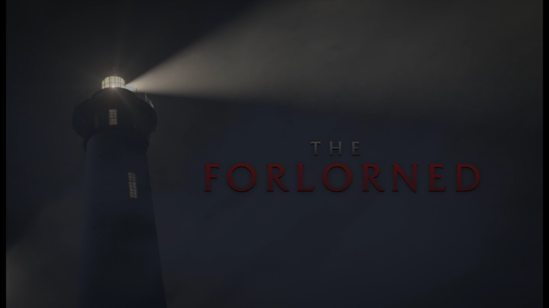
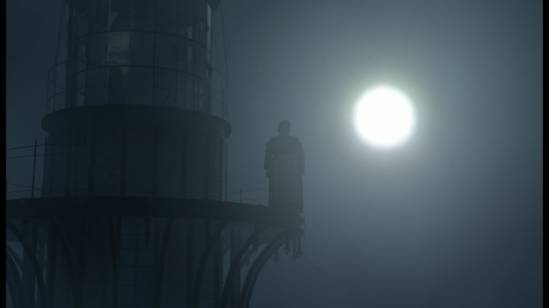
Just off the rough stormy shores of Nova Scotia is a remote island where American Tom Doherty becomes the newly hired lighthouse caretaker in search for good money. Already overwhelmingly cloaked with the lighthouse’s creepy adjacent housing and being forewarned by the island’s infamous legends, an isolated Tom experiences the abilities of dark force first hand and doesn’t know whether the forces are real or madness has swallowed him from the extreme isolation. As Tom continues the work, he discovers clues along the way that suggest the island holds a nefarious past involving murder, suicide, and cannibalism, but an old bible with a list of names is the key that has the potential to unlock all the island’s mysterious doors and can also be Tom’s unfortunate undoing if he maintains being the lighthouse caretaker.

Based off the Angela Townsend book with the same title, “The Forlorned” is the 2017 silver screen adaptation of Townsend’s mystery-thriller from “Dead Noon” director Andrew Wiest who has helmed a jolting, supernaturally visual and auditory accompaniment to Townsend’s literary work. To maintain authenticity, Townsend co-wrote a script alongside Wiest and Ryan Reed that’s riddle with an ill-omened story leading audiences down a path of insanity-ladened darkness. But what exactly is “The Forlorned?” Forlorn has two definitions: 1) pitifully sad and abandoned or lonely 2) unlikely to succeed; hopelessness. Either of the disparaging definitions, if not both, can be used to described “The Forlorned’s” eerily gloomy story that’s saturated in a motif of burdensome loneliness and relentlessly bashes the concept into our heads in a constant reminder that no one can ever escape the island even in postmortem. The character Tom is the very definition of the forlorned. Whether because of due diligence or a dark force, his role of caretaker is a permanent position allotted to him unwillingly by a sadistic, secret-keeping demon that seeks to swallow more unfortunate souls.

Colton Christensen inarguably shapes the role of Tom Doherty into his own with a solid solitary performance for more than half the film. Christensen also, for much of the last ten minutes of the story, had to systematically break away from his character in order to forge a combative persona to Tom and while Christensen does the job well for one character, shouldering a second didn’t suite the actor’s abilities despite a total embrace of character and a few jabs at his own humility. Wiest has worked with Christensen prior to “The Forlorned” and has seemed to continue the trend of using his own entourage of actors with the casting of Elizabeth Mouton (also from “Dead Noon”). Mouton’s character is briefly mentioned near the beginning as a little girl of a previous caretaker, but her adult version only makes the scene in the latter portion of the story to provide a better clarification and exposition into the demon’s background. Also serving exposition as story bookends and peppered through as emotional support is Cory Dangerfield’s “Murphy,” a sea-salty old bar owner who liaisons with the lighthouse committee and can make a mean clam chowder. Murphy hires Tom to do the restoration and caretaker work and while Murphy initiates Tom existence into the fold, Murphy, for the rest of the film, serves as slight comic relief and, in a bit of disappointment, an unfortunate waste of a character. I also wanted Benjamin Gray, Shawn Nottingham’s priest character, to be built upon and expanded more because the character is a key portion that, in the end, felt rushed with quick, messy brush strokes in order to finish painting the picture.
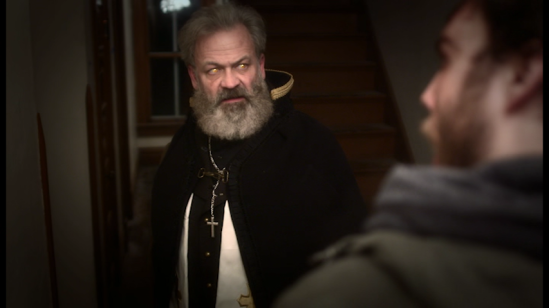
At first glance, Townsend, Wiest, and Reed’s script screens like a typical, if not slightly above par level, haunting where Tom encounters sportive spirits, ghastly visions, and a slew of ominous noises inside a time-honored lighthouse home, but then a twist is written into play, pitting Tom against a masterminding demon whose conquered many other bygone caretakers and whose the epicenter of all that is sinisterly wrong with the island. The demon, who has taken the form of a man hungry hog, lives only vicariously through the camera’s point of view, never bestowing an appearance upon to Tom or even the audience, but referenced numerous times by island locals and boisterously given hog attributes whenever the demon is near. The concept fascinates with this demon-hog thing kept stowed away deep inside the isle’s bedrock even if the dark entity never makes a materializing appearance, but where that aspect thrives in “The Forlorned,” a pancake thin backstory for the demon goes simply construed with a slapped together account of its languished two-century long past and wilts the demonic character wastefully down with backdropped uncertainly, powerlessness, and puzzlement that’s forlornly misfired. There’s no deal with the devil, no selling of the soul, no medieval rite that gives the demon-hog it’s power; it just turns into an evil spirit out of greed.
Andrew Wiest’s production company, Good Outlaw Studios, presents “The Forlorned” that found a distribution home in Midnight Releasing, the fine folks who released “Blood Punch” and “WTF!” “The Forlorned” is available on DVD and multiple VOD formats such as iTunes, Vimeo, Vudu, Xbox Video, and Google Play. Since a screener was used for this critique, a full review rundown of the technical specs will not be provided and no bonus materials were featured on the disc. Director Andrew Wiest and his cast and crew entourage are able bodied participants in assembling a good, entertaining, and sufficient indie mystery-thriller brought to fruition out of Angela Townsend’s story with the author’s pen ship assistance. With a little tweak here and there on the antagonistic demon-hog, “The Forlorned” might have necessarily escalated into a richly dark territory of a more volatile, blood thirsty spirit that’s scribed to have racked up body after body, century after century; however, the fleeting chronicle of how the demon-hog came to be a malevolent being leaves a bittersweet aftertaste on a premise that started out spooky and strong.

Available on DVD at Amazon.com!

It’s in Human Nature to be Evil. “It Comes At Night” review!

Set in an infectious diseased post-apocalypse world, Paul, his wife Sarah, and their son Travis have fortified themselves in a dense forested and isolated house to ride out the easily spreadable disease. Always prepared and ever suspicious, Paul expects everyone to follow a rigorous routine, following procedures in order to avoid becoming infected, but when a young family, seeking supplies and refuge, enters their lives and their home despite Paul’s hesitations. Paul’s family’s routine and order face disruption that opens themselves up to the ever present danger outside and inside their home.

“It Comes at Night” is an intense, heart-pounding mystery thriller set inside the close quartered confines of a desolate house where trust doesn’t come without auspicious interrogation and teeth clinching suspicion. Writer-director Trey Edward Shults’ sophomore feature has layers upon layers of underlying human nature undertones when people are put up against an unsurvivable situation inevitably with their backs against the wall, literally, when confronted to whether to implement the good will nature of their humanity or not, to take that risk to help others or to save their own skin, and to attempt to reconnect with other people or stay separate from the masses. Even the “it” in “It Comes at Night” isn’t as simple as one would first think. Most unfamiliar audiences would assume “it” is a snarling, brooding, oozing, and grotesque creature, or perhaps even a devilishly grinning clown, that comes around when the sun falls; instead, the “it” is an occurrence, an event sparking nightmares inside the human mind that formulates fear and a tall order of exemplary caution.

The Australian born Joel Edgerton (“The Thing” remake) stars as Paul, the father of the family he’s trying to protect at all costs. Edgerton perfectly pitches as a, supposed, American voice, since the story doesn’t exclaim a locality, but the assumption is the setting is nowhere, U.S.A, and plants a firm foot down as a rugged resident of wilderness survival accompanied by his wife Sarah played by Alien: Covenant’s Carmen Ejogo. Ejogo’s offering to her character gives Sarah a powerful will to do what’s necessary and to support Paul in his determination to protect their only son Travis (Kelvin Harrison Jr.). Edgerton, Ejogo, and Harrison opposite up well against the foreign element, another family with their performer genetic makeup of Christopher Abbott, Riley Keough, and Griffin Robert Faulkner as Will, Kim, and their just above toddling son, Andrew. Each actor embraces the role in their respective family and at first, the interactions are genuinely jovial, but then the uncomfortable thick tension evolves from the point of an extreme pivot into the folds of deception and fear.

Shults maintains an ominous atmosphere of overwhelming strain amongst the characters and “It Comes at Night” has a unique perspective set inside an already apocalyptic ravaged population despite the lack visual expositions. Yet, the finished project feels incomplete. Pacing is the biggest concern with the timing of events between the introduction of Will’s family and their destined downfall that results in a climax that’s so bellied-up in an sorely anti-climatic fashion that the notion of being cheated out of a more gut-punched ending pulls at the core of the cinematic soul. That’s not to say that the film has one, if not more, interpretations; in fact, Shults’ entire feature is or could be considered open for interpretation, with examples from the duly noted “red door” to the Travis’ child-like personality, and usually those types of heavily subtext films stick around more way after the credits roll, but also, in a slightly bittersweet cause and effect, leaves more of a foggy formulation of events during the unfolding of the story. Also, an aspect that didn’t help the cause was shying away from a powerful scenes that should have left an impact, but R-rated feature delivered no acute moments of remembrance and leaving much to the imagination with only the majority of the rating pie being flavored with tasteless language.

Lionsgate Entertainment presents the Animal Kingdom and A24 produced “It Comes at Night” on a 1080p resolution in an aspect ratio of 2.39:1. The imagery lavishes in a gritty, woodsy detail that organically defines the sea of trees and natural flesh tones, but as the title suggests, most scenes are shot at night that are moderately blanketed, yet ineffectively intrusive, in digital noise. The English DTS-HD Master Audio 5.1 mix definitely has more girth during the livid nightmares and vigorously tense scenes, but, surprisingly, the dialogue track lacks gusto in the wake of a more lively surround quality. During exchanges of hushed tones, dialogue is rendered nearly inaudible and the option English subtitles had to be deployed. Spanish subtitles are also available. Special features include an audio commentary by writer-director Trey Edward Shults and actor Kelvin Williams Jr and a cast and crew discourse in a segment entitled “Human Nature: Creating ‘It Comes at Night.'” Overall, the psychological and humanity breakdown of the characters of “It Comes at Night” is worth the price of admission along with the teachings that family is key and to never rely on the goodwill of strangers, but finishes with a weak sense of direction that ruptures an unsavory cyst that doesn’t conclude coherently.

Own It Comes at Night on Blu-ray!

All Evil Wants is to Make Art! “Bag Boy Lover Boy” review!

Albert’s just another lowly speck among the multifaceted masses of New York City. The lonely street hotdog vendor barely scrapes by in what could be considered a life, earning next to nothing to keep him on life support in the city that never sleeps. To impress a beautiful girl, a girl of his dreams, Albert accepts a position offered to him by an eccentric photographer and hopes to learn about creating art with a single click of a photographic camera, but Albert becomes the obsessive fixation of the photographer’s next breakthrough exhibit. Albert’s simpleton nature and the photographer’s edgy intensity pushes the aspiring artist to lure women into offbeat modeling sessions in the away photographer’s NYC flat. When he can’t retrieve the inspirational art out of his models, a frustrated Albert goes to extreme lengths to ensure his art is performed to his particular, elementary taste.

“Bag Boy Lover Boy” is the 2014 inaugural feature film debut of director Andres Torres who is one of the few directors out of countless others able to resuscitate the compellingly frightful grit of New York City long ago. I’m talking about the era of pre-Rudy Guiliani New York City in the 1980’s where graffiti splayed walls and the blue fluorescent of dilapidated charm was present on every grid blocked street. Torres, along with co-writer Toni Comas, supplements one of a kind character personalities very appropriate to inhabit the sinister ladened Big Apple. Characters who aren’t dolled up or even genuinely beautiful. Those characters who are easy on the eyes don’t have the inner soul to match, residing in them an defect of some sorts that makes “Bag Boy Lover Boy” feel all too real.

Jon Wächter, a director-actor with behaviors not too alien to that of his character, centers himself as that very bag boy, lover boy of Albert, the awkward citizen with a one track mind and living to fulfill no dreams, hopes, or goals. Wachter owns his role by giving no hints of aspiration to fortune or achievement until Albert meets the cynical Ivan, appropriately casted with New York City-based actor Theodore Bouloukos, is able to hone in on the streets’ muckiest ground level and incorporate a Ron Jeremy charm that’s shrouded sleazy, but devilishly smart. Ivan draws out of Albert a simple interest, a hope to create art through photography, but Ivan has other, more prosperous, plans for the gullible nitwit as model in his own artwork. Albert’s mind focuses solely on photography and not modeling, placing Ivan in a rather haste position to con his centerpiece with poor words of self-worth advice and filling Albert’s head with misogynistic directions when Ivan goes through his rather rough motivational spiel during shooting gigs. Albert then can’t separate reality with his newfound dream that puts “models,” played by Teena Byrd (“Ninja Versus Vampires”), Sarah O’Sullivan, and Adrienne Gori, in harms path. Kathy Biehl, Karah Serine, Tina Tanzer, Marseille Morillo, and Saoko Okano make up the rest of the cast.

What I found most interesting in Torres film is Albert’s perception of himself. After a couple of, what he thinks are successful, shoots with the women he lures and drags up to the Ivan’s flat, Albert perceives himself as this eminent rockstar, exhibited very boisterously in a fantasy scene within Albert’s dingy one room apartment. What’s really ironic about the whole story is that Ivan honestly could deliver every bit of the wealth, women, and respect he promises to Albert and with these promises, he could obtain Lexy, the girl he hopes to win over, but with such a narrow mind, unable to go beyond to foresee a positive future, Albert self-destructs into infamy with only some non-permissive nudity polaroids to show for it. Torres and Comas Shakespearean-like comedic tragedy concept is a consistent conundrum for each and every one of us, not just the slow and low like Albert, but for us who think in the short term, despite whether what we accomplish now might not be a desire or may not be our sole purpose in life. Even peering into Albert’s erratic, overly-exaggerated, if not visually stimulating, mind stories are not to different from what perhaps the rest of us experience.

Severin Films presents the EXU Media production of “Bag Boy Lover Boy” for the first time on DVD and Blu-ray home video. The region free, not rated, gorgeously illustrated Blu-ray is presented in full HD 1080p. The image quality boasts vibrant colors and really exemplifies the naturally gross visual aspects of New York City streets. Various skin tones come out nicely unfiltered and untouched, especially the pasty Wächter and the olive skin of Tina Tanzer, with only brief moments of filters to accentuate subversive content. The dual channel English stereo isn’t half bad. Even though English is not Jon Wächter’s first language, the Sweden-born actor’s dialogue is clear and coherent. The rather mixed bag soundtrack and the Barbara de Biasi score have boastful fidelity and remarkable clarity. Extras include a meaty audio commentary from director Andres Torres, Theodore Bouloukos, and editor Charlie Williams, The Student Films of Actor Jon Wächter: “Got Light” and “The Never-Starting Story,” and the film’s trailer. “Bag Boy Lover Boy” is surrealistically realistic while being slightly exploitive and courageously risky. A satirical film with the proper fortitude to challenge our judgements about life and the paths chosen while leaving an uncomfortable aftertaste of profligate opportunities. Torres also leaves with us a film that we’ll never forget.

Buy “Bag Boy Lover Boy” at Amazon!

Evil Attracts With the Fluorescent! “Feed the Light” review!

Sara, a desperate young mother, infiltrates a secret facility workplace under the false pretentions of becoming an employee of the critical janitorial department. After losing custody of her adolescent daughter Jenny in court, the child becomes misplaced when her custody awarded father, an employee, loses Jenny in the facility that’s conducting unusual activity involving the building’s light energy source. With everyone on constant edge and under the powerful and dangerous influence of the light, including her very organized and unstable employer, Sara is able to find a sympathizer in the head janitor and by exploiting his mental map and valuable knowledge of the building, Sara goes deeper into the structural bones of a nightmarish reality where evil lurks in the shadows and not everything is what it seems.

“Feed the Light” is a H.P. Lovecraft inspired sci-fi horror directed and co-written by indie filmmaker Henrik Möller with Martin Jirhamn sharing the co-write. The gothic tale stems from the Lovecraft short story “The Colour Out of Space” that tells the tale of a meteor crash landing in the hills near Arkham, Massachusetts, poisoning and deforming all the living creatures nearby that creates chaos amongst the locals. The light, that never dulls, becomes the driving force of everything malevolent and that carries over into Möller’s film, but isolates the setting to a dilapidated building instead of a natural landscape and focusing more on the people inside rather than vegetation or livestock as the Lovecraft short story builds upon. Originally shot in color, Möller thought best to suck the color out from the reel and produce a mostly black and white film, sprinkled with color at strategic moments, that would convey the importance of the ever-present light and interpret a far more dramatic effect to play out; a decision I whole-heartedly agree because if laced with color, much of the abandoned warehouse setting would be a monotonous eye-sore. Instead, black and white enhances the light’s presence, makes it almost seem to stand out amongst the greyscale, and give way to more inspirationally vibrant hues when they are revealed.

For Henrik Möller, this is the director’s first dive into feature films and for the filmmaker whose better known for his shocking shorts, “Feed the Light” doesn’t water down the deranged, creative machine that just steam-plows through a 75-minute runtime and still managing to be mechanically sound to comprehend the Lovecraftian tone. Lina Sundén fills the lead shoes as Sara and Sundén embodies complete innocence and bewilderment when her characters goes forth into this strange facility, but doesn’t show much fear as if a mother’s determination is her driving force to go beyond being what frightens her. Alongside Sundén is Martin Jirhamn, who you might remember me saying he co-wrote the script, as the sympathizing janitor. Jirhamn has collaborated on many of Möller’s shorts, feeling comfortable taking on the challenge of a full length feature by taking on more of a scripted role that has a face with two sides. Rounding out the cast of memorizing characters are “Not Like Others'” Jenny Lampa as an authoritarian boss of the facility who tries to keep Sara from going on Indian Jones and the Raiders of the Lost Ark in the basement and Patrik Karlson otherwise known as the VHS-Man and Jenny’s father in the film.

“Feed the Light” has undertones beyond that of Lovecraft. The story feels nearly anti-establishment, a surreal and extreme look at how doing the same job, in the same office, staring at the same fluorescent lights can make one loose one’s humanity. The boss is a strict enforcer of the rules and doesn’t shrug at the thought of one of her employee’s burning out as long as the job gets done, but it’s not burning out that’s the problem. The light symbolizes obedience and control, turning those with a soul into mindless workers. There’s an unseen power embodying them such as with the dog man, played by Morgan Schagerberg, who, literally, sounds and acts like a canine that just happens to have glittery dust goo ooze out of it’s anus. Yup, weird. “Feed the Light” is jarringly weird, but also laminates into the prospect of hidden doom that’s very similar to the truth is out there concept reveled in the “X-Files.”

The Severin sub-label, Intervision Picture Corp., usually subjects us to older projects, but embraces newer indie films such as Henrik Möller’s “Feed the Light” and with the help of CAV Distributing, Möller and “Feed the Light” can be exposed to every house hold on Earth as a region free Blu-ray in 1080p full Hi-Def. The full frame is a staple of Intervision and doesn’t necessary cause any distress over cropped images. There is a fair amount of interference, but again, only enhances the indie labels reputation. Other than that, the image is fine laid under a Swedish language dual channel audio track that’s well balanced with a brooding industrial soundtrack by Testbild, a Möller familiarity. There are two extras accompanying the feature: one is a making of featurette and the other is an interview with the director, Henrik Möller. “Feed the Light” is a science fiction oddity chocked full with surreal depictions and nightmare creatures with a Lovecraft base and a passionate director’s otherworldly view of how light and color powerfully dictate our everyday lives.

“FEED THE LIGHT” is available on Blu-ray at Amazon!

 It's Bloggin Evil!