Forest Hike Lands Four Friends Right in the Middle of Drug Smuggling EVIL! “Cascade” reviewed! (Breaking Glass Pictures / DVD)

“Cascade” Available on DVD! Click Here to Purchase Your Copy!

The small town of Clearview offers little opportunity and for four teenage friends, they’re diverging, life-affirming paths will either cement their relationship stronger or obliterate it completely.  Looking to do something epic before everything changes and most will put Clearview in the rearview mirror, they decide to hike an unrestricted, waterfall area of the locale state park.  What they find at the bottom of the falls is a crashed personal plane, a bag full of drugs, and a dead body.  Half of the group seeing an opportunity to make a small fortune splits ties between them and leave them blindsided by the drug dealers’ sudden appearance and guns drawn interrogation to find the downed plane and their narcotics.  A series of scuffles leaves one friend dead and two others injured, pitting a sole, unconstrained teenage woman against multiple armed and dangerous narcotraffickers hellbent on retrieving their lost goods.  Determined to not go down without a fight and free her friends, she’ll use every advantage, no matter how desperate, to outwit her pursuers.

The adage there’s no such thing as a free lunch applies to the latest film from director Egidio Coccimiglio (“Compulsion”).  Coccimiglio, who puts out one film roughly every decade since the mid-1990s, begins the story of “Cascade” with two, smalltown young couples on the verge of entering adulthood, figuring out their relationships and their lives one indecisive moment at a time, until that decision is made for them when a group no good drug smugglers roadblock their grownup rite of passage.  The debut script of Ed Mason is shot in the scenic Crystal Creek forests trails and waterfalls in Sault Ste. Marie, Canada.  “The Void’s” Rosalia Chilelli and Jennifer Pun produce with Michael Baker (“Depraved Mind”), Bruno Marino (“Tormented”), and Anders Palm (“Trench 11”) executive producing the Edge Entertainment independent production and Blue Fox Entertainment presentation.

“Cascade’s” plot is split between two perspectives, the teens and the traffickers, but we’re mostly aborded into the teens’ backstory and imminent concerns:  Vince (Stephen Kalyn), a carefree, immature cut-up and army prospect aiming to leave Clearview by any means possible,  Em (Sadie Laflamme-Snow), Vince’s girlfriend whose keeping her newfound pregnancy with him a secret because of their uncertain future, Jesse (Joel Oulette), a by choice Clearview lifer who just landed the job of shop mechanic, and Alexis (Sara Waisglass), daughter to an estranged ruthless biker gang leader and who is uncertain a college opportunity is the right choice for her.  What’s admirable about the character list is that none of them are throwaway characters with ample, individual emotional weight for relatability and substance.   Compared to the adversary drug smugglers, there’s little to be known about them as their backstories are purposefully kept in the dark, evoking a dangerous impression upon first meet and scenes.  As the story unfolds, the two groups clash, and things get ugly, true natures emerge within both factions that turn once established sympathies into traitorous duplicity and vice versa.  Amid the switcheroo of moral standards, the fight for friendship and survival becomes a one-woman show with Sara Waisglass at the wheel, showcasing Alex as good as college material by outsmarting cruel yet hesitating foes.  Coccimiglio and Mason put in the trouble of frontloading meanness and calculated brutality only to fizzle into backpedaling renegers on their ill-fated promises toward Alexis’s captured and hurt friends.  We get a pretty good showing of bad guy mentality from a creepy looking Josh Cruddas (“Resident Evil:  Welcome to Raccoon City”) and a no-nonsense leader in Allegra Fulton (“The Shape of Water”), a not good showing from the bearded oldster Matt Connors (“Kicking Blood”), and a modest teetering of morality performance from James Cade (“Antiviral”).  “Cascade” rounds out the cast with Mark Brombacher (“The Kingdom of Var”), Joanna Douglas (“Saw 3D”), Bart Rochon (“Bloodslinger”), and Greg Bryk (“Rabid”) as the leader of the biker gang The Saints and Alexis’s father. 

Under the bank check of a humble budget, serviced with one primary, exterior location, and limited ostentatious stunt work, “Cascade” is forced into a character-driven corner, carried by a pack of toothsome personalities to keep the story wet with insatiability.  For the better part of the narrative, Coccimiglio successfully stacks the blocks of sympathy, disparage, and a rough action scheme and comes out on top for an independent action-thriller.  Contrarily, a few scenes stand out being too big for the film’s skinny jean britches.  Gun shot wound effects work with compelling impact with a fair amount of gruesomeness in the makeup and how the shooter and victim react; however, other stunts, such as the car collision, dampens the believability in which one person dies, one person suffers a compound fracture, and neither vehicle has flipped or sustained substantial wreckage to cause that much damage during a shaky-cam, car-crash simulation sequence.  These moments really announce, and announce very prominently, the weak points of the production which can be looked past considering how solid this indie feature generates the big picture story on a small budget scale.

From Breaking Glass Pictures, a Philadelphian based independent distributor delivering the thrills and the chills as well as LGBQT+ films of the world, brings a Blue Fox Entertainment release, “Cascade,” onto DVD.  The MPEG-2 encoded, upscaled 720p, DVD5 presents the feature in an anamorphic widescreen 2.39:1 that has a slight wrap around lens to capture a wider frame without feeling squeezed.  This works toward the director of photography Diego Guijarro’s advantage to enclose Crystal Creek falls and forest into the optical lens without being limited to medium-to-closeup shots.  The upscaled 720 resolution holds its own to decipher details distinctly between the lush greenery, white water spray of the falls, and the actors skin tones and clothing.  Since “Cascade” has limited stunt work there’s not much room for novel or innovative camera techniques but it’s a solidly organic colored film that looks professional rather than commercially graded.  The English language LPCM 5.1 surround sound, again, doesn’t have the range to really be necessary for an all-channel assault but diffuses well enough to carry a midrange peak tone. Dialogue is clearly and cleanly expressed with adequate prominence and depth is opportune but not key for any scenes except for some radio communication. English closed captioning is optionally available. The Breaking Glass Pictures DVD release is a barebones product with no special features or stingers during or after the credits. Physically, “Cascade” models much of the same splendor to keep in tune with a feature only release in a standard DVD Amaray with a decent gun-toting mockup cover. The disc is pressed with the same image art with no included inserts or other tchotchke material. The not rated release has a runtime of 95 minutes and region 1 encoded playback.

Last Rites: If in a mood for a third-tier thriller from Canada, “Cascade” checks all the necessary car chasing, gun-shooting, double-dealing, and no-frills boxes with the hunted becoming the hunter of do-no-good drug smugglers who’ll stop at nothing until thousands of dollars’ worth of their lost in a plane wreckage nose snow is recovered.

“Cascade” Available on DVD! Click Here to Purchase Your Copy!

Everything is Bigger, and EVILLER, in Texas! “Deep in the Heart” reviewed! (Fun City Editions / Blu-ray)

“Deep in the Heart” on a Fun City Edition Blu-ray! Here for Purchase.

Boston born Catholic Kathleen was raised in a good home by Irish immigrant parents.  Having moved from the liberal Northeast America to Dallas, Texas, Kathleen finds employment as an American history teacher at a local high school.  She meets born-and-raised Texan, attorney, and gun enthusiast Larry Keeler at a colleague’s outdoor barbeque and the two casually see each other off and on with Kathleen not interested in something more serious with the charming and handsome, budding attorney, but Larry believes Kathleen’s too uptight to see how madly desirable she makes him and rapes her at gunpoint when he can longer steady his urges, proclaiming her sexual hangups and rigidness as faults against her immense drawing of sensuality during post-coital.  Reporting her attack to law enforcement and her Catholic priest for prosecution and spiritual relief, both agencies fail to side with Kathleen’s trauma based on the facts of the case and God’s ever-tolerant forgiveness toward everyone.  The anger seething inside impels her to chop off her long, blond hair, dress more matronly, and join a handgun gun club after Larry continues to casually insert himself into her life like nothing ever happened and down the barrel’s site, Kathleen plots her vengeance. 

If there was an ever a more culturally relevant and timely film today produced and released decades ago, encapsulating the worst parts of American history, “Deep in the Heart,” aka “Handgun,” is that very film.  Through the perspective of the expatriate filmmaker Tony Garrett, having been born and raised in a country without an intense gun culture, “The Prostitute” English writer-and-director entrenches his outsider take on America’s unique, and unhealthy, gun fascination around an equally powerful systematic rape culture that ignores the severity of the transgression and assigns blame to the victim and, in turn, has the attacker come out unscathed due to being an upright citizen and a pillar of the community amongst his, also male, peers.  Filmed entirely location in Dallas in 1981 but not released in 1983, Tony Garrett co-produces the film with American producer David Streit (“The Prowler”) under United Kingdom production companies EMI and Kestrel Films where American distributors were eager to bank off the sexy rape-and-revenge thrillers of “Ms. 45” or “The Last House on the Left” but received a more thought provoking and provocative thriller that analyzed more of a problematic inward of U.S. culture and global societal toxicity. 

A daunting and difficult role for any actress to play, Karen Young had captured the epitome of a formulaic victimized women in an injustice system for her first major feature-length role.  Young, who went on to have roles in “Jaws:  The Revenge,” “Daylight,” and “The Orphan Killer,” embodies the American dream of the young, educated woman, Kathleen, from humble beginnings living away from home and having a career as a high school teacher in Dallas, Texas.  Kathleen’s American dream is crushed by the methodical mentality of Larry Keeler, representing America’s grasping of the past of taking what you want, even if that means by way of force.  Keeler is played by born-and-raised Texan Clayton Day (“Osa”) with a fast-talking, full of himself reproach to a debut performance that involve rape at gunpoint and being fully nude with your equally green costar.  Garrett’s able to convert the two inexperienced actors into raw talent, extracting their singular qualities into a combined effort of a sordid cultural subtext and cat-and-mouse rape-and-revenge suspenser.  Kathleen’s transitional arc from the shy and innocent Catholic outsider to the hate-filled, pro-gun, self-serving vigilante proved to be a dazzling gem of range and moxie pulled from the rough depths of untapped talent and getting to that point is a journey expressed vividly and thoroughly to build up both characters’ constitutions without a ton of exposition or visual insight.  Keelers intentions never slip but we understand through his conversations with Kathleen he’s a gun advocate and collector, he’s a good-time, good ol’ boy party animal at a colleague’s bachelor party at the Foxy Boxy – a Women’s see-through T-shirt boxing competition, and he has overt charm pasted thick with insincerity with out on dates with the high school teacher from Boston.  “Deep in the Heart” is centrically designed around these two principals with an already established built around gun-toting, fast-and-loose, and blinders on male dominated environment inhabited by smaller, yet key roles from the denizens of Dallas.

“Deep in the Heart” is not the sexy, rapey, glorified femme fatale film every will think it is.  “Deep in the Heart” is what Tony Garrett understand and believe in from the interpretation of dark side, misguided American values and how those cultural thorns that prick into the side of the free world change the course of all that is good and pure in the foundational basis America is built upon.  Engrossingly tied to modern day hot topics, Garret had incredible foresight or, maybe, was just brazen enough to go against the grain being an foreign expat shocked by not only the legal system but by the backwards ideas and beliefs of everyday citizens in different regions of the country.  In not only the rape but the whole pre- and post-rape setup is surrounding Kathleen’s inquietude is noticeable and uncomfortable to watch.  Men and women alike should feel icky of the transpiring contexts of spirituality failure, justice system failure, and an overall human being failure that lets Kathleen suffer in silence without the hoopla of scandal and punishment.  Instead, Kathleen’s bottled anger works inward toward a radical, retribution fix, resurrecting her from downtrodden ashes like a phoenix carrying a six-shooting revolver poised to a point of no return in DIY selfcare. 

Fun City Editions understands the power from “Deep in the Heart” by showcasing a new, restored transfer for their Blu-ray release.  Restored in a 4K scan from the original 35mm camera negative, making its first Blu-ray appearance globally, “Deep in the Heart” is stored on an AVC encoded, 1080p high-definition, BD50 and presented in an anamorphic widescreen 1.85:1 aspect ratio.  Not a whisper of image infraction, “Deep in the Heart” has a gorgeously graded picture that sees hardly any signs of aging or wear and the Fun City Edition’s restoration keeps the elements in alignment with the feature’s period of a late 70’s to early 80’s harsh filmed layer.  Color hues are vibrant and bold without appearing washed, presenting near perfect textures on clothing, skin, and environment and darker scenes keep contours and some details present without being completely dense or lost in any compression banding and splotches.  A lossless English DTS-HD mono track is more than ample audio for a very tight knit thriller mostly for indoor acoustics.  Exteriors capture the and highlight the appropriate milieu ambience, managed well within the single layer monaural to keep dialogue front and center.  Dialogue does not go without some crackling and hissing but not enough to be a nuisance, just noticeable.  Mike Post’s soundtrack is eclectic between night club boogies and harrowing hangers.  English subtitles are optionally available.  Special features included are a newly recorded audio commentary by Erica Shuliz, co-host of the Texas-based Unsung Horrors podcast, and Irish filmmaker Chris O’Neill providing in-depth insight and analyst of Tony Garrett’s underappreciated film, a brief archive interview with directory Tony Garrett on his perspective route as an outsider looking at the celebration and de-celebration of guns in America, an image gallery, and the theatrical trailer.  Tactile elements and striking rigid slipcase art from graphic artist Tom Ralston makes this Fun City Edition highly desirable as the U.S. title “Deep in the Heart” graces one side and the U.K. title “Handgun” can be found on the back (or front depending on how you look at it).  Sheathed inside is a clear Blu-ray Amaray casing with reversible cover art of three different country posters from the U.S. (primary) and U.K. and Japan (on the inside).  Disc is pressed with more Ralston imagery while the opposite side insert is of a 10-page color booklet with a new essay from film critic and author, Alexandra Heller-Nicholas.  Rated R with a region A playback, “Deep in the Heart” has a runtime of 99 minutes. 

Last Rites:  “Deep in the Heart” is an important film.  For some, the rape-revenge thriller can be either be eye-opener and another reminder added to the long list that America is gun crazy and legally not perfect.  For others, those expecting the sleazy, sexy rape film followed by the subsequent gratuitous violence will quickly go limp by Tony Garrett’s call-it-as-he-sees-it narrative that, for an intensive purposes, coincides with the rest of the world’s perception. 

“Deep in the Heart” on a Fun City Edition Blu-ray! Here for Purchase.

He’s a Beast. He’s Ferocious. He’s EVIL! “Mad Dog Killer” reviewed! (Cheezy Movies / DVD)

“Mad Dog Killer” Unleashed onto DVD!

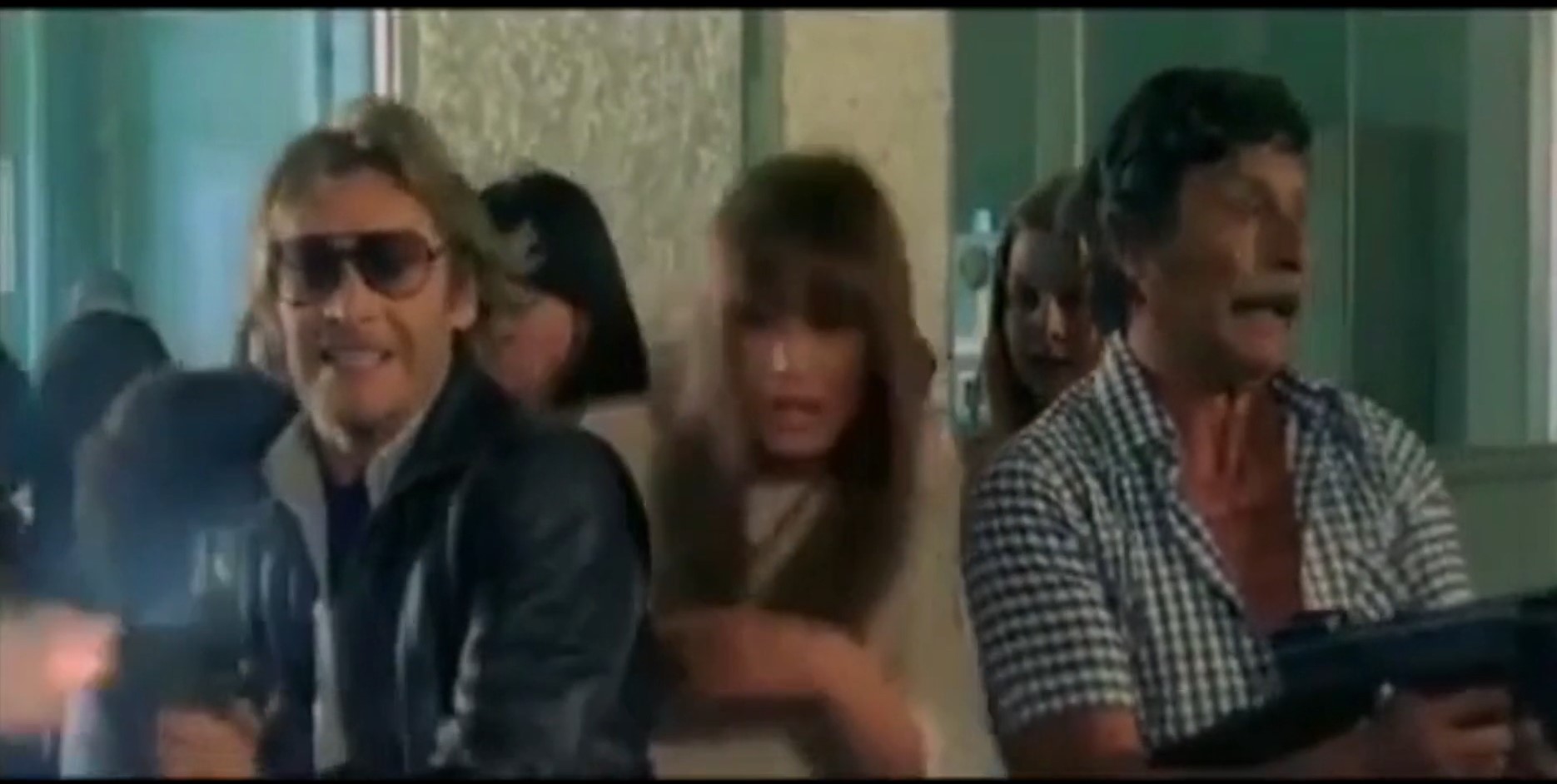
A daring hostage-taking breakout of an Italian prison puts four of the most ruthless killers back on the streets.  Sadistic and full of revenge, Nanni Vitali, the leader of the gang, has one thing of his mind before he begins a reign of outlawing terror, to find and exact due mortal punishment on a stool pigeon that cemented his incarcerated fate during the trial.  Hot on his trail is officer Giulio Santini who will stop at nothing to bring Vitali back into custody or even put a bullet between his eyes, that is until a young woman, Giuliana Caroli, girlfriend of the police informant, becomes caught unwillingly in Vitali’s web of sexual obsession and deviant plans as she’s raped and exploited for Vitali’s personal pleasure and robbery schemes.  When the frightened Caroli betrays Vitali’s trust, she becomes a kill target while Santini’s family also falls into the miscreant’s violence coursing crosshairs. 

“Mad Dog Killer,” aka “Beast with a Gun,” aka “Ferocious Beast with a Gun,” aka “La Belva col mitra,” is an Italian action-crime thriller from the late “The Sinful Nuns of Saint Valentine” and “Violence for Kicks” director Sergio Grieco in what would be his last directorial before his death five years later.  The Rome-born filmmaker also writes the 1977 exploitative and violent caper with additional dialogue from fellow Roman screenwriter, and furthermore director, Enzo Milioni who has had a hand in “The Sister of Ursula” and “Escape of Death.”  A part of the larger, multi-faceted Euro Crime subgenre, or better known as Poliziotteschi, “Mad Dog Killer” hits all the trademark elements, squeezing in a packed lot of similar content as well as stretching out for breathing room by elbowing out the era popular Italian subgenre of the phasing-out Spaghetti Western and bracing for impact against the up-and-coming Giallo films which starts get a footing with Dario Argento and Lucio Fulci paving the way.  The Supercine production is produced by Armando Bertuccioli (“The Sister of Ursula”).

In the crazed-eyed, take-no-prisoners, sandy-blonde shoes of a handsome yet hardnosed criminal in Nanni Vitali is the Austrian born Helmut Berger.  The “Salon Kitty” and “The Bloodstained Butterfly” star is another international actor who found modest success in the Italian film industry of the 1960s-1970s as well as the German movie industry afterwards, but as Nanni Vitali, the rugged actor with piercing eyes doesn’t hold back in a defining performance that’s nowhere near a one-time paltry pass over.  Vitali is so animated and over-the-top, the hot-headed character completely overshadows Inspector Giulio Santini as a counterpart, played by American actor Richard Harrison of “Orgasmo Nero” and portraying many Ninja Master Gordon films in Hong Kong in the late 80s.  No Ninja kicks or ostentatious smoke screens with officer Santini in a rather matter of fact, routine chaser of escape convicts.  The personal connection he has with Nanni, where Santini’s Judge father (Claudio Gora, “The Nun and the Devil”) was Nanni’s convicting judge, is greatly underused to extrude the ferocity needed to match Nanni’s, as so he is described in one of the many titles – a ferocious beast.  This beastly criminal takes captive and tries to psychologically manipulate through sex and threat the wrong place, wrong time victim Giuliana Caroli by the chiseled facial features of Marisa Mell (“Violent Blood Bath”), a fellow Austrian actress.  Caroli’s tall and beautiful on screen but lacks that damsel in distress in initially helpless apprehension of a woman who must restructure her bearings to take matters into her own hands.  Mell’s acting is forced throughout her span, and without that frightened bird despondency in her eyes, she looks as if she could handle Nanni Vitali by herself with ease in stature, broad shoulders, and a fierce look, diminishing Richard Harrison’s Santini role almost out of the picture entirely.  “Mad Dog Killer” rounds out the cast with Marina Giordana, Luigi Bonos, Ezio Marano, Albert Squillante, Nello Pazzafini, Antonia Basile, Sergio Smacchi, and Vittorio Duse.

“Mad Dog Killer” lives up to the designation that attentively develops the lengths the titular principal will go to achieve a wrongful debt that must be paid in full with excessive violence to spare.  Sergio Grieco lays Nanni’s nihilistic sleaze and transgressions on thick, coating the character with monolithic and enduring characteristics of a sordid and lawless bandido with Spaghetti Western type intensity, especially inside a compositional scene where he slowly walks back to the car toward a frightened Giuliana Caroli, eyes affixed onto her soul, and the all-pervading, debut score by Umberto Smaila just swallows you into the moment.  Like a true mad dog, the story never lets up on an unpredictable temperament and trajectory; it foams at the mouth with rabid blackguard that is true Euro Crime fashion, but unlike most Euro Crimes, “Mad Dog Killer” ends on an unconventional note, perhaps an unsatisfactory to some, but definitely askew yet fresh compared to the genre’s dominantly preordained doppelgangers. 

A film that goes by many names usually suggests numerous releases from around the world.  “Mad Dog Killer” receives a cheapie DVD release from our friends at Cheezy Movies with a MPEG-2 encoded, standard definition 480i, DVD5.  Not an upscaled presentation, the transfer used retains the lower quality pixel count that bleeds the definition, often better in brighter contrast scenes than in the darker settings. The forced English dub LPCM mono track, though you can clearly lip read that most principals actors are speaking English, has auditory value; the lossless quality removes compression from the table, offering a clean and robust dialogue and Smaila score through just a thin, faint even, layer of interferential static, and pops. The English dub track is the only audio option available with no optional English, or any other language, subtitles. Cheezy Movies primary goal favors a feature only release so there are no special features encoded or tangible supplementary content. Cheezy Movies pulls the stark front cover image, laced intently with suspense, sex, and violence, from one of the marketing one sheets, used by other labels such as foreign companies like 88 Films and Polar. The disc is pressed with the same image. Not rated and region free, “Mad Dog Killer” has a runtime of 91 minutes.

Last Rites: An enjoyable sadist manhunt romp, “Mad Dog Killer” does criminals gone wild Italian style. Without a higher resolution release, quality of life with this Euro Crime actioner is not at peak levels but the film, by itself, lays waste to many counterparts with a fiercer hand and a charismatic leading villain in Helmut Berger that tips the scale in the film’s favor.

“Mad Dog Killer” Unleashed onto DVD!

Getting Revenge on EVIL is a 6-Year Plan! “Kill Butterfly Kill” reviewed! (Neon Eagle Video / Blu-ray)

“Kill Butterfly Kill” – Both Films Available on Blu-ray!

Caught on the wrong side of the tracks during  a torrential downpour one dark and stormy night, a soaked Mei-Ling seeks shelter in a haybarn where a group of drunk men are playing cards.  Through an intoxicated lens of brash confidence, the men rape Mei-Ling as if the whole ordeal was nothing more than a game, like them playing cards.  For Mei-Ling, the night that changed everything ate at her for six long years as she worked her way up into a nightclub business as she sought the names and faces of her attackers.  When one of the men, a crime boss, stiffs a hitman after taking out leaders of a rival gang, Mei-Ling and the assassin form a mutual business and romantic relationship, pledging to help one another’s revenge. Together, along with Mei-Ling’s most trusted female accomplices, they plot, seduce, and lure each man out of hiding and take them out one-by-one in different ways.   

“Hei shi fu ren,” aka “Underground Wife,” aka “Kill Butterfly Kill,” is the 1982 rape-revenge Taiwanese thriller from director Yu-Lung Hsu, a fast-paced crime-action filmmaker with credits “The Boy from Dark Street” and the more fantastical, kaiju picture “King of Snakes” under his belt later in his career.  The script is penned by a compeer of such genres in Ching-Kang Yao who wrote “One-Armed Swordsman vs Nine Killers” and “Superdragon vs. Superman,” starring Bruce Lee imitator, Bruce Li.  Yu-Lung and Ching-King would collaborate often, making the film one of those efforts right at the height of their joined forces; yet, the film has gone through various titles and edits, even recut and edited in new scenes into what would become “American Commando 6:  Kill Butterfly Kill” five years later from director Godfrey Ho (as Charles Lee), and trying to get a sense of the original intention has proved nothing but difficult.  “Official Exterminator 2:  Heaven’s Hell” executive producer Wu-Tung Yet produces the film what we’ll refer to as “Kill Butterfly Kill” for the sake of his review and Fortuna Film Company is the production firm and presented by International Film Distributors (IFD).

Li-Yun Chen stars as the nightclub madam Mei-Ling hellbent on lethal revenge.  Chen, who continued her career in a few other sexy femme fatale roles in “Commando Fury” and “The Vampire Dominator,” plays the damsel in distress, forced into romping in the hay with a few baboonish male drunkards.  The rape scene is nothing to be overly wrought about as the close-ripping pursuit through the barn is violently toned down and the rape is more implied than explicit.  There isn’t even any nudity of the private parts with just Chen in ripped attire and the men baring their sweaty chests.  Chen never really receives the sympathetic tone one is supposed to receive after going through harrowing humiliation and assault.  Not because of the less intense attack, perhaps more so with how jovial and goofy the intoxicated men are, but Mei-Ling is never lit in a low-point light.  Even after the rape, Mei-Ling is standing strong, glaring, and with a look of determination to get payback while still having straw hang from her disheveled hair, segueing seamlessly right into her powerful businesswoman persona six years later.  This is the point in time where, as an exclusive call girl for a powerful crime boss (Paul Chang Chung, “Vengeance of a Snowgirl”) in a variant subplot, she meets cheated assassin Shiu Ping (Sha Ma, “The Nude Body Case in Tokyo”) who becomes a kindred spirit in seeking revenge.  Their intertwining falls on a fated sword and too serendipitous to make a lot of sense but their run-in to each other makes for good buddy action, an assassin and a high-end prostitute going full tilt on some really bad men who have dispersed into their own idiosyncratic corruption paths that makes them all the more detestable when Mei-Ling and Shiu Ping come for them.  “Kill Butterfly Kill” rounds out the cast with Sing Chen, Hung-Lieh Chen, Fu-Cheng Chen, Yaun Chuan, Li Hsu, Shao Hua Chu, Ti-Men Kan, Chen-Peng Kao, Yun Lan, Fei Lung, Wen-Tseng Liu, Kuan-Wu Lung and Ta-Chuan Chang.

“Kill Butterfly Kill” is inarguably a cult film from Taiwan with sordid themes coursing through its cinematic circulatory system.  Conjoined with the rape-revenge aspect, one of the staple themes of the genre, society corruption, gang wars, assassination attempts, prostitution and martial art skirmishes and brawls run rampant and serve “Kill Butterfly Kill” as Eastern grindhouse ambrosia.  Yet, the seemingly positive film style paraphernalia can also be detrimental.  In the case of “Kill Butterfly Kill,” there’s not a clear cut profile from Yu-Lung Hsu with lot to ingest but not a ton targeted nourishment.  The rape-revenge aspect, which feels like the keynote, foundational plot, careens into awkward comedy and the swindled assassin territory a little too much or invests heavily into the sudden and unexplained relationship between the two protagonists without much background or backstory. There’s no phoenix moment of rising from the ashes with a quick cut from the rape to the revenge without delving into the nitty-gritty details needed to satisfy an important sympathetic and empathetic resurrection.  Sha Ma’s assassin feels like a threadbare connection serving mostly for patriarchal palaver because, surely, a woman couldn’t undermine five influential men by herself, right?  In any case, what’s filmed is filmed, and the fight coordination doesn’t displease with fast-paced action and quick-striking movements.  There’s also a lean cinematographer stylistic palette that fashions surreal moments to coincide with fast action, offering unique methods in tracking down, seducing, luring, and inevitably dispatching the scum.

The film having been through multiple remixes, edits, and being obscure to begin with, the Neon Eagle Video’s 2-Disc Blu-ray release restore what’s feasibly possible in effort to showcase the best possible elements.  In return, the quality on the AVC encoded, high-definition BD50 houses a variable image that never falls terribly below par. The best surviving print is a burned-in English audio export now scanned in 4K and restored to the best possible extent that still sees vertical scratches, frame damage, splicing, and possible print decay. Yet, that doesn’t halt the fast-acting, slow-motion, and tripping visual lenses from being savored. Coloring’s limited saturation offers a flat, little-to-no, pop but there’s quite a bit of exterior light coming through the lens, creating a vivid lens flare effect that makes print have designer appeal. Aforementioned, the burned-in English DTS-HD 2.0 mono dub is the only audio track available and is about as gum-flapping as the next dub track over the likely original Mandarin, the native language track that’s presented on the standard definition presentation of “Underground Wife” in the special features. Foley’s fine with timely inclusions in the fight sequences and other naturally prescribed milieu audio bytes important for the story. English SDH subtitle are optionally available. On the first disc, “Underground Wife,” the feature’s original title and as I already mentioned available in the special features in standard definition, is a bonus version of the film in the original language audio. Also included an audio commentary by Podcast on Fire Network’s Kenneth Brorsson and Paul Fox as well as the “Kill Butterfly Kill” trailer. The second disc contains the remix of the 1982 film with the release of a 1987 “American Commando 6: Kill Butterfly Kill” with more-or-less the same premise except with the newly shot and edited in scenes of International Film Distributor (IFD Films and Arts Ltd.) regulars Mike Abbott and Mark Miller intercut to fit into the narrative that’s expanded by bringing in a powerful crime boss syndicate and his endless Rolodex of assassins. Also scanned and restored in 4K, “American Command 6: Kill Butterfly Kill” has a little more color in the cheeks and is in much healthier celluloid shape. I actually like the bastardized, Frankenstein cut better because of not only the image quality but because the fights show more intensity, but this isn’t to say “Kill Butterfly Kill” scrapes are poorly orchestrated – just different. The second disc also comes with the trailer and an IFD trailer compilation. The non-slipcovered release is housed in a clear Blu-ray Amaray with reversible cover art – one for each of the features. Inside, there’s a disc on either side of the cast featuring composite and illustration art for the respective features. Both films are region free and are not rated with “Kill Butterfly Kill” clocking in at 87-minutes and “American Commando 6: Kill Butterfly Kill” done in 90-minutes.

Last Rites: IFD had procured the rights to “Underground Wife” and mercilessly re-edited and re-mixed the storyline through the meatgrinder, producing two English exports for quick cash, and while intelligible to extent, each version carries a volatile variation that leads to a problematic personality disorder that loses sight of the story’s initial purpose. In the end, the differences denote diversity within the same framework, like facelifting a building with its original good steel bones, and shows how fluid and flexible the editing room can be as long as possibilities and creativity can prevail.

“Kill Butterfly Kill” – Both Films Available on Blu-ray!

EVIL Wants to Cut Out Your Unborn Child. “Inside” reviewed! (Second Sight / Blu-ray)

Order The Limited Edition Copy of “Inside” From Second Sight!

Four months after deadly car crash that claimed the life of her husband, a disheartened and depressed Sarah is 24 hours away from being induced into labor on Christmas day.  Just wanting to be left alone, Sarah is eager to lower her head into her work as a photojournalist of capturing horrifying images that bear a resemblance to her own accident and inviting her editor over later to discuss the work ahead.  As the even lingers into night, an unexpected woman knocks at the door and menacingly tries to break into her house.  As the police arrive to investigate the incident, the woman is nowhere to be found and brush off the incident with little concern, but the woman returns, finds herself inside Sarah’s home, and is determined to cut the baby directly from Sarah’s womb to be her own child.  The tormenting violence becomes a cat-and-mouse game between the two women with an unborn child hanging in the balance. 

Extremely violent and soul biting, “Inside” is one of the more corrosively dehumanizing and destructive films under the French New Extremism, French New Wave Horror, flag.  The 2007 French feature cowritten-and-directed by Alexandre Bustillo and Julien Maury broke the duo into the industry as formidable and fearless filmmakers, reaching global heights having helmed later in their careers a segment of the popular anthology “ABCs of Death 2” and tackling one of America’s more renowned and bred-and-buttered horror franchises with the chainsaw-wielding cannibal in “Leatherface.”  “Inside” comes after the tremendous success of Alexandre Aja’s “Haute Tension,” opening the flood gates to other extreme French horror films in early 2000s with also “Martyrs” and “Frontier(s).”  La Fabrique de Films and BR Films in association with Canal+ server as production companies with later “Frontier(s)’s” Teddy Percherancier, Frederic Ovcaric, Rodolphe Guglielmi, and “Witching and Bitching’s” Franck Ribière and Vérane Frédiani producing the film known as “À l’intérieur” in France.

Not your typical home invasion ultraviolence, Sarah and who we know as labeled only as The Woman are two vipers circling each other, ready to strike when the guards are let down.  Of course, both have distinct personalities and strategies in the measured way of attack and survival that will impress on viewers preconceived notions about them.  As Sarah, Alysson Paradis, younger sister of Johnny Depp’s wife Vanessa Paradis, is bathed in exposed light, literally and figuratively, as the pinpointed principal woman from the start, battered and bloodied in the opening two car accident, to the end, in the final harrowing moments with the relentless Woman but though Paradis performance reeks greatly of depression and perhaps hopelessness with the death of her husband with a baby soon to be brought into this world without a companion by her side, the momentum shifts towards proposed surface villain of the story, The Woman, in a frightening portrayal of stony guile and grim severity by the established, character provocateur French actress Béatrice Dalle (“The Witches’ Sabbath”) in comparison to Paradis relatively filmic beginnings.  Dalle’s role expresses more physically than vocally with motivation coursing through her eyes, facial expressions, and body language that strikes a transfixing chord, turning Dalle’s the Woman into not only an unpredictable killer but an on-screen killer with a lighted purpose without confounding arbitrary slaughter as the yearning for The Woman’s reason never breaks silence until the shocking end.  François-Régis Marchasson, Nathalie Roussel, Ludovic Berthillot, Nicolas Duvauchelle, Aymen Saïdi, Emmanuel Lanzi, and Dominique Frot (“Among the Living”) fill out “Inside’s” cast.

Most will plainly see and interpret “Inside” as a regular home invasion thriller of a pregnant woman defending herself to survive a mad woman’s unborn baby obsession, and maybe that’s how Alexandre Bustillo and Julien Maury mostly intends the narrative to be as an overly graphic portrayal of hate and envy that makes us uncontrollable sinners at heart.  However, there’s something inside me to dig deeper below the face value of terrorizing prenatal torment of a young, expecting mother-to-be in what could be construed as a double-edged explanation.  The Woman doesn’t hold a name as she symbolizes all the worst qualities of a mother, such as anger, deceit, and she even smokes, in Sarah that could be considered a split persona or an archetype of duality.  Sarah is cladded in a bright white nightgown while The Woman is dressed all in black from head-to-toe, contrasting a good versus evil, and both want the same child.  The climax does rebuff the split duality theory to an extent but the way the script is written and how the film is shot very much suggest these two women are cleaved from the same whole with a patriarch-less presence and, to add as an interesting note to further examine and contemplate, all the male characters in the story are slain by the same women while the only other female character is brought down by the other in what is a powerful suggestion of split gender and how gender plays a role in their individual lives.

In what can be said to be the most definitive edition of one of the most brutal films ever produced, Second Sight Films’ Limited-Edition boxset of “Inside” is amply packed with goodies, in application and in a tangible sense. Presented in a widescreen 1.78:1 aspect ratio, the AVC encoded, 1080p high-definition, double-layered BD50 from the UK label holds tremendous value with not only new special features and neat and attractive corporeal contents but also valued by retaining image fidelity with a gritty 35mm print. Natural grain and low-fi celluloid present the seedy grindhouse overlay that’ll take audiences from the comfy, cozy reality into a dark, anomalous atmosphere with warm muted coloring, lambency, and an overall light general haze suffused into the setting. The cinematography has been purposefully constructed with analog building blocks for a rough look for a rough story. Not technically applicable here but “Inside” is set around Christmas, Christmas eve into Christmas day to be exact, but the choice production dressing exhibits little holiday spirit with a far less ostentation presentation and in how the characters dress the season feels more fall like than winter. The lossless French 5.1 DTS-HD master audio offers plenty of spatial awareness during intense pocket skirmishes inside the quaint two-story home, which is the primary setting of the story. The range provides laceration slits and surgical squishes of blades and scissors while gunfire shocks with an innate immediacy. Even with a mostly prominent inconversable back-and-forth, the dialogue that does come up carries through with robust confidence without overbearing the action or feeling out of synch. Speaking of being in synch, English subtitles are available with the French audio track and are error-free and pace well. Special features include a new audio commentary by The Final Girls’ and film critic Anna Bogutskaya, new audio commentary by editor Elena Lazic of the online magazine outlet Animus, a newly produced interview with writer-directors Alexandre Bustillo and Julien Maury First Born as well as newly produced interviews with principal actress Alysson Paradis Labour Pains, producer Franck Ribière A New Extreme, cinematographer Laurent Barès Womb Raider, and stunt coordinator Emmanuel Lanzi Reel Action, with The Birth of a Mother, a Jenn Adams analytical essay focusing on a denied mother’s perspective and the opposite. The limited-edition physical elements of the release add additional magic to the whole package with a rigid, cardboard sleeve case with new artwork by Second Sight retainer artist James Neal. Inside the “Inside” sleeve is a 70-page book with color pictures and thematic essays from film historians and critics Chad Collins, Kat Ellinger, Annie Rose Mahamet, and Hannah Strong. There are also 6-5×7 collector art cards adjacent. The green Blu-ray Amary case houses the same Neal front cover from the rigid sleeve, likely will be the face of the standard release, with the interior disc art having a simple yet effective image of a blade open pair of scissors and psycho-split or -sliced title in red and while. UK certified 18 for strong bloody violence and very strong language, this Second Sight release is B region locked and has a runtime of 83-minutes.

Last Rites: Second Sight invests in “Inside” and its first-time French directors nearly two decades after initial release with a comprehensive package that not only elevates beyond what many labels sought to get out of the gore-laden entropy, quick cash, but this premier release also has depth and range into the film’s applied style and dives into demystifying the breadth of thought preluding random terror.

Order The Limited Edition Copy of “Inside” From Second Sight!