
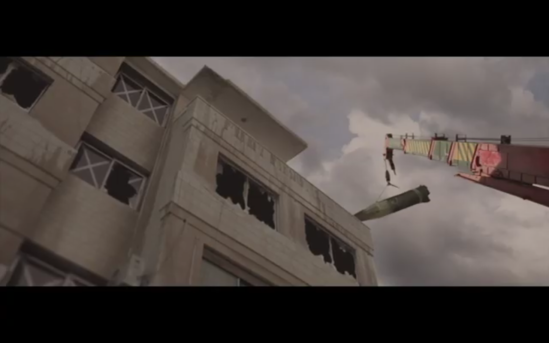
Set in conflict of the Iran-Iraq war, the young and educated Shideh living in war-frightened Tehran becomes forced to succumb to patriarchal dogma after participating in a revolution against Iran’s standing principals. Her husband’s conscription sends his medical experience to the battle front while she settles into her role as a stay at-home mother to their young daughter and despite pleas from her husband, the stubborn Shideh will not vacate her apartment building home even when the threat of an Iraqi attack is imminent. When a dud ballistic missile crashes into the apartment about them, nearly breaking through their ceiling, the fear of a sinister presence circulates amongst the tenants that drives them one-by-one from the building with the prospect of an Iraqi attack to further motivate as a logical decider. An unsuperstitious Shideh remains until her daughter’s imagery whims and unwavering fever begin to form a more terrorizing atmosphere that even has her questioning the shadowy company of evil.
Not many horror films scare nowadays. “Under the Shadow” is not one of those films. The debut feature film of writer-director Babak Anvari posses a rare commodity of grueling fear set inside an already tense backdrop of the 1980’s Iran-Iraqi war. Anvari, the Tehran born Iranian nationality who was engulfed religiously in the culture, borrowed and rendered his from his family’s stories of supernatural pre-Islamic demons whisking through the wind toward those swimming in sorrow and fear; those demons were also labeled djinns. As a child born in the 80’s, Anvari had to rely and family to obtain a sense of the anxious air suffocating those taut by potential missle strikes as well as political and social punitive measures going against the grain. The UK based independent production company, Wigwam Films, financed the BAFTA winner for an Outstanding Debut by a British Writer, Director or Producer as well as receiving other nomination nods in other categories, serving as one of young production company’s shining stars early in the tenure.
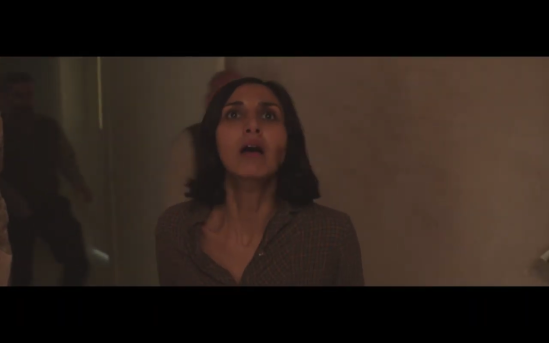
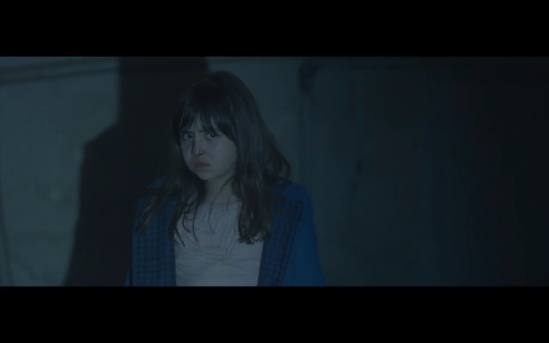
Wrought by the explosive squabbles of two sovereign nations and incepted with archaic folklore, Shideh’s bound and torn between reality and the prospect of superstition, a role dutifully played by another Iranian born, Narges Rashidi, whose family moved to Berlin and she studied acting, scoring a minor role in the motion picture adaptation of the science fiction television series, “Aeon Flux,” and in the 2009 comedy-horror “Must Love Death.” Rashidi courts Sheideh approvingly with sincere strife over how women serving beneath men in 1980’s Iran as well as struggling to overcome that internal conflict as the mirror image of herself, meaning her daughter, when a phantom prowler is afoot. Portraying Shideah’s daughter, Dorsa, and the frequent link between the Djinn’s world and her own is Avin Manshadi in her debut performance. Manshadi’s round cheeks and doughy eyes set upon a physique stilling lingering some ounces of baby fat has little range, but most creepy kids and in creepy kid horror films rarely do. Rashidi and Manshadi fend well for themselves as the sole two characters cornered by war and Shideh’s personal vendetta against her country, her husband, and even her daughter to prove she isn’t useless as the motif lets on. “Under the Shadow” rounds out with Bobby Naderi (“Bright”), Aram Ghasemy, Soussan Farroknia, Behi Djanati Atai, and Ray Haratian (“A Girl Walks Home Alone At Night”).
“Under the Shadow” finds itself in a subgenre nearly all it’s own as the variety of djinn-horror anemically pops up every so often as an unpopular and uncoiled viper, unlike the antagonist powerhouses of zombies and ghosts that’ve reigned supreme over the last two decades, and though Anvari’s film shares little with Robert Kurtzman’s demonic djinn of 1997’s “Wishmaster,” “Under the Shadow” has more in common with the late Tobe Hooper’s last film, entitled simply Djinn, before his death. Both are built on the substructure of an Arabic/Muslin mythology, set on an apartment building locale, and exhibit the malevolency side of the djinn, but Babak Anvari accomplishes a great feat on his very first attempt – a stiffly frightening air of a phenomenally harrowing horror story. Anvari patiently stacks blocks of tension, one on top of another, without a hint of quivering throughout the acts and what’s more astonishing is that all the acts deliver different notes prosed to detail that secures a simmering, shivering plot. To praise Anvari more, the young filmmaker leaves nothing to chance by closing with an open ending for the mind to assemble information and interpret the events; a classic directorial tool used by some of the greats.
Shuttering in the dark has never been so delectable with “Under the Shadow” inside a packed, limited edition Blu-ray from Second Sight Films. The LE runs with only 2000 copies sheathed inside a rigid slipcover with covert art by science fiction artist, Christopher Shy. Global horror aficionados will rejoice to learn that the UK BD disc is region free and presented in a widescreen, 2.39:1 aspect ratio, that’ll be available February 10th. Unfortunately, Second Sight Films provided a DVD-R Blu-ray screener so I’m unable to speak upon the video and audio aside from what’s already been stated. I will say the subtitles were accurate and timely paced. There were special features on the disc, including segmented interviews with director Babak Anvari, lead actress Narges Rashidi, producers Lucan Toh and Oliver Roskill, cinematographer Kit Fraser along with an audio commentary Babak Anvari and Jamie Graham and Anvari’s short film “Two and Two.” Press release also mentioned the release includes a soft cover book with new essays from Jon Towlson and Daniel Bird plus behind-the-scenes photos and concept illustrations and a poster featuring new artwork. “Under the Shadow” must be watched in the dark, alone, and with the volume up, maximizing the crawling chill down the spine and raising all the micro hairs on every square inch of skin.
Category Archives: Trailers
EVIL No Longer Swims Only in the Water! “Bad CGI Sharks” reviewed! (Sub Rosa Studios / DVD)
Living hesitant, unconfidently, and unfulfilled in Hollywood, California, Matthew finds himself fired by his employer after experiencing a promotion interview from hell, but that’s not the worst of his problems. Earlier the same day, Matthew learns his estranged older brother, a free-spirited and enthusiastic Jason, has been kicked out of his parents’ home, provided a plane ticket, and sent to live with him possibly forever. The estranged brothers finally reunite after years apart and Jason infiltrates back into Matthew’s uptight life their childhood obsession with sharks to try and finish a rough, shark-thriller script from their past, entitled “Sharks Outta Water.” When a magical movie muse decides to grant them their boyhood cinematic aspiration, the sudden appearance of a poorly render man-eating shark floats about their neighborhood streets, hunting down the brothers during a night of computer imagery terror limned with shoddy shark frenzies.
Out in the surf of the internet, a list lurks just beneath the dark waters of the web. A list containing a flooded genre of some of the worst shark movies detrimental to mankind’s inherent fear of a primordial aquatic creature that was once known to be the ocean’s apex predator. To save us from the cold, bleak shark banality, “Bad CGI Sharks” absorbs all toxic mundane trash skimming the vast global networks and big picture boxes to recourse from the singular trained thought that sharks are much more than a punching bag of relapsed rendered dogfish with jaws. Written, produced, and directed by MaJaMa, an alias for Matthew Ellsworth (Ma), Jason Ellsworth (Ja), and Matteo Molinari (Ma), “Bad CGI Sharks” flaunts a straight-to-video, no-budget comedy-horror in the face of whoever is willing to once again put themselves in front of a speeding bad shark movie train; yet, the filmmaking trio embark on a creative, meta journey risky with little blood shed and a swarm of animated things that mark somewhat of a resemblance to sharks. What crests is insightful satirical wit over the ostentatious flare of gratuitous explosion, nudity, and monstrous sharks.
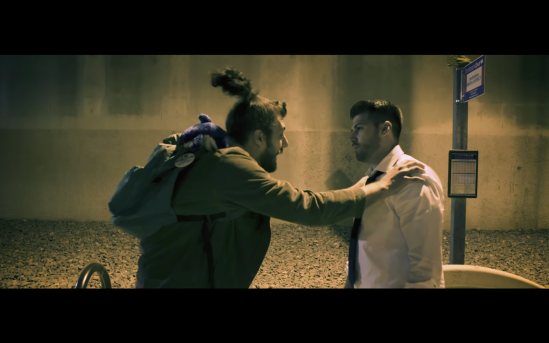
In keeping to the budget, MaJaMa already wear many hats behind the camera. To extend even further their invested working capital, the filmmakers also star in the lead roles, virtually as themselves, to surely hammer down a film entitled “Bad CGI Sharks” in their own brand of humor. We begin with Matteo Molinari, the Genova, Italy born actor who had a small role in 1994’s “Silence of the Hams,” a spoof starring Dom DeLuise and Billy Zane derived from the Jonathan Demme’s Hannibal Lector thriller, “Silence of the Lambs,” if the title itself wasn’t self-evident enough. Molinari is the only main lead not using his namesake and, instead, becomes the magical movie wizard Bernardo with his muse movie clapper. Bernardo was built for Molinari as the two are synonymous to each other’s manners, speech, and quirky simpatico charm, resulting in an innocent, mischievous movie imp to be the bridge connecting the gulf between Jason and Matthew’s polarizing characters. Jason’s a severe caricature of hyperactivity and of someone whose stuck in the past and while Jason Ellsworth has his moments, without his brother Matthew’s stern, grown-up, and spruced up onscreen self, the dynamic just wouldn’t be as potent as Matthew is essentially the activator spray to Jason’s gluey personality. The cast concludes with Jenn Liu (“Stranger in the House”), Josh Sterling, and Shaun Landry.

Tiptoeing around the fringes of being a stoner film, “Bad CGI Sharks” pushes a hyper-meta reframe of how shark movies, or perhaps the film descends deeper into the water molecule level of just the shark representation itself, should be brought back to the shores of reality from the watery depths of Davy Jones’ poorly rendered locker. Coinciding with crystallizing the shark-sploitation category is a more tender note of embrace with relatable themes of rediscovering brotherhood and mending broken bonds. Matthew’s parental manufactured disgust with his older, yet childlike, brother casts a large, dark cloud that seizes up any kind of affection and the floating shark, the symbolic dream of their childhood, tests their relationship, motivating the the character arches in the face of “Bad CGI Sharks.” Amongst the witty banter and flying carnivorous fish, “Bad CGI Sharks” shows innate signs of no-budget difficulty such as story pacing where the middle sags with Jason and Matthew running around Hollywood for awhile in a progression stagnation and there lies some early editing miscues with audio mixing and mic work. Like a shark, “Bad CGI Sharks” needs to keep swimming or else it’ll upend and die; luckily, MaJaMa saves the cinematic beast with the shark devours the internet and all bets are off!
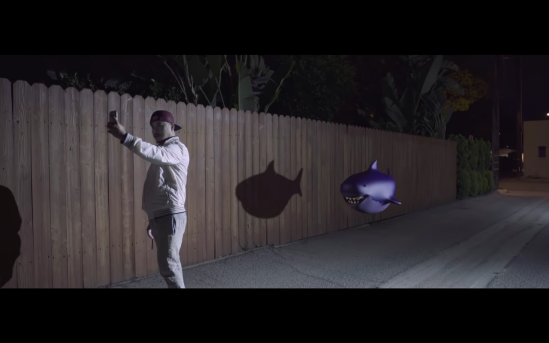
If you like your sharks floating and roaring, then “Bad CGI Sharks” DVD home video is for you, sailor, courtesy of SRS Cinema and MVDVisual. The not rated, region free DVD is presented in a widescreen, 16:9 aspect ratio, with, an IMDB listed, Sony a75 II Mirrorless camera complete with a “vintage” lens. Most of the image transpires cleanly and sharp, even the inorganic, floating sharks look fair in their farce facade, and with the specialized lens seemingly cornered to just around the Bernardo’s outer shell host duties and intermission skit and also in the initial attack sequence in which is the only scene with any kind blood shed. The English language audio tracks include a 5.1 surround sound mix and a stereo mix. The audiophiles will find solace in knowing “Bad CGI Sharks” doesn’t mean bad audio tracks. Dialogue has clarity throughout, depth and range remains steady, and there’s negligible hum electric feedback. Bonus features include a commentary track with MaJaMa, a retrograde toy commercial for all the characters, the teaser trailer, trailer, and SRS promoted trailers. Though lacking bloody chum, “Bad CGI Sharks” has bite albeit with more comedy than creature feature horror, fleshing out real world problems with hilarity in a cheapjack rendition of a killer shark.

Chomp! Chomp! Chomp!

The EVILs of Drugs, Addiction, and Art in “Bliss” reviewed!

Dezzy Donahue, a struggling Los Angeles artist, lives life ferociously with hard drugs and heavy drinking despite the cautionary advice of her quasi-boyfriend, Clive. Her current masterpiece falls behind on schedule and she hits a formidable creative block that results in being fired by her managing agent and with cash quickly dwindling, Dezzy’s losing the battle for inspiration that turns to an increasing narcotic intake surging through her system where any and all substances are fair game to explore. When she snorts a line of Diablo, a blissful, out of body experience drug, she finds herself in a rapturous three way with friend Courtney and her on-off side piece Ronnie that leave her with a post-high, post-sex altering inner body inexperience of opening the flood gates on her creativity to draw again as well as pang her with an insatiable need for a fix when no longer riding the high. Soon, Dezzy discovers the Diablo might not have been the drug that lit the fire inside her when a strong craving for blood becomes an inescapable addiction and a means to finally finish her greatest triumph work of art.

An audio/visual besieging rabbit hole shiplapped with braided beleaguering addiction and vampiric pathology in the stimulating aggressive, Joe Begos written and directed visceral horror, “Bliss,” set in the sordid Los Angeles metal scene. The “Almost Human” and “The Mind’s Eye” filmmaker hypnotizes on a stroboscope wave with his latest take on the vampire mythos with a drug-fueled, warmongering hell on a canvas tale of sex, drugs, and diabolical fiend cravings. Produced by Channel 83 Film, as are all of Bego’s works, “Bliss” is the director’s next notch up on the crazy, unrestrained belt that’s already garnished and weaponized with razor wire and three-inch cone spikes and while the story itself isn’t fashioned for originality, the way Joe Bego’s exfoliates the overripe garbage of rehashed formulaic filmmaking from the excessively strained eyeballs, sheepish with mawkish and dull stories, will be a new design to treasure as cult status.

Where’s “Bliss’s” 2019 nomination for best actress in a lead role!? Dora Madison seizes the performance of Dezzy Donahue by storm inside a role of careless abandonment that coils into viperous mode and lashes out with a deadly strike of unconventional fangs. Madison embraces the exotic Joe Begos route covered in blood, paranoia, and a sleazy shade of florescent neon and runs a willingness to express his mesmerizing vision with body cam harnesses. “Bliss” quickly establishes a hard-hitting tenor and Madison, whose credits include “The Loft,” “Night of the Babysitter,” and in the next upcoming Begos release, “VFW,” exacts a fortified layer of extreme sovereign, a do-what-I-want policy with a zero complaint department attitude, while stowing away what little hope and compassion Dezzy has in the forgotten corners of her plainspoken mind until the moment is too late to turn back. The story solely follows Dezzy’s perception of events as she encounters and reencounters characters before and after needing a junkie’s fix, an exaggerated play on an abusers volatile relationships. The cast affixed to roles of Dezzy’s vexing fix are Tru Collins, Rhys Wakefield (“The Purge”), Jeremy Gardner (“The Mind’s Eye”), Graham Skipper (“Carnage Park”), Chris McKenna (“King of the Ants”), Rachel Avery, Abraham Benrubi (“Wristcutters: A Love Story”), and that lovable “Cheers” regular, George Wendt.

At this point in the review, an overabundance of praise for Joe Begos’ “Bliss” has been logged by this reviewer, who is obviously a fan of the film, but more can be unquestionably explored. From previous reviews and comments I’ve come across regarding “Bliss,” a minority have displayed a disdain for the indistinct theme of drug withdraws and vampirism that resembles Abel Ferrera’s 1995 film “The Addiction,” but instead of being set in shadowy alleys of New York’s urban jungle, Bego’s relocates to the wayward esse of L.A. life. Perhaps Begos was inspired by Ferrera’s undiluted struggle and violence that makes “Bliss” a clone to “The Addiction’s” chief thread, but the film’s are artistically polar opposites. “The Addiction’s” black and white photography and slow-burn air tunes more into the story of the Shakespearian tragedy variety, especially when Christopher Walken provides lengthy life stance and coping monologues to establish his eternal dominance over Lili Taylor. “Bliss” proclaims a stimulus trip from the very beginning with a favorable thrashing metal soundtrack and an psychedelic filmic presence that comes with an opening epileptic warning. Both films compliment the figurative comparison for a fix in their own poetic ways and would make a fantastic double feature release or double bill midnight movie.

If this writeup has a jonesing affect, “Bliss” is cut and lined ready for blipping on an Umbrella Entertainment DVD home video presented by Dark Sky Films. The Channel 83 Films production is presented in a widescreen, 2.35:1 aspect ratio, being shot with a ARRI/ZEISS Super Speed Lenses, as credited on IMDB, that would explain the sharp image and stark contrasts on the colors. The visual perception of the seemingly humming-on-your-eyeballs neon lighting barely lets you experience the film in natural lightening during night scenes and only in the daytime that resembles the little normalcy left of Dezzy’s life, fade away with natural light the more she succumbs to blood cravings. “Bliss” feels and acts out like a 90’s film, slightly grainy for grindhouse seduction by way of shooting of actual film stock (35mm!), and forgoes the bubbly shine of perfection, coinciding damningly with Dezzy’s inner circle of sleaze, grime, and gore. The English language Dolby Digital 5.1 surround sound has a lot of kick and energy with a prevailing metal and punk/post-punk soundtrack feature Doomriders, Deth Crux, and Electric Wizard just to name drop a few. Dialogue is clean with an appropriate depth in the midsts of hard partying and live bands. Range is a little harder to discern since the soundtrack really is overpowering and dialogue sops up the remaining amount of audio track space, but when opted, the ripping of flesh and breaking of bones doesn’t disappoint. No subtitles are offered. Like many of Umbrella Entertainment’s standard releases, the single sided, singer layer DVD has no static menu or special features to offer other than the 80 minute runtime feature. “Bliss” is one coked-out, blood hungry hell of a vampire tangent from the norm that rectifies the optic and audible sanctuary for shock brilliancy to flesh out the Machiavellian in all of us.
[https://www.youtube.com/watch?v=5KdXU-n7qSg]

You want it, You need it, You desire it! Own “Bliss” today!

Watch William Shatner Shell EVIL With Explosive Munition! “Devil’s Revenge” reviewed!

Obsessed in locating a relic that has cursed his family for generations, archeologist John Brock desperately searches the cave his difficult father’s dispatches him to to locate and destroy the artifact that has plagued his lineage. His last expedition kills a man and John begins to question his father’s ranting and whether a curse actually exists, but when a mysterious accident sends him to the hospital, horrifyingly devilish visions nearly kills him in the unconscious state. As he snaps back to reality, John is hellbent on ridding the relic’s clinging evil and his family joins him for one last expedition to the cave that’s also a portal to hell and the Devil is waiting for him.

The above synopsis sounds terribly convoluted for such a rectilinear plot of the William Shatner story of demonic spelunking entitled, “Devil’s Revenge,” from 2019. The “Devil’s Domain” and “Halloween Pussy Trap Kill! Kill!” director, Jared Cohn, tackles the position’s obstacle of frustrations working with a rumored overly difficult Shatner as well as flushing out a cohesive story suited strappingly as can be on establishing a hell bound narrative with little backstory mythology from a script by Maurice Hurley, a writer on “Star Trek: The Next Generation.” What’s unusual is Hurley isn’t credited at the end or on the backcover of the Blu-ray and it’s a project he supposedly collaborated with Shatner up until his death in 2014 at the age of 75. Luckily, Cohn’s on the record saying Shatner was professional and precise, a true credit to his skill. “Star Trek” does become a constant motif not inside the frames, but more behind the camera with the cast, including Shatner, and Hurley who is the creative parent of one of outer space’s biggest nemesis, The Borg. “Devil’s Revenge” is a far cry from the final frontier, seizing on the border fringes of the underworld that seeps above ground.

Trekkie fans will appreciate the Captain Kirk star’s uncharacteristic doomsday pessimism and grand finale grenade launching that turns demons into canon fodder. Shatner is a savage as John’s fanatical father, bombarding his grown, near middle-aged, son with constant disappointment and disparagement that becomes one source of John’s (“Blood Lake: Attack of the Killer Lamprey’s” Jason Brooks) dire motivations to risk his family inside the gaping mouth of the netherworld, a questionable and ill-advised move especially when death is evident. Brooks is a career television and TV movie actor who can settle right into a third rate production with ease without batting a condemnatory eye lash. While Shatner and Brooks’ one-sided family role quibbles over languishing curses and John’s inability to man-up for the situation goes into the hilariously bad category, the second “Star Trek” star, Jeri Ryan from the “Voyager” series, lands a subdued role as John’s foot mat wife who just goes with the punches without making too much of a wake serving as John’s better half and reasonable conscious. Ryan and Brooks’ on-screen relationship is a supposed marital one, but the chemistry just isn’t present and wanders into questionability with their relationship status. The script’s backstory on John and wife is obliquely exposed through exposition without any of the visual depth and discharge of fleshing out a better dynamic for Ryan and Brooks to work with in building their characters. The remainder of the cast list includes Ciara Hanna (also from “Blood Lake: Attack of the Killer Lamprey”) and Robert Scott Wilson (“American Fright Fest”) as John’s college(?) aged kids who add little substance to the narrative.
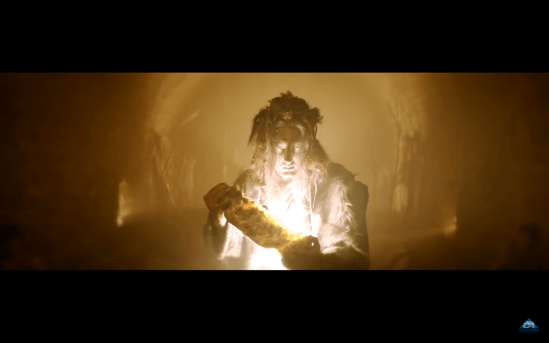
Without a better way of putting this, there’s much to demerit against “Devil’s Revenge.” The concept is sound: a disarrayed and browbeaten archeologist must locate an evil transmitting relic from destroying his family with a everlasting demonic curse. Sounds good, right? Combine that with Shatner blasting demons to smithereens with a multi-barrel grenade launcher, the potential for a solid and fun viewing experience would be a no-brainer. However, what’s sold is the made in China version of what’s being marketed. Hard to imagine Maurice Hurley’s, the man who helped re-pioneered space exploration and developed The Borg adversaries, script was so out of whack and had gone into various limp curvatures that I don’t expect all blame should point to him for the posthumous misstep as the direction is emphatically coarse and incoherent of too many ideas without any connective tissue much unlike boldly going where no man has gone before. In fact, many filmmakers have gone this route before by taking all sense of a rounded script and dissolving it the way Cohn does. The path Cohn ultimately takes is to splice loads of unnecessary and repetitive flash backs into the story to try and retain into viewers over and over again the events that conjured hell’s minions to surface. I’m sure we saw the same scenes at least five or six times from beginning to end, even during the opening credits. There’s also a looseness about how this curse attaches itself to John’s family from long ago that inexplicably goes without being conveyed and we find ourselves asking, why these people? What have they’ve been suffering through all these years? What makes them important? The curse seems rather recent rather than historic and for John’s family legacy to go uncharted just poses too many unanswered questions. What’s fundamentally right is Inan, the head demon, who represents the best parts of the “Devil’s Revenge’s” netherworld rock and roll presence with a large and ghastly humanoid with blank, fiery eyes and a protruding clasping mouth and the visual effects surrounding Inan are pretty good despite their some minuscule glossy bad aftertaste. An aftertastes that extends into Shatner using the grenade launcher with the goofiest of detonations in an unrealistic distance between him and his targets without so much of a single piece of shrapnel grazing his well postured gun-toting stance.

MVDVisual distributes “Devil’s Revenge,” a Cleopatra Entertainment production, onto a region free, special edition Blu-ray and soundtrack CD combo. The Blu-ray is presented in a widescreen, 2.78:1 aspect ratio, in a BD-25 with a 1080p transfer. “Devil’s Revenge” implores more than the natural lighting used through much of the 98 minute runtime and while natural lighting isn’t a flaw in any sense, Ryan Broomberg’s cinematography falls flat, uninspired that doesn’t represent well the presentiment eventualities past, present, or future. Technically, “Devil’s Revenge” isn’t soft around the details albeit minor banding in closer quarters of the cave. Practicality versus the computer imagery really do go head-to-head between Vincent Guastini’s (“Art of the Dead”) special effects and the visual effects team of Eric Chase (“The Black Room”) and Mike Rotella (“The Predator”). The detailed rubber body suits and the composited explosions akin to the military hellfire creatures were bombarded with in monsters movies from the 50’s are of the campy independent film culture and purgative of any expectations of the Devil actually making good on revenge. The English language Dolby Digital 5.1 surround sound audio is not as lossy as the usual Cleopatra Entertainment Blu-ray releases and certainly regales with the theatrics of a William Shatner monologue (can’t you tell I love me some Shatner). Range and depth are concurrent appropriate with each other and dialogue is clean and clear. Surprisingly and rarely does a Cleopatra Entertainment releases goes without a soundtrack intertwined with the score that contracts their signed artists from parent company Cleopatra Records; instead, we receive a brooding industrial score composed by Jürgen Engler, co-founder of German punk band “Male” and “Die Krupps,” which can be gorged on as the film’s coveted silver-lining. Luckily and conventionally for a Cleopatra special edition release, an un-cursed 13-track CD of Jürgen Engler’s score accompanies the feature Blu-ray. That being the height of the special features, other bonus material includes a picture slideshow and theatrical trailer. “Devil’s Revenge” won’t shudder your bones to milky pigments of sawdusts and will likely strikeout with fans, as perhaps the Devil’s actual revenge for portraying him so ill-conceived. Still, I suggest checking out the Jürgen Engler’s gnawing and insidious industrial score, a gleaming highlight for sure.

Check it out for yourself! “Devil’s Revenge” on Blu-ray.

Follow EVIL’s Design! “A Psycho’s Path” reviewed!

In the sleepy Californian desert town of Brownsville, the peaceful way of life has been upended and thrown into chaos when a savage murderer embarks on a path of a seemingly random killing spree. Previously apprehended and transferred to a psychiatric hospital by court order, the psychopath’s easy and violent escape places him back into an already frightened society to the likes the town has never seen. With no leads to pursue and the townsfolk fearfully blaming the ill-equipped police force, Captain Peters and his squad of deputies must establish a pattern of slaying in order to track his next move, but all kill sites lead to being arbitrary – a motel on the outskirts of town, a isolated gas station, and a suburban home. Are these killings at random or is there a path the killer is following?

Mixed martial artist Quinton “Rampage” Jackson lives up to his professional epithet in Rocky Costanzo’s “A Psycho’s Path.” The credited writer and director filmmaker from Huntington Beach, California follows up his 2016 germane, American social, malignancy teenage thriller, “Ditch Party,” with the 2019 horror-slasher birthed from the spirit of independent filmmaking and produced by Noel Gugliemi, Matthew King-Ringo, and David Ramak. Despite the title’s wordplay on A Psychopath,”A Psycho’s Path’s” gritty and dark tone is anything but a pun-wit delineation as should be presupposed judged by the Mill Creek Entertainment DVD cover of a bloodied and wild-haired Jackson garnishing a blank death stare in the foreground of a moon and neon-lit ominous motel that just screams the trope scenario of nothing ever good is going to happen to that lady standing just inside her motel room’s doorway and wrapped in wet bathroom towels.

The former UFC lightweight Champion Jackson is no neophyte when concerned with the acting world. The big screen’s “The A-Team” adaptation proves just that with his break through rendition of the rogue militant, B.A. Baracus, famously portrayed by Mr. T in the early 80’s series of the same title and established the kind of role types Jackson’s built for outside the ring – large and in charge. In “A Psycho’s Path,” Jackson just has to appear like a 6’1″, 270lb monster without so much of one word of dialogue; it’s a role without a name other than John Doe and it’s a role Jackson was born to play as his physical attributes are naturally inherited and, dare I say it, scary. Character linked on the opposite side of the behavior spectrum is Captain Peters, played by Steve De Forest in one of the few prominent performances of his career, but Captain Peters doesn’t have enough oomph as a character to size up to John Doe. Thus, enters Noel Gugliemi, also known as Noel G., one of the most famous support character faces in all of the film industry from “Training Day” to “Bruce Almighty,” “The Purge: Anarchy” to “The Fast and the Furious” franchise, Gugliemi has the big name and personality in a joint forces operation with Steve De Forest as his on-screen right hand deputy, sergeant Torres. Barely recognizable with a bad wig and without his trademark facial hair, co-producer Gugliemi spits the snake tongued, whip-cracking lines of a jaded officer, lines that have solidified him as an all time fan favorite in his credentials. “A Pyscho’s Path” rounds out with Steve Louis Villegas (also in a bad wig), Kassim Osgood, Derrick Redford, Rowan Smyth, and with a lighthearted cameo from “Different Strokes'” Todd Bridges.

For fans of Michael Myers and the “Halloween” franchise, “A Psycho’s Path” has starkly obtained familiarities to The Shape’s universe with Jackson’s stoic performance of pure, unstoppable evil escaping a psychiatric setting intending to kill, kill, and kill and in also Costanzo’s ambitious direction, especially the track and follow camerawork that’s complimented by the cold tone cinematography of Dylan Martinez (“Ditch Party”), but that’s where the positives seemingly part ways with the rest of the film as a schlocky and campy shadow looming over what could possibly drive all these lunatics to the prospect of committing mass murder. Throw aside the already aforesaid production wardrobes with bad wigs and also ill-fitting deputy uniforms, “A Psycho Path’s” has lost more at stake with little string to yarn a strong woven story together that necessarily elevates John Doe’s affixed obsession to follow a blood-shedding zig-zag path loosely in a little-to-nothing conveyed context. “A Psycho’s Path” becomes a shell of other film’s former selves.

No One is Safe as the tagline warns on the DVD and digital download release of “A Psycho’s Path,” a production from Entangled Entertainment, Hourglass Pictures, and Stroboscope Studios, and distributed ITN Studios and Mill Creek Entertainment, a division of Alliance Entertainment. Presented in it’s original aspect ratio, an anamorphic widescreen 2.35:1, the image can be lost in a shadow-heavy contrast. Though praising his dark tone earlier alongside some well framed shots, Dylan Martinez, at times, goes full midnight at moments that hide events and eventualities from being discernible. The uplighting motif helps with cutting the overly dark picture and creates a sinister mood as slithers of shadows give a hard edged appearance. There’s also a menagerie of tint that doesn’t hone a theme. The English language Dolby Digital audio track renders palpable with clarity in dialogue and a decent range of ambience; however, the lack of depth throws some shade as characters, no matter whether in the background or foreground, live on an equal degree of volume. The release clocks in at 84 minutes, is not rated, and includes option English SDH subtitles. “A Psycho’s Path” has adequate acting, indie charisma, and one hell of a kill scene with a head in a vice like death grip and squeezed to pop like a ripe tomato in one’s hand, but can’t reproduce the slasher mystique well enough to earn it the trait.

Own it today on DVD!


