An EVIL Drug That Can Cure Your Crabs and Boil Your Insides! “Private Blue” (SRS Cinema / DVD)

“Private Blue” is on the case! DVD Now Available.

A new drug is on the streets of Edmonton, Alberta.  Call Shrink, the drug can produce a massive high and contains a high level of antivirals that can cure any sexually transmitted disease, but there’s a side effect.  If taken in a single excess amount, the drug can boil your insides, leaving nothing left.  The Edmonton police are stuck on the case with no leads and to make progress on the fast-moving drug epidemic that has now claimed the life of a daughter of a prominent sports booky, the department hires Tony Blue, an ex-cop now private investigator who can use unconventional means outside the scope of police authority to get the needed information, such as where Shrink is being peddled and produced.  Working down the vine, Blue runs through the hierarchy from street pushers to the manufacturing kingpin, a brusque and brutish strip club owner named Wanda who will stop at nothing and will not let anyone get in her way to fill the streets with her deadly, venereal disease-curing drug.

A comedic spin on the 1980’s lone wolf cop-thriller, “Private Blue” immerses itself into every trope manageable inside its indie budget with business in the front, party in the back mullets, bad guy chases and beatdowns, and a smoke-filled and color gel-brightened assortment of atmospheres that propagates the cop film neo noir aspects.  The accountable party behind this crass cop caper are a pair of brothers, Devin and Robert Burkosky, based in Edmonton, Alberta, Canada.  The brothers produce, write, direct, and one-half star in what is their sophomore feature film behind the 2018 comedy-horror “Load Shark Massacre” that’s about a murderous loan shark who bites off more than he can chew.  Continuing the trend of drugs, violence, and psychotronic absurdities, “Private Blue” is an extension of their creative effort into crime action with a horror edge but with this time, they add a science-fiction element straight out of the boondocks of left field.   The feature is produced under the Burkosky company, Beechmont Entertainment. 

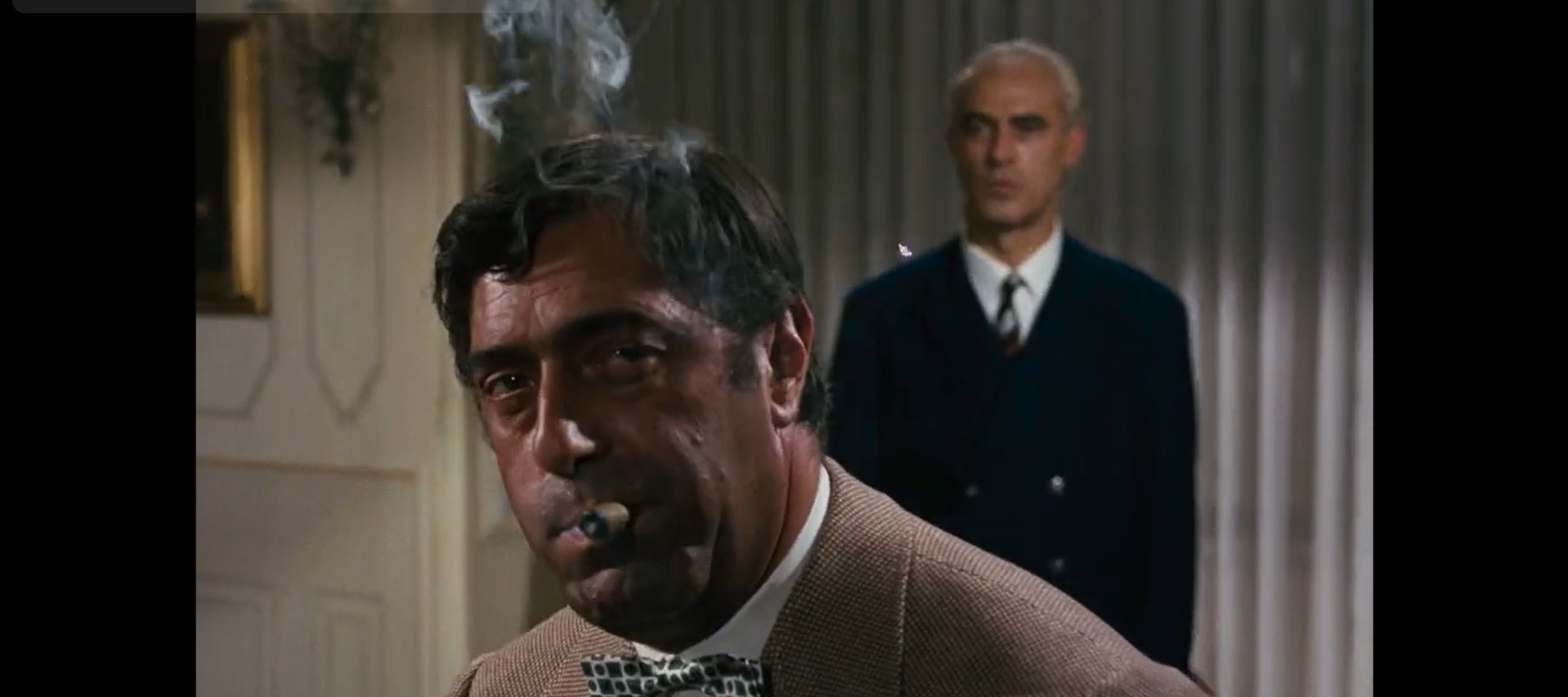
Robert Burkosky jumps into the titular role of “Private Blue” as a wisecracking and arrogant Tony Blue, an expelled detective because of his purloining of the evidence locker for his own needs, but Blue is a great chase-down detective, if not the best with his quick wit and adept situational skillset that makes him valuable.  Burkosky hams up Blue’s cocky attitude and Miami Vice-lite dress with linen blazer overtop a white tank top, sporting aviator glasses, and flaunting a greasy-looking mullet to accentuate the arrogance and confidence.  Opposite Burkosky is Moira MacKinnon as the larger-than-life adult industry head honcho and criminal mastermind Wanda who’s behind the manufacturing and distribution of the Shrink drug.  Having had a role in the Burkosky’s debut feature “Loan Shark Massacre” and was recently in their last film, the 2025 “Heat Score” that’s currently in post-production, MacKinnon’s a Burkosky go-to regular and her performance in “Private Blue” is perhaps my personal favorite with the Rita from “Power Rangers” voice and cackle and a maniacally expressed face as she bulldozes people into what she wants, no matter friend or foe.  “Private Blue’s” colorful cast doesn’t end there as there’s plenty of outrageous personalizes that are typical of a Burkosky brothers production, such as Tommy Grimes in drag playing the role of a female assigned stripper named Candy, Wolfgang Johnson as a low-level, guitar-playing, drug pusher, and Rod Wolfe as an older, mid-level dealer who wears various peppers around his neck like a necklace.  Dean Lonsdale, Ian Rowley, Dave Qurik, Kaley Leblanc, Jesse Hicks, Arielle McCuaig, Christian Stahl, and Brandi Strauss fill out the cast.

For what the Burkosky’s try to achieve in churning out “Private Blue” as a throwback of hard-boiled sleuth work, there’s success is select areas.  One of those successful portions is the phenomenally pastiche 80’s soundtrack by Robert Burkosky and the general aesthetic of the said decade with smoke-filled room illuminated by the gel lighting.  Wardrobing occasionally lands in the same era but there’s really no set point in time the story takes place but rather a mishmash of decades.  Devin and Robert, the latter quickly establishing himself as nearly a one-man show for the entire production, are competent editors that make “Private Blue” an easily digestible narrative.  What’s not easily digestible are the jokes that, for the most part, land flat.  The colorful characters do indeed entertain in their ineloquence and idiosyncrasies, but the script lacks that gut punch humor.  Instead, the script is riddled with fart gags, which personally I’m not a terrible fan of its audiological stink, and the jokes continue periodically throughout in every, or every other, scene of just randomized farting when a character sits, squats, or actually flatulates purposefully as a way of gag-inducing defense.  While most jokes don’t jive in jest, there are a handful that do, such as Tommy Grimes convincing our sexuality as dolled up sex worker Candy or Robert Burkosky’s lengthy slow-motion dance scene with a bunch of strippers at Wanda’s club.  Hilarity, as well as spurts of graphic violence, continue through whenever the story perversely changes course and mostly for the better. 

“Private Blue” is on the case.  Or, rather, is inside the case of an DVD Amaray with the release from ultra-indie underground label SRS Cinema.  The MPEG-2 encoded, standard definition 420p, DVD-R with the purple underbelly has a less-than-desired picture quality that’s par for the course with SRS Cinema.  Yet, all the sub-def eyesores are not terribly off-putting thanks to some decent camera equipment and know-how by the Burkoskys.  The palatable image has a flat grading only targeting contrast during it gel-lit scenes and the film is presented in 1.33:1 full screen that’s shot-on-videotape with uniform moments of interlacing.  Imaging produced is a result of a macro lens, encompassing even less within the standard framing and providing a flatter field that loses a bit of the depth.  The LPCM stereo mix that offers an ample dialogue track and range of audio layers that create a fair separation.  Robert Burkosky’s soundtrack epitomizes the balance between the layers when amplifying to make it the star of the scene.  Gun shots, thrown punches, and, even to an extent, the fart gags find the relative right level within a campy mix.  English captioning is available on this DVD.  Special features include a paralleling director’s commentary track, a blooper and outtake reel, the film’s trailer, and other SRS Cinema trailers.  SRS Cinema’s physical copy is standard fair but does showcase a blue-hued illustrative artwork that’s appealing and accurate with the same, but cropped, design pressed on the disc.  The 96-minute film comes not rated and is region free.

Last Rites: A debased tribute to the hard-boiled 80’s cop actioner, The Burkosky Brothers “Private Blue” has potential to be a great accolade of the subgenre as well as be funny but falls short with an overuse of pass gas gags and its inability to surpass that tenor.

“Private Blue” is on the case! DVD Now Available.

Enjoy The Last Night in EVIL’s Hotel. “The Innkeepers” reviewed! (Second Sight Films / 4K UHD Blu-ray)

Book a Copy of “The Innkeepers” on 4K Ultra High-Definition!

The Yankee Pedlar is a historic hospitality hotel with over 100 years of service that comes with its own notorious past and haunted tidings.  On the verge of closing for good, the Yankee Pedlar has one more weekend to remain open and house guests but with only a handful of rooms occupied, there’s not much else to do for the two innkeepers, Claire and Luke.  As a way to pass the time, Claire is eager to video capture spooky events to feed into Luke’s website based off the hotel’s history in the death of Madeline O’Malle, a bride to be who committed suicide on her wedding day when the finance no-showed and her corpse was left to rot for 3 days in the basement as hotel owners feared for bad publicity, but when eerie begin to plague, call for her, with visions of a bloodied O’Malle in a white gown, Claire finds herself in the dangerous company with a permanent guest at the dying hotel. 

Ti West, the established genre director with the famed “X” trilogy, kept audiences pale in fear and the hairs on the back of their neck stiff and straight up with his written-and-directed horror films that retained staying power amongst fans.  2009’s “The House of the Devil” is considered one of the more recent better throwback horrors of our time surrounding classic tropes like a satanic cult and a home alone babysitter.  West’s 2011 film  “The Innkeepers” comes at a rebound time when his commercial picture, “Cabin Fever 2:  Spring Fever”, sequel to Eli Roth’s breakthrough hit from 2002 about a flesh-eating virus, didn’t quite feel like his film and “The Innkeepers” also hit a little different by shielding audiences from any type of horrific, on screen splatter violence and be concentrated on pure fear of the senses.  Though narratively set in perhaps Pennsylvania due to some references of towns an hour outside of Philadelphia, “The Innkeepers” was actually filmed more North in Connecticut with the real-life Yankee Pedlar building.  Larry Fessenden (“The Last Winter,” “Rehab”) of Glass Eye Pix and Derek Curl of Darksky Pictures co-produce the film along with Peter Phok and Ti West. 

In the two principal roles of Claire and Luke is “Barbarian’s” Sara Paxton as an unmotivated hotel clerk coasting until the very, bitter end and “Cheap Thrill’s” Pat Healy as a blasé and uninterested front desk colleague interested in getting on the popular haunted house train with his own website about their employer’s centenarian hotel.  Paxton inarguably shoulders much of the screentime as the girl who cried wolf when she experience’s the sounds of a wolf, aka the spooky serenades of one Madeline O’Malle, and the visual eviscerations of her bloodied corpse that would scare the bejesus out of anyone.  However, the frights are not enough to seemingly strike fear in Paxton’s shield of composure or even enough to put West’s story to rest with a simple I’m outta here as most of us chickens would flock toward the exit on the first instance waking from a vivid dream too real for comfort.  Healy ultimately steals the primary performance away from Paxton with his own gruff and irritated by everything:  the hotel, the guests, his own pitiful existence.  Healy does a nice job creating that subtle tension between Luke and Claire, knowing Luke’s own hangups lie somewhere in between and haven’t been exposed yet, all the while being a sarcastic boor for most of the time.  There are also side characters in the form of random guests occupying the skeleton-crewed hotel bringing with them their own set of baggage.  One of guests is Kelly McGillis and the “Top Gun” actress, in a bit of a meta-role of an aging actress turned mystic.  There’s also Alison Bartlett (Gina from various Sesame Street shows and specials) and Jake Ryan (“Asteroid City”) as scorned wife and her son and the peculiar older gentlemen, played by George Riddle, who requests a special room and will not take no for an answer.  One of the more curious castings is Girls’ Lena Dunham as a coffeeshop barista in a one and only brief scene that doesn’t add really anything to the whole in a pointlessly random interaction with Claire that, perhaps, plays off Claire’s repetitiveness and stasis life of going there everyday but not really knowing much about the barista, who is apparently always there too. 

Juggling between the blended tones of comedy and horror, Ti West doesn’t commingle the two directly into one scene, keeping distinction for one or the other in their individualized moments.  This leaves little room for alleviating dread levity inside the scare moment after building tension and fear of being chased or waiting for the silence to be broken but an unsuspected jump scare.  Outside the context of the fright-filled moment, back and forth quips and playful antics between Luke and Claire as two bored and starved for company innkeepers in the hotel’s waning days are delivered in brightly lit rooms and mostly shared with another person to be a telltale safe space against the malevolence of serrating spook-house intensity that often lingers and waits on with bated breath.  In the innermost between is Claire’s internal struggle to cope with the impending outcome that there is nothing on the horizon for her.  No secure job, no ambitions, no plans of any kind are seemingly providing the character with no hope and in that stagnation, she desperately holds onto what’s nearby – Luke’s interest in the Yankee Pedlar’s hauntings.  Enhanced by the odd actions and placement of the modicum of guests – McGillis as a crystal charm intuitive and Riddle as a strange-enough older man with a specific room fascination – Claire motivation to reveal Madeline O’Malle becomes tenfold because of her unconscious lack to move forward in life, which then spurs the question, is Claire’s experiences grounded in truth or are they just a downspout of manifestations induced compensation?  You’ll have to be the judge.

Like “House of the Devil,” another of Ti West films makes the Second Sight Film cut onto a newly restored 4K scanned UHD Blu-ray release.  “The Innkeepers” HVEC encoded, 2160p ultra high-definition, BD100 has the true presence of quality video with a gradual improvement in the finer details of a greater pixel count inside the HDR with Dolby Vision.  Though digitally recorded with a no imperfections to note from previous releases, Second Sight’s release does appear sharper and deeper around the black levels that often improve with better resolution and suitable compression and with a good portion of the story taking place in the dark recesses of a hotel basement and the in the shadows of unlit rooms, there’s no visual compression issue or loss of expected detail.  Contrastively, darker scenes appear more lit by a lower contrast but still, the details are there in depth and in closeup.  The English DTS-HD 5.1 surround sound audio track diffuses the spread of atmospheric creepiness – ghosts whispers, nondiegetic bangs and clangs, and a Jeff Grace building orchestral score that keeps the heart bumping (think Richard Band’s “Re-Animator” but with more lulls”).  Dialogue is prominently clear and in front of the aforesaid layers with depth mostly between Claire and Luke’s conversing in the lobby and range limited to, again, the aforesaid.  English subtitles are available.  Though this review is catered to the limited edition, rigid slipbox release full of tangible goodies, the standard release does have encoded a small army of special features that has two audio commentaries with the first including Ti West, producer Larry Fessenden of Glass Eye Pix, producer Peter Phok, and sound designer Graham Reznick and the second commentary also West but with principal actors Sara Paxton and Pat Healy.  A slew of new interviews provide a well-rounded, in-depth look at the creative design as It West A Lasting Memory, Pat Healy Let’s Make This Good, Larry Fessenden Our Dysfunctional World, director of photography Eliot Rockett Living in the Process, composer Jeff Grace Cast a Wide Net, and line producer Jacob Jaffke A Validating Moment contribute to the retrospective.  Special features round out with archival behind-the-scenes and the trailer.  The physical presence of Second Sight’s “The Innkeepers” keeps in-line with previous standard edition 4K releases with a black Amaray case and a monochromic grayish illustrative cover art setting audiences up for ghostly expectations.  The UK certified 15 release contains strong horror, gore, language, and sex reference – though the gore is subtle and definitely not over-the-top or even explicit.  This particular UK release, that has a runtime of 101 minutes, is region free and presented in a widescreen 2.40:1 aspect ratio.

Last Rites: “The Innkeepers” works, if not wriggles, into the brain, much like the invasive worthlessness inside Claire’s swirling mind, and the Second Sight Films’ 4K UHD Blu-ray is an ultimate celebration of not only the film itself, but also the venerable work of the horror genre’s freshest master Ti West.

Book a Copy of “The Innkeepers” on 4K Ultra High-Definition!

An EVIL Alien Blob Storms Earth in Search for Space Feline! “The Cat” reviewed! (88 Films / Limited Edition Blu-ray)

If you missed the Blu-ray, “The Cat” Standard Edition is Available!

Storytelling author Wisely recounts one of his more fantastical pieces originating from more truth than fiction.  The writer reminisces investigating the mysterious occurrences surrounding a black cat and a young woman involved in a museum heist of an ancient, unknown artifact and, previously, in a strange encountering with Wisely’s friend Li Tung involving strange hammering noises and strewn about cat guts in an adjacent apartment.  Wisely soon discovers he’s bitten off more than he can chew becoming mixed up in extraterrestrial battle between the gentile but fierce fighting space cat and the young woman from another world versus a vicious and imposing orange alien blob that can inhabit dead humans and slip through tight confining spaces, leaving a burn trail of electrified bodies in its wake.  Wisely and his girlfriend, Pai so, decide to help the girl retrieve a second piece of the artifact that be used as a weapon against the relentless alien aggressor before the cat and girl can return to their home planet.

A strange science fiction thriller hailing from Hong Kong, “The Cat,” or “Lo mau,” is the 1991 filmic adaptation of author Ni Kuang’s “Old Cat” from a part of the Wisely adventure series of novels.  Written by frequent collaborating screenwriters Hing-Ka Chan and Gordon Chan (“Cat and Mouse,” “Behind the Yellow Line”) as well as numerous team-ups of Hing-Ka penning Gordon director helmed works (“Beast Cops,” “Thunderbolt”) and directed by “Riki-Oh:  The Story of Ricky” director Ngai Choi Lam, “The Cat’s” bizarrely unraveled as it is unrivaled but evokes a commingling of Hong Kong mysticism, science fiction, horror, and creature personification that’s hard to find not entertaining in its converging Daoism with creature feature movies!  Golden Harvest and Paragon Films, in association with Japan’s Nippon Television Network as a Hong Kong-Japanese alliance, are the companies behind the picture production with Chan Tung Chow (“Riki-Oh:  The Story of Ricky”) and Seiji Okuda (“Pulse”) as producers.

Hong Kong beauty Gloria Yip (“Riki-Oh:  The Story of Ricky,” “The Blue Jean Monster”) took Hong Kong cinema by storm in the early 90s before quietly taking a step back from acting to focus on building a family when newly married in 1995.  Since her divorce, Yip has been active in the last decade and half but to experience her best, early work, “The Cat” is a good start to behold her natural girl-next-door charisma and attractive attributes as an alien inside a human body.  Where she obtains this human form is unknown and her species social status, her name or how she became trapped on Earth is also vague, but Yip’s character can float waltz and is seemingly the caretaker of the Cat, who is a general of sorts in the alien race.  Her alien sidekick, Errol (Siu-Ming Lau, “Shaolin vs Evil Dead:  Ultimate Power,” “A Chinese Ghost Story”), too has an equivocal backstory as they search for weaponry relics and evade the caustic and electrically charged blob monster that threatens their world.  The story falls in more in tune with the three friends buried by the extraterrestrial struggle for survival and dominance with “A Chinse Ghost Story II and III’s” Waise Lee as principal lead character Wisely, a humble story writer living off the riches of girlfriend Pai So (Christine Ng, “Crime Story”), at least based on their dialogue of her owning a big house, playing tennis, and providing.  It’s an oddly laid out relationship that shows no quarrel or being tested when up against alien beings.  Li Tung (Lawrence Lau, “3-D Sex and Zen:  Extreme Ecstasy”) is Wisely’s first friend to encounter the girl and cat as noisy above neighbors but it’s their cop friend, Wang Chieh-Mei (Philip Kwok, “Hard Boiled”) who takes the unfortunate brunt being inhabited by the alien blob and becoming a Rambo-arsenal assassin.  The last piece to “The Cat’s” cast is actually the “Old Cat” author Ni Kuang having a cameo appearance as a warrior dog handler, Processor Yu.

Did I mention already that “The Cat” is beyond bizarre?  The campy story suffers from connective tissue deficiency syndrome, meaning there’s not enough exposition or explanation in the subdued, mild-manner interactions to really bring together and segue the really cool action and creature sequences that involve, but not limited to, pyrotechnics, forced perception effects, stop-motion, blood squibs, prosthetics and makeup, and high-flying wire acts involving not only people but cats and dogs!  The cat versus dog fight is a rough-and-tumble showstopper.  The special effects and choreographic teams of Hong Kong’s special makeup effects artist Chi-Wai Cheung (“Riki-Oh:  The Story of Ricky”) and stunt coordinator Philip Kwok taking their cogs and working into the grand effects design along with Japan’s f/x crew from visual effects artist Takashi Kawabata (“Dark Water”) and special effects Shinji Higuchi (“Gamera, the Guardian of the Universe”) is a masterful amalgamation of two cultures and two styles into one, blending high-flying acrobatics with the strange, bold stop-motion and visual effects that incorporate puppets and molds is optical buffet aimed stimulate and confound.  Nearly experimental in its narrative and effects while bordering being derivative, such as from the 1988 “The Blob” remake, “The Cat’ prowls, growls, and meows as a welcoming hot mess of feline phantasmagoria. 

On a new limited-edition Blu-ray set with exclusive, new artwork by graphic artist Sean Langmore, “The Cat” purrs with a fully-loaded, out of this world high definition release from UK label 88 Films and distributed by MVDVisual in the North American market.  A new 2K restoration of the original 35mm negative is encoded on a AVC encoded BD50 with a 1080p resolution in an aspect ratio of 1.85:1 widescreen.  Image presentation has the stellar glow of regular Hong Kong film stock, a stock that doesn’t dilute the defining particulars but only softens them slight.  The original negative has withstood the test of time and any improper handling providing the restoration effort with a focus-driven goal of grading and detail. The other side of that coin is that all the rubbery and irregular textures are now more in the spotlight instead of being lost in the lower resolution and more opaque video qualities.  Brilliant gel lighting and a comprehensive range of primary reds and blues coupled with an electric orange and blood red of the antagonistic monster seduces contrastingly inside a dark atmosphere with a story mostly told during the nighttime hours.  Remastered with a Cantonese DTS-HD mono track, the compositional track is about as good as it’s going to get but that’s not saying the audio is bad at all.  Clean and clear in ADR dialogue and distinct in the ambience and action, “The Cat’s” remastering is mighty without being punchy with broad-range, consistent audio that doesn’t have any holes poked into it and has an epic, original score by Phillip Chan (“Her Vengeance”).  Newly translated English subtitles are burned onto the only video file feature.  The encoded special features include an audio commentary by Asian film expert Frank Djeng of the NY Asian Film Festivial, a new interview with writer Gordon Chan in Cantonese with an English introduction, the Japanese cut of the film in standard definition, an image gallery, and theatrical trailer.  All of the encoded features will be available on the limited-edition and standard release sets.  Langmore’s artwork graces the LE O-ring slipcover and rigid slipbox with a crazy illustrative arrangement that details how bonkers “The Cat” gets.  Inside the slipbox, a full-bodied colored and detailed booklet with more original Langmore artwork, one sheets, stills, and other contents that include cast and crew acknowledgements, a Paul Bramhall retrospective essay on director Ngai Choi Lam That Cat is Dangerous, a second essay in regard to Nai-Choi’s niche cinematic credits by Matthew Edwards entitled Body Horror, and a special thanks roundup and more acknowledgements in the making of the Blu-ray release.  There’s also a collectible art card stuffed in between the clear Amaray case and the booklet.  The reversible cover art’s secondary slip-shell is of an original poster art, a good alternative to an already overused Langmore illustration that’s on the O-Ring and slipbox.  While not a numbered limited-edition release, news of the set already being or nearly sold out at most retailers is circulating, but there will be a standard edition slated for release late November ICYMI!  The not rated release has a 89-minute runtime and is encoded region A and B for playback.

Last Rites: Ngai Choi Lam’s science fiction, body horror, and creature feature inundated “The Cat” has all the weirdness and practical prosthetics, including deeply bizarre force perception visuals, that’s beyond our galaxy and capacity for understanding, landing with great precision onto a well-deserved, highly anticipated, and must own 88 Films’ limited-edition boxset!

If you missed the Blu-ray, “The Cat” Standard Edition is Available!

Under Hypnosis, You’ll Do Anything For EVIL! “Vampire at Midnight” reviewed! (MVD Visual / DVD)

“Vampire at Midnight” is now on DVD!

Gripped by a serial killer dubbed the Vampire Killer, Los Angeles is on high alert as not one single piece evidence could be recovered from the more than a dozen crime scenes where women’s’ necks are ripped to shreds, their bodies are drained of blood, and their corpses dumped for police to discover.  With detectives baffled, cowboy cop Roger Sutter is ordered by the reckless antics-frustrated Captain to stay away from case but when Roger follows a lead that lands in his lap, two people wind up dead and the killer slips through his grasp, the captain suspends him from the force.  Focusing all his energy into a newfound romance with apartment complex neighbor and aspiring pianist Jenny Carleton, Roger finds himself back onto the killer’s trail when his time with Jenny goes from special and exciting to acutely avoiding his every advance.  Roger suspects the Vampire Killer behind Jenny’s sudden change in behavior.  Unofficially back on the case, the off-duty Los Angeles homicide detective finds himself in the middle of the Vampire Killer’s ritual to seduce Jenny into his coven as one of his blood brides. 

The maverick cop versus the serial killer narrative “Vampire at Midnight” is the 1988 investigative thriller with a horror edge from editor-producer Gregory McClatchy (“The Great American Girl Robbery,” “Terror in the Aisles”) in his first, and only horror credited, feature length directorial.  Also, lesser known as “L.A. Midnight, “Hypnos” or “Murder at Midnight,” the entrancing, modern vampire script is penned by “Danger Zone II:  Reaper’s Revenge” writer Dulany Ross Clements from a story by fellow “Danger Zone II” collaborators Jason William (actor in “The Great American Girl Robbery” and “Flesh Gordon”) and Tom Friedman (“Time Walker”).  Skouras Pictures served as the production company and the theatrical distributor with Friedman and Williams also in a producing capacity.

Much like with his lead kidnapper role in “The Great American Girl Robbery,” as well as other skin-a-matic films like “Alice in Wonderland:  An X-Rated Musical” or “Flesh Gordon,” producer, conceptual storyteller, and principal star Jason Williams puts himself into the rough-and-rugged hero to get the girl, or girls, half naked in his arms.  As unorthodox method cop bending procedure to get results, Williams molds handsome homicide detective Roger Sutter to the quintessential trope of a good cop doing everything he can to get the job done, even if that means skirting around lawlessness.  Roger is pitted up against pure vampiric evil who welcomes the lawlessness under the façade of a doctor of hypnotism specializing in unleashing clients’ frustrating mental blockages in their careers and goals.  Argentine-born Gustav Vintas has the physical look of a sophisticated villain (see “Lethal Weapon,” “Verne Miller,” and “Midnight”) with his stage 6 receding hairline and foreign accent and “Vampire at Midnight” also fits the bill with Dr. Victor Radikoff, a smooth talking and charming manipulator who can literally hypnotize his clients into anything, such as serving their necks up to his fangs or be beguiled assassins.  Caught in the middle is aspiring pianist Jenny Carlton, Roger’s beautiful blonde neighbor turned girlfriend turned slave to Radikoff’s hypnosis powers.  Jenny is played by the one-and-done feature film credited Lesley Milne in a rigid performance that’s critically subsided by her well-defined figure, one of several to go topless alongside “Saturday the 14th Strikes Back’s” Jeanie Moore, “Hollywood Chainsaw Hookers’” Esther Elise, and “Angel III:  The Final Chapter” Barbara Hammond.  The film rounds out with Christopher Nee, Robert Random (“Toke”), Jonny Solomon (“Peephole”), Ted Hamaguchi, Richmond Shepard (“Simon, King of the Witches”), and Ceclia Kaye (“Don’t Be Afraid of the Dark”).

“Vampire at Midnight” is the modern vampire film that tries to blend the old tropes with the new folds.  The malevolent Dr. Victor Radikoff has the menacingly creepy charm and suavity of Bram Stoker’s tale of Count Dracula flirting up against Max Schreck’s appearance as the horribly grotesque Count Orlok in the F.W. Murnau’s bastard film, “Nosferatu:  The Symphony of Horror.”  While the latter may just be an opinionated statement or judgement on Gustav Vintas’s physical naturality, not to say Vintas is grotesque or horrible looking at all, but rather his physical characteristics are atypical of the master vampire, resembling more closely to the baseline Nosferatu with a receding hairline, slender stature, and a uniquely contoured face. Being set in Los Angeles, the gothic qualities that instill fear, dread, and medieval facets from Dracula origins are all but lost, but you must remember, this isn’t Dracula.  This is Dr. Victor Radikoff, the prestigious hypnotist of the affluent, and that speaks true to the hip city of angels setting full of funky-sexualized interpretative dancing and late-night comedy standups as well as fitting into the budget to keep the indie film costs low for the sleek new take of the vampire trope to freshly entertain late 80s audiences.  However, “Vampire at Midnight” doesn’t go plot unscathed with the first act leaning heavily into L.A. paralyzed with Vampire Killer fear and the cops nervously on edge and disheartened by the lack of evidence and leads; the atmosphere felt more despairing and darker with the killer staying one step ahead and a body count slowly rises upward.  Then, the tone shifts slowly from a tough terrorizing case to crack to Roger’s incessant hard-on for a rather focused and naïve pianist.  The case only becomes interested in again when Roger receives a happenstance call in and he’s back in the saddle of his cowboy cop antics until he’s not again, being, in my opinion, unjustifiably suspended for shooting down a suspect trying to kill him and the suspected Killer getting away.  It’s as if the police, as well as the media and the public perception, left the case to fizzle out while the relationship between Roger and Jenny builds up for the sole purpose of being broken by, again, happenstance in Radikoff’s chance meeting with Jenny at a socialite party where she’s hired to play piano.

Arriving onto a MVDVisual DVD, this obscure hypno-vampire gem is entranced with new life.  Unfortunately, however, the new release is not a technically impressive one with its 720p resolution and pillar box 1.33:1 aspect ratio in regard to video.  The MPEG2 DVD5 handles the compression without a substantial hitch.  Other than the lower resolution that creates some blurry/fuzziness, here are no seemingly other issues in the codec, such as macroblocking, or banding.  Blacks retain its void inkiness even inside the confines of a lower contrast, but the grading is nonexistent that results in flat coloring and little life in the range spectrum.  The film has a shot-on-video look, but the transfer is rendered from a 35mm print digitized with little touchup for DVD.  The original print has only minor imperfections, a brief scratch here and there, but no major damage to note.  The English language Dolby Digital 2.0 Mono doesn’t elevate the new release either.  Dialogue isn’t terribly feeble, but it definitely isn’t robust through the single channel where depth doesn’t have an influence.  The overall quality of the recording is not bad with a clean presentation that’s layered in an expertly designed arrangement; big kudos should go to editor Kaye Davis and sound mixer Vic Carpenter who enrich “Vampire at Midnight’s” filmic posture as the two do competently dance together between the audio and video editing.  English subtitles are optionally available.  MVD’s standard release is bare bones without special features.  The standard DVD Amaray sports the beautiful gothic and blood dripping poster as the front cover; however, the backside contains three out of the five stills of Ester Alise, one involving Robert Random, and one with Random and Gustav Vintas and what makes the backside a curiously funny duck is the four blocked together stills are not from the film and were plucked directly from IMDB.com.  Instead, they are from different cult films starring Random and Alise, such as Alise’s “Hollywood Chainsaw Hookers.”  The disc is pressed with the same cover art image.  The rated R release is region free and has a runtime of 93 minutes.

Last Rites: Gregory McClatchy keeps this L.A. vampire picture in constant postulation with an unconscious red herring that’s stable until the very end, but the story pivot strains too far from its gritty and dark cop-chase-killer opening by focusing more on a love polygon of sex, deception, and true devotion, a swivel that puts a stake right in the heart of this 80’s exuberant story.

“Vampire at Midnight” is now on DVD!

Sometimes It Takes EVIL To Bring Out the EVIL In Us All. “Jacob” reviewed! (Crazed House and MVDVisual / Unrated, Director’s Cut Blu-ray)

“Jacob’s” EVIL is Coming to Blu-ray! Order Here!

In the Texas smalltown of Melvin Falls, a dark history engulfs the Kell family.  Edith Kell and her two children have lived in ostracized notoriety for years amongst their neighbors as Edith’s husband, obsessed with restoring a suddently inherited house immersed in haunted opine, walked into the town crowded bar and started violently killing patrons before being shot dead by the local sheriff.  Years later, Edith’s son Jacob is now a quiet, large, and lumbering young man with a death stare that’s akin to looking into the abyss, but Jacob’s underlining rage and psychopathic tendencies are comforted by his younger sister, Sissy, when tensions rise between his mother and her boyfriend, the abusive town drunk Otis.  When Otis inadvertently kills Sissy, Jacob’s bloody rampage is unleashed and the townspeople, led by a capital punitive sheriff, form a posse to bring down the vengeful Jacob, if they even can, in another Kell family massacre.

IMDB.com

Larry Wade Carrell writes-and-directs the dysfunction family and rural community horror “Jacob,” released over a decade ago in 2012.  The film is Carrell’s debut solo directorial that earned the filmmaker best Indie Fantasy-Horror, Best Young Actress, and Best Music Score at the WorldFest Houston before embarking into more recent horror of the last decade with “She Rises,” “Girl Next,” and “The Quantum Devil” that run the subgenre gamut with supernatural terror, trafficking abductions, and evil on a whole other plane of existence.  Carrell’s humble backwoods basket case thriller has broad stroke inklings of a supernatural catalyst.  Filmed in and around Richmond, Texas, “Jacob” is the last feature from Odyssee Pictures and the first for Javaline 98 Productions, produced on a low budget by Carrell, Odyssee Picture’s Stacy Davidson and Jeremy Sumrall (“Domain of the Damned,” “Sweatshop”), William B. Davis, Catherine and Frederick Rushford, James Martinelli, and Chuck Norfolk (“Conjoined”).

IMDB.com

Like most indie features, multiple hats are being worn in front of and behind the camera.  Not only does director Larry Wade Carrell write the script, he also dons the twin brother roles of drunkard abuser Otis and the gentile deputy Billy.  Edited so the two characters are never fully faced in a scene together, Carrell manages to pull off contrast personalities by portraying, essentially, the epitome of bad versus good with the no-good delinquent and intoxicated aggressor Otis up against the mild-mannered solicitous nature of Billy, a deputy.  While Carrell may be the core of the story playing two characters, he’s written a narrative that has to battle out against the titular character Jacob, played by Dylan Horne, and the venerated genre name of Michael Biehn (“Terminator”), in what can be considered as the worst impersonation of a whoopie-exclaiming Podunk, literally with the character yelling whoopie when learning of inheriting a house.  Aside from Biehn’s cringy performance, the acting is generally positive and compelling.  Carrell goes beyond the bar in melodramatics but manages to keep grounded by much of dynamic interactions supplied by scrupulous actors with Krystn Caldwell (“Psychic Experiment”) as Edith Kell, the staying in victim of abuse, Leo D. Wheeler (“Domain of the Damned”) as the manbun sheriff with a firm but gentle approach, and Grace Powell (“Hell of a Night”) as Jacob’s soothing little sister Sissy.  Horne, in the Jacob role, is voiceless throughout but imparts Jacob’s ogre-esque killer from inside out but is still overshadowed by Carrell’s double-edge role that takes away from his menancing run through the simpleminded townsfolk.   Dustin Lane (“The Darq’), Travis Hester, Sandy Ray (“Hairmetal Shotgun Zombie Massacre: The Movie”), Shane Stewart, Karen Schlag (“Domain of the Dead”), Nick W. Nicholson (“Pickaxe”), and Deke Garner (“The Void”) rounds out the “Jacob” cast.

IMDB.com

“Jacob” is one of those horror-thrillers that wears the trope suit of a large, quiet, countryside hulk with little intelligence but makes up for with strength and goes on a killing spree when a cataclysmic moment, usually spurred by external elements like peer bullying or the death of significant person, in this case the death of his sister, Sissy, breaks Jacob’s dammed violent tendencies and what ensues is a deluge of body mangling carnage in a big ole heap of misunderstanding as the Melvin Falls residents believe, with prior judgement and without a doubt, Jacob finally snapped and murdered his sweet baby sister, though far from the truth.  However, the reason for Jacob’s turn to madness is a little more complex than just dead sister vindictiveness.  In this case, less is more would have suited Carrell’s film more aptly as Carrell adds in a supernatural element with Jacob’s father inheriting a supposed haunted house.  As the father attends to the house rehab, a montage of him finding a book and able to read and be beguiled by the demon scripture inside causes him to slowly become obsessed and insane while fixing their newfound home which then leads to the bar massacre Jacob witnesses.  Jacob also comes in contact with his father’s spilled blood that night and that presumably passes whatever supernatural forces the father was affected by to his son, an evident metaphorical theme of hereditary genes gone wild through blood lineage that’s also demonstrated within Sissy who mentions hearing the house’s callings to her but she was not tainted by the touch of her father’s blood with her being inside mother’s womb. There’s a lot to digest and decipher but not properly arranged or the demonic mainspring is sorely underplayed to really nail the occult supernaturality on its head.

The Unrated, Director’s Cut of Larry Wade Carrell’s “Jacob” lands onto Blu-ray from Carrell’s current release company Crazed House and distributor MVDVisual.  The AVC encoded, 1080p, BD50 and presented in a widescreen 1.78:1 aspect ratio.  Picture quality is a bit all over the place and its likely not from the compression codec but rather stylistic choices for flashbacks for a narrative that goes into a flashback while already inside a flashback, creating multiple tonal layers to distinguish the vying eras.    Carrell really gets his hands into a sepia and desaturated grading that sucks the color out in a fit leaning toward overexposure taking with it much of the finer detail points.  Combined with digital stock, the gritty tone Carrell goes for often loses the battle to an ultra-sheen effect.  The English LPCM 5.1 surround sound plays to the rigors of the dialogue.  The loquacious script, delivered on point by the actors, goes unobstructed with a prominent dialogue layer underscored by its Iain Kelso score that evokes a slightly better grittier tone Carrell attempts to achieve with the film’s appearance.  Range is limited to just what’s in frame and within the nucleus bubble and that often goes together with eliminating much of the depth when all the centered focus objects are making all the noise in the room and scene, diegetic speaking.  English subtitles are available.  The director’s cut has special features that include two commentaries with one including writer-director Larry Wade Carrell and the other including Stacy Davidson, a behind-the-scenes documentary The Journey of Jacob that has retrospective cast and crew interviews as well as raw footage and film footage of the film’s from alpha to omega, an interview at the “Jacob” Canadian premiere hosted by Yell Magazine, actors screen test, extended and deleted scenes with Carrell commentary, a storyboard comparison with Carrell commentary, and the theatrical trailer.  There is no stinger scene post credit.  The cover art screams low-budget and photoshop but is an adequate shoe that fits the rural horror and lumbering maniac concept.  “Jacob” comes in a standard Blu-ray Amaray for its region free, 92-minute feature presentation.

Last Rites: “Jacob’s” a good first effort in the big chair for filmmaker Larry Wade Carrell with solid acting, interesting characters, and palpable bloodshed. Where the weaknesses lie is with the story’s inability to connect the demonic, haunted house, ghost story, or whatever supernatural force may be to the essence of backwater calamity and dysfunctional family lineage.

“Jacob’s” EVIL is Coming to Blu-ray! Order Here!