A Gang’s EVIL Ransom Elicits the Wrath of “Zero Woman: Red Handcuffs” reviewed! (Neon Eagle Video / Blu-ray)

“Zero Woman: Red Handcuffs” is Number One on Our Must Have Lists!

When undercover officer Rei lets her overwhelming emotions kill a suspect on an assignment, her displeased colleagues lock her into a cell, unable to decide her fate with fear of public outcry of police brutality that would blemish the department and force leadership regsinations.  When a prime minister candidate’s daughter is kidnapped by a ruthless gang of rapists and murderers and brought to a cathouse for sale, the brothel madam believes the young woman is better exploited by issuing a large ransom for her safe return.  Unwilling to face public scandal, the politician and a rigid yet loyal investigator of the clandestine Zero Division rig up a covert plan to eliminate every person involved with the kidnapping by offering a murderous deal to Rei in exchange for her freedom.  Rei’s able to infiltrate the gang’s inner circle only to see the plan devolve into chaos and blood between the gang and corrupt authorities.   

Japan doesn’t make films like “Zero Woman:  Red Handcuffs” anymore!  The violent Toei company pinkusploitation production, released in 1974, played a major role in unifying the sexual appetites of Japan’s pink pornos with the rough-and-tumble violence of exploitation action films.  The rising of Nikkatsu Roman Pornos forced the hand of the Toei Company to expand their portfolio, creating such as combinational conquest over salivating grindhouse cinema patrons that the radical subgenre deserved a new sublet coinage labeled pinky violence.  Toei company man Yukio Noda, a staple yakuza filmmaker for the company, helms the visuals translated from a script penned by “Female Prisoner #701:  Scorpion” writers Fumio Kônami and Hirô Matsuda.  Loosely based off the manga written by Tooru Shinohara (who also penned the manga of “Female Prison Scorpion series”), “Zero Woman: Red Handcuffs” stitches its own blood soaked and sexually provocative clothing that would later continue “Zero Woman’s” adventures throughout the years with more films.

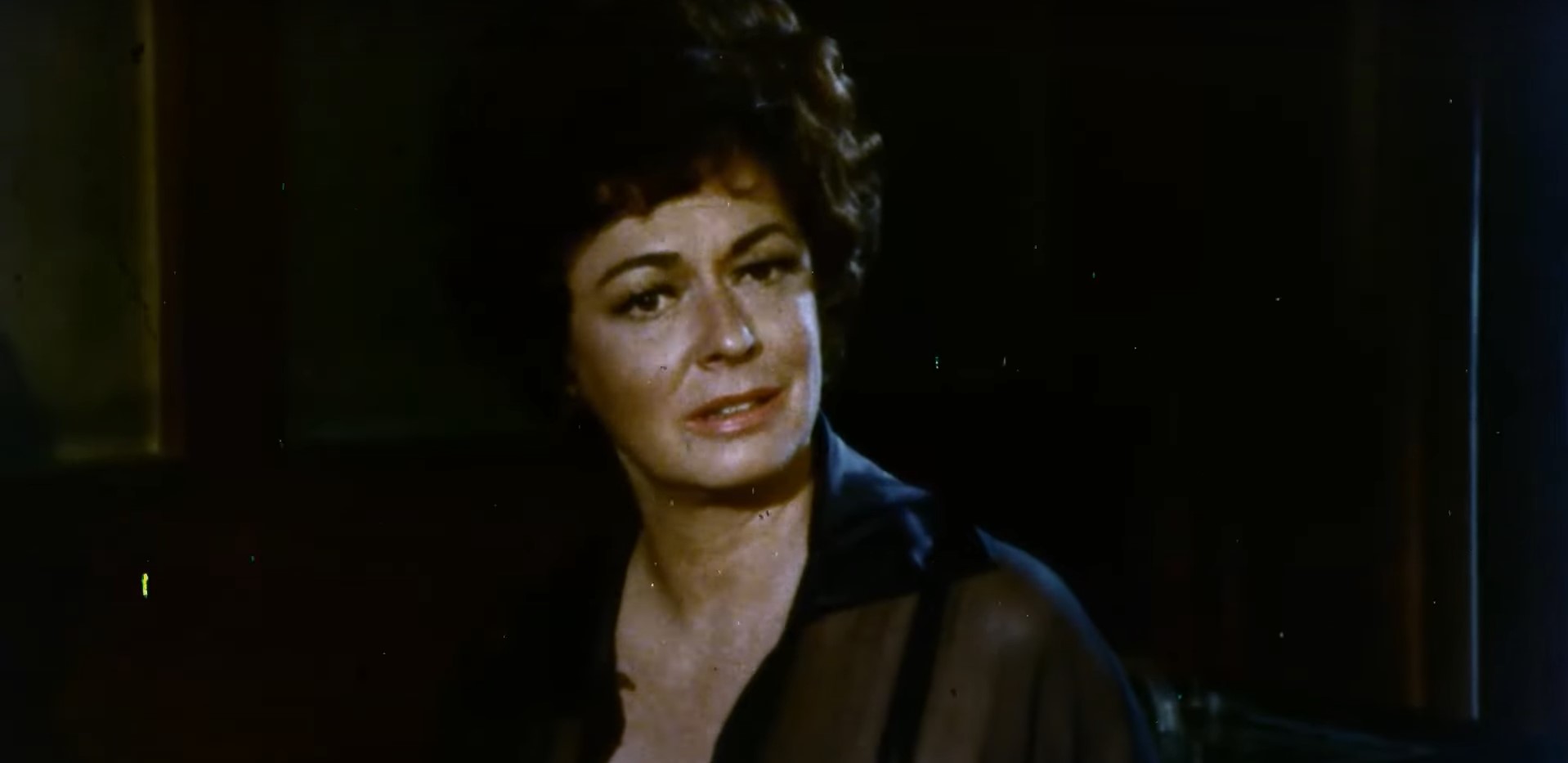
Cladded in a chic long red coat, black boats strapped up just below the knee, and wielding an extra-long connector chain pair of red handcuffs, Rei is the anti-heroine of our manga fantasies.  Miki Sugimoto works deep into that fantasy vision as Rei, Division Zero’s lady cop who will do anything and everything, clothed or undressed, to get the job done, even with extreme prejudice.  A frequent delinquent girl portrayer for Toei Company’s gritty bad girl gang pink pictures (try saying that five times fast), Sugimoto’s filmography include the “Girl Boss” series, “Terrifying Girls’ High School:  Women’s Violent Classroom, and “Criminal Woman:  Killing Melody,” and so Sugimoto already had established this foundational layer for Rei as a fortitude of badassery and now tacking on another layer of a moral high ground, justified only by seeing her word through to the end.  Rei is up against a gang of five – four street thugs led by the recent prison released Nagumo (Eiji Go,” The Executioner”) and one lesbian brothel madam (Yôko Mihara, “Sex & Fury”) – as she agrees to a back-against-the-wall deal and slyly subverts the gang by helping Nagumo during a faux ransom sting operation.  Along with Sugimoto’s stoicism, the Toei porn actress retains her promiscuous allure, one where she doesn’t have to do anything to be seductive but just be herself, working not only toward the favor of her character, who continuously is taken advantage of sexually without shame, but also keeping the integrity of the Toei élan for Japanese sleaze.  “Harakiri’s” Tetsurô “Tiger” Tanba resides to the general’s overlooking hill as the prime minister candidate who sends his battlefield colonel in Hideo Murota (“Rape and Death of a Housewife”) to be the Zero Woman’s handler.  Their scheme quickly devolves as their plan evolve when the operation goes slower than expected and the gang’s leader Nagumo begins feel the pressure of paranoia and starts to unhinge, especially around his ruffian acolytes played by Seiji Endô, Rokkô Toura, Iwao Dan, Kôji Fujiyama, and Ichirô Araki as Saburo the mysteriously quiet, aviator-waring knifeman who in himself is an interesting character.  Cast fills in with the Japanese speaking Westerner Ralph Jesser in a wild opening sequence that results in a gunshot to the groin!  

Like most pinky films, “Zero Woman:  Red Handcuff’s” incorporates an X-rated sexual violence but unlike most pinky films, the pinky violence subgenre omits the softer side of sensuality, creating more of a nihilistic viewpoint toward sex of taking what you want, when you want it, and aggressively at that.  Yukio Noda picture contains hostile lesbianism, gang rape, and pressurized perversions that take control thematically in pinky violence.  The corrosive context that has a guilty pleasure pull in most patriarchal dominated cultures and fleapit cinemagoers goes hand-in-hand with the over-the-top violence conjoined at the hip of cause-and-effect.  Usually, the narrative goes an ugly rape equals hard-fought revenge; in Noda’s film, the cause is the kidnapping, and subsequent deflowering of a power politician’s little girl leas to the Zero Woman effect of silencing with corporal punishment that circumvents the law.  Stylish like a spaghetti western and brutally violent, “Zero Woman:  Red Handcuffs” is a meanspirited, out-for-blood, femme fatale engendered on the verge of the pinkusploitation genesis.

Neon Eagle Video, a collaborative boutique label effort between Cauldron Films and Mondo Macabro’s Jared Auner, releases “Zero Woman: Red Handcuffs” onto a new Blu-ray, restored in 4K from the 35mm print. The transfer is AVC encoded, 1080p high-definition, onto a BD50 and shown in the widescreen aspect ratio of 2.35:1. A relatively clean 50-year-old print hardly displays any age wear, if any at all. Scarcely marred by blue vertical emulsion scratches in only a single scene, the print retains and is stored with care to diffuse the range of color and to effectuate as much detail as possible in textures and skin while without taking away from Noda’s underbelly surrealism. The lower contrast infuses a pulpy layer to create softer shadows, but contouring manages to stick an outline thanks to key Rembrandt lighting precision, akin to Hammer Horror with a splash of Kensington gore. The uncompressed Japanese DTS-HD MA 2.0 mono peaks with the best possible optical audio. While not much in the way of depth creation, there’s plenty of range in the Foley, even if it’s artificially abstract and illogical compared to shotgun microphone captured audio. The ADR synch is one of the best inlaid post-recordings with visuals that renders hardly any feedback or unnatural noises on the audio layer. English subtitles are burned into the only available Japanese language picture on the release. Special features include a feature length audio commentary by author and producer for Vinegar Syndrome Samm Deighan, Sex + Violence = Pink Violence TokyoScope author Patrick Macias analyzes “Zero Woman: Red Handcuffs,” and an image gallery. Graphic designer Justin Coffee produces a new, rich-in-red, and taletelling composite illustration of what kind of film to expect on the front cover art of the clear Amaray Blu-ray. The reverse cover houses another illustration, one pulled from the feature’s original poster line. The BD is pressed with more Coffee fiery and red-laced artwork. This particular copy reviewed is not the limited edition set with accompanying slipcover and neither copy contains insert material. The region A playback release comes unrated and has a runtime of 88 minutes.

Last Rites: “Zero Woman: Red Handcuffs” is a fine introductory film into the world of Pinky Violence, a starting line for those perverse-thirsty for the unification of sex and violence in Japanese cinema. Neon Eagle Video delivers excellences with their restored print, second to none in its picture and audio quality that will provide a sterling experience.

“Zero Woman: Red Handcuffs” is Number One on Our Must Have Lists!

Is this EVIL Real or is it a “Deathdream” reviewed! “(Blue Underground / 4K UHD and Blu-ray Combo)

The Nightmare is Here. “Deathdream” on 4K UHD Blu-ray!

The Brooks family just sat down for dinner before receiving a personal house call by a military commander, conveying the tragic killed in action telegram of their son Andy during a Vietnam War skirmish.  Very early next morning, Andy inexplicably arrives at their doorstep and the whole family is elated with his return and relieved in the military’s gross error about his death.  But something isn’t right with Andy; he isn’t the same affable young man his family and friends knew.  All day, every day Andy sits in his room, gliding back and forth in his rocking chair, won’t eat or drink anything, and has the social personality of a slug.  While his father can’t grasp Andy’s bizarre behavior, his mother defends him, being overjoyed, comforted, and relieved by her son’s safe return.  Anybody who comes close to discovering what Andy has done or has become is preyed upon by Andy’s need for concealment and need for blood. 

If there was ever the quintessential anti-Vietnam War film, Bob Clark’s “Deathdream” is it.  The 1974, Alan Ormsby (“Cat People,” “The Substitute”) scribed grindhouse classic introduces combat shock to audiences through a macabre and ghoulish lens as the U.S. involvement in the Vietnam War came to an official end in 1973.  Before becoming one of the holidays’ household names with “A Christmas Story” and “Black Christmas,” Bob Clark sat in what would be one of his first films as a director, a film that wasn’t sold in taking just one title having also been bestowed “Dead of Night,” “The Veteran,” “Night Walk,” and “It Came from the Grave.”  The U.S.-based shot and crewed feature, filmed in and around Brooksville, Florida, is a production of Quadrant Films and Impact Films with United Kingdom producers Gerald Flint-Shipman, Peter James (“Children Shouldn’t Play with Dead Things”), and Geoffrey Nethercott (“Blue Blood”) with John Trent and Bob Clark coproducing.  

For the ambiguous terror of “Deathdream” to work without baffling audiences to a nonsensical death, the cast had to really give it their all and not only that but also sell the deteriorating dynamics of an American nuclear family when the son returns home strangely different from then when he left for war.   The debut film of Richard Backus, playing the reclusive and uncharacteristic Andy who has returned home from the battlefield, is complimented by the heart-wrenching performances miseries of his onscreen parents in John Marley (“The Dead Are Alive!”), as the distraught father over Andy’s peculiar behavior, and Lynn Carlin (“Superstition”), as the denialist mother who can’t or won’t see the issues with Andy, the gift of her little boy returning home. Not only does Andy’s return ignite a slow-burning divisive wedge between parents and child but it also exposes pre-war schisms that were long established years ago.  We’re initially introduced the family sitting around the dinner table filled with compassion, hope, and happiness but Andy’s return kicks the wasp’s nest and we can see their true nature.  The father is a crotchety, dogged man who can’t connect with a more sensitive son and the mother spoils his only boy the point where Andy must enlist himself voluntarily to prove something to toward his father’s disappointment.  Then, there’s sister Cathy.  Poor sister Cathy, the gentle, positive, and sweet daughter who is all buy nearly forgotten by her parents as they push her out of the way by her father stating to mind her own business or is exclaimed in so many words of her little worth in compared to her brother by her mother.  Yet, Cathy, played softly and attractively by Alan Ormsby’s then wife, Anya Ormsby (“Children Shouldn’t Play with Dead Things”), continues a cool and level head about her shoulders as the only true family member willing to give Andy time, to let him be himself, while acclimating back into society, let alone his family.  However, the family’s opposing forces is ultimately what destroys them in conjunction with Andy’s terrible, morbid secret.  Henderson Forsythe, Jane Daly, Arthur Anderson, Michael Mazes, and David Gawlikowski fill out the cast.

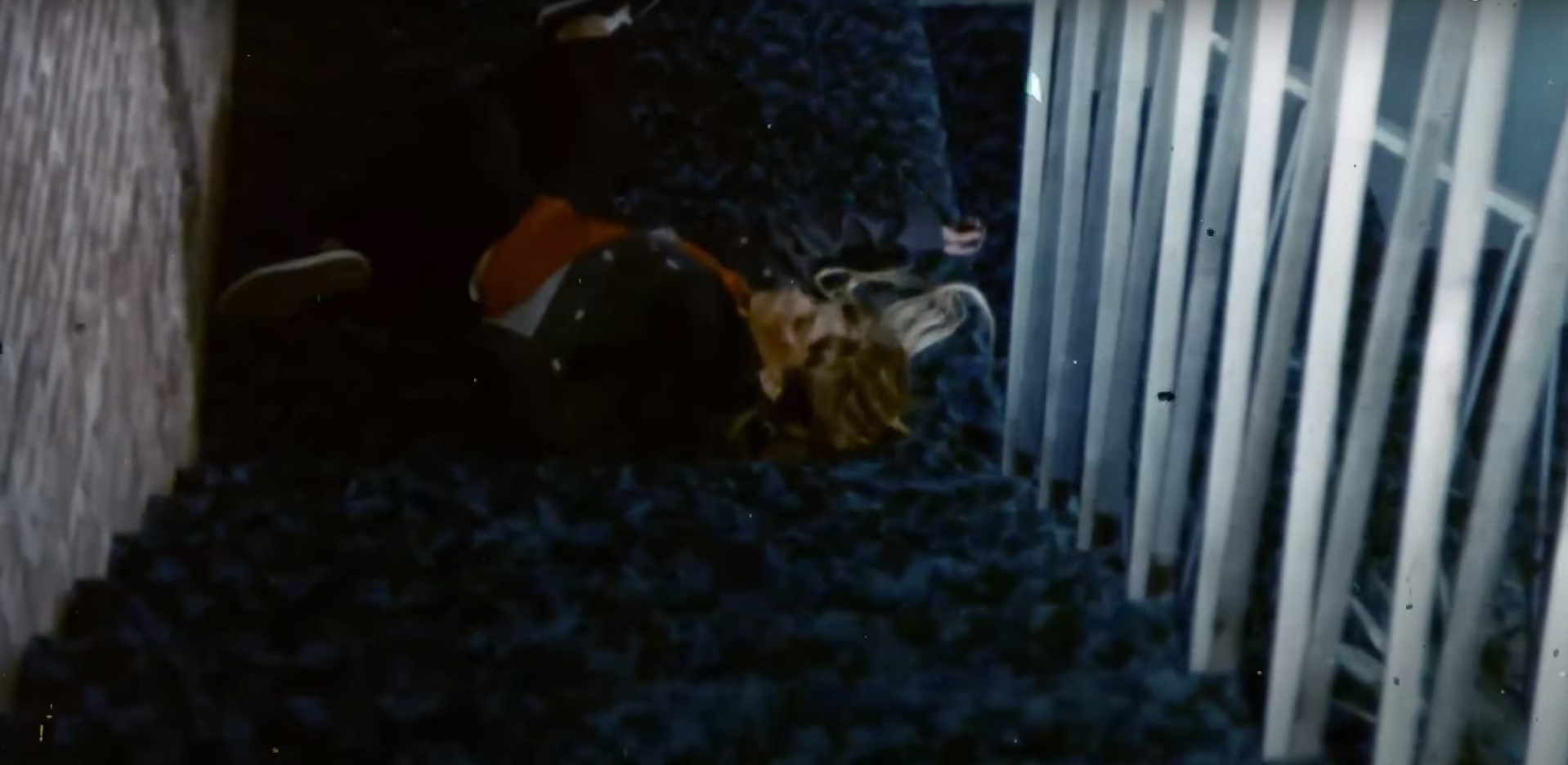
All of the costly signs of shell shock and PTSD are present within the context of “Deathdream,” blanketed under a sensationalized, representational guise, but the film’s cinematic façade of Tom Savini’s rot and decay special effects and the appalling imagery of living death doesn’t alleviate or even dilute the horror of the revenant in the actual disorder.  In fact, it pales in comparison if you ruminate on it for a while.  Andy’s withdrawn from the likes of acquaintances, friends, and family alike and is severely impassive at signs of cordiality.  Director Bob Clark emphasizes the effect even further in one scene where a World War II veteran anecdotally describes in nonchalant detail the death of a brother in arms and this flashes images in Andy’s mind of him and his friend’s own mortal wounds in the jungles of Nam, sending the young man into a minor fight or flight moment, two of the associated signs of shell shock:  fight and flight.  Within the sensationalized horror context, Andy requires blood to keep his body from decaying, like a reanimated corpse trying to hang on a little long before his skin and muscle tissue just seep and ooze off, and in one scene of attack, Andy shoots up his victim’s blood with a hypodermic needle in a reminiscent drug addiction scene of shooting up narcotics right into the vein of one’s arm, an experience afflicted on many PTSD vets. Ormsby’s script might be specific in the anti-Vietnam War propaganda but is not so detailed in the narrative’s whys and wherefores as much of Andy’s unlikely, and undead, return to his family falls into that inexplicable, ambiguous, “Twilight Zone,” and “Tales from the Crypt” category to foster a greater cloud of mysticism and darkness around the story, one in which has a hopeful, desperate mother conjure will and desire in order to see her son come home again.

In continuing to upgrade their catalogue to the best possible format currently available, “Blue Underground” pulls an Andy and returns “Deathdream” from the dead, heading home to the nearest ultra high-definition player. The 2-disc 4K Ultra HD and Blu-ray combo set arrives with a brand-new restoration, scanned in 4K 16-bit from the 35mm negative with Dolby Vision HDR in honor of its 50th anniversary. The UHD is HVEC encoded onto a 66GB Blu-ray with 2160p resolution while the Blu-ray is AVC encoded, 1080p resolution, on a BD50, both presented in a widescreen 1.85:1 aspect ratio. A grainy 35mm print is ingrained with superior color saturation and understanding of how to manage the perceptibility of image. Blue Underground’s previous restorations show a spectrum, step-by-step improvement to get to where the film is today in a higher, upgraded format. “Deathdream” can be a very dark film at times and often, but this release eliminates speculation of events without collapsing the contrast integrity, providing a clear and concise image for its spot in history. Blu-ray is a step down albeit only minorly and with some color stability shimmer, more notably in the finale with a less than standardized and wear-showing deleted scene that is integrated back into the story. A single, English DTS-HD master audio mono track is available. The lossless option doesn’t need any more or any less to effectively be the overlaid track. Distinction runs through the single channel with managed assurances that dialogue, ambience, and soundtrack divide and conquer their respective uniquities. English SDH, Spanish, and French subtitles are available. Due to space on 4K UHD disc, all of the package’s special features are encoded onto the standard Blu-ray. The UHD Blu-ray includes an archival commentary from director Bob Clark, a commentary by writer Alan Ormsby, and a brand-new commentary with a pair of film historians Troy Howarth and Nathaniel Thompson, plus the theatrical trailer. All that and a slew of previously recorded content, including a recollection featurette with Alan Ormsby and star Anya Liffey (Ormsby), an interview with composter Carl Zittrer Notes for A Homecoming, an interview with production manager John “Bud” Cardos Flying Down to Brooksville, an interview with star Richard Backus Deathdreaming, an interview with Tom Savini regarding his early years in special effects, a screen test of the original Andy actor Gary Swanson, an alternate opening title sequence, Alan Ormsby’s student film, theatrical trailer and still galleries. The only other new content is an interview with the original Andy actor Gary Swanson The First Andy. The same illustrated cover art composite from the 2017 Blue Underground Blu-ray is recycled for the 4K UHD Blu-ray with tactile elements of a raised title and taglines on the cardboard slipcover. The primary art also resides on the black UHD Amary but the reverse side has retro traits of the film’s starkly contrasted yellow and blue poster art and the “Dead of Night” title to which, once again, is preferrable for me to have diverging slipcover and case cover arts. The two discs reside on their respective sides of the interior with the 4K UHD pressed with the illustrated art and the Blu-ray going contrarily retro like the reverse cover art. There are no loose insert materials. With an 88-minute runtime, Blue Underground release comes region free and is rated R.

Last Rites: Andy didn’t destroy his family. He was only the last straw, a catalyst that tipped the boat over into a sea of slowly brewing tempest. Doesn’t help that he was also decaying right before their eyes as the embodiment of walking death and looked good doing it too with the help from Blue Underground’s sharp-edged and solidly sound 4K upgrade.

The Nightmare is Here. “Deathdream” on 4K UHD Blu-ray!

Conman Bites Off More EVIL Than He Can Chew. “Impulse” reviewed! (Grindhouse Releasing / Blu-ray)

Pre-Order “Impulse” Here at Amazon!

As a boy, Matt Stone had an altercation that resulted in the transfixing death of a man at his hands.  As an adult years later after a sanitarium stint, Stone seduces wealthy women as a sophisticated and well-off playboy, using the cultured guise as way to con women out of thousands of dollars, and then murders them when has milked them for all their worth or when their patience for his extravagant and philandering behavior has run it’s course.  When he meets widow Ann Moy, Stone begins his plan of deceit, eyeing not only the single mother for her riches but also Ann’s even more affluent and eccentric best friend Julia.   Stone’s scheme begins to unravel when a strong-arming ex-partner unexpected show up to force into his ploy, his mental instability flares into paranoia and near psychosis, and then there’s rambunctious Tina, Ann’s young daughter who even though doesn’t want Stone to replace her deceased father also witnesses firsthand Stone’s violent transgressions. 

Personally, when William Shatner comes into the conversation about anything, “Star Trek” inevitable pops into the mind first thing.  “Star Trek” and “Captain Kirk” have become not only a household name for Trekkies but also for the non-science fiction laymen who rather get lost in, dare I say, rom-coms.  Shudder.  Diehard horror fans know Shatner is more than just the charismatic space explorer seducing alien women, karate chopping the Gorn, and become inundated with the furry Tribble.  The now 92-year-old Canadian born Shatner has sporadically yet constantly been the star of thrillers for much of his career, such as 1966’s “Incubus,” 1975’s “The Devil’s Rain,” and even the more recent 2019’s “Devil’s Revenge” with fluctuating, polarizing success.  Yet, one of Shatner’s engrossingly more disturbing performances comes from director William Grefé’s (“Mako:  The Jaws of Death”) 1974 schizo-thriller “Impulse.”  Penned by “Blood Mania” and “The Killing Kind’s” Tony Crechales, “Impulse” was filmed in Tampa, Florida under Conquerer Films with Socrates Ballis in his first producing role.

What most don’t realize about William Shatner, from their limited scope of him inside just “Star Trek,” is the man has range and can accomplish more complexity than just being confident space captain.  “Impulse” really drives Shatner to split hairs and be a polygonal persona, one that goes into deep anxiety at the sight of blood or extreme violence, one that can polished and suave in charm and romance, and one that can be ruthless and cunning.  All these traits fit into Shatner’s performance bubble of Matt Stone, chiseling each angle of the traumatized encoded individual into a wolf in sheep’s clothing in constant conflict with himself and those around him.  With the exception of Tina, those around Stone are targets as he swoons Anne Moy (Jennifer Bishop, “Horror of the Blood Monster”) and Julia Marstow (Ruth Roman, “The Baby”) of their money.  Anne and Julie feed into Stone’s false promises and hidden agendas and, as characters, Bishop and Marstow play their diverse friendship with traditional flare that can be easily duped by a stranger from off the street and barely know.  Tina is the only wildcard.  With the look like Heather O’Rourke and a prickly preteen attitude, Kim Nicholas falls in tune with the boy who cried wolf but, in this instance, as the girl who cried wolf as she becomes the aware adolescent privy to a fault to Stone’s dangerous side.  Agitated by the loss of her father and her mother’s effortless slip into a physical relationship, not to forget to mention her impish naughtiness, turns Tina into an incredible source, labeled spiteful, and angry at the world despite her true knowledge of her own world burning down around her with Matt Stone at the wheel.  “Impulse” rounds out the cast with James Dobson (“The Search for the Evil One”), Marcia Knight (“Stanley”), Shatner’s then wife Marcy Lafferty (“Kingdom of the Spiders”), and James Bond’s Odd-Job himself, the former heavy weight wrestler Harold Sakata as the ex-partner Karate Pete crashing Stone’s scam.

William Grefé steers childhood trauma to be the root cause that shapes Matt Stone into a cold and calculating killer.  While not driven to be a rabid dog seeking to kill on sight, the sweet and innocent child only protecting his mother from the potentially rapist hand of a drunken brute had not only been scarred by the incident but also incited his mother to institutionally commit him as if assigning him blameful wrongdoing, extenuating his reality into a woman hating deviant.  And the worst part of it is, and the part that Grefé is able to define and make Stone be sympathetic to audiences, is Stone knows he shouldn’t have been deinstitutionalized, as he more than once referred to his situation as a puppy left out in the middle of the street.  Then, does “Impulse” become more of a tragedy for our principal villain as an unfortunate byproduct of a catastrophic situation, an ill fit mother, and a system that have all let him spiral down to this point in the story?  The only individual to see through his ruse, in fact, is another child, Tina, with a child’s sixth sense in their melting pot of developing emotions.  The social niceties and grown-up cognitive reasoning shield Anne Moy, Julia Marstow, and others, and even to an extent the unscrupulous brute Karate Pete, from Stone’s devious nature and his will to survive at any cost, no matter who he has to kill whether be a lover, former partner, or a little girl. 

The new Grindhouse Releasing, the first through the distribution firm MVD, is a 2-disc Blu-ray release restored from a rare archived, 35mm film elements.  The original negative was unfortunately destroyed and the restored, 4K scanned print comes with a prologue disclaimer that some elements may not be up to quality standards.  However, the print, on the March 12th Blu-ray release now available for pre-order, looks stellar, stored on an AVC encoded, 1080p High-Definition, BD50, and presented in a widescreen 1.85:1 aspect ratio, with only a few noticeable scratches, faint to the eye, in a few brief frames within the natural grain.  Grading can appear monochromatic gray in some exterior scenes but the overall grading pops and are distinct in natural-looking shading. We can also look at Grefé’s direction and Edmund Gibson’s cinematography as just as striking as the picture quality with brazen, worth-while shots that include an interior car shot aimed toward the windshield heading toward a watery grave. The English language original mono track, for a single channel output, clears the bar with room to spare with intelligible, comprehensive dialogue, capturing every word and sentence distinct and syllabized to great detail without too much interference, technically and from layering. Slight popping and background electronic interference never engulfs or take the reins over the layers. Decent spacing and a good range, supported by the Lewis Perles lingering unhinged musical composition, adds value to Shatner and the casts’ performances. Grindhouse Releasing Blu-ray also comes with the original mono French soundtrack. English subtitles are optionally available. Loaded with special features with a William Grefé audio commentary, Shatner Between the Treks a Ballyhoo produced documentary regarding Shatner’s various projects before, after, and in-between, Kingdom of the Shatner is a William Shatner live interview in Santa Monica in Oct. ’22 after a Shatner triple feature, Shatner promo shorts, William Grefé shorts “Thumbs,” “Iceman,” “The Cask of Amontillado,” and “Underwood,” a making-of “Impulse,” the 40th anniversary screening at the Tampa Theater with William Grefé post-film discussion, the raw footage of Shatner saving Harold Sakata from accidental lynching with two commentaries from Grefé and Shatner, still gallery, two theatrical trailers, and other trailers from Grindhouse Releasing titles. Also included are bonus Grefé features, including “The Devil’s Sisters that has its own special features with an introduction, Grefé audio commentary, radio spot, still gallery, and a revisiting of the film from the director, plus “The Godmothers” with only an intro by Grefé. Grindhouse Releasing’s “Impulse” is truly a lovefest of the two Bills, Grefé and Shatner, and the label really goes the extra mile with a deluxe edition and restored release with a character and title embossed, fully colorized, and rigid cardboard sleeve with a clear, dual disc push lock Amaray Blu-ray case sporting the originally illustrated, composition cover art that’s also reversible with the same sleave cover design that’s utter madness on printed cardboard. Inside, the discs are locked in on the right, one on top of the other with the top disc snuggly in behind the feature disc in a vertical layout, and both disc arts are rendered with pulpy aesthetics and primary colored, yet darkened feature stills for full fear effect. Opposite in the insert section, a 4×6 illustrated liner portrait of Matt Stone painted by artist Dave Lebow, and a 6-page linear note booklet with color pictures, grindhouse posters, and an essay by Jacques Boyreau. The 87-minute Blu-ray comes region free and is not rated.

Last Rites: The tale of two Bills, Shatner and Grefé, is a match made in heaven, or, better yet, a match made in demented evil with “Impulse” and Grindhouse Releasing stuns with a fully loaded, supersized, and Shatner-stuffed 2-Disc release that puts the film rightfully up on a grandstand pedestal.

Pre-Order “Impulse” Here at Amazon!

100-Year Return Brings a Plague of Flesh-Eating EVIL to a Small Town! “Messiah of Evil” reviewed! (Radiance Films / Blu-ray)

The “Messiah of Evil” has Come to Blu-ray Home Video!

Arletty travels up the California coast to a small beach town known as Point Dune.  The reason for her visit is to find her artisan father after a series of bizarre letters came to an abrupt stop.  She arrives at his mural-graffitied home to discover it empty and decides to stay a few days to ask around town about his whereabouts and to be present for his return home.  Her inquiries at art gallery shopkeepers lead to a motel where Thom, a wealthy collector of urban legends and spooky stories, and his two travelling female companions, Laura and Toni, have also sought out Artletty’s father for his bizarre experiences.  As the days pass, Point Dune slowly becomes a literal ghost town that forces Thom and his companions to stay with Arletty and, together, they experience the horrible truth of what’s really happening to the  residents of the west coast community who eagerly await the arrival of the dark stranger. 

Once married filmmakers Willard Huyck and Gloria Katz are the creative minds behind the stories of “Howard the Duck” and “Indiana Jones and the Temple of Doom.”  They also wrote “American Graffiti” in what was to become their link toward working on Steven Spielberg’s Indiana Jones sequel since both “American Graffiti” and “The Temple of Doon” were both produced by the father of “Star Wars,” George Lucas.  Yet, in the midst of “American Graffiti,” the couple also penned and Huyck came into the entrance of directing with the 1974 horror-thriller “Messiah of Evil” that pulled from various themes of mindless consumerism and the rising fears of dangerous and deadly cults in the U.S.  Also known by a variety of titles around the world, including “Dead People,” “Night of the Danmed,” “Messiah of the Evil Dead,” “Revenge of the Screaming Dead,” and “Blood Busters” to name a few, the Californian coast shot film is a production of the International Cine Film Corp and V/M Productions with Gatz producing and Alan Riche (“Deep Blue Sea”) serving as executive producer. 

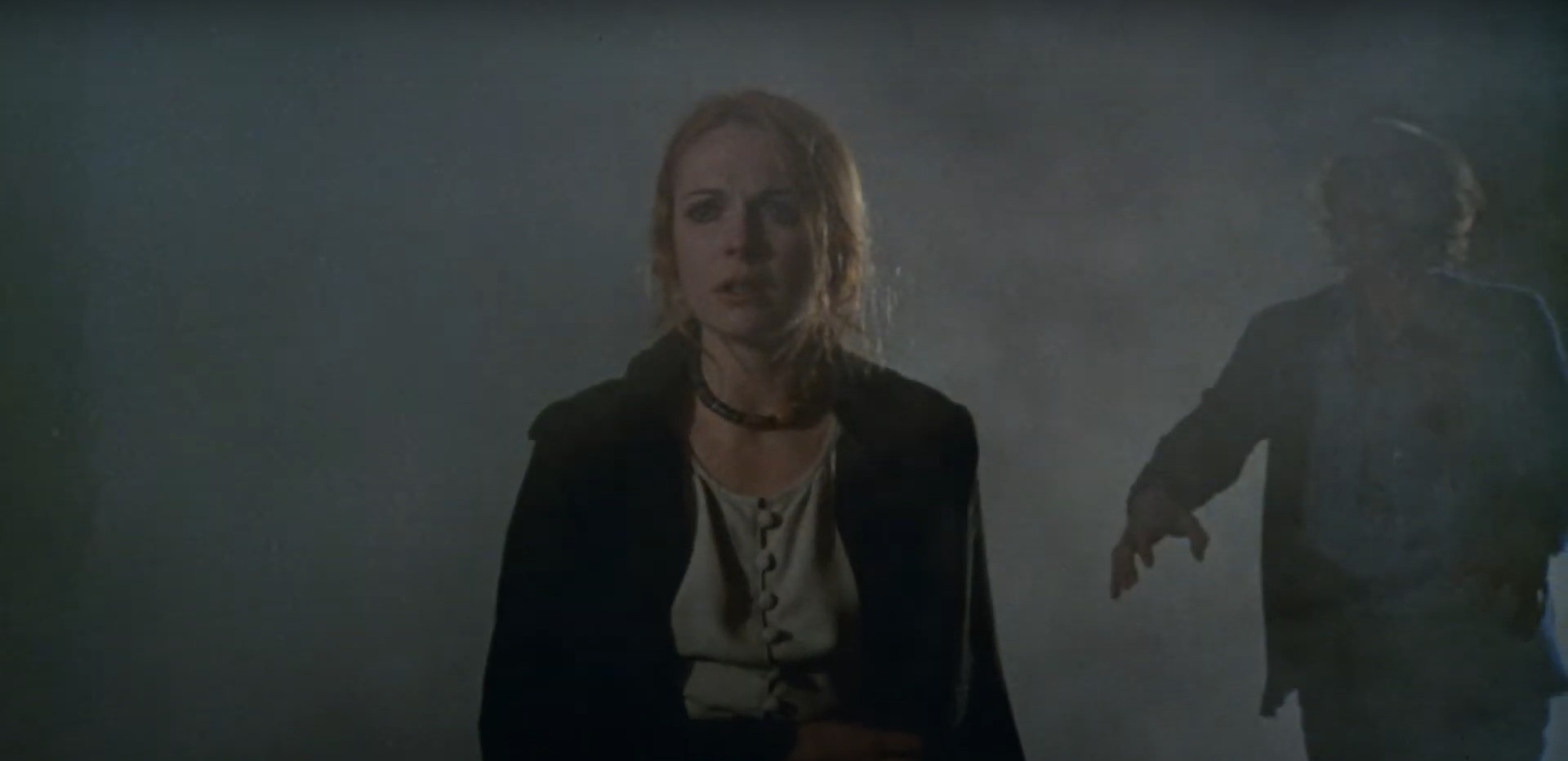
“Messiah of Evil” slinks into the soul leaving behind dread’s unwashed pull against what we know as conventional horror.  In order to accomplish such a fear-induced feat, a cast must envelope themselves fully in world of weird and irregularities that nestle an uneasiness stemmed not solely from their performances but from how they react to the eccentric environment, to the crumbling small town society, and to ghastly behaviors of normal-looking people.  Like most daughters, Arletty has concerns for her father and seeks to understand the truth behind his unhinged letters.  Marianna Hill (“Schizoid,” “The Baby”) plays the quietly curious at a cat daughter dabbing residents with barely an effort in interrogational questioning of her father’s whereabouts.  Hill floats Arletty through stages of a slow descent into madness that simmers slowly to a boiling point understanding of what’s taking shape around her.  The same happens to Thom, played by Richard Greer (“The Curious Female”), who initially is a fraction of the nonconformity surrounding Point Dune with his obsession toward collecting strange stories and his polyamorous collection of women.  Of character, Greer is resoundingly in control without being dominating with Thom who has wealth and magnetisms but isn’t someone to be beholden to forever as we see with Laura (Anita Ford, “The Big Bird Cage”) who deserts him for his open-door intimacy policy in his pursuit of Arletty and with the childish Toni (Joy Bang, “Night of the Cobra Woman”) in her infinitely naïve opinions surrounding the dull Point Dune.  One actor I wish we had more of but is utilized perfectly as Arletty’s father and a harbinger of what’s coming is Royal Dano (“Ghoulies II,” “Spaced Invaders”) in a non-humorous nor drunken idiot role that seemed to typecast him later in his career.  Dano’s short but sweetly terrifying stretch divulges a man torn between his previous life and a new terror that now occupies him as he interacts with Marianna Hill as concerned and contaminated father holding it all within toward his frightened, confused daughter.  “Messiah of Evil’s” cast rounds out with Elisha Cook Jr (“Rosemary’s Baby”), Bennie Robinson, and Charles Dierkop (“Grotesque”). 

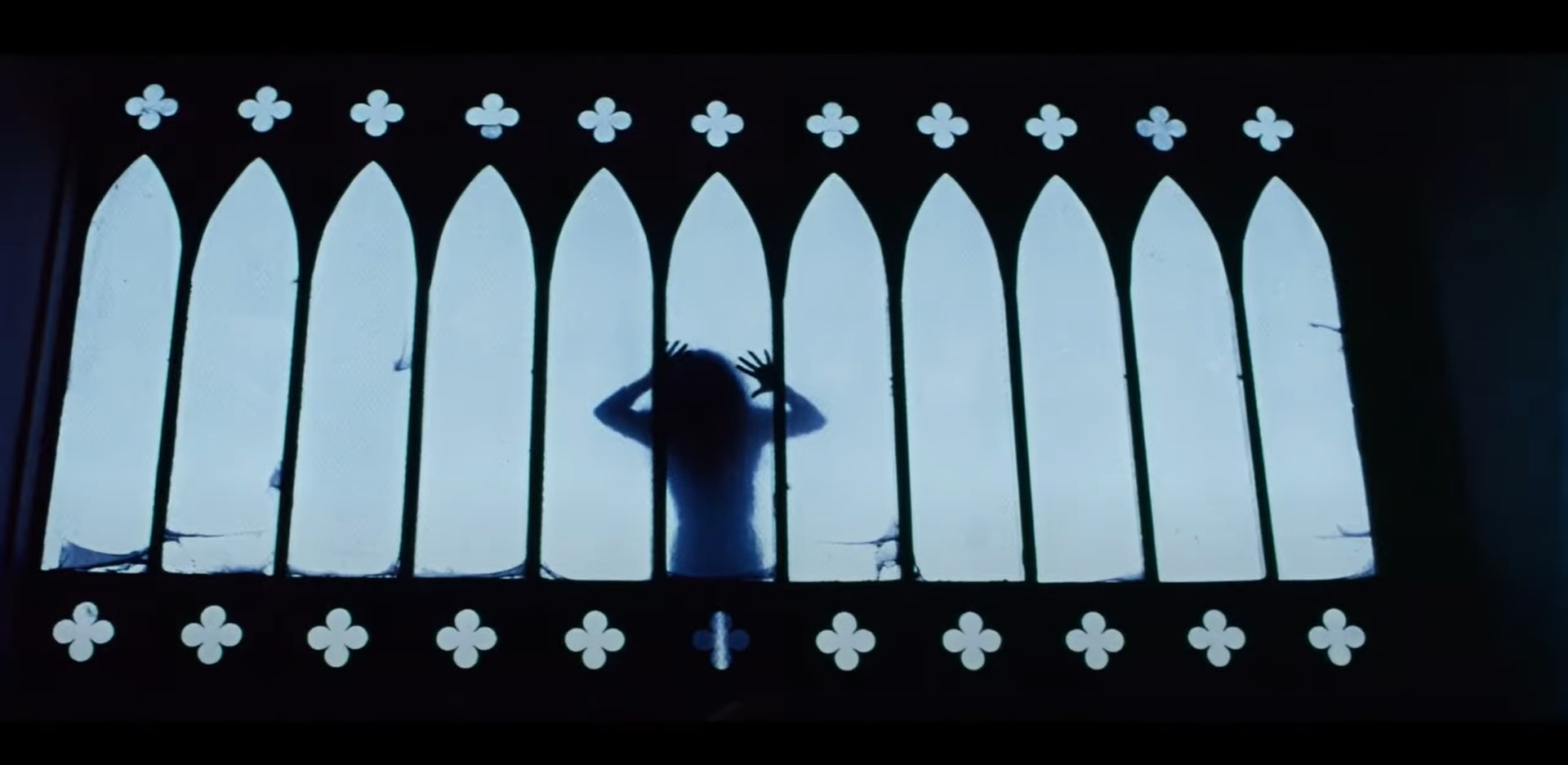
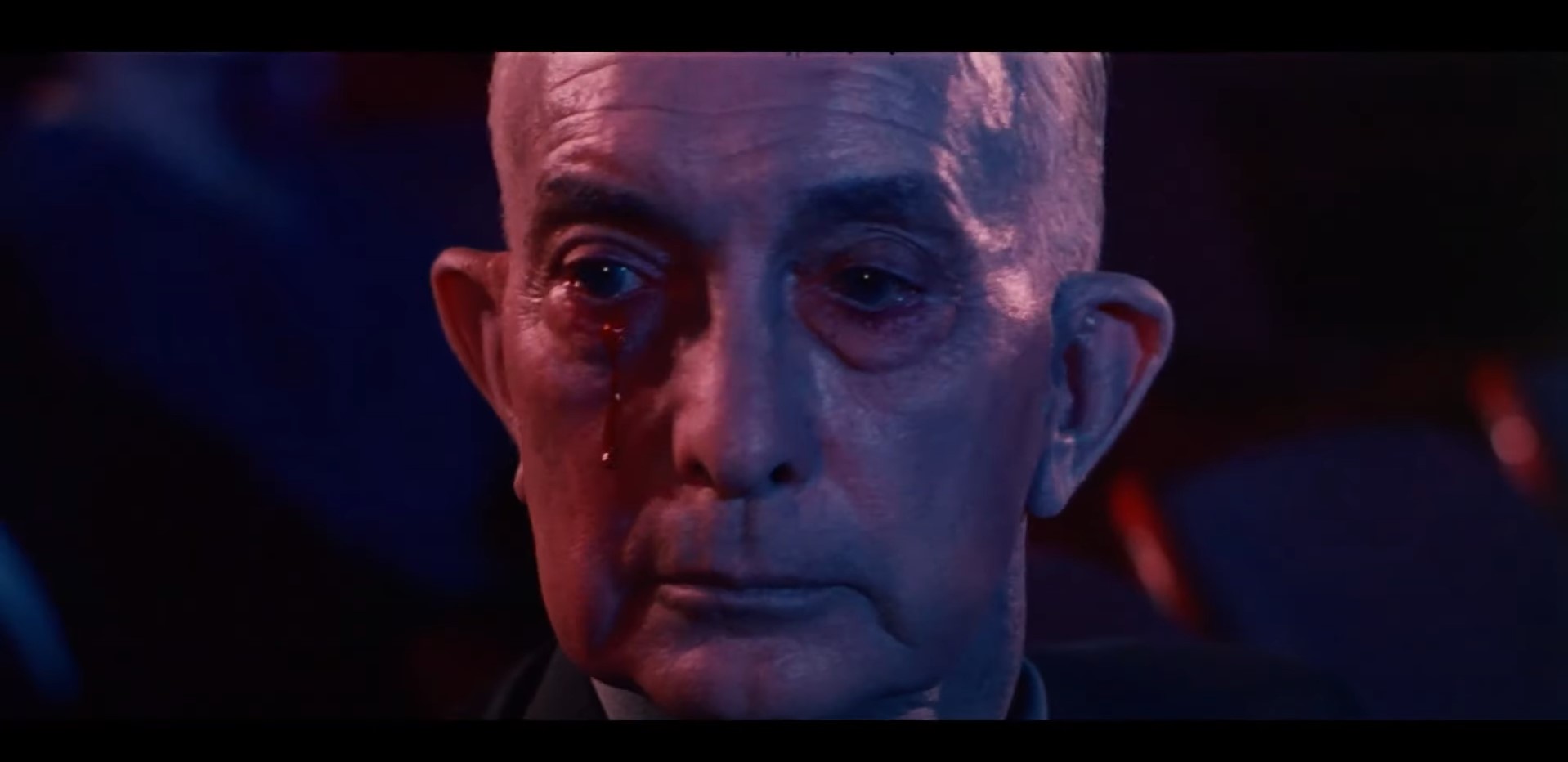
Huyck directs with colorful and verismo synergism that takes the positives of what should be life’s routine pleasures and turns them against us as fantastical and harrowin deadly elements of false securities.  The rolling crashes of Point Dune’s waves takes on a constant cacophony of sinister foreshadowing, a bright and welcoming supermarket becomes a vacant trap in every aisle, the entertaining movie theater darkens with blood on the screen, and an artist’s home, full realistic murals and colors, is an oppressive feast of lifeless eyes.  Point Dune becomes a dead town, literally, as the inhabitants succumb to dark forces from beyond their years, turning primeval in their contemporary three-piece suits and evening blouses.  Huyck and Gatz story pulls inspiration from U.S. history and folklore to mark the 100-year return of spreading evil amongst the land, an evil that resorts to cannibalism by either spellbinding archfiend, an internal infection, or the rise of the undead and not just any mindless, shuffling, flesh-eating zombie but a transmogrified plotter able to move fast and think as a single unit with the touched by evil masse with telltale signs of a single rivel of blood seeping from out of their eye and their insatiable need to consume other people. ”Messiah of Evil” is not overtly graphic like George A. Romero zombies or like the unbridled number of zombie films to follow inspired by Romero’s zombie game-changing wake for the last 60 plus years, separating the flesh-eaters from Romero’s gut-gnashing, pale faced, and slow-walking undead and Huyck and Gatz’s transmitted pestilent receiving horde running fast in their best church shoes with vastly different traits. Huyck and Gatz dip into more eldritch means with the return of a paganistic dark stranger in a pared down explanation without explicitly being definitive who or what the dark stranger (a demon?Antichrist?) is that is driving foreboding signs to a doomsday-disseminating end. ”Messiah of Evil” thrives as the mysterious and strange fulcrum of the beginning of the end told through the point of view of young woman left to tell the world of what’s to come only to be about as believed as much as a man wearing a polka-dotted tutu who has delusions of unicorns dancing the waltz with garden gnomes in his front yard. 

United Kingdom distributor Radiance Films releases a new restoration transfer of “Messiah of Evil” also on their U.S. line. The AVC encoded, 1080p high-definition, BD50 presents a 4K scan of the best-known surviving 35mm print from the Academy Film Archive in a widescreen 2.35:1 aspect ratio. As noted in the release’s inserted booklet, the restoration processes used was the Digital Vision’s Phoenix Finish and DaVinci Resolve was used for color correction, under the supervision of Sebastian del Castillo at the Heavenly Movie Corporation. Audio was also restored with the Izotope RXB. For a surviving print, the original elements look pretty darn good with barely any celluloid hiccup. No vinegar syndrome, not significant tearing, or exposure to name a few issues of possibility. There are a few minor blemishes and missing or damaged frames that seem to provide an unwanted cut but most of “Messiah of Evil’s” film problems stem mostly behind the camera with a rework of the story during the stop-and-go production and conflicts in marketing the film, hence the various title aliases of the film from around the globe. Other detail low points are when the film is bathed in blue and purple gels and tint for to set an apprehensive wander and wonder while retaining more natural grading in its majority throughout. The resorted audio is a lossless English LPCM mono mix. Really focusing on the electronic score of Phillan Bishop (“The Severed Arm”), the low-frequency score sets a perpetual and durable tone of dread out of place in a prosaic small town, much like the Arletty’s father’s work-of-art home that sticks out amongst the mediocrity. In design, dialogue remains robust yet delicate when the scene calls for it, such as Elisha Cook Jr. story of how he was born in what is essentially him, as a vagrant paid for his story, making the only noise in the room. Dialogue in these moments is greatly discernible with negligible electronic interference. Depth layers the permeating isolation of a town gone mad in unison with the range stretching from the distressing design of rolling, crashing, oppressive waves to the scuffles of zombies’ consuls and heels scuffing against asphalt, pavement, and shattering through panes of glass. Radiance provides English subtitles with their release. Bonus features include a new audio commentary by film historian and horror archetype authors Kim Newman and Stephen Thrower, an archived interview with director Willard Huyck, and a new, feature-length documentary showcasing “Messiah of Evil’s” background, themes, production, and influences by various horror scholars, including Kat Ellinger who also voiceovers a visual essay on American Gothic and Female Hysteria, which if I’m being honest, parallelly treads on similarities with Ellinger’s Motherhood & Madness: Mia Farrow and the Female Gothic on Imprint’s “The Haunting of Julia.” Radiance has in the short time poured their heart and soul into their releases and “Messiah of Evil” is no different with a sleek cladded and clear Amara Blu-ray case that’s subtle in showing less but feeling more on the cover art, opposite of the reverse side that houses a classical black and white compositional illustration of characters. Inside the 28th release for the label is a 23-page color booklet insert with the appraisal writings of Bill Ackerman, transfer notes, release credits, and acknowledgements. The disc is pressed red, much like the red moon in the film, with a stark black title. The Radiance release is unrated, region free, and has a runtime of 90 minutes. ”Messiah of Evil” uses cult fears, satanic panic, and the loss of ordinary life to penetrate the spirit by way of slowly eating at it. The crawling, creeping dread meanders, much like Artletty who is seemingly held in place at Point Dune, and we’re glued to the engrossing rate of the terror to come orchestrated by the captivations of a once married couple on a fast track toward success.

The “Messiah of Evil” has Come to Blu-ray Home Video!

Sonar Radiation is Music to the EVIL’s Ears! “The Living Dead at Manchester Morgue” reviewed! (Synapse / Blu-ray)


Don’t Let the Sleeping Corpses Just Lie!  Grab a copy of “The Living Dead at Manchester Morgue” at Amazon!

After having a run-in with a beautiful woman, Edna, at a gas station who accidently wrecking his motorbike, Manchester antique dealer George offers to drive her car to her destination in the country, her sister’s place in Southgate, and then borrow the car to continue on toward his appointment in Windermere.  However, upon their arrival in Southgate, Edna’s husband Martin has been brutally murdered and the police immediately suspect the two urbanite out-of-towners George and Edna of coming the heinous crime.  In reality, the recently dead in a mile radius has their nervous system reactivated and directed to kill the living by a new sonar radiation technology aimed to destroy crop pests.  With the police and the dead on their heels, George and Edna seek to expose the truth to the world before its too late and the experimental new pesticide’s range is extended to cover more ground. 

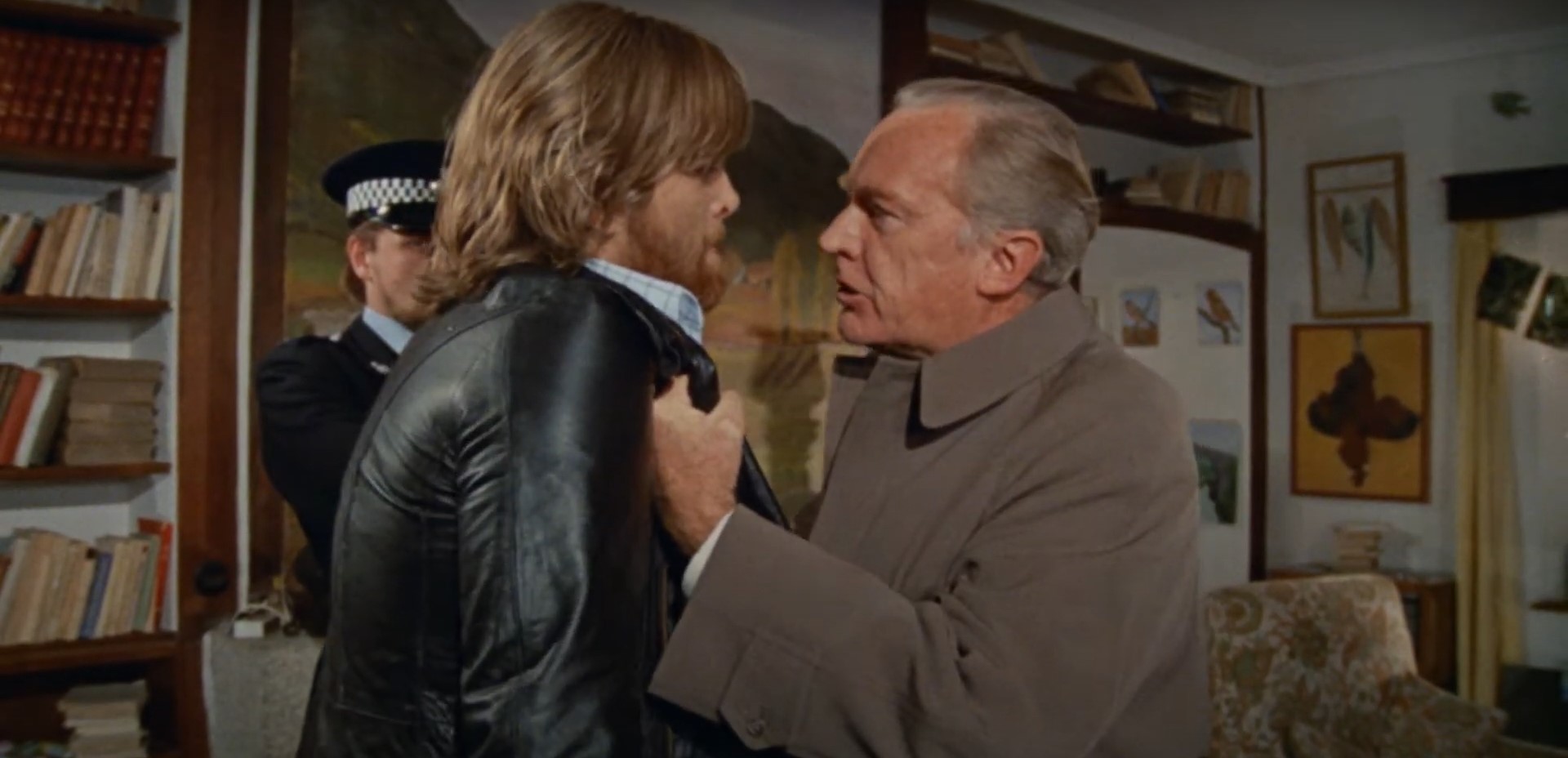
Hitting the stop button here before we dive into our review of “The Living Dead at Manchester Morgue.”  If you’ve never seen the Jorge Grau directed 1974 flesh eating zombie film then drop everything – you’re work, your kids, your winning lottery ticket worth millions – and take the next one hour and 33 minutes to enjoy the graphically gory, social commentary horror that not only cashes in on the George Romero “Night of the Living Dead” gamechanger undead horror but also rivals Romero’s film in story and in full, gorgeous color.  “The Legend of Blood Castle” director Jorge Grau helms the Spanish-Italiano co-produced script penned by Sandro Continenza (“Uncle Was a Vampire”) and Marcello Coscia (“Teenage Emmanuelle”) and was provided to Grau by “The Eroticist” and “Don’t Torture the Duckling” producer Edmundo Amati who wanted to make a Romero-esque flesh-eating zombie film of his own.  Also more widely known as “Let Sleeping Corpses Lie,” “The Living Dead at Manchester Morgue” is co-produced by Manuel Pérez and is a co-production between Star Films and Flaminia Produzioni Cinematografiche.

Hot off the presses of Italian action-crime dramas, Ray Lovelock (“Emergency Squad,” “Almost Human”) finds himself playing an antique merchant holding up shop in the metropolitan area of Manchester, England and as George Meaning, the relatively undisclosed personal experience as an antique merchant, Lovelock gets into character not on the business end but when the shopkeeper goes on holiday in the country, riding his motorcycle Windermere where he has arranged a meeting with some very important people that never flesh out in the end. Speaking of flesh, don’t expect the leading lady Cristina Galbó (“The House that Screamed”) to provide any as the panicky Edna Simmonds on her way to her sisters (Jeannine Mestre, “Count Dracula”) for an intervention toward her sister’s severe heroin use. Much of the only flesh to be hand in “The Living Dead at Manchester Morgue” is that is which ripped from the bodies and stuffed into rotten, undead mouths. In itself, the entire scenario between Edna and her druggie sister is a compelling enough story to warrant attention in accumulating a sense of sisterly betrayal and a sacrificial compassion to do the right thing despite the consequences. However, that pathway, no matter how distressingly prominent it may seem, does not carry over into the main plot points of an experimental pesticide treatment involving sonar inadvertently raising the dead to be superhuman zombies. Between an Italiano (Lovelock) and a Spainard (Galbó), who not throw in an American while we’re at it with Massachusetts born Arthur Kennedy (“The Antichrist”) to be the aging local inspector keen on pinning every murder on youthful urbanites with their hippie ways and satanists beliefs. “The Living Dead at Manchester Morgue” fills out the cast with José Lifante (“Night of the Walking Dead”), Vincente Vega (“Historias para no dormir“), and “Flesh+Blood’s” Fernando Hilbeck as the foremost feared zombie.

What makes Jorge Grau’s take on the living dead canon so impressive is not only the social commentary story that seeks to deconstruct ecological progression as an ironic destructive poison to the Earth and its inhabitants and the striking moments in gore effects from the team of Juan Antonio Balandin, Luciano Byrd, and Giannetto De Rossi (of Lucio Fulci’s “Zombi”) that have remained timeless in holding up and rivaling against many of today’s gruesome effects, but also the terror-inducing sound design that combines Giuliano Sorgini’s funky-spook with Antonio Cárdenas zombie-vision resonances of heavy breathing and resonating heart thuds that cues the lurking of an undead lurker.  The effect is potent and full of imminent danger when included into Grau and cinematographer Francisco Sempere’s (“Death Will Have Your Eyes”) perfectly framed shots of the Romero-esque zombie lumbering toward their prey in an unstoppable hunger to kill and eat and, sometimes, convert to their infant-legion inside-and-out of the zombie perspective.  Along the lines of “The Living Dead at Manchester Morgue’s” environmental theme is the juxtaposition of big city and countryside in regards to their pollution levels in the opening credit scene where George rides out of Manchester through the degradation of the masses who are popping pills, wearing face masks (like in today’s COVID climate), numb to shock (in the scene where a naked protestor runs in front of stalled traffic for peace and the motorists are blank to the moment), passing by death and polluted nuclear smoke stacks.  Once the lead George reaches the countryside, he removes the scarf covering his nose and mouth and breathes in fresh air with a smirk on his face.  From then on, the story moves forward with a cautionary tale of ill-fated modern progression, such as urbanism, seeping into a natural landscape and causing death and destruction, leaving an poignant aftertaste in the inevitably of man’s ignorance will kill us all.  Grau’s film is a good candidate to be a promotional movie for the dramatic effects of climate change in today’s campaign for ecological change to reduce our carbon footprint.

Synapse brings “The Living Dead at Manchester Morgue” home onto a Blu-ray home video, restored in 4K from the original camera 35mm negative that includes the authentic and intact opening and closing credit sequences. The region free, AVC encoded release is presented in 1080p high definition of a widescreen 1.85:1 aspect ratio and the picture is the gold standard of presentation with a vivid and stable color palette, controlled DNR without any posterization, and greatly detailed without an inkling of lossy image quality. Two audio mix come with the release – a DTS-HD Master Audio 5.1 surround sound remix and the distinctive to the Synapse release the original English theatrical mono mix. Though nice and nostalgic in the original English mono mix, the clarity and robustness of the channels on the DTS-HD track is by far superior with its reformulated by Synapse lossless quality and fidelity, especially in that aforementioned sound design by Antonio Cárdenas. The English dub on Ray Lovelock can be off-putting at times but the track is still beyond the best of the two available audio options. English SDH subtitles are available. Extras include two audio commentaries by author and film scholars Troy Howarth, Nathaniel Thompson, and Bruce Holescheck, a feature length (89 min) documentary Jorge Grau – Catolonia’s Cult Film King that explores the lift and films of director Jorge Grau, The Scene of the Crime is special effects and makeup artist Gionnetto de Rossi discussion on the film, another de Rossi feature of the SFX artist at a Q&A at the Festival of Fantastic Films in the UK (43 minutes), the theatrical trailer, TV and radio spots, and a sleek black snapper case that wouldn’t be complete with a Synapse catalogue booklet. If you’re a diehard zombie genre fiend, Jorge Grau’s “The Living Dead at Manchester Morgue” must be at the top of your personal video collection. If it isn’t, kick yourself in the shin really hard and then check out Synapse’s gorgeous release of the Spanish-Italiano production that’s worth every second of your life viewing.

Don’t Let the Sleeping Corpses Just Lie!  Grab a copy of “The Living Dead at Manchester Morgue” at Amazon!