EVIL Waited 30 Years. Now It’s Unleashed! “Zombie Rampage II” reviewed! (Wild Eye Releasing / DVD)


A zombie ravaged world divides survivors into gangs. In this case, two warring rivals, a group of decent folk versus cannibalistic savages, spar over little territory left untouched by the undead. Seeking tactical advantage, the contentious factions either scheme a plan for appropriating the land while the other recruits and trains an inexpert survivalist to better their odds against one another. Leave it to humanity to still be the most dangerous animal on Earth during a zombie apocalypse when an armed showdown opens the doors for death and the undead to wreak havoc on the best and worst parts of being human.

Full disclosure. I have never seen or even sought out Todd Sheets’ renown direct-to-video, zombie epic, “Zombie Rampage,” from 1989. So, when the opportunity came around to check out the sequel, “Zombie Rampage II,” presented on a Wild Eye Releasing DVD, I jumped at the chance to witness the anticipated follow-up despite the sequel not being steered by Sheets himself. The “Bonehill Road” director’s involvement extends to the credit of producer and co-writer of the aborted 1990 sequel, which had unearthed VHS footage repurposed for the 2019 release, while Alexander Brotherton makes his directorial and script debut the new material and Mike Hellman and Charles Gooseman, who were a heavily involved duo of the original discovered footage, are credited as co-directors. In the last few years, Brotherton’s been a staple of Sheets’ films in some skeleton cast and crew capacity from the satirically bonkers “Clownado” to the narcotically world toppling chaos of “Dreaming Purple Neon” and with full confidence in Brotherton, therein lies sanctions for the filmmaker to pay homage to the 1989 original with its own shot-on-video rendition that maintains that gritty VHS integrity, continuing to be a financial churned out by Todd Sheets’ production company, Extreme Entertainment, which has been goring out content since 1988 and that makes “Zombie Rampage” and “Zombie Rampage II” larger than life, honorary bookends to Sheets’ continued indie success.

Cast is comprised of Sheets’ entourage of actors and actresses, starting off with Antwoine Steele whose reprising the afro-sporting, smooth talking, lady loving, ass-kicking Durville Sweet from “Zombie Bloodbath 3: Zombie Armageddon.” Steele steals the show with his indifferently foul mouth Sam Jackson approach that somehow manages to spin into a favorable personality trait. Another show stealer is Dilynn Fawn Harvey serving a plate of scantily-cladded roughness with the sexually suggestive Hot Stuff. Harvey jumps at the opportunity to show off her chest again while being the sultry lass who never has to be the dame in distress. Both Steele and Harvey are bigger than life on screen and that trend continues with other key players in Jack Mccord as the cross-dressed Mr. Hyde, leader of the cannibal gang, Eve Smith as an androgynous warrior for the good side, Jay Perkaple as the inept survivor recruit, and Skyler Roberts as a psychotic cannibal with a severed finger partner in crime. The supporting cast is made up of Daniell Bell, Carol Word, and Jenny McCarty.

“Zombie Rampage II” is a rough, SOV mix of black-to-satirical humor and a healthy amount of zombie carnage that isn’t a direct sequel. Don’t expect the carnage to be overwhelming complete and gory as the low budget bullet flatlines the realism of any kind of flesh-eating horde violence, but that lack of zombie realism is to be expected from the kitschy quality that seals in air tight the stank of the 30-year-old VHS predecessor. Yes, mistakes and miscues will be a natural condition of a penny-pinched film, such as a conspicuous train passing by in the background during a supposed zombie desolated world, fight sequences that will be hilariously and horrendously overstated, and the gore would be nothing more than quick explosive flashes of red matted paint and be about as Wharferin thin to the point of being limpid clear. Yet, what bothers me the most out of everything is the drifting flimsy and anorexic plot that initially emphases on finding Stewart and his assimilation into the gang of well-versed survivalist, but then grossly upends more for a battle of territory between gang one and gang two with a final showdown involving Durville swinging a colossally fluorescent, two-sided dildo as a num-chuk and the bashing of heads in with foam covered kids’ toy bat that you can purchase offline for $10. There’s a crude and abnormal sense of poetry in that scene involving an adult’s orifice stuffing sex toy with a children’s athletic plaything being combative instruments in the same scene, but for the sake of not going off on a tangent, “Zombie Rampage II” bares little plot growth that flaunts more tasteless humor than rampaging a zombie chorus and the destruction that leaves in it’s wake.

For fans sworn to be loyal acolytes of Todd Sheets, take a long, hard gander at “Zombie Rampage II” on DVD home video from Wild Eye Releasing on their Raw and Extreme banner. Those who’ve waited for a sequel will be pleasantly surprised in how the video presentation and quality are comprised of two similar but distinct formats with a letterbox 16:9 in the recently shot video that bookends the letterbox 4:3 footage from 1990. Both formats are heavily lossy in providing a detailed presentation and express vapid color that comes to not surprise inside a production value cost little-to-nothing at all. “Zombie Rampage II” definitely harks back to the demeanor of a shot on video film where quality is but an intangible illusion compared to the unfathomable gore that fills the quality caliber void, but to my shock, there is just not enough fake blood in the sequel to justify a purchase of a subpar quality pardon. The English language single channel stereo output caters to the same lossy conditions of a low bitrate amplitude with a stiffened dialogue track and poorly edited stock foley inserts. Again, all telltale attributes of an indie video recorded classic that’ll certainly get SOV and Todd Sheets’ fans rocks off. The only special feature amongst a model static menu available is the film’s trailer, but the visceral DVD cover, distributed by MVDVisual, has a milky eyed zombie grotesquely chowing down viscera that’s very poignant of a Raw and Extreme title and very welcoming, eye-catching package feature. There are bonus features before and after the feature with a fake trailer for “Durville Sweet and the Lost Temple of Ass Pirates” and bloopers during the rolling credits. “Zombie Rampage II” covers 30-years of ground, breaking the laws of time, and giving retrograde VHS and Todd Sheets aficionados what they want – blood, boobs, and butchery.

“Zombie Rampage II” on DVD!

Danzig’s EVIL Stank All Over This One! “Verotika” reviewed! (Blu-ray, DVD, CD / Cleopatra Entertainment)


Three sordid, macabre tales straight from the controversial pages of Glenn Danzig’s Verotik comic line that slips into the surreal lurid dimension of obscure stories of a subconscious half-human, half-spider manifestation with a sexual appetite and a morbid desire to break the necks of women of the night, of a disfigured and mysteriously alluring stripper who seeks out beautiful women nightly to crudely remove their faces with a knife and overlay their once perfect skin on top of her face as she adds them to her collection of facial distinctions, and, lastly, of a bloodthirsty medieval countess known to her subjects for exquisite beauty and grace emanated by the blood baths of her virginal female subjects.

Legendary metal musician and songwriter Glenn Danzig has been a symbolic (Anti-)God that inspired other metal bands and fans over for more than 40 years, birthing perhaps the original, and still more popular, horror-goth punk bands to ever set the black lit stage, the Misfits in the late 1970’s. Outside his illustrious musical career, Danzig owns Verotik, a comic book publisher, that’s a portmanteau derived from “violent” and “erotic,” geared toward adult-themed material and inspired by his fascination with horror. In comes “Verotika,” a three short film anthological horror feature penned by Danzig and is his director debut while in collaboration with powerhouse musical recording label, Cleopatra Records, under their cinema label, Cleopatra Entertainment. Co-producing alongside Danzig is James Cullen Bressack, whose heavily been the created force behind the affectional indie found footage horror “2 Jennifer” and “From Jennifer” films, and Bressack associating collaborator, Jarrett Furst.

Keeping with the “Verotika’s” motif of scantily cladded women and the elements of horror, each story is driven by a female lead portrayed by actress who’ve established themselves with a scream queen presence, have enter the entertainment industry by way of X-rated programming, or are fresh faced with the presumptive hypothesis that the role secured was for their voluptuous assets. Ashley Wisdom is one of those endowed actresses that fit the latter category. The Instagram model and fling of Glenn Danzig becomes a shoe in for the lead of Dajette in the first segment, “The Albino Spider of Dajette.” Wisdom’s cringing faux French accent and rigid manner doesn’t wholly dilute from her bustier attributes that include prosthetic eyeballs for nipples – all part of Dajette’s character – and fairs better than Scotch Hopkins’s (“2 Jennifer”) absurd Albino Spider of grim free verse prospects inside a stiff, stingy mockery of a humoresque spider. Optimistically, the episodes only go up from her with the following tale ”Change of Face” that follows mystery girl, “12/12/12’s” Rachel Alig, hunting down and slashing off the faces of beautiful women for her collection. Alig is a palpable psychopath amongst a sea of overzealous, conventional orchestrated character types that sells a noir, or hints at a giallo, loom that sensualizes as well as sexualizes a salacious one-person schismatic view of beauty. However, the grand finale saves the best for last with Verotik’s more diabolical and foundational brutal transgressors, Drukija: The Countessa of Blood. Without so much of a setup or without expositional bookends that dive into backstory, conflict blossoming, or even resolution, Drukija’s a voyeuristic chronicle that exhibits the day in a life of a abhorrent ruler soaked in virgin blood with Australian actress Alice Tate fulfilling Drukija’s iron spike studded crown. Numerous scenes linger with Tate just bathing in blood or checking her sangre-moisturized skin in a three-way mirror to just extenuate the picking and choosing of daughtered victims, gleaming of deity-hood inside the eye’s of her maniacal maiden hand, and, in her spare time, amasses decapitated heads of the slaughtered young women as keepsakes. Yet, Kayden Kross dignifies that porn stars can get into the silver screen market, well, at least in Danzig’s irregular one. The director and starlet filmmaker hosts an outer edge story as the witchy-gowned and demonically unholy Morella who introduces each segment in between. Sean Kenan (“My Trip Back to the Dark Side”), Natalia Borowsky, Emma Gradin, with special cameo appearances by Caroline Williams (“Texas Chainsaw Massacre II”), Courtney Stodden, and a number of women from the porn circuit like Kross, such as Bobbi Dylan, Katrina Jade, Emma Hix, Aalyiha Hadid, and Veronica Ricci.

I’m all for the forging of industry realms when comic meet the big screen with adaptation and love Verotik’s edgy eroticism and hyper-violence mantra, but “Verotika’s” pulpy irregular narrative meter coursed a perplexing devolved sojourn through our visual cortex, leading us pleading for a bigger, better version of Danzig’s auteur dreamscapes. Verotik’s a fire and brimstone optical narrative from the illustrated pages that speak volumes of profligate and vivid avant-garde characters and unlimited violence that tremendously lose that tailor-made authenticity when translated to the screen. Danzig’s free-form script works with music symbiotically; for together, the strums and riffs glue together disassociating dialogue to a unison of harmonics, even if Danzig’s prefers harsher rock melodies. For the musician’s first dance with directing, Danzig deserves props creating a gory, pulpy, and colorful piece of his subsequent profession. Yet, there’s always room for improvement in his technique, such as Danzig’s fascination with the zoom feature on the camera. The edit cut is almost too rough for swallow with no segue equilibrium between shots that result in some obvious cue acting and I’m usually a fan of Vincent Guaustini’s work, but his Albino Spider suit, in which the other four arms out of the three sets were fastened together, rolled back years of good effects work.

True to form, Cleopatra Entertainment offers a staggering release for Glenn Danzig’s “Verotika” in a triple-format Blu-ray/DVD/CD release distributed by MVDVisual. For this review, the Blu-ray was covered and the transfer is released in a widescreen, 2.35:1 aspect ratio, shot on an Arri Alexa anamorphic lens camera. The enormity of color schemes offers a wide variety of tints, especially in “The Albino Spider of Dajette,” but revert to more a natural tone for “Change of Face” and “Drukija: Countess of Blood” with stable details inside and outside the black. Slightly hazy (or maybe just smokey?) at times, but the 1080 does too good of a job to see all the nonexistent pores on the ripped off faces in “Change of Face.” The English language Dolby Digital 5.1 surround sound audio mix that, again, has a lossy quality from Cleopatra Entertainment, a sub-label of a major music recording company. The surround faintly register ambient audiophiles inside the channels whereas Danzig’s rock solid and eclectic soundtrack offers more, just a notch more, LFE oomph quality to boost into all areas. The CD renders around the same lossy quality. Bonus features include a trailer, a slideshow, and, of course, the compact disc featuring a new track from Danzig and also features tracks by Ministry, Pink Velvet, Studio 69, and Switchblade Symphony. Like a bizarro “Red Shoes Diaries'” episode, “Verotika” bares no shortage of nudity that’s interlocked with well-nigh arbitrary violence spread-eagled in a gnarled cinema anthology of surreality that lied festering inside Glenn Danzig’s head.

3 Disc Danzig! “Verotika” on Amazon!

The EVILs of Drugs, Addiction, and Art in “Bliss” reviewed!


Dezzy Donahue, a struggling Los Angeles artist, lives life ferociously with hard drugs and heavy drinking despite the cautionary advice of her quasi-boyfriend, Clive. Her current masterpiece falls behind on schedule and she hits a formidable creative block that results in being fired by her managing agent and with cash quickly dwindling, Dezzy’s losing the battle for inspiration that turns to an increasing narcotic intake surging through her system where any and all substances are fair game to explore. When she snorts a line of Diablo, a blissful, out of body experience drug, she finds herself in a rapturous three way with friend Courtney and her on-off side piece Ronnie that leave her with a post-high, post-sex altering inner body inexperience of opening the flood gates on her creativity to draw again as well as pang her with an insatiable need for a fix when no longer riding the high. Soon, Dezzy discovers the Diablo might not have been the drug that lit the fire inside her when a strong craving for blood becomes an inescapable addiction and a means to finally finish her greatest triumph work of art.

An audio/visual besieging rabbit hole shiplapped with braided beleaguering addiction and vampiric pathology in the stimulating aggressive, Joe Begos written and directed visceral horror, “Bliss,” set in the sordid Los Angeles metal scene. The “Almost Human” and “The Mind’s Eye” filmmaker hypnotizes on a stroboscope wave with his latest take on the vampire mythos with a drug-fueled, warmongering hell on a canvas tale of sex, drugs, and diabolical fiend cravings. Produced by Channel 83 Film, as are all of Bego’s works, “Bliss” is the director’s next notch up on the crazy, unrestrained belt that’s already garnished and weaponized with razor wire and three-inch cone spikes and while the story itself isn’t fashioned for originality, the way Joe Bego’s exfoliates the overripe garbage of rehashed formulaic filmmaking from the excessively strained eyeballs, sheepish with mawkish and dull stories, will be a new design to treasure as cult status.

Where’s “Bliss’s” 2019 nomination for best actress in a lead role!? Dora Madison seizes the performance of Dezzy Donahue by storm inside a role of careless abandonment that coils into viperous mode and lashes out with a deadly strike of unconventional fangs. Madison embraces the exotic Joe Begos route covered in blood, paranoia, and a sleazy shade of florescent neon and runs a willingness to express his mesmerizing vision with body cam harnesses. “Bliss” quickly establishes a hard-hitting tenor and Madison, whose credits include “The Loft,” “Night of the Babysitter,” and in the next upcoming Begos release, “VFW,” exacts a fortified layer of extreme sovereign, a do-what-I-want policy with a zero complaint department attitude, while stowing away what little hope and compassion Dezzy has in the forgotten corners of her plainspoken mind until the moment is too late to turn back. The story solely follows Dezzy’s perception of events as she encounters and reencounters characters before and after needing a junkie’s fix, an exaggerated play on an abusers volatile relationships. The cast affixed to roles of Dezzy’s vexing fix are Tru Collins, Rhys Wakefield (“The Purge”), Jeremy Gardner (“The Mind’s Eye”), Graham Skipper (“Carnage Park”), Chris McKenna (“King of the Ants”), Rachel Avery, Abraham Benrubi (“Wristcutters: A Love Story”), and that lovable “Cheers” regular, George Wendt.

At this point in the review, an overabundance of praise for Joe Begos’ “Bliss” has been logged by this reviewer, who is obviously a fan of the film, but more can be unquestionably explored. From previous reviews and comments I’ve come across regarding “Bliss,” a minority have displayed a disdain for the indistinct theme of drug withdraws and vampirism that resembles Abel Ferrera’s 1995 film “The Addiction,” but instead of being set in shadowy alleys of New York’s urban jungle, Bego’s relocates to the wayward esse of L.A. life. Perhaps Begos was inspired by Ferrera’s undiluted struggle and violence that makes “Bliss” a clone to “The Addiction’s” chief thread, but the film’s are artistically polar opposites. “The Addiction’s” black and white photography and slow-burn air tunes more into the story of the Shakespearian tragedy variety, especially when Christopher Walken provides lengthy life stance and coping monologues to establish his eternal dominance over Lili Taylor. “Bliss” proclaims a stimulus trip from the very beginning with a favorable thrashing metal soundtrack and an psychedelic filmic presence that comes with an opening epileptic warning. Both films compliment the figurative comparison for a fix in their own poetic ways and would make a fantastic double feature release or double bill midnight movie.

If this writeup has a jonesing affect, “Bliss” is cut and lined ready for blipping on an Umbrella Entertainment DVD home video presented by Dark Sky Films. The Channel 83 Films production is presented in a widescreen, 2.35:1 aspect ratio, being shot with a ARRI/ZEISS Super Speed Lenses, as credited on IMDB, that would explain the sharp image and stark contrasts on the colors. The visual perception of the seemingly humming-on-your-eyeballs neon lighting barely lets you experience the film in natural lightening during night scenes and only in the daytime that resembles the little normalcy left of Dezzy’s life, fade away with natural light the more she succumbs to blood cravings. “Bliss” feels and acts out like a 90’s film, slightly grainy for grindhouse seduction by way of shooting of actual film stock (35mm!), and forgoes the bubbly shine of perfection, coinciding damningly with Dezzy’s inner circle of sleaze, grime, and gore. The English language Dolby Digital 5.1 surround sound has a lot of kick and energy with a prevailing metal and punk/post-punk soundtrack feature Doomriders, Deth Crux, and Electric Wizard just to name drop a few. Dialogue is clean with an appropriate depth in the midsts of hard partying and live bands. Range is a little harder to discern since the soundtrack really is overpowering and dialogue sops up the remaining amount of audio track space, but when opted, the ripping of flesh and breaking of bones doesn’t disappoint. No subtitles are offered. Like many of Umbrella Entertainment’s standard releases, the single sided, singer layer DVD has no static menu or special features to offer other than the 80 minute runtime feature. “Bliss” is one coked-out, blood hungry hell of a vampire tangent from the norm that rectifies the optic and audible sanctuary for shock brilliancy to flesh out the Machiavellian in all of us.

[https://www.youtube.com/watch?v=5KdXU-n7qSg]

You want it, You need it, You desire it! Own “Bliss” today!

Follow EVIL’s Design! “A Psycho’s Path” reviewed!


In the sleepy Californian desert town of Brownsville, the peaceful way of life has been upended and thrown into chaos when a savage murderer embarks on a path of a seemingly random killing spree. Previously apprehended and transferred to a psychiatric hospital by court order, the psychopath’s easy and violent escape places him back into an already frightened society to the likes the town has never seen. With no leads to pursue and the townsfolk fearfully blaming the ill-equipped police force, Captain Peters and his squad of deputies must establish a pattern of slaying in order to track his next move, but all kill sites lead to being arbitrary – a motel on the outskirts of town, a isolated gas station, and a suburban home. Are these killings at random or is there a path the killer is following?

Mixed martial artist Quinton “Rampage” Jackson lives up to his professional epithet in Rocky Costanzo’s “A Psycho’s Path.” The credited writer and director filmmaker from Huntington Beach, California follows up his 2016 germane, American social, malignancy teenage thriller, “Ditch Party,” with the 2019 horror-slasher birthed from the spirit of independent filmmaking and produced by Noel Gugliemi, Matthew King-Ringo, and David Ramak. Despite the title’s wordplay on A Psychopath,”A Psycho’s Path’s” gritty and dark tone is anything but a pun-wit delineation as should be presupposed judged by the Mill Creek Entertainment DVD cover of a bloodied and wild-haired Jackson garnishing a blank death stare in the foreground of a moon and neon-lit ominous motel that just screams the trope scenario of nothing ever good is going to happen to that lady standing just inside her motel room’s doorway and wrapped in wet bathroom towels.

The former UFC lightweight Champion Jackson is no neophyte when concerned with the acting world. The big screen’s “The A-Team” adaptation proves just that with his break through rendition of the rogue militant, B.A. Baracus, famously portrayed by Mr. T in the early 80’s series of the same title and established the kind of role types Jackson’s built for outside the ring – large and in charge. In “A Psycho’s Path,” Jackson just has to appear like a 6’1″, 270lb monster without so much of one word of dialogue; it’s a role without a name other than John Doe and it’s a role Jackson was born to play as his physical attributes are naturally inherited and, dare I say it, scary. Character linked on the opposite side of the behavior spectrum is Captain Peters, played by Steve De Forest in one of the few prominent performances of his career, but Captain Peters doesn’t have enough oomph as a character to size up to John Doe. Thus, enters Noel Gugliemi, also known as Noel G., one of the most famous support character faces in all of the film industry from “Training Day” to “Bruce Almighty,” “The Purge: Anarchy” to “The Fast and the Furious” franchise, Gugliemi has the big name and personality in a joint forces operation with Steve De Forest as his on-screen right hand deputy, sergeant Torres. Barely recognizable with a bad wig and without his trademark facial hair, co-producer Gugliemi spits the snake tongued, whip-cracking lines of a jaded officer, lines that have solidified him as an all time fan favorite in his credentials. “A Pyscho’s Path” rounds out with Steve Louis Villegas (also in a bad wig), Kassim Osgood, Derrick Redford, Rowan Smyth, and with a lighthearted cameo from “Different Strokes'” Todd Bridges.

For fans of Michael Myers and the “Halloween” franchise, “A Psycho’s Path” has starkly obtained familiarities to The Shape’s universe with Jackson’s stoic performance of pure, unstoppable evil escaping a psychiatric setting intending to kill, kill, and kill and in also Costanzo’s ambitious direction, especially the track and follow camerawork that’s complimented by the cold tone cinematography of Dylan Martinez (“Ditch Party”), but that’s where the positives seemingly part ways with the rest of the film as a schlocky and campy shadow looming over what could possibly drive all these lunatics to the prospect of committing mass murder. Throw aside the already aforesaid production wardrobes with bad wigs and also ill-fitting deputy uniforms, “A Psycho Path’s” has lost more at stake with little string to yarn a strong woven story together that necessarily elevates John Doe’s affixed obsession to follow a blood-shedding zig-zag path loosely in a little-to-nothing conveyed context. “A Psycho’s Path” becomes a shell of other film’s former selves.

No One is Safe as the tagline warns on the DVD and digital download release of “A Psycho’s Path,” a production from Entangled Entertainment, Hourglass Pictures, and Stroboscope Studios, and distributed ITN Studios and Mill Creek Entertainment, a division of Alliance Entertainment. Presented in it’s original aspect ratio, an anamorphic widescreen 2.35:1, the image can be lost in a shadow-heavy contrast. Though praising his dark tone earlier alongside some well framed shots, Dylan Martinez, at times, goes full midnight at moments that hide events and eventualities from being discernible. The uplighting motif helps with cutting the overly dark picture and creates a sinister mood as slithers of shadows give a hard edged appearance. There’s also a menagerie of tint that doesn’t hone a theme. The English language Dolby Digital audio track renders palpable with clarity in dialogue and a decent range of ambience; however, the lack of depth throws some shade as characters, no matter whether in the background or foreground, live on an equal degree of volume. The release clocks in at 84 minutes, is not rated, and includes option English SDH subtitles. “A Psycho’s Path” has adequate acting, indie charisma, and one hell of a kill scene with a head in a vice like death grip and squeezed to pop like a ripe tomato in one’s hand, but can’t reproduce the slasher mystique well enough to earn it the trait.

Own it today on DVD!

EVIL’s Brush Stroke of Genius in “Art of the Dead” reviewed!


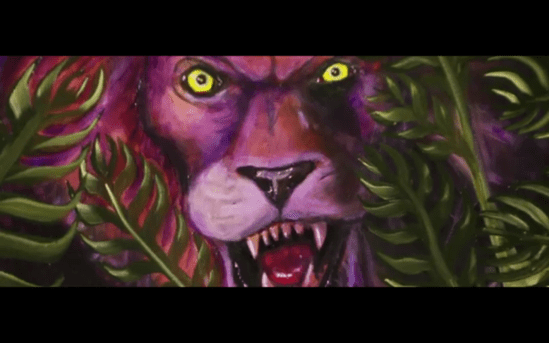
The Wilsons’ are the perfect portrait of a nice family; they’re wealthy but charitable and kind without exploiting the humility of others. However, when Dylan and Gina Wilson bid and win on the SinSational art collection at auction and hang the enchanted paintings strewn through their mansion estate, a strange succumbing to sin overwhelms their moral fiber. The paintings of Dorian Wilde, an eccentric and obsessive 1890’s painter who achieved eternal soul longevity by making a pact with the devil, created the art, depicting primal animals symbolic of the seven deadly sins, by using canvas and paint out of flesh and blood of his victims. The Wilsons’ become corrupted and carry out the sins of Pride, Lust, Gluttony, Sloth, Greed, Envy, and Wrath and the only way to save the family from damnation lies in the hands of a former priest, Father Mendale, and a girlfriend, Kim, of the oldest Wilson boy engulfed by Wrath.

“Art of the Dead” is what people call when art comes to life, or in this case, death. From the selective “Emmanuelle” film series and “There’s Nothing Out There” writer-director, Rolfe Kanefsky comes a story woven with the seven deadly sins theme as a foundation that approximates a 90’s grade thriller of epically gory proportions. With a catchy, yet dead horse beaten “of the Dead” title, “Art of the Dead” uses the seven deadly sin theme and blends it with an obvious homage to the gothic literary novel, “The Picture of Dorian Gray,” by Oscar Wilde. The main antagonist, Dorian Wilde, is the merging of the author and his fictional creation. Oscar Wilde wrote the novel in 1891, the same era the story enlightens in which Dorian Wilde makes a pact with the devil. Unlike another notable film, “Se7en,” where a practical killer exploits the capital vices to thwart a pair of detectives, “Art of the Dead” introduces dark, supernatural forces of Oscar Wilde’s work into the fold that are not only abject in what makes us human, but also biblically condemning, spearheaded by a satanic maniac who will do everything and anything to maintain his precious work and eternal soul, Produced by Michael and Sonny Mahal of Mahal Empire productions, the financial investors have also backed a previous Kanefsky film, another occult gone astray thriller entitled “Party Bus to Hell,” and in association with Nicholas George Productions and Slaughtercore Presentations.

Another pair of producers are also a couple of headlining actors who are household names – “Sharknado’s” Tara Reid and “21 Jump Street” actor and avid painter, Richard Grieco. Reid plays a snooty and shallow art gallery curator who sells willingly the Dorian Wilde set knowing well enough of their malignant history, but Grieco has a personal connection toward a film regarding art more so than the dolled up Reid because of his nearly 20 year passion as an painter of Abstract Emotionalism. His character, Douglas Winter, is obsessed with the SinSational collection to the point where it uses him as an instrument to kill his artistically unappreciative family; a sensation washed over as parallel and broad among all artists alike fore sure. Jessica Morris (“Evil Bong 666”) and Lukas Hassel (“The Black Room”) also headline. Morris provides the sultry and lustful-influenced mother, Gina, and her golden hair and blue eyes has a fitting innocence that’s is tainted and provocatively shields the cruel intentions of lust and power while Hassel, a giant of a man, immediately becomes capitulated to greeds’ warty influence. Each actor renders a version of their paintings and each dons the sinful presence gorgeously with individual personalties and traits; those other actors include Cynthia Aileen Strahan (“Dead End”), Sheila Krause, Jonah Gilkerson, and Zachary Chyz as well as “The Black Room’s” Alex Rinehart and Robert Donovan along with Danny Tesla playing the demonic proxy of Dorian Wilde.

“Art of the Dead” embodies an innovated spin on a classic tale of self-absorption and deferring one’s own detrimental sins upon others to carry the burden. Kanefsky grasps the concept well and visually sustains a contextualized 98 minute feature that carries a straightforward connection to the Gothicism of Oscar Wilde while cascading a family tree (pun intended) of problems that pinpoint each sin’s affecting destruction upon the soul through a wide burst of dispersive poison. While the idea is sound enough, the script and narrative channelling hardly carries the equivalent weight of the idea and comes off clunky, cheap, and sometimes uncharismatic. “The Black Room” was the last Kanefsky film critiqued at ItsBlogginEvil.com and the script was noted with the characters that hardly progress up toward and out of the despondent and deviant muck and it was the filmmaker’s softcore cinema background that attributed to the characters over-saturated girth of lust, which elevated and hindered “The Black Room’s” incubus storyline. With “Art of the Dead,” Kanefsky redresses the lust to quench just the respective sin with the right amount of perversion, represented by the mythical, sex driven Satyr that was created beyond being a nice touch of storytelling, disturbance, and meta kinkiness. Kanefsky continues to proportionally feed each sin the same manner with the exception of Pride that lures in a specific victim; however, the paintings’ insidious nature wonders to a circumstantial level at best with Kanefsky’s tongue-and-cheek dialogue and uncouth playfulness of Dorian Wilde while possessing the flesh of a black-laced, Fredrick’s of Hollywood-cladded Gina.

Umbrella Entertainment and ITN distribution release “Art of the Dead” onto a region 4 DVD home video and is presented in a widescreen, 2.35:1 aspect ratio. The sterile and polished look of the image renders doesn’t invite stimuli to visual senses, but is superbly clean and free of blotchiness that can routinely be a contrast issues with darker, indie productions; however, the digital source is nicely maintained and the darker scenes and colorfully deep portions of the paintings, the viscous blood, the modernized Wilson house, and the anywhere else have quality caliber. Visual and practical effects are necessarily key for “Art of the Dead” to be successful and the film scores a combination of talent to enhance the ho-hum photography with renaissance man Clint Carney, whose visual effects work on his own written and starred in film “Dry Blood” was flawless and who also painted Dorian Wilde’s works of art, and some solid practical and Satyr creature effects work by “Child Play’s 3” Victor Guastini and the VGP Effects team. The English language Dolby 5.1 surround sound audio is clear, precise, and no inkling of issues with the range and depth of ambient sound. Like most standard DVD releases from Umbrella Entertainment, this release comes with no bonus material or even a static menu. To observe his work as a whole, filmmaker Rolfe Kanefsky has nothing to prove with a body of work spanning over nearly three decades, but in reducing “Art of the Dead as a singular film, there in lies a double edged sword. A true sin is to headline a film with actors with brief roles just to draw in investors and an audience, yet “Art of the Dead” also finds innovated modernism out of classical creativity, giving new life by homage, and displaying some maximum carnage fun with plenty oil and water color.

“Art of the Dead” available to own and rent!